vendredi 17 juin 2011

ATV preparing for fiery destruction


ESA - ATV-2 Johannes Kepler Mission patch.

17 June 2011

ATV Johannes Kepler has been an important part of the International Space Station since February. Next week, it will complete its mission by undocking and burning up harmlessly in the atmosphere high over an uninhabited area of the Pacific Ocean.

Serving the International Space Station is a valuable job but it will come to a spectacular end: ESA’s second Automated Transfer Vehicle, packed with Station rubbish, will deliberately plummet to its destruction on Tuesday in Earth’s atmosphere.

Just like the tonnes of natural space debris that collide with our planet every day, the 10-tonne ferry will burn up on reentry.

ATV Jules Verne after undocking, 2008

Only a few hardy pieces might survive and splash into the uninhabited South Pacific. The area’s air and sea traffic has been warned and a no-fly zone will prevent any accidents.

The racks inside ATV have been filled with some 1200 kg of waste bags and unwanted hardware by the crew.

Mission so far

ATV Johannes Kepler delivered about seven tonnes of much-needed supplies to the Space Station, including 1170 kg of dry cargo, 100 kg of oxygen, 851 kg of propellants to replenish the Station tanks and 4535 kg of fuel for the ferry itself to boost the outpost’s altitude and make other adjustments.

Nespoli and Kaleri working in ATV-2

ATV-2 manoeuvred the complex on 2 April to avoid a collision with space debris.

During the hectic mission of Johannes Kepler, two Space Shuttles and Japan’s HTV cargo carrier visited the Station, along with two Progress and Soyuz spacecraft. These required several changes of Station attitude, mostly controlled by ATV’s thrusters.

Big boosts and preparations for dive

ATV’s last important task was to give the Station’s orbit a big boost. One important sequence was performed 12 June, another on 15 June and the last one this afternoon, 17 June.

The combined effect of these manoeuvres was to raise the Station’s orbit to around 380 km.

ATV animation

The crew will close the hatches between the Station and ATV-2 on Sunday afternoon at 15:30 GMT (17:30 CEST). Undocking follows on Monday, at 14:51 GMT (16:51 CEST), with ATV’s thrusters gently increasing the distance from the outpost.

On 21 June, Johannes Kepler will fire its engines twice to descend from orbit.

The first burn, at 17:07 GMT (19:07 CEST) will drop it towards Earth. The second burn, at 20:05 GMT (22:05 CEST), will direct it precisely towards its Pacific target.

Hitting the upper atmosphere, ATV will tumble, disintegrate and burn, and any remains will strike the ocean at around 20:50 GMT (22:50 CEST).

Useful up to last moments

Some aspects of a controlled destructive entry are still not well known, so ATV’s last moments will be recorded by a prototype ‘black box’.

ATV-1 fireball over Pacific, 2008

The Reentry Breakup Recorder will gather measurements on the location, temperature, pressure and attitude of the vehicle’s breakup before ejecting.

Once it reaches an altitude of about 18 km, it will transmit the information via the Iridium satphone system.

With this last phone call home, Johannes Kepler will be productive right to the very end of a fruitful mission.

Related links:

International Space Station: http://www.esa.int/esaHS/iss.html

EADS Astrium: http://www.astrium.eads.net/

Arianespace: http://www.arianespace.com/index/index.asp

Images, Video, Text, Credits: ESA / NASA.

Best regards, Orbiter.ch

Phobos slips past Jupiter


ESA - Mars Express Mission patch.

17 June 2011

  Phobos and Jupiter in conjunction

Earlier this month, ESA’s Mars Express performed a special manoeuvre to observe an unusual alignment of Jupiter and the martian moon Phobos. The impressive images have now been processed into a movie of this rare event.

At the moment when Mars Express, Phobos, and Jupiter aligned on 1 June 2011, there was a distance of 11 389 km between the spacecraft and Phobos, and a further 529 million km to Jupiter.

The High Resolution Stereo Camera on Mars Express was kept fixed on Jupiter for the conjunction, ensuring that the planet remained static in the frame. The operation returned a total of 104 images over a period of 68 seconds, all of them taken using the camera’s super-resolution channel.

By knowing the exact moment when Jupiter passed behind Phobos, the observation will help to verify and even improve our knowledge of the orbital position of the martian moon.

The images shown here were processed at the Department of Planetary Sciences and Remote Sensing at the Institute of Geological Sciences of the Freie Universität Berlin.

(Click on the images for enlarge)

Conjunction: before, during and after

 Paths of Phobos and Mars Express

 Phobos and Mars Express

 Phobos and Jupiter in 3D

Related links:

High Resolution Stereo Camera: http://berlinadmin.dlr.de/Missions/express/indexeng.shtml

Behind the lens: http://www.esa.int/SPECIALS/Mars_Express/SEMSXE1PGQD_0.html

Frequently asked questions: http://www.esa.int/SPECIALS/Mars_Express/SEM76D9OY2F_0.html

For specialists:

ESA Planetary Science archive (PSA): http://www.rssd.esa.int/PSA

NASA Planetary Data System: http://pds-geosciences.wustl.edu/missions/mars_express/hrsc.htm

HRSC data viewer: http://hrscview.fu-berlin.de/

Images, Video, Text, Credits: ESA/DLR/FU Berlin (G. Neukum).

Cheers, Orbiter.ch

Proba-V equipped for radiation census of space


ESA labeled logo.

17 June 2011

Space engineering 

Planned to be launched next year, ESA’s Proba-V mission will perform daily tracking of global vegetation growth. At the same time, the small satellite will also monitor the space environment with a compact radiation instrument.

Proba-V’s Energetic Particle Telescope (EPT) will record the charge, energy and angle of incoming charged particles along a wide range of energies across a 50° field-of-view.

Space is awash with radiation

Space might be a vacuum but it is far from empty: particles of different energies and charges are thrown off by the Sun, arrive from deep space or are captured and accelerated within radiation belts of Earth’s magnetic field.

Learning more about the ever-changing radiation environment is important to satellite operators as well as scientifically interesting. These particles are hazardous for satellites –radiation is one of the main causes of onboard anomalies and malfunctions – and potentially harmful to astronauts.

EPT

The telescope has two sections: one for low- and one for high-energy particle detection. The first, low-energy, section is made up of two silicon detectors at the entrance of the instrument. The high-energy section deeper in the device has a stack of 10 ‘digital absorber modules’.

“The charge imparted by a particle is collected, amplified and analysed to determine the particle species and energy causing it,” said Petteri Nieminen of ESA’s Space Environment and Effects section.

“Unlike the more simple radiation monitors previously flown in space, this telescope can unambiguously separate particles and energies for much more accurate sampling of the radiation flux.”

Proba-V

Built by a consortium of Proba-V prime contractor QinetiQ Space, the Belgian Institute for Space Aeronomy, the Centre for Space Radiation of Belgium’s Catholic University of Louvain and Aboa Space Research Oy in Finland, the shoe-box-sized instrument weighs just 5 kg and needs only six watts of power.

The compact size and power turned out to be crucial in getting it on Proba-V. The Proba series of technology demonstration satellites traditionally host multiple payloads, but Proba-V has less room to spare than usual: its main mission is to extend the 13 years of continuous observations by the Vegetation sensor flying on France’s Spot series of observation satellites.

EPT side view

Proba-V will fly a cut-down version of the same Vegetation instrument, despite being less than a cubic metre in volume. It demanded a re-engineering based on a triple-mirror design to obtain the 2250 km field-of-view needed for almost daily coverage of Earth’s entire land surface.

“Proba-V has a firm launch date because its goal is to replace the Vegetation sensor on the current Spot-5,” added Petteri.

“This benefits the telescope as well because the Sun’s cycle of activity is increasing, with ‘solar max’ due to occur in mid-2013.

Rosetta's SREM during Earth swing-by

“In addition, this October Proba-1 will pass its first decade in space. The satellite is carrying a Standard Radiation Environment Monitor (SREM) – also on several other ESA missions – and we would like to perform simultaneous observations from both the SREM and EPT.

“In future, we envisage one or two EPTs being in space at any one time, performing in-orbit cross-calibration for more numerous but less sensitive radiation monitors aboard other European satellites.”

The EPT flight model is due to be completed by the end of this year, with integration onto Proba-V in early 2012. The mission’s launch is scheduled for spring 2012.

Related links:

Energetic Particle Telescope: http://csrsrv1.fynu.ucl.ac.be/csr_web/ept/eptinfos.php

SREM instrument: http://srem.web.psi.ch/html/srem_instrument.shtml

QinetiQ Space: http://www.qinetiq.com/home_qinetiq_space_nv.html

Images, Text, Credits: ESA / QinetiQ Space.

Greetings, Orbiter.ch

jeudi 16 juin 2011

NASA Spacecraft Confirms Theories, Sees Surprises at Mercury


NASA - MESSENGER Mission to Mercury patch.

June 16, 2011

NASA scientists are making new discoveries about the planet Mercury. Data from MESSENGER, the first spacecraft to orbit Mercury, is giving scientists important clues to the origin of the planet and its geological history and helping them better understand its dynamic interior and exterior processes.

Targeted color imaging: Degas crater

NASA's MErcury Surface, Space ENvironment, GEochemistry, and Ranging spacecraft, or MESSENGER, has been orbiting Mercury since March 18. To date the spacecraft has provided tens of thousands of images showing detailed planetary features. The planet's surface previously had been seen only at comparatively low resolution but is now in sharper focus.

The spacecraft also has collected extensive measurements of the chemical composition of Mercury's surface and topography and gathered global observations of the planet's magnetic field. Data now confirm that bursts of energetic particles in Mercury's magnetosphere are a continuing product of the interaction of Mercury's magnetic field with the solar wind.

Magnetic field lines differ at Mercury's north and south poles

"We are assembling a global overview of the nature and workings of Mercury for the first time," said MESSENGER principal investigator Sean Solomon of the Carnegie Institution of Washington. "Many of our earlier ideas are being cast aside as new observations lead to new insights. Our primary mission has another three Mercury years to run, and we can expect more surprises as our solar system's innermost planet reveals its long-held secrets."

Flyby images of Mercury had detected bright, patchy deposits on some crater floors. Without high-resolution images to obtain a closer look, these features remained only a curiosity. Now new detailed images have revealed these patchy deposits to be clusters of rimless, irregular pits varying in size from several hundred feet to a few miles wide. These pits are often surrounded by diffuse halos of more reflective material and are found on central peaks, peak rings, and rims of craters.

"The etched appearance of these landforms is unlike anything we've seen before on Mercury or the moon," said Brett Denevi, a staff scientist at the Johns Hopkins University Applied Physics Laboratory (APL) in Laurel, Md., and a member of the MESSENGER imaging team. "We are still debating their origin, but they appear to be relatively young and may suggest a more abundant than expected volatile component in Mercury's crust."

One of two instruments on the spacecraft designed to measure the quantity of key chemical elements on Mercury has made several important discoveries since the orbital mission began. Elemental ratios averaged over large areas of the planet's surface show that Mercury's surface differs markedly in composition from that of the moon.

Major-element composition of Mercury surface materials

Observations have revealed substantial amounts of sulfur at Mercury's surface, lending support to prior suggestions from ground-based telescopic observations that sulfide minerals are present. This discovery suggests that the original building blocks from which Mercury formed may have been less oxidized than those that formed the other terrestrial planets. The result also hints that sulfur-containing gases may have contributed to past explosive volcanic activity on Mercury.

Topography data of Mercury's northern hemisphere reveal the planet's large-scale shape and profiles of geological features in high detail. The north polar region is a broad area of low elevations, whereas the overall range in topographic heights seen to date exceeds 5 miles (9 kilometers).

Two decades ago, Earth-based radar images showed deposits thought to consist of water ice and perhaps other ices near Mercury's north and south poles. These deposits are preserved on the cold, permanently shadowed floors of high-latitude impact craters. MESSENGER is testing this idea by measuring the floor depths of craters near Mercury's north pole. The craters hosting polar deposits appear to be deep enough to be consistent with the idea that those deposits are in permanently shadowed areas.

During the first of three Mercury flybys in1974, Mariner 10 discovered bursts of energetic particles in the planet's Earth-like magnetosphere. Four bursts of particles were observed on that flyby. Scientists were puzzled that no such strong events were detected by MESSENGER during any of its three flybys of the planet in 2008 and 2009. But now that the spacecraft is in near-polar orbit around Mercury, energetic events are being seen regularly.

Locations of energetic electron events relative to Mercury’s magnetic field

The spacecraft was designed and built by APL. The lab manages and operates the mission for NASA's Science Mission Directorate (SMD) in Washington. The mission is part of NASA's Discovery Program, managed for SMD by the agency's Marshall Space Flight Center in Huntsville, Ala.

For more information about the mission, visit: http://www.nasa.gov/messenger

or more supporting materials, visit: http://messenger.jhuapl.edu/news_room/presscon9.html

Images, Text, Credits: NASA / Johns Hopkins University Applied Physics Laboratory / Carnegie Institution of Washington.

Best regards, Orbiter.ch

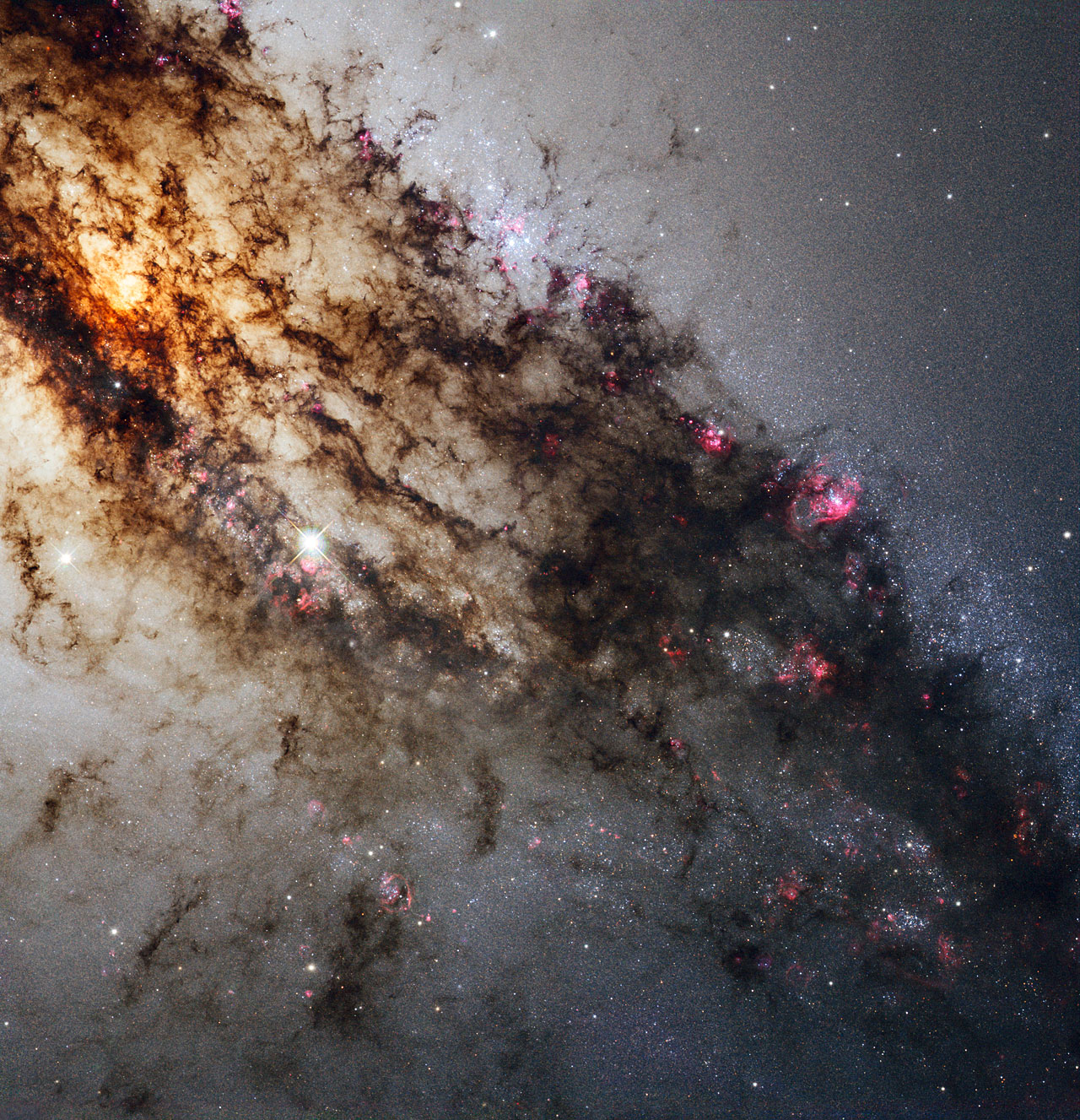
Spectacular Hubble View of Centaurus A


ESA - Hubble Space Telescope logo.

16 June 2011


The NASA/ESA Hubble Space Telescope has produced a close-up view of the galaxy Centaurus A. Hubble’s out-of-this-world location and world-class Wide Field Camera 3 instrument reveal a dramatic picture of a dynamic galaxy in flux.

Centaurus A, also known as NGC 5128, is well known for its dramatic dusty lanes of dark material. Hubble’s observations, using its most advanced instrument, the Wide Field Camera 3, are the most detailed ever made of this galaxy. They have been combined here in a multi-wavelength image that reveals never-before-seen detail in the dusty portion of the galaxy.

As well as features in the visible spectrum, this composite shows ultraviolet light from young stars, and near-infrared light, which lets us glimpse some of the detail otherwise obscured by the dust.

The dark dust lane that crosses Centaurus A does not show an absence of stars, but rather a relative lack of starlight, as the opaque clouds block the visible light from reaching us. Hubble’s Wide Field Camera 3 has focussed on these dusty regions, which span from corner to corner in this image. Wider views from ground-based telescopes show this stripe crossing the entire galaxy.

Interesting features such as the warped shape of its disc of gas and dust (outside the view) hint that at some point in the past, Centaurus A collided and merged with another galaxy. The shockwaves of this event caused hydrogen gas to coalesce and sparked intense areas of star formation, as seen in its outlying regions and in red patches visible in this Hubble close-up.

A tour of Centaurus A

The galaxy’s compact nucleus contains a highly active supermassive black hole at its centre. Powerful relativistic jets release vast amounts of radio and X-ray radiation — although these are invisible here as Hubble’s instruments are designed to study optical, ultraviolet and infrared wavelengths.

At just over 11 million light-years distant, Centaurus A is relatively nearby in astronomical terms. However, it is not only close, it is also bright. This makes it a very attractive target for amateur astronomers in the southern hemisphere, where it is visible. Stargazers can see the galaxy through binoculars, while larger amateur telescopes begin to unveil the distinctive dusty lanes.

Pan across Centaurus A

However it is only with the capabilities of the Hubble Space Telescope that many of the features in this image become visible: as well as providing unparalleled clarity and resolution, Hubble’s position in orbit means that it can see ultraviolet wavelengths which are blocked by the atmosphere and so invisible from the ground.

Notes:

The Hubble Space Telescope is a project of international cooperation between ESA and NASA.

Image credit: NASA, ESA, and the Hubble Heritage (STScI/AURA)-ESA/Hubble Collaboration. Acknowledgment: R. O’Connell (University of Virginia) and the WFC3 Scientific Oversight Committee

Links:

    Images of Hubble: http://www.spacetelescope.org/images/archive/category/spacecraft/

    Wide-field image of Centaurus A from the European Southern Observatory: http://www.eso.org/public/news/eso0315/

    NASA press release: http://hubblesite.org/newscenter/archive/releases/2011/18/

Images, Text, Credit: NASA / ESA, and the Hubble Heritage (STScI / AURA)-ESA / Hubble Collaboration. Acknowledgment: R. O’Connell (University of Virginia) and the WFC3 Scientific Oversight Committee / Videos: ESA / Hubble / The Hubble Heritage (STScI / AURA)-ESA/Hubble Collaboration. Acknowledgment: R. O’Connell (University of Virginia) and the WFC3 Scientific Oversight Committee.

Greetings, Orbiter.ch

A Green Ring Fit for a Superhero


NASA - SPITZER Space Telescope logo.

16 June 2011


This glowing emerald nebula seen by NASA's Spitzer Space Telescope is reminiscent of the glowing ring wielded by the superhero Green Lantern. In the comic books, the diminutive Guardians of the Planet "Oa" forged his power ring, but astronomers believe rings like this are actually sculpted by the powerful light of giant "O" stars, the most massive type of star known to exist.

Named RCW 120, this region of hot gas and glowing dust can be found in the murky clouds encircled by the tail of the constellation Scorpius. The ring of dust actually is glowing in infrared colors that our eyes cannot see, but show up brightly when viewed by Spitzer's infrared detectors. At the center of this ring are a couple of giant stars whose intense ultraviolet light has carved out the bubble, though they blend in with other stars when viewed in infrared.

This bubble is far from unique. Just as the Guardians of Oa have selected many beings to serve as Green Lanterns and patrol different sectors of space, Spitzer has found that such bubbles are common and an can be found around O stars throughout our Milky Way galaxy. The small objects at the lower right area of the image may themselves be similar regions seen at much greater distances across the galaxy.

Rings like this are so common in Spitzer's observations that astronomers have even enlisted the help of the public to help them find and catalog them all. Anyone interested in joining the search as a citizen scientist can visit "The Milky Way Project," part of the "Zooniverse" of public astronomy projects, at: http://www.milkywayproject.org/

Image, Text, Credit: NASA / JPL-Caltech.

Cheers, Orbiter.ch

mercredi 15 juin 2011

NASA'S Chandra Finds Massive Black Holes Common In Early Universe


NASA - Chandra X-Ray Observatory logo.

June 15, 2011

Using the deepest X-ray image ever taken, astronomers found the first direct evidence that massive black holes were common in the early universe. This discovery from NASA's Chandra X-ray Observatory shows that very young black holes grew more aggressively than previously thought, in tandem with the growth of their host galaxies.


Image above: Composite image of Chandra Deep Field South. (X-ray: NASA/CXC/U.Hawaii/ E.Treister et al; Infrared: NASA/STScI/UC Santa Cruz/G.Illingworth et al; Optical: NASA/STScI/S.Beckwith et al).

By pointing Chandra at a patch of sky for more than six weeks, astronomers obtained what is known as the Chandra Deep Field South (CDFS). When combined with very deep optical and infrared images from NASA's Hubble Space Telescope, the new Chandra data allowed astronomers to search for black holes in 200 distant galaxies, from when the universe was between about 800 million to 950 million years old.

"Until now, we had no idea what the black holes in these early galaxies were doing, or if they even existed," said Ezequiel Treister of the University of Hawaii, lead author of the study appearing in the June 16 issue of the journal Nature. "Now we know they are there, and they are growing like gangbusters."


Image above: Artist impression of a growing supermassive black hole located in the early universe. (NASA/CXC/A.Hobart).

The super-sized growth means that the black holes in the CDFS are less extreme versions of quasars -- very luminous, rare objects powered by material falling onto supermassive black holes. However, the sources in the CDFS are about a hundred times fainter and the black holes are about a thousand times less massive than the ones in quasars.

The observations found that between 30 and 100 percent of the distant galaxies contain growing supermassive black holes. Extrapolating these results from the small observed field to the full sky, there are at least 30 million supermassive black holes in the early universe. This is a factor of 10,000 larger than the estimated number of quasars in the early universe.


Image above: Artist impression of a very young galaxy located in the early universe less than one billion years after the Big Bang. (NASA/CXC/M.Weiss).

"It appears we've found a whole new population of baby black holes," said co-author Kevin Schawinski of Yale University. "We think these babies will grow by a factor of about a hundred or a thousand, eventually becoming like the giant black holes we see today almost 13 billion years later."

A population of young black holes in the early universe had been predicted, but not yet observed. Detailed calculations show that the total amount of black hole growth observed by this team is about a hundred times higher than recent estimates.

Watch an animation of a hidden black hole

Because these black holes are nearly all enshrouded in thick clouds of gas and dust, optical telescopes frequently cannot detect them. However, the high energies of X-ray light can penetrate these veils, allowing the black holes inside to be studied.

Physicists studying black holes want to know more how the first supermassive black holes were formed and how they grow. Although evidence for parallel growth of black holes and galaxies has been established at closer distances, the new Chandra results show that this connection starts earlier than previously thought, perhaps right from the origin of both.

"Most astronomers think in the present-day universe, black holes and galaxies are somehow symbiotic in how they grow," said Priya Natarajan, a co-author from Yale University. "We have shown that this codependent relationship has existed from very early times."

Watch a video of Chandra Deep Field South

It has been suggested that early black holes would play an important role in clearing away the cosmic "fog" of neutral, or uncharged, hydrogen that pervaded the early universe when temperatures cooled down after the Big Bang. However, the Chandra study shows that blankets of dust and gas stop ultraviolet radiation generated by the black holes from traveling outwards to perform this "reionization." Therefore, stars and not growing black holes are likely to have cleared this fog at cosmic dawn.

Chandra is capable of detecting extremely faint objects at vast distances, but these black holes are so obscured that relatively few photons can escape and hence they could not be individually detected. Instead, the team used a technique that relied on Chandra’s ability to accurately determine the direction from which the X-rays came to add up all the X-ray counts near the positions of distant galaxies and find a statistically significant signal.

NASA's Marshall Space Flight Center in Huntsville, Ala., manages the Chandra program for the agency's Science Mission Directorate in Washington. The Smithsonian Astrophysical Observatory controls Chandra's science and flight operations from Cambridge, Mass.

More information, including images and other multimedia, can be found at: http://www.nasa.gov/chandra and http://chandra.si.edu

Images (mentioned), Videos, Text, Credit: NASA / CXC / STScI.

Greetings, Orbiter.ch