mercredi 31 mai 2017
NASA Renames Solar Probe Mission to Honor Pioneering Physicist Eugene Parker
NASA - Parker Solar Probe logo.
May 31, 2017
NASA has renamed the Solar Probe Plus spacecraft — humanity’s first mission to a star, which will launch in 2018 — as the Parker Solar Probe in honor of astrophysicist Eugene Parker. The announcement was made at a ceremony at the University of Chicago, where Parker serves as the S. Chandrasekhar Distinguished Service Professor Emeritus, Department of Astronomy and Astrophysics.
In 1958, Parker — then a young professor at the university’s Enrico Fermi Institute — published an article in the Astrophysical Journal called “Dynamics of the interplanetary gas and magnetic fields.” Parker believed there was high speed matter and magnetism constantly escaping the sun, and that it affected the planets and space throughout our solar system.
Image above: Illustration of the Parker Solar Probe spacecraft approaching the sun. Image Credit: Johns Hopkins University Applied Physics Laboratory.
This phenomenon, now known as the solar wind, has been proven to exist repeatedly through direct observation. Parker’s work forms the basis for much of our understanding about how stars interact with the worlds that orbit them.
“This is the first time NASA has named a spacecraft for a living individual,” said Thomas Zurbuchen, associate administrator for NASA’s Science Mission Directorate in Washington. “It’s a testament to the importance of his body of work, founding a new field of science that also inspired my own research and many important science questions NASA continues to study and further understand every day. I’m very excited to be personally involved honoring a great man and his unprecedented legacy.”
“The solar probe is going to a region of space that has never been explored before,” said Parker. “It’s very exciting that we’ll finally get a look. One would like to have some more detailed measurements of what’s going on in the solar wind. I’m sure that there will be some surprises. There always are.”
In the 1950s, Parker proposed a number of concepts about how stars — including our sun — give off energy. He called this cascade of energy the solar wind, and he described an entire complex system of plasmas, magnetic fields and energetic particles that make up this phenomenon. Parker also theorized an explanation for the superheated solar atmosphere, the corona, which is — contrary to what was expected by physics laws — hotter than the surface of the sun itself. Many NASA missions have continued to focus on this complex space environment defined by our star — a field of research known as heliophysics.
“Parker Solar Probe is going to answer questions about solar physics that we’ve puzzled over for more than six decades,” said Parker Solar Probe Project Scientist Nicola Fox, of the Johns Hopkins University Applied Physics Laboratory. “It’s a spacecraft loaded with technological breakthroughs that will solve many of the largest mysteries about our star, including finding out why the sun’s corona is so much hotter than its surface. And we’re very proud to be able to carry Gene’s name with us on this amazing voyage of discovery.”
Image above: NASA’s first mission to go to the sun, the Parker Solar Probe, is named after Eugene Parker who first theorized that the sun constantly sends out a flow of particles and energy called the solar wind. Image Credits: NASA/APL.
NASA missions are most often renamed after launch and certification; in this case, given Parker’s accomplishments within the field, and how closely aligned this mission is with his research, the decision was made to honor him prior to launch, in order to draw attention to his important contributions to heliophysics and space science.
Born on June 10, 1927, in Michigan, Eugene Newman Parker received a Bachelor of Science in physics from Michigan State University and a doctorate from Caltech. He then taught at the University of Utah, and since 1955, Parker has held faculty positions at the University of Chicago and at its Fermi Institute. He has received numerous awards for his research, including the George Ellery Hale Prize, the National Medal of Science, the Bruce Medal, the Gold Medal of the Royal Astronomical Society, the Kyoto Prize, and the James Clerk Maxwell Prize.
Parker Solar Probe is on track for launch during a 20-day window that opens July 31, 2018. The mission is part of NASA’s Living With a Star program to explore aspects of the sun-Earth system that directly affect life and society. LWS is managed by the agency’s Goddard Space Flight Center in Greenbelt, Maryland, for NASA’s Science Mission Directorate in Washington, D.C. Johns Hopkins APL manages the mission for NASA and is designing and building and will operate the spacecraft.
Learn More:
https://www.nasa.gov/solarprobe
http://solarprobe.jhuapl.edu
Images (mentioned), Text, Credits: NASA/Rob Garner/Johns Hopkins University Applied Physics Laboratory, by Geoff Brown.
Greetings, Orbiter.ch
mardi 30 mai 2017
Station Duo Ready to Depart Station Before Dragon’s Arrival
ISS - Expedition 51 Mission patch.
May 30, 2017
The International Space Station is preparing this week for the departure of two Expedition 51 crew members and the arrival of the SpaceX Dragon.
Expedition 52 will begin Friday morning when two Expedition 51 crew members depart the station inside the Soyuz MS-03 spacecraft. Cosmonaut Oleg Novitskiy and astronaut Thomas Pesquet will return to Earth and parachute to landing in Kazakhstan after a 196-day mission in space.
NASA astronauts Peggy Whitson and Jack Fischer along with cosmonaut Fyodor Yurchikhin will continue their stay aboard the orbital complex. Whitson will hand over station command to Yurchikhin the day before the Expedition 51 crew leaves.
Image above: NASA astronaut Jack Fischer works inside the cupola with the Soyuz and Cygnus spaceships right outside the windows. Image Credit: NASA.
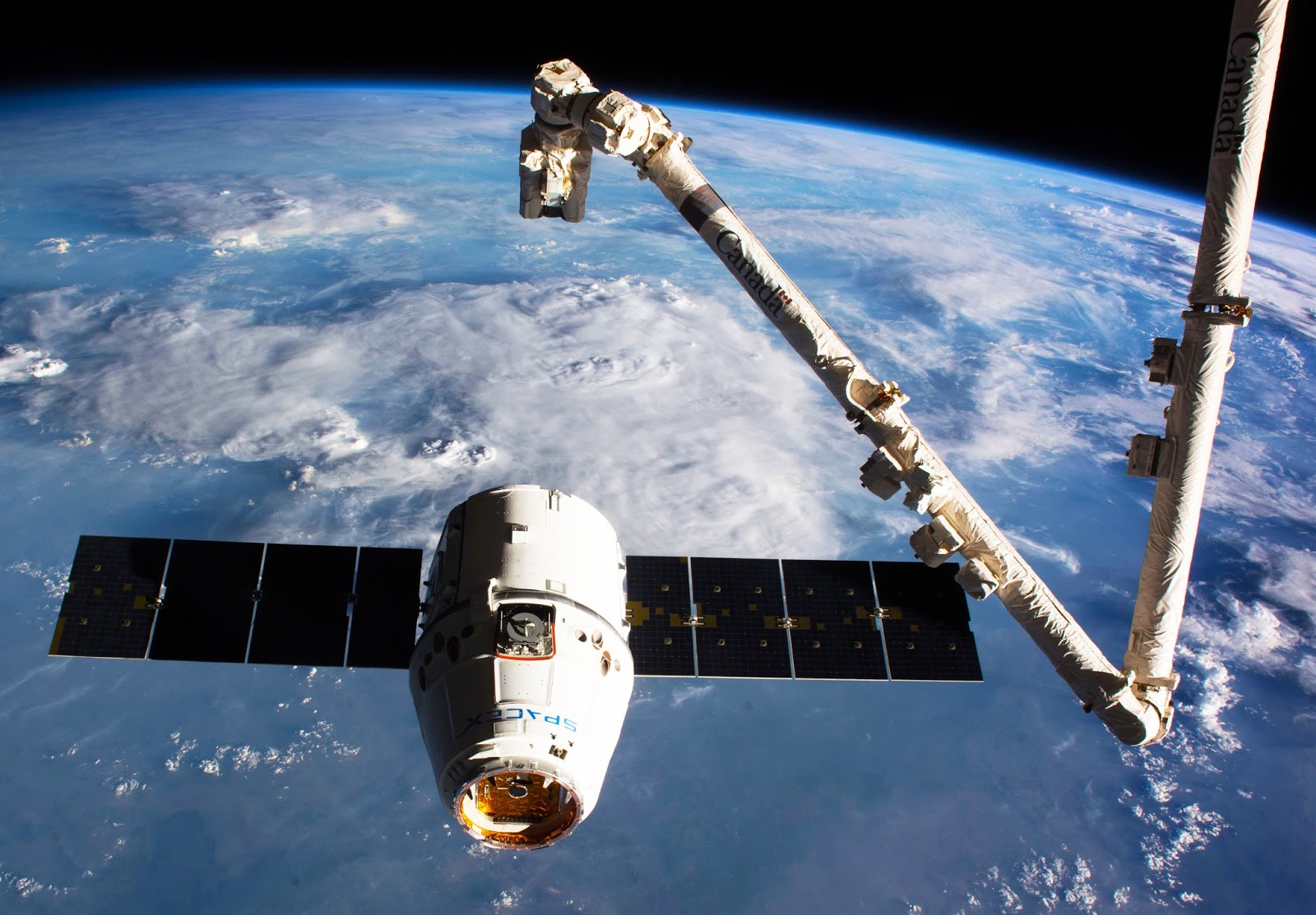
Dragon is due to launch Thursday at 5:55 p.m. EDT atop a Falcon 9 rocket for a three-day trip to the space station. NASA astronaut Jack Fischer will command the Canadarm2 to grapple Dragon when it arrives Sunday morning. Afterward, robotics controllers on the ground will remotely install Dragon to the Harmony module.
Dragon is hauling nearly 6,000 pounds of cargo to the station including new science payloads, crew supplies, vehicle hardware, spacewalk equipment and computer gear. Three new experiments are being delivered for installation on the station’s exterior. The external research gear will study flexible solar arrays, the physics of neutron stars and new ways to assist with navigation, agriculture, emergency response and petroleum exploration.
Related article:
Dragon Spacecraft Prepared to Resupply International Space Station
http://orbiterchspacenews.blogspot.ch/2017/05/dragon-spacecraft-prepared-to-resupply.html
Related link:
International Space Station (ISS): https://www.nasa.gov/mission_pages/station/main/index.html
Image (mentioned), Text, Credits: NASA/Mark Garcia.
Greetings, Orbiter.ch
Dragon Spacecraft Prepared to Resupply International Space Station
SpaceX - CRS-11 Dragon Mission patch.
May 30, 2017
The International Space Station brings together science, technology and human innovation, demonstrating new technologies and research breakthroughs not possible on Earth. A resupply line of unpiloted spacecraft keeps this work going, supporting efforts to enable human and robotic exploration of destinations well beyond low-Earth orbit.
The next mission to the Earth-orbiting laboratory will be the eleventh commercial resupply services flight for SpaceX. Liftoff is targeted for 5:55 p.m. EDT on June 1, 2017, from Launch Complex 39A at NASA's Kennedy Space Center in Florida. This will be the sixth SpaceX rocket to take off from the historic pad further emphasizing the center's role as a premier, multi-user spaceport.
Image above: At the base of Launch Complex 39A at NASA's Kennedy Space Center, the SpaceX horizontal processing facility is where rockets and spacecraft are processed before they are transported to the pad to complete preparations for liftoff. SpaceX CRS-11 will be the company's sixth rocket to take off from the historic pad further emphasizing the Kennedy's role as a premier, multi-user spaceport. Image Credit: SpaceX.
The company's 230-foot-tall Falcon 9 rocket will boost a 20-foot high, 12-foot-diameter Dragon capsule filled with supplies and experiments. The payload will include important materials to support more than 250 science and research investigations taking place during Expeditions 52 and 53.
When the Dragon arrives at the space station, U.S. astronauts Peggy Whitson and Jack Fischer will grapple Dragon using the station’s 57-foot-long robotic arm. Ground commands then will be sent from mission control for the station’s arm to rotate and install the Dragon capsule to the station’s Harmony module.
The Expedition 51 crew will unpack the Dragon and begin working with the experiments that include the following:
Seedling Growth-3
Image above: Tiny Arabidopsis thaliana seeds are visible as a dotted line across the membrane that is sealed inside of an experiment cassette. The Seedling Growth-3 experiment should help scientists gain a better understanding of the basic mechanisms of light and gravity-sensing in plants. The results could aid in improving the long-term sustainability of agricultural production both on Earth and extended-durations spaceflights. Image Credits: NASA/Dominc Hart.
A joint project of NASA and the European Space Agency (ESA), the Seedling Growth-3 experiment is being flown for the third time. Once onboard the space station, seeds will be placed in the European Modular Cultivation System, or EMCS, where they will be hydrated and exposed to varying conditions of light and gravity. The EMCS is an ESA research facility aboard the space station dedicated to studying plant biology in a microgravity environment. The resulting seedlings will be either frozen or chemically fixed and returned to Earth for post-flight analysis. Seedling Growth-3 is designed to help scientists gain a better understanding of the basic mechanisms of light and gravity-sensing in plants. The results could aid in improving the long-term sustainability of agricultural production both on Earth and extended-duration spaceflights.
Advanced Colloids Experiment-Temperature-6
Colloids are microscopic particles suspended in a liquid found in products ranging from milk to fabric softener. Consumer products often use colloidal gels to distribute specialized ingredients such as droplets that soften fabrics. But the gels must serve two opposite purposes. They must disperse the active ingredient so it can work, yet maintain an even distribution so the product does not spoil. The Advanced Colloids Experiment-Temperature-6, or ACE-T-6, is designed to study the microscopic behavior of colloids in gels and creams, providing new insight into fundamental interactions that can improve product shelf life.
Advanced Combustion via Microgravity Experiments
The Advanced Combustion via Microgravity Experiments, or ACME, is a set of five independent studies of gaseous flames being conducted aboard the space station. ACME’s goals are to improved fuel efficiency and reduced pollutants in practical combustion on Earth. It also is expected to aid in spacecraft fire prevention through innovative research focused on materials flammability.
NanoRacks
NanoRacks of Houston again will provide commercial hardware and services supporting several experiments flown to the U.S. National Laboratory aboard the space station. The company provides low-cost services, many supporting opportunities for students in middle and high schools to develop investigations to be conducted in the microgravity environment of the station. Such programs provide young scholars with hands-on experience in disciplines of science, technology, engineering and mathematics, or STEM. The goal is to encourage these students to pursue careers in fields that support NASA research.
Image above: Inside the Space Station Processing Facility at NASA's Kennedy Space Center on April 6, 2017, technicians prepare the Neutron star Interior Composition Explorer, or NICER, payload for final packaging. NICER will be delivered to the International Space Station aboard the SpaceX Dragon cargo capsule. NICER will study the extraordinary physics of these stars, providing new insights into their nature and behavior. Image Credits: NASA/Frank Michaux.
The Dragon capsule will spend approximately one month attached to the space station, remaining until early July. The spacecraft then will return to Earth with results of earlier experiments, splashing down in the Pacific Ocean off the coast of Baja California.
Image above: The SpaceX CRS-10 Dragon cargo spacecraft is seen during final approach to the International Space Station on Feb. 23, 2017. The commercial spacecraft launched from NASA's Kennedy Space Center four days earlier with about 5,500 pounds of experiments and supplies for the crew aboard the orbiting laboratory. Image Credit: NASA.
The space station has been occupied continuously since November 2000. In that time, more than 200 people from around the world and a variety of international and commercial spacecraft have visited the orbiting laboratory. The space station remains the springboard to NASA's next great leap in exploration, including future missions to Mars.
Related article:
Studying Flame Behavior in Microgravity with a Solid “High-Five”
http://orbiterchspacenews.blogspot.ch/2017/05/studying-flame-behavior-in-microgravity.html
Related links:
Commercial resupply services: https://www.nasa.gov/mission_pages/station/structure/launch/index.html
SpaceX: https://www.nasa.gov/mission_pages/station/structure/launch/spacex.html
Dragon: https://www.nasa.gov/mission_pages/station/structure/elements/dragon.html
Seedling Growth-3: https://www.nasa.gov/ames/research/space-biosciences/seedling-growth-3
European Modular Cultivation System (EMCS): https://www.nasa.gov/mission_pages/station/research/experiments/345.html
Advanced Colloids Experiment-Temperature-6: https://www.nasa.gov/mission_pages/station/research/experiments/1968.html
Advanced Combustion via Microgravity Experiments (ACME): https://www.nasa.gov/mission_pages/station/research/experiments/1908.html
NanoRacks: https://www.nasa.gov/centers/ames/researchpark/partners/space/nanoracks/
International Space Station (ISS): https://www.nasa.gov/mission_pages/station/main/index.html
Images (mentioned), Text, Credits: NASA/Kennedy Space Center, by Bob Granath.
Best regards, Orbiter.ch
Studying Flame Behavior in Microgravity with a Solid “High-Five”
ISS - International Space Station logo.
May 30, 2017
Fire is used to heat our homes, cook our food and fuel our trips. Whether we burn fuel in our homes, vehicles, or power plants, flames play an important role in powering our lives on Earth.
Researchers from across the country have developed a series of experiments to expand our understanding of flames at a fundamental level. NASA’s Advanced Combustion via Microgravity Experiments (ACME) project is comprised of five experiments designed to test different aspects of flames. Working with NASA’s Glenn Research Center in Cleveland to conduct research on the International Space Station, the investigators will study microgravity flames burning under a range of conditions. Results of the experiments could lead to improved fuel efficiency and pollutant reduction.
Image above: Microgravity conditions allow the creation of spherical flames which simplify analysis and reveal behavior that is difficult to study on Earth. Flames like this are yielding valuable information about soot formation and flame extinction. Image Credit: NASA.
“Four of ACME’s experiments are designed to improve our understanding of flame behavior for practical use on Earth,” said Glenn’s ACME project scientist Dennis Stocker. “The other experiment is intended to help us understand and improve spacecraft fire safety.”
- Coflow Laminar Diffusion Flame will extend the range of flame conditions that can be accurately predicted, especially under conditions where the flame is sooty or could become unstable.
- Electric-Field Effects on Laminar Diffusion Flames will investigate how an electric field can be used to control flames, through their naturally occurring ions, to reduce pollutant emission.
- Structure and Response of Spherical Flames will aid in predicting the structure and dynamics of soot-free and sooty flames.
- Flame Design experiment seeks to expand our understanding of soot inception and control in order to optimize oxygen enriched combustion and the design of robust and soot-free flames.
- Burning Rate Emulator experiment is focused on flammability and the selection of materials for use in spacecraft.
Most of ACME’s hardware will launch on SpaceX’s 11th contracted cargo mission to the space station. Once in orbit, ACME tests will be conducted in the space stations’ Combustion Integrated Rack. The experiments will be operated remotely from Glenn’s ISS Payload Operations Center.
“The crew of the space station will set up the hardware needed for the experiments and then they float away. ACME tests are then commanded from the ground and data is downlinked for analysis and planning of subsequent tests,” said Stocker.
Image above: ACME Systems Engineer Chris Mroczka (left) and CIR engineer Jim Birchenough perform a ground check of the ACME chamber insert which fits into the space station’s Combustion Integrated Rack (CIR). Image Credit: NASA.
A microgravity environment enables researchers to explore flame behavior without the influence of gravity, so they can look at the underlying physics behind flame structure and behavior. That knowledge can help designers and engineers develop furnaces, power plants, boilers and other power systems that are more efficient and less polluting.
ACME is sponsored by the Physical Sciences Research Program with the Space Life and Physical Sciences Research and Applications Division at NASA Headquarters in Washington.
Related links:
Advanced Combustion via Microgravity Experiments (ACME): https://spaceflightsystems.grc.nasa.gov/sopo/ihho/psrp/fcf/fcf-investigations/acme/
Coflow Laminar Diffusion Flame: https://spaceflightsystems.grc.nasa.gov/sopo/ihho/psrp/fcf/fcf-investigations/acme/cld-flame/
Electric-Field Effects on Laminar Diffusion Flames: https://spaceflightsystems.grc.nasa.gov/sopo/ihho/psrp/fcf/fcf-investigations/acme/e-field-flames/
Structure and Response of Spherical Flames: https://spaceflightsystems.grc.nasa.gov/sopo/ihho/psrp/fcf/fcf-investigations/acme/s-flame/
Flame Design: https://spaceflightsystems.grc.nasa.gov/sopo/ihho/psrp/fcf/fcf-investigations/acme/flame-design/
Burning Rate Emulator: https://spaceflightsystems.grc.nasa.gov/sopo/ihho/psrp/fcf/fcf-investigations/acme/bre/
Combustion Integrated Rack: https://spaceflightsystems.grc.nasa.gov/sopo/ihho/psrp/fcf/cir/
Space Station Research and Technology: https://www.nasa.gov/mission_pages/station/research/index.html
International Space Station (ISS): https://www.nasa.gov/mission_pages/station/main/index.html
Images (mentioned), Text, Credits: NASA/Kelly Heidman/Glenn Research Center/Mike Giannone.
Greetings, Orbiter.ch
Cassini Finds Saturn Moon May Have Tipped Over
NASA - Cassini Mission to Saturn patch.
May 30, 2017
Saturn's icy, ocean-bearing moon Enceladus may have tipped over in the distant past, according to recent research from NASA's Cassini mission. Researchers with the mission found evidence that the moon's spin axis -- the line through the north and south poles -- has reoriented, possibly due to a collision with a smaller body, such as an asteroid.
Image above: Working with image data from NASA's Cassini mission, researchers have found evidence that Saturn's moon Enceladus may have tipped over, reorienting itself so that terrain closer to its original equator was relocated to the poles. This phenomenon is known as true polar wander. Image Credits: NASA/JPL-Caltech/Space Science Institute/Cornell University.
Examining the moon's features, the team showed that Enceladus appears to have tipped away from its original axis by about 55 degrees -- more than halfway toward rolling completely onto its side. "We found a chain of low areas, or basins, that trace a belt across the moon's surface that we believe are the fossil remnants of an earlier, previous equator and poles," said Radwan Tajeddine, a Cassini imaging team associate at Cornell University, Ithaca, New York, and lead author of the paper.
The area around the icy moon's current south pole is a geologically active region where long, linear fractures referred to as tiger stripes slice across the surface. Tajeddine and colleagues speculate that an asteroid may have struck the region in the past when it was closer to the equator. "The geological activity in this terrain is unlikely to have been initiated by internal processes," he said. "We think that, in order to drive such a large reorientation of the moon, it's possible that an impact was behind the formation of this anomalous terrain."
Image above: Cassini researchers have found evidence the active south polar region of Enceladus -- the fractured terrain seen here at bottom -- may have originally been closer to the icy moon's equator. Image Credits: NASA/JPL-Caltech/ Space Science Institute.
In 2005, Cassini discovered that jets of water vapor and icy particles spray from the tiger stripe fractures -- evidence that an underground ocean is venting directly into space from beneath the active south polar terrain.
Whether it was caused by an impact or some other process, Tajeddine and colleagues think the disruption and creation of the tiger-stripe terrain caused some of Enceladus' mass to be redistributed, making the moon's rotation unsteady and wobbly. The rotation would have eventually stabilized, likely taking more than a million years. By the time the rotation settled down, the north-south axis would have reoriented to pass through different points on the surface -- a mechanism researchers call "true polar wander."
The polar wander idea helps to explain why Enceladus' modern-day north and south poles appear quite different. The south is active and geologically young, while the north is covered in craters and appears much older. The moon's original poles would have looked more alike before the event that caused Enceladus to tip over and relocate the disrupted tiger-stripe terrain to the moon's south polar region.
Cassini spacecraft flyby Enceladus North Pole Plumes. Animation Credits: NASA/JPL-Caltech
The results were published in the online edition of the journal Icarus on April 30, 2017.
The Cassini-Huygens mission is a cooperative project of NASA, ESA (European Space Agency) and the Italian Space Agency. NASA's Jet Propulsion Laboratory, a division of Caltech in Pasadena, California, manages the mission for NASA's Science Mission Directorate, Washington. JPL designed, developed and assembled the Cassini orbiter.
More information about Cassini:
https://www.nasa.gov/cassini
https://saturn.jpl.nasa.gov
http://www.esa.int/Our_Activities/Space_Science/Cassini-Huygens
Images (mentioned), Text, Credits: NASA/Tony Greicius/JPL/Preston Dyches.
Best regards, Orbiter.ch
High-Silica 'Halos' Shed Light on Wet Ancient Mars
NASA - Mars Science Laboratory (MSL) patch.
May 30, 2017
Image above: Pale zones called "halos" border bedrock fractures visible in this 2015 image from NASA's Curiosity Mars rover. Measurements overlaid on the image offer a sense of scale for the size of these fractures. The rover team determined that the halos are rich in silica, a clue to the duration of wet environmental conditions long ago. The location is on the lower slope of Mars' Mount Sharp. Image Credits: NASA/JPL-Caltech.
Pale "halos" around fractures in bedrock analyzed by NASA's Curiosity Mars rover contain copious silica, indicating that ancient Mars had liquid water for a long time.
"The concentration of silica is very high at the centerlines of these halos," said Jens Frydenvang, a rover-team scientist at Los Alamos National Laboratory in New Mexico, and the University of Copenhagen in Denmark. "What we’re seeing is that silica appears to have migrated between very old sedimentary bedrock and into younger overlying rocks."
Frydenvang is the lead author of a report about these findings published in Geophysical Research Letters.
NASA landed Curiosity on Mars in 2012 with a goal to determine whether Mars ever offered environmental conditions favorable for microbial life. The mission "has been very successful in showing that Gale Crater once held a lake with water that we would even have been able to drink from, but we still don’t know how long this habitable environment endured," he said. "What this finding tells us is that, even when the lake eventually evaporated, substantial amounts of groundwater were present for longer than we previously thought -- further expanding the window for when life might have existed on Mars."
For more information about the newly published report, visit: http://bit.ly/2r8dyOF
The halos were first analyzed in 2015 with Curiosity's science-instrument payload, including the laser-shooting Chemistry and Camera (ChemCam) instrument, which was developed at Los Alamos National Laboratory in conjunction with the French space agency. The rover has subsequently explored higher and younger layers of lower Mount Sharp, investigating how ancient environmental conditions changed.
Animation above: Curiosity Self-Portrait at 'Okoruso' Drill Hole, Mars. This animated image blinks two versions of a May 11, 2016, selfie of NASA's Curiosity Mars rover at a drilled sample site called "Okoruso." In one version, cameras atop the rover's mast face the arm-mounted camera taking the portrait. In the other, they face away. Animation Credits: NASA/JPL-Caltech.
NASA's two active Mars rovers and three Mars orbiters are all part of ambitious robotic exploration to understand Mars, which helps lead the way for sending humans to Mars in the 2030s. The Curiosity mission is managed by NASA's Jet Propulsion Laboratory, a division of Caltech in Pasadena, California, for NASA's Science Mission Directorate, Washington. For more about Curiosity, visit: http://www.nasa.gov/curiosity
Mars Science Laboratory (Curiosity): https://www.nasa.gov/mission_pages/msl/index.html
Image (mentioned), Animation (mentioned), Text, Credits: NASA/Laurie Cantillo/Dwayne Brown/Tony Greicius/JPL/Guy Webster/Los Alamos National Laboratory/Laura Mullane.
Best regards, Orbiter.ch
NASA Sees Tropical Cyclone Mora Making Landfall in Bangladesh

NASA - EOS Aqua Mission logo / NASA - Suomi-NPP Mission logo.
May 30, 2017
Mora (No. Indian Ocean/Bay of Bengal)
Tropical Cyclone Mora formed in the Bay of Bengal and in just two days it strengthened into a tropical storm and was making landfall in Bangladesh. NASA's Aqua and NASA-NOAA's Suomi NPP satellites helped monitor the progress and extent of the storm.
Image above: On May 29 at 07:54 UTC (3:54 a.m. EDT) NOAA-NASA's Suomi NPP Satellite captured this image of Tropical Cyclone Mora over the Bay of Bengal, approaching landfall in Bangladesh. Image Credits: NOAA/NASA Goddard Rapid Response Team.
The second tropical cyclone of the Northern Indian Ocean season formed on Sunday, May 28 and once it strengthened into a tropical storm, it was renamed Mora. By May 30, Mora reached hurricane strength.
On May 29 at 07:54 UTC (3:54 a.m. EDT) NOAA-NASA's Suomi NPP Satellite captured a visible image of Tropical Cyclone Mora over the Bay of Bengal, approaching landfall in Bangladesh. Tropical Cyclone's Mora circulation had improved and it continued to move toward Bangladesh. At the time of the Suomi NPP satellites overpass, Mora's maximum sustained winds were near 55 knots (63 mph/102 kph) and it was approximately 277 nautical miles south of Chittagong, Bangladesh moving to the north-northeast.
At 0300 UTC on May 30 (11 p.m. EDT on May 29) the Joint Typhoon Warning Center said Tropical Cyclone Mora was located near 21.8 degrees north latitude and 91.9 degrees east longitude, about 78 nautical miles south of Chittagong, Bangladesh. Mora's maximum sustained winds were near 65 knots (75 mph/120 kph), making it a Category 1 hurricane on the Saffir-Simpson Hurricane Wind Scale.
Mora has tracked northward at 15 knots (17 mph/27 kph) and is expected to continue in that direction through landfall later in the day.
Image above: This visible image of Tropical Cyclone Mora from Aqua was captured on May 30 at 07:20 UTC (3:20 EDT) when the storm extended over Bangladesh, India, and Myanmar. Image Credits: NASA Goddard MODIS Rapid Response Team.
A visible image of Tropical Cyclone Mora was captured on May 30 at 07:20 UTC (3:20 EDT) by the Moderate Resolution Imaging Spectroradiometer instrument aboard the Aqua satellite. Mora's center made landfall and the storm's clouds extended over Bangladesh, India, and Myanmar. Animated enhanced infrared satellite imagery depicts improved consolidation with an eye feature struggling to emerge during the morning of May 30.
By 1500 UTC (11 a.m. EDT) Mora made landfall near Chittagong, Bangladesh. Following landfall, rapid weakening is expected, with the system dissipating in a day and a half. For updated local forecasts from the Bangladesh Meteorological Service, visit: http://www.bmd.gov.bd
Aqua Satellite: https://www.nasa.gov/mission_pages/aqua/index.html
Suomi NPP (National Polar-orbiting Partnership): http://www.nasa.gov/mission_pages/NPP/main/index.html
Images (mentioned), Text, Credits: NASA's Goddard Space Flight Center, by Rob Gutro/Lynn Jenner.
Greetings, Orbiter.ch
Inscription à :
Articles (Atom)