jeudi 8 juin 2017

Window to a watery past on Mars


ESA - Mars Express Mission patch.

8 June 2017

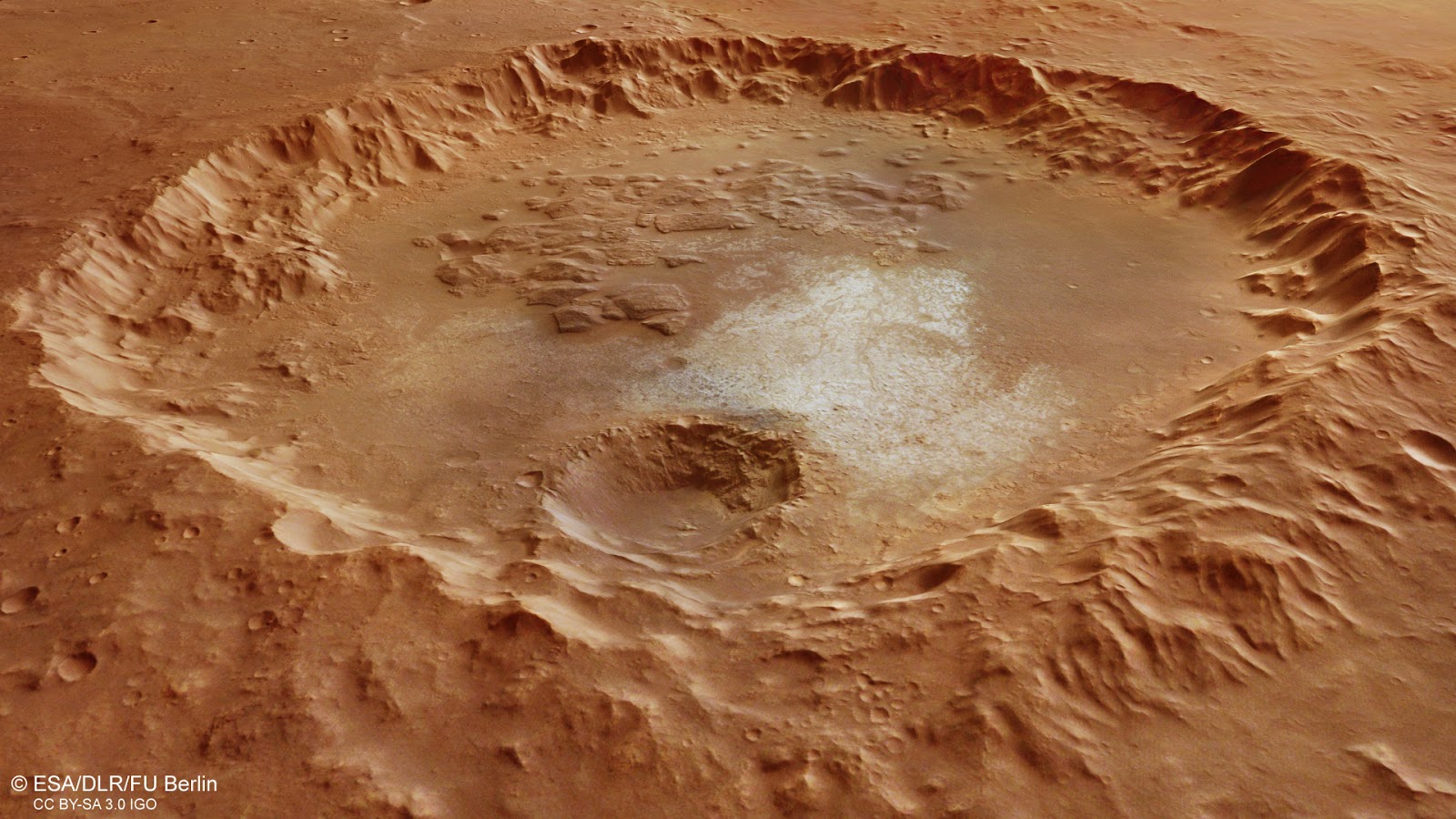
Perspective view across a crater in Erythraeum Chaos

This 70 km-wide crater and its surrounds offer a window into the watery past of the Red Planet.

The scene, captured by ESA’s Mars Express, is a composite of two images taken in March 2007 and February 2017.

Erythraeum Chaos in context

It focuses on a large crater in the Margaritifer Terra region in the southern hemisphere of Mars, and includes a portion of Erythraeum Chaos to the north (right in the main colour image below).

The region is located at the northern edge of Noachis Terra, which at 3.7–4 billion years old, represents some of the oldest and most heavily cratered terrain on Mars.

Margaritifer Terra and Erythraeum Chaos

Remnants of valley networks across the scene indicate that water once flowed through this region, shaping the features seen today. Indeed, as shown by the context image, Parana Valles lies to the east, while Loire Valles lies to the northwest.

There are a number of distinctive features inside the 70 km crater, such as the striking light-toned material that is interpreted as exposed bedrock.

Erythraeum Chaos and surrounds: topography

‘Chaotic terrain’ is visible both inside and outside the crater, marked by randomly oriented blocks separated by troughs.

In general, chaotic terrain is associated with the collapse of the surface above regions where large amounts of subsurface water have been released, for example by the sudden melting of ice. As such, outflow channels often begin in chaos terrains.

Erythraeum Chaos and surrounds in 3D

Chaotic terrain may also mark the sites of ancient lakes, such as in Erythraeum Chaos to the north (right) of the crater in this scene, between Loire and Parana Valles.

Related links:

Mars Express: http://www.esa.int/Our_Activities/Space_Science/Mars_Express

Mars Express overview: http://www.esa.int/Our_Activities/Space_Science/Mars_Express_overview

Mars Express 10 year brochure: http://esamultimedia.esa.int/multimedia/publications/BR-312/

Mars Express in-depth: http://sci.esa.int/marsexpress

ESA Planetary Science archive (PSA): http://www.rssd.esa.int/PSA

Mars Webcam: http://blogs.esa.int/vmc

High Resolution Stereo Camera: http://berlinadmin.dlr.de/Missions/express/indexeng.shtml

HRSC data viewer: http://hrscview.fu-berlin.de/

Behind the lens: http://www.esa.int/Our_Activities/Space_Science/Mars_Express/Behind_the_lens

Frequently asked questions: http://www.esa.int/Our_Activities/Space_Science/Mars_Express/Frequently_asked_questions

Images, Text, Credits: ESA/DLR/FU Berlin, CC BY-SA 3.0 IGO/NASA MGS MOLA Science Team.

Best regards, Orbiter.ch

mercredi 7 juin 2017

Weekly Recap From the Expedition Lead Scientist, week of May 29, 2017


ISS - Expedition 52 Mission patch.

June 7, 2017

(Highlights: Week of May 29, 2017) - As two crew members on the International Space Station started packing up for their scheduled return to Earth June 2, investigations continued into a ground-breaking habitat for use in space and on the ground.

Crew members inspected the Bigelow Expandable Activity Module (BEAM) attached to the station, one of the periodic checkups of BEAM, which was deployed May 28, 2016. Expandable habitats are designed to take up less room on a spacecraft while providing greater volume for living and working in space once expanded. The various sensors and radiation monitors were inspected. Tasks included checking for leaks and taking surface samples to assess the microbe environment inside the expandable node.


Image above: European Space Agency astronaut and International Space Station crew member Thomas Pesquet captured this image of Niagara Falls on the border between the United States and Canada. Image Credit: NASA.

BEAM, the first test of an expandable module, allows investigators to gauge how well the habitat performs -- specifically, how well it protects against solar radiation, space debris and the temperature extremes of space. Crew members will continue to inspect the module every three months to check for stability. Durable, reliable and safe expandable structures have applications on Earth as well. Expandable modules can be used as pop-up habitats in disaster areas or remote locations; storm surge protection devices; pipeline or subway system plugs to prevent flooding; fluid storage containers; or hyperbaric chambers for pressurized oxygen delivery.

Operations began on the Light Microscopy Module (LMM) supporting the Effect of Macromolecular Transport on Microgravity Protein Crystallization (LMM Biophysics 1) study. The state-of-the-art light imaging microscope facility provides researchers with powerful diagnostic hardware and software on the station enabling microscopic research of phenomena in microgravity. The LMM also allows ground teams to remotely acquire and download digital images and videos across many levels of magnification.


Image above: NASA astronaut Peggy Whitson harvested another crop of Tokyo bekana cabbage on the International Space Station. The Veggie hardware used to grow the cabbage will now be temporarily stowed. Image Credit: NASA.

Proteins are important biological molecules that can be crystallized to provide better views of their structure, which helps scientists understand how they work. Using the structural information, researchers can determine how proteins function and which ones are involved in disease processes. The structure is often used to design new drugs that specifically interact with the protein. Proteins crystallized in microgravity are often higher quality than those grown on Earth. The LMM Biophysics 1 investigation studies why this is the case, examining the movement of single protein molecules in microgravity.

Crew members prepared the Microgravity Science Glovebox for the arrival of an investigation into the Functional Effects of Spaceflight on Cardiovascular Stem Cells (Cardiac Stem Cells) – an important study into the physical and molecular changes of stem cells in orbit. Spaceflight is known to affect cardiac function and structure, but the biological basis of these changes is not clearly understood. This investigation should provide new insight into stem cell function pertaining to cardiac tissue maintenance, repair and function. This research may provide new avenues for the use of stem cell therapies to combat heart disease and therapies to repair cardiac tissue damage. It may also confirm the hypothesis that microgravity accelerates the aging process and help develop therapies to maintain astronaut cardiac health during long voyages in space as well as treatments for reversing heart muscle loss once astronauts return to Earth.


Image above: ESA astronaut Thomas Pesquet captured this image of external platforms and solar arrays aboard the International Space Station, and tweeted, “One last glance at our mother-ship before we depart. The @Space_Station is such a unique and remote and almost magical place… I will miss it.” Image Credit: NASA.

Progress was made on other investigations, outreach activities, and facilities this week, including Cardio Ox, Vascular Echo, Glacier 2, Rodent Research, Veggie, Cool Flames Investigation, NanoRack CubeSat Deployer (NRCSD), Radi-N, Amateur Radio on the International Space Station (ISS Ham Radio (ARISS)), Fine Motor Skills, Passive Thermal Flight Experiment, Dose Tracker, and Marrow.

Space to Ground: Cargo Inbound-Crew Outbound : 06/02/2017

Video above: NASA's Space to Ground is a weekly update on what is happening on the International Space Station. Video Credits: NASA.

Related links:

Bigelow Expandable Activity Module (BEAM): http://www.nasa.gov/mission_pages/station/research/experiments/1804.html

Light Microscopy Module (LMM): http://www.nasa.gov/mission_pages/station/research/experiments/541.html

LMM Biophysics 1: https://www.nasa.gov/mission_pages/station/research/experiments/2191.html

Functional Effects of Spaceflight on Cardiovascular Stem Cells (Cardiac Stem Cells): https://www.nasa.gov/mission_pages/station/research/experiments/2436.html

Cardio Ox: https://www.nasa.gov/mission_pages/station/research/experiments/931.html

Vascular Echo: http://www.nasa.gov/mission_pages/station/research/experiments/1921.html

Rodent Research: https://www.nasa.gov/mission_pages/station/research/experiments/1132.html

Veggie: https://www.nasa.gov/mission_pages/station/research/experiments/1294.html

Cool Flames Investigation: https://www.nasa.gov/mission_pages/station/research/experiments/1947.html

NanoRack CubeSat Deployer (NRCSD): http://www.nasa.gov/mission_pages/station/research/experiments/1350.html

Radi-N: https://www.nasa.gov/mission_pages/station/research/experiments/197.html

Amateur Radio on the International Space Station (ISS Ham Radio (ARISS): http://www.nasa.gov/mission_pages/station/research/experiments/346.html

Fine Motor Skills: https://www.nasa.gov/mission_pages/station/research/experiments/1767.html

Passive Thermal Flight Experiment: https://www.nasa.gov/mission_pages/station/research/experiments/2360.html

Dose Tracker: https://www.nasa.gov/mission_pages/station/research/experiments/1933.html

Marrow: https://www.nasa.gov/mission_pages/station/research/experiments/1931.html

Space Station Research and Technology: https://www.nasa.gov/mission_pages/station/research/index.html

International Space Station (ISS): https://www.nasa.gov/mission_pages/station/main/index.html

Images (mentioned), Video (mentioned), Text, Credits: NASA/Kristine Rainey/Jorge Sotomayor, Lead Increment Scientist Expeditions 51 & 52.

Best regards, Orbiter.ch

LHC’s objective: maximum intensity


CERN - European Organization for Nuclear Research logo.


June 7, 2017

Protons are jostling for space in the Large Hadron Collider. Since the start of the physics run on 23 May, the operators of the huge accelerator have been increasing the intensity of the beams, injecting more and more protons in order to increase the number of collisions.

“Trains” of proton bunches have been circulating in the machine for the past week. Consisting of up to 288 bunches, each containing more than 100 billion protons, the trains are formed by the accelerator chain and then sent into the large ring. They are then accelerated to a speed close to that of light for around twenty minutes, before they collide with each other in the centre of each experiment. Recently, 600 bunches have been circulating in each direction. The aim is to reach 2500 bunches in each beam within a few weeks.

To achieve this, the machine specialists must first improve the surface conditions of the vacuum chambers in which the protons circulate. Obtaining the best possible vacuum is an essential prerequisite to make an accelerator work. Molecules remaining in the vacuum chamber are obstacles to the circulation of the protons – it is like sending Formula 1 cars around a track full of parked cars. Hence, before starting up the accelerator, the vacuum specialists pump the air out of the beam pipes, obtaining a high-quality vacuum, almost as good as on the surface of the moon (10-10 or even 10-11 millibar). This is enough to allow the circulation of a few hundred proton bunches, but beyond that, things get harder.


Image above: This image shows a simulation of the electron clouds development when the proton beam passes through the vacuum chamber. (Image: CERN).

Despite the ultra-high vacuum, residual gas molecules and electrons remain trapped on the walls of the vacuum chambers. When the beam circulates, these electrons are liberated from the surface of the walls due to the impact of lost particles or photons emitted by the LHC proton beams. They are accelerated by the beam’s electrical field and hit the walls on the opposite side of the chamber, detaching trapped molecules and freeing more electrons. If the number of liberated electrons is larger than the number of impacting electrons, it may initiate an avalanche of electrons, which will destabilise the beam. This phenomenon, known as the “electron cloud”, is amplified by the large number of proton bunches and the short distance between the bunches in the beam.

To mitigate the impact of these clouds, the vacuum chamber can be conditioned with the beam itself. Increasing the number of circulating bunches frees as many molecules of gas as can be sustained and causes a massive release of electron clouds. Experience has shown that, once this operation, called "scrubbing", has been carried out, the production rate of gas molecules and electrons progressively falls. This allows the beam intensity to be increased stepwise until the LHC can be filled completely.

So it’s time for spring cleaning at the LHC. For several days, starting today, the LHC operators will carry out scrubbing of the vacuum chambers with beam. The physics run will take a short break, starting again in much better conditions mid-June.

Note:

CERN, the European Organization for Nuclear Research, is one of the world’s largest and most respected centres for scientific research. Its business is fundamental physics, finding out what the Universe is made of and how it works. At CERN, the world’s largest and most complex scientific instruments are used to study the basic constituents of matter — the fundamental particles. By studying what happens when these particles collide, physicists learn about the laws of Nature.

The instruments used at CERN are particle accelerators and detectors. Accelerators boost beams of particles to high energies before they are made to collide with each other or with stationary targets. Detectors observe and record the results of these collisions.

Founded in 1954, the CERN Laboratory sits astride the Franco–Swiss border near Geneva. It was one of Europe’s first joint ventures and now has 22 Member States.

Related links:

Large Hadron Collider: http://home.cern/topics/large-hadron-collider

For more information about European Organization for Nuclear Research (CERN), Visit: http://home.cern/

Image (mentioned), Text, Credits: CERN/Corinne Pralavorio.

Greetings, Orbiter.ch

mardi 6 juin 2017

Jackpot! Cosmic Magnifying-Glass Effect Captures Universe's Brightest Galaxies


NASA - Hubble Space Telescope patch.

June 6, 2017

Boosted by natural magnifying lenses in space, NASA's Hubble Space Telescope has captured unique close-up views of the universe's brightest infrared galaxies, which are as much as 10,000 times more luminous than our Milky Way.

The galaxy images, magnified through a phenomenon called gravitational lensing, reveal a tangled web of misshapen objects punctuated by exotic patterns such as rings and arcs. The odd shapes are due largely to the foreground lensing galaxies' powerful gravity distorting the images of the background galaxies. The unusual forms also may have been produced by spectacular collisions between distant, massive galaxies in a sort of cosmic demolition derby.


Images above: These six Hubble Space Telescope images reveal a jumble of misshapen-looking galaxies punctuated by exotic patterns such as arcs, streaks, and smeared rings. These unusual features are the stretched shapes of the universe's brightest infrared galaxies that are boosted by natural cosmic magnifying lenses. Some of the oddball shapes also may have been produced by spectacular collisions between distant, massive galaxies. The faraway galaxies are as much as 10,000 times more luminous than our Milky Way. The galaxies existed between 8 billion and 11.5 billion years ago. Image Credits: NASA, ESA, and J. Lowenthal (Smith College).

"We have hit the jackpot of gravitational lenses," said lead researcher James Lowenthal of Smith College in Northampton, Massachusetts. "These ultra-luminous, massive, starburst galaxies are very rare. Gravitational lensing magnifies them so that you can see small details that otherwise are unimaginable. We can see features as small as about 100 light-years or less across. We want to understand what's powering these monsters, and gravitational lensing allows us to study them in greater detail."

The galaxies are ablaze with runaway star formation, pumping out more than 10,000 new stars a year. This unusually rapid star birth is occurring at the peak of the universe's star-making boom more than 8 billion years ago. The star-birth frenzy creates lots of dust, which enshrouds the galaxies, making them too faint to detect in visible light. But they glow fiercely in infrared light, shining with the brilliance of 10 trillion to 100 trillion suns.

Gravitational lenses occur when the intense gravity of a massive galaxy or cluster of galaxies magnifies the light of fainter, more distant background sources. Previous observations of the galaxies, discovered in far-infrared light by ground- and space-based observatories, had hinted of gravitational lensing. But Hubble's keen vision confirmed the researchers' suspicion.

Lowenthal is presenting his results at 3:15 p.m. (EDT), June 6, at the American Astronomical Society meeting in Austin, Texas.

According to the research team, only a few dozen of these bright infrared galaxies exist in the universe, scattered across the sky. They reside in unusually dense regions of space that somehow triggered rapid star formation in the early universe.

The galaxies may hold clues to how galaxies formed billions of years ago. "There are so many unknowns about star and galaxy formation," Lowenthal explained. "We need to understand the extreme cases, such as these galaxies, as well as the average cases, like our Milky Way, in order to have a complete story about how galaxy and star formation happen."

In studying these strange galaxies, astronomers first must detangle the foreground lensing galaxies from the background ultra-bright galaxies. Seeing this effect is like looking at objects at the bottom of a swimming pool. The water distorts your view, just as the lensing galaxies' gravity stretches the shapes of the distant galaxies. "We need to understand the nature and scale of those lensing effects to interpret properly what we're seeing in the distant, early universe," Lowenthal said. "This applies not only to these brightest infrared galaxies, but probably to most or maybe even all distant galaxies."

Lowenthal's team is halfway through its Hubble survey of 22 galaxies. An international team of astronomers first discovered the galaxies in far-infrared light using survey data from the European Space Agency's (ESA) Planck space observatory, and some clever sleuthing. The team then compared those sources to galaxies found in ESA's Herschel Space Observatory's catalog of far-infrared objects and to ground-based radio data taken by the Very Large Array in New Mexico. The researchers next used the Large Millimeter Telescope (LMT) in Mexico to measure their exact distances from Earth. The LMT's far-infrared images also revealed multiple objects, hinting that the galaxies were being gravitationally lensed.

These bright objects existed between 8 billion and 11.5 billion years ago, when the universe was making stars more vigorously than it is today. The galaxies' star-birth production is 5,000 to 10,000 times higher than that of our Milky Way. However, the ultra-bright galaxies are pumping out stars using only the same amount of gas contained in the Milky Way.

So, the nagging question is, what is powering the prodigious star birth? "We've known for two decades that some of the most luminous galaxies in the universe are very dusty and massive, and they're undergoing bursts of star formation," Lowenthal said. "But they've been very hard to study because the dust makes them practically impossible to observe in visible light. They're also very rare: they don't appear in any of Hubble's deep-field surveys. They are in random parts of the sky that nobody's looked at before in detail. That's why finding that they are gravitationally lensed is so important."

These galaxies may be the brighter, more distant cousins of the ultra-luminous infrared galaxies (ULIRGS), hefty, dust-cocooned, starburst galaxies, seen in the nearby universe. The ULIRGS' star-making output is stoked by the merger of two spiral galaxies, which is one possibility for the stellar baby boom in their more-distant relatives. However, Lowenthal said that computer simulations of the birth and growth of galaxies show that major mergers occur at a later epoch than the one in which these galaxies are seen.

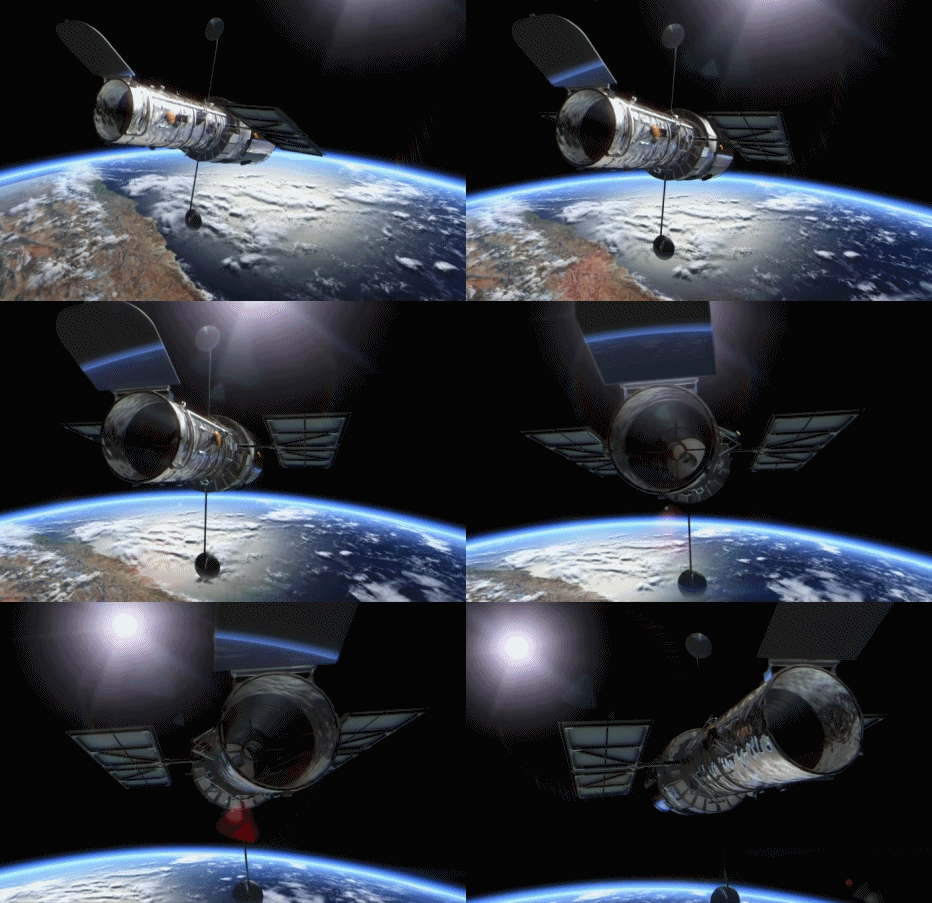
Hubble Space Telescope. Animation Credits: NASA/ESA

Another idea for the star-making surge is that lots of gas, the material that makes stars, is flooding into the faraway galaxies. "The early universe was denser, so maybe gas is raining down on the galaxies, or they are fed by some sort of channel or conduit, which we have not figured out yet," Lowenthal said. "This is what theoreticians struggle with: How do you get all the gas into a galaxy fast enough to make it happen?"

The research team plans to use Hubble and the Gemini Observatory in Hawaii to try to distinguish between the foreground and background galaxies so they can begin to analyze the details of the brilliant monster galaxies.

Future telescopes, such as NASA's James Webb Space Telescope, an infrared observatory scheduled to launch in 2018, will measure the speed of the galaxies' stars so that astronomers can calculate the mass of these ultra-luminous objects.

"The sky is covered with all kinds of galaxies, including those that shine in far-infrared light," Lowenthal said. "What we're seeing here is the tip of the iceberg: the very brightest of all."

The Hubble Space Telescope is a project of international cooperation between NASA and ESA (European Space Agency). NASA's Goddard Space Flight Center in Greenbelt, Maryland, manages the telescope. The Space Telescope Science Institute (STScI) in Baltimore conducts Hubble science operations. STScI is operated for NASA by the Association of Universities for Research in Astronomy, Inc., in Washington, D.C.

For images and more information about Hubble, visit:
http://hubblesite.org/
http://www.nasa.gov/hubble
http://www.spacetelescope.org/

Images (mentioned), Animation (mentioned), Text, Credits: NASA/Karl Hille/Space Telescope Science Institute/Donna Weaver/Ray Villard/Smith College, Northampton/James Lowenthal.

Best regards, Orbiter.ch

Flares May Threaten Planet Habitability Near Red Dwarfs


NASA - Galaxy Evolution Explorer (GALEX) patch.

June 6, 2017

Cool dwarf stars are hot targets for exoplanet hunting right now. The discoveries of planets in the habitable zones of the TRAPPIST-1 and LHS 1140 systems, for example, suggest that Earth-sized worlds might circle billions of red dwarf stars, the most common type of star in our galaxy. But, like our own sun, many of these stars erupt with intense flares. Are red dwarfs really as friendly to life as they appear, or do these flares make the surfaces of any orbiting planets inhospitable?

To address this question, a team of scientists has combed 10 years of ultraviolet observations by NASA's Galaxy Evolution Explorer (GALEX) spacecraft looking for rapid increases in the brightness of stars due to flares. Flares emit radiation across a wide swath of wavelengths, with a significant fraction of their total energy released in the ultraviolet bands where GALEX observed. At the same time, the red dwarfs from which the flares arise are relatively dim in ultraviolet. This contrast, combined with the GALEX detectors' sensitivity to fast changes, allowed the team to measure events with less total energy than many previously detected flares. This is important because, although individually less energetic and therefore less hostile to life, smaller flares might be much more frequent and add up over time to create an inhospitable environment.


Image above: This illustration shows a red dwarf star orbited by a hypothetical exoplanet. Image Credits: NASA/ESA/G. Bacon (STScI).

“What if planets are constantly bathed by these smaller, but still significant, flares?” asked Scott Fleming of the Space Telescope Science Institute (STScI) in Baltimore. “There could be a cumulative effect.”

To detect and accurately measure these flares, the team had to analyze data over very short time intervals. From images with exposure times of nearly half an hour, the team was able to reveal stellar variations lasting just seconds.

First author Chase Million of Million Concepts in State College, Pennsylvania, led a project called gPhoton that reprocessed more than 100 terabytes of GALEX data held at the Mikulski Archive for Space Telescopes (MAST), located at the Space Telescope Science Institute. The team then used custom software developed by Million and Clara Brasseur, also at the institute, to search several hundred red dwarf stars, and they detected dozens of flares.

“We have found dwarf star flares in the whole range that we expected GALEX to be sensitive to, from itty bitty baby flares that last a few seconds, to monster flares that make a star hundreds of times brighter for a few minutes,” said Million.

The flares GALEX detected are similar in strength to flares produced by our own sun. However, because a planet would have to orbit much closer to a cool, red dwarf star to maintain a temperature friendly to life as we know it, such planets would be subjected to more of a flare’s energy than Earth.

Large flares can strip away a planet’s atmosphere. Strong ultraviolet light from flares that penetrates to a planet’s surface could damage organisms or prevent life from arising.

Currently, team members Rachel Osten and Brasseur are examining stars observed by both the GALEX and Kepler missions to look for similar flares. The team expects to eventually find hundreds of thousands of flares hidden in the GALEX data.

NASA's Galaxy Evolution Explorer (GALEX) spacecraft. Image Credit: NASA

"These results show the value of a survey mission like GALEX, which was instigated to study the evolution of galaxies across cosmic time and is now having an impact on the study of nearby habitable planets," said Don Neill, research scientist at Caltech in Pasadena, who was part of the GALEX collaboration. "We did not anticipate that GALEX would be used for exoplanets when the mission was designed."

New and powerful instruments like NASA's James Webb Space Telescope, scheduled for launch in 2018, ultimately will be needed to study atmospheres of planets orbiting nearby red dwarf stars and search for signs of life. But as researchers pose new questions about the cosmos, archives of data from past projects and missions, like those held at MAST, continue to produce exciting new scientific results.

These results were presented in a news conference at a meeting of the American Astronomical Society in Austin, Texas.

The GALEX mission, which ended in 2013 after more than a decade of scanning the skies in ultraviolet light, was led by scientists at Caltech. NASA's Jet Propulsion Laboratory, also in Pasadena, managed the mission and built the science instrument. JPL is managed by Caltech for NASA.

STScI conducts Hubble Space Telescope science operations and is the mission and science operations center for the James Webb Space Telescope. STScI is operated for NASA by the Association of Universities for Research in Astronomy in Washington.

Related links:

TRAPPIST-1: https://exoplanets.nasa.gov/trappist1

NASA's Galaxy Evolution Explorer (GALEX): https://www.nasa.gov/centers/jpl/missions/galex.html

Space Telescope Science Institute (STScI): http://www.stsci.edu/portal/

For more information about exoplanets, visit: https://exoplanets.nasa.gov

Images (mentioned), Text, Credits: NASA/Tony Greicius/JPL/Elizabeth Landau/Space Telescope Science Institute/Christine Pulliam/Ray Villard/Million Concepts, State College/Chase Million.

Greetings, Orbiter.ch

First SmallGEO mission to start service

ESA - European Space Agency logo.

6 June 2017

After four months of exhaustive testing in space, the flagship SmallGEO mission Hispasat 36W-1 has passed all trials with flying colours, which means control has been handed to the operator. 

Relive the SmallGEO launch preparations

H36W-1 lifted off from Europe’s Spaceport in Kourou on 27 January on a Soyuz rocket. The launch marked a number of impressive firsts for both ESA and industry, as not only the first ESA partnership with a Spanish operator and the first telecom satellite to be built in Germany for over 20 years, but also the first time a Soyuz carried a telecom satellite to geostationary transfer orbit from French Guiana.

Once the rocket’s upper stage released the satellite into this orbit, the team back on Earth set to work, measuring its health and performance after launch to ensure everything was working as it should.

Based at the German Space Operations Centre in Oberpfaffenhofen, the team of ESA, Hispasat, OHB System AG and DLR German Aerospace Center engineers meticulously took H36W-1 through a sequence of manoeuvres to move it to the optimum position for testing. 

Artist’s impression of the SmallGEO/H36W-1 Fregat separation

From that point on, every subsystem, transponder and antenna was put through its paces over the course of several months. Particular attention was paid to another first: the Redsat payload. This was the Spanish processor’s first flight, and its flexible four-beam Ku-band Direct Radiating Antenna was thoroughly verified to make sure the delicate equipment was unscathed.

All partners joined forces to bring the satellite to the point of service readiness under two overlapping public–private partnerships. The SmallGEO platform on which the ESA–Hispasat satellite is based is the result of a partnership between ESA and OHB System AG. This programme was ESA’s response to the demands of the fast-paced telecom market, as a way of helping industry to develop the cutting-edge technology and advanced manufacturing techniques needed to produce more efficient, modular satellite platforms at a much faster rate.

The culmination of this H36W-1 partnership is the satellite arriving at its operational position on the geostationary arc at 36ºW, and the final handover to its owner Hispasat.

Hispasat 36W-1 with SmallGEO platform

Andrea Cotellessa, ESA’s SmallGEO project manager, noted: “Now that it is at 36ºW, the satellite will start its 15 year operational life. We, at ESA, are very proud to have made possible the delivery to Hispasat of this new satellite. This is the result of several years of tremendous works carried out with OHB Group and their suppliers’ base, and with our partner Hispasat.

“Europe’s competitive offer for three tonne-class geostationary satellites is now a reality and Hispasat 36W-1 is the first of a long series of satellites using the newly developed SmallGEO platform.”

H36W-1 will complement Hispasat’s existing fleet of telecommunications satellites, providing a commercial broadband service over Europe, the Canary Islands and the Americas.

Partners & related links:

SmallGEO Overview: http://www.esa.int/Our_Activities/Telecommunications_Integrated_Applications/SmallGEO/Overview

SmallGEO evolution: http://www.esa.int/Our_Activities/Telecommunications_Integrated_Applications/SmallGEO/SmallGEO_evolution

Hispasat: http://www.hispasat.com/

OHB System AG: http://www.ohb-system.de/

DLR German Aerospace Center: http://www.dlr.de/

Images, Video, Text, Credits: ESA/Pierre Carril/Video: Directed by Stephane Corvaja, ESA and Manuel Pedoussaut, Zetapress; Music by Hubrid-Earth. 

Best regards, Orbiter.ch

Successfully launches of GSLV Mk III D1 carrying GSAT-19


ISRO - Indian Space Research Organisation logo.


June 6, 2017

GSLV Mk III-D1 launches GSAT-19

GSLV Mk III-D1 launched GSAT-19 on Monday, June 05, 2017 from the Second Launch Pad (SLP) at Satish Dhawan Space Centre SHAR (SDSC SHAR), Sriharikota.

GSLV Mk III D1 / GSAT-19 Tracking and Onboard Camera Video

GSLV-Mk III is capable launching 4 ton class of satellites to Geosynchronous Transfer orbit (GTO). It is a three-stage vehicle with two solid motor strap-ons (S200), a liquid propellant core stage (L110) and a cryogenic stage (C25).

GSLV Mk III-D1/GSAT-19 Mission Curtain Raiser Video

GSLV-Mk III-D1 is the first developmental flight, carrying 3136 kg GSAT-19 satellite to a Geosynchronous Transfer Orbit (GTO). The vehicle is configured with a 5 m ogive payload fairing and slanted strap-on nose cone to provide aerodynamic robustness.

GSAT 19E experimental communications satellite

India’s Geosynchronous Satellite Launch Vehicle Mk. 3 (GSLV Mk.3) launches its first orbital test flight with the GSAT 19E experimental communications satellite.

Related links:

GSAT-19: http://www.isro.gov.in/Spacecraft/gsat-19

GSLV Mark III-D1 / GSAT-19 Brochure: http://www.isro.gov.in/gslv-mk-iii-d1-gsat-19-mission/gslv-mark-iii-d1-gsat-19-brochure

For more information about the mission, visit: http://www.isro.gov.in/launcher/gslv-mk-iii-d1-gsat-19-mission

For more information about Indian Space Research Organisation (ISRO), visit:  http://www.isro.gov.in/

Images, Videos, Text, Credits: Indian Space Research Organisation (ISRO)/Günter Space Page.

Greetings, Orbiter.ch