mardi 27 août 2019

Sixteen Images for Spitzer's Sweet 16


NASA - Spitzer Space Telescope patch.

Aug. 27, 2019

NASA launched its Spitzer Space Telescope into orbit around the Sun on Aug. 25, 2003. Since then, the observatory has been lifting the veil on the wonders of the cosmos, from our own solar system to faraway galaxies, using infrared light.

Spitzer Space Telescope. Animation Credit: NASA

Managed by NASA's Jet Propulsion Laboratory in Pasadena, California, Spitzer enabled scientists to confirm the presence of seven rocky, Earth-size planets in the TRAPPIST-1 system. The telescope has also provided weather maps of hot, gaseous exoplanets and revealed a hidden ring around Saturn. It has illuminated hidden collections of dust in a wide variety of locations, including cosmic nebulas (clouds of gas and dust in space), where young stars form, and swirling galaxies. Spitzer has additionally investigated some of the universe's oldest galaxies and stared at the black hole at the center of the Milky Way.

Spitzer's primary mission lasted five-and-a-half years and ended when it ran out of the liquid helium coolant necessary to operate two of its three instruments. But its passive-cooling design has allowed part of its third instrument to continue operating for more than 10 additional years. The mission is scheduled to end on Jan. 30, 2020.

In honor of Spitzer's Sweet 16 in space, here are 16 amazing images from the mission.

Giant Star Makes Waves

Credits: NASA/JPL-Caltech

This Spitzer image shows the giant star Zeta Ophiuchi and the bow shock, or shock wave, in front of it. Visible only in infrared light, the bow shock is created by winds that flow from the star, making ripples in the surrounding dust. Located roughly 370 light-years from Earth, Zeta Ophiuchi dwarfs our Sun: It is about six times hotter, eight times wider, 20 times more massive and about 80,000 times as bright. Even at its great distance, it would be one of the brightest stars in the sky were it not largely obscured by dust clouds.

Read more about this image here:  https://www.jpl.nasa.gov/news/news.php?feature=3630

The Seven Sisters Pose for Spitzer

Credits: NASA/JPL-Caltech

The Pleiades star cluster, also known as the Seven Sisters, is a frequent target for night sky observers. This image from Spitzer zooms in on a few members of the sisterhood. Viewed in the infrared, the stars seem to float on a bed of feathers. The filaments surrounding the stars are dust, and the three colors represent different wavelengths of infrared light. The densest portion of the dust cloud appears in yellow and red, and the more diffuse outskirts appear in green hues.

Read more about this image here: https://www.jpl.nasa.gov/news/news.php?feature=1344

Young Stars in Their Baby Blanket of Dust

Credits: NASA/JPL-Caltech/Harvard-Smithsonian CfA

Newborn stars peek out from beneath their blanket of dust in this image of the Rho Ophiuchi nebula. Called "Rho Oph" by astronomers and located about 400 light-years from Earth, it's one of the closest star-forming regions to our own solar system.

The youngest stars in this image are surrounded by dusty disks of material from which the stars — and their potential planetary systems — are forming. More evolved stars, which have shed their natal material, are blue. The extended white nebula right of center is a region of the cloud that glows in infrared light due to the heating of dust by bright young stars near the cloud's right edge.

Read more about this image here: https://www.jpl.nasa.gov/spaceimages/details.php?id=PIA10181

The Infrared Helix

Credits: NASA/JPL-Caltech

Located about 700 light-years from Earth, the eye-like Helix nebula is a planetary nebula, or the remains of a Sun-like star. When these stars run out of their internal fuel supply, their outer layers puff up to create the nebula. The nebula is heated by the hot core of the dead star, called a white dwarf, which is not visible in this image but is located in the middle of the "eye." Our Sun will blossom into a planetary nebula when it dies in about 5 billion years.

Read more about this image here:

http://www.spitzer.caltech.edu/news/881-feature07-13-Spitzer-Celebrates-Fourth-Anniversary-with-Celestial-Fireworks

The Tortured Clouds of Eta Carinae

Credits: NASA/JPL-Caltech/Harvard-Smithsonian CfA

The bright star at the center of this image is Eta Carinae, one of the most massive stars in the Milky Way galaxy. With around 100 times the mass of the Sun and at least 1 million times the brightness, Eta Carinae releases a tremendous outflow of energy that has eroded the surrounding nebula. Spitzer's infrared vision lets us see the dust, shown in red, as well as clouds of hot, glowing gas, which appear green.

Read more about this image here: https://www.jpl.nasa.gov/spaceimages/details.php?id=PIA17257

Spitzer Spies Spectacular Sombrero

Credits: NASA/JPL-Caltech/STScI

Located 28 light-years from Earth, Messier 104 — also called the Sombrero galaxy or M104 — is notable for its nearly edge-on orientation as seen from our planet. Spitzer observations were the first to reveal the smooth, bright ring of dust (seen in red) circling the galaxy. Spitzer's full view also shows the disk is warped, often the result of a gravitational encounter with another galaxy, and clumpy areas spotted in the far edges of the ring indicate young star-forming regions. Hubble Space Telescope data showing starlight appears blue.

Read more about this image here: https://www.jpl.nasa.gov/spaceimages/details.php?id=PIA07899

Spiral Galaxy Messier 81

Credits: NASA/JPL-Caltech

This infrared image of the galaxy Messier 81, or M81, reveals lanes of dust illuminated by active star formation throughout the galaxy's spiral arms.. Located in the northern constellation of Ursa Major (which includes the Big Dipper), M81 is also about 12 million light-years from Earth.

Read more about this image here: https://astropix.ipac.caltech.edu/image/spitzer/ssc2003-06c1

Spitzer Reveals Stellar Smoke

Credits: NASA/JPL-Caltech

Messier 82 — also known as the Cigar galaxy or M82 — is a hotbed of young, massive stars. In visible light, it appears as a diffuse bar of blue light, but in this infrared image, scientists can see huge red clouds of dust blown out into space by winds and radiation from those stars. Messier 82 is located about 12 million light-years away in the Ursa Major constellation.

Read more about this image here:

http://www.spitzer.caltech.edu/news/234-ssc2006-09-Galaxy-on-Fire-NASA-s-Spitzer-Reveals-Stellar-Smoke

A Pinwheel Galaxy Rainbow

Credits: NASA/JPL-Caltech/STScI/CXC

This image of Messier 101, also known as the Pinwheel Galaxy or M101, combines data in the infrared, visible, ultraviolet and X-rays from Spitzer and three other NASA space telescopes: Hubble, the Galaxy Evolution Explorer's Far Ultraviolet detector (GALEX) and the Chandra X-Ray Observatory. The galaxy is about 70% larger than our own Milky Way, with a diameter of about 170,000 light-years, and sits at a distance of 21 million light-years from Earth.

The red colors in the image show infrared light, as seen by Spitzer. These areas show light emitted by dusty lanes in the galaxy where stars are forming. The yellow component is visible light, observed by Hubble. Most of this light comes from stars, and they trace the same spiral structure as the dust lanes seen in the infrared. The blue areas are ultraviolet light, given off by hot, young stars that formed about 1 million years ago and that were observed by GALEX. The hottest areas are shown in purple, where Chandra observed the X-ray emission from exploded stars, million-degree gas and material colliding around black holes.

Read more about this image here: https://astropix.ipac.caltech.edu/image/spitzer/sig12-005

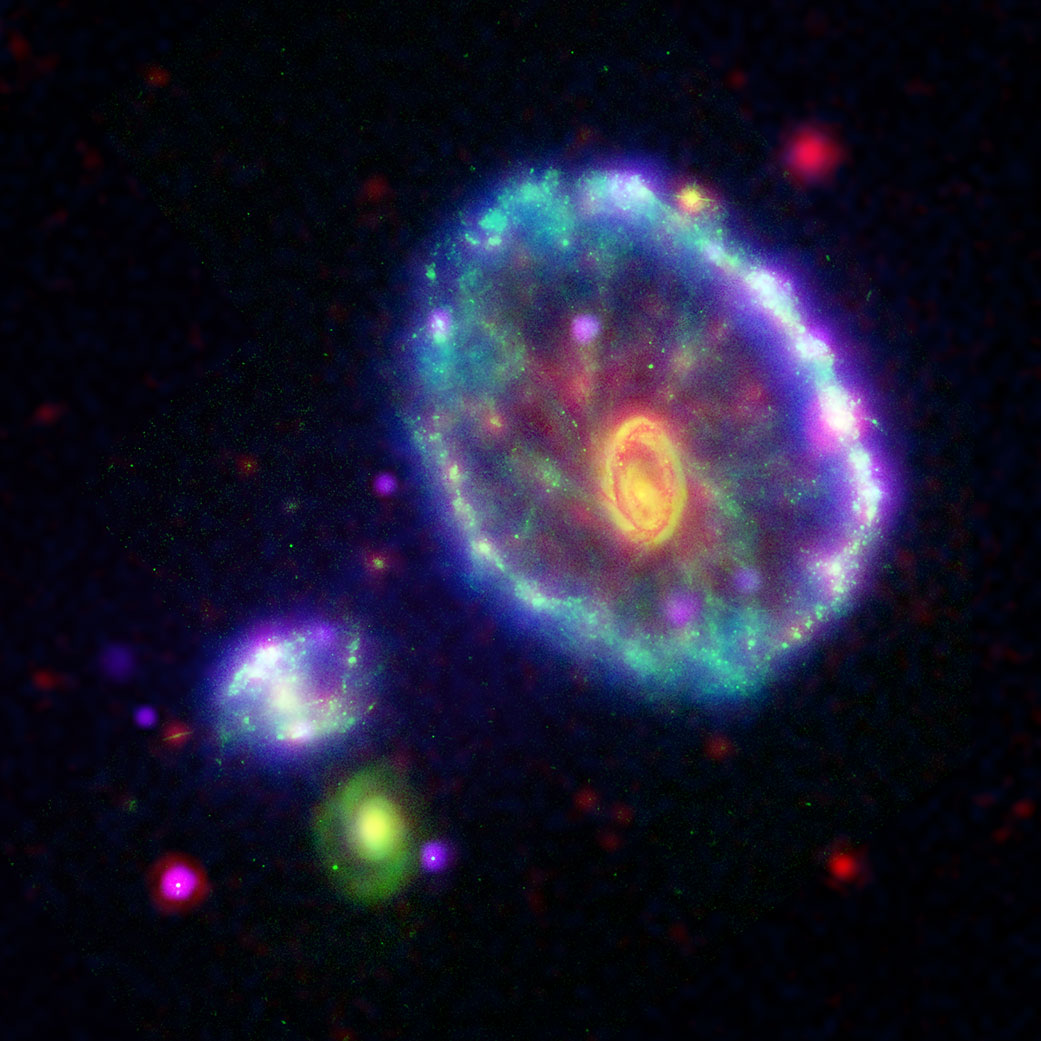
Cartwheel Galaxy Makes Waves
Credits: NASA/JPL-Caltech/STScI/CXC

Approximately 100 million years ago, a smaller galaxy plunged through the heart of the Cartwheel galaxy, creating ripples of brief star formation. As with the Pinwheel galaxy above, this composite image includes data from NASA's Spitzer, Hubble, GALEX and Chandra observatories.

The first ripple appears as a bright blue outer ring around the larger object, radiating ultraviolet light visible to GALEX. The clumps of pink along the outer blue ring are X-ray (observed by Chandra) and ultraviolet radiation.

A combination of visible and infrared light from Hubble and Spitzer, the yellow-orange inner ring and center of the galaxy represent the second ripple, or ring wave, created in the collision. Tints of green are older, less-massive visible-light stars. Although astronomers haven't pinpointed which galaxy collided with the Cartwheel, two of three candidate galaxies can be seen in this image to the bottom left of the ring, one as a neon blob and the other as a green spiral.

Read more about this image here: https://photojournal.jpl.nasa.gov/feature/Cartwheel

Spitzer and Hubble Create Colorful Masterpiece

Credits: NASA/JPL-Caltech/STScI

Located 1,500 light-years from Earth, the Orion nebula is the brightest spot in the sword of the constellation Orion. Both NASA's Spitzer and Hubble space telescopes contributed to this vibrant image. Four massive stars, collectively called the Trapezium, appear as a yellow smudge near the image center. Visible and ultraviolet data from Hubble appear as swirls of green that indicate the presence of gas heated by intense ultraviolet radiation from the Trapezium's stars. Less-embedded stars appear as specks of green, and foreground stars as blue spots. Meanwhile, Spitzer's infrared view exposes carbon-rich molecules called polycyclic aromatic hydrocarbons, shown here as wisps of red and orange. Orange-yellow dots are infant stars deeply embedded in cocoons of dust and gas.

Read more about this image here: https://www.nasa.gov/mission_pages/spitzer/news/spitzer-20061107.html

A Space Spider Watches Over Young Stars

Credits: NASA/JPL-Caltech/2MASS

Located about 10,000 light-years from Earth in the constellation Auriga, the Spider nebula resides in the outer part of the Milky Way. Combining data from Spitzer and the Two Micron All Sky Survey (2MASS), the image shows green clouds of dust illuminated by star formation in the region. Right of center, against the black background of space, lies a bright group of stars called Stock 8. The radiation from this cluster carves out a bowl in the nearby dust clouds. Running in a tributary to the left of Stock 8 are more young stars that appear as red point sources.

Read more about this image here: https://www.jpl.nasa.gov/news/news.php?feature=6422

North America Nebula in Different Lights

Credits: NASA/JPL-Caltech

This view of the North America nebula combines visible light collected by the Digitized Sky Survey with infrared light from NASA's Spitzer Space Telescope. Blue hues represent visible light, while infrared is displayed as red and green. Clusters of young stars (about 1 million years old) can be found throughout the image. Slightly older but still very young stars (about 3 to 5 million years) are also liberally scattered across the complex.

Read more about this image here: https://www.jpl.nasa.gov/spaceimages/details.php?id=PIA13845

Spitzer Captures Our Galaxy's Bustling Center

Credits: NASA/JPL-Caltech

This infrared mosaic offers a stunning view of the Milky Way galaxy's busy center. The pictured region, located in the Sagittarius constellation, is 900 light-years agross and shows hundreds of thousands of mostly old stars amid clouds of glowing dust lit up by younger, more massive stars. Our Sun is located 26,000 light-years away in a more peaceful, spacious neighborhood, out in the galactic suburbs. The bright core in the middle of the image is a dense cluster of stars at the center of the Milky Way, within which lurks a black hole about 4 million times more massive than our Sun.

Viewing the center of the Milky Way from Earth can be difficult because the plane of the galaxy's spiral disk is filled with cold dust. Visible light coming from the galaxy's center is virtually impossible to observe because dust dims it by a factor of 1 trillion. But infrared light can shine through this dust.

Read more about this image here: https://www.jpl.nasa.gov/news/news.php?feature=1008

The Eternal Life of Stardust

Credits: NASA/JPL-Caltech

The Large Magellanic Cloud, a dwarf galaxy located about 160,000 light-years from Earth, looks like a choppy sea of dust in this infrared portrait. The blue color, seen most prominently in the central bar, represents starlight from older stars. The chaotic, bright regions outside this bar are filled with hot, massive stars buried in thick blankets of dust. The red color around these bright regions is from dust heated by stars, while the red dots scattered throughout the picture are either dusty, old stars; young stars newly forming; or more distant galaxies. The greenish clouds contain cooler interstellar gas and molecule-size dust grains illuminated by ambient starlight.

Read more about this image here: https://www.jpl.nasa.gov/news/news.php?feature=1161

A Stellar Family Portrait

Credits: NASA/JPL-Caltech

In this large celestial mosaic from Spitzer, there's a lot to see, including multiple clusters of stars born from the same dense clumps of gas and dust. Some of these clusters are older than others and more evolved, making this a generational stellar portrait.

The grand green-and-orange delta filling most of the image is a faraway nebula. The bright white region at its tip is illuminated by massive stars, and dust that has been heated by the stars' radiation creates the surrounding red glow.

Read more about this image here: https://www.jpl.nasa.gov/news/news.php?feature=7413

More information about Spitzer is available at the following site(s):

https://www.nasa.gov/mission_pages/spitzer/main/index.html

Related links:

Chandra X-Ray Observatory: https://www.nasa.gov/mission_pages/chandra/main/index.html

Hubble Space Telescope: https://www.nasa.gov/mission_pages/hubble/main/index.html

Images (mentioned), Animation (mentioned), Text, Credits: NASA/Tony Greicius/JPL/Calla Cofield.

Best regards, Orbiter.ch

Dragon Splashes Down in Pacific Ocean Packed With Science and Cargo


SpaceX - Dragon CRS-18 Mission patch.

August 27, 2019

SpaceX’s Dragon cargo spacecraft splashed down in the Pacific Ocean at 4:21 p.m. EDT (1:21 p.m PDT), approximately 300 miles southwest of Long Beach, California, marking the end of the company’s 18th contracted cargo resupply mission to the International Space Station for NASA. The spacecraft returned more than 2,700 pounds of valuable scientific experiments and other cargo.


Image above: The SpaceX Dragon resupply ship is pictured above the Canadian Rocky Mountains after it departed the International Space Station today. Image Credit: @Astro_Christina.

Some of the scientific investigations Dragon will return to Earth include:

Bio-Mining in Microgravity

The Biorock investigation provides insight into the physical interactions of liquid, rocks and microorganisms in microgravity and improving the efficiency and understanding of mining materials in space. Bio-mining eventually could help explorers on the Moon or Mars get needed materials on site, lessening the need for precious resources from Earth and reducing the amount of supplies explorers must take with them.

Mechanisms of Moss in Microgravity

Space Moss compares mosses grown aboard the space station with those grown on Earth to determine how microgravity affects its growth, development, and other characteristics. Tiny plants without roots, mosses need only a small area for growth, an advantage for their potential use in space and future bases on the Moon or Mars. This investigation also could yield information that aids in engineering other plants to grow better on the Moon and Mars, as well as on Earth.

Improving Tire Manufacturing from Orbit

The Goodyear Tire investigation uses microgravity to push the limits of silica fillers for tire applications. A better understanding of silica morphology and the relationship between silica structure and its properties could provide improvements for increased fuel efficiency, which would reduce transportation costs and help to protect Earth’s environment.


Image above (archive): Splashdown! SpaceX Dragon Returns To Earth. Image Credits: SpaceX/NASA.

These are just a few of the hundreds of investigations aimed at keeping astronauts healthy during space travel and demonstrating technologies for future human and robotic exploration beyond low-Earth orbit, including missions to the Moon by 2024 and on to Mars. Space station research also provides opportunities for other U.S. government agencies, private industry, and academic and research institutions to conduct microgravity research that leads to new technologies, medical treatments, and products that improve life on Earth.

For more than 18 years, humans have lived and worked continuously aboard the International Space Station, advancing scientific knowledge and demonstrating new technologies, making research breakthroughs not possible on Earth that will enable long-duration human and robotic exploration into deep space. A global endeavor, more than 230 people from 18 countries have visited the unique microgravity laboratory that has hosted more than 2,500 research investigations from researchers in 106 countries.

Related articles:

SpaceX Dragon Released from Station for Earth Return
https://orbiterchspacenews.blogspot.com/2019/08/spacex-dragon-released-from-station-for.html

Scientific Samples Make the Journey Back to Earth aboard SpaceX’s Dragon
https://orbiterchspacenews.blogspot.com/2019/08/scientific-samples-make-journey-back-to.html

Related links:

Biorock: https://www.nasa.gov/mission_pages/station/research/experiments/explorer/Investigation.html?#id=7566

Space Moss: https://www.nasa.gov/mission_pages/station/research/experiments/explorer/Investigation.html?#id=7892

Goodyear Tire: https://www.nasa.gov/mission_pages/station/research/experiments/explorer/Investigation.html?#id=7716

Space Station Research and Technology: https://www.nasa.gov/mission_pages/station/research/index.html

International Space Station (ISS): https://www.nasa.gov/mission_pages/station/main/index.html

Images (mentioned), Text, Credits: NASA/Mark Garcia.

Greetings, Orbiter.ch

SpaceX Dragon Released from Station for Earth Return


SpaceX - Dragon CRS-18 Mission patch.

August 27, 2019


Image above: The SpaceX Dragon resupply ship is pictured attached to the International Space Station’s Harmony module on Aug. 13, 2019, as the orbital complex flew 260 miles above the Nile River Delta in Egypt. Image Credit: NASA.

The SpaceX Dragon cargo spacecraft released from the International Space Station at 10:59 a.m. EDT after flight controllers in Houston delivered remote commands to the station’s Canadarm2 robotic arm. Expedition 60 Flight Engineer Flight Engineer Christina Koch of NASA monitored Dragon’s systems as it departed the microgravity laboratory.

SpaceX CRS-18: Dragon unberthing and departure

Next up, Dragon will fire its thrusters to move a safe distance from the station and execute a deorbit burn around 3:22 p.m. to leave orbit. Splashdown down is targeted for 4:21 p.m. EDT (1:21 p.m. PDT).

Related article:

Scientific Samples Make the Journey Back to Earth aboard SpaceX’s Dragon
https://orbiterchspacenews.blogspot.com/2019/08/scientific-samples-make-journey-back-to.html

Related links:

Expedition 60: https://www.nasa.gov/mission_pages/station/expeditions/expedition60/index.html

Space Station Research and Technology: https://www.nasa.gov/mission_pages/station/research/index.html

International Space Station (ISS): https://www.nasa.gov/mission_pages/station/main/index.html

Image (mentioned), Video, Text, Credits: NASA/Mark Garcia/NASA TV/SciNews.

Best regards, Orbiter.ch

The Latest Look at "First Light" from Chandra


NASA - Chandra X-ray Observatory patch.

Aug. 27, 2019


NASA’s Chandra X-ray Observatory has captured many spectacular images of cosmic phenomena over its two decades of operations, but perhaps its most iconic is the supernova remnant Cassiopeia A.

Located about 11,000 light-years from Earth, Cas A (as it’s nicknamed) is the glowing debris field left behind after a massive star exploded. When the star ran out of fuel, it collapsed onto itself and blew up as a supernova, possibly briefly becoming one of the brightest objects in the sky. (Although astronomers think that this happened around the year 1680, there are no verifiable historical records to confirm this.)

The shock waves generated by this blast supercharged the stellar wreckage and its environment, making the debris glow brightly in many types of light, particularly X-rays. Shortly after Chandra was launched aboard the Space Shuttle Columbia on July 23, 1999, astronomers directed the observatory to point toward Cas A. It was featured in Chandra's official “First Light” image, released Aug. 26, 1999, and marked a seminal moment not just for the observatory, but for the field of X-ray astronomy. Near the center of the intricate pattern of the expanding debris from the shattered star, the image revealed, for the first time, a dense object called a neutron star that the supernova left behind.

Since then, Chandra has repeatedly returned to Cas A to learn more about this important object. A new video shows the evolution of Cas A over time, enabling viewers to watch as incredibly hot gas – about 20 million degrees Fahrenheit – in the remnant expands outward. These X-ray data have been combined with data from another of NASA’s “Great Observatories,” the Hubble Space Telescope, showing delicate filamentary structures of cooler gases with temperatures of about 20,000 degrees Fahrenheit. Hubble data from a single time period are shown to emphasize the changes in the Chandra data.

A Tour of the Latest Look at "First Light" from Chandra

Video above: Credits: NASA/CXC/RIKEN/T. Sato et al.

The video shows Chandra observations of Cas A from 2000 to 2013. In that time, a child could enter kindergarten and graduate from high school. While the transformation might not be as apparent as that of a student over the same period, it is remarkable to watch a cosmic object change on human time scales.

The blue, outer region of Cas A shows the expanding blast wave of the explosion. The blast wave is composed of shock waves, similar to the sonic booms generated by a supersonic aircraft. These expanding shock waves produce X-ray emission and are sites where particles are being accelerated to energies that reach about two times higher than the most powerful accelerator on Earth, the Large Hadron Collider. As the blast wave travels outwards at speeds of about 11 million miles per hour, it encounters surrounding material and slows down, generating a second shock wave – called a “reverse shock” – that travels backwards, similar to how a traffic jam travels backwards from the scene of an accident on a highway.

These reverse shocks are usually observed to be faint and much slower moving than the blast wave. However, a team of astronomers led by Toshiki Sato from RIKEN in Saitama, Japan, and NASA’s Goddard Space Flight Center, have reported reverse shocks in Cas A that appear bright and fast moving, with speeds between about 5 and 9 million miles per hour. These unusual reverse shocks are likely caused by the blast wave encountering clumps of material surrounding the remnant, as Sato and team discuss in their 2018 study. This causes the blast wave to slow down more quickly, which re-energizes the reverse shock, making it brighter and faster. Particles are also accelerated to colossal energies by these inward moving shocks, reaching about 30 times the energies of the LHC.

Chandra X-ray Observatory. Animation Credits: NASA/CXC

This recent study of Cas A adds to a long collection of Chandra discoveries over the course of the telescope’s 20 years. In addition to finding the central neutron star, Chandra data have revealed the distribution of elements essential for life ejected by the explosion, have constructed a remarkable three dimensional model of the supernova remnant, and much more.

Scientists also created a historical record in optical light of Cas A using photographic plates from the Palomar Observatory in California from 1951 and 1989 that had been digitized by the Digitized Access to a Sky Century @ Harvard (DASCH) program, located at the Center for Astrophysics | Harvard & Smithsonian (CfA). These were combined with images taken by the Hubble Space Telescope between 2000 and 2011. This long-term look at Cas A allowed astronomers Dan Patnaude of CfA and Robert Fesen of Dartmouth College to learn more about the physics of the explosion and the resulting remnant from both the X-ray and optical data.

This recent study of Cas A adds to a long collection of Chandra discoveries over the course of the telescope’s 20 years. In addition to finding the central neutron star, Chandra data have revealed the distribution of elements essential for life ejected by the explosion, clues about the details of how the star exploded, and much more.

NASA's Marshall Space Flight Center manages the Chandra program. The Smithsonian Astrophysical Observatory’s Chandra X-ray Center controls science and flight operations from Cambridge, Massachusetts.

2018 study: https://arxiv.org/abs/1710.06992

Read more from NASA's Chandra X-ray Observatory: http://chandra.harvard.edu/photo/2019/firstlight/

For more Chandra images, multimedia and related materials, visit: http://www.nasa.gov/chandra

Image, Video (mentioned), Animation (mentioned), Text, Credits: X-ray: NASA/CXC/RIKEN/T. Sato et al.; Optical: NASA/STScI/Text Credits: NASA/Lee Mohon.

Greetings, Orbiter.ch

Fires ravage the Amazon


ESA - Sentinel-2 Mission logo / ESA - Sentinel-3 Mission logo.

27 August 2019

Thousands of fires have broken out in the Amazon rainforest. Satellite data show that there are almost four times as many fires this year compared to the same period last year. Apart from Brazil, parts of Peru, Bolivia, Paraguay and Argentina have also been affected.

Wildfires in Brazil from Copernicus Sentinel-3

While forest fires normally occur in Brazil’s dry season, which runs from July to October, the unprecedented increase is reported to come from both legal and illegal deforestation which allows land to be used for agricultural purposes, rising global temperatures are also thought to be making the region more susceptible to fire.

The Amazon basin is the world’s largest tropical rainforest, spanning four countries and is home to millions of plants and animals. It is estimated to produce up to 20% of the world’s oxygen – hence the region being called ‘the lungs of the world’ – and is crucial for helping to regulate global warming as the forests absorb millions of tonnes of carbon emissions every year.

Amazon fires seen from International Space Station (ISS) taken by ESA astronaut L. Parmitano

Using Copernicus Sentinel-3 data, as part of the Sentinel-3 World Fires Atlas, almost 4000 fires were detected from 1 August to 24 August 2019, while last year there were far fewer during the same period, just 1110 fires.

“By processing 249 images for August 2018 and 275 images for August 2019, we are able to see the incredible number of fires burning in the Amazon. This was achieved by the World Fire Atlas night time algorithm, in order to avoid any possible false alarms with the daytime algorithm,” says ESA’s Olivier Arino.  

Number of wildfires in the Amazon

Plumes of smoke have spread across the Amazon region. Strong winds have blown smoke to São Paulo – more than 2500 km away— causing a black out in the city. According to the Copernicus Atmosphere Monitoring System (CAMS), smoke has travelled as far as the Atlantic coast.

CAMS also reports that the fires have released 228 megatonnes of carbon dioxide into the atmosphere, as well as copious amounts of carbon monoxide. The fires also threaten the lives of many indigenous people.

The Copernicus Emergency Mapping Service was activated to help respond to the fire. The service uses satellite observations to help civil protection authorities and, in cases of disaster, the international humanitarian community to help to respond to emergencies.

Wildfires on the border between Bolivia, Paraguay and Brazil from Copernicus Sentinel-2

The severity of the fires has reached the highest political levels. Deemed an international crisis, the G7 nations who met in France yesterday, have offered a 20 million euro emergency funding to assist Brazil and its neighbouring countries to put out the fires, according to French President Emmanuel Macron.

Josef Aschbacher, ESA’s Director of Earth Observation Programmes, said, “As we continue to face the ongoing climate crisis, satellites are essential in monitoring wildfires in remote areas, especially for a key component of the Earth system such as the Amazon.”

Related articles:

Uptick in Amazon Fire Activity in 2019
https://orbiterchspacenews.blogspot.com/2019/08/uptick-in-amazon-fire-activity-in-2019.html

NASA's AIRS Maps Carbon Monoxide from Brazil Fires & Cross Country Smoke
https://orbiterchspacenews.blogspot.com/2019/08/nasas-airs-maps-carbon-monoxide-from.html

Related links:

Sentinel-3 World Fires Atlas: https://s3worldfireatlas.esa.int/

Copernicus Emergency Management Service: http://emergency.copernicus.eu/

G7 Summit: https://www.elysee.fr/en/g7

Sentinel-2: http://www.esa.int/Our_Activities/Observing_the_Earth/Copernicus/Sentinel-2

Sentinel-3: http://www.esa.int/Our_Activities/Observing_the_Earth/Copernicus/Sentinel-3

Copernicus: http://www.esa.int/Our_Activities/Observing_the_Earth/Copernicus

Images, Animations, Text, Credits: ESA/Contains modified Copernicus Sentinel data (2019), processed by ESA, CC BY-SA 3.0 IGO/Contains modified Copernicus Sentinel data (2019), processed by ESA on ONDA Copernicus DIAS/ESA/NASA–L. Parmitano.

Greetings, Orbiter.ch

Russian Spacecraft Second Docking Attempt Successful


ROSCOSMOS - Soyuz MS-14 / Skybot F-850 patch.

August 27, 2019

While the spacecraft were flying about 250 miles above Eastern Mongolia, an uncrewed Russian Soyuz spacecraft arrived and docked to the International Space Station at 11:08 p.m. EDT.


Image above: The Soyuz MS-14 spacecraft is pictured during it’s approach. The Soyuz MS-13 is seen in the forground. Image Credit: NASA.

The Soyuz MS-14 spacecraft attached to the station’s aft-facing Zvezda module for a two-week stay as part of its test flight. The Soyuz delivers 1,450 pounds of cargo, including a Skybot F-850 humanoid robot, to the Expedition 60 crew currently residing on the orbital outpost.

Soyuz MS-14 docking

The docking of the unpiloted Soyuz sets the stage for the robotic release of the SpaceX Dragon cargo craft Tuesday morning after a four-week stay at the station. The Dragon is filled with almost 2,700 pounds of valuable scientific experiments and other cargo. NASA Television and the agency’s website will broadcast its departure live beginning at 10:15 a.m. EDT.

Related links:

Expedition 60: https://www.nasa.gov/mission_pages/station/expeditions/expedition60/index.html

SpaceX Dragon: https://www.nasa.gov/press-release/nasa-tv-to-air-us-cargo-ship-departure-from-space-station/

Harmony: https://www.nasa.gov/mission_pages/station/structure/elements/harmony

Canadarm2: https://www.nasa.gov/mission_pages/station/structure/elements/remote-manipulator-system-canadarm2/

NASA TV: https://www.nasa.gov/multimedia/nasatv/#public and https://www.nasa.gov/nasalive

Space Station Research and Technology: https://www.nasa.gov/mission_pages/station/research/index.html

International Space Station (ISS): https://www.nasa.gov/mission_pages/station/main/index.html

Image (mentioned), Video, Text, Credits: NASA/Mark Garcia/Roscosmos/SciNews.

Greetings, Orbiter.ch

lundi 26 août 2019

Scientific Samples Make the Journey Back to Earth aboard SpaceX’s Dragon


SpaceX - Dragon CRS-18 Mission patch.

Aug. 26, 2019

On July 27, 2019, a Dragon cargo spacecraft arrived at the International Space Station carrying dozens of scientific experiments. Now, Dragon heads home. It brings samples, hardware and data from completed investigations back to Earth on its return trip, with undocking from the station currently scheduled for one month after arrival: August 27.

Here are details on some of the investigations returning to the ground for further analysis and reporting of results.

A cinematic look at life and science aboard the space station

The ISS Experience is creating a cinematic virtual reality (VR) film from footage taken during the yearlong investigation covering different aspects of crew life, execution of science and the international partnerships involved on the space station. The immersive VR film will give audiences on Earth an up close and personal taste of the challenges of adaptation to life in space, the work and science, and the human interaction between crew members.


Image above: Canadian Space Agency astronaut David Saint-Jacques setting up the Z-CAM V1 Pro Cinematic camera to film aboard the space station for The ISS Experience. Image Credit: NASA.

Developers Felix & Paul Studios, in partnership with private space services firm NanoRacks and the ISS National Lab, launched two cinematic virtual reality camera systems to the space station on a SpaceX Dragon cargo spacecraft in December 2018. The crew films less than four hours each week. Every week or so, they transfer footage from the camera onto solid state drives – an original and a backup – for storage and downlinking. One of each pair of drives eventually physically returns to Earth for editing and production and astronauts then can reuse the other one.

Seeking Alzheimer’s understanding in microgravity

Amyloid fibrils, a conglomeration of proteins that can build up in the body, are associated with a number of neurodegenerative diseases such as Alzheimer’s and Parkinson’s. The Amyloid Aggregation investigation assesses whether microgravity affects formation of these fibrils, which could represent a possible risk to astronauts on long flights.


Image above: These colored caps distinguish samples with various incubation times for the Amyloid Aggregation investigation. This investigation assesses whether microgravity affects formation of amyloid fibrils, self-assembled fibrous protein aggregates associated with a number of neurodegenerative diseases such as Alzheimer’s and Parkinson’s. Image Credit: NASA.

Samples exposed to microgravity return to Earth using the General Laboratory Active Cryogenic ISS Experiment Refrigerator (GLACIER), a facility that maintains a temperature of -20°C. Teams on the ground must quickly retrieve the equipment and keep the samples at -20°C until delivery to the principal investigators for analysis.

From microgravity lab to manufacturing facility

Physical Optics Corporation’s Fiber Optic Production investigation created optical fibers with high commercial value on the space station using a blend of materials called ZBLAN. Studies suggest that ZBLAN optical fibers produced in microgravity should be higher quality than those produced on Earth. On Earth, ZBLAN optical fibers offer high bandwidth for the telecommunications industry, and potential applications for laser surgery, remote sensing and environmental monitoring.

The fiber produced on the space station is returning to Earth for testing to help verify previous studies and guide future efforts to manufacture large volumes of such fiber in microgravity.

SpaceX dragon. Image Credit: NASA

Testing flexible fuel tanks

Furphy tested the transfer of fluids from a rigid tank to a flexible tank that can launch collapsed and deploy as it fills. This capability would make it possible to fuel small satellites in orbit rather than prior to launch, potentially saving launch mass and volume. This first microgravity test verified tank dynamics including slosh and retention of angular momentum. Flexible fuel tanks also have potential applications on Earth, including supporting operations in remote and harsh environments and in disaster relief.

The investigation used a rigid tank, delivered to the space station filled with water, and a FlexTank™ made from silicone elastomer, which arrived empty and compressed. After the tests, crew offloaded the water to the station’s water supply. The tanks are returning to Earth aboard the Dragon.

Other investigations returning on the Dragon:

The BioRock investigation examines interactions between microbes and rocks and physical and genetic changes in the microbes in space to support future acquisition of materials in space through biomining. After culturing and fixation on the space station, the crew placed samples into cold storage at 4°C for return to the investigation team on the ground for analysis.

LMM Biophysics 6 crystallized two proteins of interest in cancer treatment and radiation protection. The microgravity-grown crystals return to the ground for comparison to control crystallization experiments performed on Earth, using microscopic images, X-Ray diffraction analysis and structural analysis.


Image above: NASA astronaut Andrew Morgan monitors a pair of free-floating Synchronized Position Hold, Engage, Reorient, Experimental Satellites, or SPHERES. Middle and high school students compete to design algorithms that autonomously control the basketball-sized satellites aboard the station. Image Credit: NASA.

Synchronized Position Hold, Engage, Reorient, Experimental Satellites, or SPHERES, are bowling-ball sized satellites used to study formation flying, control algorithms, and material science. First sent to the station during Expedition 13 in 2006, these satellites have been employed in a dozen different investigations. The Dragon brings back hardware from two recent ones that examined the behavior of fluids in microgravity, SPHERES Tether Slosh and SPHERES-Slosh.

The Cell Science-02 investigation examined the effects of microgravity on healing and tissue regeneration and on the agents that induce that healing. Cultures were maintained on-orbit for approximately 21 days and then preserved and placed in -80˚C cold stowage for return to NASA’s Johnson Space Center. They will then ship to the research team within 24 hours of payload handover.


Image above: NASA astronauts Nick Hague and Christina Koch conducting the Cell Science-02 bone healing and tissue regeneration experiment in the Life Sciences Glovebox. Image Credit: NASA.

The Goodyear Tire investigation evaluates the creation of silica fillers using traditional techniques but in microgravity, potentially yielding results not possible on Earth. After processing, the six rubber samples return via cold-stowage to the Goodyear Research facility for analysis.

Mobile Companion examined the efficiency and acceptance by the crew of support from artificial intelligence (AI) during long-term missions in space. AI could provide operational support that reduces the amount of stress and workload on human crew members. Investigation hardware returns to Earth on Dragon.

Space Moss compares mosses grown aboard the space station with those grown on Earth to determine how microgravity affects growth, development, gene expression, photosynthesis and other features. Crew members fixed some of the mosses using a Chemical Fixation Bag and stored the rest for live return.

Related links:

The ISS Experience: https://www.nasa.gov/mission_pages/station/research/experiments/explorer/Investigation.html?#id=7877

Amyloid Aggregation: https://www.nasa.gov/mission_pages/station/research/experiments/explorer/Investigation.html?#id=7902

GLACIER: https://www.nasa.gov/mission_pages/station/research/experiments/explorer/Facility.html?#id=342

Fiber Optic Production: https://www.nasa.gov/mission_pages/station/research/experiments/explorer/Investigation.html?#id=7630

BioRock: https://www.nasa.gov/mission_pages/station/research/news/biorock-iss-research-microbes-space

LMM Biophysics 6: https://www.nasa.gov/mission_pages/station/research/experiments/explorer/Investigation.html?#id=7743

SPHERES: https://www.nasa.gov/mission_pages/station/research/experiments/explorer/Facility.html?#id=1760

SPHERES Tether Slosh: https://www.nasa.gov/mission_pages/station/research/experiments/explorer/Investigation.html?#id=7381

SPHERES-Slosh: https://www.nasa.gov/mission_pages/station/research/experiments/explorer/Investigation.html?#id=953

Cell Science-02: https://www.nasa.gov/mission_pages/station/research/experiments/explorer/Investigation.html?#id=1676

Goodyear Tire: https://www.nasa.gov/mission_pages/station/research/experiments/explorer/Investigation.html?#id=7716

Mobile Companion: https://www.nasa.gov/mission_pages/station/research/experiments/explorer/Investigation.html?#id=7639

Space Moss: https://www.nasa.gov/mission_pages/station/research/experiments/explorer/Investigation.html?#id=7892

Space Station Research and Technology: https://www.nasa.gov/mission_pages/station/research/index.html

International Space Station (ISS): https://www.nasa.gov/mission_pages/station/main/index.html

Images (mentioned), Text, Credits: NASA/Carrie Gilder/JSC/International Space Station Program Science Office/Melissa Gaskill.

Greetings, Orbiter.ch