mercredi 26 décembre 2012

2012 International Space Station Research and Discovery Highlights


ISS - International Space Station patch.

Dec. 26, 2012

This past year has been a busy one for the International Space Station. With a variety of new investigations, facilities, researchers, data and results, the space station Program Science Office has had much to share. These investigations benefit life on Earth, inform future space exploration and advance fundamental scientific understanding.


Image above: In the International Space Station’s Kibo laboratory, Japan Aerospace Exploration Agency (JAXA) astronaut Akihiko Hoshide, Expedition 33 flight engineer, works on the Multipurpose Small Payload Rack in preparation for the arrival of the JAXA Medaka Osteoclast payload on the Soyuz TMA-06M spacecraft on Oct. 25. (NASA).

"This has been an amazing year for the space station," said International Space Station Program Scientist Julie Robinson, Ph.D. "We have achieved and exceeded our research goals for the first year of full research use."

Two ongoing investigations that continue to stimulate interest are Robonaut and the Alpha Magnetic Spectrometer-02, or AMS. Robonaut's "human" capabilities are being tested methodically, expanding robotics technology. AMS is collecting charged particles for scientists to sift through to find dark matter and anti-matter. This data could help unlock the secrets of our universe -- and possibly change the world of physics. AMS already has measured over 26 billion charged particles.

Location (red circle) of the Alpha Magnetic Spectrometer-02, or AMS-02 on ISS

Human research studies have shown that during their stay aboard the space station, astronauts can combat bone loss by using the Advanced Resistive Exercise Device, or ARED, for high intensity workouts in addition to a proper diet and an intake of vitamin D. This countermeasure also aids in rebuilding their bones once they return to Earth. These studies could have profound effects on future space exploration, as well as the aging population on Earth.

Education investigations, like the YouTube Space Lab competition and others, are part of every expedition and work to inspire students of all ages. YouTube Space Lab had an international following this year, culminating in a live webcast of the winning student investigations performed by Expedition 33 Commander Sunita Williams. More than 2,000 entries focusing on the subjects of physics and biology were received from more than 80 countries.

Robonaut,  expanding robotics technology on ISS

Physical science investigations -- crystal growth, colloid and flame investigations -- continue. Each study is adding to the knowledge database. This knowledge expansion provides benefits for future exploration, as well as life on Earth. Some interesting results were discovered in the Flame Extinguishment Experiment, or FLEX. For the first time, researchers observed low-temperature, soot-free "cool" flames -- proving two different modes of fuel combustion and flame extinction in microgravity: one was visible to the naked eye and one was not.

Earth and space science investigations include observational studies that look at changes involving pollution; sea levels; urban sprawl and population growth; climate and temperature, along with storms, floods, fires and volcanic eruptions; and other dynamic events. Images taken during these observations provide researchers with data important to understanding the planet from a different perspective and provide a way to track these changes over long periods of time. The information learned from these studies enhances our understanding of Earth science. The International Space Station SERVIR Environmental Research and Visualization System, or ISERV, was delivered to the station last July. It is a remote-controlled Earth imaging system designed to capture imagery of identified areas for environmental studies and disaster analysis from the vantage point of the station.


Image above: Downlinked from the International Space Station, this image shows the wild fires in the Southwest United States in early June 2012.(NASA).

Researchers are always working to increase the understanding of biological processes in microgravity and how this information can help people on Earth. Two highlights from the past year include studies of fish and yeast organisms. The Aquatic Habitat received its first inhabitants in 2012: Medaka fish. These translucent fish allow for easy observation of their skeletal systems, providing more insight into bone and muscle atrophy (medical issues for astronauts and the aging population) and radiation effects.

Genotypic and Phenotypic Responses of Candida albicans to Spaceflight, or Micro-6, is studying the health risks of the opportunistic yeast Candida albicans.. This yeast is naturally occurring in humans, and researchers want to understand why it becomes more powerful (rapidly reproducing in the human body) and infectious when the human immune system is under stress. What is learned from this study will not only benefit people on Earth who battle this opportunistic pathogen, but it also will benefit future space travelers.

Technology demonstrations also are part of the suite of investigations being examined on the orbiting outpost. One of the many highlights this year is the Robotic Refueling Mission, or RRM. This mission intends to validate technologies, tools and procedures needed to robotically repair and refuel satellites in orbit. This ability is particularly helpful for extending the service life of many satellites, particularly those not originally built for servicing, referred to as non-cooperative satellites.


Image above: Several tiny satellites are featured in this image taken by an Expedition 33 crew member. The satellites were released on Oct. 4 outside the Kibo laboratory using a Small Satellite Orbital Deployer attached to the Japanese module's robotic arm. (NASA).

Several new facilities were delivered to the space station and allow for an array of new research projects. The Japanese Experiment Module Small Satellite Orbital Deployer, or J-SSOD, changed the way mini-satellites can be deployed to their optimal orbit, allowing for greater flexibility, operational control and significant monetary savings. A Gravitational Biology Lab also was delivered to the orbiting laboratory. The centrifuge allows for biological experimentation in artificial gravity -- from zero gravity to twice Earth's normal gravity -- for prolonged periods of time. This lab is useful for biological organism research, and it could lead to advances in medications and vaccines, agricultural controls and discoveries in genetics.

The Center for the Advancement of Science in Space, or CASIS, the nonprofit organization in charge of promoting and managing research aboard the space station’s U.S. National Laboratory segment, announced several requests for solicitations. Its current focus is on advancing protein crystallization, materials science and Earth observational science.


Image above: Expedition 32 Flight Engineer Sunita Williams works at the Microgravity Science Glovebox in the Destiny laboratory of the International Space Station, August 2012. (NASA).

With its first commercial resupply service mission, SpaceX has increased the capability to return science samples, among other items, to Earth. The return of these samples expedites research results. This ability also frees up stowage space on the station.

This year also saw the release of the Space Station Benefits for Humanity book, as well as the Space Station Education publication. These publications help the public understand how research in orbit helps people on Earth, and they provide many educational activities to engage students of all ages.

The research carried out aboard the space station continues to provide new insights for scientists. "We see a dramatic increase in scientific publications and their quality," said Robinson. "Extraordinary benefits from this research are developing. The International Space Station is helping to save lives and make our economy stronger."

The next ten years should prove to be very exciting regarding new discoveries that will advance human space travel and benefit people on Earth in a host of different arenas.

You can read more about these investigations, and others, on the space station latest news page: http://www.nasa.gov/mission_pages/station/research/news.html

Related links:

International Space Station: http://www.nasa.gov/mission_pages/station/main/index.html

Robonaut: http://robonaut.jsc.nasa.gov/default.asp

Alpha Magnetic Spectrometer-02, or AMS: http://www.nasa.gov/mission_pages/station/research/experiments/AMS-02.html

YouTube Space Lab: http://www.nasa.gov/mission_pages/station/research/experiments/YouTube_Space_Lab.html

Flame Extinguishment Experiment, or FLEX: http://www.nasa.gov/mission_pages/station/research/experiments/FLEX-2.html

International Space Station SERVIR Environmental Research and Visualization System, or ISERV: http://www.nasa.gov/mission_pages/station/research/experiments/ISERV.html

The Aquatic Habitat: http://iss.jaxa.jp/kibo/kibomefc/aqh_e.html

Genotypic and Phenotypic Responses of Candida albicans to Spaceflight, or Micro-6: http://www.nasa.gov/mission_pages/station/research/experiments/Micro6.html

Robotic Refueling Mission, or RRM: http://www.nasa.gov/mission_pages/station/research/news/rrm_demonstrations.html

Experiment Module Small Satellite Orbital Deployer, or J-SSOD: http://www.nasa.gov/mission_pages/station/research/experiments/JSSOD.html

The Center for the Advancement of Science in Space, or CASIS: http://www.iss-casis.org/Home.aspx

Images, Text, Credit: NASA / NASA's Johnson Space Center / Lori Keith.

Best regards, Orbiter.ch

samedi 22 décembre 2012

This month in 1991: The web spreads beyond CERN


CERN - European Organization for Nuclear Research logo.

Dec. 22, 2012


Image above: The world's first web server, Tim Berners-Lee's NeXT machine at CERN. The hand-written sticker reads: "This machine is a server. DO NOT POWER DOWN!" (Image: CERN).

Twenty-one years ago this month, physicists at the Stanford Linear Accelerator Center (SLAC) in California installed the first web server outside of Europe. The move marked the beginning of the global reach of the World Wide Web, a key point in the history of digital communications.

Twenty-one years ago this month, physicists at the Stanford Linear Accelerator Center (SLAC) in California installed the first web server outside of Europe. The move marked the beginning of the global reach of the World Wide Web, a key point in the history of digital communications.

"WorldWideWeb"

Tim Berners-Lee and Robert Cailliau developed the world's first browser,"WorldWideWeb" at CERN in 1990. In November that year, they presented a new coding language called hypertext to CERN colleagues. A month later, Berners-Lee and Cailliau used WorldWideWeb software for the first communication between a web client and a server over the internet. The machine at SLAC used the same software to serve several pages, including a phonebook and preprints of papers on high-energy physics.

Tim Berners-Lee, World Wide Web inventor

Robert Cailliau, World Wide Web inventor

The world's first ever website and server, info.cern.ch, ran on a NeXT computer at CERN. The first web page address was http://info.cern.ch/hypertext/WWW/TheProject.html, which centred on information regarding the WorldWideWeb project itself. Visitors could learn more about hypertext, technical details for creating their own webpages, and even an explanation on how to search the web for information. There are no screenshots of this original page and, in any case, changes were made daily to the information available on the page as the WorldWideWeb project developed. You may find a later copy, from 1992, on the World Wide Web Consortium website.

The web at CERN grew from info.cern.ch include a phonebook, high-energy physics papers, and general information about the experiments at the laboratory. Today CERN hosts over 10,000 websites, helping to keep a global community of physicists connected.

Note:

CERN, the European Organization for Nuclear Research, is the world's leading laboratory for particle physics. It has its headquarters in Geneva. At present, its member states are Austria, Belgium, Bulgaria, the Czech Republic, Denmark, Finland, France, Germany, Greece, Hungary, Italy, the Netherlands, Norway, Poland, Portugal, Slovakia, Spain, Sweden, Switzerland and the United Kingdom. Romania is a candidate for accession. Israel and Serbia are associate members in the pre-stage to membership. India, Japan, the Russian Federation, the United States of America, Turkey, the European Commission and UNESCO have observer status.

Find out more on the new CERN website:

The birth of the World Wide Web: http://timeline.web.cern.ch/timelines/The-birth-of-the-World-Wide-Web/export#

CERN - European Organization for Nuclear Research website: http://public.web.cern.ch/public/Welcome.html

Related links:

Stanford Linear Accelerator Center: http://www.slac.stanford.edu/

World Wide Web Consortium website: http://www.w3.org/

Images, Text, Credits: CERN / Orbiter.ch Aerospace.

Best regards, Orbiter.ch

vendredi 21 décembre 2012

Apollo 8: Christmas at the Moon


NASA - Apollo 8 Mission patch / NASA - Lunar Reconnaissance Orbiter (LRO) patch.

Dec. 21, 2012

Christmas Eve, 1968. As one of the most turbulent, tragic years in American history drew to a close, millions around the world were watching and listening as the Apollo 8 astronauts -- Frank Borman, Jim Lovell and Bill Anders -- became the first humans to orbit another world.


Image above: Apollo 8, the first manned mission to the moon, entered lunar orbit on Christmas Eve, Dec. 24, 1968. That evening, the astronauts held a live broadcast from lunar orbit, during which they showed pictures of the Earth and moon as seen from their spacecraft. Image Credit: NASA.

As their command module floated above the lunar surface, the astronauts beamed back images of the moon and Earth and took turns reading from the book of Genesis, closing with a wish for everyone "on the good Earth."

"We were told that on Christmas Eve we would have the largest audience that had ever listened to a human voice," recalled Borman during 40th anniversary celebrations in 2008. "And the only instructions that we got from NASA was to do something appropriate."

"The first ten verses of Genesis is the foundation of many of the world's religions, not just the Christian religion," added Lovell. "There are more people in other religions than the Christian religion around the world, and so this would be appropriate to that and so that's how it came to pass."

The mission was also famous for the iconic "Earthrise" image, snapped by Anders, which would give humankind a new perspective on their home planet. Anders has said that despite all the training and preparation for an exploration of the moon, the astronauts ended up discovering Earth.

NASA's LRO Brings Earthrise to Everyone

Video above: On December 24, 1968, Apollo 8 Commander Frank Borman and crew members William A. Anders and James A. Lovell, Jr. became the first humans to photograph the Earth rising over the moon. Now, the rest of us can see what it was like in a new NASA visualization that draws on richly detailed maps of the moon's surface made from data gathered by NASA's Lunar Reconnaissance Orbiter!

Lunar Reconnaissance Orbiter (LRO)

The Apollo 8 astronauts got where they were that Christmas Eve because of a bold, improvisational call by NASA. With the clock ticking on President Kennedy's challenge to land on the moon by decade's end, delays with the lunar module were threatening to slow the Apollo program. So NASA decided to change mission plans and send the Apollo 8 crew all the way to the moon without a lunar module on the first manned flight of the massive Saturn V rocket.

Apollo 8 - Round the moon and back

The crew rocketed into orbit on December 21, and after circling the moon 10 times on Christmas Eve, it was time to come home. On Christmas morning, mission control waited anxiously for word that Apollo 8's engine burn to leave lunar orbit had worked. They soon got confirmation when Lovell radioed, "Roger, please be informed there is a Santa Claus."

The crew splashed down in the Pacific on December 27. A lunar landing was still months away, but for the first time ever, men from Earth had visited the moon and returned home safely.

Related story:

NASA's Lunar Reconnaissance Orbiter Brings 'Earthrise' to Everyone:
http://www.nasa.gov/mission_pages/LRO/news/apollo8-retrace.html

Images, Video, Text, Credit: NASA / GSFC.

Best regards, Orbiter.ch

Canadian Experiment to Track Space Radiation and Its Risks


ISS - International Space Station patch.

Dec. 21, 2012

Space can be a potentially hazardous environment to live and work in, especially when it comes to radiation. Originating from violent storms on the sun and galactic cosmic rays produced in distant supernovae explosions, this natural radiation can pose a serious health risk for astronauts on long-duration space missions like those on the International Space Station.

Like a protective bubble, Earth's atmosphere and magnetosphere shields life on our planet from this never-ending bombardment of high-energy particles. However, in low-Earth orbit where the space station flies, astronauts are regularly exposed to high doses of radiation, including charged particles trapped in Earth's magnetic field, as well as cosmic rays and solar radiation.

NASA SDO - Filament Eruption August 31, 2012

Video above: Solar storms, like this coronal mass ejection on Aug. 31, 2012, can propel a billion tons of charged particles and radiation into space. Occasionally, these eruptions are directed towards Earth, prompting special protective measures for astronauts aboard the International Space Station, as well as aircraft crew on transpolar flights where risk to exposure is greatest. (NASA SDO).

To prepare for future missions that may last for months or years, the Canadian Space Agency, or CSA, along with other space agencies around the world, have been stepping up research into radiation biology in recent years, recognizing that it deserves the highest priority.

International Space Station (ISS)

During CSA astronaut Chris Hadfield's mission to the space station, he will carry a new set of instruments into orbit to measure one of the most serious types of radiation -- caused by high-energy neutron particles -- and monitor the dose an astronaut absorbs during space flight.

What is Neutron Radiation?

Neutron radiation is considered to be one of the most severe of all types of radiation experienced in space as it can cause biological damage. It represents approximately 30 percent of the total exposure for those aboard the station. In space, neutrons are produced when charged particles collide with physical matter, such as the walls and equipment on the space station. Just like medical X-rays, these high-energy particles can shoot through delicate body tissues, and through long-term exposure, they can damage DNA and potentially cause cataracts, bone marrow damage or even cancer.

It's all in the bubbles -- Bubbles and Radiation Trouble

Radi-N2 is Canada's second generation of neutron radiation monitoring aboard the station and continues on where fellow Canadian astronaut Robert Thirsk and the original Radi-N experiment left off in 2009.

A collaborative effort between the CSA and Russia's RSC-Energia and State Research Center of Russia Institute of Biomedical Problems, or IBMP, Russian Academy of Sciences, the Radi-N2 study will have Hadfield and fellow crew member Roman Romanenko measure the neutron radiation levels on the station while onboard the station for Expedition 34/35.


Image above: Radi-N2 bubble detectors are filled with a gel, inside which are liquid droplets that help quantify neutron radiation inside the International Space Station. (Canadian Space Agency).

Radi-N2 uses bubble detectors produced by a Canadian company, Bubble Technology Industries of Chalk River, Ontario, designed to focus on detecting neutrons while ignoring other types of radiation. Bubble detectors have been used in space for more than two decades on space shuttle missions and the MIR space station, and have become popular because of their accuracy and convenience.

Eight of these finger-sized instruments are going to be placed by Hadfield and Romanenko around various space station modules. Each detector is filled with a clear polymer gel, inside which are liquid droplets. When a neutron strikes the test tube, a droplet may be vaporized. This creates a visible gas bubble in the polymer. Each bubble, which represents neutron radiation, is then placed within an automatic reader and counted.

Radi-N2 will provide critical information for potential future human missions to the moon, asteroids and eventually Mars.

CSA's support of radiation research will not only lead to major advancements for future human exploration of space but also in our knowledge of the health risks of radiation, such as cancer, neurological damage and degenerative tissue disease.

This original story was written and published by the Canadian Space Agency on Dec. 12, 2012. Date modified: http://www.asc-csa.gc.ca/eng/sciences/radi-n2.asp

Related links:

Radi-N2 Experiment: http://www.nasa.gov/mission_pages/station/research/experiments/RaDIN2.html

Chris Hadfield's mission to the space station: http://www.asc-csa.gc.ca/eng/missions/expedition34-35/default.asp

Canadian Space Agency: http://www.asc-csa.gc.ca/eng/default.asp

International Space Station: http://www.nasa.gov/mission_pages/station/main/index.html

Images, Video, Text, Credits: NASA / SDO / CSA-ASC.

Greetings, Orbiter.ch

Hubble Eyes the Needle Galaxy


NASA - Hubble Space Telescope patch.

Dec. 21, 2012


Like finding a silver needle in the haystack of space, the NASA/ESA Hubble Space Telescope has produced this beautiful image of the spiral galaxy IC 2233, one of the flattest galaxies known.

Typical spiral galaxies like the Milky Way are usually made up of three principal visible components: the disk where the spiral arms and most of the gas and dust is concentrated; the halo, a rough and sparse sphere around the disk that contains little gas, dust or star formation; and the central bulge at the heart of the disk, which is formed by a large concentration of ancient stars surrounding the Galactic Center.

However, IC 2233 is far from being typical. This object is a prime example of a super-thin galaxy, where the galaxy’s diameter is at least ten times larger than the thickness. These galaxies consist of a simple disk of stars when seen edge on. This orientation makes them fascinating to study, giving another perspective on spiral galaxies. An important characteristic of this type of objects is that they have a low brightness and almost all of them have no bulge at all.

Hubble Space Telescope

The bluish color that can be seen along the disk gives evidence of the spiral nature of the galaxy, indicating the presence of hot, luminous, young stars, born out of clouds of interstellar gas. In addition, unlike typical spirals, IC 2233 shows no well-defined dust lane. Only a few small patchy regions can be identified in the inner regions both above and below the galaxy’s mid-plane.

Lying in the constellation of Lynx, IC 2233 is located about 40 million light-years away from Earth. This galaxy was discovered by British astronomer Isaac Roberts in 1894.

This image was taken with the Hubble’s Advanced Camera for Surveys, combining visible and infrared exposures. The field of view in this image is approximately 3.4 by 3.4 arcminutes.

Notes:

The Hubble Space Telescope is a project of international cooperation between ESA and NASA.

ESA Hubble website: http://www.spacetelescope.org/

NASA Hubble website: http://hubblesite.org/

Images, Text, Credits: ESA / Hubble & NASA.

Cheers, Orbiter.ch

Manned transport spacecraft Soyuz TMA-07M docked to the ISS


ROSCOSMOS - Soyuz TMA07M Mission patch.

21/12/2012

December 21, 18 hours 08 minutes MSK manned transport spacecraft "Soyuz TMA-07M", was successfully launched on December 19 from the Baikonur Cosmodrome, automatically docked with the research module Rassvet at 9:09 a.m. EST on Friday after spending two days in orbit.

Soyuz TMA07M arrival at the Station

After checking airtightness between the spacecraft and the module will open passageways. After that, the ISS crew will TPK "Soyuz TMA-07M" in the Roman Romanenko (Roscosmos), Chris Hadfield (Canadian Space Agency) and Thomas Marshburn (NASA). They will join the crew at the station as part of the ISS Commander Kevin Ford, flight engineer Oleg Novitsky and Eugene Tarelkin.

Soyuz TMA-07M docking ISS

After opening the hatch room main mission will change to 34/35, and the crew will consist of six members.


 Image above: The six-member Expedition 34 crew participates in a welcome ceremony with family members and mission officials. Credit: NASA TV.

The expedition will continue to carry out experiments in space biotechnology, biomedical research, remote sensing of the Earth, solar system exploration, space material science, geophysics and exploration of near space, as well as education and development of the technology.

Artist's view of the docking of  the Soyuz TMA at the Space Station

According to the flight program scheduled to run programs for scientific and applied research and experimentation, spacewalk, working with cargo spacecraft "Progress M-16M", "Progress M-17M", "Progress M-18M", "Progress M- 19M "as well as with European cargo spacecraft ATV4.

All crew members TPK "Soyuz TMA-07M" have the experience of space flight to the International Space Station. Roman Romanenko completed his first space flight from May 27 to December 1, 2009 as the commander of the WPK "Soyuz TMA-15" and ISS flight engineer. Chris Hadfield performed two space flights: from 12 to 20 November 1995 as a specialist one in the crew STS-74 and from April 19 to May 1, 2001 as a Mission Specialist-1 in the crew of STS-100. In the space career Thomas Marshburn one space mission from 15 to 31 July 2009 as a specialist in the crew of STS-127.

Original text in Russian: http://www.federalspace.ru/main.php?id=2&nid=19786

Read more about Expedition 34 (NASA): http://www.nasa.gov/mission_pages/station/expeditions/expedition34/index.html

Send a holiday postcard to the station crew: http://www.nasa.gov/externalflash/postcard/

Images, Video, Text, Credits: Press Service of the Russian Federal Space Agency (Roscosmos PAO) / ROSCOSMOS / ROSCOSMOS TV / NASA / NASA TV / Translation: Orbiter.ch Aerospace.

Greetings, Orbiter.ch

Cryosat Hits Land


ESA - CRYOSAT Mission logo.

21 December 2012

ESA’s ice mission is now giving scientists a closer look at oceans, coastal areas, inland water bodies and even land, reaching above and beyond its original objectives.

Launched in 2010, the polar-orbiting CryoSat was developed to measure the changes in the thickness of polar sea ice, the elevation of the ice sheets that blanket Greenland and Antarctica, and mountain glaciers.

Altimeter reading over Cuba

The satellite’s radar altimeter not only detects tiny variations in the height of the ice, it also measures sea level and the sea ice’s height above water to derive sea-ice thickness with an unprecedented accuracy.

At a higher precision than previous altimeters, CryoSat’s measurements of sea level are improving the quality of the model forecasts. Small, local phenomena in the ocean surface like eddies can be detected and analysed.

300 m resolution

Taking CryoSat a step further, scientists have now discovered that the altimetry readings have the potential to map sea level closer to the coast, and even greater capabilities to profile land surfaces and inland water targets such as small lakes, rivers and their intricate tributaries.

Radar altimeters have more difficulty doing this because, compared to open ocean measurements, the landscape surrounding inland water bodies is a lot more complex.

These had not been previously monitored with satisfying accuracy by conventional altimeters because the sensor footprints – about 5x5 km – were too large to detect subtle differences in the topography around small landforms.

CryoSat, however, has a resolution along its ground track of about 300 m.

In order to thoroughly investigate the possibilities offered by CryoSat over water, ESA recently began scientific exploitation projects coined ‘CryoSat+’.

Readings over Danube River delta

Scientists are reprocessing large, raw and uncompressed sets of data coming directly from CryoSat to obtain new information on oceans, inland water bodies and land.

In the example pictured above, CryoSat’s altimeter made readings over central Cuba, extending north and south into the surrounding water.

The image clearly shows the difference between the bright radar reflections from the steady water and the elevated land.

For instance, near the edges of the island, points of high radar reflection are pictured in red. This is due to the more placid waters of the bay and over coral reefs.

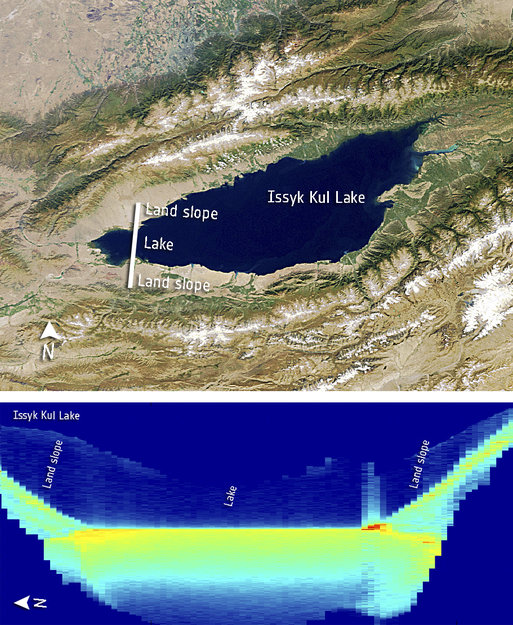
Examples are also pictured over the Danube delta in eastern Romania, and the land-locked Issyk Kul lake in Kyrgyzstan.

Altimeter readings over Issyk Kul

“Thanks to CryoSat being operated over some inland water targets in high resolution mode, we were able to distinctly chart the contours of a flood that occurred last March at Rio Negro in the Amazon,” said Salvatore Dinardo, working for ESA on CryoSat+.

Jérôme Benveniste, the ESA scientist who initiated the project, continued, “We were able to emphasise the unique capability to see the floodwater extent under the forest canopy, where optical sensors or even imaging radars are blocked by the trees.”

CryoSat seen from underneath

Results from the project will be unveiled to the scientific community at the Third CryoSat User Workshop to be held in Germany at the Technical University of Dresden on 12–14 March.

Related links:

Third CryoSat User Workshop: http://www.cryosat2013.org/

Access CryoSat data: https://earth.esa.int/web/guest/missions/esa-operational-eo-missions/cryosat

Images, Text, Credits: ESA.

Best regards, Orbiter.ch