lundi 21 janvier 2013

A day in the life of Venus Express


ESA - Venus Express Mission patch.

21 January 2013

A day in the life of Venus Express

Bright and dark cloud bands wind around the poles of Venus in this beautiful sequence tracked by ESA’s Venus Express as it makes a rollercoaster orbit around the planet.

We join the spacecraft from a staggering 66 000 km above the south pole, staring down into the swirling south polar vortex. From this bird’s-eye view, half of the planet is in darkness, the ‘terminator’ marking the dividing line between the day and night sides of the planet.

Intricate features on smaller and smaller scales are revealed as Venus Express dives to just 250 km above the north pole and clouds flood the field of view, before regaining a global perspective as it climbs away from the north pole.

The movie is based on images snapped by the Venus Monitoring Camera over a period of 18 hours during one of the spacecraft’s 24-hour orbits around the planet on 7–8 January last year. It was compiled using public data from the Venus Express data archive.

The camera observes the planet in ultraviolet wavelengths, revealing intriguing patterns in the cloud tops, which ride around the planet about 70 km above the surface.

The observed pattern of bright and dark markings is caused by variations in an unknown absorbing chemical at the Venus cloud tops.

Venus Express

The clouds are driven by extremely strong winds, sweeping around the planet once every four days. By comparison, the planet takes 243 days to complete one rotation about its own axis.

Venus Express has been orbiting the planet since 2006. It carries seven scientific instruments investigating the surface, atmosphere and ionosphere of Venus.

Where is Venus Express now?: http://www.esa.int/Our_Activities/Space_Science/Venus_Express/Where_is_Venus_Express_now2

Venus Express in-depth: http://sci.esa.int/venusexpress

Image, Video, Text, Credits: ESA / MPS / DLR / IDA, M. Pérez-Ayúcar & C. Wilson.

Greetings, Orbiter.ch

Martian Crater May Once Have Held Groundwater-Fed Lake


NASA - Mars Reconnaissance Orbiter (MRO) patch.

Jan. 21, 2013


This view of layered rocks on the floor of McLaughlin Crater shows sedimentary rocks that contain spectroscopic evidence for minerals formed through interaction with water. Image credit: NASA/JPL-Caltech/Univ. of Arizona.

 The new information comes from researchers analyzing spectrometer data from NASA's Mars Reconnaissance Orbiter, which looked down on the floor of McLaughlin Crater. The Martian crater is 57 miles (92 kilometers) in diameter and 1.4 miles (2.2 kilometers) deep. McLaughlin's depth apparently once allowed underground water, which otherwise would have stayed hidden, to flow into the crater's interior.

Layered, flat rocks at the bottom of the crater contain carbonate and clay minerals that form in the presence of water. McLaughlin lacks large inflow channels, and small channels originating within the crater wall end near a level that could have marked the surface of a lake.

Together, these new observations suggest the formation of the carbonates and clay in a groundwater-fed lake within the closed basin of the crater. Some researchers propose the crater interior catching the water and the underground zone contributing the water could have been wet environments and potential habitats. The findings are published in Sunday's online edition of Nature Geoscience.

"Taken together, the observations in McLaughlin Crater provide the best evidence for carbonate forming within a lake environment instead of being washed into a crater from outside," said Joseph Michalski, lead author of the paper, which has five co-authors. Michalski also is affiliated with the Planetary Science Institute in Tucson, Ariz., and London's Natural History Museum.

Michalski and his co-authors used the Compact Reconnaissance Imaging Spectrometer for Mars (CRISM) on the Mars Reconnaissance Orbiter (MRO) to check for minerals such as carbonates, which are best preserved under non-acidic conditions.

"The MRO team has made a concerted effort to get highly processed data products out to members of the science community like Dr. Michalski for analysis," said CRISM Principal Investigator Scott Murchie of the Johns Hopkins University Applied Physics Laboratory in Laurel, Md. "New results like this show why that effort is so important."

Launched in 2005, the Mars Reconnaissance Orbiter and its six instruments have provided more high-resolution data about the Red Planet than all other Mars orbiters combined. Data are made available for scientists worldwide to research, analyze and report their findings.

"A number of studies using CRISM data have shown rocks exhumed from the subsurface by meteor impact were altered early in Martian history, most likely by hydrothermal fluids," Michalski said. "These fluids trapped in the subsurface could have periodically breached the surface in deep basins such as McLaughlin Crater, possibly carrying clues to subsurface habitability."


This image is an artist's concept of a view looking down on the Mars Reconnaissance Orbiter. The spacecraft is pictured using its Shallow Radar (SHARAD) to "look" under the surface of Mars. Image credit: NASA/JPL.

McLaughlin Crater sits at the low end of a regional slope several hundreds of miles, or kilometers, long on the western side of the Arabia Terra region of Mars. As on Earth, groundwater-fed lakes are expected to occur at low regional elevations. Therefore, this site would be a good candidate for such a process.

"This new report and others are continuing to reveal a more complex Mars than previously appreciated, with at least some areas more likely to reveal signs of ancient life than others," said Mars Reconnaissance Orbiter Project Scientist Rich Zurek of NASA's Jet Propulsion Laboratory, Pasadena, Calif.

The Johns Hopkins University Applied Physics Laboratory in Laurel, Md., provided and operates CRISM. JPL, a division of the California Institute of Technology in Pasadena, manages the Mars Reconnaissance Orbiter for NASA's Science Mission Directorate in Washington. Lockheed Martin Space Systems in Denver built the orbiter.

To see an image of the carbonate-bearing layers in McLaughlin Crater, visit: http://photojournal.jpl.nasa.gov/catalog/PIA16710 .

For more about the Mars Reconnaissance Orbiter mission, visit: http://www.nasa.gov/mro .

Images (mentioned), Text, Credits: NASA / Dwayne Brown / JPL / Guy Webster / Planetary Science Institute / Alan Fischer.

Best regards, Orbiter.ch

samedi 19 janvier 2013

Two Steps Forward for Human Space Flight


Aerospace engineering.

Jan. 19, 2013

NASA Signs Agreement for a European-Provided Orion Service Module

NASA signed an agreement in mid-December for the European Space Agency (ESA) to provide a service module for the Orion spacecraft’s Exploration Mission-1 in 2017.


Image above: As part of a new agreement between the two space agencies, the European Space Agency will provide the service module for NASA’s Orion spacecraft. Image credit: NASA.

When the Orion spacecraft blasts off atop NASA’s Space Launch System rocket in 2017, attached will be the ESA-provided service module – the powerhouse that fuels and propels the Orion spacecraft.

Orion Service Module. Image credit: NASA.

“Space has long been a frontier for international cooperation as we explore,” said Dan Dumbacher, deputy associate administrator for Exploration System Development at NASA Headquarters in Washington. “This latest chapter builds on NASA’s excellent relationship with ESA as a partner in the International Space Station, and helps us move forward in our plans to send humans farther into space than we’ve ever been before.”

The agreement primarily maps out a plan for ESA to fulfill its share of operational costs and additional supporting services for the International Space Station by providing the Orion service module and necessary elements of its design for NASA’s Exploration Mission-1 in 2017.

Orion’s Exploration Mission-1 animation

There are three major components to the Orion vehicle: the crew capsule, which will carry four astronauts into space on crewed flights and bring them home for a safe landing; the launch abort system, which would pull the crew module to safety in the unlikely event of a life-threatening problem during launch; and the service module, which will house Orion’s power, thermal and propulsion systems. The service module is located directly below the crew capsule and will contain the in-space propulsion capability for orbital transfer, attitude control and high-altitude ascent aborts. It also will generate and store power and provide thermal control, water and air for the astronauts. It will remain connected to the crew module until just before the capsule returns to Earth.


Image above: As part of a new agreement between the two space agencies, the European Space Agency will provide the service module for NASA’s Orion spacecraft. Image credit: ESA, D. Ducros.

“This is not a simple system” said Mark Geyer, Orion Program manager. “ESA’s contribution is going to be critical to the success of Orion’s 2017 mission."

Exploration Mission-1 in 2017 will be the first integrated flight test with both the Orion spacecraft and NASA’s new Space Launch System. It will follow the upcoming Exploration Flight Test-1 in 2014, in which an uncrewed Orion will launch atop a Delta IV Heavy rocket and fly to an altitude of 3,600 miles above Earth’s surface, farther than a human spacecraft has gone in 40 years. For the flight test, a test service module is being built by Lockheed Martin.

Exploration Mission-1 in 2017 will launch an uncrewed Orion spacecraft to demonstrate the performance of the integrated Space Launch System rocket and the spacecraft prior to a crewed flight. It will be followed by Exploration Mission-2, which will launch Orion and a crew of four astronauts into space.

“We have a lot to look forward to in the coming years with human exploration,” Dumbacher said. “NASA is thrilled to have ESA as a partner as we set out to explore our solar system.”

Related links:

ESA Workhorse to power NASA'S Orion Spacecraft: http://www.esa.int/Our_Activities/Human_Spaceflight/Research/ESA_workhorse_to_power_NASA_s_Orion_spacecraft

View images from Orion Partnership News Conference: http://www.flickr.com/photos/nasa2explore/sets/72157632541988740/

View the Orion Service Module Briefing Graphics: http://www.nasa.gov/exploration/systems/mpcv/images/orion_sm_011613.html

NASA to Test Bigelow Expandable Module on Space Station

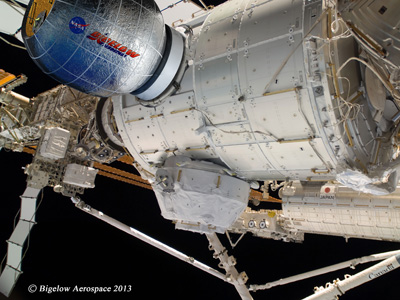
NASA Deputy Administrator Lori Garver announced Jan. 16 a newly planned addition to the International Space Station that will use the orbiting laboratory to test expandable space habitat technology. NASA has awarded a $17.8 million contract to Bigelow Aerospace to provide a Bigelow Expandable Activity Module (BEAM), which is scheduled to arrive at the space station in 2015 for a two-year technology demonstration.

Bigelow Expandable Module on Space Station

"Today we're demonstrating progress on a technology that will advance important long-duration human spaceflight goals," Garver said. "NASA's partnership with Bigelow opens a new chapter in our continuing work to bring the innovation of industry to space, heralding cutting-edge technology that can allow humans to thrive in space safely and affordably."

The BEAM is scheduled to launch aboard the eighth SpaceX cargo resupply mission to the station contracted by NASA, currently planned for 2015. Following the arrival of the SpaceX Dragon spacecraft carrying the BEAM to the station, astronauts will use the station's robotic arm to install the module on the aft port of the Tranquility node.

After the module is berthed to the Tranquility node, the station crew will activate a pressurization system to expand the structure to its full size using air stored within the packed module.

During the two-year test period, station crew members and ground-based engineers will gather performance data on the module, including its structural integrity and leak rate. An assortment of instruments embedded within module also will provide important insights on its response to the space environment. This includes radiation and temperature changes compared with traditional aluminum modules.

Bigelow Expandable Activity Module Installation Animation

"The International Space Station is a uniquely suited test bed to demonstrate innovative exploration technologies like the BEAM," said William Gerstenmaier, associate administrator for human exploration and operations at NASA Headquarters in Washington. "As we venture deeper into space on the path to Mars, habitats that allow for long-duration stays in space will be a critical capability. Using the station's resources, we'll learn how humans can work effectively with this technology in space, as we continue to advance our understanding in all aspects for long-duration spaceflight aboard the orbiting laboratory."

Bigelow Expandable Module on Space Station (Artist's view)

Astronauts periodically will enter the module to gather performance data and perform inspections. Following the test period, the module will be jettisoned from the station, burning up on re-entry.

The BEAM project is sponsored by NASA's Advanced Exploration Systems (AES) Program, which pioneers innovative approaches to rapidly and affordably develop prototype systems for future human exploration missions. The BEAM demonstration supports an AES objective to develop a deep space habitat for human missions beyond Earth orbit.

For more information about Bigelow Aerospace, visit: http://www.bigelowaerospace.com

Images, Videos, Text, Credits: NASA / ESA, D. Ducros / Bigelow Aerospace.

Best regards, Orbiter.ch

jeudi 17 janvier 2013

Progress M-17M corrected the orbit of the International Space Station


ROSCOSMOS - Russian Vehicles patch.

01/17/2013

In accordance with the International Space Station (ISS) on 17 January the correction of its orbit.

The maneuver was carried out using an engine cargo spacecraft Progress M-17M, located on the axial port service module Zvezda.

Progress docket at the module Zvezda making a ISS reboost

According to the ballistic-navigation service the Mission Control Center "FSUE TsNIImash" cargo ship engines were included in 06 hours 15 minutes Moscow time and worked for 233 seconds.

As a result of this dynamic operation ISS increment rate was 0.46 m / s. The average height of the orbit increased by 830 feet and was 411 km.

ISS with Progress docked at the module Zvezda

     After maneuvering the ISS orbital parameters were:

     - Minimum height - 401.9 km,

     - Maximum height - 432.18 km

     - Orbital period - 92.73 min.,

     - Inclination - 51,67 °.


The purpose of this operation was to maintain the working and forming the ISS before flying cargo ship Progress M-18M, the launch of which is scheduled for February 2013.

Original text in Russian: http://www.federalspace.ru/main.php?id=2&nid=19820

Images, Text, Credits: Press Service of the Russian Federal Space Agency (Roscosmos PAO) / ROSCOSMOS / NASA / G. De Chiara/ Translation: Orbiter.ch Aerospace.

Cheers, Orbiter.ch

A hidden treasure in the Large Magellanic Cloud


ESA - Hubble Space Telescope patch.

17 January 2013

 LHA 120-N11 in the Large Magellanic Cloud

Nearly 200 000 light-years from Earth, the Large Magellanic Cloud, a satellite galaxy of the Milky Way, floats in space, in a long and slow dance around our galaxy. Vast clouds of gas within it slowly collapse to form new stars. In turn, these light up the gas clouds in a riot of colours, visible in this image from the NASA/ESA Hubble Space Telescope.

The Large Magellanic Cloud (LMC) is ablaze with star-forming regions. From the Tarantula Nebula, the brightest stellar nursery in our cosmic neighbourhood, to LHA 120-N 11, part of which is featured in this Hubble image, the small and irregular galaxy is scattered with glowing nebulae, the most noticeable sign that new stars are being born.

Overview of the Large Magellanic Cloud (ground-based image)

The LMC is in an ideal position for astronomers to study the phenomena surrounding star formation. It lies in a fortuitous location in the sky, far enough from the plane of the Milky Way that it is neither outshone by too many nearby stars, nor obscured by the dust in the Milky Way’s centre. It is also close enough to study in detail (less than a tenth of the distance of the Andromeda Galaxy, the closest spiral galaxy), and lies almost face-on to us [1], giving us a bird’s eye view.

LHA 120-N 11 (known as N11 for short) is a particularly bright region of the LMC, consisting of several adjacent pockets of gas and star formation. NGC 1769 (in the centre of this image) and NGC 1763 (to the right, see heic1011) are among the brightest parts.

 Zoom into LHA 120-N11

In the centre of this image, a dark finger of dust blots out much of the light. While nebulae are mostly made of hydrogen, the simplest and most plentiful element in the Universe, dust clouds are home to heavier and more complex elements, which go on to form rocky planets like the Earth. Much finer than household dust (it is more like smoke), this interstellar dust consists of material expelled from previous generations of stars as they died.

The data in this image were identified by Josh Lake, an astronomy teacher at Pomfret School in Connecticut, USA, in the Hubble’s Hidden Treasures image processing competition. The competition invited members of the public to dig out unreleased scientific data from Hubble’s vast archive, and to process them into stunning images.

 Pan across LHA 120-N11

Josh Lake won first prize in the competition with an image contrasting the light from glowing hydrogen and nitrogen in N11. The image above combines the data he identified with additional exposures taken in blue, green and near infrared light.

Notes:

The Hubble Space Telescope is a project of international cooperation between ESA and NASA.

[1] Although the Large Magellanic Cloud is generally classified as an irregular galaxy, it shares some features with spiral galaxies, including a clearly visible bar, and a single spiral-arm-like structure. It is thought that the LMC may be a small spiral galaxy that was pulled out of shape by the Milky Way.

Links:

Hidden Treasures: http://www.spacetelescope.org/hiddentreasures/

Josh Lake's image of N11: http://www.spacetelescope.org/projects/fits_liberator/fitsimages/josh_lake_ngc_1763/

ESA Hubble website: http://www.spacetelescope.org/

Images, Text, Credits: NASA, ESA. Acknowledgement: Josh Lake / ESO / Digitized Sky Survey 2. Acknowledgment: Davide De Martin/Video: NASA, ESA, Digitized Sky Survey 2 / Acknowledgement: Josh Lake.

Best regards, Orbiter.ch

Reull Vallis: A River Ran Through It


ESA - Mars Express Mission patch.

17 January 2013

 Reull Vallis

ESA’s Mars Express imaged the striking upper part of the Reull Vallis region of Mars with its high-resolution stereo camera last year.

Reull Vallis, the river-like structure in these images, is believed to have formed when running water flowed in the distant martian past, cutting a steep-sided channel through the Promethei Terra Highlands before running on towards the floor of the vast Hellas basin.

This sinuous structure, which stretches for almost 1500 km across the martian landscape, is flanked by numerous tributaries, one of which can be clearly seen cutting in to the main valley towards the upper (north) side.

Perspective view of Reull Vallis

The new Mars Express images show a region of Reull Vallis at a point where the channel is almost 7 km wide and 300 m deep. 

Topographic view of Reull Vallis

The sides of Reull Vallis are particularly sharp and steep in these images, with parallel longitudinal features covering the floor of the channel itself. These structures are believed to be caused by the passage of loose debris and ice during the ‘Amazonian’ period (which continues to this day) due to glacial flow along the channel.

The structures were formed long after it was originally carved by liquid water during the Hesperian period, which is believed to have ended between 3.5 billion and 1.8 billion years ago.

Similar lineated structures, believed to be rich in ice, can also be found in many of the surrounding craters.

Reull Vallis in context

In the wider context image, the tributary intersecting the main channel appears to be part of a forking of the main valley into two distinct branches further upstream before merging back into a single main valley.

The right (northern) part of the main image is dominated by the Promethei Terra Highlands with their high and soft-rounded mountains shown in these images, rising around 2500 m above the surrounding flat plains.

The perspective view below shows one of these mountains with nearby sediment-filled impact craters. 

Perspective view of Reull Vallis

This region shows a striking resemblance to the morphology found in regions on Earth affected by glaciation. For example, we can see circular step-like structures on the inner walls of the sediment-filled crater in the foreground of the second perspective view. Planetary scientists think that these may represent former high water or glacial levels, before ice and water sublimated or evaporated away in stages at various times.

3D view of Reull Vallis

The morphology of Reull Vallis suggests it has experienced a diverse and complex history, with analogies seen in glacial activity on Earth. These analogies are giving planetary geologists tantalising glimpses of a past on the Red Planet not too dissimilar to events on our own world today.

Related links:

High Resolution Stereo Camera: http://berlinadmin.dlr.de/Missions/express/indexeng.shtml

Behind the lens: http://www.esa.int/Our_Activities/Space_Science/Mars_Express/Behind_the_lens

Frequently asked questions: http://www.esa.int/Our_Activities/Space_Science/Mars_Express/Frequently_asked_questions

ESA Planetary Science archive (PSA): http://www.rssd.esa.int/PSA

NASA Planetary Data System: http://pds-geosciences.wustl.edu/missions/mars_express/hrsc.htm

HRSC data viewer: http://hrscview.fu-berlin.de/

Mars Express in depth: http://sci.esa.int/science-e/www/area/index.cfm?fareaid=9

Images, Text, Credits: ESA / DLR / FU Berlin (G. Neukum) / NASA MGS MOLA Science Team.

Greetings, Orbiter.ch
mercredi 16 janvier 2013

Boeing 787 'Dreamliner' jets grounded in Japan after series of issues


Airbus vs Boeing.

Jan. 16, 2013

Japan's two biggest airlines grounded all their Boeing 787 aircraft for safety checks Wednesday after one was forced to make an emergency landing in the latest blow for the new jet.

All Nippon Airways said a cockpit message showed battery problems and a burning smell was detected in the cockpit and the cabin, forcing the 787 on a domestic flight to land at Takamatsu airport in western Japan.


Image above: Jan. 16, 2013: An All Nippon Airways flight sits at Takamatsu airport in Takamatsu, western Japan after it made an emergency landing. (AP/Kyodo News).

The 787, known as the Dreamliner, is Boeing's newest and most technologically advanced jet, and the company is counting heavily on its success. Since its launch, which came after delays of more than three years, the plane has been plagued by a series of problems including a battery fire and fuel leaks. Japan's ANA and Japan Airlines are major customers for the jet and among the first to fly it.

Japan's transport ministry said it got notices from ANA, which operates 17 of the jets, and Japan Airlines which has seven, that all their 787s would not be flying. The grounding was done voluntarily by the airlines.


The earliest manufactured jets of any new aircraft usually have problems and airlines run higher risks in flying them first, said Brendan Sobie, Singapore-based chief analyst at CAPA-Center for Aviation. Since about half the 787 fleet is in Japan, more problems are cropping up there.

"There are always teething problems with new aircraft and airlines often are reluctant to be the launch customer of any new airplanes," Sobie said. "We saw it with other airplane types, like the A380 but the issues with the A380 were different," he said. (ne*: problem of cracks in the wing spars).

Boeing 787 Dreamliner / Airbus A380 comparative

Japan's transport ministry categorized Wednesday's problem as a "serious incident" that could have led to an accident, and sent officials for further checks to Takamatsu airport. The airport was closed.

It was unclear how long the Dreamliners would be grounded. ANA said 14 flights were changed to other aircraft, while 31 domestic and 7 international were cancelled. JAL said eight were cancelled, while two were changed to a 777.

ANA executives apologized, bowing deeply at a hastily called news conference in Tokyo.

"We are very sorry to have caused passengers and their family members so much concern," said ANA Senior Executive Vice President Osamu Shinobe.

One male in his 60s was taken to the hospital for minor hip injuries after going down the emergency slides at the airport, the fire department said. The other 128 passengers and eight crew members of the ANA domestic flight were uninjured, according to ANA.

The grounding in Japan was the first for the 787, whose problems had been brushed off by Boeing as teething pains for a new aircraft. The transport ministry had already started a separate inspection Monday on another 787 jet, operated by Japan Airlines, which had leaked fuel at Tokyo's Narita airport after flying back from Boston, where it had also leaked fuel.

Boeing 787 Dreamliner

A fire ignited Jan. 7 in the battery pack of an auxiliary power unit of a Japan Airlines 787 empty of passengers as the plane sat on the tarmac at Boston's Logan International Airport. It took firefighters 40 minutes to put out the blaze.

ANA cancelled a domestic flight to Tokyo on Jan. 9 after a computer wrongly indicated there was a problem with the Boeing 787's brakes. Two days later, the carrier reported two new cases of problems with the aircraft -- a minor fuel leak and a cracked windscreen in a 787 cockpit.

The 787 relies more than any other modern airliner on electrical signals to help power nearly everything the plane does. It's also the first Boeing plane to use rechargeable lithium ion batteries, which charge faster and can be molded to space-saving shapes compared to other airplane batteries. The plane is made with lightweight composite materials instead of aluminum.

The U.S. Federal Aviation Administration said in a statement that it is "monitoring a preliminary report of an incident in Japan earlier today involving a Boeing 787."

It said the incident will be included in the comprehensive review the FAA began last week of the 787 critical systems, including design, manufacture and assembly. U.S. government officials have been quick to say that the plane is safe. Nearly 50 of them are in the skies now.

GS Yuasa Corp., the Japanese company that supplies all the lithium ion batteries for the 787, had no comment as the investigation was still ongoing. Thales, which makes the battery charging system, had no immediate comment.

In Tokyo, the transport minister, Akihiro Ota, said authorities were taking the incidents seriously.

"These problems must be fully investigated," he said.

Boeing has said that various technical problems are to be expected in the early days of any aircraft model.

"Boeing is aware of the diversion of a 787 operated by ANA to Takamatsu in western Japan. We will be working with our customer and the appropriate regulatory agencies," Boeing spokesman Marc Birtel said.

The U.S. National Transportation Safety Board is aware of Wednesday's emergency landing in Japan and is gathering information on the incident, Kelly Nantel, a spokeswoman for the board, said.

In Wednesday's incident, a cockpit instrument showed a problem with the 787's battery and the pilot noticed an unusual smell, the airline said. The flight requested and was granted permission to make an emergency landing at Takamatsu airport.

Airbus A380

Aviation safety expert John Goglia, a former National Transportation Safety Board member, said the ANA pilot made the right choice.

"They were being very prudent in making the emergency landing even though there's been no information released so far that indicates any of these issues are related," he said.

But much remains uncertain about the problems being experienced by the 787, said Masaharu Hirokane, analyst at Nomura Securities Co. in Tokyo.

"You need to ensure safety 100 percent, and then you also have to get people to feel that the jet is 100 percent safe," said Hirokane.

*ne: note editor.

Related link:

Airbus A380 cracks in the wing spars: http://orbiterchspacenews.blogspot.ch/2012/02/cracks-in-wing-all-airbus-a380-will-be.html

Images, Text, Credits: Boeing / Airbus / AP / Orbiter.ch Aerospace.

Greetings, Orbiter.ch