vendredi 14 juin 2013

A View of Mercury From Afar


NASA - MESSENGER Mission to Mercury patch.

June 14, 2013

 A View of Mercury From Afar

This image of Mercury, acquired by the Mercury Dual Imaging System (MDIS) aboard NASA's MESSENGER mission on April 23, 2013, allows us to take a step back to view the planet. Prior to the MESSENGER mission, Mercury's surface was often compared to the surface of Earth's moon, when in fact, Mercury and the moon are very different. This image in particular highlights many basins near Mercury's terminator, including Bach crater. Many craters with central peaks and the nearby bright rays of Han Kan crater are also evident.

Once per week, MDIS captures images of Mercury's limb, with an emphasis on imaging the southern hemisphere limb. These limb images provide information about Mercury's shape and complement measurements of topography made by the Mercury Laser Altimeter (MLA) of Mercury's northern hemisphere.

MESSENGER Has Imaged 100 Percent of Mercury

The Mercury Dual Imaging System (MDIS) on the MESSENGER spacecraft, in orbit about Mercury for nearly two years, has finally imaged 100 percent of the planet. Until recently, explains Brett Denevi of the Johns Hopkins University Applied Physics Laboratory (APL) in Laurel, Md., MDIS images acquired from orbit collectively covered most (99.99%), but not all, of the surface. The recent downlink of an image of the north polar region now completes the picture.

Mercury Global Coverage

“It's a huge accomplishment – we've gone from having more than half of the planet a complete mystery prior to MESSENGER to a full coverage that will enable a better understanding of the global processes that shaped Mercury's formation and evolution,” says Denevi, the deputy instrument scientist for MDIS and a member of MESSENGER’s Geology Discipline Group. “But we've still only seen just a tiny fraction of the planet at the highest resolution, and we are learning more daily from color images, reflectance spectra, geochemical measurements, and topographic information – none of which have anywhere close to 100% coverage, and all of which will be important aspects of a second extended mission at Mercury.”

During its one-year primary mission, MESSENGER acquired 88,746 images and extensive other data sets. It is now nearing completion of a yearlong extended mission, during which the spacecraft has acquired more than 80,000 additional images and other measurements to support MESSENGER's science goals.

NASA's MESSENGER in orbit around Mercury

“Completing the initial imaging of the entire surface of our solar system’s innermost planet is an important milestone,” adds MESSENGER Principal Investigator Sean Solomon, of Columbia University’s Lamont-Doherty Earth Observatory. “Those global images have produced many important discoveries about how Mercury’s crust formed and evolved, but all of those discoveries have raised new questions.  With ongoing and planned targeted observations, conducted synergistically with all of MESSENGER’s instruments, we can look forward to further discoveries and new understanding.”

For more information about MESSENGER Mission, visit: http://www.nasa.gov/mission_pages/messenger/main/index.html

Images, Text, Credits: NASA / Johns Hopkins University Applied Physics Laboratory / Carnegie Institution of Washington.

Best regards, Orbiter.ch

NASA-Led Study Explains Decades of Black Hole Observations


NASA patch.

June 14, 2013

A new study by astronomers at NASA, Johns Hopkins University and the Rochester Institute of Technology confirms long-held suspicions about how stellar-mass black holes produce their highest-energy light.

"Our work traces the complex motions, particle interactions and turbulent magnetic fields in billion-degree gas on the threshold of a black hole, one of the most extreme physical environments in the universe," said lead researcher Jeremy Schnittman, an astrophysicist at NASA's Goddard Space Flight Center in Greenbelt, Md.

By analyzing a supercomputer simulation of gas flowing into a black hole, the team finds they can reproduce a range of important X-ray features long observed in active black holes.

Peer into a Simulated Stellar-mass Black Hole

Video above: This animation of supercomputer data takes you to the inner zone of the accretion disk of a stellar-mass black hole. Gas heated to 20 million degrees Fahrenheit as it spirals toward the black hole glows in low-energy, or soft, X-rays. Just before the gas plunges to the center, its orbital motion is approaching the speed of light. X-rays up to hundreds of times more powerful ("harder") than those in the disk arise from the corona, a region of tenuous and much hotter gas around the disk. Coronal temperatures reach billions of degrees. The event horizon is the boundary where all trajectories, including those of light, must go inward. Nothing, not even light, can pass outward across the event horizon and escape the black hole. Credit: NASA's Goddard Space Flight Center / Music: "Lost in Space" by Lars Leonhard, courtesy of the artist.

Gas falling toward a black hole initially orbits around it and then accumulates into a flattened disk. The gas stored in this disk gradually spirals inward and becomes greatly compressed and heated as it nears the center. Ultimately reaching temperatures up to 20 million degrees Fahrenheit (12 million C) -- some 2,000 times hotter than the sun's surface -- the gas shines brightly in low-energy, or soft, X-rays.

For more than 40 years, however, observations have shown that black holes also produce considerable amounts of "hard" X-rays, light with energy tens to hundreds of times greater than soft X-rays. This higher-energy light implies the presence of correspondingly hotter gas, with temperatures reaching billions of degrees.

The new study bridges the gap between theory and observation, demonstrating that both hard and soft X-rays inevitably arise from gas spiraling toward a black hole.

Working with Julian Krolik, a professor at Johns Hopkins University in Baltimore, and Scott Noble, a research scientist at the Rochester Institute of Technology in Rochester, N.Y., Schnittman developed a process for modeling the inner region of a black hole's accretion disk, tracking the emission and movement of X-rays, and comparing the results to observations of real black holes.

Noble developed a computer simulation solving all of the equations governing the complex motion of inflowing gas and its associated magnetic fields near an accreting black hole. The rising temperature, density and speed of the infalling gas dramatically amplify magnetic fields threading through the disk, which then exert additional influence on the gas.

The result is a turbulent froth orbiting the black hole at speeds approaching the speed of light. The calculations simultaneously tracked the fluid, electrical and magnetic properties of the gas while also taking into account Einstein's theory of relativity.

Running on the Ranger supercomputer at the Texas Advanced Computing Center located at the University of Texas in Austin, Noble's simulation used 960 of Ranger's nearly 63,000 central processing units and took 27 days to complete.

Over the years, improved X-ray observations provided mounting evidence that hard X-rays originated in a hot, tenuous corona above the disk, a structure analogous to the hot corona that surrounds the sun.

"Astronomers also expected that the disk supported strong magnetic fields and hoped that these fields might bubble up out of it, creating the corona," Noble explained. "But no one knew for sure if this really happened and, if it did, whether the X-rays produced would match what we observe."

Using the data generated by Noble's simulation, Schnittman and Krolik developed tools to track how X-rays were emitted, absorbed, and scattered throughout both the accretion disk and the corona region. Combined, they demonstrate for the first time a direct connection between magnetic turbulence in the disk, the formation of a billion-degree corona, and the production of hard X-rays around an actively "feeding" black hole.

A paper reporting the findings was published in the June 1 edition of The Astrophysical Journal.


Image above: Matter can stably orbit closer to a spinning (rotating) black hole, right, than a non-spinning one (non-rotating), left (Illustration: NASA/CXC/M Weiss).

In the corona, electrons and other particles move at appreciable fractions of the speed of light. When a low-energy X-ray from the disk travels through this region, it may collide with one of the fast-moving particles. The impact greatly increases the X-ray's energy through a process known as inverse Compton scattering.

"Black holes are truly exotic, with extraordinarily high temperatures, incredibly rapid motions and gravity exhibiting the full weirdness of general relativity," Krolik said. "But our calculations show we can understand a lot about them using only standard physics principles."

The study was based on a non-rotating black hole. The researchers are extending the results to spinning black holes, where rotation pulls the inner edge of the disk further inward and conditions become even more extreme. They also plan a detailed comparison of their results to the wealth of X-ray observations now archived by NASA and other institutions.

Black holes are the densest objects known. Stellar-mass black holes form when massive stars run out of fuel and collapse, crushing up to 20 times the sun's mass into compact objects less than 75 miles (120 kilometers) wide.

Related Links:

Download high-resolution images and video in HD formats from NASA Goddard's Scientific Visualization Studio: http://svs.gsfc.nasa.gov/goto?11206

Paper: X-ray Spectra from MHD Simulations of Accreting Black Holes. doi:10.1088/0004-637X/769/2/156: http://arxiv.org/abs/1207.2693

The Ranger supercomputer: http://www.tacc.utexas.edu/resources/hpc/ranger

"Simulations Uncover 'Flashy' Secrets of Merging Black Holes" (09.27.12): http://www.nasa.gov/topics/universe/features/black-hole-secrets.html

"NASA's Swift Satellite Discovers a New Black Hole in our Galaxy" (10.05.12): http://www.nasa.gov/mission_pages/swift/bursts/new-black-hole.html

Image (mentioned), Video (mentioned), Text, Credits: NASA's Goddard Space Flight Center/Francis Reddy/Lynn Chandler.

Greetings, Orbiter.ch

jeudi 13 juin 2013

Hubble Uncovers Evidence for Extrasolar Planet Under Construction


NASA - Hubble Space Telescope patch.

June 13, 2013

Nearly 900 extrasolar planets have been confirmed to date, but now for the first time astronomers think they are seeing compelling evidence for a planet under construction in an unlikely place, at a great distance from its diminutive red dwarf star.

The keen vision of NASA / ESA Hubble Space Telescope has detected a mysterious gap in a vast protoplanetary disk of gas and dust swirling around the nearby star TW Hydrae, located 176 light-years away in the constellation Hydra (the Sea Serpent). The gap's presence is best explained as due to the effects of a growing, unseen planet that is gravitationally sweeping up material and carving out a lane in the disk, like a snow plow.

Researchers, led by John Debes of the Space Telescope Science Institute in Baltimore, Md., found the gap about 7.5 billion miles from the red dwarf star. If the putative planet orbited in our solar system, it would be roughly twice Pluto's distance from the Sun.

TW Hydrae Protoplanetary Disk

The suspected planet's wide orbit means that it is moving slowly around its host star. Finding the suspected planet in this orbit challenges current planet formation theories. The conventional planet-making recipe proposes that planets form over tens of millions of years from the slow but persistent buildup of dust, rocks, and gas as a budding planet picks up material from the surrounding disk. TW Hydrae, however, is only 8 million years old. There has not been enough time for a planet to grow through the slow accumulation of smaller debris. In fact, a planet at 7.5 billion miles from its star would take more than 200 times longer to form than Jupiter did at its distance from the Sun because of its much slower orbital speed and a deficiency of material in the disk.

An alternative planet-formation theory suggests that a piece of the disk becomes gravitationally unstable and collapses on itself. In this scenario, a planet could form more quickly, in just a few thousand years.

"If we can actually confirm that there's a planet there, we can connect its characteristics to measurements of the gap properties," Debes says. "That might add to planet formation theories as to how you can actually form a planet very far out. There's definitely a gap structure. We think it's probably a planet given the fact that the gap is sharp and circular."

Compass and Scale Image of TW Hydrae Disk

What complicates the story is that the red dwarf star is only 55 percent the mass of our Sun. "It's so intriguing to see a system like this," Debes says. "This is the lowest-mass star for which we've observed a gap so far out."

The disk also lacks large dust grains in its outer regions. Observations from ALMA (the Atacama Large Millimeter Array) show that millimeter-sized (tenths-of-an-inch-sized) dust, roughly the size of a grain of sand, cuts off sharply at about 5.5 billion miles from the star, just short of the gap. The disk is 41 billion miles across.

"Typically, you need pebbles before you can have a planet. So, if there is a planet and there is no dust larger than a grain of sand farther out, that would be a huge challenge to traditional planet-formation models," Debes says.

The Hubble observations reveal that the gap, which is 1.9 billion miles wide, is not completely cleared out. The team suggests that if a planet exists, it is in the process of forming and not very massive. Based on the evidence, team member Hannah Jang-Condell at the University of Wyoming in Laramie estimates that the putative planet is 6 to 28 times more massive than Earth. Within this range lies a class of planets called super-Earths and ice giants. Such a small planet mass is also a challenge to direct-collapse planet-formation theories, which predict that clumps of material one to two times more massive than Jupiter can collapse to form a planet.

Comparison of TW Hydrae System and Solar System

TW Hydrae has been a popular target with astronomers. The system is one of the closest examples of a face-on disk, giving astronomers an overhead view of the star's environment. Debes's team used Hubble's Near Infrared Camera and Multi-Object Spectrometer (NICMOS) to observe the star in near-infrared light. The team then re-analyzed archival Hubble data, using more NICMOS images as well as optical and spectroscopic observations from the Space Telescope Imaging Spectrograph (STIS). Armed with these observations, they composed the most comprehensive view of the system in scattered light over many wavelengths.

When Debes accounted for the rate at which the disk dims from reflected starlight, the gap was highlighted. It was a feature that two previous Hubble studies had suspected but could not definitively confirm. These earlier observations noted an uneven brightness in the disk but did not identify it as a gap.

"When I first saw the gap structure, it just popped out like that," Debes says. "The fact that we see the gap at every wavelength tells you that it's a structural feature rather than an instrumental artifact or a feature of how the dust scatters light.

The team plans to use ALMA and NASA's upcoming James Webb Space Telescope, an infrared observatory set to launch in 2018, to study the system in more detail.

The team's paper will appear online on June 14 in The Astrophysical Journal.

The Hubble Space Telescope is a project of international cooperation between ESA and NASA.

For more information about NASA / ESA Hubble Space Telescope: http://www.nasa.gov/hubble and http://www.spacetelescope.org/

Images, Text, Credits: NASA, ESA, J. Debes (STScI), H. Jang-Condell (University of Wyoming), A. Weinberger (Carnegie Institution of Washington), A. Roberge (Goddard Space Flight Center), G. Schneider (University of Arizona/Steward Observatory), and A. Feild (STScI/AURA).

Best regards, Orbiter.ch

Proba-V Traking Aircraft in Flight from Orbit


ESA - Proba-V Mission logo.

13 June 2013

ESA’s Proba-V has become the first satellite to pick up aircraft tracking signals, allowing aircraft across the globe to be followed in flight from space.

“We have succeeded in proving that these relatively low-powered air traffic control signals can indeed be detected from space as they are, without any need for upgraded aircraft equipment,” explained Toni Delovski of the DLR German Aerospace Center, overseeing the experiment.

Proba-V

“Now we want to go on and check how many aircraft we can actually observe in practice, and which types – different sized aircraft being assigned systems with differing signal strengths.

“This research opens the way to operational space-based aircraft monitoring in future.”

Launched on 7 May, Proba-V’s main task is to map vegetation growth, covering the whole world every two days. But the minisatellite – smaller than a cubic metre – also doubles as a miniature research lab, testing a number of promising technologies in space.

These ‘guest payloads’ include an experiment to detect Automatic Dependent Broadcast – Surveillance (ADS-B) signals from aircraft, contributed to the mission by DLR in cooperation with Luxembourg’s SES TechCom.

Detecting aircraft in vicinity of Europe

 ADS-B signals are regularly broadcast from equipped aircraft, giving flight information such as speed, position and altitude. All aircraft entering European airspace are envisaged to carry ADS-B in the years ahead.

ADS-B ground systems are currently deployed as an add-on to ground-based radar monitoring for air traffic management.

“However, for most areas of the world, in particular oceans and remote regions, installing air traffic infrastructure based on radars or ADS-B stations is not economically or technically feasible,” Mr Delovski added.

“Instead, space-based ADS-B monitoring holds a lot of potential in terms of security and safety – including search and rescue for airspace not covered by ground-based surveillance. Filling in these gaps has obvious value.

Detecting aircraft along Australian east coast

“Moreover, it may allow aircraft to traverse regions with decreased separation between them and on more efficient routes, boosting overall traffic capacity while cutting fuel consumption and carbon dioxide emissions.”

“This is another success for ESA’s Proba series, dedicated to providing early flight opportunities to promising European technologies,” added Frédéric Teston, overseeing the Proba series of satellites as part of ESA’s Technology Flight Opportunities Programme. 

About Proba-V

Currently undergoing commissioning in orbit, Proba-V is a miniaturised ESA satellite tasked with a full-scale mission: to map land cover and vegetation growth across the entire planet every two days.

Proba-V satellite

It is the latest addition to the Proba family of small, low-cost space missions, giving flight experience to promising European technologies. So along with hosting its main instrument, Proba-V also provides early test flights for a variety of advanced guest payloads.

These include a pair of novel space-radiation detectors, a radio amplifier using the high-performance gallium nitride semiconductor and lightweight high-capacity optical fibre connectors.

Related links:

DLR: http://www.dlr.de/dlr;internal&action=_setlanguage.action?LANGUAGE=en

SES TechCom: http://www.ses.com/4337486/techcom

ESA’S Vega launcher scores new success with Proba-V: http://www.esa.int/Our_Activities/Launchers/ESA_S_Vega_launcher_scores_new_success_with_Proba-V

Images, Text, Credits: ESA / P.Carril / ATG Medialab / DLR / SES TechCom.

Greetings, Orbiter.ch

mercredi 12 juin 2013

Mars Water-Ice Clouds Are Key to Odd Thermal Rhythm


NASA - Mars Reconnaissance Orbiter (MRO) patch.

June 12, 2013

Researchers using NASA's Mars Reconnaissance Orbiter have found that temperatures in the Martian atmosphere regularly rise and fall not just once each day, but twice.

"We see a temperature maximum in the middle of the day, but we also see a temperature maximum a little after midnight," said Armin Kleinboehl of NASA's Jet Propulsion Laboratory in Pasadena, Calif., who is the lead author of a new report on these findings.

Temperatures swing by as much as 58 degrees Fahrenheit (32 kelvins) in this odd, twice-a-day pattern, as detected by the orbiter's Mars Climate Sounder instrument.

Scanning Martian Atmospheric Temperatures

This graphic depicts the Mars Climate Sounder instrument on NASA's Mars Reconnaissance Orbiter measuring the temperature of a cross section of the Martian atmosphere as the orbiter passes above the south polar region. Image credit: NASA/JPL-Caltech.

The new set of Mars Climate Sounder observations sampled a range of times of day and night all over Mars. The observations found that the pattern is dominant globally and year-round. The report is being published in the journal Geophysical Research Letters.

Global oscillations of wind, temperature and pressure repeating each day or fraction of a day are called atmospheric tides. In contrast to ocean tides, they are driven by variation in heating between day and night. Earth has atmospheric tides, too, but the ones on Earth produce little temperature difference in the lower atmosphere away from the ground. On Mars, which has only about one percent as much atmosphere as Earth, they dominate short-term temperature variations throughout the atmosphere.

Tides that go up and down once per day are called "diurnal." The twice-a-day ones are called "semi-diurnal." The semi-diurnal pattern on Mars was first seen in the 1970s, but until now it had been thought to appear just in dusty seasons, related to sunlight warming dust in the atmosphere.

"We were surprised to find this strong twice-a-day structure in the temperatures of the non-dusty Mars atmosphere," Kleinboehl said. "While the diurnal tide as a dominant temperature response to the day-night cycle of solar heating on Mars has been known for decades, the discovery of a persistent semi-diurnal response even outside of major dust storms was quite unexpected, and caused us to wonder what drove this response."

Mars Reconnaissance Orbiter (MRO). Image credit: NASA/JPL-Caltech

He and his four co-authors found the answer in the water-ice clouds of Mars. The Martian atmosphere has water-ice clouds for most of the year. Clouds in the equatorial region between about 6 to 19 miles (10 to 30 kilometers) above the surface of Mars absorb infrared light emitted from the surface during daytime. These are relatively transparent clouds, like thin cirrus clouds on Earth. Still, the absorption by these clouds is enough to heat the middle atmosphere each day. The observed semi-diurnal temperature pattern, with its maximum temperature swings occurring away from the tropics, was also unexpected, but has been replicated in Mars climate models when the radiative effects of water-ice clouds are included.

"We think of Mars as a cold and dry world with little water, but there is actually more water vapor in the Martian atmosphere than in the upper layers of Earth's atmosphere," Kleinboehl said. "Water-ice clouds have been known to form in regions of cold temperatures, but the feedback of these clouds on the Mars temperature structure had not been appreciated. We know now that we will have to consider the cloud structure if we want to understand the Martian atmosphere. This is comparable to scientific studies concerning Earth's atmosphere, where we have to better understand clouds to estimate their influence on climate."

JPL, a division of the California Institute of Technology in Pasadena, provided the Mars Climate Sounder instrument and manages the Mars Reconnaissance Orbiter project for NASA's Science Mission Directorate, Washington.

For more about the Mars Reconnaissance Orbiter, visit: http://www.nasa.gov/mro .

Images (mentioned), Text, Credits: NASA / Dwayne Brown / JPL / Guy Webster.

Cheers, Orbiter.ch

NASA's Chandra Turns Up Black Hole Bonanza in Galaxy Next Door


NASA - Chandra X-ray Observatory logo.

June 12, 2013


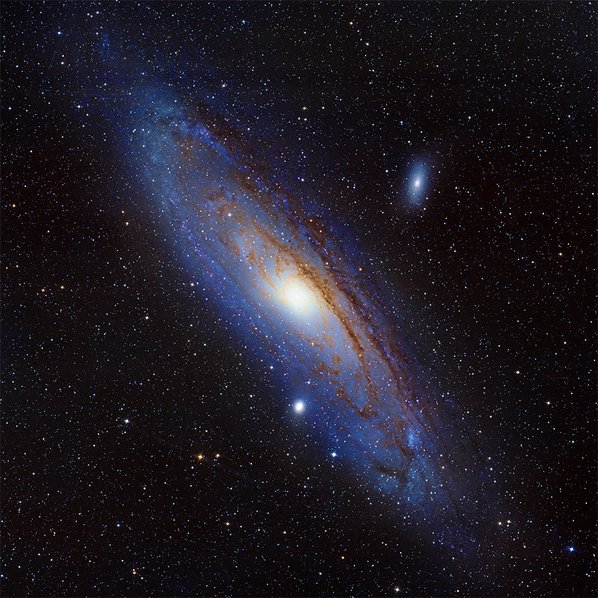
Optical Images of M31's Core. Image credit: NOAO/AURA/NSF/REU Prog./B.Schoening, V.Harvey; Descubre Fndn./CAHA/OAUV/DSA/V.Peris.

Using data from NASA's Chandra X-ray Observatory, astronomers have discovered an unprecedented bonanza of black holes in the Andromeda Galaxy, one of the nearest galaxies to the Milky Way.

Using more than 150 Chandra observations, spread over 13 years, researchers identified 26 black hole candidates, the largest number to date, in a galaxy outside our own. Many consider Andromeda to be a sister galaxy to the Milky Way. The two ultimately will collide, several billion years from now.

"While we are excited to find so many black holes in Andromeda, we think it's just the tip of the iceberg," said Robin Barnard of Harvard-Smithsonian Center for Astrophysics (CfA) in Cambridge, Mass., and lead author of a new paper describing these results. "Most black holes won't have close companions and will be invisible to us."


Data from NASA's Chandra X-ray Observatory has been used to discover 26 black hole candidates in the Milky Way's galactic neighbor, Andromeda. X-ray: NASA/CXC/SAO/R. Barnard, Z. Lee et al.; Optical: NOAO/AURA/NSF/REU Program/B. Schoening, V. Harvey and Descubre Foundation/CAHA/OAUV/DSA/V. Peris.

The black hole candidates belong to the stellar mass category, meaning they formed in the death throes of very massive stars and typically have masses five to 10 times that of our sun. Astronomers can detect these otherwise invisible objects as material is pulled from a companion star and heated up to produce radiation before it disappears into the black hole.

The first step in identifying these black holes was to make sure they were stellar mass systems in the Andromeda Galaxy itself, rather than supermassive black holes at the hearts of more distant galaxies. To do this, the researchers used a new technique that draws on information about the brightness and variability of the X-ray sources in the Chandra data. In short, the stellar mass systems change much more quickly than the supermassive black holes.

X-ray Images of M31's Core. Image credit: NASA/CXC/SAO/R. Barnard, Z. Lee et al.

To classify those Andromeda systems as black holes, astronomers observed that these X-ray sources had special characteristics: that is, they were brighter than a certain high level of X-rays and also had a particular X-ray color. Sources containing neutron stars, the dense cores of dead stars that would be the alternate explanation for these observations, do not show both of these features simultaneously. But sources containing black holes do.

The European Space Agency's XMM-Newton X-ray observatory added crucial support for this work by providing X-ray spectra, the distribution of X-rays with energy, for some of the black hole candidates. The spectra are important information that helps determine the nature of these objects.

"By observing in snapshots covering more than a dozen years, we are able to build up a uniquely useful view of M31," said co-author Michael Garcia, also of CfA. "The resulting very long exposure allows us to test if individual sources are black holes or neutron stars."


This Chandra image shows 28 of the 35 black hole candidates in this view. The other seven candidates seen in this Chandra image larger field of view. Seven of the 35 black hole candidates are within only 1,000 light years of the Andromeda Galaxy's center (dotted circle enclosing these sources). Image credit: NASA/CXC/SAO/R. Barnard, Z. Lee et al.

The research group previously identified nine black hole candidates within the region covered by the Chandra data, and the present results increase the total to 35. Eight of these are associated with globular clusters, the ancient concentrations of stars distributed in a spherical pattern about the center of the galaxy. This also differentiates Andromeda from the Milky Way as astronomers have yet to find a similar black hole in one of the Milky Way's globular clusters.

Seven of these black hole candidates are within 1,000 light-years of the Andromeda Galaxy's center. That is more than the number of black hole candidates with similar properties located near the center of our own galaxy. This is not a surprise to astronomers because the bulge of stars in the middle of Andromeda is bigger, allowing more black holes to form.


Optical Image of M31, Wide-field. Image credit: NOAO/AURA/NSF/REU Prog./B.Schoening, V.Harvey; Descubre Fndn./CAHA/OAUV/DSA/V.Peris.

"When it comes to finding black holes in the central region of a galaxy, it is indeed the case where bigger is better," said co-author Stephen Murray of Johns Hopkins University and CfA. "In the case of Andromeda we have a bigger bulge and a bigger supermassive black hole than in the Milky Way, so we expect more smaller black holes are made there as well."

This new work confirms predictions made earlier in the Chandra mission about the properties of X-ray sources near the center of M31. Earlier research by Rasmus Voss and Marat Gilfanov of the Max Planck Institute for Astrophysics in Garching, Germany, used Chandra to show there was an unusually large number of X-ray sources near the center of M31. They predicted most of these extra X-ray sources would contain black holes that had encountered and captured low mass stars. This new detection of seven black hole candidates close to the center of M31 gives strong support to these claims.

"We are particularly excited to see so many black hole candidates this close to the center, because we expected to see them and have been searching for years," said Barnard.

These results will be published in the June 20 issue of The Astrophysical Journal. Many of the Andromeda observations were made within Chandra's Guaranteed Time Observer program.

NASA's Marshall Space Flight Center in Huntsville, Ala., manages the Chandra Program for NASA's Science Mission Directorate in Washington. The Smithsonian Astrophysical Observatory controls Chandra's science and flight operations from Cambridge, Mass.

For Chandra images, multimedia and related materials, visit: http://www.nasa.gov/chandra

For an additional interactive image, podcast, and video on the finding, visit: http://chandra.si.edu

Images (mentioned), Text, Credits: NASA / J.D. Harrington / Marshall Space Flight Center / Janet Anderson / Chandra X-ray Center / Megan Watzke.

Greetings, Orbiter.ch

New Kind of Variable Star Discovered


ESO - European Southern Observatory logo.

June 12, 2013

Minute variations in brightness reveal whole new class of stars

The star cluster NGC 3766

Astronomers using the Swiss 1.2-metre Euler telescope at ESO’s La Silla Observatory in Chile have found a new type of variable star. The discovery was based on the detection of very tiny changes in brightness of stars in a cluster. The observations revealed previously unknown properties of these stars that defy current theories and raise questions about the origin of the variations.

The Swiss are justly famed for their craftsmanship when creating extremely precise pieces of technology. Now a Swiss team from the Geneva Observatory has achieved extraordinary precision using a comparatively small 1.2-metre telescope for an observing programme stretching over many years. They have discovered a new class of variable stars by measuring minute variations in stellar brightness.

The star cluster NGC 3766 in the constellation of Centaurus

The new results are based on regular measurements of the brightness of more than three thousand stars in the open star cluster NGC 3766 [1] over a period of seven years. They reveal how 36 of the cluster’s stars followed an unexpected pattern — they had tiny regular variations in their brightness at the level of 0.1% of the stars’ normal brightness. These variations had periods between about two and 20 hours. The stars are somewhat hotter and brighter than the Sun, but otherwise apparently unremarkable. The new class of variable stars is yet to be given a name.

This level of precision in the measurements is twice as good as that achieved by comparable studies from other telescopes — and sufficient to reveal these tiny variations for the first time.

The Swiss 1.2-metre Leonhard Euler Telescope in its dome at La Silla

“We have reached this level of sensitivity thanks to the high quality of the observations, combined with a very careful analysis of the data,” says Nami Mowlavi, leader of the research team, “but also because we have carried out an extensive observation programme that lasted for seven years. It probably wouldn’t have been possible to get so much observing time on a bigger telescope.”

Many stars are known as variable or pulsating stars, because their apparent brightness changes over time. How the brightness of these stars changes depends in complex ways on the properties of their interiors. This phenomenon has allowed the development of a whole branch of astrophysics called asteroseismology, where astronomers can “listen” to these stellar vibrations, in order to probe the physical properties of the stars and get to know more about their inner workings.

Zooming in on the star cluster NGC 3766

“The very existence of this new class of variable stars is a challenge to astrophysicists,” says Sophie Saesen, another team member. “Current theoretical models predict that their light is not supposed to vary periodically at all, so our current efforts are focused on finding out more about the behaviour of this strange new type of star.”

Although the cause of the variability remains unknown, there is a tantalising clue: some of the stars seem to be fast rotators. They spin at speeds that are more than half of their critical velocity, which is the threshold where stars become unstable and throw off material into space.

The star cluster NGC 3766

“In those conditions, the fast spin will have an important impact on their internal properties, but we are not able yet to adequately model their light variations,” explains Mowlavi. “We hope our discovery will encourage specialists to address the issue in the hope of understanding the origin of these mysterious variations.”

Notes:

[1] This star cluster is one of several included in this major monitoring programme. NGC 3766 lies about 7000 light-years from Earth in the southern constellation of Centaurus (The Centaur) and is estimated to be about 20 million years old.
More information

This research was presented in a paper “Stellar variability in open clusters I. A new class of variable stars in NGC 3766”, by N. Mowlavi et al., published in the journal Astronomy & Astrophysics on 12 June 2013.

The team is composed of N. Mowlavi, F. Barblan, S. Saesen and L. Eyer. All four authors are from the Geneva Observatory in Switzerland.

ESO is the foremost intergovernmental astronomy organisation in Europe and the world’s most productive ground-based astronomical observatory by far. It is supported by 15 countries: Austria, Belgium, Brazil, the Czech Republic, Denmark, France, Finland, Germany, Italy, the Netherlands, Portugal, Spain, Sweden, Switzerland and the United Kingdom. ESO carries out an ambitious programme focused on the design, construction and operation of powerful ground-based observing facilities enabling astronomers to make important scientific discoveries. ESO also plays a leading role in promoting and organising cooperation in astronomical research. ESO operates three unique world-class observing sites in Chile: La Silla, Paranal and Chajnantor. At Paranal, ESO operates the Very Large Telescope, the world’s most advanced visible-light astronomical observatory and two survey telescopes. VISTA works in the infrared and is the world’s largest survey telescope and the VLT Survey Telescope is the largest telescope designed to exclusively survey the skies in visible light. ESO is the European partner of a revolutionary astronomical telescope ALMA, the largest astronomical project in existence. ESO is currently planning the 39-metre European Extremely Large optical/near-infrared Telescope, the E-ELT, which will become “the world’s biggest eye on the sky”.

Links:

Research paper: http://www.eso.org/public/archives/releases/sciencepapers/eso1326/eso1326a.pdf

More information about the Swiss 1.2-metre Leonhard Euler Telescope: http://www.eso.org/public/teles-instr/lasilla/swiss.html

Images, Text, Credits: ESO / M.Tewes / IAU and Sky & Telescope / Videos: ESO / Nick Risinger (skysurvey.org)/Hiro. Music: John Dyson (from the album Moonwind) / movetwo.

Best regards, Orbiter.ch