lundi 28 avril 2014

Rocket Proton-M with the spacecraft Luch-5B and KazSat-3 was launched from the Baikonur Cosmodrome


ROSCOSMOS logo.

28.04.2014

Launch of the Proton-M with the spacecraft Luch-5B and KazSat-3

April 28, 2014 at 08:00 25 minutes Moscow time from the launch complex of the platform 81 Baikonur cosmodrome starting calculations of rocket - space industry, the launch of Russian rocket vehicle (LV) Proton-M with the upper stage (RB) Breeze-M and the two spacecraft (SC) - Russian repeater Luch-5B and Kazakhstan - KazSat-3.

Launch of the RKN Proton-M spacecraft KazSat-3 and Luch-5B

After separation of satellites from the third stage of the launch vehicle orbital assembly comprising RB Breeze-M and spacecraft Luch-5B and KazSat-3 continues to autonomous flight. After the travel of the spacecraft to the target orbit at the expense of the propulsion system booster. Estimated time of separation of the spacecraft Luch-5B from the RB - at 17:17 MSK, SC KazSat-3 - 17:57 MSK April 28.

Spacecraft Luch-5B - the third satellite relay multifunctional space system Ray created under the Federal Space Program of Russia for 2006-2015. Retransmission system Ray is designed to provide communication of the Russian segment of the International Space Station, LEO spacecraft, rockets, boosters with ground stations. The first two satellites series Ray was successfully launched in December 2011 and November 2012.

Luch-5B

Telecommunications spacecraft KazSat-3 is designed to provide communications, television and high-speed Internet access on the territory of Kazakhstan and neighboring states. The satellite is designed and manufactured under contract with JSC "Republican center of space communication" (Kazakhstan) in the project to create a national system of space communications and broadcasting the Republic of Kazakhstan.

KazSat-3

Both spacecraft (Luch-5B and KazSat-3) designed and manufactured by JSC Information Satellite Systems them. Academician Reshetnev.

ROSCOSMOS Press Release: http://www.federalspace.ru/20501/

Images, Video, Text, Credits: Roscosmos press service / ROSCOSMOS TV / Günter Space Page / Translation: Orbiter.ch Aerospace.

Greetings, Orbiter.ch

dimanche 27 avril 2014

Progress M-21M again docked at the ISS


ROSCOSMOS - Russian Vehicles patch.

April 27, 2014

April 25, 2014 at 16 hours 13 minutes Moscow time successfully re-docked cargo vehicle Progress M-21M at the International Space Station (ISS).

Space station cargo craft completes test of automated rendezvous system

Rendezvous and docking with the station were carried out in automatic mode under control specialists Mission Control Center. During the rendezvous and docking operation audited rendezvous "Course-by" on the vehicle cargo ship Progress M-21M. TGC Progress M-21M docked to the instrument compartment of the service module Zvezda, where he went to the autonomous flight two days ago.

Progress space cargo approaching the docking port of the service module Zvezda on ISS

The Kurs rendezvous hardware will be incorporated into Progress cargo vehicles currently under development. Flight International Space Station continues according to the scheduled program.

ROSCOSMOS Press Release: http://www.federalspace.ru/20497/

Image, Video, Text, Credits: Roscosmos press service / NASA / NASA TV / Translation: Orbiter.ch Aerospace.

Greetings, Orbiter.ch

Group Wants To Recover a Lost Spacecraft


NASA - ISEE-3 (renamed ICE, International Cometary Explorer) Mission patch.

April 27, 2014

Crowdfunding the Recovery of a Lost Spacecraft

The hackers behind the Lunar Orbiter Image Recovery Project  have moved on to a different challenge. Not content with images, this time they want to recover a whole spacecraft.

The ISEE-3 probe was launched in 1978. After completing it’s original mission—it was the first spacecraft ever to enter a halo orbit at one of the Earth-Sun Lagrangian points—studying the interaction between the Earth’s magnetic field and the solar wind, it was repurposed—leaving its halo orbit. The spacecraft was then sent on its way to intercept Comet Giacobini-Zinner in 1985, and then Comet Halley in 1986 as part of the Halley Armada. Afterwards, left in a heliocentric orbit, it was then used for  investigations of coronal mass ejections until 1997 when it was decommissioned by NASA.

ISEE-3 probe

However after the Comet Halley encounter in the 80′s the ISEE-3 was intentionally left in an orbit that would—eventually—bring the 35 year old spacecraft home, and if Dennis Wingo and Keith Cowing have their way, it’ll return to a warm welcome from its creators.

They’ve set up a crowdfunding effort to cover the costs of getting back in contact with the spacecraft, and ordering it to fire its thrusters one last time to put it into Earth orbit. The intricate trajectory necessary to make that happen—including a flyby of the Moon at an altitude of less than 50 km—has already been calculated by Robert Farquhar, the original mission design specialist from ISEE-3′s Halley encounter.

"Our plan is simple: we intend to contact the ISEE-3 (International Sun-Earth Explorer) spacecraft, command it to fire its engine and enter an orbit near Earth, and then resume its original mission – a mission it began in 1978."

The instrumentation carried by the ISEE-3 spacecraft

If successful ISEE-3 will spend its retirement as a platform for citizen science, with smartphone apps—and a twitter feed—giving students direct access to the instruments onboard the ageing spacecraft.

While the spacecraft carries no imaging cameras, 12 of the probes 13 onboard instruments were still working back in 1999—the  last time NASA contacted the spacecraft—and it’d be a powerful tool in the hands of educators allowing amateurs and students access to instrumentation to measure plasma, high-energy particles and the magnetic fields in Earth orbit.

ISEE-3 Reboot Project by Space College, Skycorp, and SpaceRef

This is a great opportunity to put what is still world class instrumentation into the hands of the community. But orbital dynamics means that there’s only one chance to do so, and contact must be reestablished with the probe in late May or early June to ensure that the burn into Earth orbit happens during the correct window—and there are just 24 days left to find the money to do it.

Related links:

ISEE-3 Reboot Project: https://twitter.com/ISEE3Reboot

Popular Mechanics - How to Resurrect a 35-Year-Old Spacecraft: http://www.popularmechanics.com/science/space/nasa/how-to-resurrect-a-35-year-old-spacecraft-16724874?src=spr_TWITTER&spr_id=1457_54583169

Lunar Orbiter Image Recovery Project: http://www.moonviews.com/

NASA ISEE-3 probe: http://nssdc.gsfc.nasa.gov/nmc/

Images, Video, Text, Credits: NASA / Space College / Skycorp / SpaceRef / Alasdair Allan.

Best regards, Orbiter.ch

vendredi 25 avril 2014

NASA's Spitzer and WISE Telescopes Find Close, Cold Neighbor of Sun


NASA - Spitzer Space Telescope patch / NASA - WISE Mission patch.

April 25, 2014

Cold and Close Celestial Orb

Image above: This artist's conception shows the object named WISE J085510.83-071442.5, the coldest known brown dwarf. Brown dwarfs are dim star-like bodies that lack the mass to burn nuclear fuel as stars do. Image Credit: Penn State University/NASA/JPL-Caltech.

NASA's Wide-field Infrared Survey Explorer (WISE) and Spitzer Space Telescope have discovered what appears to be the coldest "brown dwarf" known -- a dim, star-like body that  surprisingly is as frosty as Earth's North Pole.

Images from the space telescopes also pinpointed the object's distance to 7.2 light-years away, earning it the title for fourth closest system to our sun. The closest system, a trio of stars, is Alpha Centauri, at about 4 light-years away.

"It's very exciting to discover a new neighbor of our solar system that is so close," said Kevin Luhman, an astronomer at Pennsylvania State University's Center for Exoplanets and Habitable Worlds, University Park. "And given its extreme temperature, it should tell us a lot about the atmospheres of planets, which often have similarly cold temperatures."


Animation above: This animation shows the coldest brown dwarf yet seen, and the fourth closest system to our sun. Image Credit: NASA/JPL-Caltech/Penn State.

Brown dwarfs start their lives like stars, as collapsing balls of gas, but they lack the mass to burn nuclear fuel and radiate starlight. The newfound coldest brown dwarf is named WISE J085510.83-071442.5. It has a chilly temperature between minus 54 and 9 degrees Fahrenheit (minus 48 to minus 13 degrees Celsius). Previous record holders for coldest brown dwarfs, also found by WISE and Spitzer, were about room temperature.

WISE was able to spot the rare object because it surveyed the entire sky twice in infrared light, observing some areas up to three times. Cool objects like brown dwarfs can be invisible when viewed by visible-light telescopes, but their thermal glow -- even if feeble -- stands out in infrared light. In addition, the closer a body, the more it appears to move in images taken months apart. Airplanes are a good example of this effect: a closer, low-flying plane will appear to fly overhead more rapidly than a high-flying one.

"This object appeared to move really fast in the WISE data," said Luhman. "That told us it was something special."


Image above: This diagram illustrates the locations of the star systems closest to the sun. The year when the distance to each system was determined is listed after the system's name. Image Credit: Penn State University.

After noticing the fast motion of WISE J085510.83-071442.5 in March of 2013, Luhman spent time analyzing additional images taken with Spitzer and the Gemini South telescope on Cerro Pachon in Chile. Spitzer's infrared observations helped determine the frosty temperature of the brown dwarf. Combined detections from WISE and Spitzer, taken from different positions around the sun, enabled the measurement of its distance through the parallax effect. This is the same principle that explains why your finger, when held out right in front of you, appears to jump from side to side when you alternate left- and right-eye views.

"It is remarkable that even after many decades of studying the sky, we still do not have a complete inventory of the sun's nearest neighbors," said Michael Werner, the project scientist for Spitzer at NASA's Jet Propulsion Laboratory in Pasadena, Calif. JPL manages and operates Spitzer. "This exciting new result demonstrates the power of exploring the universe using new tools, such as the infrared eyes of WISE and Spitzer."

WISE J085510.83-071442.5 is estimated to be 3 to 10 times the mass of Jupiter. With such a low mass, it could be a gas giant similar to Jupiter that was ejected from its star system. But scientists estimate it is probably a brown dwarf rather than a planet since brown dwarfs are known to be fairly common. If so, it is one of the least massive brown dwarfs known.

In March of 2013, Luhman's analysis of the images from WISE uncovered a pair of much warmer brown dwarfs at a distance of 6.5 light years, making that system the third closest to the sun. His search for rapidly moving bodies also demonstrated that the outer solar system probably does not contain a large, undiscovered planet, which has been referred to as "Planet X" or "Nemesis."

For more information on NASA's WISE mission, visit: http://www.nasa.gov/wise

For more information on NASA's Spitzer mission, visit: http://www.nasa.gov/spitzer

The California Institute of Technology in Pasadena manages JPL for NASA.

Images (mentioned), Animation (mentioned), Text, Credits: NASA / J.D. Harrington / JPL / Whitney Clavin.

Greetings, Orbiter.ch

Hubble's Messier 5


NASA - Hubble Space Telescope patch.

April 25, 2014


"Beautiful Nebula discovered between the Balance [Libra] & the Serpent [Serpens] ..." begins the description of the 5th entry in 18th century astronomer Charles Messier's famous catalog of nebulae and star clusters. Though it appeared to Messier to be fuzzy and round and without stars, Messier 5 (M5) is now known to be a globular star cluster, 100,000 stars or more, bound by gravity and packed into a region around 165 light-years in diameter. It lies some 25,000 light-years away. Roaming the halo of our galaxy, globular star clusters are ancient members of the Milky Way. M5 is one of the oldest globulars, its stars estimated to be nearly 13 billion years old. The beautiful star cluster is a popular target for Earthbound telescopes. Of course, deployed in low Earth orbit on April 25, 1990, the Hubble Space Telescope has also captured its own stunning close-up view that spans about 20 light-years near the central region of M5. Even close to its dense core at the left, the cluster's aging red and blue giant stars and rejuvenated blue stragglers stand out in yellow and blue hues in the sharp color image.

Hubble orbiting Earth

The Hubble Space Telescope is a project of international cooperation between NASA and the European Space Agency. NASA's Goddard Space Flight Center in Greenbelt, Md., manages the telescope. STScI in Baltimore conducts Hubble science operations. STScI is operated for NASA by the Association of Universities for Research in Astronomy, Inc., in Washington.

For images and more information about Hubble, visit: http://www.nasa.gov/hubble and http://www.spacetelescope.org/

Image, Video, Text, Credits: NASA, Hubble Space Telescope, ESA.

Cheers, Orbiter.ch

X-class Flare Erupts from Sun on April 24


NASA - Solar Dynamics Observatory (SDO) patch.

April 25, 2014


Image above: NASA's Solar Dynamics Observatory sees an X-class flare exploding off the right side of the sun. This image shows light in the 131-angstrom wavelength, which is particularly good for seeing material at the high temperatures present in solar flares and which is typically colorized in teal.
Image Credit: NASA/SDO.

The sun emitted a significant solar flare, peaking at 8:27 p.m. EDT on April 24, 2014. Images of the flare were captured by NASA's Solar Dynamics Observatory. Solar flares are powerful bursts of radiation. Harmful radiation from a flare cannot pass through Earth's atmosphere to physically affect humans on the ground, however -- when intense enough -- they can disturb the atmosphere in the layer where GPS and communications signals travel.

To see how this event may impact Earth, please visit NOAA's Space Weather Prediction Center at http://spaceweather.gov, the U.S. government's official source for space weather forecasts, alerts, watches and warnings.

This flare is classified as an X1.4 flare. X-class denotes the most intense flares, while the number provides more information about its strength. An X2 is twice as intense as an X1, an X3 is three times as intense, etc.

Updates will be provided as needed.

For more information about Solar Dynamics Observatory (SDO), visit: http://sdo.gsfc.nasa.gov/ and http://www.nasa.gov/mission_pages/sdo/main/

Image (mentioned), Text, Credits: NASA's Goddard Space Flight Center / Karen C. Fox.

Greetings, Orbiter.ch

jeudi 24 avril 2014

Asteroids as Seen From Mars; A Curiosity Rover First


NASA - Mars Science Laboratory (MSL) logo.

April 24, 2014


Image above: NASA's Curiosity Mars rover has caught the first image of asteroids taken from the surface of Mars. The image includes two asteroids, Ceres and Vesta. This version includes Mars' moon Deimos in a circular, exposure-adjusted inset and square insets at left from other observations the same night. Image Credit: NASA/JPL-Caltech/MSSS/Texas A&M.

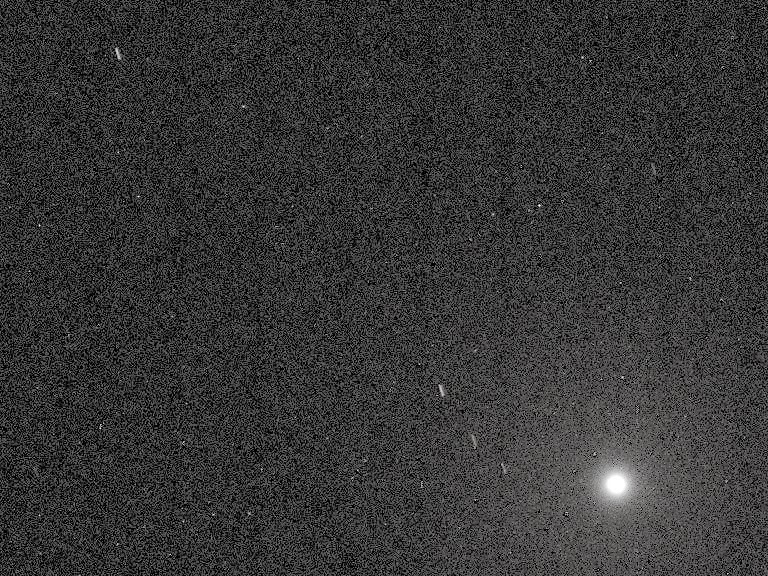
A new image from NASA's Curiosity Mars rover is the first ever from the surface of Mars to show an asteroid, and it shows two: Ceres and Vesta.

These two -- the largest and third-largest bodies in the asteroid belt between Mars and Jupiter -- are the destinations of NASA's Dawn mission.  Dawn orbited Vesta in 2011 and 2012, and is on its way to begin orbiting Ceres next year. Ceres is a dwarf planet, as well as an asteroid.

Ceres and Vesta appear as short, faint streaks in a 12-second exposure taken by Curiosity's Mast Camera (Mastcam) on April 20, 2014, PDT (April 21, UTC).  An annotated version of the image, also including insets from other observations the same night, is online at: http://www.jpl.nasa.gov/spaceimages/details.php?id=PIA17937

"This imaging was part of an experiment checking the opacity of the atmosphere at night in Curiosity's location on Mars, where water-ice clouds and hazes develop during this season," said camera team member Mark Lemmon of Texas A&M University, College Station. "The two Martian moons were the main targets that night, but we chose a time when one of the moons was near Ceres and Vesta in the sky."


Image above: First Asteroid Image from the Surface of Mars (Unannotated Version). Image Credit: NASA/JPL-Caltech/MSSS/Texas A&M.

Ceres and Vesta are much larger and farther from Earth's orbit than the types of near-Earth asteroids under consideration for NASA's asteroid initiative. That initiative includes two separate, but related activities: the asteroid redirect mission and the grand challenge. NASA is currently developing concepts for the redirect mission that will employ a robotic spacecraft, driven by an advanced solar electric propulsion system, to capture a small near-Earth asteroid or remove a boulder from the surface of a larger asteroid. The spacecraft then will attempt to redirect the object into a stable orbit around the moon.

Astronauts will travel aboard NASA's Orion spacecraft, launched on the Space Launch System rocket, to rendezvous in lunar orbit with the captured asteroid. Once there, they will collect samples to return to Earth for study.

The grand challenge is a search for the best ideas for finding asteroids that pose a potential threat to human populations, and to accelerate the work NASA already is doing for planetary defense.

NASA's Mars Science Laboratory Project is using Curiosity to assess ancient habitable environments and major changes in Martian environmental conditions. JPL, a division of the California Institute of Technology in Pasadena, built the rover and manages the project for NASA's Science Mission Directorate in Washington. Malin Space Science Systems, San Diego, built and operates the rover's Mastcam.

More information about the Dawn mission is available at these websites: http://www.nasa.gov/dawn and http://dawn.jpl.nasa.gov

For more information about Curiosity, visit http://www.nasa.gov/msl and http://mars.jpl.nasa.gov/msl/ . You can follow the mission on Facebook at http://www.facebook.com/marscuriosity and on Twitter at: http://www.twitter.com/marscuriosity

Images (mentioned), Text, Credits: NASA / JPL / Guy Webster.

Best regards, Orbiter.ch