lundi 8 décembre 2014
On Pluto’s Doorstep, NASA’s New Horizons Spacecraft Awakens for Encounter
NASA - New Horizons Mission logo.
December 8, 2014
Image above: Artist's concept of the New Horizons spacecraft as it approaches Pluto and its three moons. Image Credits: NASA/JPL.
After a voyage of nearly nine years and three billion miles —the farthest any space mission has ever traveled to reach its primary target – NASA’s New Horizons spacecraft came out of hibernation today for its long-awaited 2015 encounter with the Pluto system.
Operators at the Johns Hopkins University Applied Physics Laboratory in Laurel, Md., confirmed at 9:53 p.m. (EST) that New Horizons, operating on pre-programmed computer commands, had switched from hibernation to “active” mode. Moving at light speed, the radio signal from New Horizons – currently more than 2.9 billion miles from Earth, and just over 162 million miles from Pluto – needed four hours and 26 minutes to reach NASA’s Deep Space Network station in Canberra, Australia.
“This is a watershed event that signals the end of New Horizons crossing of a vast ocean of space to the very frontier of our solar system, and the beginning of the mission’s primary objective: the exploration of Pluto and its many moons in 2015,” said Alan Stern, New Horizons principal investigator from Southwest Research Institute, Boulder, Colo.
Image above: New Horizons Mission Operations Manager Alice Bowman and operations team member Karl Whittenburg watch the screens for data confirming that the New Horizons spacecraft had transitioned from hibernation to active mode on Dec. 6. Image Credit: NASA.
Since launching on January 19, 2006, New Horizons has spent 1,873 days — about two-thirds of its flight time — in hibernation. Its 18 separate hibernation periods, from mid-2007 to late 2014, ranged from 36 days to 202 days in length. The team used hibernation to save wear and tear on spacecraft components and reduce the risk of system failures.
“Technically, this was routine, since the wake-up was a procedure that we’d done many times before,” said Glen Fountain, New Horizons project manager at APL. “Symbolically, however, this is a big deal. It means the start of our pre-encounter operations.”
The wake-up sequence had been programmed into New Horizons' onboard computer in August, and started aboard the spacecraft at 3 p.m. EST on Dec. 6. About 90 minutes later, New Horizons began transmitting word to Earth on its condition, including the report that it is back in "active" mode.
The New Horizons team will spend the next several weeks checking out the spacecraft, making sure its systems and science instruments are operating properly. They’ll also continue to build and test the computer-command sequences that will guide New Horizons through its flight to and reconnaissance of the Pluto system.
Image above: New Horizons flight controllers Sarah Bucior, Katie Bechtold and George Lawrence monitor data confirming that the Pluto-bound spacecraft had exited hibernation. Image Credit: NASA.
With a seven-instrument science payload that includes advanced imaging infrared and ultraviolet spectrometers, a compact multicolor camera, a high-resolution telescopic camera, two powerful particle spectrometers and a space-dust detector, New Horizons will begin observing the Pluto system on Jan. 15.
New Horizons’ closest approach to Pluto will occur on July 14, but plenty of highlights are expected before then, including, by mid-May, views of the Pluto system better than what the mighty Hubble Space Telescope can provide of the dwarf planet and its moons.
“New Horizons is on a journey to a new class of planets we’ve never seen, in a place we’ve never been before,” says New Horizons Project Scientist Hal Weaver, of APL. “For decades we thought Pluto was this odd little body on the planetary outskirts; now we know it’s really a gateway to an entire region of new worlds in the Kuiper Belt, and New Horizons is going to provide the first close-up look at them.”
The Johns Hopkins Applied Physics Laboratory manages the New Horizons mission for NASA's Science Mission Directorate. Alan Stern, of the Southwest Research Institute (SwRI) is the principal investigator and leads the mission; SwRI leads the science team, payload operations, and encounter science planning. New Horizons is part of the New Frontiers Program managed by NASA's Marshall Space Flight Center in Huntsville, Alabama. APL designed, built and operates the New Horizons spacecraft.
A Musical Wake-Up
Image above: For New Horizons, Russell Watson Records Special Version of ‘Where My Heart Will Take Me’. Image Credit: NASA.
New Horizons joins the astronauts on four space shuttle missions who “woke up” to English tenor Russell Watson’s inspirational "Where My Heart Will Take Me" – in fact, Watson himself recorded a special greeting and version of the song to honor New Horizons! The song was played in New Horizons mission operations upon confirmation of the spacecraft’s wake-up on Dec. 6.
The Sleeping Spacecraft: How Hibernation Worked
During hibernation mode, much of the New Horizons spacecraft was unpowered. The onboard flight computer monitored system health and broadcast a weekly beacon-status tone back to Earth. Onboard sequences sent in advance by mission controllers woke New Horizons two or three times each year to check out critical systems, calibrate instruments, gather some science data, rehearse Pluto-encounter activities, and perform course corrections.
New Horizons pioneered routine cruise-flight hibernation for NASA. Not only has hibernation reduced wear and tear on the spacecraft's electronics, it also lowered operations costs and freed up NASA Deep Space Network tracking and communication resources for other missions.
For more information about New Horizons, visit: http://www.nasa.gov/mission_pages/newhorizons/main/
Images (mentioned), Text, Credit: NASA.
Greetings, Orbiter.ch
Proba-3 double-satellite nearer to space
ESA - European Space Agency patch.
8 December 2014
A pair of satellites flying in close formation to cast an artificial eclipse is now being turned into space-ready reality by ESA’s industrial partners.
The latest member of ESA’s Proba minisatellite family will begin its ambitious mission in about four years’ time. Two satellites will be launched together then separate to fly in tandem, going on to experiment with high-precision formation-flying techniques.
Proba-3
As has become traditional with Proba missions, the success of Proba-3’s technology will be proven through acquiring high-quality scientific data. In this case, the ‘occulter’ satellite will blot out the Sun’s fiery disc as viewed by the ‘coronagraph’ satellite, revealing mysterious regions of our parent star’s ghostly ‘corona’, or outer atmosphere.
The Sun is a million times brighter than its surrounding corona, so eclipsing it is essential for coronal studies.
“For these studies, the satellites will fly 150 m apart with millimetre and fraction-of-a-degree precision,” explains Agnes Mestreau-Garreau, ESA’s Proba-3 project manager.
Proba-3's pair of satellites
“The technical challenge will be keeping them safely controlled and correctly positioned relative to each other.
“But success would deliver a whole new way of designing and flying space missions, with multiple rigidly controlled satellites able to form giant virtual instruments in space, far larger than anything that could be launched in one piece.”
Flight data gathered from Proba-3 can then guide the programming of simulators, opening the way to designing and evaluating a wide range of formation-flying missions to do all the tasks of a virtual large single satellite.
Payload contract signing
On the scientific side, the shadow cast from one Proba-3 satellite to the other will give a sustained view of close-up regions of the solar corona. Usually, these segments are visible only for brief moments during terrestrial solar eclipses.
Effectively, the two satellites will form a single ‘giant coronagraph’ in space. Proba-3 offers to address various enigmas, such as the fact that the corona, at upwards of a million degrees in temperature, somehow remains much hotter than the Sun’s 6000°C surface.
Contract signings
ESA Paris on 11 July hosted the contract signing for the Proba-3 mission, between Franco Ongaro, ESA’s Director of Technical and Quality Management, and Diego Rodriguez, Space Department Director of Spain’s Sener.
Mission contract signing
On 27 November, the contract for Proba-3’s scientific payload was signed byFranco Ongaro and Thierry Chantreine, General Manager of Belgium’s Centre Spatial de Liège, at ESA’s ESTEC technical centre in Noordwijk, the Netherlands.
Related links:
About Proba-3: http://www.esa.int/Our_Activities/Space_Engineering_Technology/Proba_Missions/About_Proba-3
Mission: http://www.esa.int/Our_Activities/Space_Engineering_Technology/Proba_Missions/Mission2
Proba: http://www.esa.int/Our_Activities/Space_Engineering_Technology/Proba_Missions
Sener: http://www.sener.es/home/en
Centre Spatial de Liège (CSL): http://www.csl.ulg.ac.be/
Images, Text, Credits: ESA/P. Carril (Proba-3)/Anneke Le Floc'h (signing pictures).
Cheers, Orbiter.ch
dimanche 7 décembre 2014
Long March 4B launches CBERS-4 for Brazil

CASC - China Aerospace Science and Technology Corporation logo / CBERS Program logo.
December 7, 2014
Long March-4B launch
The fifth cooperative mission between China and Brazil was launched at 03:26 UTC on Sunday. In what was a milestone 200th launch for the Chinese rocket fleet, the CBERS-4 satellite was lofted by China’s Long March-4B from the LC9 launch complex at the Taiyuan Satellite Launch Center.
China’s milestone 200th rocket launch mission
CBERS (China-Brazil Earth Resources Satellite) is a cooperative program of China and Brazil.
The overall objective is the observation and monitoring of the Earth’s resources and environment with a multi-sensor imaging payload providing different spatial resolutions.
CBERS-4 satellite
CBERS-4 – with a mass of 1,980 kg – will operate on a sun-synchronous orbit at 778 km altitude with an inclination of 98.504 deg and 100.26 minutes orbital period. This orbit has a repeat cycle of 26 days.
The launch of CBERS-4 was originally schedule for December 2015. However, due to the loss of CBERS-3, China and Brazil agreed to anticipate the launch one year.
For more information about CBERS Program, visit:
CBERS - China-Brazil Earth Resources Satellite - Inpe: http://www.cbers.inpe.br/ingles/satellites/history.php
For more information about China Aerospace Science and Technology Corporation (CASC), visit: http://english.spacechina.com/n16421/index.html
Images, Video, Text, Credits: CASC/CBERS/CCTV News/Orbiter.ch Aerospace.
Best regards, Orbiter.ch
samedi 6 décembre 2014
Sixth launch for Ariane 5 this year
ARIANESPACE - Ariane 5 Flight VA 221 Mission poster.
6 December 2014
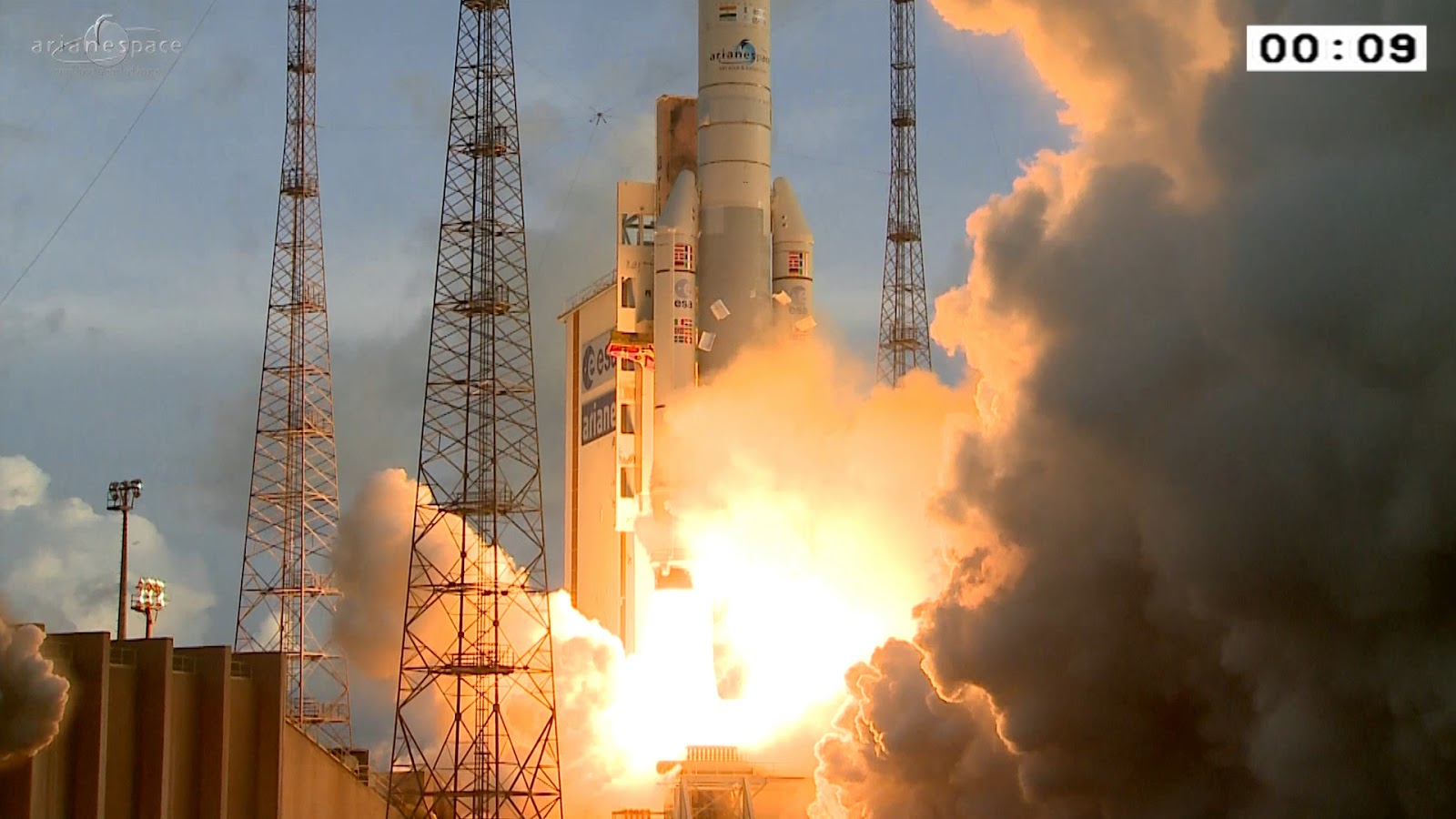
Ariane 5 liftoff on flight VA221
An Ariane 5 has lifted off from Europe’s Spaceport in Kourou, French Guiana and delivered two telecom satellites into their planned orbits.
Launch of flight VA221 occurred on 6 December at 20:40 GMT (21:40 CET, 17:40 local time).
Ariane 5 flight VA221 liftoff replay
DirecTV-14, with a mass of about 6300 kg and mounted on top of Ariane’s Sylda dual-payload carrier, was the first to be released about 28 minutes into the mission.
DirecTV-14 satellite
Following a series of burns controlled by Ariane’s computer, the Sylda structure encasing the 3181 kg GSAT-16 was then jettisoned. GSAT was released into its own transfer orbit about four and a half minutes after the first satellite.
DirecTV-14, owned by DirecTV, will be positioned at 99°W longitude in geostationary orbit to deliver Ultra HD direct-to-home TV across the USA and Puerto Rico. The satellite has a design life of about 15 years.
GSAT-16 satellite
GSAT-16, owned by the Indian Space Research Organization, will be positioned at 55°E in geostationary orbit to augment communication services across India. It has a design life of 12 years.
The payload mass for this launch was 10 352 kg. The satellites totalled 9481 kg, with payload adapters and carrying structures making up the rest.
Flight VA221 was the 77th Ariane 5 mission.
Related links:
Arianespace: http://www.arianespace.com/
About the launcher: http://www.esa.int/Our_Activities/Launchers/Launch_vehicles/Ariane_5_ECA2
Images, Video, Text, Credits: ESA/Arianespace/Gunter Space Page.
Greetings, Orbiter.ch
vendredi 5 décembre 2014
Dawn Snaps Its Best-Yet Image of Dwarf Planet Ceres
NASA - DAWN Mission patch.
December 5, 2014
The Dawn spacecraft has delivered a glimpse of Ceres, the largest body in the main asteroid belt, in a new image taken 740,000 miles (1.2 million kilometers) from the dwarf planet. This is Dawn's best image yet of Ceres as the spacecraft makes its way toward this unexplored world.
Image above: From about three times the distance from Earth to the moon, NASA's Dawn spacecraft spies its final destination -- the dwarf planet Ceres. This uncropped, unmagnified view of Ceres was taken by Dawn on Dec. 1, 2014. Image Credit: NASA/JPL-Caltech/UCLA/MPS/DLR/IDA.
"Now, finally, we have a spacecraft on the verge of unveiling this mysterious, alien world. Soon it will reveal myriad secrets Ceres has held since the dawn of the solar system," said Marc Rayman, of NASA's Jet Propulsion Laboratory in Pasadena, California, chief engineer and mission director of the Dawn mission.
Dawn will be captured into Ceres' orbit in March, marking the first visit to a dwarf planet by a spacecraft. To date, the best images of Ceres come from the Hubble Space Telescope. In early 2015, however, Dawn will begin delivering images at much higher resolution.
Image above: From about three times the distance from Earth to the moon, NASA's Dawn spacecraft spies its final destination -- the dwarf planet Ceres. This zoomed-in image was taken on Dec. 1, 2014 with the Dawn spacecraft's framing camera. Image Credit: NASA/JPL-Caltech/UCLA/MPS/DLR/IDA.
Since launching in 2007, Dawn has already visited Vesta, a giant protoplanet currently located 104 million miles (168 million kilometers) away from Ceres. The distance between Vesta and Ceres is greater than the distance between the Earth and the sun. During its 14 months in orbit around Vesta, the spacecraft delivered unprecedented scientific insights, including images of its cratered surface and important clues about its geological history. Vesta and Ceres are the two most massive bodies in the main asteroid belt.
The nine-pixel-wide image of Ceres released today serves as a final calibration of the science camera that is necessary before Dawn gets to Ceres. The dwarf planet appears approximately as bright as Venus sometimes appears from Earth. Ceres has an average diameter of about 590 miles (950 kilometers).
Image above: The Dawn spacecraft acquired this view as part of a calibration of its science camera. Ceres is the bright spot in the center of the image. A cropped, magnified view of Ceres appears in the inset image at lower left. Image Credit: NASA/JPL-Caltech/UCLA/MPS/DLR/IDA.
Dawn begins its approach phase toward Ceres on December 26.
The Dawn mission to Vesta and Ceres is managed by NASA's Jet Propulsion Laboratory, a division of the California Institute of Technology in Pasadena, for NASA's Science Mission Directorate, Washington D.C. UCLA is responsible for overall Dawn mission science. The Dawn framing cameras were developed and built under the leadership of the Max Planck Institute for Solar System Research, Gottingen, Germany, with significant contributions by German Aerospace Center (DLR), Institute of Planetary Research, Berlin, and in coordination with the Institute of Computer and Communication Network Engineering, Braunschweig. The Framing Camera project is funded by the Max Planck Society, DLR, and NASA/JPL.
More information about Dawn is online at http://dawn.jpl.nasa.gov.
Images (mentioned), Text, Credits: NASA/JPL/Elizabeth Landau.
Greetings, Orbiter.ch
Warm Gas Pours 'Cold Water' on Galaxy's Star-Making

ESA - HerschelMission patch / NASA - Spitzer Space Telescope logo / NASA - Hubble Space Telescope patch.
December 5, 2014
Image above: A new feature in the evolution of galaxies has been captured in this image of galactic interactions. Image Credit: NASA/CFHT/NRAO/JPL-Caltech/Duc/Cuillandre.
Some like it hot, but for creating new stars, a cool cosmic environment is ideal. As a new study suggests, a surge of warm gas into a nearby galaxy -- left over from the devouring of a separate galaxy -- has extinguished star formation by agitating the available chilled gas.
The unique findings illustrate a new dimension to galaxy evolution, and come courtesy of the European Space Agency's Herschel space observatory, in which NASA played a key role, and NASA's Spitzer and Hubble space telescopes.
Herschel space observatory. Image Credit: ESA
Astronomers want to understand why galaxies in the local universe fall into two major categories: younger, star-forming spirals (like our own Milky Way), and older ellipticals, in which fresh star making has ceased. The new study's galaxy, NGC 3226, occupies a transitional middle ground, so getting a bead on its star formation is critical.
"We have explored the fantastic potential of big data archives from NASA's Hubble, Spitzer and ESA's Herschel observatory to pull together a picture of an elliptical galaxy that has undergone huge changes in its recent past due to violent collisions with its neighbors," said Philip Appleton, project scientist for the NASA Herschel Science Center at the California Institute of Technology in Pasadena and lead author of a recent Astrophysical Journal paper detailing the results. "These collisions are modifying not only its structure and color, but also the condition of the gas that resides in it, making it hard -- at the moment -- for the galaxy to form many stars."
NGC 3226 is relatively close, just 50 million light-years away. Several star-studded, gassy loops emanate from NGC 3226. Filaments also run out from it and between a companion galaxy, NGC 3227. These streamers of material suggest that a third galaxy probably existed there until recently -- that is, until NGC 3226 cannibalized it, strewing pieces of the shredded galaxy all over the area.
A prominent piece of these messy leftovers stretches 100,000 light-years and extends right into the core of NGC 3226. This long tail ends as a curved plume in a disk of warm hydrogen gas and a ring of dust. Contents of the tail, thought to be the debris from that departed galaxy, are falling into NGC 3226, drawn by its gravity.
Spitzer Space Telescope. Image Credit: NASA
In many instances, adding material to galaxies in this manner rejuvenates them, triggering new rounds of star birth thanks to gas and dust gelling together. Yet data from the three telescopes agree that NGC 3226 has a very low rate of star formation. It appears that in this case, the material falling into NGC 3226 is heating up as it collides with other galactic gas and dust, quenching star formation instead of fueling it.
The outcome could have been different, as NGC 3226 hosts a supermassive black hole at its center. The influx of gas and dust might have ended up just feeding the black hole, setting off energetic outpourings as the material crashed together while whirling toward its doom. Instead, the black hole in NGC 3226's core is just snacking, not gorging, as the material has spread out in the galaxy's central regions.
"We are discovering that gas does not simply funnel down into the center of a galaxy and feed the supermassive black hole known to be lurking there," Appleton said. "Rather, it gets hung up in a warm disk, shutting down star formation and probably frustrating the black hole's growth by being too turbulent at this point in time."
NGC 3226 is considered something between a youthful "blue" galaxy and an old "red" galaxy. The colors refer to the predominantly galactic blue light radiated by giant, young stars -- a telltale sign of recent star formation -- and the reddish light cast by mature stars in the absence of new, blue ones.
This intermediary galaxy illuminates how galaxies accruing fresh gas and dust can bloom with new stars or have their stellar factories close shop, at least temporarily. After all, as the warm gas flooding NGC 3226 cools to star-forming temperatures, the galaxy should get a second wind.
Intriguingly, ultraviolet and optical light observations suggest that NGC 3226 may have produced more stars in the past, leading to its current intermediate color, somewhere between red and blue. The new study indicates that those traces of youth must indeed be lingering from higher levels of star formation, before the infalling gas scrambled the scene.
Hubble Space Telescope. Image Credit: NASA/ESA
"NGC 3226 will continue to evolve and may hatch abundant new stars in the future," said Appleton. "We're learning that the transition from young- to old-looking galaxies is not a one-way, but a two-way street."
Other authors of the report are: C. Mundell of Liverpool John Moores University, England; M. Lacy of National Radio Astronomy Observatory, Charlottesville, Virginia; V. Charmandaris of University of Creete, Greece; P-A. Duc of CEA-Saclay, France; U. Lisenfeld of University of Granda, Spain; and T. Bitsakis, K. Alatalo, L. Armus and P. Ogle of Caltech.
Herschel is a European Space Agency mission, with science instruments provided by consortia of European institutes and with important participation by NASA. While the observatory stopped making science observations in April 2013, after running out of liquid coolant, as expected, scientists continue to analyze its data. NASA's Herschel Project Office is based at NASA's Jet Propulsion Laboratory, Pasadena, California. JPL contributed mission-enabling technology for two of Herschel's three science instruments. The NASA Herschel Science Center, part of the Infrared Processing and Analysis Center at Caltech, supports the U.S. astronomical community.
JPL manages the Spitzer Space Telescope mission for NASA's Science Mission Directorate, Washington. Science operations are conducted at the Spitzer Science Center at Caltech. Spacecraft operations are based at Lockheed Martin Space Systems Company, Littleton, Colorado. Data are archived at the Infrared Science Archive housed at the Infrared Processing and Analysis Center at Caltech.
Caltech manages JPL for NASA.
The Hubble Space Telescope is a project of international cooperation between NASA and the European Space Agency. NASA's Goddard Space Flight Center in Greenbelt, Maryland, manages the telescope. The Space Telescope Science Institute (STScI) in Baltimore conducts Hubble science operations. STScI is operated for NASA by the Association of Universities for Research in Astronomy, Inc., in Washington.
Fore more information about NASA's role in Herschel, visit: http://www.nasa.gov/herschel
For more information about Spitzer, visit: http://www.nasa.gov/spitzer
For more information about Hubble, visit: http://www.nasa.gov/hubble
Images (mentioned), Text, Credits: NASA/JPL/Whitney Clavin.
Cheers, Orbiter.ch
LIFTOFF! Orion Begins New Era in Space Exploration!

NASA - Orion EFT-1 Mission patch / ULA - Delta IV Heavy EFT Mission patch.
December 5, 2014
Launch of Orion. Photo Credit: NASA/Bill Ingalls
The Orion spacecraft is heading into orbit on the brilliant fire and power of the United Launch Alliance Delta IV Heavy rocket! Orion launched from Cape Canaveral this morning at 7:05 a.m EST (12:05 GMT).
Orion Soars on First Flight Test
Booster Burnout and Jettison
The core stages to the left and right on the rocket burned through their propellants in less than four minutes and have fallen away. A single core stage is now powering Orion toward space. The second stage will take over in 93 seconds.
Fairing Jettison Image
A camera aboard the Delta IV Heavy recorded the separation of the fairing panels over the Orion service module during the climb into orbit. The fairing provided structural support during the early phases of launch.
Second Stage Engine Cutoff – Orion’s In Orbit
The second stage engine completed its first burn and Orion is in orbit now, on a path that is about 560 miles by 120 miles above Earth. There will be another burn by the Delta IV second stage to lift its orbit and then push it out 3,600 miles from Earth. For now, though, Orion begins a coast phase of about 97 minutes. The second stage will reignite at the 1 hour, 55 minute, 26 second point of the mission. The coast phase will allow flight controllers to continue evaluating telemetry coming down from the spacecraft and make sure Orion is healthy thus far in its mission.
Second Stage Ignites to Lift Orbit
Upper Stage Re-Ignition animation
The single engine of the second stage is firing now, using its 24,750 pounds of thrust to push Orion higher above Earth. This burn will last 4 minutes and 42 seconds and place Orion on a path through the Van Allen radiation belts and then back to Earth’s atmosphere at high speed.
Peak Heating
Orion continues to slow down quickly as the atmosphere it flies through gets thicker and thicker. The thickening air also generates more heat and the spacecraft is now passing through that hottest part of reentry.
Main Chutes Deployed!
Orion is falling gently toward the Pacific Ocean surface under three parachutes that combined would cover a football field.
Orion on the Ocean Surface
The Orion capsule landed upright on its base in a position called Stable 1 and remains in Stable 1 as it floats on the Pacific’s surface. The spacecraft’s systems performed perfectly throughout the mission including two passes through the Van Allen radiation belts and the heat of re-entry.
Orion Splashes Down in the Pacific Ocean
Critical Step on the Journey to Mars
The Orion crew module splashed down in the Pacific Ocean approximately 600 southwest of San Diego at 11:29 a.m. EST. Flight controllers have reported that the spacecraft is in a stable configuration. The recovery team from NASA, the U.S. Navy and Lockheed Martin will perform initial recovery operations, including safing the crew module and towing it into the well deck of the USS Anchorage ahead of its return to U.S. Naval Base, San Diego and then on to NASA’s Kennedy Space Center in Florida. Orion launched from Cape Canaveral this morning at 7:05 a.m. EST (12:05 GMT).
Orion Explore and Beyond
For more information about Orion Crew Module, visit: http://www.nasa.gov/orion/
Images, Videos, Text, Credits: NASA/Bill Ingalls/NASA blog/NASA TV/Screen captures from NASA TV by Orbiter.ch Aerospace.
Best regards, Orbiter.ch
Inscription à :
Articles (Atom)