lundi 23 novembre 2015
Dione Before the Rings
NASA - Cassini International logo.
Nov. 23, 2015
Saturn's rings are so expansive that they often sneak into Cassini's pictures of other bodies. Here, they appear with the planet in a picture taken during a close flyby of Dione.
The flyby of Dione (698 miles or 1123 kilometers across) during which this image was taken was the last close encounter with this moon during Cassini's mission. The main goal of the flyby was to use the spacecraft as a probe to measure Dione's gravity field. However, scientists also managed to take some very close images of the surface. All of the data will be helpful to understand the interior structure and geological history of this distant, icy world.
This view is centered on terrain at 7 degrees south latitude, 122 degrees west longitude. The image was taken in visible light with the Cassini spacecraft narrow-angle camera on Aug. 17, 2015.
The view was obtained at a distance of approximately 48,000 miles (77,000 kilometers) from Dione and at a Sun-Dione-spacecraft, or phase angle of 35 degrees. Image scale is 1,520 feet (464 meters) per pixel.
The Cassini mission is a cooperative project of NASA, ESA (the European Space Agency) and the Italian Space Agency. The Jet Propulsion Laboratory, a division of the California Institute of Technology in Pasadena, manages the mission for NASA's Science Mission Directorate, Washington. The Cassini orbiter and its two onboard cameras were designed, developed and assembled at JPL. The imaging operations center is based at the Space Science Institute in Boulder, Colorado.
For more information about the Cassini-Huygens mission visit http://saturn.jpl.nasa.gov or http://www.nasa.gov/cassini . The Cassini imaging team homepage is at http://ciclops.org ESA website: http://www.esa.int/Our_Activities/Space_Science/Cassini-Huygens
Image, Text, Credits: NASA/JPL-Caltech/Space Science Institute/Tony Greicius.
Greetings, Orbiter.ch
Earth Might Have Hairy Dark Matter
NASA logo.
Nov. 23, 2015
The solar system might be a lot hairier than we thought.
A new study publishing this week in the Astrophysical Journal by Gary Prézeau of NASA's Jet Propulsion Laboratory, Pasadena, California, proposes the existence of long filaments of dark matter, or "hairs."
Image above: This illustration shows Earth surrounded by theoretical filaments of dark matter called "hairs." Image Credits: NASA/JPL-Caltech.
Dark matter is an invisible, mysterious substance that makes up about 27 percent of all matter and energy in the universe. The regular matter, which makes up everything we can see around us, is only 5 percent of the universe. The rest is dark energy, a strange phenomenon associated with the acceleration of our expanding universe.
Neither dark matter nor dark energy has ever been directly detected, although many experiments are trying to unlock the mysteries of dark matter, whether from deep underground or in space.
Based on many observations of its gravitational pull in action, scientists are certain that dark matter exists, and have measured how much of it there is in the universe to an accuracy of better than one percent. The leading theory is that dark matter is "cold," meaning it doesn't move around much, and it is "dark" insofar as it doesn't produce or interact with light.
Galaxies, which contain stars made of ordinary matter, form because of fluctuations in the density of dark matter. Gravity acts as the glue that holds both the ordinary and dark matter together in galaxies.
Image above: This artist's rendering zooms in on what dark matter "hairs" might look like around Earth. Image Credits: NASA/JPL-Caltech.
According to calculations done in the 1990s and simulations performed in the last decade, dark matter forms "fine-grained streams" of particles that move at the same velocity and orbit galaxies such as ours.
"A stream can be much larger than the solar system itself, and there are many different streams crisscrossing our galactic neighborhood," Prézeau said.
Prézeau likens the formation of fine-grained streams of dark matter to mixing chocolate and vanilla ice cream. Swirl a scoop of each together a few times and you get a mixed pattern, but you can still see the individual colors.
"When gravity interacts with the cold dark matter gas during galaxy formation, all particles within a stream continue traveling at the same velocity," Prézeau said.
But what happens when one of these streams approaches a planet such as Earth? Prézeau used computer simulations to find out.
His analysis finds that when a dark matter stream goes through a planet, the stream particles focus into an ultra-dense filament, or "hair," of dark matter. In fact, there should be many such hairs sprouting from Earth.
A stream of ordinary matter would not go through Earth and out the other side. But from the point of view of dark matter, Earth is no obstacle. According to Prézeau's simulations, Earth's gravity would focus and bend the stream of dark matter particles into a narrow, dense hair.
Image above: The root of a dark matter hair produced from particles going through Jupiter's core would be about 1 trillion times denser than average. Image Credits: NASA/JPL-Caltech.
Hairs emerging from planets have both "roots," the densest concentration of dark matter particles in the hair, and "tips," where the hair ends. When particles of a dark matter stream pass through Earth’s core, they focus at the "root" of a hair, where the density of the particles is about a billion times more than average. The root of such a hair should be around 600,000 miles (1 million kilometers) away from the surface, or twice as far as the moon. The stream particles that graze Earth's surface will form the tip of the hair, about twice as far from Earth as the hair’s root.
"If we could pinpoint the location of the root of these hairs, we could potentially send a probe there and get a bonanza of data about dark matter," Prézeau said.
A stream passing through Jupiter's core would produce even denser roots: almost 1 trillion times denser than the original stream, according to Prézeau's simulations.
"Dark matter has eluded all attempts at direct detection for over 30 years. The roots of dark matter hairs would be an attractive place to look, given how dense they are thought to be,” said Charles Lawrence, chief scientist for JPL’s astronomy, physics and technology directorate.
Another fascinating finding from these computer simulations is that the changes in density found inside our planet – from the inner core, to the outer core, to the mantle to the crust – would be reflected in the hairs. The hairs would have "kinks" in them that correspond to the transitions between the different layers of Earth.
Theoretically, if it were possible to obtain this information, scientists could use hairs of cold dark matter to map out the layers of any planetary body, and even infer the depths of oceans on icy moons.
Further study is needed to support these findings and unlock the mysteries of the nature of dark matter.
The California Institute of Technology manages JPL for NASA.
Related links:
Dark Energy and Dark Matter: http://www.nasa.gov/subject/6891/dark-energy-and-dark-matter/
Universe: http://www.nasa.gov/topics/solarsystem/index.html
Images (mentioned), Text, Credits: NASA/Tony Greicius/JPL/Elizabeth Landau.
Greetings, Orbiter.ch
Where Alice in Wonderland Meets Albert Einstein
NASA - Chandra X-ray Observatory patch.
Nov. 23, 2015
One hundred years ago this month, Albert Einstein published his theory of general relativity, one of the most important scientific achievements in the last century.
A key result of Einstein’s theory is that matter warps space-time, and thus a massive object can cause an observable bending of light from a background object. The first success of the theory was the observation, during a solar eclipse, that light from a distant background star was deflected by the predicted amount as it passed near the sun.
Astronomers have since found many examples of this phenomenon, known as “gravitational lensing.” More than just a cosmic illusion, gravitational lensing provides astronomers with a way of probing extremely distant galaxies and groups of galaxies in ways that would otherwise be impossible even with the most powerful telescopes.
The latest results from the “Cheshire Cat” group of galaxies show how manifestations of Einstein’s 100-year-old theory can lead to new discoveries today. Astronomers have given the group this name because of the smiling cat-like appearance. Some of the feline features are actually distant galaxies whose light has been stretched and bent by the large amounts of mass, most of which is in the form of dark matter detectable only through its gravitational effect, found in the system.
More specifically, the mass that distorts the faraway galactic light is found surrounding the two giant “eye” galaxies and a “nose” galaxy. The multiple arcs of the circular “face” arise from gravitational lensing of four different background galaxies well behind the “eye” galaxies. The individual galaxies of the system, as well as the gravitationally lensed arcs, are seen in optical light from NASA’s Hubble Space Telescope.
Each “eye” galaxy is the brightest member of its own group of galaxies and these two groups are racing toward one another at over 300,000 miles per hour. Data from NASA’s Chandra X-ray Observatory (purple) show hot gas that has been heated to millions of degrees, which is evidence that the galaxy groups are slamming into one another. Chandra’s X-ray data also reveal that the left “eye” of the Cheshire Cat group contains an actively feeding supermassive black hole at the center of the galaxy.
Astronomers think the Cheshire Cat group will become what is known as a fossil group, defined as a gathering of galaxies that contains one giant elliptical galaxy and other much smaller, fainter ones. Fossil groups may represent a temporary stage that nearly all galaxy groups pass through at some point in their evolution. Therefore, astronomers are eager to better understand the properties and behavior of these groups.
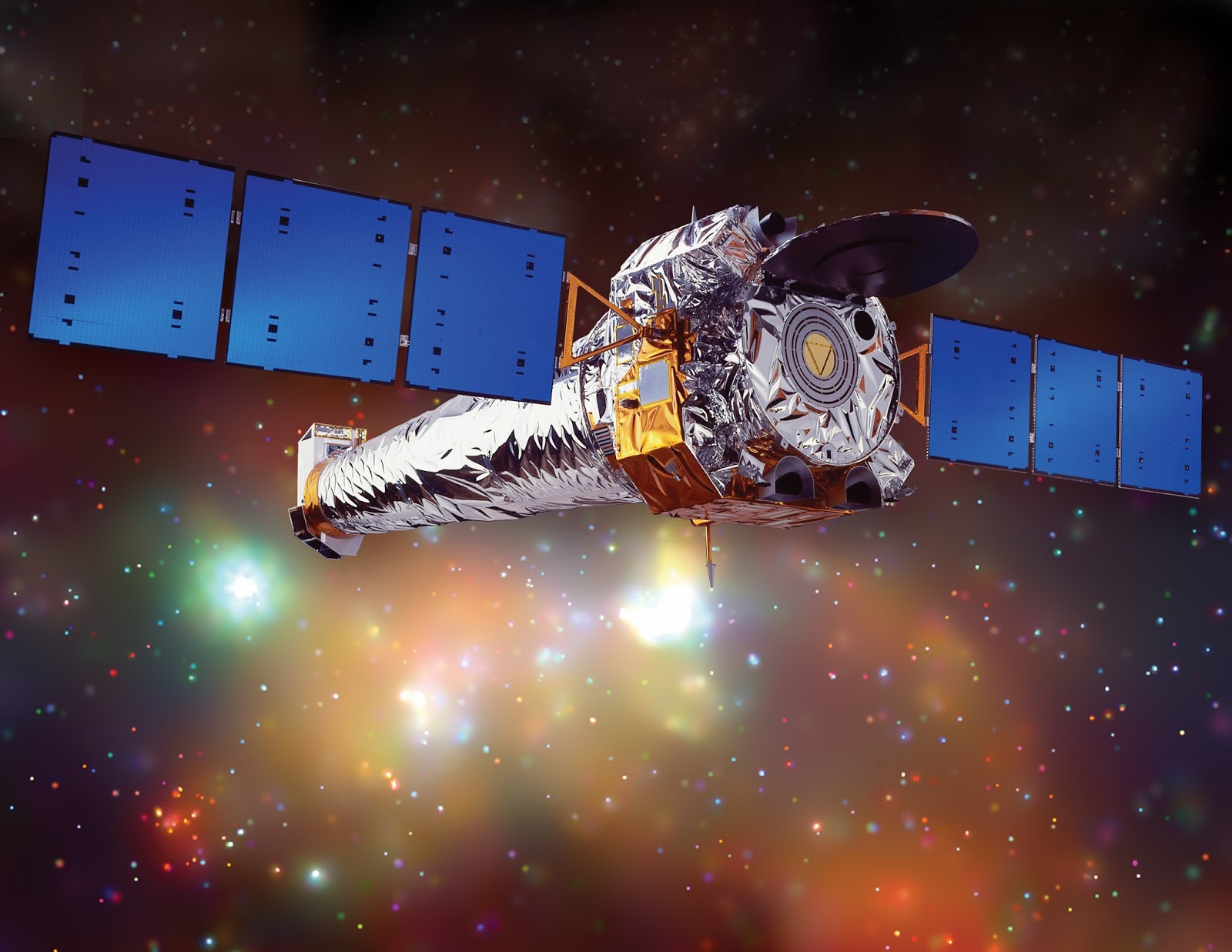
Chandra X-ray Observatory
The Cheshire Cat represents the first opportunity for astronomers to study a fossil group progenitor. Astronomers estimate that the two “eyes” of the cat will merge in about one billion years, leaving one very large galaxy and dozens of much smaller ones in a combined group. At that point it will have become a fossil group and a more appropriate name may be the “Cyclops” group.
A new paper on the Cheshire Cat was recently published in The Astrophysical Journal and appears online. The authors are Jimmy Irwin (University of Alabama), Renato Dupke (National Observatory of Brazil), Rodrigo Carrasco (Gemini Observatory), Peter Maksym (Harvard-Smithsonian Center for Astrophysics), Lucas Johnson, Raymond White III (Alabama).
http://arxiv.org/abs/1505.05501
NASA's Marshall Space Flight Center in Huntsville, Alabama, manages the Chandra program for NASA's Science Mission Directorate in Washington. The Smithsonian Astrophysical Observatory in Cambridge, Massachusetts, controls Chandra's science and flight operations.
For more Chandra images, multimedia and related materials, visit: http://www.nasa.gov/chandra
Image, Text, Credits: X-ray: NASA/CXC/UA/J.Irwin et al; Optical: NASA/STScI/Lee Mohon.
Greetings, Orbiter.ch
dimanche 22 novembre 2015
China Launches First Communication Satellite for Laos
CASC - China Aerospace Science and Technology Corporation logo.
November 22, 2015
Image above: A Long March 3B rocket carrying the LaoSat-1 satellite blasts off from the Xichang Satellite Launch Center in Xichang, southwest China’s Sichuan Province, Nov. 20, 2015. Image Credit: Xinhua/Qin Haishi.
China Launches First Communication Satellite for Laos. Video Credit: CCTV+
Long March 3B lifted off from the Xichang Satellite Launch Center at 16:07 UTC on November 20, 2015 (Friday), becoming the fifth GTO launch from Xichang in the last two and a half months. Following its midnight blastoff, the 56-meter tall Long March 3B swung to the south-east for a standard GTO delivery, taking the three-stage rocket across the Chinese mainland ahead of a pass over the Pacific Ocean.
LaoSat-1 satellite. Image Credit: CAST
The satellite is the first to use the DFH-3B of the China Academy of Space Technology. The satellite bus measures 2.2 by 2.0 by 3.1 meters in size with a launch mass of 3,800+ Kilograms, hosting payloads of to 450 Kilograms and a power of 4,000 Watts. LaoSat-1 is outfitted with 14 C-Band transponders and 8 Ku-Band transponders to deliver television and data services to southeastern Asia, stationed in a position of 128.5 degrees East in Geostationary Orbit.
For more information about China Aerospace Science and Technology Corporation (CASC), visit: http://english.spacechina.com/n16421/index.html
Images (mentioned), Video (mentioned), Text, Credits: CASC/Orbiter.ch Aerospace.
Greetings, Orbiter.ch
samedi 21 novembre 2015
LHC: A proton 'reference' run to prepare for lead
CERN - European Organization for Nuclear Research logo.
November 21, 2015
With the proton run at 13 teraelectronvolts (TeV) now over for 2015, preparations are in full swing for the Large Hadron Collider (LHC) to investigate lead ions, as it does for part of each year. But first, the Operations team is colliding protons at lower energies than usual to provide a baseline for the lead run.
Collisions between lead ions are much more complex than those between single protons. When lead ions collide at energies of several teraelectronvolts (TeV), the extreme conditions give rise to a hot, dense soup of particles known as "quark-gluon plasma" – a state of matter thought to have existed just after the Big Bang. Experiments at CERN study this plasma to gain insights into the nature of the early universe.
Image above: The LHC is colliding protons at the lower energy of 2.51 teraelectronvolts (TeV) per beam, to provide a baseline for collisions between lead ions. (Image: Maximilien Brice).
To cut through the complexity of the lead fireball, CERN physicists will compare their lead-lead collision data with previous measurements from proton-proton, as well as proton-lead collisions.
"A lead nucleus in the LHC has 82 times the energy of a proton," says accelerator physicist John Jowett. "But that energy is distributed among its 208 nucleons (the protons and neutrons that make up the lead nucleus). As 82 divided by 208 is 0.39, it follows that one proton or nucleon in a colliding lead nucleus has just less than 40% of the energy of an independent proton colliding."
This is why, in today’s proton-proton run, the Operations team has adjusted the energy of the proton beam downwards. "For the upcoming collisions between lead ions, we will reduce the LHC’s magnetic fields a little – from the levels corresponding to a proton energy of 6.5 TeV, to 6.37 TeV – because that gives us the same centre-of-mass energy of 5.02 TeV per nucleon pair as we had in 2013, when we collided 4 TeV protons with lead ions," says Jowett. "The proton-proton reference data being taken this week is at 2.51 TeV per beam, which is the corresponding energy for protons. So finally the experiments will be able to make precise comparisons among data sets with three different combinations of particles colliding at the same effective energy."
Accelerator physicist Jorg Wenninger of the LHC Operations team says that preparing the LHC for proton beams at 2.51 TeV was relatively straightforward. “We had to re-commission the run to lower energy, find the collisions and set up all the conditions for physics,” he says. “But we already ran the LHC at high energy this year, so we can profit from experience. We will however apply one innovation: instead of squeezing the beam optics at the collision points after the energy ramp, we will perform both operations in parallel. If this is working smoothly, we may decide to use the same technique to shorten the LHC cycles in 2016 and beyond. ”
"This proton-proton reference run will give the experiments an idea of what the proton-proton equations look like; it gives them a comparison for the upcoming lead-lead collisions,” says Mike Lamont of the LHC Operations team.
The LHC experiments are also preparing for the lead-lead run. ALICE is specialised for heavy-ion physics, ATLAS and CMS have added calorimeters to the LHC tunnel, and for the first time, the LHCb experiment will take data from these heavy-ion collisions.
Note:
CERN, the European Organization for Nuclear Research, is one of the world’s largest and most respected centres for scientific research. Its business is fundamental physics, finding out what the Universe is made of and how it works. At CERN, the world’s largest and most complex scientific instruments are used to study the basic constituents of matter — the fundamental particles. By studying what happens when these particles collide, physicists learn about the laws of Nature.
The instruments used at CERN are particle accelerators and detectors. Accelerators boost beams of particles to high energies before they are made to collide with each other or with stationary targets. Detectors observe and record the results of these collisions.
Founded in 1954, the CERN Laboratory sits astride the Franco–Swiss border near Geneva. It was one of Europe’s first joint ventures and now has 22 Member States.
Related articles:
LHC completes proton run for 2015, preps for lead:
http://orbiterchspacenews.blogspot.ch/2015/11/lhc-completes-proton-run-for-2015-preps.html
Engineers refine protection system for LHC magnets:
http://orbiterchspacenews.blogspot.ch/2015/09/engineers-refine-protection-system-for.html
ATLAS and CMS experiments shed light on Higgs properties:
http://orbiterchspacenews.blogspot.ch/2015/09/atlas-and-cms-experiments-shed-light-on.html
LHC progresses towards higher intensities:
http://orbiterchspacenews.blogspot.ch/2015/08/lhc-progresses-towards-higher.html
Related links:
Large Hadron Collider (LHC): http://home.cern/topics/large-hadron-collider
ALICE experiments: http://home.cern/about/experiments/alice
ATLAS experiments: http://home.cern/about/experiments/atlas
CMS experiments: http://home.cern/about/experiments/cms
LHCb experiments: http://home.cern/about/experiments/lhcb
Quark-gluon plasma: http://home.cern/about/physics/heavy-ions-and-quark-gluon-plasma
Big Bang: http://home.cern/about/physics/early-universe
For more information about European Organization for Nuclear Research (CERN), Visit: http://home.cern/
Image (mentioned), Text, Credits: CERN/Cian O'Luanaigh.
Best regards, Orbiter.ch
Khrunichev Center: ISS - 17 years in orbit
ROSCOSMOS - Zarya IA/R - ISS power block 1 patch.
November 21, 2015
17 years ago, on 20 November 1998, it began the construction of the International Space Station (ISS). From the Baikonur cosmodrome was successfully launched Proton rocket with the Functional Cargo Block (FGB) "Dawn."
November 20, 1998 - Proton-K launch with Zarya - ISS block 1
The International Space Station - the largest scientific and technical unique space project, which combined intellectual and financial resources of many countries.
Work on defining the configuration of the ISS with Russia began in August 1993. In early September 1993 signed an intergovernmental agreement on Russia's participation in the creation of the ISS and the US participation in the program of the Russian "Mir". In September 1993, a team of NASA and industrial firms visited the Khrunichev Center to become familiar with its capabilities to participate in the ISS program.
October 4, 1993 at the Russian Federal Space Agency (FKA) held a meeting with representatives of the Khrunichev. MV Khrunichev, RSC "Energia», NASA and the Boeing company, where it was decided to use as the first module of the ISS power block "Zarya" - an analog of heavy transport ships and modules for space stations created in the Center Khrunichev more than 20 years. The lead developer and manufacturer of module "Zarya" was the Khrunichev Center. Total unit participated in the creation of about 240 Russian companies.
FGB "Zarya" - ISS block 1 in orbit
Over the years, the construction of the space station to the FGB "Zarya" were docked American module Unity (1998) and the Russian module "Zvezda" (2000). In 2001, the ISS were attached: laboratory module Destiny, airlock Quest and docking compartment "Pirs". Then added to the ISS American module Harmony (2007), the European module Columbus (2008) and the Japanese Kibo (2008).
Khrunichev Center held a large amount of work to extend the service life of the ISS until 2024. At the Khrunichev Center is involved in the final stage of creating the third module of the Russian segment of the ISS - a multipurpose laboratory module "Science."
ROSCOSMOS Press Release: http://www.federalspace.ru/21844/
Images, Text, Credits: ROSCOSMOS/Khrunichev Center/Wikimedia/Translation: Orbiter.ch Aerospace/Roland Berga.
Best regards, Orbiter.ch
vendredi 20 novembre 2015
A Day on Pluto, a Day on Charon
NASA - New Horizons Mission logo.
Nov. 20, 2015
Images above: On approach in July 2015, the cameras on NASA’s New Horizons spacecraft captured Pluto rotating over the course of a full “Pluto day.” The best available images of each side of Pluto taken during approach have been combined to create this view of a full rotation. Images Credits: NASA/JHUAPL/SwRI.
Pluto’s day is 6.4 Earth days long. The images were taken by the Long Range Reconnaissance Imager (LORRI) and the Ralph/Multispectral Visible Imaging Camera as the distance between New Horizons and Pluto decreased from 5 million miles (8 million kilometers) on July 7 to 400,000 miles (about 645,000 kilometers) on July 13. The more distant images contribute to the view at the 3 o’clock position, with the top of the heart-shaped, informally named Tombaugh Regio slipping out of view, giving way to the side of Pluto that was facing away from New Horizons during closest approach on July 14. The side New Horizons saw in most detail – what the mission team calls the “encounter hemisphere” – is at the 6 o’clock position.
These images and others like them reveal many details about Pluto, including the differences between the encounter hemisphere and the so-called “far side” hemisphere seen only at lower resolution. Dimples in the bottom (south) edge of Pluto’s disk are artifacts of the way the images were combined to create these composites.
Images above: On approach to the Pluto system in July 2015, the cameras on NASA’s New Horizons spacecraft captured images of the largest of Pluto’s five moons, Charon, rotating over the course of a full day. The best currently available images of each side of Charon taken during approach have been combined to create this view of a full rotation of the moon. Images Credits: NASA/JHUAPL/SwRI.
Charon – like Pluto – rotates once every 6.4 Earth days. The photos were taken by the Long Range Reconnaissance Imager (LORRI) and the Ralph/Multispectral Visible Imaging Camera from July 7-13, as New Horizons closed in over a range of 6.4 million miles (10.2 million kilometers). The more distant images contribute to the view at the 9 o’clock position, with few of the signature surface features visible, such as the cratered uplands, canyons, or rolling plains of the informally named Vulcan Planum. The side New Horizons saw in most detail, during closest approach on July 14, 2015, is at the 12 o’clock position.
These images and others like them reveal many details about Charon, including how similar looking the encounter hemisphere is to the so-called “far side” hemisphere seen only at low resolution – which is the opposite of the situation at Pluto. Dimples in the bottom (south) edge of Charon’s disk are artifacts of the way the New Horizons images were combined to create these composites.
For more information about New Horizons, visit: http://www.nasa.gov/mission_pages/newhorizons/main/index.html
Images (mentioned), Text, Credits: NASA/Tricia Talbert.
Inscription à :
Articles (Atom)