mercredi 27 avril 2016
CERN - CMS releases new batch of LHC open data
CERN - European Organization for Nuclear Research logo.
April 27, 2016
The CMS collaboration has made 300 TB of high-quality data from the LHC available to the public through the CERN Open Data Portal.
The collision data come in two types: The so-called “primary datasets” are in the same format used by the CMS Collaboration to perform research. The “derived datasets” on the other hand require a lot less computing power and can be readily analysed by university or even high-school students.
Notably, CMS is also providing the simulated data generated with the same software version that should be used to analyse the primary datasets. Simulations play a crucial role in particle-physics research and CMS is also making available the protocols for generating the simulations that are provided. The data release is accompanied by analysis tools and code examples tailored to the datasets.
Image above: A CMS collision event as seen in the built-in event display on the CERN Open Data Portal. (Image: CERN).
These data are being made public in accordance with CMS’s commitment to long-term data preservation and as part of the collaboration’s open-data policy.
“Members of the CMS Collaboration put in lots of effort and thousands of person-hours each of service work in order to operate the CMS detector and collect these research data for our analysis,” explains Kati Lassila-Perini, a CMS physicist who leads these data-preservation efforts. “However, once we’ve exhausted our exploration of the data, we see no reason not to make them available publicly. The benefits are numerous, from inspiring high-school students to the training of the particle physicists of tomorrow. And personally, as CMS’s data-preservation co-ordinator, this is a crucial part of ensuring the long-term availability of our research data.”
The scope of open LHC data has already been demonstrated with the previous release of research data. A group of theorists at MIT wanted to study the substructure of jets — showers of hadron clusters recorded in the CMS detector. Since CMS had not performed this particular research, the theorists got in touch with the CMS scientists for advice on how to proceed. This blossomed into a fruitful collaboration between the theorists and CMS revolving around CMS open data.
Note:
CERN, the European Organization for Nuclear Research, is one of the world’s largest and most respected centres for scientific research. Its business is fundamental physics, finding out what the Universe is made of and how it works. At CERN, the world’s largest and most complex scientific instruments are used to study the basic constituents of matter — the fundamental particles. By studying what happens when these particles collide, physicists learn about the laws of Nature.
The instruments used at CERN are particle accelerators and detectors. Accelerators boost beams of particles to high energies before they are made to collide with each other or with stationary targets. Detectors observe and record the results of these collisions.
Founded in 1954, the CERN Laboratory sits astride the Franco–Swiss border near Geneva. It was one of Europe’s first joint ventures and now has 22 Member States.
Read more about CMS Open Data on the CERN Open Data Portal: http://opendata.cern.ch/about/CMS
A longer version of this article was originally published on the CMS website: http://cms.web.cern.ch/news/cms-releases-new-batch-research-data-lhc
For more information about the European Organization for Nuclear Research (CERN), visit: http://home.web.cern.ch/
Image (mentioned), Text, Credits: CERN/Achintya Rao/Kate Kahle.
Greetings, Orbiter.ch
Curiosity Mars Rover Crosses Rugged Plateau
NASA - Mars Science Laboratory (MSL) logo.
April 27, 2016
(Click on the image for enlarge)
Image above: This 360-degree panorama from the Mastcam on NASA's Curiosity Mars rover shows the rugged surface of "Naukluft Plateau" plus upper Mount Sharp at right and part of the rim of Gale Crater. The April 4, 2016, scene is dominated by eroded remnants of a finely layered ancient sandstone deposit. Image Credits: NASA/JPL-Caltech/MSSS.
NASA's Curiosity Mars rover has nearly finished crossing a stretch of the most rugged and difficult-to-navigate terrain encountered during the mission's 44 months on Mars.
The rover climbed onto the "Naukluft Plateau" of lower Mount Sharp in early March after spending several weeks investigating sand dunes. The plateau's sandstone bedrock has been carved by eons of wind erosion into ridges and knobs. The path of about a quarter mile (400 meters) westward across it is taking Curiosity toward smoother surfaces leading to geological layers of scientific interest farther uphill.
The roughness of the terrain on the plateau raised concern that driving on it could be especially damaging to Curiosity's wheels, as was terrain Curiosity crossed before reaching the base of Mount Sharp. Holes and tears in the rover's aluminum wheels became noticeable in 2013. The rover team responded by adjusting the long-term traverse route, revising how local terrain is assessed and refining how drives are planned. Extensive Earth-based testing provided insight into wheel longevity.
The rover team closely monitors wear and tear on Curiosity's six wheels. "We carefully inspect and trend the condition of the wheels," said Steve Lee, Curiosity's deputy project manager at NASA's Jet Propulsion Laboratory, Pasadena, California. "Cracks and punctures have been gradually accumulating at the pace we anticipated, based on testing we performed at JPL. Given our longevity projections, I am confident these wheels will get us to the destinations on Mount Sharp that have been in our plans since before landing."
Image above: The team operating NASA's Curiosity Mars rover uses the MAHLI camera on the rover's arm to check the condition of the wheels at routine intervals. This image of the left-middle and left-rear wheels is part of an inspection set taken on April 18, 2016, while the rover was on "Naukluft Plateau." Image Credits: NASA/JPL-Caltech/MSSS.
Inspection of the wheels after crossing most of the Naukluft Plateau has indicated that, while the terrain presented challenges for navigation, driving across it did not accelerate damage to the wheels.
On Naukluft Plateau, the rover's Mast Camera has recorded some panoramic scenes from the highest viewpoints Curiosity has reached since its August 2012 landing on the floor of Gale Crater on Mars.
The scenes show wind-sculpted textures in the sandstone bedrock close to the rover, and Gale Crater's rim rising above the crater floor in the distance. Mount Sharp stands in the middle of the crater, which is about 96 miles (154 kilometers) in diameter.
The next part of the rover's route will return to a type of lake-deposited mudstone surface examined previously. Farther ahead on lower Mount Sharp are three geological units that have been key destinations for the mission since its landing site was selected. One of the units contains an iron-oxide mineral called hematite, which was detected from orbit. Just above it lies a band rich in clay minerals, then a series of layers that contain sulfur-bearing minerals called sulfates. By examining them with Curiosity, researchers hope to gain a better understanding of how long ancient environmental conditions remained favorable for microbial life, if it was ever present on Mars, before conditions became drier and less favorable.
Each of Curiosity's six wheels is about 20 inches (50 centimeters) in diameter and 16 inches (40 centimeters) wide, milled out of solid aluminum. Most of the wheel's circumference is a metallic skin that is about half the thickness of a U.S. dime. Nineteen zigzag-shaped treads, called grousers, extend about a quarter inch (three-fourths of a centimeter) outward from the skin of each wheel. The grousers bear much of the rover's weight and provide most of the traction and ability to traverse over uneven terrain.
(Click on the image for enlarge)
Image above: This early-morning view from the Mastcam on NASA's Curiosity Mars rover on March 16, 2016, covers a portion of the inner wall of Gale Crater. At right, the image fades into glare of the rising sun. Details such as gullies and debris fans help geologists understand processes that shaped the crater. Image Credits: NASA/JPL-Caltech/MSSS.
The holes seen in the wheels so far perforate only the skin. Wheel-monitoring images obtained every 547 yards (500 meters) have not yet shown any grouser breaks on Curiosity. Earth-based testing examined long-term wear characteristics and the amount of damage a rover wheel can sustain before losing its usefulness for driving. The tests indicate that when three grousers on a wheel have broken, that wheel has reached about 60 percent of its useful mileage.
At a current odometry of 7.9 miles (12.7 kilometers) since its August 2012 landing, Curiosity's wheels are projected to have more than enough life remaining to investigate the hematite, clay and sulfate units ahead, even in the unlikely case that up to three grousers break soon. The driving distance to the start of the sulfate-rich layers is roughly 4.7 miles (7.5 kilometers) from the rover's current location.
Curiosity reached the base of Mount Sharp in 2014 after fruitfully investigating outcrops closer to its landing site and then trekking to the layered mountain. For more information about Curiosity, visit: http://mars.jpl.nasa.gov/msl
Images (mentioned), Text, Credits: NASA/Dwayne Brown/Laurie Cantillo/Tony Greicius/JPL/Guy Webster.
Best regards, Orbiter.ch
mardi 26 avril 2016
Bone and Muscle Research, Future Spacecraft Preps Today
ISS - Expedition 47 Mission patch.
April 26, 2016
The six Expedition 47 crew members were back at work Tuesday exploring life science and other fields to advance humanity on and off Earth. The International Space Station residents also checked out new spacecraft communications gear.
Scientists are researching how the lack of gravity weakens bones and muscles. They are testing an antibody used on Earth that prevents this weakening in mice. The facility that houses the mice on the station for this study was inspected today then restocked with food.
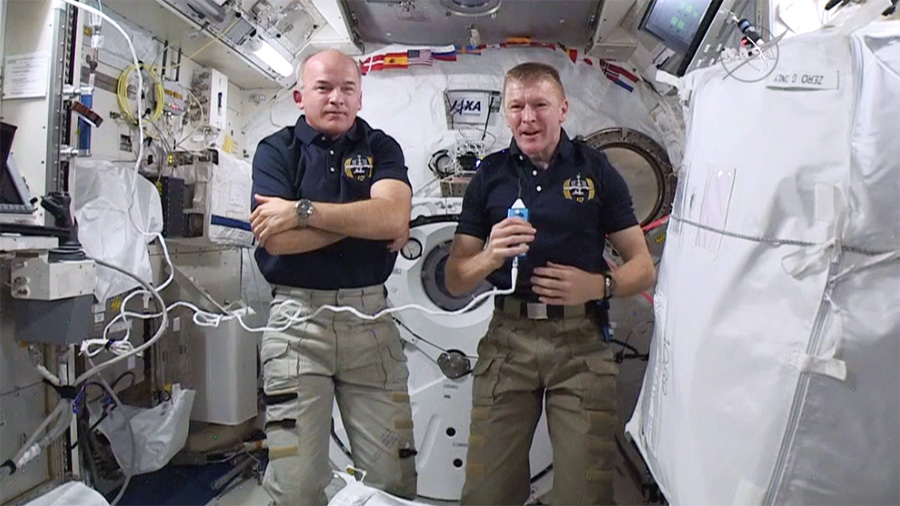
Image above: Astronauts Jeff Williams and Tim Peake talk to students in Dallas, Texas for an educational event. Image Credit: NASA TV.
Hardware was set up today that will measure fluid pressure in an astronaut’s head for the Fluid Shifts experiment. That study observes how living in space impacts cells and blood vessels and researches the possibility that it may affect vision.
The crew continues to document its living conditions on the space station to help engineers design future spacecraft with habitable accommodations. New radios that were installed in March are also being tested that will communicate with future spacecraft to visit the station.
Related links:
Assessment of myostatin inhibition to prevent skeletal muscle atrophy and weakness in mice exposed to long-duration spaceflight (Rodent Research-3-Eli Lilly): http://www.nasa.gov/mission_pages/station/research/experiments/1722.html
Fluid Shifts experiment: http://www.nasa.gov/mission_pages/station/research/experiments/1257.html
Habitable accommodations: http://www.nasa.gov/mission_pages/station/research/experiments/1772.html
International Space Station (ISS): https://www.nasa.gov/mission_pages/station/main/index.html
Space Station Research and Technology: https://www.nasa.gov/mission_pages/station/research/index.html
Image (mentioned), Text, Credits: NASA/Mark Garcia.
Greetings, Orbiter.ch
Hubble Discovers Moon Orbiting the Dwarf Planet Makemake
NASA - Hubble Space Telescope patch.
April 26, 2016
Peering to the outskirts of our solar system, NASA’s Hubble Space Telescope has spotted a small, dark moon orbiting Makemake, the second brightest icy dwarf planet — after Pluto — in the Kuiper Belt.
The moon — provisionally designated S/2015 (136472) 1 and nicknamed MK 2 — is more than 1,300 times fainter than Makemake. MK 2 was seen approximately 13,000 miles from the dwarf planet, and its diameter is estimated to be 100 miles across. Makemake is 870 miles wide. The dwarf planet, discovered in 2005, is named for a creation deity of the Rapa Nui people of Easter Island.
Hubble Discovers Moon Orbiting the Dwarf Planet Makemake
Video above: Astronomers using the Hubble Space Telescope discovered a moon orbiting dwarf planet Makemake -- the third largest known object past the orbit of Neptune, about two thirds the size of Pluto. Further observations of this moon may allow astronomers to calculate Makemake's mass, which will give them a better idea of its density and thus its bulk composition. The Hubble Space Telescope has been instrumental in studying our outer solar system; it also discovered four of the five moons orbiting Pluto. Video Credits: NASA/Goddard/Katrina Jackson.
The Kuiper Belt is a vast reservoir of leftover frozen material from the construction of our solar system 4.5 billion years ago and home to several dwarf planets. Some of these worlds have known satellites, but this is the first discovery of a companion object to Makemake. Makemake is one of five dwarf planets recognized by the International Astronomical Union.
The observations were made in April 2015 with Hubble’s Wide Field Camera 3. Hubble’s unique ability to see faint objects near bright ones, together with its sharp resolution, allowed astronomers to pluck out the moon from Makemake’s glare. The discovery was announced today in a Minor Planet Electronic Circular.
Image above: This Hubble image reveals the first moon ever discovered around the dwarf planet Makemake. The tiny satellite, located just above Makemake in this image, is barely visible because it is almost lost in the glare of the very bright dwarf planet. Hubble’s sharp-eyed WFC3 made the observation in April 2015. Image Credits: NASA, ESA, and A. Parker and M. Buie (SwRI).
The observing team used the same Hubble technique to observe the moon as they did for finding the small satellites of Pluto in 2005, 2011, and 2012. Several previous searches around Makemake had turned up empty. “Our preliminary estimates show that the moon’s orbit seems to be edge-on, and that means that often when you look at the system you are going to miss the moon because it gets lost in the bright glare of Makemake,” said Alex Parker of Southwest Research Institute, Boulder, Colorado, who led the image analysis for the observations.
A moon’s discovery can provide valuable information on the dwarf-planet system. By measuring the moon’s orbit, astronomers can calculate a mass for the system and gain insight into its evolution.
Uncovering the moon also reinforces the idea that most dwarf planets have satellites.
“Makemake is in the class of rare Pluto-like objects, so finding a companion is important,” Parker said. “The discovery of this moon has given us an opportunity to study Makemake in far greater detail than we ever would have been able to without the companion.”
Finding this moon only increases the parallels between Pluto and Makemake. Both objects are already known to be covered in frozen methane. As was done with Pluto, further study of the satellite will easily reveal the density of Makemake, a key result that will indicate if the bulk compositions of Pluto and Makemake are also similar. “This new discovery opens a new chapter in comparative planetology in the outer solar system,” said team leader Marc Buie of the Southwest Research Institute, Boulder, Colorado.
The researchers will need more Hubble observations to make accurate measurements to determine if the moon’s orbit is elliptical or circular. Preliminary estimates indicate that if the moon is in a circular orbit, it completes a circuit around Makemake in 12 days or longer.
Determining the shape of the moon’s orbit will help settle the question of its origin. A tight circular orbit means that MK 2 is probably the product of a collision between Makemake and another Kuiper Belt Object. If the moon is in a wide, elongated orbit, it is more likely to be a captured object from the Kuiper Belt. Either event would have likely occurred several billion years ago, when the solar system was young.
The discovery may have solved one mystery about Makemake. Previous infrared studies of the dwarf planet revealed that while Makemake’s surface is almost entirely bright and very cold, some areas appear warmer than other areas. Astronomers had suggested that this discrepancy may be due to the sun warming discrete dark patches on Makemake’s surface. However, unless Makemake is in a special orientation, these dark patches should make the dwarf planet’s brightness vary substantially as it rotates. But this amount of variability has never been observed.
These previous infrared data did not have sufficient resolution to separate Makemake from MK 2. The team’s reanalysis, based on the new Hubble observations, suggests that much of the warmer surface detected previously in infrared light may, in reality, simply have been the dark surface of the companion MK 2.
Image above: This artist's concept shows the distant dwarf planet Makemake and its newly discovered moon. Makemake and its moon, nicknamed MK 2, are more than 50 times farther away than Earth is from the sun. Image Credits: NASA, ESA, and A. Parker (Southwest Research Institute).
There are several possibilities that could explain why the moon would have a charcoal-black surface, even though it is orbiting a dwarf planet that is as bright as fresh snow. One idea is that, unlike larger objects such as Makemake, MK 2 is small enough that it cannot gravitationally hold onto a bright, icy crust, which sublimates, changing from solid to gas, under sunlight. This would make the moon similar to comets and other Kuiper Belt Objects, many of which are covered with very dark material.
When Pluto’s moon Charon was discovered in 1978, astronomers quickly calculated the mass of the system. Pluto’s mass was hundreds of times smaller than the mass originally estimated when it was found in 1930. With Charon’s discovery, astronomers suddenly knew something was fundamentally different about Pluto. “That’s the kind of transformative measurement that having a satellite can enable,” Parker said.
The Hubble Space Telescope is a project of international cooperation between NASA and the European Space Agency. NASA's Goddard Space Flight Center in Greenbelt, Maryland, manages the telescope. The Space Telescope Science Institute (STScI) in Baltimore, Maryland, conducts Hubble science operations. STScI is operated for NASA by the Association of Universities for Research in Astronomy in Washington, D.C.
For images and more information about Makemake's moon MK 2 and Hubble, visit:
http://www.nasa.gov/hubble
http://hubblesite.org/
https://www.spacetelescope.org/
Images (mentioned), Text, Credits: NASA/Felicia Chou/Ashley Morrow/Space Telescope Science Institute, Baltimore/Donna Weaver/Ray Villard/Southwest Research Institute/Alex Parker.
Greetings, Orbiter.ch
Light Echoes Give Clues to Protoplanetary Disk
NASA - Spitzer Space Telescope patch.
April 26, 2016
Imagine you want to measure the size of a room, but it's completely dark. If you shout, you can tell if the space you're in is relatively big or small, depending on how long it takes to hear the echo after it bounces off the wall.
Astronomers use this principle to study objects so distant they can't be seen as more than points. In particular, researchers are interested in calculating how far young stars are from the inner edge of their surrounding protoplanetary disks. These disks of gas and dust are sites where planets form over the course of millions of years.
"Understanding protoplanetary disks can help us understand some of the mysteries about exoplanets, the planets in solar systems outside our own," said Huan Meng, postdoctoral research associate at the University of Arizona, Tucson. "We want to know how planets form and why we find large planets called 'hot Jupiters' close to their stars."
Image above: This illustration shows a star surrounded by a protoplanetary disk. Material from the thick disk flows along the star’s magnetic field lines and is deposited onto the star’s surface. When material hits the star, it lights up brightly. Image Credits: NASA/JPL-Caltech.
Meng is the first author on a new study published in the Astrophysical Journal using data from NASA's Spitzer Space Telescope and four ground-based telescopes to determine the distance from a star to the inner rim of its surrounding protoplanetary disk.
Making the measurement wasn't as simple as laying a ruler on top of a photograph. Doing so would be as impossible as using a satellite photo of your computer screen to measure the width of the period at the end of this sentence.
Instead, researchers used a method called "photo-reverberation," also known as "light echoes." When the central star brightens, some of the light hits the surrounding disk, causing a delayed “echo.” Scientists measured the time it took for light coming directly from the star to reach Earth, then waited for its echo to arrive.
Thanks to Albert Einstein's theory of special relativity, we know that light travels at a constant speed. To determine a given distance, astronomers can multiply the speed of light by the time light takes to get from one point to another.
To take advantage of this formula, scientists needed to find a star with variable emission -- that is, a star that emits radiation in an unpredictable, uneven manner. Our own sun has a fairly stable emission, but a variable star would have unique, detectable changes in radiation that could be used for picking up corresponding light echoes. Young stars, which have variable emission, are the best candidates.
The star used in this study is called YLW 16B and lies about 400 light-years from Earth. YLW 16B has about the same mass as our sun, but at one million years old, it's just a baby compared to our 4.6-billion-year-old home star.
Image above: Astronomers can use light echoes to measure the distance from a star to its surrounding protoplanetary disk. This diagram illustrates how the time delay of the light echo is proportional to the distance between the star and the inner edge of the disk. Image Credits: NASA/JPL-Caltech.
Astronomers combined Spitzer data with observations from ground-based telescopes: the Mayall telescope at Kitt Peak National Observatory in Arizona; the SOAR and SMARTS telescopes in Chile; and the Harold L. Johnson telescope in Mexico. During two nights of observation, researchers saw consistent time lags between the stellar emissions and their echoes in the surrounding disk. The ground-based observatories detected the shorter-wavelength infrared light emitted directly from the star, and Spitzer observed the longer-wavelength infrared light from the disk's echo. Because of thick interstellar clouds that block the view from Earth, astronomers could not use visible light to monitor the star.
Researchers then calculated how far this light must have traveled during that time lag: about 0.08 astronomical units, which is approximately 8 percent of the distance between Earth and its sun, or one-quarter the diameter of Mercury's orbit. This was slightly smaller than previous estimates with indirect techniques, but consistent with theoretical expectations.
Although this method did not directly measure the height of the disk, researchers were able to determine that the inner edge is relatively thick.
Previously, astronomers had used the light echo technique to measure the size of accretion disks of material around supermassive black holes. Since no light escapes from a black hole, researchers compare light from the inner edge of the accretion disk to light from the outer edge to determine the disk size. This technique is also used to measure the distance to other features near the accretion disk, such as dust and the surrounding fast-moving gas.
Spitzer Space Telescope. Image Credit: NASA
While light echoes from supermassive black holes represent delays of days to weeks, scientists measured the light echo from the protoplanetary disk in this study to be a mere 74 seconds.
The Spitzer study marks the first time the light echo method was used in the context of protoplanetary disks.
"This new approach can be used for other young stars with planets in the process of forming in a disk around them," said Peter Plavchan, co-author of the study and assistant professor at Missouri State University in Springfield.
NASA's Jet Propulsion Laboratory in Pasadena, California, manages the Spitzer Space Telescope mission for NASA's Science Mission Directorate in Washington. Science operations are conducted at the Spitzer Science Center at the California Institute of Technology in Pasadena. Meng was a visiting researcher at Caltech during this research. Spacecraft operations are based at Lockheed Martin Space Systems Company in Littleton, Colorado. Data are archived at the Infrared Science Archive housed at the Infrared Processing and Analysis Center at Caltech. Caltech manages JPL for NASA.
Related study published on Astrophysical Journal: http://arxiv.org/abs/1603.06000
For more information about Spitzer, visit: http://www.nasa.gov/spitzer
Images (mentioned), Text, Credits: NASA/Tony Greicius/JPL/Elizabeth Landau.
Greetings, Orbiter.ch
Profile of a methane sea on Titan
ESA - Cassini Mission to Saturn logo.
26 April 2016
Image above: Sunlight glints off of Titan's northern seas this near-infrared, color mosaic from NASA's Cassini spacecraft. Image Credits: NASA/JPL/Univ. Arizona/Univ. Idaho.
Saturn's largest moon is covered in seas and lakes of liquid hydrocarbons – and one sea has now been found to be filled with pure methane, with a seabed covered by a sludge of organic-rich material, and possibly surrounded by wetlands.
Of all the moons in the Solar System, Titan is the only one with a thick atmosphere and large liquid reservoirs on its surface – in some ways making it more like a planet such as Earth.
Both Earth and Titan have atmospheres dominated by nitrogen, over 95% in Titan's case. However, unlike Earth, there is little oxygen: the remaining is mostly methane, with a small amount of hydrogen, and trace amounts of other gases such as ethane.
Ligeia Mare. Image Credits: NASA/JPL-Caltech/ASI/Cornell
And at the low temperatures found far from the Sun, the methane and ethane can in principle sit on the surface as liquids.
There has long been speculation about possible hydrocarbon lakes and seas on Titan, and when the international Cassini-Huygens mission arrived at Saturn in 2004 they were revealed.
Since then, the Cassini orbiter has revealed that more than 1.6 million sq km of Titan – almost 2% – are covered in liquid.
There are three large seas, all close to the north pole, surrounded by dozens of smaller lakes in the northern hemisphere. Just one lake has been found in the southern hemisphere.
The exact make-up of these liquid reservoirs remained elusive until recently. A new study using scans from Cassini's radar during flybys of Titan between 2007 and 2015 confirms that one of the largest seas on the moon, Ligeia Mare, is mostly liquid methane.
"We expected to find that Ligeia Mare would be mostly ethane, which is produced in abundance in the atmosphere when sunlight breaks methane molecules apart," explains Alice Le Gall from the Laboratoire Atmosphères, Milieux, Observations Spatiales and Université Versailles Saint-Quentin, France, and lead author of the new study.
"Instead, this sea is predominantly made of pure methane."
There are a number of possible explanations to account for the unexpected composition confirmed by this study.
Images above: Lakes and Seas on Titan. Images Credits: Centre: NASA/JPL-Caltech/ASI/USGS; left and right: NASA/ESA.
"Either Ligeia Mare is replenished by fresh methane rainfall, or something is removing ethane from it," says Alice.
"It is possible that the ethane ends up in the undersea crust, or that it somehow flows into the adjacent sea, Kraken Mare, but that will require further investigation."
In their research, the scientists combined several observations of thermal emission from Ligeia Mare at one microwave wavelength. They also made use of data from a radio sounding experiment performed in May 2013 in a study led by Marco Mastrogiuseppe, who also collaborated on the current study.
During the radio sounding, the instrument detected echoes from the seafloor and inferred the depth of Ligeia Mare along Cassini's track over the sea – the first-ever detection of the bottom of an extraterrestrial sea. The scientists were surprised to find depths in Ligeia Mare as great as 160 m at the deepest point along the radar track.
With this depth information, Alice and her colleagues were able to separate the contributions made to the sea's observed thermal emission by the liquid sea and the seabed.
"This revealed that the seabed of Ligeia Mare is likely covered by a sludge layer of organic-rich compounds," adds Alice.
Organic compounds in Titan's seas and lakes. Image Credit: ESA
In the atmosphere of Titan, nitrogen and methane react to produce a variety of organic molecules. Scientists believe the heaviest of these molecules fall to the surface. When they reach the sea, either by directly falling from the air, via rain or through Titan's rivers, some are dissolved in the liquid methane, while the insoluble ones – compounds such as nitriles and benzene – sink to the sea floor.
The study also looked at the temperature of Ligeia Mare from winter to spring. The scientists expected that, like the seaside on Earth, the surrounding solid terrain would warm more rapidly than the sea.
Interestingly, the measurements showed no significant difference between the sea's temperature and that of the shore, but they did reveal a general lag in warming in Titan's north polar region as summer approaches. This suggests that the terrains surrounding the lakes and seas are flooded with liquid hydrocarbons, which would alter their thermal characteristics.
"This study has pinned down, for the first time, the basic properties of one of Titan's seas, improving our understanding of climate and circulation processes on this fascinating world," says Nicolas Altobelli, ESA's Cassini-Huygens Project Scientist.
Soaring Over Titan: Extraterrestrial Land of Lakes
Video above: This colorized flyover movie from NASA's Cassini mission takes viewers over the two largest seas on Saturn's moon Titan and nearby lakes.
Notes for Editors:
"Composition, seasonal change, and bathymetry of Ligeia Mare, Titan, derived from its microwave thermal emission," by A. Le Gall et al. (2016) is published in Journal of Geophysical Research: Planets. The study is also based on the results presented in "The bathymetry of a Titan sea" by M. Mastrogiuseppe et al. (2014), published in Geophysical Research Letters:
http://dx.doi.org/10.1002/2015JE004920
http://dx.doi.org/10.1002/2013GL058618
Cassini-Huygens is a cooperative project of NASA, ESA and ASI, the Italian space agency.
For more information about the Cassini-Huygens mission visit http://saturn.jpl.nasa.gov and http://www.nasa.gov/cassini. The Cassini imaging team homepage is at http://ciclops.org and ESA's website: http://www.esa.int/Our_Activities/Space_Science/Cassini-Huygens
Images (mentioned), Video, Text, Credits: ESA/Markus Bauer/Nicolas Altobelli/Laboratoire Atmosphères, Milieux, Observations Spatiales (LATMOS), Université Versailles Saint-Quentin (UVSQ)/Alice Le Gall/NASA/JPL-Caltech.
Best regards, Orbiter.ch
SDO Captures Stunning View of April 17 Solar Flare
NASA - Solar Dynamics Observatory (SDO) patch.
April 26, 2016
SDO 4K View of April 17 Solar Flare. Image Credits: NASA/SDO
On April 17, 2016, an active region on the sun’s right side released a mid-level solar flare, which can be seen in this movie as a bright flash of light. The movie shows imagery from NASA’s Solar Dynamics Observatory, which observes the sun constantly to help scientists understand what causes eruptions like these. Solar flares are powerful bursts of radiation. Harmful radiation from a flare cannot pass through Earth's atmosphere to physically affect humans on the ground, however -- when intense enough -- they can disturb the atmosphere in the layer where GPS and communications signals travel.
NASA's 4K View of April 17 Solar Flare
Video above: NASA's 4K View of April 17 Solar Flare. Video Credits: NASA's Goddard Space Flight Center/SDO/Genna Duberstein.
The flare shown here was of moderate strength and only caused brief radio blackouts, according to NOAA's Space Weather Prediction Center. This video was captured in several wavelengths of extreme ultraviolet light, a type of light that is typically invisible to our eyes, but is color-coded in SDO images for easy viewing.
Related article:
More about the April 17, 2016, solar flare:
http://orbiterchspacenews.blogspot.ch/2016/04/nasas-sdo-captures-images-of-mid-level.html
For more information about Solar Dynamics Observatory (SDO), visit:
http://www.nasa.gov/mission_pages/sdo/main/index.html
Image (mentioned), Video (mentioned), Text, Credits: NASA's Goddard Space Flight Center/Sarah Frazier/Rob Garner.
Greetings, Orbiter.ch
Inscription à :
Articles (Atom)