mardi 8 novembre 2016
Crew Sets up for Earth and Radiation Studies Before Next Trio Launches
ISS - Expedition 50 Mission patch.
November 8, 2016
The Expedition 50 trio orbiting on the International Space Station is conducting maintenance while getting ready for Earth observations and radiation exposure studies today. In Kazakhstan, three new crew members are waiting as their Soyuz rocket is prepared for launch.
Commander Shane Kimbrough started work on the U.S. segment’s Oxygen Generation System (OGS), which will undergo maintenance throughout the week. Today, Kimbrough tagged up with ground specialists and replaced a hydrogen sensor and will continue to work on OGS through Wednesday. The system is currently shut down due to a low voltage signature within the Hydrogen Orbital Replacement Unit (ORU) that contains the electrolyzing cell stack. The Russian Elektron system is providing oxygen for the crew at this time.
Image above: Middle school children programmed a space station camera to photograph this portion of the Sahara desert seen in western Libya in October. Image Credits: Sally Ride EarthKAM.
The two flight engineers, new cosmonaut Sergey Ryzhikov and veteran station commander Andrey Borisenko, are handing over a set of radiation detectors to Kimbrough. The NASA astronaut, who is on his second trip in space, will install the Radi-N2 detectors in the Destiny laboratory for a week to help doctors understand the radiation risk to crew health and develop protective measures.
Ryzhikov is also setting up a camera that will allow middle school students to photograph targets on Earth and downlink the imagery. The Sally Ride EarthKAM gear will be set up in the Harmony module’s Earth-facing hatch window and use internet-based tools to promote the learning process.
Another trio of Expedition 50 members is counting down to its Nov. 17 launch and two-day trip to the space station from the Baikonur Cosmodrome. Veteran station residents Peggy Whitson of NASA and Oleg Novitskiy of Roscosmos, along with first-time space flyer Thomas Pesquet of the European Space Agency, are in final training before they liftoff aboard the Soyuz MS-03 spacecraft. This will be Whitson’s third station mission and Novitskiy’s second.
Image above: Expedition 50-51 crew members (from left) Peggy Whitson, Oleg Novitskiy and Thomas Pesquet try on their spacesuits and check out the Soyuz MS-01 spacecraft in Kazakhstan. Image Credits: NASA/Alexander Vysotsky.
Thomas Pesquet, Peggy Whitson and Oleg Novitskiy have tried on their spacesuits and checked out the Soyuz MS-03 spacecraft they will blast off in Nov. 17. After launch, the trio will take a two-day trip to their new home in space where they will live until May. Today, the new crew is participating in flag-raising and tree-planting ceremonies at the Baikonur Cosmodrome launch site.
The orbiting crew of Commander Shane Kimbrough and Flight Engineers Sergey Ryzhikov and Andrey Borisenko are conducting critical space science while maintaining station systems.
Related links:
Expedition 50: http://www.nasa.gov/mission_pages/station/expeditions/expedition50/index.html
Radi-N2 detectors: http://www.nasa.gov/mission_pages/station/research/experiments/898.html
Sally Ride EarthKAM: http://www.nasa.gov/mission_pages/station/research/experiments/90.html
Space Station Research and Technology: https://www.nasa.gov/mission_pages/station/research/index.html
International Space Station (ISS): https://www.nasa.gov/mission_pages/station/main/index.html
Images (mentioned), Text, Credits: NASA/Mark Garcia.
Greetings, Orbiter.ch
lundi 7 novembre 2016
Weekly Recap From the Expedition Lead Scientist, Week of Oct. 24, 2016
ISS - International Space Station logo.
Nov. 7, 2016
(Highlights: Week of Oct. 24, 2016) - It’s harvesting time for many crops in North America as winter approaches, but it’s planting season on the International Space Station as new crew members kicked off another run of an investigation that could help food production efforts on Earth.
NASA astronaut Shane Kimbrough configured and installed the hardware for the Veg-03 investigation, including planting six small plant pillows that will grow red romaine lettuce plants. Future long-duration space missions will require crew members to grow their own food. Understanding how plants respond to microgravity is an important step. Crew members on the station have previously grown lettuce and flowers in the Veggie facility. This new series of the study expands on previous validation tests. After the lettuce is harvested, crew members will attempt to grow cabbage in orbit. The investigation has scheduled four harvests over the course of two months.
Image above: NASA astronauts Kate Rubins, left, and Shane Kimbrough install the Veggie hardware to begin growing another crop of lettuce on the International Space Station. Image Credit: NASA.
Veggie provides lighting and necessary nutrients for plants in the form of a low-cost growth chamber and planting pillows, which deliver nutrients for the root system. The Veggie pillow concept is a low-mass, low-maintenance, modular system that requires no additional energy beyond a special light to help the plants grow. It supports a variety of plant species that can be cultivated for fresh food, and even for education experiments.
Crew members have commented that space gardening is fun, and investigators believe growing plants could provide a psychological benefit to crew members on long-duration missions, just as gardening is often a fun hobby for people on Earth. Data from this investigation could benefit agricultural practices on Earth by designing systems that use valuable resources, such as water, more efficiently.
Image above: Russian cosmonaut Anatoly Ivanishi, left, and JAXA astronaut Takuya Onishi take one last peek out of the Earth-facing portal in the cupola to enjoy another sunset on the International Space Station before they returned to Earth with NASA astronaut Kate Rubins Oct. 29. Image Credit: NASA.
Kimbrough installed hardware for the University of Nebraska-Lincoln Detector for the Analysis of Solar Neutrons investigation. When spacecraft components are exposed to solar neutrons for an extended period, degradation issues may result. Neutron radiation is also a concern for humans. There is a risk of low-energy neutron exposure while in space, with the potential to suffer from adverse health consequences as a result. Accurate measurement of the neutron environment inside space vehicles advances development of more effective radiation-shielding materials and methods. This project involves installation of a new type of detector to improve the reliability of identifying these electrically neutral particles. An efficient and compact detector requiring no operational power is well-suited for use aboard spacecraft. The detector uses special crystals and a thin film of the boron isotope to absorb neutrons, leaving a distinct signature which is then processed and analyzed to determine radiation levels.
Neutron sources also are widely used in scientific research, including medical and commercial applications. A small and sensitive slow-neutron detector is useful for neutron radiation monitoring.
Image above: The solar arrays of the Cygnus cargo vehicle can be seen as the space station orbited over the Bahamas. Image Credit: NASA.
A similar study monitoring solar radiation is the Dose Distribution Inside the International Space Station-3D (DOSIS-3D) investigation. As one of his last tasks in orbit before returning to Earth on Oct. 29, JAXA (Japan Aerospace Exploration Agency) astronaut Takuya Onishi retrieved 11 detectors for further study. The DOSIS-3D investigation uses several active and passive detectors to determine the radiation doses. The goal of the ESA (European Space Agency) investigation is creating a 3-D radiation map covering all sections of the outpost, documenting the nature and distribution of the radiation field inside the orbiting laboratory. On Earth, flight crews and nuclear plant workers are exposed to greater-than-average radiation. DOSIS-3D also provides insight into combining different devices for dosage monitoring and lessons in how to monitor real-time data. This could improve radiation monitoring for commercial and military airline crews, as well as other workers exposed to radiation on Earth.
Progress was made on other investigations and facilities this week, including JAXA Protein Crystal Growth, Meteor, JAXA EPO, ACE T-1, EML Batch 1.2c, FLEX-2, MSL Batch 2b, SODI DCMIX, BEAM, Biomolecule Sequencer and Manufacturing Device.
Other human research investigations conducted this week include Airway Monitoring, Biochem Profile, EDOS-2, IMMUNO-2, Fine Motor Skills, Habitability, IPVI, Neuromapping, Dose Tracker, and Space Headaches.
Related links:
Japan Aerospace Exploration Agency (JAXA): http://global.jaxa.jp/
European Space Agency (ESA): http://www.esa.int/ESA
Veg-03 investigation: http://www.nasa.gov/mission_pages/station/research/experiments/1294.html
Veggie facility: http://www.nasa.gov/mission_pages/station/research/experiments/383.html
University of Nebraska-Lincoln Detector for the Analysis of Solar Neutrons investigation: http://www.nasa.gov/mission_pages/station/research/experiments/2296.html
International Space Station-3D (DOSIS-3D): http://www.nasa.gov/mission_pages/station/research/experiments/184.html
JAXA Protein Crystal Growth: http://www.nasa.gov/mission_pages/station/research/experiments/157.html
Meteor: http://www.nasa.gov/mission_pages/station/research/experiments/1323.html
JAXA EPO: http://www.nasa.gov/mission_pages/station/research/experiments/970.html
ACE T-1: http://www.nasa.gov/mission_pages/station/research/experiments/2033.html
FLEX-2: http://www.nasa.gov/mission_pages/station/research/experiments/480.html
MSL Batch 2b: http://www.nasa.gov/mission_pages/station/research/experiments/1978.html
SODI DCMIX: http://www.nasa.gov/mission_pages/station/research/experiments/1175.html
BEAM: http://www.nasa.gov/mission_pages/station/research/experiments/1804.html
Biomolecule Sequencer: http://www.nasa.gov/mission_pages/station/research/experiments/2181.html
Manufacturing Device: http://www.nasa.gov/mission_pages/station/research/experiments/2198.html
Airway Monitoring: http://www.nasa.gov/mission_pages/station/research/experiments/1172.html
Biochem Profile: http://www.nasa.gov/mission_pages/station/research/experiments/1008.html
EDOS-2: http://www.nasa.gov/mission_pages/station/research/experiments/619.html
IMMUNO-2: http://www.nasa.gov/mission_pages/station/research/experiments/1790.html
Fine Motor Skills: http://www.nasa.gov/mission_pages/station/research/experiments/1767.html
Habitability: http://www.nasa.gov/mission_pages/station/research/experiments/1772.html
IPVI: http://www.nasa.gov/mission_pages/station/research/experiments/1950.html
Neuromapping: http://www.nasa.gov/mission_pages/station/research/experiments/1007.html
Dose Tracker: http://www.nasa.gov/mission_pages/station/research/experiments/1933.html
Space Headaches: http://www.nasa.gov/mission_pages/station/research/experiments/181.html
Space Station Research and Technology: https://www.nasa.gov/mission_pages/station/research/index.html
International Space Station (ISS): https://www.nasa.gov/mission_pages/station/main/index.html
Images (mentioned), Text, Credits: NASA/Vic Cooley, Lead Increment Scientist Expeditions 49 & 50/Kristine Rainey.
Best regards, Orbiter.ch
Ring Details on Display
NASA - Cassini Mission to Saturn patch.
Nov. 7, 2016
This view from NASA's Cassini spacecraft showcases some of the amazingly detailed structure of Saturn's rings.
The rings are made up of many smaller ringlets that blur together when seen from a distance. But when imaged up close, the rings' structures display quite a bit of variation. Ring scientists are debating the nature of these features — whether they have always appeared this way or if their appearance has evolved over time.
This view looks toward the sunlit side of the rings from about 4 degrees above the ring plane. The image was taken in visible light with the Cassini spacecraft wide-angle camera on Sept. 24, 2016.
The view was acquired at a distance of approximately 283,000 miles (456,000 kilometers) from Saturn and at a Sun-Saturn-spacecraft, or phase, angle of 32 degrees. Image scale is 17 miles (27 kilometers) per pixel.
The Cassini mission is a cooperative project of NASA, ESA (the European Space Agency) and the Italian Space Agency. The Jet Propulsion Laboratory, a division of the California Institute of Technology in Pasadena, manages the mission for NASA's Science Mission Directorate, Washington. The Cassini orbiter and its two onboard cameras were designed, developed and assembled at JPL. The imaging operations center is based at the Space Science Institute in Boulder, Colorado.
For more information about the Cassini-Huygens mission visit http://saturn.jpl.nasa.gov and http://www.nasa.gov/cassini. The Cassini imaging team homepage is at http://ciclops.org and ESA's website http://www.esa.int/Our_Activities/Space_Science/Cassini-Huygens
Image, Text, Credits: NASA/JPL-Caltech/Space Science Institute/Tony Greicius.
Greetings, Orbiter.ch
Mars' ionosphere shaped by crustal magnetic fields
ESA - Mars Express Mission patch.
07 November 2016
Scattered pockets of magnetism across the surface of Mars have a significant influence on the planet's upper atmosphere, according to observations from ESA's Mars Express. Understanding these effects may be crucial for ensuring safe radio communications between Mars and Earth and, eventually, between explorers on the surface of the planet.
Earth's magnetic field is dominated by a single, strong source: the dynamo deep below the planet's surface. However, the same cannot be said for Mars. Rather than possessing a single source of magnetic field, Mars has many.
Image above: Mars as viewed by the Visual Monitoring Camera on Mars Express. Image Credits: ESA/D. O'Donnell - CC BY-SA IGO.
The Red Planet has numerous pockets of strong magnetism locked up within its crust, remnants from its earliest days. Modern-day Mars may be known for its relative lack of magnetism but young Mars was likely a different world; it was probably warmer and wetter, with a denser atmosphere and a hotter core. Scientists believe the young planet also had a sizeable magnetic field, driven by the circulating motion of molten material within its core (known as a planetary dynamo).
This global field switched off long ago – likely as the core cooled and solidified, freezing the dynamo in place – but the planet still boasts anomalous patches of strong remnant magnetism spread across its surface, known as 'crustal fields'.
Magnetic memories of early Mars
Parts of Mars' crust and rock remain magnetised today due to a phenomenon known as 'ferro-magnetism', which lasts even when the external magnetic field is no longer present (as is the case with Mars).
Magnetic map of Mars. Image Credit: NASA
Mars' crust cooled to below a specific temperature – known as the Curie temperature [1] – when the planet's core dynamo, and thus its magnetic field, was still active and present, causing residual magnetism to become permanently locked within ferrous (iron-containing) material in the crust. Similar crustal magnetic fields are also found on the Earth and the Moon.
These fields can later be removed by reheating material to above the Curie temperature – via large impacts, for example – and then allowing it to cool again in the absence of a magnetic field.
Magnetism is thought to have been wiped out from sizeable patches of the martian crust in this way, but large portions of the southern, and smaller parts of the northern, hemisphere of Mars remain magnetised to some degree, with pockets scattered planet-wide. These crustal fields are strong enough to drive features in Mars' upper atmosphere akin to the aurorae seen on Earth – such features have been seen by ESA's Mars Express).
Image above: Mars Express aurora detections. Image Credits: Based on data from J.-C. Gérard et al. (2015).
"They may be weak in terms of absolute strength – hundreds of nanotesla in the upper atmosphere on average, or between 0.1 and 1 per cent of the field strength produced by the Earth's dynamo at the equivalent altitude – but Mars' crustal fields are significantly stronger than those found on the Earth or the Moon," says Markus Fraenz of the Max Planck Institute for Solar System Research in Göttingen, Germany. "This indicates that Mars' dynamo field was once at least as strong as Earth's – but in order to produce such strong patches of remnant crustal magnetisation, it was probably stronger than our planet's has ever been."
Unfortunately no lander or rover has yet reached these sites of strong magnetisation, but comprehensive observations from long-lived orbiters such as NASA's Mars Global Surveyor and ESA's Mars Express have helped scientists to characterise Mars' magnetic environment.
Mars Express has been in orbit around Mars since 2003, and has completed numerous studies using its MARSIS (Mars Advanced Radar for Subsurface and Ionosphere Sounding) and ASPERA-3 (Analyzer of Space Plasmas and Energetic Atoms) instruments to explore the effect these crustal fields have on Mars' ionosphere.
"Mars' crustal fields appear to strongly control the plasma in the planet's upper atmosphere," says David Andrews of the Swedish Institute of Space Physics in Uppsala. More specifically, they affect a layer of weakly ionised gas known as the ionosphere, which sits sandwiched between the bulk of Mars' neutral atmosphere and the intense radiation of outer space (including the solar wind, a stream of charged particles – protons and electrons – emanating from the Sun).
Climbing plasma in Mars' ionosphere
Mars' ionosphere is quite similar to Earth's in many respects, such as the typical densities, altitudes, and so on. "Earth's ionosphere is a bit more complex in terms of its structure, and has a larger number of distinct layers," says Andrews. "This is partly due to Earth's atmosphere being a mix of nitrogen and oxygen, unlike the CO2-dominated martian atmosphere."
Mars' crustal fields affect the motion and dynamics of its ionospheric plasma, influencing how it circulates, accumulates, and escapes to space. For example, plasma soars to far higher altitudes than expected in regions with vertically-oriented crustal fields, and areas with stronger crustal fields are topped by denser and more extensive layers of ionosphere than weaker or absent fields.
The magnetic and plasma environment at Mars. Image Credit: ESA
Mars' ionosphere sits at the boundary between Mars' lower atmosphere and the solar wind, which floods out into space from the Sun. The solar wind also drags the solar magnetic field out into the Solar System as it travels, creating the interplanetary magnetic field (IMF).
When dragged into Mars' vicinity, IMF field lines can connect with the field lines emanating from some regions of Mars' crust (a process known as 'magnetic reconnection'). This process allows plasma to race upwards along the newly-created lines and escape to space, creating narrow cavities within Mars' ionosphere that are comparatively lacking in electrons.
"The big question, however, is whether or not these crustal fields affect the rate at which Mars loses its atmosphere to space and if so, how," says Andrews. "It's likely that while plasma is reconfigured in regions where the field is strong, the long-term averages of atmospheric escape are not massively different – but we're unsure."
From day to night
The behaviour and properties of the ionosphere differ between the region nearest the Sun (the 'dayside', between Mars and the Sun) and that stretching away from it (the 'night side', tailing away from Mars towards the outer Solar System).
Mars Express data have shown the dayside ionosphere to be surprisingly complex and variable, with electron densities and structured layers of plasma that change abruptly and inconsistently. The satellite has also flagged up how much there is to understand about the night side, and why some of its properties differ considerably from the dayside.
The process of plasma escape via magnetic reconnection, for example, is especially efficient at the day-night boundary (the regions surrounding this boundary, or terminator, are sometimes named 'morning' and 'evening' or 'dawn' and 'dusk'). Similarly, the ionosphere on the dayside is both denser and stretches to higher altitudes over crustal anomalies than on the night side. Plasma also appears to flow towards Mars on the dayside, and away at the day-night boundary.
In general, the number and density of electrons in the ionosphere increases with field strength during the day and at the boundary between day and night – but on the night side, the opposite is true. Mars' night side ionosphere is patchy; it is replenished by some of the plasma from the dayside ionosphere, and by precipitating electrons from the solar wind and magnetosphere (the region of space over which Mars' small intrinsic magnetic field dominates).
"This all reinforces the idea that Mars' plasma environment is strongly influenced by both the levels of incoming solar radiation, and the strength and distribution of the planet's crustal fields," says Eduard Dubinin of the Max Planck Institute for Solar System Research in Göttingen, Germany. "We need to understand much more about these interactions and about Mars' ionosphere in general to paint a detailed picture of Mars' longer-term evolution in terms of climate, habitability, loss of water and atmosphere, and more."
Issues for Red Planet radio?
As well as forming a better scientific understanding of Mars as a planet, knowing more about the martian ionosphere and crustal fields is vital for missions currently at Mars, and for those planned in the future (including crewed missions).
For example, the ionosphere dictates how, when, and where Mars Express' radar equipment (MARSIS) can operate. The dayside ionosphere of Mars is denser and more reflective of radio waves. MARSIS can thus probe Mars' ionosphere on the dayside, as the plasma there reflects incoming radar pulses at the appropriate frequencies (~MHz). On the night side, however, MARSIS performs subsurface sounding. The instrument's radio waves reach through the comparatively sparse ionosphere and can make it far further before being reflected, reaching Mars' surface and up to about 10 km below.
Mars Express with MARSIS antenna unfurled. Image Credit: ESA
"MARSIS can exploit the varying properties of the ionosphere, making it a great instrument to probe both the ionosphere and subsurface of Mars," says Dmitri Titov, project scientist for ESA's Mars Express.
The variability of the martian ionosphere could be an issue, however, for any communications on the surface of Mars.
Landers and rovers on Mars communicate with Earth via an orbiter, which in turn uses high enough radio frequencies (GHz) that the ionosphere is not a huge obstacle. However, this may become a larger issue if and when humans set foot on the planet.
"Shortwave radio communications (MHz) on the surface may be affected by variability of Mars' ionosphere, especially around stronger crustal fields, and our understanding here is still incomplete," adds Titov. "Understanding more about Mars' magnetic and plasma environment is key. Findings such as these from Mars Express are crucial to our continued exploration of the Solar System, whether with robots or human crews."
Background Information:
[1] The Curie temperature is the temperature above which some materials lose their permanent magnetic properties.
Contributing studies include:
Martian ionosphere observed by Mars Express. 1. Influence of the crustal magnetic fields, by E. Dubinin et al., Planetary and Space Science, Vol. 124, May 2016, pp.62-75; doi: 10.1016/j.pss.2016.02.004 (http://dx.doi.org/10.1016/j.pss.2016.02.004)
Empirical model of the Martian dayside ionosphere: Effects of crustal magnetic fields and solar ionizing flux at higher altitudes, by F. Nemec et al., Journal of Geophysical Research: Space Physics, Vol. 121, February 2016, pp. 1760-1771; doi: 10.1002/2015JA022060 (http://dx.doi.org/10.1002/2015JA022060)
The morphology of the topside ionosphere of Mars under different solar wind conditions: Results of a multi-instrument observing campaign by Mars Express in 2010, by P. Withers et al., Planetary and Space Science, Vol. 120, January 2016, pp. 24-34; doi: 10.1016/j.pss.2015.10.013 (http://dx.doi.org/10.1016/j.pss.2015.10.013)
Control of the topside Martian ionosphere by crustal magnetic fields, by D. Andrews et. al., Journal of Geophysical Research: Space Physics, Vol. 120, April 2015, pp. 3042-3058; doi: 10.1002/2014JA020703 (http://dx.doi.org/10.1002/2014JA020703)
The measurements were conducted by the Mars Express Analyzer for Space Plasmas and Energetic Atoms (ASPERA-3) plasma instrument suite and the Mars Advanced Radar for Sub-Surface and Ionospheric Sounding (MARSIS).
Related links:
Looking at Mars: http://www.esa.int/Our_Activities/Space_Science/Mars_Express
More about...
Mars Express overview: http://www.esa.int/Our_Activities/Space_Science/Mars_Express_overview
Mars Express 10 year brochure: http://esamultimedia.esa.int/multimedia/publications/BR-312/
Images (mentioned), Text, Credits: ESA/Dmitri Titov/Max Planck Institute for Solar System Research/Markus Fraenz/Eduard Dubinin/Swedish Institute of Space Physics/David Andrews.
Best regards, Orbiter.ch
vendredi 4 novembre 2016
ASACUSA improves measurement of antiproton mass
CERN - European Organization for Nuclear Research logo.
Nov. 4, 2016
In a paper published yesterday in the journal Science, the ASACUSA experiment at CERN reported new precision measurement of the mass of the antiproton relative to that of the electron. This result is based on spectroscopic measurements with about 2 billion antiprotonic helium atoms cooled to extremely cold temperatures of 1.5 to 1.7 degrees above absolute zero. In antiprotonic helium atoms an antiproton takes the place of one of the electrons that would normally be orbiting the nucleus. Such measurements provide a unique tool for comparing with high precision the mass of an antimatter particle with its matter counterpart. The two should be strictly identical.
"A pretty large number of atoms containing antiprotons were cooled below minus 271 degrees Celsius. It’s kind of surprising that a ‘half-antimatter’ atom can be made so cold by simply placing it in a refrigerated gas of normal helium," said Masaki Hori, group leader at the ASACUSA collaboration.
Image above: The ASACUSA experiment at CERN today reported new precision measurement of the mass of the antiproton relative to that of the electron. (Image: Sophia Bennett/ CERN).
Matter and antimatter particles are always produced as a pair in particle collisions. Particles and antiparticles have the same mass and opposite electric charge. The positively charged positron, for example, is an anti-electron, the antiparticle of the negatively charged electron. Positrons have been observed since the 1930s, both in natural collisions from cosmic rays and in particle accelerators. They are used today in hospital in PET scanners. However, studying antimatter particles with high-precision remains a challenge because when matter and antimatter come into contact, they annihilate – disappearing in a flash of energy.
CERN’s Antiproton Decelerator is a unique facility delivering low-energy antiproton beams to experiments for antimatter studies. In order to make measurements with these antiprotons, several experiments trap them for long periods using magnetic devices. ASACUSA’s approach is different as the experiment is able to create very special hybrid atoms made of a mix of matter and antimatter: these are the antiprotonic helium atoms composed of an antiproton and an electron orbiting a helium nucleus. They are made by mixing antiprotons with helium gas. In this mixture, about 3% of the antiprotons replace one of the two electrons of the helium atom. In antiprotonic helium, the antiproton is in orbit around the helium nucleus, and protected by the electron cloud that surrounds the whole atom, making antiprotonic helium stable enough for precision measurements.
The measurement of the antiproton’s mass is done by spectroscopy, by shining a laser beam onto the antiprotonic helium. Tuning the laser to the right frequency causes the antiprotons to make a quantum jump within the atoms. From this frequency the antiproton mass relative to the electron mass can be calculated. This method has been successfully used before by the ASACUSA collaboration to measure with high accuracy the antiproton’s mass. However, the microscopic motion of the antiprotonic helium atoms introduced a significant source of uncertainty in previous measurements.
The major new achievement of the collaboration, as reported in Science, is that ASACUSA has now managed to cool down the antiprotonic helium atoms to temperatures close to absolute zero by suspending them in a very cold helium buffer-gas. In this way, the microscopic motion of the atoms is reduced, enhancing the precision of the frequency measurement. The measurement of the transition frequency has been improved by a factor of 1.4 to 10 compared with previous experiments. Experiments were conducted from 2010 to 2014, with about 2 billion atoms, corresponding to roughly 17 femtograms of antiprotonic helium.
According to standard theories, protons and antiprotons are expected to have exactly the same mass. To date, no difference has been found between their masses, but pushing the precision limits of this comparison is a very important test of key theoretical principles such as the CPT symmetry. CPT is a consequence of basic symmetries of space-time, such as its isotropy in all directions. The observation of even a minute breaking of CPT would call for a review of our assumptions about the nature and properties of space-time.
The ASACUSA collaboration is confident that it will be able to further improve the precision of antiproton’s mass by using two laser beams. In the near future, the start of the ELENA facility at CERN will also allow the precision of such measurements to be improved.
Note:
CERN, the European Organization for Nuclear Research, is one of the world’s largest and most respected centres for scientific research. Its business is fundamental physics, finding out what the Universe is made of and how it works. At CERN, the world’s largest and most complex scientific instruments are used to study the basic constituents of matter — the fundamental particles. By studying what happens when these particles collide, physicists learn about the laws of Nature.
The instruments used at CERN are particle accelerators and detectors. Accelerators boost beams of particles to high energies before they are made to collide with each other or with stationary targets. Detectors observe and record the results of these collisions.
Founded in 1954, the CERN Laboratory sits astride the Franco–Swiss border near Geneva. It was one of Europe’s first joint ventures and now has 22 Member States.
For more information about European Organization for Nuclear Research (CERN), Visit: http://home.cern/
Image (mentioned), Text, Credits: CERN/Harriet Kim Jarlett.
Best regards, Orbiter.ch
NASA and FEMA Conduct Asteroid Impact Emergency Planning Exercise
Asteroid Watch logo.
Nov. 4, 2016
Asteroid. Image Credit: NASA
What would we do if we discovered a large asteroid on course to impact Earth? While highly unlikely, that was the high-consequence scenario discussed by attendees at an Oct. 25 NASA-FEMA tabletop exercise in El Segundo, California.
The third in a series of exercises hosted jointly by NASA and FEMA -- the Federal Emergency Management Agency -- the simulation was designed to strengthen the collaboration between the two agencies, which have Administration direction to lead the U.S. response. “It’s not a matter of if -- but when -- we will deal with such a situation,” said Thomas Zurbuchen, Associate Administrator for NASA’s Science Mission Directorate in Washington. “But unlike any other time in our history, we now have the ability to respond to an impact threat through continued observations, predictions, response planning and mitigation.”
Image above: NASA Planetary Defense Officer Lindley Johnson was among speakers at an Oct. 25, 2016, NASA/FEMA tabletop exercise in El Segundo, California, simulating emergency response to a hypothetical future asteroid impact. Regular exercises like this facilitate a strong working relationship between the asteroid science community and emergency managers. Image Credit: The Aerospace Corporation.
The exercise provided a forum for the planetary science community to show how it would collect, analyze and share data about a hypothetical asteroid predicted to impact Earth. Emergency managers discussed how that data would be used to consider some of the unique challenges an asteroid impact would present—for preparedness, response and public warning.
“It is critical to exercise these kinds of low-probability but high-consequence disaster scenarios,” FEMA Administrator Craig Fugate said. “By working through our emergency response plans now, we will be better prepared if and when we need to respond to such an event.”
Exercise attendees included representatives from NASA, FEMA, NASA’s Jet Propulsion Laboratory, the Department of Energy’s National Laboratories, the U.S. Air Force, and the California Governor’s Office of Emergency Services.
The exercise simulated a possible impact four years from now -- a fictitious asteroid imagined to have been discovered this fall with a 2 percent probability of impact with Earth on Sept. 20, 2020. The simulated asteroid was initially estimated to be between 300 and 800 feet (100 and 250 meters) in size, with a possibility of making impact anywhere along a long swath of Earth, including a narrow band of area that crossed the entire United States.
In the fictitious scenario, observers continued to track the asteroid for three months using ground-based telescope observations, and the probability of impact climbed to 65 percent. Then the next observations had to wait until four months later, due to the asteroid’s position relative to the sun. Once observations could resume in May of 2017, the impact probability jumped to 100 percent. By November of 2017, it was simulated that the predicted impact would occur somewhere in a narrow band across Southern California or just off the coast in the Pacific Ocean.
Image above: Representatives of NASA, FEMA, the Jet Propulsion Laboratory, the U.S. Department of Energy’s national laboratories, the U.S. Air Force, and the California Governor’s Office of Emergency Services gathered in El Segundo, California, on Oct. 25, 2016, for a tabletop exercise simulating a possible asteroid impact in 2020. The exercise provided a forum for the planetary science community to show emergency managers how it would collect, analyze and share data about such an event. Image Credit: The Aerospace Corporation.
While mounting a deflection mission to move the asteroid off its collision course had been simulated in previous tabletop exercises, this particular exercise was designed so that the time to impact was too short for a deflection mission to be feasible -- to pose a great future challenge to emergency managers faced with a mass evacuation of the metropolitan Los Angeles area.
Scientists from JPL, Lawrence Livermore National Laboratory, Sandia National Laboratories, and The Aerospace Corporation presented predicted impact footprint models, population displacement estimates, information on infrastructure that would be affected, as well as other data that could realistically be known at various points throughout the exercise scenario.
“The high degree of initial uncertainty coupled with the relatively long impact warning time made this scenario unique and especially challenging for emergency managers,” said FEMA National Response Coordination Branch Chief Leviticus A. Lewis. “It’s quite different from preparing for an event with a much shorter timeline, such as a hurricane.”
Attendees considered ways to provide accurate, timely and useful information to the public, while also addressing how to refute rumors and false information that could emerge in the years leading up to the hypothetical impact.
“These exercises are invaluable for those of us in the asteroid science community responsible for engaging with FEMA on this natural hazard,” said NASA Planetary Defense Officer Lindley Johnson. “We receive valuable feedback from emergency managers at these exercises about what information is critical for their decision making, and we take that into account when we exercise how we would provide information to FEMA about a predicted impact.”
NASA provides expert input to FEMA about the asteroid impact hazard through the Planetary Defense Coordination Office. NASA and FEMA will continue to conduct asteroid impact exercises and intend to expand participation in future exercises to include additional representatives from local and state emergency management agencies and the private sector.
Related links:
Planetary Defense Coordination Office: https://www.nasa.gov/planetarydefense
Asteroids: https://www.nasa.gov/mission_pages/asteroids/main/index.html
Jet Propulsion Laboratory (JPL): https://www.nasa.gov/centers/jpl/home/index.html
Images (mentioned), Text, Credits: NASA/JPL/Tony Greicius.
Greetings, Orbiter.ch
NASA’s MMS Breaks Guinness World Record
NASA - MMS Mission logo.
Nov. 4, 2016
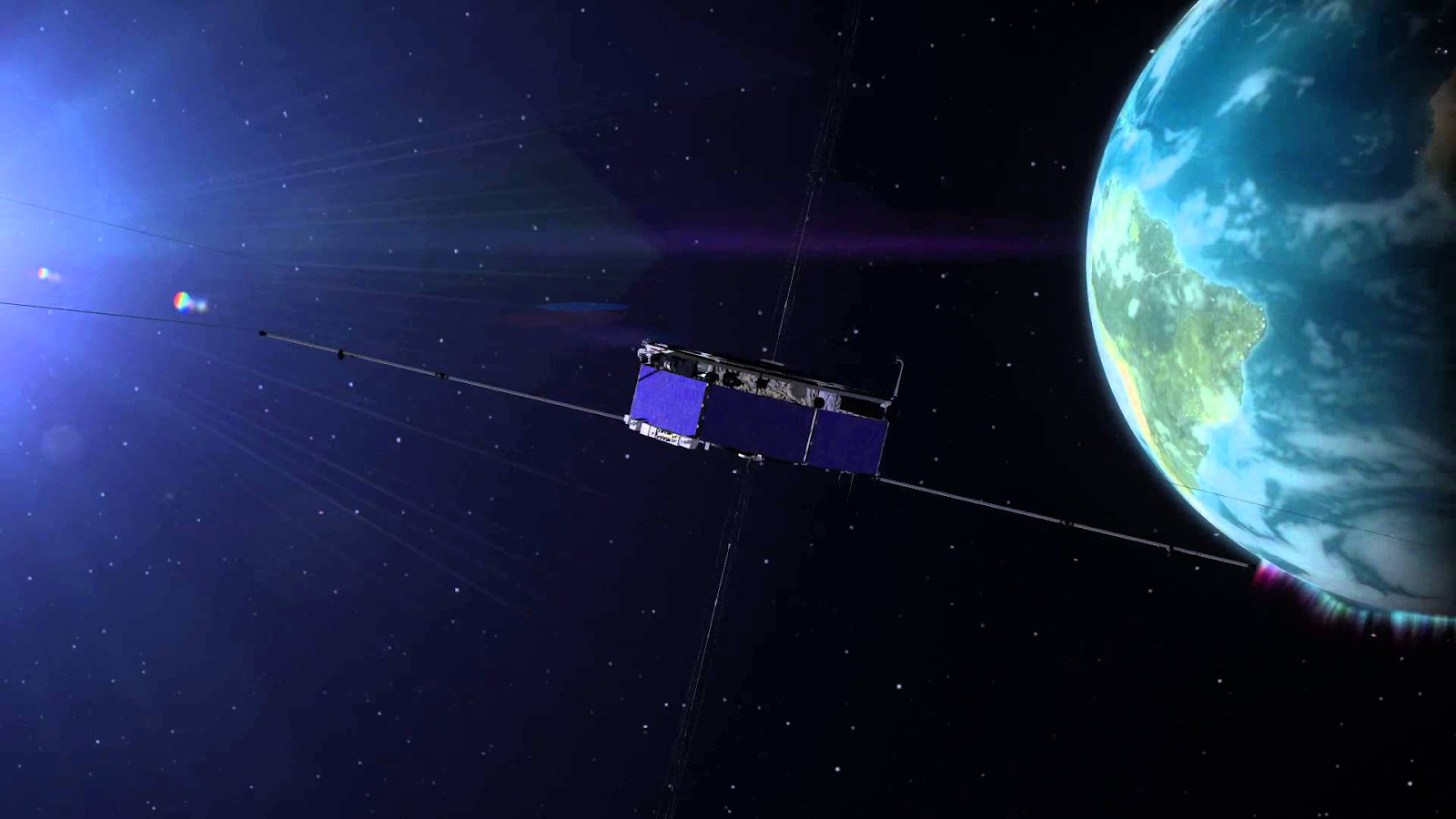
NASA’s Magnetospheric Multiscale mission, or MMS, is breaking records. MMS now holds the Guinness World Record for highest altitude fix of a GPS signal. Operating in a highly elliptical orbit around Earth, the MMS satellites set the record at 43,500 miles above the surface. The four MMS spacecraft incorporate GPS measurements into their precise tracking systems, which require extremely sensitive position and orbit calculations to guide tight flying formations.
MMS Breaks World Record
Video above: MMS now holds the Guinness World Record for highest altitude GPS fix – 43,500 miles above Earth’s surface. Video Credits: NASA’s Goddard Space flight Center/Genna Duberstein, producer.
Earlier this year, MMS achieved the closest flying separation of a multi-spacecraft formation with only four-and-a-half miles between the four satellites. When the satellites are closest to Earth, they move at up to 22,000 miles per hour, making them the fastest known operational use of a GPS receiver.
When MMS is not breaking records, it conducts ground-breaking science. Still in the first year of its prime mission, MMS is giving scientists new insight into Earth’s magnetosphere. The mission uses four individual satellites that fly in a pyramid formation to map magnetic reconnection – a process that occurs as the sun and Earth’s magnetic fields interact. Precise GPS tracking allows the satellites to maintain a tight formation and obtain high resolution three-dimensional observations.
Image above: Artist concept of one of the four MMS spacecraft. Image Credit: NASA's Goddard Space Flight Center.
Understanding the causes of magnetic reconnection is important for understanding phenomena around the universe from auroras on Earth, to flares on the surface of the sun, and even to areas surrounding black holes.
Next spring, MMS will enter Phase 2 of the mission and the satellites will be sent in to an even larger orbit where they will explore a different part of Earth’s magnetosphere. During that time, the satellites are anticipated to break their current high altitude GPS record by a factor of two or more.
Related Link:
NASA's MMS mission website: http://www.nasa.gov/mission_pages/mms/index.html
Image (mentioned), Video (mentioned), Text, Credits: NASA’s Goddard Space Flight Center, by Mara Johnson-Groh/Rob Garner.
Greetings, Orbiter.ch
Inscription à :
Articles (Atom)