mercredi 14 décembre 2016
AWAKE: Making waves in accelerator technology
CERN - European Organization for Nuclear Research logo.
14 Dec 2016
Image above: A member of the AWAKE collaboration, from the Max Planck Institute, performing tests in the experiment's underground tunnel (Image: Maximilien Brice/CERN).
The AWAKE collaboration has reached a major milestone; in the final week of CERN's accelerator operations for 2016, it has observed strong modulation of high-energy proton bunches in plasma, signaling the generation of very strong electromagnetic fields. This is a significant step towards the goal of using the proton-driven plasma wakefield technique to accelerate electrons.
The facility was successfully commissioned between June and November and the experiment took its first data in the final week of accelerator operations at CERN in 2016.
The Advanced Proton Driven Plasma Wakefield Acceleration Experiment (AWAKE) is the first facility investigating the use of plasma wakefields driven by proton beams to accelerate charged particles.
"The use of proton bunches to drive wakefields is of particular interest because of the large energy carried by the proton bunches from the CERN SPS and LHC accelerators," says the AWAKE spokesperson, Allen Caldwell, from the Max Planck Institute of Physics in Munich. "It allows for much longer acceleration stages than for other techniques," he points out.
The AWAKE experiment injects a "drive" bunch of protons from CERN’s SPS accelerator into a plasma column created by ionising a gas with a laser. When this bunch interacts with the plasma, it splits into a series of smaller bunches, in a process called self-modulation. As these shorter bunches move through the plasma, they generate a strong wakefield. It is the process of self-modulation that the AWAKE team has observed signals of, and from which it can infer the creation of the wakefield.
Graphic above: Image showing the simulation of the interaction between the bunches of protons (red dots) and the plasma wakefield (blue waves). (Image: Alexey Petrenko/CERN).
The next step, which AWAKE has yet to demonstrate, is to inject a second beam of electrons, the “witness” beam, in the right phase behind the proton beam. This witness beam "feels" the wakefield and is accelerated, just as a surfer accelerates by riding a wave.
The use of plasma to accelerate particles is a potential alternative to traditional accelerating methods that rely on radiofrequency electromagnetic cavities. It has long been known that plasmas are capable of supporting very strong electric fields. The challenge for researchers is to understand the best way to take advantage of this capability in order to create future compact and powerful particle accelerators at reasonable costs. The fields generated by plasma wakefields driven by proton beams could be up to two orders of magnitude higher than fields achievable using conventional radio-frequency cavities.
“To have observed indications for the first time of proton bunch self-modulation, after just a few days of tests is an excellent achievement. It's down to a very motivated and dedicated team," grins Edda Gschwendtner, AWAKE technical coordinator and CERN AWAKE project leader.
"We now plan to study this process in detail in 2017. We hope then to demonstrate the acceleration of electrons in the wake of the proton bunch,” adds Patric Muggli, AWAKE physics coordinator from CERN and the Max Planck Institute for Physics in Munich.
This exciting development, the culmination of three years of intense preparation, opens a new era of particle accelerator development at CERN and worldwide.
Note:
CERN, the European Organization for Nuclear Research, is one of the world’s largest and most respected centres for scientific research. Its business is fundamental physics, finding out what the Universe is made of and how it works. At CERN, the world’s largest and most complex scientific instruments are used to study the basic constituents of matter — the fundamental particles. By studying what happens when these particles collide, physicists learn about the laws of Nature.
The instruments used at CERN are particle accelerators and detectors. Accelerators boost beams of particles to high energies before they are made to collide with each other or with stationary targets. Detectors observe and record the results of these collisions.
Founded in 1954, the CERN Laboratory sits astride the Franco–Swiss border near Geneva. It was one of Europe’s first joint ventures and now has 22 Member States.
Related links:
Advanced Proton Driven Plasma Wakefield Acceleration Experiment (AWAKE): https://home.web.cern.ch/about/experiments/awake
SPS accelerator: http://home.cern/about/accelerators/super-proton-synchrotron
LHC accelerator: http://home.cern/about/accelerators/large-hadron-collider
For more information about European Organization for Nuclear Research (CERN), Visit: http://home.cern/
Image (mentioned), Graphic (mentioned), Text, Credits: CERN/Stephanie Hills/Corinne Pralavorio.
Best regards, Orbiter.ch
How on Earth Does NASA Choose a Landing Site on Mars?
NASA patch.
Dec. 14, 2016
Image above: A small basin (center foreground) lies below the southern rim of Melas Chasma, part of Valles Marineris. This is one of the eight potential landing sites being studied for the Mars 2020 rover. Image Credits: NASA/JPL-Caltech/Arizona State University, R. Luk.
Getting to the surface of Mars takes years of planning, engineering and science work, a successful launch, and a months-long journey of millions of miles. You only get one opportunity to touch down at a site on Mars, so it’s critical to get it right.
“You can’t say, ‘here are ten different sites, let’s go to them,’” said Michael Meyer, the lead scientist for the Mars Exploration Program at NASA Headquarters in Washington. “Each mission—it’s one shot. You definitely want to pick the right one.”
The Community is Crucial
Meyer spoke about how NASA picks Mars landing sites on Sunday, during the annual meeting of the American Geophysical Union (AGU) in San Francisco. He said the “spectacular” involvement of the broader science community is critical in choosing sites for both robotic and human landings. Continuing the open process started with Spirit and Opportunity, NASA is holding landing site workshops for both the next rover, Mars 2020, and a future human landing site mission. (Find out how to get involved or attend a workshop: Mars 2020 Landing Sites | Human Landing Sites )
Meyer was joined at the AGU lecture by Alex Longo, a high school student who has proposed both human and robotic landing sites, and Bethany Ehlmann, a scientist from NASA's Jet Propulsion Laboratory who works on both the Mars Reconnaissance Orbiter and Curiosity, and will be part of the Mars 2020 team.
Meyer gave the AGU audience an update on landing site selection for Mars 2020. Two workshops have already narrowed suggested sites down from 54 to 21, and then from 21 to eight high priority sites. A third workshop is set for February 8-10 in Monrovia, California. Now, Meyer said, the scientific community can do more “homework,” using orbital assets such as the high-resolution camera on the Mars Reconnaissance Orbiter to get more information about the site.
The community starts its search by focusing on the mission objectives and what areas might support that kind of science. For Mars 2020, scientists are looking for a place that has evidence of water – possibly an ancient shoreline -- and a strong potential to be a place where life could’ve thrived. Mars 2020 is also set to cache samples for return to Earth later. That adds more interesting possibilities for landing sites, since there could be science targets the rover isn’t set up to study on Mars that still have value when returned to Earth.
The last Mars 2020 workshop had 150 attendees and another 50 online, exchanging ideas and raising fresh questions. “It’s a sincere scientific discussion about what we know about Mars, about what we think we know but have to admit that we really don’t know, or things we have misconceptions about,” said Meyer.
Decisions for Decades to Come
Image above: Artist's concept of astronauts at work in a Martian exploration zone. Image Credit: NASA.
NASA’s Journey to Mars calls for sending humans to orbit the Red Planet in the 2030s, with trips to the surface to follow. But NASA isn’t waiting to scout potential sites. We're using the orbiters at Mars today to help refine our sense of what makes an optimal landing site, and to eventually narrow the list of candidate sites.
The first human landing sites workshop in 2015 yielded 47 landing site proposals. NASA is looking to set up a semi-permanent base, dubbed an “exploration zone,” where crews can live off the land and explore up to a 60-mile (100-kilometer) radius. There will be more workshops and more reconnaissance as the list narrows down in years to come.
With humans, said Meyer, NASA is looking for a place where astronauts can make the best of the surroundings, and trying to answer some key questions. As he puts it, “Is there a place to land? Are there resources that you can make use of there, such as water so that you can make your own fuel? Are there interesting things in the area for the astronauts to explore?”
More than 400 people supported the first human landing sties workshop in 2015, with a diverse group of disciplines represented—all of which are critical for picking an ideal site for the first human base on Mars.
Selecting the Site — for 2020 or Human Exploration
Even after the process narrows it down to a small group of sites, it can be painful to pick only one. And despite all the advance work, there are always new things to learn from going there.
“You feel like you know the place already, and then when you get there,” said Meyer, “it’s different. It’s always a great surprise.”
Related links:
Mars 2020 Landing Sites: http://marsnext.jpl.nasa.gov/
Human Landing Sites: https://www.nasa.gov/journeytomars/mars-exploration-zones
Eight high priority sites: http://mars.nasa.gov/mars2020/mission/timeline/prelaunch/landing-site-selection/
Exploration zone: https://www.nasa.gov/feature/where-on-mars-might-humans-first-land
NASA’s Journey to Mars: https://www.nasa.gov/topics/journeytomars/index.html
Images (mentioned), Text, Credits: NASA/Jim Wilson.
Greetings, Orbiter.ch
ATLAS releases first measurement of W mass using LHC data
CERN - European Organization for Nuclear Research logo.
14 Dec 2016
Image above: ATLAS is one of the four major experiments at the LHC. It is a general-purpose particle physics experiment run by an international collaboration (Image: Claudia Marcelloni/ CERN).
The ATLAS collaboration today reports the first measurement of the W boson mass using Large Hadron Collider (LHC) proton–proton collision data at a centre-of-mass energy of 7 TeV.
Graphic above: The ATLAS measurement of the W boson mass (in red) is compared to the Standard Model prediction (in purple), and to the combined values measured at the LEP and Tevatron collider (in blue) (Image: ATLAS Collaboration/CERN).
The W boson was discovered in 1983 at the CERN SPS collider and led to a Nobel prize in physics in 1984. Although the properties of the W boson have been studied for more than 30 years, measuring its mass remains a major challenge. A precise measurement of the W boson mass is vital, as a deviation from the Standard Model’s predictions could hint at new physics.
The latest results from ATLAS show a measured value of 80370±19 MeV, which is consistent with the Standard Model prediction. It is also consistent with the combined values measured at the LEP and Tevatron colliders, and with the world average (see graph above).
Measuring the W mass is particularly challenging at the LHC, compared to previous colliders, due to the large number of interactions per beam crossing. Despite this, the ATLAS result matches the best single-experiment measurement of the W mass (performed by the CDF collaboration https://www-cdf.fnal.gov/collaboration/).
Read more on the ATLAS experiment’s website: http://cern.ch/go/p6sN
Note:
CERN, the European Organization for Nuclear Research, is one of the world’s largest and most respected centres for scientific research. Its business is fundamental physics, finding out what the Universe is made of and how it works. At CERN, the world’s largest and most complex scientific instruments are used to study the basic constituents of matter — the fundamental particles. By studying what happens when these particles collide, physicists learn about the laws of Nature.
The instruments used at CERN are particle accelerators and detectors. Accelerators boost beams of particles to high energies before they are made to collide with each other or with stationary targets. Detectors observe and record the results of these collisions.
Founded in 1954, the CERN Laboratory sits astride the Franco–Swiss border near Geneva. It was one of Europe’s first joint ventures and now has 22 Member States.
Related links:
Large Hadron Collider (LHC): http://home.web.cern.ch/topics/large-hadron-collider
SPS collider: http://home.cern/about/accelerators/super-proton-synchrotron
LEP collider: http://about/accelerators/large-electron-positron-collider
Tevatron collider: https://www.fnal.gov/pub/tevatron/tevatron-accelerator.html
W boson: http://home.cern/tags/w-boson
Standard Model: http://home.cern/about/physics/standard-model
For more information about European Organization for Nuclear Research (CERN), Visit: http://home.cern/
Image (mentioned), Graphic (mentioned), Text, Credits: CERN/Harriet Kim Jarlett.
Best regards, Orbiter.ch
Weekly Recap From the Expedition Lead Scientist, week of Dec. 5, 2016
ISS - Expedition 50 Mission patch.
Dec. 14, 2016
(Highlights: Week of Dec. 5, 2016) - Investigations this week on the International Space Station centered on technology demonstrations of wearable health monitors designed for long-duration space travel that might also be used on Earth.
NASA astronaut Shane Kimbrough calibrated and charged the Personal CO2 Monitors in preparation for distributing them to crew members to test their viability as wearable safety devices. Humans produce carbon dioxide through the natural breathing process, but too much CO2 in the air can cause headaches, dizziness, increased blood pressure and more severe symptoms. All human spacecraft must be designed with environmental control systems that remove this gas from the air supply, but the space environment can still lead to pockets of CO2 that are difficult to detect and remove. Much like the canary in a coalmine, the Personal CO2 Monitor demonstrates a new capability of wearable technology to continuously monitor astronauts' immediate surroundings on the space station.
Image above: ESA astronaut Thomas Pesquet captured this image while flying over South America on the International Space Station. He shared it to his Twitter social media account, calling it “a dragon-shaped river.” Image Credits: NASA/@Thom_astro.
Many industries on Earth require workers to enter enclosed spaces – such as mines, submarines, or construction tunnels and pipes -- where environmental monitoring is critical to safety. This technology could prove useful in these industries. With the addition of an alarm system, the Personal CO2 Monitor could serve as a warning device for hazardous conditions. The focus of the technology is to create a small, durable device that can be comfortably attached to clothing, making it well suited for continuous wear.
ESA (European Space Agency) astronaut Thomas Pesquet configured a biometric patch to wear on his arm and a Smartshirt to wear during an exercise period as part of the EVERYWEAR investigation. These items are data collection points that are downloaded onto a computer tablet for scientific and medical study. The ESA study will test this emerging technology for nutritional assessment, sleep quality evaluation and constant blood pressure measurement through the day’s activities. Part of the investigation is a new, easy-to-use application on an iPad, simplifying the procedure for astronauts and saving valuable time to perform other tasks in orbit. The data is automatically recorded to the iPad and downloaded to scientists for the project in Toulouse, France.
Image above: NASA astronaut Shane Kimbrough works on the Capillary Flow Experiment – 2, which demonstrates how capillary forces work in space. Image Credit: NASA.
NASA astronaut Peggy Whitson installed a camera system to record science operations for the Packed Bed Reactor Experiment (PBRE), an investigation that may help build better space vehicles. The experiment studies the behavior of gases and liquids as they simultaneously flow through the same column filled with fixed porous media. This is important for the study of many chemical and biological processing systems, as well as numerous geophysical applications.
Water-recovery systems, fuel cells and other equipment on the station use packed bed reactors, but none are designed to handle both liquid and gas at the same time. Scientists are working to understand how a packed bed two-phase flow would work in microgravity. The results of the experiment could help scientists design more efficient and lightweight thermal management and life support systems that use less energy, benefiting not only the space station, but future Mars missions as well.
Whitson joined Pesquet for their flight day 15 human research activities, which included collecting blood pressure and ultrasound measurements for the Biochemical Profile (Biochem Profile) and Cardio Ox investigations. The astronauts spend time in orbit studying themselves to learn how the human body reacts to long-duration spaceflight. Biochem Profile tests bodily fluid samples obtained from astronauts before, during and after spaceflight. Cardio Ox looks for signs of oxidative and inflammatory stress on cardiovascular health during and after spaceflight.
Image above: ESA astronaut Thomas Pesquet uses a tonometer to record how his arteries react to weightlessness. The tonometer is connected to an iPad that is running the EveryWear app, which offers one interface for a variety of health-related tasks. Image Credit: NASA.
Specific proteins and chemicals in the samples are used as biomarkers, or indicators of health. Post-flight analysis yields a database of samples and test results, which scientists can use to study the effects of spaceflight on the body. Establishing a chemical profile of the body’s response to spaceflight will help scientists understand how different systems in the body interact in microgravity in different groups of people. Scientists can also test the effectiveness of possible countermeasures like exercise and nutrition and their effects on crew health during long-duration exploration missions.
An improved understanding of the biochemical effects of microgravity could help patients with limited mobility on Earth, such as those on bed rest. Understanding how various physiological systems respond and interact to changing gravity conditions could help physicians design different treatments or exercises for people with limited mobility.
Crew members conducted other human research investigations this week, including At Home in Space, Repository, Habitability, ESA-Active-Dosimeters, Fine Motor Skills, Fluid Shifts, Vascular Echo, Dose Tracker and Space Headaches.
Progress also was made on other investigations and facilities this week, including Veg-03, Meteor, AstroPi, ISS Ham, Story Time From Space, ACE-T-1, CFE-2, EML Batch 1.2c, Group Combustion, JAXA ELF, Aerosol Samplers, ISS External Leak Locator, J-SSOD, Radi-N2, and CIR.
Related links:
Personal CO2 Monitors: http://www.nasa.gov/mission_pages/station/research/experiments/2101.html
EVERYWEAR investigation: https://www.nasa.gov/mission_pages/station/research/experiments/2308.html
Packed Bed Reactor Experiment (PBRE): https://www.nasa.gov/mission_pages/station/research/experiments/1111.html
Biochem Profile: http://www.nasa.gov/mission_pages/station/research/experiments/1008.html
At Home in Space: https://www.nasa.gov/mission_pages/station/research/experiments/1988.html
Repository: https://www.nasa.gov/mission_pages/station/research/experiments/981.html
Habitability: https://www.nasa.gov/mission_pages/station/research/experiments/1772.html
ESA-Active-Dosimeters: https://www.nasa.gov/mission_pages/station/research/experiments/2132.html
Fine Motor Skills: https://www.nasa.gov/mission_pages/station/research/experiments/1767.html
Fluid Shifts: https://www.nasa.gov/mission_pages/station/research/experiments/1257.html
Vascular Echo: https://www.nasa.gov/mission_pages/station/research/experiments/1921.html
Dose Tracker: http://www.nasa.gov/mission_pages/station/research/experiments/1933.html
Space Headaches: http://www.nasa.gov/mission_pages/station/research/experiments/181.html
Veg-03: https://www.nasa.gov/mission_pages/station/research/experiments/1294.html
Meteor: https://www.nasa.gov/mission_pages/station/research/experiments/1323.html
ISS Ham: http://www.nasa.gov/mission_pages/station/research/experiments/346.html
Story Time From Space: http://www.nasa.gov/mission_pages/station/research/experiments/1287.html
ACE-T-1: https://www.nasa.gov/mission_pages/station/research/experiments/2033.html
CFE-2: https://www.nasa.gov/mission_pages/station/research/experiments/459.html
Group Combustion: https://www.nasa.gov/mission_pages/station/research/experiments/1077.html
JAXA ELF: https://www.nasa.gov/mission_pages/station/research/experiments/1999.html
Aerosol Samplers: https://www.nasa.gov/mission_pages/station/research/experiments/2300.html
ISS External Leak Locator: https://www.nasa.gov/mission_pages/station/research/experiments/1817.html
Radi-N2: https://www.nasa.gov/mission_pages/station/research/experiments/898.html
CIR: https://spaceflightsystems.grc.nasa.gov/sopo/ihho/psrp/fcf/cir/
Space Station Research and Technology: https://www.nasa.gov/mission_pages/station/research/index.html
International Space Station (ISS): https://www.nasa.gov/mission_pages/station/main/index.html
Images (mentioned), Text, Credits: NASA/John Love, Acting Lead Increment Scientist Expeditions 49 & 50/Kristine Rainey.
Best regards, Orbiter.ch
Juno Captures Jupiter 'Pearl'
NASA - JUNO Mission logo.
Dec. 14, 2016
Image Credits: NASA/JPL-Caltech/SwRI/MSSS
This image, taken by the JunoCam imager on NASA's Juno spacecraft, highlights the seventh of eight features forming a ‘string of pearls’ on Jupiter -- massive counterclockwise rotating storms that appear as white ovals in the gas giant's southern hemisphere. Since 1986, these white ovals have varied in number from six to nine. There are currently eight white ovals visible.
The image was taken on Dec. 11, 2016, at 9:27 a.m. PST (12:27 EST), as the Juno spacecraft performed its third close flyby of Jupiter. At the time the image was taken, the spacecraft was about 15,300 miles (24,600 kilometers) from the planet.
JunoCam is a color, visible-light camera designed to capture remarkable pictures of Jupiter's poles and cloud tops. As Juno's eyes, it will provide a wide view, helping to provide context for the spacecraft's other instruments. JunoCam was included on the spacecraft specifically for purposes of public engagement; although its images will be helpful to the science team, it is not considered one of the mission's science instruments.
NASA's Jet Propulsion Laboratory, Pasadena, California, manages the Juno mission for the principal investigator, Scott Bolton, of Southwest Research Institute in San Antonio. The Juno mission is part of the New Frontiers Program managed by NASA's Marshall Space Flight Center in Huntsville, Alabama, for the Science Mission Directorate. Lockheed Martin Space Systems, Denver, built the spacecraft. JPL is a division of Caltech in Pasadena, California.
For more information about JUNO Mission: http://www.nasa.gov/mission_pages/juno/main/index.html
Image (mentioned), Text, Credits: NASA/Tony Greicius/JPL/DC Agle.
Greetings, Orbiter.ch
mardi 13 décembre 2016
NASA’s Exo-Brake 'Parachute' to Enable Safe Return for Small Spacecraft
NASA logo.
Dec. 13, 2016
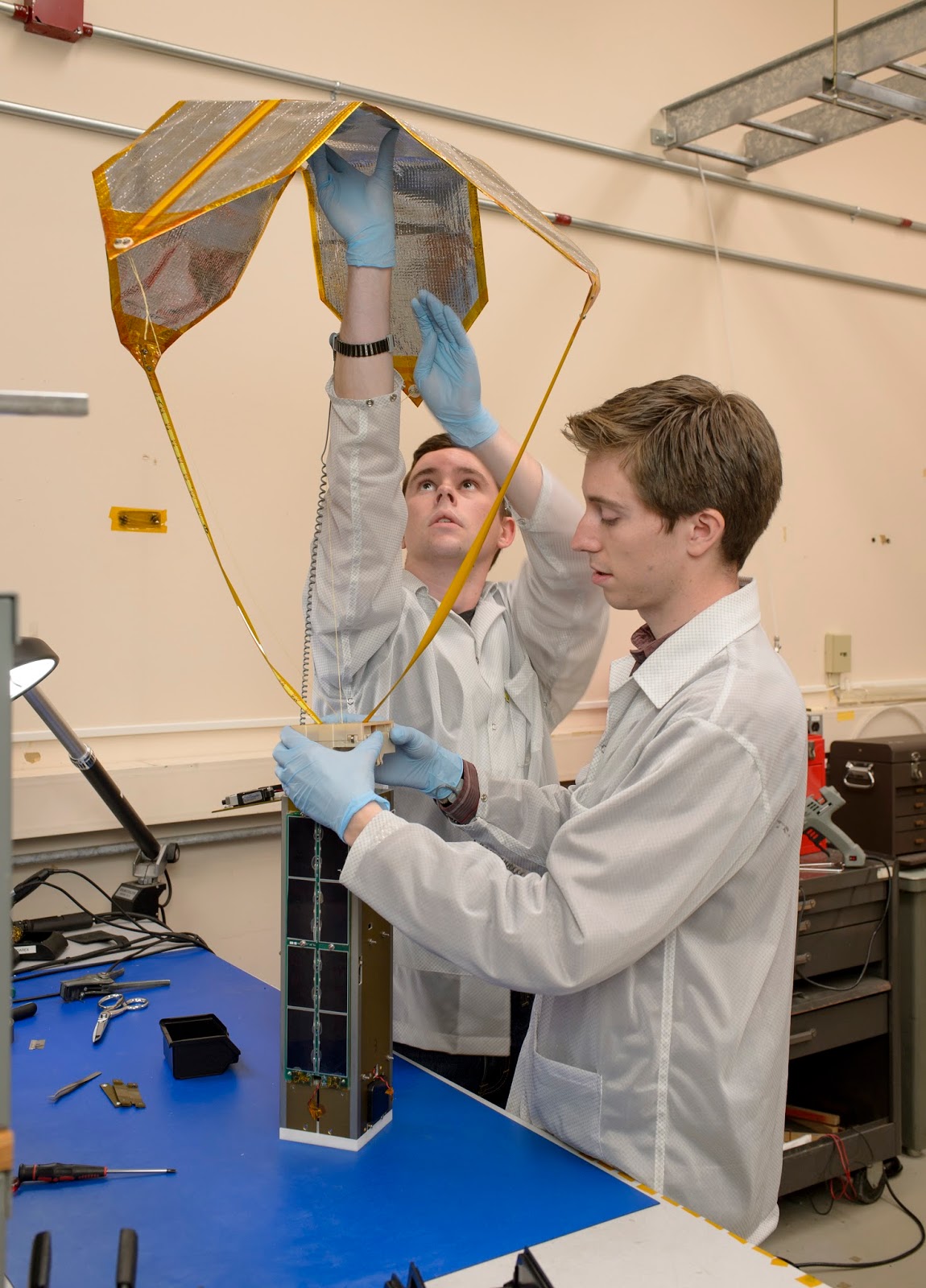
International Space Station through the deployment of Exo-Brake. Image Credit: NASA
NASA’s “Exo-Brake” will demonstrate a critical technology leading to the potential return of science payloads to Earth from the International Space Station through the deployment of small spacecraft in early 2017.
An Exo-Brake is a tension-based, flexible braking device resembling a cross-parachute that deploys from the rear of a satellite to increase the drag. It is a de-orbit device that replaces the more complicated rocket-based systems that would normally be employed during the de-orbit phase of re-entry.
“The Exo-Brake’s current design uses a hybrid system of mechanical struts and flexible cord with a control system that ‘warps’ the Exo-Brake – much like how the Wright brothers used warping to control the flight behavior of their first wing design,” said Marcus Murbach, principal investigator and inventor of the Exobrake device.
This warping, combined with real-time simulations of the orbital trajectory, allows engineers to guide the spacecraft to a desired entry point without the use of fuel, enabling accurate landing for future payload return missions.
Engineers at NASA’s Ames Research Center in California’s Silicon Valley, have been testing the Exo-Brake technology as a simple design that promises to help bring small payloads back through Earth’s atmosphere unharmed. The technology demonstration mission is a part of the Technology Education (TechEdSat-5) nanosatellite that was launched Dec. 9 on Japan’s H-II Transfer Vehicle from Tanegashima Space Center in Japan. The Exo-Brake will reside on the space station until its deployment in early 2017.
Image above: Engineers pack the Technical Education Satellite (TechEdSat-5) with the Exo-Brake payload. At almost 4 square feet in cross section (0.35 square meters), the Exo-Brake is made of Mylar and is controlled by a hybrid system of mechanic struts and flexible cord. Image Credits: NASA Ames/Dominic Hart.
Since 2012, the Exo-Brake has been tested on balloons and sub-orbital rockets through the Sub-Orbital Aerodynamic Re-entry Experiments, or SOAREX, flight series. Earlier versions of the Exo-Brake and other critical systems also have been tested on orbital experiments on TechEdSat nano-satellite missions.
Two additional technologies will be demonstrated on TechEdSat-5. These include the ‘Cricket’ Wireless Sensor Module (WSM), which provides a unique wireless network for multiple wireless sensors, providing real time data for TechEdSat-5.
TechEdSat-5’s nanosatellite bus element will also utilize the PhoneSat-5 avionics board that uses, for the first time, the versatile Intel Edison microprocessor. The new board is designed to test TechEdSat-5’s unique Wi-Fi capabilities, high fidelity cameras, and contains Iridium L-band transceiver for data.
In addition to the goal of returning samples from the space station, the project seeks to develop “building blocks” for larger scale systems that might enable future small or nanosatellite missions to reach the surface of Mars and other planetary bodies in the solar system.
The Exo-Brake is funded by the Entry Systems Modeling project within the Space Technology Mission Directorate’s Game Changing Development program. Additional funding for the Exo-Brake is provided by NASA Ames Research Center and the NASA Engineering and Safety Center. The TechEdSat series of nanosatellites is a STEM collaborative activity that involves NASA early-career employees, interns and students from several universities including San Jose State University, University of Idaho, University of California at Riverside, and California Polytechnic San Luis Obispo.
For more information on the Game Changing Development program, visit: https://www.nasa.gov/directorates/spacetech/game_changing_development/index.html
For more information on NASA’s small satellite missions, visit: http://www.nasa.gov/smallsats
Images (mentioned), Text, Credits: NASA/Loura Hall/Ames Research Center/Kimberly Williams.
Greetings, Orbiter.ch
Mars Rock-Ingredient Stew Seen as Plus for Habitability
NASA - Mars Science Laboratory (MSL) patch.
Dec. 13, 2016
NASA's Curiosity rover is climbing a layered Martian mountain and finding evidence of how ancient lakes and wet underground environments changed, billions of years ago, creating more diverse chemical environments that affected their favorability for microbial life.
Images above: This pair of drawings depicts the same location at Gale Crater on at two points in time: now and billions of years ago. Water moving beneath the ground, as well as water above the surface in ancient rivers and lakes, provided favorable conditions for microbial life, if Mars has ever hosted life. Images Credits: NASA/JPL-Caltech.
Hematite, clay minerals and boron are among the ingredients found to be more abundant in layers farther uphill, compared with lower, older layers examined earlier in the mission. Scientists are discussing what these and other variations tell about conditions under which sediments were initially deposited, and about how groundwater moving later through the accumulated layers altered and transported ingredients.
Effects of this groundwater movement are most evident in mineral veins. The veins formed where cracks in the layers were filled with chemicals that had been dissolved in groundwater. The water with its dissolved contents also interacted with the rock matrix surrounding the veins, altering the chemistry both in the rock and in the water.
"There is so much variability in the composition at different elevations, we've hit a jackpot," said John Grotzinger, of Caltech in Pasadena, California. He and other members of Curiosity's science team presented an update about the mission Tuesday, Dec. 13, in San Francisco during the fall meeting of the American Geophysical Union. As the rover examines higher, younger layers, researchers are impressed by the complexity of the lake environments when clay-bearing sediments were being deposited, and also the complexity of the groundwater interactions after the sediments were buried.
Image above: The foreground of this scene from the Mastcam on NASA's Curiosity Mars rover shows purple-hued rocks near the rover's late-2016 location. The middle distance includes future destinations for the rover. Variations in color of the rocks hint at the diversity of their composition on lower Mount Sharp. Image Credits: NASA/JPL-Caltech/MSSS.
'Chemical Reactor'
"A sedimentary basin such as this is a chemical reactor," Grotzinger said. "Elements get rearranged. New minerals form and old ones dissolve. Electrons get redistributed. On Earth, these reactions support life."
Whether Martian life has ever existed is still unknown. No compelling evidence for it has been found. When Curiosity landed in Mars' Gale Crater in 2012, the mission's main goal was to determine whether the area ever offered an environment favorable for microbes.
The crater's main appeal for scientists is geological layering exposed in the lower portion of its central mound, Mount Sharp. These exposures offer access to rocks that hold a record of environmental conditions from many stages of early Martian history, each layer younger than the one beneath it. The mission succeeded in its first year, finding that an ancient Martian lake environment had all the key chemical ingredients needed for life, plus chemical energy available for life. Now, the rover is climbing lower on Mount Sharp to investigate how ancient environmental conditions changed over time.
"We are well into the layers that were the main reason Gale Crater was chosen as the landing site," said Curiosity Deputy Project Scientist Joy Crisp of NASA's Jet Propulsion Laboratory, in Pasadena, California. "We are now using a strategy of drilling samples at regular intervals as the rover climbs Mount Sharp. Earlier we chose drilling targets based on each site's special characteristics. Now that we're driving continuously through the thick basal layer of the mountain, a series of drill holes will build a complete picture."
Four recent drilling sites, from "Oudam" this past June through "Sebina" in October, are each spaced about 80 feet (about 25 meters) apart in elevation. This uphill pattern allows the science team to sample progressively younger layers that reveal Mount Sharp's ancient environmental history.
Changing Environments
One clue to changing ancient conditions is the mineral hematite. It has replaced less-oxidized magnetite as the dominant iron oxide in rocks Curiosity has drilled recently, compared with the site where Curiosity first found lakebed sediments. "Both samples are mudstone deposited at the bottom of a lake, but the hematite may suggest warmer conditions, or more interaction between the atmosphere and the sediments," said Thomas Bristow of NASA Ames Research Center, Moffett Field, California. He helps operate the Chemistry and Mineralogy (CheMin) laboratory instrument inside the rover, which identifies minerals in collected samples.
Chemical reactivity occurs on a gradient of chemical ingredients' strength at donating or receiving electrons. Transfer of electrons due to this gradient can provide energy for life. An increase in hematite relative to magnetite indicates an environmental change in the direction of tugging electrons more strongly, causing a greater degree of oxidation in iron.
Another ingredient increasing in recent measurements by Curiosity is the element boron, which the rover's laser-shooting Chemistry and Camera (ChemCam) instrument has been detecting within mineral veins that are mainly calcium sulfate. "No prior mission has detected boron on Mars," said Patrick Gasda of the U.S. Department of Energy's Los Alamos National Laboratory, Los Alamos, New Mexico. "We're seeing a sharp increase in boron in vein targets inspected in the past several months." The instrument is quite sensitive; even at the increased level, boron makes up only about one-tenth of one percent of the rock composition.
'Dynamic System'
Boron is famously associated with arid sites where much water has evaporated away -- think of the borax that mule teams once hauled from Death Valley. However, environmental implications of the minor amount of boron found by Curiosity are less straightforward than for the increase in hematite.
Scientists are considering at least two possibilities for the source of boron that groundwater left in the veins. Perhaps evaporation of a lake formed a boron-containing deposit in an overlying layer, not yet reached by Curiosity, then water later re-dissolved the boron and carried it down through a fracture network into older layers, where it accumulated along with fracture-filling vein minerals. Or perhaps changes in the chemistry of clay-bearing deposits, such as evidenced by the increased hematite, affected how groundwater picked up and dropped off boron within the local sediments.
"Variations in these minerals and elements indicate a dynamic system," Grotzinger said. "They interact with groundwater as well as surface water. The water influences the chemistry of the clays, but the composition of the water also changes. We are seeing chemical complexity indicating a long, interactive history with the water. The more complicated the chemistry is, the better it is for habitability. The boron, hematite and clay minerals underline the mobility of elements and electrons, and that is good for life."
Image above: The top of the rover's mast faces away in this May 11, 2016, self-portrait of NASA's Curiosity Mars rover, which shows the vehicle at the "Okoruso" drilling site on lower Mount Sharp. The scene is a mosaic of multiple images taken with the arm-mounted Mars Hands Lens Imager (MAHLI). Image Credits: NASA/JPL-Caltech/MSSS.
Curiosity is part of NASA's ongoing Mars research and preparation for a human mission to Mars in the 2030s. Caltech manages JPL, and JPL manages the Curiosity mission for NASA's Science Mission Directorate in Washington. For more about Curiosity, visit:
http://www.nasa.gov/msl and http://mars.jpl.nasa.gov/msl/
Learn about NASA’s Journey to Mars at: http://www.nasa.gov/content/nasas-journey-to-mars/
Images (mentioned), Text, Credits: NASA/Laurie Cantillo/Dwayne Brown/Tony Greicius/JPL/Guy Webster/DC Agle/Ames Research Center/Abigail Tabor/Los Alamos National Research Laboratory/Laura Mullane.
Best regards, Orbiter.ch
Inscription à :
Articles (Atom)


