mardi 3 juillet 2018
First Laser Light for GRACE Follow-On
NASA - GRACE Follow-On Mission logo.
July 3, 2018
The laser ranging interferometer (LRI) instrument has been successfully switched on aboard the recently launched twin U.S./German Gravity Recovery and Climate Experiment Follow-On (GRACE-FO) satellites. The LRI, which is being flown as a technology demonstration, has made its first measurements in parallel with GRACE-FO's main microwave ranging instrument, and initial comparisons of the data from the two types of instruments show that they agree as expected.
"The LRI is a breakthrough for precision distance measurements in space," said LRI Instrument Manager Kirk McKenzie of NASA's Jet Propulsion Laboratory in Pasadena, California, which manages NASA's contribution to the instrument. "It's the first inter-spacecraft laser interferometer and the culmination of about a decade of NASA- and German-funded research and development."
Image above: Artist's rendering of the twin spacecraft of the Gravity Recovery and Climate Experiment Follow-On (GRACE-FO) mission, scheduled to launch in May. GRACE-FO will track the evolution of Earth's water cycle by monitoring changes in the distribution of mass on Earth.Image Credits: NASA/JPL-Caltech.
The GRACE-FO mission, launched on May 22, continues the work of the original GRACE mission of monitoring phenomena such as the melting of ice sheets and changes in groundwater levels by tracking the changing pull of gravity on the GRACE-FO satellites. The microwave ranging interferometer records these changes in gravity by measuring how they change the distance between the twin spacecraft. By accurately measuring these minute changes as the two spacecraft orbit the planet, scientists are able to calculate month-to-month variations in Earth's gravity field. The LRI is an enabling technology for future GRACE-FO-like missions with potential to significantly improve the accuracy of those missions. The instrument is jointly managed by JPL and the Max Planck Institute for Gravitational Physics (Albert Einstein Institute) in Hanover, Germany.
Seeing the light
The LRI's "first light" operation took place over two days. On June 13, the two GRACE-FO satellites began sweeping their lasers in spiral patterns in search of each other. Gerhard Heinzel, leader of the space interferometry research group at the Albert Einstein Institute and manager of the German contribution to the LRI, explained the challenge: "There are coin-sized holes on each satellite through which the laser has to be precisely pointed towards the holes in the other satellite over a distance of more than 200 kilometers [137 miles], while both spacecraft race around Earth at 27,000 kilometers an hour [16,000 miles per hour]. It is truly mind-boggling." (Here is a fuller explanation of how the LRI operates https://www.jpl.nasa.gov/news/news.php?feature=7116.)
In the data that were downlinked the next day, it was clear that each spacecraft had seen several flashes of light during the spiral scans, indicating both LRI instruments received light from the opposite spacecraft and were working as expected. The settings needed to establish a continuous laser link were calculated and uploaded to the satellites, and the LRI delivered its first intersatellite range data at a later downlink that day.
Image above: As GRACE-FO orbits (ground track at bottom; north is to the right) the distance between the two spacecraft changes very slightly (top) as the mass below changes (middle, shown as changes in ground elevation). Image Credits: B. Knispel/G.Heinzel/AEI/GFZ/NASA/JPL-Caltech/SRTM.
"The plan for establishing the laser link worked exactly as designed. In fact, the laser link locked in on the first attempt," said Christopher Woodruff, the LRI mission operations lead at JPL.
In the coming weeks and months, the GRACE-FO research team will work on fine-tuning the operation of this novel instrument and completing their understanding of the data it delivers.
The fine print
GRACE-FO is a partnership between NASA and German Research Centre for Geosciences in Potsdam, Germany. JPL manages the mission for NASA's Science Mission Directorate. Additional contributors to the laser ranging interferometer include SpaceTech in Immenstaad, Germany; Tesat-Spacecom in Backnang, Germany; Ball Aerospace in Boulder, Colorado; iXblue in Saint-Germain-en-Laye, France; the German Aerospace Center (DLR) Institute of Robotics and Mechatronics in Adlershof and Institute of Space Systems in Bremen; Hensoldt Optronics in Oberkochen; Apcon AeroSpace and Defence in Neubiberg/Munich; Diamond USA, Inc., and Diamond SA in Losone, Switzerland; and Airbus Defence and Space in Friedrichshafen.
For more information on the LRI, see:
http://www.aei.mpg.de/2277280/first-light-for-grace-follow-on-laser-interferometer
For more information about GRACE-FO, see:
https://www.nasa.gov/gracefo
https://gracefo.jpl.nasa.gov/
Images (mentioned), Text, Credits: NASA/JPL/Alan Buis/Esprit Smith.
Greetings, Orbiter.ch
lundi 2 juillet 2018
Dragon Now Installed To Station For Month-Long Stay
SpaceX - Dragon CRS-15 Mission patch.
July 2, 2018
Three days after its launch from Florida, the SpaceX Dragon cargo spacecraft was installed on the Earth-facing side of the International Space Station’s Harmony module at 9:52 a.m. EDT.
The 15th contracted commercial resupply mission from SpaceX (CRS-15) delivers more than 5,900 pounds of research, crew supplies and hardware to the orbiting laboratory.
Image above: July 2, 2018: International Space Station Configuration. Five spaceships are attached to the space station including the SpaceX Dragon and Cygnus resupply ships from the United States; and from Roscosmos, the Progress 69 resupply ship and the Soyuz MS-08 and MS-09 crew ships. Image Credit: NASA.
The Dragon lifted off on a SpaceX Falcon 9 rocket from Space Launch Complex 40 at Cape Canaveral Air Force Station in Florida Friday, June 29 with more than 5,900 pounds of research, equipment, cargo and supplies that will support dozens of investigations aboard the orbiting laboratory.
Among the hardware flying to the space station is a spare Canadian-built Latching End Effector (LEE), the part used as the “hands” that grapple payloads and visiting cargo spaceships such as Dragon. This was the 30th grapple of an arriving spacecraft, and the 15th time the Canadarm2 has captured a Dragon. Each end of the Canadarm2 robotic arm has an identical LEE, and they also enable Canadarm2 to “walk” to different locations on the orbiting outpost.
Image above: Flying over North Atlantic Ocean, seen by EarthCam on ISS, speed: 27'608 Km/h, altitude: 411,17 Km, image captured by Roland Berga (on Earth in Switzerland) from International Space Station (ISS) using ISS-HD Live application with EarthCam's from ISS on July 2, 2018 at 15:41 UTC. Image Credits: Orbiter.ch Aerospace/Roland Berga.
Among the research arriving to the U.S. National Laboratory is the Space Algae investigation, will discuss research to select algae strains adapted to space and sequence their genomes to identify growth-related genes. Algae consume waste carbon dioxide, can provide basic nutrition and may perceive microgravity as a trigger to produce algae oils rich in antioxidants that may help mitigate the harmful effects of microgravity and cosmic radiation during spaceflight. The Center for the Advancement of Science in Space (CASIS), which manages the U.S. National Laboratory, is sponsoring the investigation.
SpaceX CRS-15: Dragon capture, 2 July2018
A technology demonstration arriving is an observational pilot study with the Crew Interactive MObile companioN (CIMON) that aims to provide first insights into the effects of crew support from an artificial intelligence (AI) in terms of efficiency and acceptance during long-term missions in space.
An Earth science instrument called the ECOsystem Spaceborne Thermal Radiometer Experiment on Space Station (ECOSTRESS) will provide a new space-based measurement of how plants respond to changes in water availability. This data can help society better manage agricultural water use.
Image above: The SpaceX Dragon is pictured about 30 meters from the International Space Station. It would be captured minutes later when it reached its capture point 10 meters from the station. Image Credit: NASA TV.
After Dragon spends approximately one month attached to the space station, the spacecraft will return to Earth with about 3,800 pounds of cargo and research, including an investigation to advance DNA sequencing in space and the Angiex cancer therapy investigation to improve understanding of endothelial cells that line the walls of blood vessels.
Related links:
Space Algae: https://www.nasa.gov/mission_pages/station/research/experiments/explorer/Investigation.html?#id=7446
Center for the Advancement of Science in Space (CASIS): http://www.iss-casis.org/
Crew Interactive MObile companioN (CIMON): https://www.nasa.gov/mission_pages/station/research/experiments/explorer/Investigation.html?#id=7639
DNA sequencing: https://www.nasa.gov/mission_pages/station/research/news/BEST_DNA_RNA
Angiex cancer therapy investigation: https://www.nasa.gov/mission_pages/station/research/experiments/explorer/Investigation.html?#id=7502
ECOSTRESS: https://www.nasa.gov/mission_pages/station/research/experiments/explorer/Investigation.html?#id=1878
Expedition 56: https://www.nasa.gov/mission_pages/station/expeditions/expedition56/index.html
Spot the Station: https://spotthestation.nasa.gov/
Space Station Research and Technology: https://www.nasa.gov/mission_pages/station/research/index.html
International Space Station (ISS): https://www.nasa.gov/mission_pages/station/main/index.html
NASA/Mark Garcia/NASA TV/SciNews/Orbiter.ch Aerospace/Roland Berga.
Best regards, Orbiter.ch
Seeing Jupiter
NASA - JUNO Mission logo.
July 2, 2018
This image of Jupiter's southern hemisphere was captured by NASA's Juno spacecraft on the outbound leg of a close flyby of the gas-giant planet. Citizen scientist Kevin M. Gill created this image using data from the spacecraft's JunoCam imager.
The color-enhanced image was taken at 11:31 p.m. PDT on May 23, 2018 (2:31 a.m. EDT on May 24), as the spacecraft performed its 13th close flyby of Jupiter. At the time, Juno was about 44,300 miles (71,400 kilometers) from the planet's cloud tops, above a southern latitude of 71 degrees.
JunoCam takes advantage of Juno's unique polar orbit, studying the atmospheric dynamics and clouds right up to Jupiter's poles, which no spacecraft has ever done before.
JunoCam: http://www.missionjuno.swri.edu/junocam
NASA's Juno: http://www.nasa.gov/mission_pages/juno/main/index.html
Image, Text, Credits: NASA/Yvette Smith/JPL-Caltech/SwRI/MSSS/Kevin M. Gill.
Greetings, Orbiter.ch
Dawn’s Latest Orbit Reveals Dramatic New Views of Occator Crater
NASA - Dawn Mission patch.
July 2, 2018
Image above: This mosaic of a prominent mound located on the western side of Cerealia Facula was obtained by NASA's Dawn spacecraft on June 22, 2018 from an altitude of about 21 miles (34 kilometers). Image Credits: NASA/JPL-Caltech/UCLA/MPS/DLR/IDA.
NASA’s Dawn spacecraft reached its lowest-ever and final orbit around dwarf planet Ceres on June 6 and has been returning thousands of stunning images and other data.
The flight team maneuvered the spacecraft into an orbit that dives 22 miles (35 kilometers) above the surface of Ceres and viewed Occator Crater, site of the famous bright deposits, and other intriguing regions. In more than three years of orbiting Ceres, Dawn's lowest altitude before this month was 240 miles (385 kilometers), so the data from this current orbit bring the dwarf planet into much sharper focus.
These low orbits have revealed unprecedented details of the relationships between bright and dark materials in the region of Vinalia Faculae. Dawn’s visible and infrared mapping spectrometer had previously found the bright deposits to be made of sodium carbonate, a material commonly found in evaporite deposits on Earth. Last week Dawn fired its ion engine, possibly for the final time, to fly nearer Cerealia Facula, the large deposit of sodium carbonate in the center of Occator Crater.
Image above: This close-up image of the Vinalia Faculae in Occator Crater was obtained by NASA's Dawn spacecraft on June 14, 2018 from an altitude of about 24 miles (39 kilometers). Image Credits: NASA/JPL-Caltech/UCLA/MPS/DLR/IDA.
“Acquiring these spectacular pictures has been one of the greatest challenges in Dawn's extraordinary extraterrestrial expedition, and the results are better than we had ever hoped,” said Dawn’s chief engineer and project manager, Marc Rayman, of NASA’s Jet Propulsion Laboratory, Pasadena, California. “Dawn is like a master artist, adding rich details to the otherworldly beauty in its intimate portrait of Ceres.”
The wealth of information contained in these images, and more that are planned in the coming weeks, will help address key, open questions about the origin of the faculae, the largest deposits of carbonates observed thus far outside Earth, and possibly Mars. In particular, scientists have been wondering how that material was exposed, either from a shallow, sub-surface reservoir of mineral-laden water, or from a deeper source of brines (liquid water enriched in salts) percolating upward through fractures.
And the low-altitude observations obtained with Dawn’s other instruments, a gamma ray and neutron detector and a visible and infrared mapping spectrometer, will reveal the composition of Ceres at finer scale, shedding new light on the origin of the materials found across Ceres’ surface. New gravity measurements also may reveal details of the subsurface.
Dawn orbiting Ceres. Image Credits: NASA/JPL-Caltech
“The first views of Ceres obtained by Dawn beckoned us with a single, blinding bright spot,” said Carol Raymond of JPL, Dawn’s principal investigator. “Unraveling the nature and history of this fascinating dwarf planet during the course of Dawn’s extended stay at Ceres has been thrilling, and it is especially fitting that Dawn’s last act will provide rich new data sets to test those theories.”
See more images from Dawn’s low orbits here: https://dawn.jpl.nasa.gov/multimedia/images/
Read more details about Dawn’s recent orbits in Rayman’s Dawn Journal: https://www.jpl.nasa.gov/blog/columns/dawn-journal/
The Dawn mission is managed by JPL for NASA's Science Mission Directorate in Washington. Dawn is a project of the directorate's Discovery Program, managed by NASA's Marshall Space Flight Center in Huntsville, Alabama. JPL is responsible for overall Dawn mission science. Orbital ATK Inc., in Dulles, Virginia, designed and built the spacecraft. The German Aerospace Center, Max Planck Institute for Solar System Research, Italian Space Agency and Italian National Astrophysical Institute are international partners on the mission team.
For a complete list of mission participants, visit: https://dawn.jpl.nasa.gov/mission
More information about Dawn is available at the following sites:
https://www.nasa.gov/dawn
https://dawn.jpl.nasa.gov
Images (mentioned), Text, Credits: NASA/Dwayne Brown/JoAnna Wendel/Tony Greicius/JPL/Gretchen McCartney.
Greetings, Orbiter.ch
First Confirmed Image of Newborn Planet Caught with ESO’s VLT
ESO - European Southern Observatory logo.
2 July 2018
Spectrum reveals cloudy atmosphere
SPHERE image of the newborn planet PDS 70b
SPHERE, a planet-hunting instrument on ESO’s Very Large Telescope, has captured the first confirmed image of a planet caught in the act of forming in the dusty disc surrounding a young star. The young planet is carving a path through the primordial disc of gas and dust around the very young star PDS 70. The data suggest that the planet’s atmosphere is cloudy.
Astronomers led by a group at the Max Planck Institute for Astronomy in Heidelberg, Germany have captured a spectacular snapshot of planetary formation around the young dwarf star PDS 70. By using the SPHERE instrument on ESO’s Very Large Telescope (VLT) — one of the most powerful planet-hunting instruments in existence — the international team has made the first robust detection of a young planet, named PDS 70b, cleaving a path through the planet-forming material surrounding the young star [1].
Widefield image of the sky around PDS 70
The SPHERE instrument also enabled the team to measure the brightness of the planet at different wavelengths, which allowed properties of its atmosphere to be deduced.
The planet stands out very clearly in the new observations, visible as a bright point to the right of the blackened centre of the image. It is located roughly three billion kilometres from the central star, roughly equivalent to the distance between Uranus and the Sun. The analysis shows that PDS 70b is a giant gas planet with a mass a few times that of Jupiter. The planet's surface has a temperature of around 1000°C, making it much hotter than any planet in our own Solar System.
The dark region at the centre of the image is due to a coronagraph, a mask which blocks the blinding light of the central star and allows astronomers to detect its much fainter disc and planetary companion. Without this mask, the faint light from the planet would be utterly overwhelmed by the intense brightness of PDS 70.
The dwarf star PDS 70 in the constellation Centaurus
“These discs around young stars are the birthplaces of planets, but so far only a handful of observations have detected hints of baby planets in them,” explains Miriam Keppler, who lead the team behind the discovery of PDS 70’s still-forming planet. “The problem is that until now, most of these planet candidates could just have been features in the disc.”
The discovery of PDS 70’s young companion is an exciting scientific result that has already merited further investigation. A second team, involving many of the same astronomers as the discovery team, including Keppler, has in the past months followed up the initial observations to investigate PDS 70’s fledgling planetary companion in more detail. They not only made the spectacularly clear image of the planet shown here, but were even able to obtain a spectrum of the planet. Analysis of this spectrum indicated that its atmosphere is cloudy.
PDS 70’s planetary companion has sculpted a transition disc — a protoplanetary disc with a giant “hole” in the centre. These inner gaps have been known about for decades and it has been speculated that they were produced by disc-planet interaction. Now we can see the planet for the first time.
Zooming in on the orange dwarf star PDS 70 and its newly discovered planet
“Keppler’s results give us a new window onto the complex and poorly-understood early stages of planetary evolution,” comments André Müller, leader of the second team to investigate the young planet. “We needed to observe a planet in a young star’s disc to really understand the processes behind planet formation.” By determining the planet’s atmospheric and physical properties, the astronomers are able to test theoretical models of planet formation.
This glimpse of the dust-shrouded birth of a planet was only possible thanks to the impressive technological capabilities of ESO’s SPHERE instrument, which studies exoplanets and discs around nearby stars using a technique known as high-contrast imaging — a challenging feat. Even when blocking the light from a star with a coronagraph, SPHERE still has to use cleverly devised observing strategies and data processing techniques to filter out the signal of the faint planetary companions around bright young stars [2] at multiple wavelengths and epochs.
Thomas Henning, director at the Max Planck Institute for Astronomy and leader of the teams, summarises the scientific adventure: “After more than a decade of enormous efforts to build this high-tech machine, now SPHERE enables us to reap the harvest with the discovery of baby planets!”
Notes:
[1] The disc and planet images and the planet’s spectrum have been captured in the course of the two survey programmes called SHINE (SpHere INfrared survey for Exoplanets) and DISK (sphere survey for circumstellar DISK). SHINE aims to image 600 young nearby stars in the near-infrared using SPHERE’s high contrast and high angular resolution to discover and characterise new exoplanets and planetary systems. DISK explores known, young planetary systems and their circumstellar discs to study the initial conditions of planetary formation and the evolution of planetary architectures.
[2] In order to tease out the weak signal of the planet next to the bright star, astronomers use a sophisticated method that benefits from the Earth's rotation. In this observing mode, SPHERE continuously takes images of the star over a period of several hours, while keeping the instrument as stable as possible. As a consequence, the planet appears to slowly rotate, changing its location on the image with respect to the stellar halo. Using elaborate numerical algorithms, the individual images are then combined in such a way that all parts of the image that appear not to move during the observation, such as the signal from the star itself, are filtered. This leaves only those that do apparently move — making the planet visible.
More information:
This research was presented in two papers, entitled “Discovery of a planetary-mass companion within the gap of the transition disk around PDS 70” and “Orbital and atmospheric characterization of the planet within the gap of the PDS 70 transition disk”, both to be published in Astronomy & Astrophysics.
The team behind the discovery paper is composed of M. Keppler (Max Planck Institute for Astronomy, Heidelberg, Germany), M. Benisty (Univ. Grenoble, France and Unidad Mixta Internacional Franco-Chilena de Astronomía, Chile), A. Müller (Max Planck Institute for Astronomy, Heidelberg, Germany), Th. Henning (Max Planck Institute for Astronomy, Heidelberg, Germany), R. van Boekel (Max Planck Institute for Astronomy, Heidelberg, Germany), F. Cantalloube (Max Planck Institute for Astronomy, Heidelberg, Germany), C. Ginski (Leiden Observatory, The Netherlands), R.G. van Holstein (Leiden Observatory, The Netherlands), A.-L. Maire (Max Planck Institute for Astronomy, Heidelberg, Germany), A. Pohl (Max Planck Institute for Astronomy, Heidelberg, Germany), M. Samland (Max Planck Institute for Astronomy, Heidelberg, Germany), H. Avenhaus (Max Planck Institute for Astronomy, Heidelberg, Germany), J.-L. Baudino (Department of Physics, University of Oxford, Oxford, UK), A. Boccaletti (LESIA, Observatoire de Paris, France), J. de Boer (Leiden Observatory, The Netherlands), M. Bonnefoy (Univ. Grenoble, France), S. Desidera (INAF - Osservatorio Astronomico di Padova, Italy), M. Langlois (Aix Marseille Univ, CNRS, LAM, Marseille, France and CRAL, UMR 5574, CNRS, Université de Lyon, Ecole Normale Supérieure de Lyon, France), C. Lazzoni (INAF - Osservatorio Astronomico di Padova, Italy), N. Pawellek (Max Planck Institute for Astronomy, Heidelberg, Germany), T. Stolker (Institute for Particle Physics and Astrophysics, ETH Zurich, Switzerland), A. Vigan (Aix Marseille Univ, CNRS, LAM, Marseille, France), T. Birnstiel (University Observatory, Faculty of Physics, Ludwig-Maximilians- Universität München, Germany), W. Brandner(Max Planck Institute for Astronomy, Heidelberg, Germany), G. Chauvin (Univ. Grenoble, France and Unidad Mixta Internacional Franco-Chilena de Astronomía, Chile), M. Feldt (Max Planck Institute for Astronomy, Heidelberg, Germany), M. Flock (Jet Propulsion Laboratory, California Institute of Technology, USA and Kavli Institute For Theoretical Physics, University of California, USA), J. Girard(Univ. Grenoble, France and ESO, Chile), R. Gratton (INAF - Osservatorio Astronomico di Padova, Italy), J. Hagelberg (Univ. Grenoble, France), A. Isella (Rice University, Department of Physics and Astronomy, USA), M. Janson (Max Planck Institute for Astronomy, Heidelberg, Germany and Department of Astronomy, Stockholm University, Sweden), A. Juhasz (Institute of Astronomy, Cambridge, UK), J. Kemmer (Max Planck Institute for Astronomy, Heidelberg, Germany), Q. Kral (LESIA, Observatoire de Paris, PSL Research University, CNRS, Sorbonne Universités, UPMC, Univ. Paris 06, Univ. Paris Diderot, Sorbonne Paris Cité, France and Institute of Astronomy, Cambridge, UK), A.-M. Lagrange (Univ. Grenoble, France), R. Launhardt (Max Planck Institute for Astronomy, Heidelberg, Germany), G. Marleau (Institut für Astronomie und Astrophysik, Eberhard Karls Universität Tübingen, Germany and Max Planck Institute for Astronomy, Heidelberg, Germany) A. Matter (Université Côte d’Azur, OCA, CNRS, France), F. Ménard (Univ. Grenoble, France), J. Milli (ESO, Chile), P. Mollière (Leiden Observatory, The Netherlands), C. Mordasini (Physikalisches Institut, Universität Bern, Switzerland), J. Olofsson (Max Planck Institute for Astronomy, Heidelberg, Germany, Instituto de Física y Astronomía, Facultad de Ciencias, Universidad de Valparaíso, Chile, and Núcleo Milenio Formación Planetaria - NPF, Universidad de Valparaíso, Chile), L. Pérez (Max-Planck-Institute for Astronomy, Bonn, Germany and Universidad de Chile, Departamento de Astronomia, Chile), P. Pinilla (Department of Astronomy/Steward Observatory, University of Arizona, USA), C. Pinte (Univ. Grenoble, France, UMI-FCA, CNRS/INSU, France (UMI 3386), and Dept. de Astronomía, Universidad de Chile, Chile, and Monash Centre for Astrophysics (MoCA) and School of Physics and Astronomy, Monash University, Australia), S. Quanz (Institute for Particle Physics and Astrophysics, ETH Zurich, Switzerland), T. Schmidt (LESIA, Observatoire de Paris, PSL Research University, CNRS, Sorbonne Universités, UPMC, Univ. Paris 06, Univ. Paris Diderot, France), S. Udry (Geneva Observatory, University of Geneva, Switzerland), Z. Wahhaj (ESO, Chile), J. Williams (Institute for Astronomy, University of Hawaii at Manoa, Honolulu, USA), A. Zurlo (Aix Marseille Univ, CNRS, LAM, Laboratoire d’Astrophysique de Marseille, France, Núcleo de Astronomía, Facultad de Ingeniería y Ciencias, Universidad Diego Portales, Chile, Escuela de Ingeniería Industrial, Facultad de Ingeniería y Ciencias, Universidad Diego Portales, Chile), E. Buenzli (Institute for Particle Physics and Astrophysics, ETH Zurich, Switzerland), M. Cudel (Univ. Grenoble, France), R. Galicher (LESIA, Observatoire de Paris, PSL Research University, CNRS, Sorbonne Universités, UPMC, Univ. Paris 06, Univ. Paris Diderot, France), M. Kasper (ESO, Germany), J. Lannier (Univ. Grenoble, France), D. Mesa (INAF - Osservatorio Astronomico di Padova, Italy and INCT, Universidad De Atacama, Copiapó, Chile), D. Mouillet (Univ. Grenoble, France), S. Peretti (Geneva Observatory, University of Geneva, Switzerland), C. Perrot (LESIA, Observatoire de Paris, PSL Research University, CNRS, Sorbonne Universités, UPMC, Univ. Paris 06, Univ. Paris Diderot, Sorbonne Paris Cité, France), G. Salter (Aix Marseille Univ, CNRS, LAM, Laboratoire d’Astrophysique de Marseille, France), E. Sissa (INAF - Osservatorio Astronomico di Padova, Italy), F. Wildi (Geneva Observatory, University of Geneva, Switzerland), L. Abe (Université Côte d’Azur, OCA, CNRS, Lagrange, France), J. Antichi (INAF - Osservatorio Astrofisico di Arcetri, Italy), J.-C. Augereau (Univ. Grenoble, France), P. Baudoz (LESIA, Observatoire de Paris, PSL Research University, CNRS, Sorbonne Universités, UPMC, Univ. Paris 06, Univ. Paris Diderot, Sorbonne Paris Cité, France), J.-L. Beuzit (Univ. Grenoble, France), P. Blanchard (Aix Marseille Univ, CNRS, LAM, Laboratoire d’Astrophysique de Marseille, France), S. S. Brems (Landessternwarte Königstuhl, Zentrum für Astronomie der Universität Heidelberg, Germany), M. Carle (Aix Marseille Univ, CNRS, LAM, Laboratoire d’Astrophysique de Marseille, France), A. Cheetham (Geneva Observatory, University of Geneva, Switzerland), A. Costille (Aix Marseille Univ, CNRS, LAM, Laboratoire d’Astrophysique de Marseille, France), A. Delboulbé (Univ. Grenoble, France), C. Dominik (Anton Pannekoek Institute for Astronomy, The Netherlands), P. Feautrier (Univ. Grenoble, France), L. Gluck (Univ. Grenoble, France), D. Gisler (Institute for Particle Physics and Astrophysics, ETH Zurich, Switzerland), Y. Magnard (Univ. Grenoble, France), D. Maurel (Univ. Grenoble, France), M. Meyer (Institute for Particle Physics and Astrophysics, ETH Zurich, Switzerland), T. Moulin (Univ. Grenoble, France), T. Buey (LESIA, Observatoire de Paris, PSL Research University, CNRS, Sorbonne Universités, UPMC, Univ. Paris 06, Univ. Paris Diderot, France), A. Baruffolo (INAF - Osservatorio Astronomico di Padova, Italy), A. Bazzon (Institute for Particle Physics and Astrophysics, ETH Zurich, Switzerland), V. De Caprio (INAF - Osservatorio Astronomico di Capodimonte, Italy), M. Carbillet (Université Côte d’Azur, OCA, CNRS, Lagrange, France), E. Cascone (INAF - Osservatorio Astronomico di Capodimonte, Italy), R. Claudi (INAF - Osservatorio Astronomico di Padova, Italy), K. Dohlen (Aix Marseille Univ, CNRS, LAM, Laboratoire d’Astrophysique de Marseille, France), D. Fantinel (INAF - Osservatorio Astronomico di Padova, Italy), T. Fusco (ONERA (Office National d’Etudes et de Recherches Aérospatiales), France), E. Giro (INAF - Osservatorio Astronomico di Padova, Italy), C. Gry (Aix Marseille Univ, CNRS, LAM, Laboratoire d’Astrophysique de Marseille, France), N. Hubin (ESO, Germany), E. Hugot (Aix Marseille Univ, CNRS, LAM, Laboratoire d’Astrophysique de Marseille, France), M. Jaquet (Aix Marseille Univ, CNRS, LAM, Laboratoire d’Astrophysique de Marseille, France), D. Le Mignant (Aix Marseille Univ, CNRS, LAM, Laboratoire d’Astrophysique de Marseille, France), M. Llored (Aix Marseille Univ, CNRS, LAM, Laboratoire d’Astrophysique de Marseille, France), O. Möller-Nilsson (Max Planck Institute for Astronomy, Heidelberg, Germany), F. Madec (Aix Marseille Univ, CNRS, LAM, Laboratoire d’Astrophysique de Marseille, France), P. Martinez (Université Côte d’Azur, OCA, CNRS, Lagrange, France), L. Mugnier (ONERA (Office National d’Etudes et de Recherches Aérospatiales), France), A. Origné (Aix Marseille Univ, CNRS, LAM, Laboratoire d’Astrophysique de Marseille, France), P. Puget (Univ. Grenoble, France), D. Perret (LESIA, Observatoire de Paris, PSL Research University, CNRS, Sorbonne Universités, UPMC, Univ. Paris 06, Univ. Paris Diderot, France), J. Pragt (NOVA Optical Infrared Instrumentation Group, Dwingeloo, The Netherlands), F. Rigal (Anton Pannekoek Institute for Astronomy, The Netherlands), R. Roelfsema (NOVA Optical Infrared Instrumentation Group, Dwingeloo, The Netherlands), A. Pavlov (Max Planck Institute for Astronomy, Heidelberg, Germany), C. Petit (ONERA (Office National d’Etudes et de Recherches Aérospatiales), France), G. Rousset (LESIA, Observatoire de Paris, PSL Research University, CNRS, Sorbonne Universités, UPMC, Univ. Paris 06, Univ. Paris Diderot, France), J. Ramos (Max Planck Institute for Astronomy, Heidelberg, Germany), P. Rabou (Univ. Grenoble, France), S. Rochat (Univ. Grenoble, France), A. Roux (Univ. Grenoble, France), B. Salasnich (INAF - Osservatorio Astronomico di Padova, Italy),C. Soenke (ESO, Germany), E. Stadler (Univ. Grenoble, France), J.-F. Sauvage (ONERA (Office National d’Etudes et de Recherches Aérospatiales), France), M. Suarez ( INAF - Osservatorio Astrofisico di Arcetri, Italy), A. Sevin (LESIA, Observatoire de Paris, PSL Research University, CNRS, Sorbonne Universités, UPMC, Univ. Paris 06, Univ. Paris Diderot, France), M. Turatto (INAF - Osservatorio Astronomico di Padova, Italy), L. Weber (Geneva Observatory, University of Geneva, Switzerland).
The team behind the characterisation paper consisted of A. Müller (Max Planck Institute for Astronomy, Heidelberg, Germany), M. Keppler (Max Planck Institute for Astronomy, Heidelberg, Germany), Th. Henning (Max Planck Institute for Astronomy, Heidelberg, Germany), M. Samland (Max Planck Institute for Astronomy, Heidelberg, Germany), G. Chauvin (Univ. Grenoble Alpes, France and Unidad Mixta Internacional Franco-Chilena de Astronomía, CNRS/INSU Universidad de Chile, Chile), H. Beust (Univ. Grenoble Alpes, France), A.-L. Maire (Max Planck Institute for Astronomy, Heidelberg, Germany), K. Molaverdikhani (Max Planck Institute for Astronomy, Heidelberg, Germany), R. van Boekel (Max Planck Institute for Astronomy, Heidelberg, Germany), M. Benisty (Univ. Grenoble Alpes, France and Unidad Mixta Internacional Franco-Chilena de Astronomía, CNRS/INSU Universidad de Chile, Chile), A. Boccaletti (LESIA, Observatoire de Paris, PSL Research University, CNRS, Sorbonne Universités, UPMC, Univ. Paris 06, Univ. Paris Diderot, France), M. Bonnefoy (Univ. Grenoble Alpes, France), F. Cantalloube (Max Planck Institute for Astronomy, Heidelberg, Germany), B. Charnay (LESIA, Observatoire de Paris, PSL Research University, CNRS, Sorbonne Universités, UPMC, Univ. Paris 06, Univ. Paris Diderot, France), J.-L. Baudino (Department of Physics, University of Oxford, UK), M. Gennaro (Space Telescope Science Institute, USA), Z. C. Long (Space Telescope Science Institute, USA), A. Cheetham (Geneva Observatory, University of Geneva, Switzerland), S. Desidera (INAF - Osservatorio Astronomico di Padova, Italy), M. Feldt (Max Planck Institute for Astronomy, Heidelberg, Germany), T. Fusco (DOTA, ONERA, Université Paris Saclay, and Aix Marseille Université, CNRS, LAM Marseille, France), J. Girard (Univ. Grenoble Alpes, France and Space Telescope Science Institute, USA), R. Gratton (INAF - Osservatorio Astronomico di Padova, Italy), J. Hagelberg (Institute for Particle Physics and Astrophysics, ETH Zurich, Switzerland), M. Janson (Max Planck Institute for Astronomy, Heidelberg, Germany and Department of Astronomy, Stockholm University, Sweden), A.-M. Lagrange (Univ. Grenoble Alpes, France), M. Langlois (Aix Marseille Univ, CNRS, LAM, Marseille, France and CRAL, UMR 5574, CNRS, Université de Lyon, Ecole Normale Supérieure de Lyon, France), C. Lazzoni (INAF - Osservatorio Astronomico di Padova, Italy), R. Ligi (INAF-Osservatorio Astronomico di Brera, Italy), F. Ménard (Univ. Grenoble Alpes, France), D. Mesa (INAF - Osservatorio Astronomico di Padova, Italy and INCT, Universidad De Atacama, Copiapó, Atacama, Chile), M. Meyer (Institute for Particle Physics and Astrophysics, ETH Zurich, Switzerland and Department of Astronomy, University of Michigan, USA), P. Mollière (Leiden Observatory, Leiden University, the Netherlands), C. Mordasini (Physikalisches Institut, Universität Bern, Switzerland), T. Moulin (Univ. Grenoble Alpes, France), A. Pavlov (Max Planck Institute for Astronomy, Heidelberg, Germany), N. Pawellek (Max Planck Institute for Astronomy, Heidelberg, Germany and Konkoly Observatory, Research Centre for Astronomy and Earth Sciences, Hungarian Academy of Sciences, Hungary), S. Quanz (Institute for Particle Physics and Astrophysics, ETH Zurich, Switzerland), J. Ramos (Max Planck Institute for Astronomy, Heidelberg, Germany), D. Rouan (LESIA, Observatoire de Paris, PSL Research University, CNRS, Sorbonne Universités, UPMC, Univ. Paris 06, Univ. Paris Diderot, France), E. Sissa (INAF - Osservatorio Astronomico di Padova, Italy), E. Stadler (Univ. Grenoble Alpes, France), A. Vigan (Aix Marseille Univ, CNRS, LAM, Laboratoire d’Astrophysique de Marseille, France), Z. Wahhaj (ESO, Chile), L. Weber (Geneva Observatory, University of Geneva, Switzerland), A. Zurlo (Núcleo de Astronomía, Facultad de Ingeniería y Ciencias, Universidad Diego Portales, Chile, Escuela de Ingeniería Industrial, Facultad de Ingeniería y Ciencias, Universidad Diego Portales, Chile).
ESO is the foremost intergovernmental astronomy organisation in Europe and the world’s most productive ground-based astronomical observatory by far. It has 15 Member States: Austria, Belgium, the Czech Republic, Denmark, France, Finland, Germany, Italy, the Netherlands, Poland, Portugal, Spain, Sweden, Switzerland and the United Kingdom, along with the host state of Chile and with Australia as a strategic partner. ESO carries out an ambitious programme focused on the design, construction and operation of powerful ground-based observing facilities enabling astronomers to make important scientific discoveries. ESO also plays a leading role in promoting and organising cooperation in astronomical research. ESO operates three unique world-class observing sites in Chile: La Silla, Paranal and Chajnantor. At Paranal, ESO operates the Very Large Telescope and its world-leading Very Large Telescope Interferometer as well as two survey telescopes, VISTA working in the infrared and the visible-light VLT Survey Telescope. ESO is also a major partner in two facilities on Chajnantor, APEX and ALMA, the largest astronomical project in existence. And on Cerro Armazones, close to Paranal, ESO is building the 39-metre Extremely Large Telescope, the ELT, which will become “the world’s biggest eye on the sky”.
Links:
Zooming in on the orange dwarf star PDS 70 and its newly discovered planet: https://www.eso.org/public/videos/eso1821b/
Research papers:
Keppler et al.: https://www.eso.org/public/archives/releases/sciencepapers/eso1821/eso1821a.pdf
Müller et al.: https://www.eso.org/public/archives/releases/sciencepapers/eso1821/eso1821b.pdf
Photos of the VLT: https://www.eso.org/public/images/archive/category/paranal/
SPHERE instrument: https://www.eso.org/public/teles-instr/paranal-observatory/vlt/vlt-instr/sphere/
ESO’s Very Large Telescope (VLT): https://www.eso.org/public/teles-instr/paranal-observatory/vlt/
Images, Video, Text, Credits: ESO/Mariya Lyubenova/Max Planck Institute for Astronomy Heidelberg, Germany/Thomas Henning/André Müller/Miriam Keppler/Digitized Sky Survey 2. Acknowledgement: Davide De Martin/IAU and Sky & Telescope/N. Risinger (skysurvey.org), DSS. Music: Astral electronic.
Best regards, Orbiter.ch
Combined orbital Galileo-GPS position fix achieved aboard ISS
SCaN - Space Communication and Navigation patch.
2 July 2018
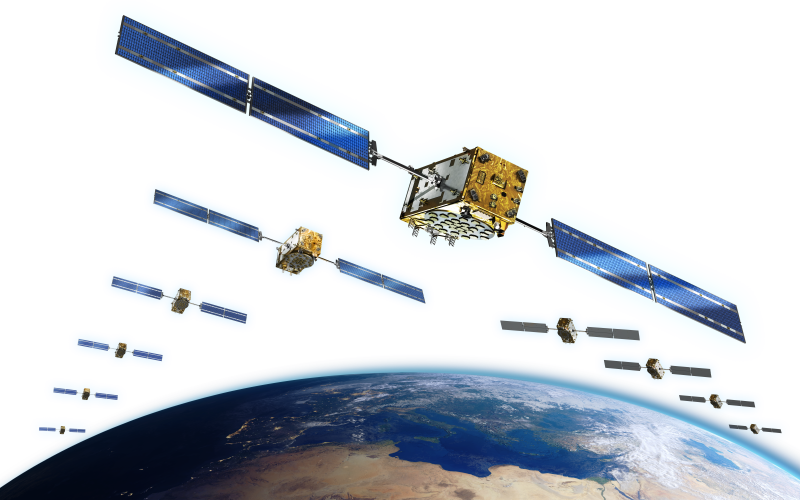
Europe’s satellite navigation system Galileo is already in use worldwide, usable by itself or in combination with the US Global Positioning System (GPS). Now a combined Galileo–GPS positioning fix has been achieved in space – aboard the International Space Station – through an ESA–NASA collaboration.
Low-Earth orbiting satellites routinely make use of satellite navigation signals to pinpoint their position in space and allow their paths through space to be fixed with extremely high accuracy, known as ‘precise orbit determination’.
SCaN Testbed on ISS
So far, such positioning has mainly been performed using GPS, but this new test proves it can also be achieved on a dual-constellation basis with both GPS and Galileo – as well as through the sole use of Galileo.
The experiment is based on the use of a re-configurable NASA receiver called the Space Communications and Navigation Testbed, SCaN, attached to the exterior of the ISS.
ESA’s Navigation Support Office, based at its ESOC control centre in Darmstadt, Germany, teamed up with its Radio Navigation Systems and Technology team, located at its ESTEC technical centre in Noordwijk, the Netherlands, and Italy’s Qascom company to develop the techniques, software and firmware required for the experiment, which was passed to NASA’s Glenn Research Center in Ohio for upload to the receiver.
Space Station
“SCaN is a versatile software-defined radio receiver in space for both telecommunications and navigation testing, delivered to the Station back in 2012,” explains ESA radio-navigation engineer Pietro Giordano. “It made it possible, with suitable modifications, to demonstrate combined GPS-Galileo positioning determination of the ISS.”
The algorithm developed for the SCaN Testbed had to take account of the high dynamics involved, and resulting Doppler shifting of signals: not only are the Galileo and GPS satellites moving at orbital velocity, so is the ISS itself. Orbital information of all the satellites in both constellations was included in the algorithm, allowing SCaN to make a ‘warm start’ – to search out signals in the correct segments of the sky.
“Dual constellation fixes offer many advantages for space, providing extremely robust and high-precision positioning,” adds Pietro. “More signals become available overall, and the quality of the Galileo Open service and modernised GPS signals are extremely good.”
Navigation Support Office
Werner Enderle, overseeing the project at the Navigation Support Office notes: “These excellent first results, coming out of great teamwork within ESA, collaboration with industry and with our NASA partners, mark just the beginning of our project data analysis. Many other exciting results are expected related to signal aspects, precise orbit determination and positioning based on optimised algorithms.”
James J. Miller, GPS Sr. Technologist within the SCaN programme office at NASA Headquarters, comments: “We’ve been promoting interoperability of GPS and Galileo through a number of activities within the United Nation’s International Committee on Global Navigation Satellite Systems (GNSS). In particular, NASA, with ESA and other national space agencies, has been identifying benefits to be gained for high altitude users in the multi-GNSS Space Service Volume under development. By further demonstrating multi-GNSS capabilities in low Earth orbit, the drive for additional utility at geostationary orbit and beyond is only strengthened”.
Europe’s Galileo system began Initial Services for users in December 2016, and there are 22 Galileo satellites in orbit. The launch of four more Galileo satellites by Ariane 5 is scheduled for 25 July, bringing the constellation to 24 satellites plus two orbital spares.
Galileo satellites
ESA is developing dual Galileo-GPS receivers for the next generation of Earth-observing Sentinel satellites. The more precise the orbit determination, the more accurate the environmental data that can be returned to Earth.
Combined use of Galileo and GPS signals on an interoperable basis for positioning and precise orbit determination should bring significant advantages for space users in particular, set to provide a seamless navigation capability from low to high Earth orbits – and potentially beyond.
Paul Verhoef, ESA’s Director of Navigation, states: “This shows the versatility of the Galileo system and the use of the system for scientific and other purposes, way beyond traditional navigation services. We have also started work to determine whether we can use Galileo, in combination with GPS and other systems, for navigation to the Moon.”
Related links:
SCaN Testbed: https://directory.eoportal.org/web/eoportal/satellite-missions/i/iss-scan
RF Systems, Payloads and Technology: http://www.esa.int/Our_Activities/Space_Engineering_Technology/RF_Systems_Payloads_and_Technology
What is Galileo?: http://www.esa.int/Our_Activities/Navigation/Galileo/What_is_Galileo
ESA’s Navigation Support Office: http://www.esa.int/Our_Activities/Operations/gse/ESA_Navigation_Support_Office
ESOC: http://www.esa.int/About_Us/ESOC
Qascom company: http://www.qascom.com/
Images, Text, Credits: ESA/J. Mai/NASA/OHB System AG.
Greetings, Orbiter.ch
dimanche 1 juillet 2018
Astronaut Dan Burbank Retires from NASA
NASA logo.
July 1,2018
NASA Astronaut Dan Burbank, who spent 188 days in space over three missions, is retiring from the agency. Friday, June 29, will be his last day with NASA.
“Dan has been a good friend since we began astronaut candidate training together,” said Pat Forrester, chief of the Astronaut Office at NASA’s Johnson Space Center in Houston. “He’s done extraordinary work for the agency and has been a valuable member of the NASA team for more than 20 years. He will be missed and we wish him all the best moving forward.”
Burbank began his career in the U.S. Coast Guard, where he achieved the rank of captain and logged more than 4,000 flight hours, primarily in Coast Guard helicopters. He flew more than 2,000 missions – including more than 300 search and rescue missions – before being selected as an astronaut candidate in 1996.
After becoming an astronaut, Burbank flew his first mission aboard space shuttle Atlantis in 2000, a mission specialist on STS-106. He and his crewmates prepared the then-fledgling International Space Station for its first crew, which would arrive two months later. They stayed 12 days and delivered more than three tons of supplies.
Astronaut Dan Burbank
He returned to the space station, again aboard Atlantis, for the STS-115 mission in 2006. On that mission, which also lasted 12 days, he and his crewmates delivered a set of electricity-generating solar arrays, which Burbank helped to install during a 7-hour and 11-minute spacewalk.
Burbank’s final trip to the space station lasted more than five months. In November 2011, Burbank launched aboard Soyuz TMA-22 from Baikonur, Kazakhstan, and served as a flight engineer for Expedition 29 and commander of Expedition 30. He and his crew completed 23 major hardware upgrades and six major software upgrades to the command and data handling system, hosted five visiting spacecraft and took part in nearly 200 science experiments before returning to Earth in April 2012.
Between his space missions, Burbank served in a number of technical and managerial positions, most recently as chief of the vehicle integration and test office in the Flight Operations Directorate at NASA Johnson.
Burbank was born in Manchester, Connecticut, but considers Yarmouth Port, Massachusetts, to be his home. He earned a bachelor’s degree in electrical engineering from the U.S. Coast Guard Academy in 1985, and a master’s degree in Aeronautical Science from Embry Riddle Aeronautical University in 1990.
Burbank’s complete biography is available at:
https://www.nasa.gov/astronauts/biographies/daniel-c-burbank/biography
Image, Text, Credits: NASA/Sara McAlister/Mark Garcia/JSC/Brandi Dean.
Greetings, Orbiter.ch
Inscription à :
Articles (Atom)