lundi 28 octobre 2019
Stars Pollute, but Galaxies Recycle
NASA’s Goddard Space Flight Center logo.
Oct. 28, 2019
Galaxies were once thought of as lonely islands in the universe: clumps of matter floating through otherwise empty space. We now know they are surrounded by a much larger, yet nearly invisible cloud of dust and gas. Astronomers call it the circumgalactic medium, or CGM. The CGM acts as a giant recycling plant, absorbing matter ejected by the galaxy and later pushing it right back in.
NASA’s Far-ultraviolet Off Rowland-circle Telescope for Imaging and Spectroscopy, or FORTIS, mission will study this recycling process to help settle several unsolved mysteries. Launching on a sounding rocket from the White Sands Missile Range in New Mexico, FORTIS will observe a nearby galaxy to measure the gases its stars and supernova pump into the surrounding CGM. These observations will shed light on how material circulates in and out of galaxies, fueling star formation and galactic evolution. FORTIS’s launch window opens on Oct. 27.
A case of missing matter
Astronomers who study the life cycle of galaxies have struggled with two major mysteries.
First, to build new stars, galaxies need fuel — gases like hydrogen, helium, and sometimes heavier elements. But many galaxies continue making stars long after astronomers predict their fuel should have been exhausted. Where was the extra gas coming from?
Second, the byproducts of existing stars seemed to be missing. “As stars age, they pollute their surroundings,” said Stephan McCandliss, an astrophysicist at Johns Hopkins University and principal investigator for FORTIS. “They take in material around them and blow it right out.”
But scientists found that star-filled galaxies weren’t as polluted with metals — the heavy elements forged as stars burn — as they should have been. Metal-enriched gas was both entering and exiting galaxies, but no one knew how.
The galactical recycling center
Astronomers knew about the existence of CGMs, but most were too dim and spread out to be studied in detail. Then, in 2009, the Cosmic Origins Spectrograph was added to the Hubble Space Telescope. The study of the CGM was now open for business.
Two years after the addition, a survey of the CGMs of 42 galaxies revealed they were full of gaseous metals. It was the stock of metals, missing from the galaxy, that astronomers had been looking for.
These metal-enriched gases weren’t just sitting there, either. Instead, the CGM passes them back and forth with the galaxy as part of a continuous recycling process.
“The CGM is critically important to understanding galaxy evolution, since it is the repository for much of the star formation fuel,” said Scott Porter, an astrophysicist at NASA’s Goddard Space Flight Center in Greenbelt, Maryland.
Gravity, pulling gases from the CGM towards the galactic center, injects galaxies with fresh fuel for making stars. At the same time, stellar winds and supernova shoot metals back into the CGM, replenishing the supply.
Animation of a gigantic star exploding in a “core collapse” supernova. Supernovae are one way that galaxies eject metal-enriched gases into the circumgalactic medium. Animation Credits: NASA/JPL-Caltech.
How stars and supernovae pollute
The FORTIS mission will quantify how much gas gets pumped into the CGM as part of this recycling process. Specifically, the telescope measures the winds of stars and supernovae to find out how much gas is blown into the CGM — and how much flies right past it.
“If gas is ejected at a very high speed, it’ll escape the galaxy completely,” McCandliss said. Precious metals may be shot through the CGM all the way to intergalactic space, dropping out of the recycling process. “But if they’re ejected at a low speed they’ll circulate around and help enrich the galaxy.”
To this end, FORTIS will fly high on a sounding rocket, a suborbital space vehicle that launches into space for a 15-minute roundtrip before landing back on Earth. FORTIS will aim its instruments at the Triangulum galaxy, also known as M33, 2.7 million light-years away. Triangulum is bright, with many recently formed stars boasting strong stellar winds.
Image above: The Triangulum galaxy, also known as Messier 33 or M33, as imaged by the Hubble Space Telescope. Image Credits: NASA, ESA, and M. Durbin, J. Dalcanton, and B. F. Williams (University of Washington).
After about a minute observing M33, FORTIS will focus on its brightest clusters of stars and supernovae to measure the speed and composition of their winds. “This will all give us an idea of how that material is circulating and just how much of it is being moved,” McCandliss said.
New tech, new science
Like many sounding rocket missions, FORTIS will pursue these science questions while testing new tools. For this flight, FORTIS is using a next-generation microshutter array that builds on a design used for NASA’s James Webb Space Telescope. The updated instrument will allow FORTIS to measure up to 40 separate targets at a time, in wavelengths of far-ultraviolet light beyond what earlier versions could resolve.
“It’s new science enabled by new technologies,” said McCandliss. “We want to train our workforce into bigger and better missions.”
The FORTIS mission will launch from the White Sands Missile Range in New Mexico on a Black Brant IX sounding rocket. The trajectory peaks at an altitude of approximately 155 miles before falling back to Earth for recovery. The team expects six minutes of observing time, with a total flight time of approximately 15 minutes. The launch window opens on Oct. 27 at 10:30 p.m. MDT.
Related links:
Cosmic Origins Spectrograph: https://www.nasa.gov/content/hubble-space-telescope-cosmic-origins-spectrograph
FORTIS, next-generation microshutter array: https://www.nasa.gov/feature/goddard/2019/nasa-to-demonstrate-new-star-watching-technology-with-thousands-of-tiny-shutters/
Galaxies: https://www.nasa.gov/subject/6894/galaxies
Supernova: https://www.nasa.gov/subject/7226/supernova
Stars: https://www.nasa.gov/subject/6892/stars
Image (mentioned), Animation (mentioned), Text, Credits: NASA’s Goddard Space Flight Center, by Miles Hatfield.
Greetings, Orbiter.ch
Mars InSight's Mole Has Partially Backed Out of Its Hole
NASA - InSight Mission patch.
Oct. 28, 2019
Animation above: In this image from Oct. 26, 2019 — the 325th Martian day, or sol, of the mission — InSight's heat probe, or "mole," is seen after backing about halfway out of the hole it had burrowed. Animation Credits: NASA/JPL-Caltech.
After making progress over the past several weeks digging into the surface of Mars, InSight's mole has backed about halfway out of its hole this past weekend. Preliminary assessments point to unusual soil conditions on the Red Planet. The international mission team is developing the next steps to get it buried again.
A scoop on the end of the arm has been used in recent weeks to "pin" the mole against the wall of its hole, providing friction it needs to dig. The next step is determining how safe it is to move InSight's robotic arm away from the mole to better assess the situation. The team continues to look at the data and will formulate a plan in the next few days.
Meantime, the lander's seismometer — the Seismic Experiment for Interior Structure, or, SEIS — continues to collect data on marsquakes in order to provide a better understanding of the Mars interior and why Earth and the Red Planet are so different today after sharing similarities billions of years ago. The French space agency, Centre National d’Études Spatiales (CNES) and its partners provided the SEIS instrument to NASA.
NASA's InSight spacecraft has used its robotic arm to help its heat probe, known as "the mole," dig nearly 2 centimeters (3/4 of an inch) over the past week. While modest, the movement is significant: Designed to dig as much as 16 feet (5 meters) underground to gauge the heat escaping from the planet's interior, the mole has only managed to partially bury itself since it started hammering in February 2019.
The recent movement is the result of a new strategy, arrived at after extensive testing on Earth, which found that unexpectedly strong soil is holding up the mole's progress. The mole needs friction from surrounding soil in order to move: Without it, recoil from its self-hammering action will cause it to simply bounce in place. Pressing the scoop on InSight's robotic arm against the mole, a new technique called "pinning," appears to provide the probe with the friction it needs to continue digging.
Since Oct. 8, 2019, the mole has hammered 220 times over three separate occasions. Images sent down from the spacecraft's cameras have shown the mole gradually progressing into the ground. It will take more time — and hammering — for the team to see how far the mole can go.
Animation above: This GIF shows NASA InSight's heat probe, or "mole," digging about a centimeter (half an inch) below the surface last week. Using a technique called "pinning," InSight recently pressed the scoop on its robotic arm against the self-hammering mole in order to help it dig. Animation Credits: NASA/JPL-Caltech.
The mole is part of an instrument called the Heat Flow and Physical Properties Package, or HP3, which was provided by the German Aerospace Center (DLR).
"Seeing the mole's progress seems to indicate that there's no rock blocking our path," said HP3 Principal Investigator Tilman Spohn of DLR. "That's great news! We're rooting for our mole to keep going."
NASA's Jet Propulsion Laboratory in Pasadena, California, leads the InSight mission. JPL has tested the robotic arm's movement using full-scale replicas of InSight and the mole. Engineers continue to test what would happen if the mole were to sink beneath the reach of the robotic arm. If it stops making progress, they might scrape soil on top of the mole, adding mass to resist the mole's recoil.
If no other options exist, they would consider pressing the scoop down directly on the top of the mole while trying to avoid the sensitive tether there; the tether provides power to and relays data from the instrument.
Mars InSight. Image Credits: NASA/JPL
"The mole still has a way to go, but we're all thrilled to see it digging again," said Troy Hudson of JPL, an engineer and scientist who has led the mole recovery effort. "When we first encountered this problem, it was crushing. But I thought, 'Maybe there's a chance; let's keep pressing on.' And right now, I'm feeling giddy."
About InSight
JPL manages InSight for NASA's Science Mission Directorate. InSight is part of NASA's Discovery Program, managed by the agency's Marshall Space Flight Center in Huntsville, Alabama. Lockheed Martin Space in Denver built the InSight spacecraft, including its cruise stage and lander, and supports spacecraft operations for the mission.
A number of European partners, including France's Centre National d'Études Spatiales (CNES) and the German Aerospace Center (DLR), are supporting the InSight mission. CNES provided the Seismic Experiment for Interior Structure (SEIS) instrument to NASA, with the principal investigator at IPGP (Institut de Physique du Globe de Paris). Significant contributions for SEIS came from IPGP; the Max Planck Institute for Solar System Research (MPS) in Germany; the Swiss Federal Institute of Technology (ETH Zurich) in Switzerland; Imperial College London and Oxford University in the United Kingdom; and JPL. DLR provided the Heat Flow and Physical Properties Package (HP3) instrument, with significant contributions from the Space Research Center (CBK) of the Polish Academy of Sciences and Astronika in Poland. Spain's Centro de Astrobiología (CAB) supplied the temperature and wind sensors.
Related articles:
Mars InSight's 'Mole' Is Moving Again
https://orbiterchspacenews.blogspot.com/2019/10/mars-insights-mole-is-moving-again.html
NASA's Push to Save the Mars InSight Lander's Heat Probe
https://orbiterchspacenews.blogspot.com/2019/10/nasas-push-to-save-mars-insight-landers.html
More about InSight:
https://mars.nasa.gov/insight/
https://www.nasa.gov/insight/
Seismic Experiment for Interior Structure (SEIS): https://mars.nasa.gov/insight/mission/instruments/seis/
Animations (mentioned), Image (mentioned), Text, Credits: NASA/Tony Greicius/Alana Johnson/JPL/Andrew Good.
Greetings, Orbiter.ch
samedi 26 octobre 2019
Hubble Sees a Familiar Sight
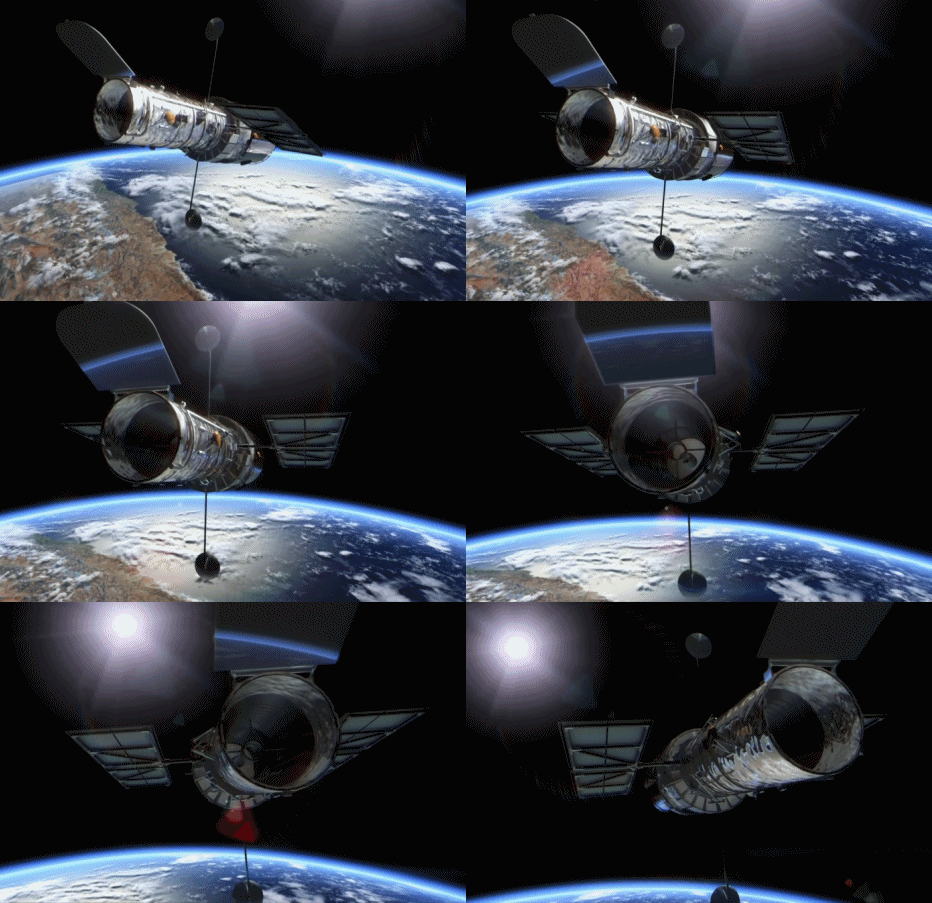
NASA - Hubble Space Telescope patch.
Oct. 26, 2019
This image from the NASA/ESA Hubble Space Telescope shows IC 4653, a galaxy just over 80 million light-years from Earth. That may sound like quite a distance, but it’s not that far on a cosmic scale. At these kinds of distances, the types and structures of the objects we see are similar to those in our local area.
The galaxy's whirling arms tell us a story about what’s happening inside this galaxy. Bright blue patches mark sites of active star formation. Studying the structures of other galaxies is a key way to learn about the structure of our own, given that humans can’t leave the Milky Way to look back and see what it looks like from the outside. It helps to compare our observations of our home galaxy with those of nearby galaxies we can see in their entirety.
Hubble Space Telescope (HST)
For more information about Hubble, visit:
http://hubblesite.org/
http://www.nasa.gov/hubble
http://www.spacetelescope.org/
Text Credits: European Space Agency (ESA)/NASA/Lynn Jenner/Image, Animation, Credits: ESA/Hubble & NASA, D. Rosario (CEA, Durham University).
Greetings, Orbiter.ch
vendredi 25 octobre 2019
Astronauts Explore How Space Impacts Brain and Muscles
ISS - Expedition 61 Mission patch.
October 25, 2019
Brain and muscle research were on today’s schedule of human research aboard the International Space Station. The Expedition 61 crew also ensured the plumbing and air conditioning systems stay in tip-top shape.
The brain is able to optimize its blood flow even if the cardiovascular system cannot maintain an ideal blood pressure. Flight Engineer Jessica Meir explored the brain’s capacity to regulate that blood flow in space today. She used Doppler gear to measure her blood pressure in her finger artery and blood flow velocity in her cerebral artery. Scientists may use the data to help astronauts adjust to microgravity and ease the return to Earth after months or years in space.
Image above: Portions of the International Space Station are pictured as the orbiting complex was flying into an orbital sunset. Image Credit: NASA.
NASA astronauts Christina Koch and Andrew Morgan collaborated on the Myotones muscle tone in space study. The duo took turns measuring their arms and legs before scanning them with an ultrasound device. Observations may help doctors improve rehabilitation techniques for astronauts on long-duration missions and sedentary patients on Earth.
Commander Luca Parmitano of ESA (European Space Agency) put on his plumber’s hat today and replaced hydraulic components in the station’s bathroom located in the Tranquility module. He also deactivated science hardware that was tracking ocean-going vessels.
International Space Station (ISS). Image Credit: NASA
Cosmonauts Alexander Skvortsov and Oleg Skripochka stayed focused on the upkeep of the Russian segment of the orbiting lab. The duo charged Soyuz spacecraft batteries and cleaned fans and filters in the air conditioning system in their portion of the space station.
Related links:
Expedition 61: https://www.nasa.gov/mission_pages/station/expeditions/expedition61/index.html
Regulate that blood flow: https://www.nasa.gov/mission_pages/station/research/experiments/explorer/Investigation.html?#id=1938
Myotones: https://www.nasa.gov/mission_pages/station/research/experiments/explorer/Investigation.html?#id=7573
Tranquility module: https://www.nasa.gov/mission_pages/station/structure/elements/tranquility/
Tracking ocean-going vessels: https://www.nasa.gov/mission_pages/station/research/experiments/explorer/search.html?#q=maritime&i=&p=&c=&g=&s=
Space Station Research and Technology: https://www.nasa.gov/mission_pages/station/research/index.html
International Space Station (ISS): https://www.nasa.gov/mission_pages/station/main/index.html
Images (mentioned), Text, Credits: NASA/Mark Garcia.
Greetings, Orbiter.ch
A Mega-Cluster of Galaxies in the Making
NASA - Chandra X-ray Observatory patch.
Oct. 25, 2019
Astronomers using data from the Chandra X-ray Observatory and other telescopes have put together a detailed map of a rare collision between four galaxy clusters. Eventually, all four clusters – each with a mass of at least several hundred trillion times that of the Sun – will merge to form one of the most massive objects in the universe.
Galaxy clusters are the largest structures in the cosmos that are held together by gravity. Clusters consist of hundreds or even thousands of galaxies embedded in hot gas, and contain an even larger amount of invisible dark matter. Sometimes two galaxy clusters collide, as in the case of the Bullet Cluster, and occasionally more than two will collide at the same time.
The new observations show a mega-structure being assembled in a system called Abell 1758, located about 3 billion light-years from Earth. It contains two pairs of colliding galaxy clusters that are heading toward one another. Scientists first recognized Abell 1758 as a quadruple galaxy cluster system in 2004 using data from Chandra and XMM-Newton, a satellite operated by the European Space Agency (ESA).
Chandra X-ray Observatory
X-rays from Chandra are shown as blue and white, depicting fainter and brighter diffuse emission, respectively. This new composite image also includes an optical image from the Sloan Digital Sky Survey. The Chandra data revealed for the first time a shock wave -- similar to the sonic boom from a supersonic aircraft -- in hot gas visible with Chandra in the northern pair's collision. From this shock wave, researchers estimate two clusters are moving about 2 million to 3 million miles per hour (3 million to 5 million kilometers per hour), relative to each other.
The team also used radio data from the Giant Metrewave Radio Telescope (GMRT), and X-ray data from the European Space Agency’s XMM-Newton mission.
Chandra X-ray Observatory: https://www.nasa.gov/mission_pages/chandra/main/index.html
Image, Animation, Credits: X-ray: NASA/CXC/SAO/G.Schellenberger et al.; Optical:SDSS/Text Credits: Yvette Smith.
Greetings, Orbiter.ch
Space Station Science Highlights: Week of October 21, 2019
ISS - Expedition 61 Mission patch.
Oct. 25, 2019
Following the first all-woman space walk on Friday, Oct. 18, the crew of the International Space Station spent the week of Oct. 21 conducting scientific studies on amyloid fiber formation, the human gut biota and more. The space station provides a platform for long-duration research on the human body in microgravity and makes important contributions to Artemis, NASA’s program to go forward to the Moon and on to Mars.
International Space Station (ISS). Animation Credit: NASA
Here are details on some of the science conducted on the orbiting laboratory during the week:
Creating a virtual reality space experience
The ISS Experience creates virtual reality videos from footage covering different aspects of crew life, execution of science and the international partnerships involved on the space station. Crew members record footage using a Z-CAM V1 Pro Cinematic Virtual Reality (VR) 360-degree camera with nine 190° fisheye lenses. Events recorded this week included NASA astronaut Jessica Meir’s thoughts following the historic, all-female spacewalk.
Examining amyloid formation in microgravity
The Ring Sheared Drop investigation takes advantage of the fact that fluids float in microgravity, which allows researchers to examine formation of amyloid fibrils in liquids held together by surface tension rather than a container. Abnormal fibrous deposits found in organs and tissues, amyloids are associated with neurodegenerative conditions such as Alzheimer’s disease. Results could contribute to better understanding of and treatments for these diseases. Data on the flow of liquids without the complications associated with solid walls also could contribute to development of advanced materials. The crew reviewed procedures and conducted tests in preparation for investigation operations.
Building a better gut biota
Image above: NASA astronaut Christina Koch conducts the Ring Sheared Drop investigation in the Microgravity Sciences Glovebox. The investigation uses microgravity to examine the formation and flow of amyloids in microgravity, which may contribute to a better understanding of neurodegenerative diseases caused by these fibers. Image Credit: NASA.
Crew members collected saliva samples and completed questionnaires for the Probiotics investigation.The human immune system is weaker in space and some species of harmful bacteria become stronger and more virulent in microgravity. This combination poses an increased risk to crew member health. The investigation studies whether beneficial bacteria or probiotics can improve the intestinal microbiota and immune function and help protect astronaut health on long-duration space missions.
On the trail of dark matter
Stars, planets and interstellar dust represent only a small fraction of the total mass in the universe. The rest is dark matter, invisible matter that cannot be directly detected but can be inferred. The Alpha Magnetic Spectrometer - 02 (AMS-02) is a state-of-the-art particle physics detector that uses the unique environment of space to advance knowledge of the universe and understanding of its origins by searching for antimatter and measuring cosmic rays. The crew reviewed procedures for an upcoming spacewalk planned to refurbish AMS so its important exploration can continue.
Image above: The Alpha Magnetic Spectrometer - 02 (AMS-02), mounted on the exterior of the space station, measures cosmic rays looking for evidence of dark matter and dark energy. Image Credit: NASA.
Other investigations on which the crew performed work:
- Veg-04B, part of a phased research project to address the need for a continuous fresh-food production system in space, focuses on the effects of light quality and fertilizer on a leafy crop, Mizuna mustard greens, as well as taste as assessed by the crew.
https://www.nasa.gov/mission_pages/station/research/experiments/explorer/Investigation.html?#id=7895
Image above: NASA astronaut Andrew Morgan works on the Veg-04 investigation, which is growing Mizuna mustard greens as part of ongoing efforts to develop methods to provide food in space and on other planets. Image Credit: NASA.
- Food Acceptability examines changes in the appeal of food aboard the space station during long-duration missions. “Menu fatigue” from repeatedly consuming a limited choice of foods may contribute to the loss of body mass often experienced by crew members, potentially affecting astronaut health, especially as mission length increases.
https://www.nasa.gov/mission_pages/station/research/experiments/explorer/Investigation.html?#id=7562
- Standard Measures captures a consistent set of measures from crew members to characterize how their bodies adapt to living in space.
https://www.nasa.gov/mission_pages/station/research/experiments/explorer/Investigation.html?#id=7711
- BEST studies the use of DNA sequencing to identify unknown microbial organisms and improve understanding of how humans, plants and microbes adapt to living in space.
https://www.nasa.gov/mission_pages/station/research/experiments/explorer/Investigation.html?#id=7687
Space to Ground: Space Jam: 10/25/2019
Related links:
Expedition 61: https://www.nasa.gov/mission_pages/station/expeditions/expedition61/index.html
Artemis: https://www.nasa.gov/artemis
The ISS Experience: https://www.nasa.gov/mission_pages/station/research/experiments/explorer/Investigation.html?#id=7877
Ring Sheared Drop: https://www.nasa.gov/mission_pages/station/research/experiments/explorer/Investigation.html?#id=7383
Probiotics: https://www.nasa.gov/mission_pages/station/research/experiments/explorer/Investigation.html?#id=2047
Alpha Magnetic Spectrometer - 02 (AMS-02): https://www.nasa.gov/mission_pages/station/research/experiments/explorer/Investigation.html?#id=729
ISS National Lab: https://www.issnationallab.org/
Space Station Research and Technology: https://www.nasa.gov/mission_pages/station/research/index.html
International Space Station (ISS): https://www.nasa.gov/mission_pages/station/main/index.html
Images (mentioned), Video (NASA), Text, Credits: NASA/Michael Johnson/John Love, Lead Increment Scientist Expedition 61.
Best regards, Orbiter.ch
jeudi 24 octobre 2019
Crew Explores Space Biology, Reviews Particle Detector Repairs
ISS - Expedition 61 Mission patch.
October 24, 2019
The six residents living aboard the International Space Station are busy today ensuring advanced microgravity research continues to provide benefits for citizens on Earth and in space. The Expedition 61 crew is also brushing up on repair techniques for a cosmic particle detector attached to the outside of the orbiting lab.
Image above: NASA astronaut Andrew Morgan watered plants earlier this week to help NASA learn how to provide fresh food for crews on long-term space missions. Image Credit: NASA.
NASA astronauts Jessica Meir and Christina Koch juggled an array of life science activities throughout Thursday. Meir cared for plants for a new field of botany research exploring how to provide fresh food for long-term space crews. Meir later swapped out a failed computer hard drive that supports combustion experiments. Koch organized biology hardware for a study seeking therapies for aging-related conditions. Koch then serviced microbial DNA samples to understand how microorganisms adapt to weightlessness.
The Alpha Magnetic Spectrometer (AMS-02) is due for an upgraded thermal control system after being installed on the outpost’s Starboard-3 truss structure in 2011. NASA is planning a series of spacewalks to restore the AMS-02 to full service. Commander Luca Parmitano of ESA (European Space Agency) and NASA Flight Engineer Andrew Morgan are reviewing the tools and techniques necessary to complete the AMS repair job.
International Space Station (ISS). Animation Credit: NASA
Over in the station’s Russian segment, composed of five modules, a pair of cosmonauts focused on hardware and systems maintenance. Alexander Skvortsov inspected lab windows and checked batteries. Fellow cosmonaut Oleg Skripochka worked on air conditioning and plumbing tasks inside the orbital lab. The duo also explored how to improve accuracy when detecting and photographing Earth landmarks.
Related links:
Expedition 61: https://www.nasa.gov/mission_pages/station/expeditions/expedition61/index.html
Botany research: https://www.nasa.gov/mission_pages/station/research/experiments/explorer/Investigation.html?#id=7895
Combustion experiments: https://www.nasa.gov/mission_pages/station/research/experiments/explorer/Facility.html?#id=317
Aging-related conditions: https://www.nasa.gov/mission_pages/station/research/experiments/explorer/Investigation.html?#id=7992
Microbial DNA samples: https://www.nasa.gov/mission_pages/station/research/experiments/explorer/Investigation.html?#id=7687
Alpha Magnetic Spectrometer (AMS-02): https://www.nasa.gov/mission_pages/station/research/alpha-magnetic-spectrometer.html
Outpost’s Starboard-3 truss structure: https://www.nasa.gov/mission_pages/station/structure/elements/truss-structure
Photographing Earth landmarks: https://www.energia.ru/en/iss/researches/develop/04.html
Space Station Research and Technology: https://www.nasa.gov/mission_pages/station/research/index.html
International Space Station (ISS): https://www.nasa.gov/mission_pages/station/main/index.html
Image (mentioned), Animation (mentioned), Text, Credits: NASA/Mark Garcia.
Best regards, Orbiter.ch
Inscription à :
Articles (Atom)