jeudi 20 août 2020

Successful re-entry of H-II Transfer Vehicle “KOUNOTORI9” (HTV9)


JAXA - H-II Transfer Vehicle “KOUNOTORI9” (HTV9) patch.

August 20, 2020

The H-II Transfer Vehicle “KOUNOTORI9” (HTV9) successfully re-entered the atmosphere after the third de-orbit maneuver at 3:40 p.m. on August 20, 2020 (Japanese Standard Time, JST).

Illustration  of H-II Transfer Vehicle “KOUNOTORI” atmospheric re-entry

The “KOUNOTORI9” has successfully accomplished its main objective to ship cargo to the International Space Station (ISS).

The estimated date/time of “KOUNOTORI9” re-entry and splashdown are as follows (Japanese Standard Time, JST):

Estimated re-entry*1:     August 20, 2020 / 4:07 p.m.
Estimated splashdown:     August 20, 2020 / 4:19 p.m. ~ 4:57 p.m.

*1: Altitude at 120 km
https://global.jaxa.jp/press/2020/08/20200820-2_e.html

Related article:

Japanese Cargo Craft Completes Station Mission
https://orbiterchspacenews.blogspot.com/2020/08/japanese-cargo-craft-completes-station.html

Reference link:

For more details, please refer to the following website:
https://iss.jaxa.jp/en/htv/mission/htv-9/

Address of Dr. YAMAKAWA Hiroshi, President of JAXA, on the H-II Transfer Vehicle “KOUNOTORI9” Mission Completion

Today, on August 20, 2020, the 9th H-II Transfer Vehicle "KOUNOTORI9" ("HTV9") left the orbit and reentered Earth’s atmosphere as scheduled. Launched from the Tanegashima Space Center on May 21, 2020, “KOUNOTORI9” successfully docked to the International Space Station (ISS) and transferred onboard resupply items and utilization cargoes to it. Then, loaded with trash materials from the ISS, “KOUNOTORI9” departed from the ISS and completed Today’s reentry into the atmosphere to finish its mission.

The nine “KOUNOTORI” transfer vehicles have been transporting not only Japanese cargo but also those of the ISS international partners since its first launch in 2009, and have played an important and indispensable role for operations and utilization of the ISS as the only spacecraft capable of transporting large-sized experiment racks to the ISS. In particular, we believe that we were able to make a significant contribution to the future stable operation of the ISS by continuously transporting the ISS’s new batteries from “KOUNOTORI6” to “KOUNOTORI9” which replaced the old ones that had been used beyond their design life.

JAXA has acquired various new technologies and knowledge through the development, launch and operations of “KOUNOTORI”. In order to meet the strict safety standards imposed on spacecraft flying and approaching manned space facilities, JAXA developed the rendezvous and capture technology and applied it to “KONOTORI”. This new technology has also been adopted by the U.S. resupply vehicle, and we believe it has become and international standard. Moreover, we have also achieved many results that might lead to progress of future manned space activities through technical demonstrations making use of opportunities of “KONOTORI” operation, such as demonstration of the Small Re-entry Capsule (HSRC) on “KOUNOTORI7” and Wireless LAN Demonstration (WLD) on “KOUNOTORI9”.

JAXA is currently developing a new resupply vehicle, the HTV-X, as a successor to the KOUNOTORI. Based on our accumulated technologies and knowledge, we will steadily develop the HTV-X as a new resupply vehicle with improved transport capability and operability, as well as a spacecraft that can be used for cargo resupply to the manned cislunar station, Gateway.

Finally, we would like to express here our heartfelt gratitude to many officials from domestic and international organizations and many individuals who provided us with precious support and assistance to “KOUNOTORI” missions. We would like to ask you for continued attention and support to us.

August 20, 2020
YAMAKAWA Hiroshi,
President
Japan Aerospace Exploration Agency (JAXA)

Related link:
International Space Station (ISS) /Japanese Experiment Module (Kibo): https://iss.jaxa.jp/en/index.html

Image, Text, Credit: JAXA.

Best regards, Orbiter.ch

mercredi 19 août 2020

Space Traffic Clear at Station Until October


ISS - Expedition 63 Mission patch.

August 19, 2020

The Expedition 63 crew has turned its attention toward space science and lab maintenance after releasing a Japanese cargo craft from the International Space Station on Tuesday. More cargo and crew missions to replenish the orbiting lab are planned for October.

Commander Chris Cassidy switched off communications gear today used to send commands to Japan’s H-II Transfer Vehicle-9 (HTV-9) after its departure on Tuesday. The HTV-9 will orbit Earth until Thursday morning when it descends into the atmosphere for a fiery, but safe demise over the South Pacific.


Image above: Expedition 63 Commander Chris Cassidy applies a mission sticker inside the space station to signify the departure of Japan’s HTV-9 resupply ship from the U.S. Harmony module. Image Credit: NASA.

The NASA commander spent the rest of the day working on orbital plumbing and life support gear. Cassidy removed and replaced the Waste and Hygiene Compartment’s recycle tank located in the Tranquility module. He also inspected out gear that analyzes organic compounds in the station’s air.

Veteran station cosmonaut Anatoly Ivanishin focused on battery work as he installed current converters throughout the lab’s Russian segment. First-time cosmonaut Ivan Vagner spent Wednesday morning working on more orbital plumbing before exploring ways to improve Earth photography techniques and determine how mission events impact the orbiting lab.

International Space Station (ISS). Animation Credit: NASA

Space traffic will be clear at the space station for the rest of August and into September. The mission pace will pick back up in October with a U.S. Cygnus cargo ship from Northrop Grumman, the Expedition 64 crew and the SpaceX Crew-1 mission all to set to arrive within a period of three weeks.

Related articles:

Japanese Cargo Craft Completes Station Mission
https://orbiterchspacenews.blogspot.com/2020/08/japanese-cargo-craft-completes-station.html

Crew Dragon Returns as SpaceX, Russia Prep Future Crew Missions
https://orbiterchspacenews.blogspot.com/2020/08/crew-dragon-returns-as-spacex-russia.html

Related links:

Expedition 63: https://www.nasa.gov/mission_pages/station/expeditions/expedition63/index.html

Expedition 64: http://www.nasa.gov/mission_pages/station/expeditions/expedition64/index.html

Tranquility module: https://www.nasa.gov/mission_pages/station/structure/elements/tranquility/

Earth photography techniques: https://www.energia.ru/en/iss/researches/develop/04.html

Mission events impact the orbiting lab: https://www.energia.ru/en/iss/researches/develop/07.html

Space Station Research and Technology: https://www.nasa.gov/mission_pages/station/research/overview.html

International Space Station (ISS): https://www.nasa.gov/mission_pages/station/main/index.html

Image (mentioned), Animation (mentioned), Text, Credits: NASA/Mark Garcia.

Best regards, Orbiter.ch

Tiny Asteroid Buzzes by Earth - the Closest Flyby on Record


Asteroid Watch logo.

August 19, 2020

An SUV-size space rock flew past our planet over the weekend and was detected by a NASA-funded asteroid survey as it departed. 


Animation above: This illustration shows asteroid 2020 QG's trajectory bending during its close approach to Earth. The asteroid is the closest known nonimpacting asteroid ever detected. Image Credits: NASA/JPL-Caltech.

Near Earth Asteroids, or NEAs, pass by our home planet all the time. But an SUV-size asteroid set the record this past weekend for coming closer to Earth than any other known NEA: It passed 1,830 miles (2,950 kilometers) above the southern Indian Ocean on Sunday, Aug. 16 at 12:08 a.m. EDT (Saturday, Aug. 15 at 9:08 p.m. PDT).

At roughly 10 to 20 feet (3 to 6 meters) across, asteroid 2020 QG is very small by asteroid standards: If it had actually been on an impact trajectory, it would likely have become a fireball as it broke up in Earth's atmosphere, which happens several times a year.

By some estimates, there are hundreds of millions of small asteroids the size of 2020 QG, but they are extremely hard to discover until they get very close to Earth. The vast majority of NEAs pass by safely at much greater distances - usually much farther away than the Moon.


Image above: The circled streak in the center of this image is asteroid 2020 QG, which came closer to Earth than any other nonimpacting asteroid on record. It was detected by the Zwicky Transient Facility on Sunday, Aug. 16 at 12:08 a.m. EDT (Saturday, Aug. 15 at 9:08 p.m. PDT). Image Credits: ZTF/Caltech Optical Observatories.

"It's really cool to see a small asteroid come by this close, because we can see the Earth's gravity dramatically bend its trajectory," said Paul Chodas, director of the Center for Near-Earth Object Studies (CNEOS) at NASA's Jet Propulsion Laboratory in Southern California. "Our calculations show that this asteroid got turned by 45 degrees or so as it swung by our planet."

Zipping along at almost 8 miles per second (12.3 kilometers per second) - a little slower than average, Chodas noted - 2020 QG was first recorded as just a long streak in a wide-field camera image taken by the Zwicky Transient Facility. The image was taken six hours after the closest point of approach as the asteroid was heading away from Earth. A sky-scanning survey telescope funded by the National Science Foundation and NASA, the Zwicky Transient Facility is based at Caltech's Palomar Observatory in San Diego County. NASA's Near-Earth Object Observations Program funds data processing for NEO detections.

Asteroid 2020 QG enters the record books as the closest known nonimpacting asteroid; many very small asteroids impact our planet every year, but only a few have actually been detected in space a few hours before impacting Earth. On average, an asteroid the size of 2020 QG passes this closely only a few times a year.

In 2005, Congress assigned NASA the goal of finding 90% of the near-Earth asteroids that are about 460 feet (140 meters) or larger in size. These larger asteroids pose a much greater threat if they were to impact, and they can be detected much farther away from Earth, because their rate of motion across the sky is typically much smaller at that distance.

"It's quite an accomplishment to find these tiny close-in asteroids in the first place, because they pass by so fast," Chodas said. "There's typically only a short window of a couple of days before or after close approach when this small of an asteroid is close enough to Earth to be bright enough but not so close that it moves too fast in the sky to be detected by a telescope."

A division of Caltech in Pasadena, JPL hosts CNEOS for NASA's Near-Earth Object Observations Program in NASA's Planetary Defense Coordination Office. More information about CNEOS, asteroids and near-Earth objects can be found at:

https://cneos.jpl.nasa.gov

For more information about NASA's Planetary Defense Coordination Office, visit:

https://www.nasa.gov/planetarydefense

For asteroid and comet news and updates, follow @AsteroidWatch on Twitter:

https://twitter.com/AsteroidWatch

Animation (mentioned), Image (mentioned), Text, Credits: NASA/Josh Handal/JPL/Andrew Good.

Greetings, Orbiter.ch

The Hayabusa2 Re-entry Capsule Approved to Land in Australia


JAXA - Hayabusa2 Mission patch.

August 19, 2020

On August 10, 2020, JAXA was informed that the Authorisation of Return of Overseas-Launched Space Object (AROLSO) for the re-entry capsule from Hayabusa2 was issued by the Australian Government. The date of the issuance is August 6, 2020.

The Hayabusa2 re-entry capsule will return to Earth in South Australia on December 6, 2020 (Japan Time and Australian Time). The landing site will be the Woomera Prohibited Area. The issuance of the AROLSO gave a major step forward for the capsule recovery.

We will continue careful operation for return of Hayabusa2 and recovery of the capsule, and the operation status will be announced in a timely manner.


Comment from JAXA President, Hiroshi Yamakawa

The approval to carry out the re-entry and recovery operations of the Hayabusa2 return sample capsule is a significant milestone. We would like to express our sincere gratitude for the support of the Australian Government as well as multiple organizations in Australia for their cooperation.
We will continue to prepare for the successful mission in December 2020 in close cooperation with the Australian Government.

Related Links:

Hayabusa2 Project: http://www.hayabusa2.jaxa.jp/en/

Asteroid Probe Hayabusa2 (ISAS): http://www.isas.jaxa.jp/en/missions/spacecraft/current/hayabusa2.html

Asteroid Explorer "Hayabusa2": https://global.jaxa.jp/projects/sas/hayabusa2/index.html

Tick given for asteroid samples to land in Australia(Minister for Industry, Science and Technology, Australian Goverment): https://www.minister.industry.gov.au/ministers/karenandrews/media-releases/tick-given-asteroid-samples-land-australia

Image, Text, Credits: National Research & Development Agency/Japan Aerospace Exploration Agency (JAXA).

Best regards, Orbiter.ch

mardi 18 août 2020

Space Station 20th: Food on ISS


ISS - 20 Years on the International Space Station patch.

Aug. 18, 2020

On April 12, 1961, Soviet cosmonaut Yuri A. Gagarin made history as the first human in space aboard his Vostok capsule. During his single orbit around the Earth, he also became the first person to eat in space, squeezing beef and liver paste from an aluminum tube into his mouth. For dessert he had a chocolate sauce, eating it using the same method. His fellow cosmonauts who flew longer missions, up to five days, also consumed their meals from tubes. Astronaut John H. Glenn was the first American to eat in space – apple sauce from a toothpaste-like tube. His fellow Mercury astronauts on slightly longer missions consumed other food items also from tubes. These early experiences proved that humans could eat and swallow in weightlessness with no ill effects, although the meals weren’t particularly appetizing.
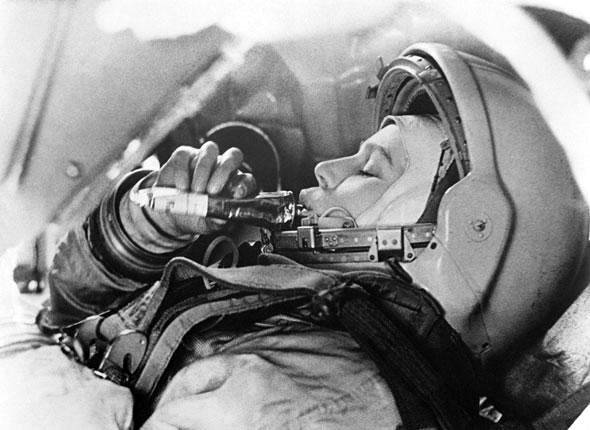
Above: Cosmonaut Valentina V. Tereshkova eating from a tube during her Vostok 6 mission.
Middle: Aluminum tube containing beef and vegetables from Mercury food supplies.
Below: Samples of food from the Mercury program.
Images Credits: NASM.

Freeze-dried foods were introduced during the Gemini Program to support astronauts for missions lasting up to two weeks. Crewmembers used the spacecraft’s water supply to reconstitute the food prior to eating. During Apollo missions to the Moon, astronauts had about 70 items to choose from, including entrees, condiments, and beverages. The food came freeze-dried and prepackaged, requiring the astronauts to add water from the onboard supply. Some improvements were made in the course of the Apollo program, including the addition of hot water to rehydrate some food items and food that could be eaten out of its bag using a spoon. Sandwiches were tried but proved less than ideal, as the bread didn’t stay very fresh and caused crumbs that would float away in the cabin and possibly cause harm to sensitive equipment or even get in the astronaut’s eyes or lungs. The number of items aboard Skylab didn’t increase very much, but the preservation of some foods did, made possible by the addition of a freezer aboard America’s first space station. According to Charles Bourland who developed much of the food system for Skylab, about 15 percent of the food supply was frozen and the astronauts could enjoy lobster Newburg, ice cream, and other frozen delicacies. The remainder of the food items were stored in cans which provided a long shelf-life.

Above: Food for Gemini 3. Middle: Food specialist Rita M. Rapp with food for Apollo 16.
Below: Skylab 4 astronaut Edward G. Gibson at the Skylab galley.

During the Apollo-Soyuz Test Project (ASTP) in 1975, American astronauts sampled Russian space food for the first time as crewmembers shared meals during two days of docked activities. Much of the food aboard the Soviet Soyuz came in tubes, and Soviet Commander Aleksei A. Leonov played a prank on American astronauts Thomas P. Stafford and Donald K. “Deke” Slayton by replacing the labels on tubes of borsch with labels from famous Russian vodkas. With the advent of the Space Shuttle in 1981, the availability of a galley to both rehydrate and reheat foods made the astronauts’ menus more palatable and varied. The lack of refrigeration on the other hand required most food items to be dehydrated or thermostabilized, apart from a small locker of fresh food intended for immediate consumption.

Above: ASTP astronauts Stafford (left) and Slayton holding up tubes of “vodka” aboard Soyuz.
Middle: Astronaut Thomas Akers using the Shuttle galley to prepare a meal.
Below: Astronauts (left to right) Charles F. Bolden, Robert L. Gibson, and George P. Nelson
preparing meals for their STS-61C crewmates.

The space station Mir’s Core Module included a dining table with the ability to reheat food in cans and tubes, and using a nearby cold and hot water dispenser, cosmonauts could rehydrate certain food items such as juices and soups. Over the course of its 15-year lifetime, a steady stream of uncrewed Progress cargo resupply vehicles brought food to the station, including much welcome fresh fruits and vegetables. The variety of Russian dishes was regularly supplemented when visiting crewmembers from other nations brought their own culinary specialties. The first French citizen to visit Mir, astronaut Jean-Loup Chrétien, brought such items as paté, sautéed veal, cheeses and chocolate. During the Shuttle-Mir Program, American astronauts residing aboard Mir first ate mostly Russian food, but on later missions brought American food as well, such as astronaut Shannon M. Lucid’s favorite, jello, that became a regular Sunday treat with her Mir 21 crewmates Yuri I. Onufriyenko and Yuri V. Usachev. Andrew S. Thomas remarked very positively on the variety and quality of the Russian food during his five-month stay aboard Mir in 1998, especially praising the Russian soups and fruit juices.

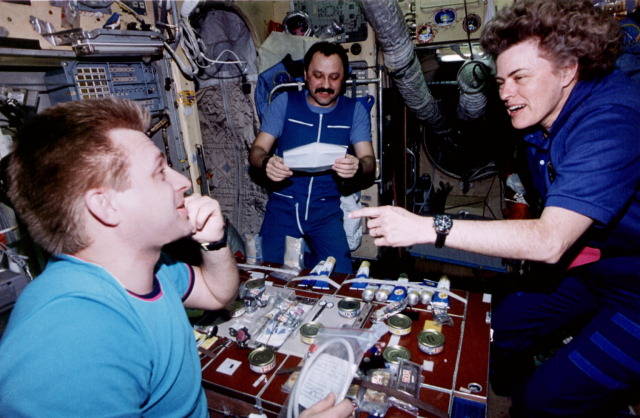
Above: Items taken to Mir by French astronaut Chrétien. Below: Mir 21 crew
(left to right) Onufriyenko, Usachev, and Lucid during mealtime onboard Mir.

One item noticeably absent from these past space menus is bread. As noted above, attempts at flying sandwiches during Apollo missions met with little success. In November 1985, Mexican Payload Specialist Rodolfo Neri Vela, who was a crewmember aboard Atlantis during the STS-61B mission, requested that tortillas be included in his food supply. Once on orbit, his fellow crewmembers noticed that the tortillas, unlike regular bread, didn’t create crumbs and could be used to make sandwiches or hold other food items. Since that mission, tortillas have been a favorite of astronauts and are standard fare aboard ISS. Crewmembers use them to make breakfast burritos, hamburgers, and even peanut butter and jelly sandwiches, as demonstrated by Expedition 50 Commander R. Shane Kimbrough.

Above: Payload Specialist Neri Vela enjoying a trend-setting tortilla aboard Atlantis in 1985.
Middle: STS-98 Pilot Kenneth D. Cockrell preparing breakfast burritos for his crewmates.
Below: Expedition 51 Commander Peggy A. Whitson showing off the hamburger she prepared using a tortilla.

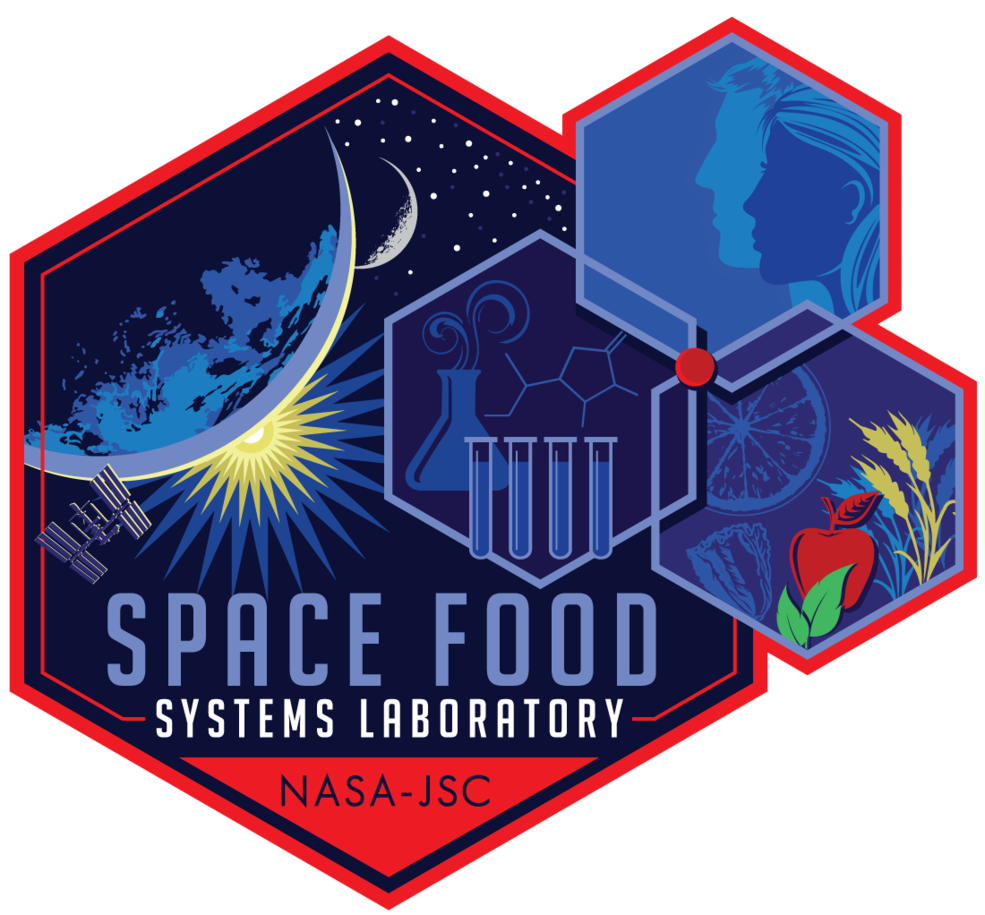
The Space Food Systems Laboratory at the Johnson Space Center (JSC) in Houston is responsible for the testing, preparation, and packaging of U.S. food to be delivered to ISS. Today, crewmembers can choose from about 200 different items for their standard menu that can be augmented with some personal choices to include commercial off-the-shelf items. Without any dedicated refrigerators or freezers for food storage other than a chiller to cool beverages and condiments, all food items on ISS are stored at ambient temperature and must remain stable at those conditions. Foods can be freeze-dried or thermostabilized to achieve the required shelf-life. The packaged food is then shipped to one of three launch sites for loading into resupply vehicles – to Cape Canaveral Air Force Station in Florida for launch aboard SpaceX Dragons, the Mid-Atlantic Regional Spaceport in Virginia to be loaded into Cygnus spacecraft, or the Tanegashima Space Center in Japan from where HTVs are launched.

Above: Patch of the JSC Space Food Systems Laboratory. Below: Expedition 1
crewmembers (left to right) Yuri P. Gidzenko, William M. Shepherd, and
Sergei K. Krikalev and two of their backups Vladimir N. Dezhurov and
Mikhail V. Tyurin sample ISS foods in the JSC food lab in 1998.

The U.S. and Russia each provide their half of the food destined for ISS and the two partners share some food with each other. Before their missions to ISS, crewmembers sample the American food at JSC’s food lab and repeat the process with Russian food in Moscow. Astronauts from the other ISS partner agencies such as the European Space Agency (ESA), the Japan Aerospace Exploration Agency (JAXA), and the Canadian Space Agency (CSA) often bring their own specialties that are shared among all the crewmembers. For example, for his flight during Expedition 50 and 51, ESA astronaut Thomas G. Pesquet from France brought 13 dishes prepared especially for him by the French space agency CNES.

Above: A food scientist prepares a meal for ISS using fresh vegetables.
Middle: Grace Douglas and Vickie Kloeris in front of the freeze-drier in the JSC food lab.
Below: A food technician packages food for delivery to ISS.
Credits: Brian Goldman/Texas Monthly.

The most difficult foods to provide to long-duration crewmembers on ISS, and the most sought after by them, are fresh fruits and vegetables. Their short shelf life and the lack of dedicated refrigeration on ISS for food result in them being a rare commodity in orbit. A limited supply of fresh fruits and vegetables regularly arrives with each visiting vehicle and is eagerly consumed by the onboard crews. Another option, exercised by Russian cosmonaut Oleg G. Artemev on both his long-duration missions, is to bring along your own, in this case onions that he carefully tended and regularly snipped off the growing shoots to add as a flavoring to his usual dishes. A third possibility, so far only tried on a very limited and experimental basis, is to grow your own aboard ISS. In 2013, after earlier trial runs that showed that eating the red romaine lettuce grown in the Veggie apparatus was safe to eat, Expedition 44 Flight Engineers Kimiya Yui, Kjell N. Lindgren, and Scott J. Kelly tried the space-grown vegetable and declared it delicious.

Above: Expedition 9 Commander Gennadi I. Padalka showing off fresh fruits recently delivered by a
Progress cargo resupply vehicle. Middle: Fresh onion photographed by Expedition 39 Flight Engineer Artemev.
Below: Expedition 44 Flight Engineers Yui, Lindgren, and Kelly sampling red romaine lettuce grown aboard ISS.

The first pizza aboard ISS arrived via a Progress resupply vehicle in May 2001 in a commercial agreement between the Russian Space Agency and Pizza Hut. Expedition 2 Commander Yuri V. Usachev reheated the salami-topped pie and filmed himself eating a slice in a commercial for the pizza company. In 2017, Expedition 53 astronaut Paolo Nespoli from the Italian Space Agency casually mentioned that he missed one of his favorite foods, pizza. So ISS managers ensured that all the necessary ingredients were loaded on the next Cygnus resupply vehicle and Nespoli and his ISS crewmates had themselves an out of this world pizza party. Needless to say, in weightlessness it wasn’t enough to just eat the pies, spinning and playing with them was just too irresistible.

Above: Expedition 2 Commander Usachev tasting the pizza delivered to ISS. Below: Expedition 53
crewmembers (left to right) Mark T. vande Hei, Sergei N. Ryazanski, Aleksandr A. Misurkin,
Paolo A. Nespoli, Joseph M. Acaba, and Randolph J. Bresnik show off the pizzas they created onboard ISS.

With the increased diversity of NASA’s astronaut corps as well as the number of international astronauts who have visited ISS, the variety of food available to all crewmembers has grown significantly. Astronaut Sunita L. Williams not only enjoyed Fluffernutter sandwiches with peanut butter on a tortilla to remind her of her childhood but Slovenian sausages to celebrate her mother’s culture and samosas to celebrate her father’s Indian heritage. To help celebrate his birthday, French astronaut Thomas G. Pesquet had macarons delivered to ISS. Several astronauts from JAXA held sushi parties for their fellow crewmembers. Short-term visits by Space Flight Participants from several nations added culinary spice to ISS menus, such as satay from Malaysia, kimchee from Korea, and madrooba, saloona, and balaleet from the United Arab Emirates.

Above: Expedition 10 Commander Leroy Chiao enjoying a Chinese-inspired dish. Middle: Expedition 50 astronaut
Pesquet enjoys macarons delivered for his birthday. Below: Expedition 55 crewmembers
(left to right) Anton N. Shkaplerov, Oleg G. Artemev, and Norishige Kanai enjoy a sushi dinner.

Despite the wide variety of foods available to ISS crewmembers, sometimes they crave that little something extra, either an extra sweet dessert or some comfort food item that reminds them of home. Although ISS doesn’t have a dedicated freezer for food, freezers destined to return science samples are frequently launched on cargo vehicles like SpaceX Dragon or Northrup Grumman Cygnus spacecraft. Since the freezers often launch empty, they can carry items such as ice cream or other frozen treats for crewmembers to enjoy as soon as they open the hatches to the vehicles. During Expedition 42, Italian astronaut Samantha Cristoforetti from ESA enjoyed the first authentic espresso in space made in a device provided by the Italian Space Agency in cooperation with espresso maker Lavazzo. In November 2019, the Cygnus 12 vehicle brought to ISS a Zero G oven provided by Doubletree Hotels as an experiment to assess the possibility of baking in space. And just in time for Christmas, Expedition 61 astronauts Luca S. Parmitano and Christina H. Koch baked chocolate chip cookies that returned to Earth aboard SpaceX 19 in January 2020.

Above: Expedition 55 Flight Engineer Oleg G. Artemev enjoys a frozen candy bar.
Middle: Expedition 42 Flight Engineer Cristoforetti savoring an espresso made aboard ISS.
Below: Expedition 61 astronauts Parmitano and Koch showing off the chocolate cookie they baked aboard ISS.

Great improvements have been made in the food available to long-duration crewmembers over the 20 years that ISS has been permanently occupied. The international nature of the program adds much-appreciated variety to the menu as crewmembers bring their culturally important food items to the dining tables on ISS. Future developments in onboard technologies will certainly expand these already broad and diverse culinary horizons.

Above: Expedition 32 Flight Engineer Williams displays the meal she prepared in the
Unity Node 1 module. Below: The table is prepared for dinner in the Zvezda
Service Module during Expedition 40.  

ISS – taking culinary delights to new heights.

With special thanks to Ryan Dowdy from the JSC Space Food Systems Lab for outstanding support in writing this article.

Related articles:

Space Station 20th – Space Flight Participants
https://orbiterchspacenews.blogspot.com/2020/05/space-station-20th-space-flight.html

Space Station 20th: Six Months Until Expedition 1
https://orbiterchspacenews.blogspot.com/2020/04/space-station-20th-six-months-until.html

Space Station 20th – Women and the Space Station
https://orbiterchspacenews.blogspot.com/2020/03/space-station-20th-women-and-space.html

Space Station 20th: Long-duration Missions
https://orbiterchspacenews.blogspot.com/2020/03/space-station-20th-long-duration.html

NASA Counts Down to Twenty Years of Continuous Human Presence on International Space Station
https://orbiterchspacenews.blogspot.com/2019/11/nasa-counts-down-to-twenty-years-of.html

20 memorable moments from the International Space Station
https://orbiterchspacenews.blogspot.com/2018/11/20-memorable-moments-from-international.html

International Space Station (ISS): https://www.nasa.gov/mission_pages/station/main/index.html

Images, Text, Credits: NASA/Kelli Mars/JSC/John Uri.

Best regards, Orbiter.ch

Japanese Cargo Craft Completes Station Mission


JAXA - H-II Transfer Cargo Vehicle 9 (HTV-9) patch.

August 18, 2020

Eleven years after the launch of the first H-II Transfer cargo vehicle (HTV) to the International Space Station, the Japan Aerospace Exploration Agency’s (JAXA’s) HTV-9 departed the orbital laboratory today at 1:36 p.m. EDT.


Image above: Japan’s HTV-9 resupply ship is on its own after being released from the Canadarm2 robotic arm completing a three-month cargo mission at the station. Image Credit: NASA TV.

Earlier today, flight controllers operating from NASA’s Mission Control Center at the agency’s Johnson Space Center in Houston used the space station’s Canadarm2 robotic arm to detach the cargo spacecraft from the station’s Harmony module, then moved the spacecraft into its release position. Expedition 63 Commander Chris Cassidy of NASA used the Canadarm2 robotic arm to release the spacecraft from the station at 1:35 p.m., ending its three-month stay.

HTV-9 departure

This was the final station departure of JAXA’s first-generation Kounotori, or “white stork,” cargo craft, nine of which have delivered more than 40 tons of supplies to space station crews.  JAXA is developing a new fleet of HTV cargo craft, the HTV-X, which is targeted for its first launch in 2022.

The spacecraft launched from the Tanegashima Space Center in Japan on May 20, arriving May 25 to deliver about four tons of supplies and experiments to the orbital complex, including new lithium-ion batteries that were used to upgrade the station’s power systems. The new-technology batteries were installed through a series of spacewalks along the far port truss “backbone” of the station.


Image above: In this image, the versatile Canadarm2 robotic arm is poised to grapple and remove the HTV-9 resupply craft from the Harmony module. Station Commander and NASA astronaut Chris Cassidy will command the Canadarm2 to release the HTV-9. The HTV-9 arrived at the station on May 25, 2020, delivering four tons of new science experiments, station hardware, crew supplies and fuel. Image Credit: NASA.

HTV-9 will be commanded by JAXA flight controllers at its HTV control center in Tsukuba, Japan, to move away from the station and, on Aug. 20, to fire its deorbit engine in a burn that will send it back into Earth’s atmosphere. Loaded with trash from the space station, the spacecraft will burn up harmlessly over the Pacific Ocean.

For nearly 20 years, astronauts have continuously lived and work on the space station, testing technologies, performing science and developing the skills needed to explore farther from Earth. As a global endeavor, 240 people from 19 countries have visited the unique microgravity laboratory that has hosted more than 3,000 research and educational investigations from researchers in 108 countries and areas.

Related links:

Expedition 63: https://www.nasa.gov/mission_pages/station/expeditions/expedition63/index.html

Canadarm2 robotic arm: https://www.nasa.gov/mission_pages/station/structure/elements/mobile-servicing-system.html

Space Station Research and Technology: https://www.nasa.gov/mission_pages/station/research/overview.html

International Space Station (ISS): https://www.nasa.gov/mission_pages/station/main/index.html

Images (mentioned), Video, Text, Credits: NASA/Mark Garcia/NASA TV/SciNews.

Best regards, Orbiter.ch

Hubble Catches a Ring of Stellar Wildfire


NASA - Hubble Space Telescope patch.

Aug. 18, 2020


NGC 1614, captured here by the NASA/ESA Hubble Space Telescope, is an eccentrically shaped galaxy ablaze with activity. The galaxy resides about 200 million light-years from Earth and is nestled in the southern constellation of Eridanus (the River).

NGC 1614 is the result of an active galactic merger, which creates its peculiar appearance, including a tidal tail. The cosmic collision also drives a turbulent flow of interstellar gas from the smaller of the two galaxies involved into the nucleus of the larger one, resulting in a burst of star formation that started in the core and has slowly spread outward through the galaxy.

Owing to its turbulent past and its current appearance, astronomers classify NGC 1614 as a peculiar galaxy, a starburst galaxy, and a luminous infrared galaxy. Luminous infrared galaxies are among the most luminous objects in the local universe — and NGC 1614 is, in fact, the second most luminous galaxy within 250 million light-years.

Hubble Space Telescope (HST)

For more information about Hubble, visit:

http://hubblesite.org/

http://www.nasa.gov/hubble

http://www.spacetelescope.org/

Text Credits: ESA (European Space Agency)/NASA/Rob Garner/Image, Animation Credits: ESA/Hubble & NASA, A. Adamo.

Greetings, Orbiter.ch