lundi 22 février 2021

No sign of Planet Nine? Trail runs cold for hypothetical world


Astrophysics logo.


22 February 2021

Analysis of three astronomical surveys provides some of the best evidence yet against the existence of a giant planet at the fringes of the Solar System.
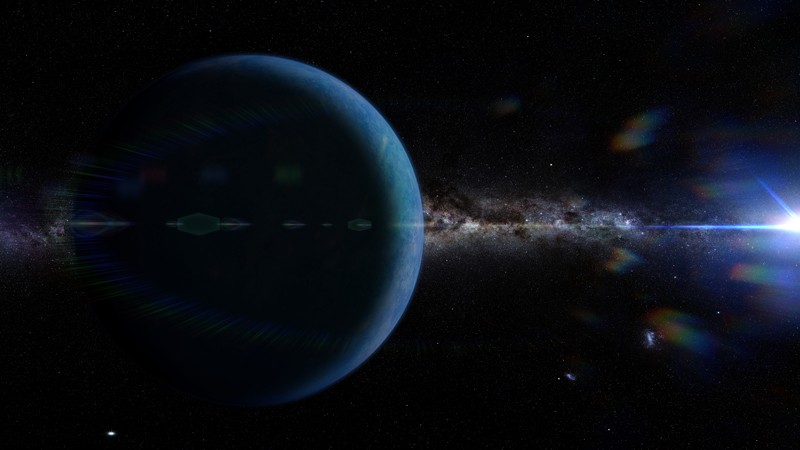

Image above: The hypothetical ninth planet (illustration). Image Credit: Shutterstock.

Planet Nine is dead; long live Planet Nine? For some years, scientists have debated the existence of an unseen planet at least five times the mass of Earth in the outer reaches of the Solar System. Now, the hypothesis has been dealt a blow by a new analysis of distant, icy objects, which questions the evidence that they are under the gravitational pull of a huge planet.

The findings do not rule out the possibility of a ninth planet orbiting the Sun, and astronomers say more data will be needed to put the debate to rest.

The presence of Planet Nine was proposed (1) in 2016, when astronomers Mike Brown and Konstantin Batygin at the California Institute of Technology in Pasadena observed that the orbits of six trans-Neptunian objects (TNOs) — part of the Kuiper belt, a collection of small bodies orbiting the Sun beyond Neptune — seemed to be clustered together.

This clustering, they said, had to be due to the gravitational influence of a huge planet hiding somewhere in the outer Solar System, at least 400 times as far from the Sun as Earth, or around 10 times as far as the most famous TNO, the dwarf planet Pluto. If proved to exist, the distant world would be a major discovery — a giant beyond Neptune that would unquestionably be classed as a planet.

But not all astronomers were convinced. Other surveys cast doubt on whether TNOs were in fact clustered — or whether they merely appeared to be, because researchers had conducted detailed observations in only certain directions.

A team led by Kevin Napier, a physicist at the University of Michigan in Ann Arbor, has now taken this analysis further. Combining 3 surveys to examine the orbits of 14 ‘extreme’ TNOs (ETNOs) — those orbiting far beyond Neptune — the researchers found that the objects’ orbits could be explained without the presence of a nearby planet. After accounting for selection bias — the fact that researchers have observed only a small portion of the outer Solar System — the data suggest that ETNOs are uniformly distributed across the sky.

“This is the first meta-analysis of all three of the most productive ETNO-discovery surveys,” says Napier. The team’s findings (2) were posted on the preprint server arXiv on 10 February.

Horses, not zebras

To investigate whether the objects were truly clustered, Napier’s team built a computer model simulating ten billion evenly distributed ETNOs in the outer Solar System, and then calculated the chances that observing a small sample of these would produce results matching existing observations. The team concluded that there is no reason to think that ETNOs are not uniformly distributed, and that it’s possible that observed objects only seem to be clustered because of selection bias. “That doesn’t mean that Planet Nine isn’t there, but it’s not necessary to explain the data,” says Napier. “You could fit this data with clustered ETNOs as well — but if you hear hoofbeats, you should think horses, not zebras.”

Brown, however, disagrees. “I plotted all their data on top of our old paper, and you just simply look at it, and it’s very clustered,” he says. “There’s actually strong evidence for Planet Nine in their data.” He points out that the paper does not include the six TNOs that he and Batygin used in their original research. He also argues that the researchers are “mixing dirt in with their ice cream”, because their analysis considers objects whose orbits might be affected by their proximity to Neptune.

Napier says the team didn’t include Brown and Batygin’s original six objects in its analysis because not enough data are available on the surveys that found them earlier this century. “We need to know when and where the telescope pointed, and how faint of an object the telescope was able to detect,” he says. “In the past, surveys did not tend to do that.”

Samantha Lawler, an astronomer at the University of Regina in Canada who worked on the Outer Solar System Origins Survey — one of the surveys that Napier’s team used in its analysis — agrees with the team’s conclusions, arguing that there is no need for Planet Nine when the simpler explanation of selection bias accounts for the data.

“There is no evidence for any sort of clustering in the orbits of these distant TNOs, they’re consistent with being uniformly distributed,” she says. “I can’t say that Planet Nine is dead, but I can say there’s no evidence for it.”

Thousands more objects

Lawler says new surveys of the outer Solar System are needed to look for any other evidence of clustering. One of the best chances will come from the Vera C. Rubin Observatory in Chile, which will begin a ten-year survey of the sky in 2022.

“They’re going to detect thousands more Kuiper belt objects,” says Lawler. “I think we’ve really done all that we can with the data we currently have.”

Even if it turns out Planet Nine isn’t there, Lawler says, it has sparked a lot of useful interest in the outer Solar System from astronomers. “The theory of Planet Nine has been fantastic for the study of the Kuiper belt,” she says.

doi: https://doi.org/10.1038/d41586-021-00456-7

References:

1. Batygin, K. & Brown, M. E. Astron. J. 151, 22 (2016).

2. Napier, K. J. et al. Preprint at https://arxiv.org/abs/2102.05601 (2021).

Image (mentioned), Text, Credits: Nature/Jonathan O'Callaghan.

Greetings, Orbiter.ch

How Were the Trojan Asteroids Discovered and Named?


NASA - LUCY Mission patch.


Feb 22, 2021

On Feb. 22, 1906, German astrophotographer Max Wolf helped reshape our understanding of the solar system. Again.

Born in 1863, Wolf had a habit of dramatically altering the astronomy landscape. Something of a prodigy, he discovered his first comet at only 21 years old. Then in 1890, he boldly declared that he planned to use wide-field photography in his quest to discover new asteroids, which would make him the first to do so. Two years later, Wolf had found 18 new asteroids. He later became the first person to use the “stereo comparator,” a View-Master-like device that showed two photographs of the sky at once so that moving asteroids appeared to pop out from the starry background.


Image above: Illustration of the Lucy mission's seven targets: the binary asteroid Patroclus/Menoetius, Eurybates, Orus, Leucus, Polymele, and the main belt asteroid DonaldJohanson. Image Credits: NASA's Goddard Space Flight Center Conceptual Image Lab.

It is perhaps unsurprising, then, that on Feb. 22, 1906, Wolf made another important discovery: an asteroid with a particularly unusual orbit. As Jupiter moved, this asteroid remained ahead of Jupiter, as though it was somehow trapped in Jupiter’s orbit around the Sun. German astronomer Adolf Berberich observed that the asteroid was nearly 60 degrees in front of Jupiter. This specific position reminded Swedish astronomer Carl Charlier of a peculiar behavior predicted by the Italian-French mathematician Joseph-Louis Lagrange over 100 years earlier. Lagrange argued that if a small body (such as an asteroid) is placed at one of two stable points in a planet’s orbit around the Sun (called the L4 and L5 Lagrange Points), the asteroid would remain stationary from the planet’s perspective due to the combined gravitational forces of the planet and the Sun. Charlier realized that Wolf’s asteroid was actually caught in Jupiter’s L4 Lagrange point. Until Wolf’s discovery, Lagrange’s prediction had only been a mathematical exercise. Now, these astronomers had photographic proof that Lagrange was right.

Eight months later, one of Wolf’s graduate students August Kopff discovered an asteroid in Jupiter’s other stable Lagrange point L5, as well as another asteroid caught in L4 a few months afterward.

Once three of these Lagrange point-inhabiting asteroids had been discovered, astronomers began wondering what to call them. At this point, most asteroids were given the names of women from Roman or Greek mythology, unless their orbits were particularly strange. The asteroids in question certainly had bizarre orbits, so Austrian astronomer Johann Palisa suggested the names Achilles, Patroclus, and Hektor after characters from The Iliad. Achilles was a nigh-invulnerable Greek hero (except for his heel), and Patroclus was a friend of his. Hektor, prince of the Trojans, eventually killed Patroclus, and Achilles exacted revenge by killing Hektor. The recently discovered asteroids were then given Iliad-inspired names.

Jupiter's Trojan Asteroids

Video above: This is a view of the inner solar system in a Jupiter-rotating reference frame. The camera begins at viewpoint oblique to the ecliptic plane, then moves up to a top-down view. Clusters of Trojan asteroids appear behind and ahead of Jupiter in its orbit. Video Credits: NASA's Scientific Visualization Studio.

As astronomers continued discovering asteroids hiding in Jupiter’s Lagrange points, they continued naming them after heroes of the Trojan War and began referring to them as “Trojan asteroids.” (“Trojan asteroids” would eventually refer to asteroids inhabiting any planet’s stable Lagrange points, though names from The Iliad are reserved for Jupiter’s Trojans.) It later became convention to name Jupiter’s L4 asteroids after Greek characters and Jupiter’s L5 asteroids after Trojan characters, so L4 and L5 became the “Greek camp” and the “Trojan camp” respectively. Palisa apparently did not foresee this tradition, for his naming of first three asteroids led to a Greek “spy” residing in the Trojan camp (Patroclus) and a confused Trojan (Hektor) who probably wandered into the Greek camp hoping to order some of their famous custom-built wooden horses.

No spacecraft has ever been to this population of small bodies, called the Trojan asteroids. Now, a new NASA Discovery Program mission called Lucy will fly by seven Trojan asteroids, plus a main belt asteroid, to survey the diversity of this population in a single 12-year record-breaking mission. The Lucy spacecraft launch window opens Oct. 16, 2021.

Lucy Mission Overview: Journey to Explore the Trojan Asteroids

Video above: Launching in late 2021, Lucy will be the first space mission to explore the Trojan asteroids. These are a population of small bodies that are left over from the formation of the solar system. They lead or follow Jupiter in their orbit around the Sun, and may tell us about the origins of organic materials on Earth. Video Credits: NASA's Goddard Space Flight Center.

Southwest Research Institute in Boulder, Colorado, is the principal investigator institution and leads the science investigation. NASA’s Goddard Space Flight Center in Greenbelt, Maryland, provides overall mission management, systems engineering, and safety and mission assurance. Lockheed Martin Space Systems in Denver is building the spacecraft. Spacecraft payload is being provided by Goddard, the Johns Hopkins University Applied Physics Lab, and Arizona State University. The Discovery Program management is executed by NASA’s Marshall Space Flight Center in Huntsville, Alabama.

Lucy (Asteroid Mission): https://www.nasa.gov/lucy

Image (mentioned), Videos (mentioned), Text, Credits: NASA/Rob Garner/GSFC/Nancy Neal Jones/Southwest Research Institute, by David Dezell Turner.

Best regards, Orbiter.ch

Fuel for world’s largest fusion reactor ITER is set for test run


Fusion Power Reactor logo.


22 February 2021

Nuclear fusion experiments with deuterium and tritium at the Joint European Torus are a crucial dress rehearsal for the mega-experiment.


Image above: The Joint European Torus has started conducting experiments with tritium fuel. Image Credit: EUROfusion (CC BY 4.0).

A pioneering reactor in Britain is gearing up to start pivotal tests of a fuel mix that will eventually power ITER — the world’s biggest nuclear-fusion experiment. Nuclear fusion is the phenomenon that powers the Sun and, if physicists can harness it on Earth, it would be a source of almost limitless energy.

In December, researchers at the Joint European Torus (JET) started conducting fusion experiments with tritium — a rare and radioactive isotope of hydrogen. The facility is a one-tenth-volume mock-up of the US$22-billion ITER project and has the same doughnut-shaped ‘tokomak’ design— the world's most developed approach to fusion energy. It is the first time since 1997 that researchers have done experiments in a tokamak with any significant amount of tritium.

In June, JET will begin fusing even quantities of tritium and deuterium, another isotope of hydrogen. It is this fuel mix that ITER will use in its attempt to create more power from a fusion reaction than is put in — something that has never before been demonstrated. The reactor should heat and confine a plasma of deuterium and tritium such that the fusion of the isotopes into helium produces enough heat to sustain further fusion reactions.

“It’s very exciting now to, at last, get to the point where we can put into practice what we’ve been preparing all these years,” says Joelle Mailloux, who co-leads the scientific programme at JET. “We’re ready for it.”

Trial run

JET’s experiments will help scientists to predict how the plasma in the ITER tokamak will behave and to craft the mega-experiment’s operating settings. “It’s the closest we can get to achieving ITER conditions in present-day machines,” says Tim Luce, chief scientist at ITER, near Cadarache in France. The experiments are the culmination of around two decade’s work, says Luce. ITER will begin operations with low-power hydrogen reactions in 2025. But from 2035, it will run on a 50:50 mix of deuterium and tritium.

Both ITER and JET, based at the Culham Centre for Fusion Energy (CCFE) near Oxford, use extreme magnetic fields to confine plasma into a ring and heat it until fusion occurs. The temperatures in JET can reach 100 million degrees, many times hotter than the Sun’s core.

ITER fusion reactor tokamak. Animation Credit: ITER

The world’s last tokamak fusion experiments with tritium also took place at JET. The goal then was to hit peak power, and the facility succeeded in achieving a record ratio of power out to power in (known as a Q value) of 0.67. That record still stands today; 1 would be break-even. But this year, the aim is to sustain a similar level of fusion power for 5 seconds or more, to eke out as much data from the experiments as possible and to understand the behaviour of longer-lasting plasmas.

Working with tritium poses unique challenges — JET researchers have spent more than two years refitting elements of their machine and preparing to handle the radioactive material. The isotope decays quickly, so it occurs only in trace amounts in nature and is usually be made as a by-product in nuclear-fission reactors; the world’s supply is just 20 kilograms.

Part of the challenge of handling tritium is that its reactions with deuterium produce neutrons at a much higher rate than deuterium reactions alone. Commercial reactors will capture the energy of these neutrons to generate electricity, but in JET, the high-energy particles will pepper the machine’s interior and damage diagnostic systems. That means that the JET team has had to move cameras and other instruments behind concrete shielding, says Ian Chapman, who leads the CCFE.

“We’ve had to refresh and renew all of our processes”, from storage to handling, Chapman says. Once tritium experiments start, neutron bombardment will make the inner facility radioactive, so it will become a no-go zone for humans for 18 months. Staff have therefore had to get used to a mindset similar to that of the engineers who send craft into space: “You can’t just go in and fix things, it has to work first time,” Chapman says.

Tritium pulses

JET’s campaign will use less than 60 grams of tritium, which it will recycle. Fuel containing a fraction of a gram of tritium will be pulsed into the tokamak 3–14 times a day. Each of these discharges will be an individual experiment with slightly different parameters, and will generate between 3 and 10 seconds of useful data, says Mailloux. “What we are after is physics information that we can use to validate our understanding, and then we can apply that to preparing the future machine,” she says.

Some experiments will use just tritium; others will combine deuterium and tritium in equal proportions. Both types of experiment are important, because a key goal is to understand the effect of tritium’s larger mass on plasma behaviour (tritium has two neutrons in its nucleus, whereas deuterium has one and hydrogen has none). That will help in predicting the impact of using different isotopes in ITER. The mass of the isotopes influences the conditions — such as magnetic field, current, external heating — needed for the plasma to reach a crucial state known as confinement. (In this state, the highest-energy particles remain within the ionized gas, and that is important for sustaining the plasma’s temperature). “We want to explore this and understand why,” says Anne White, a plasma physicist at the Massachusetts Institute of Technology in Cambridge.

Another major difference from the 1997 experiments is that JET has been refitted so that the inner materials that protect the machine against the effects of heat and neutron bombardment, and remove impurities from the plasma, match those in ITER’s design. Because these materials could radiate back into the plasma and cool it down, understanding how they interact with the fusion process is crucial.

The latest generation of fusion scientists has never worked with tritium, which makes it all the more important to do the experiments, says Chapman. “It’s a big deal. People are watching,” adds Luce.

doi: https://doi.org/10.1038/d41586-021-00408-1

Joint European Torus (JET): https://www.euro-fusion.org/devices/jet/

Image (mentioned), Animation (mentioned), Text, Credits: Nature/Elizabeth Gibney.

Greetings, Orbiter.ch

Cygnus Resupply Ship Bolted to Station’s Unity Module


Northrop Grumman - Cygnus NG-15 Mission patch.


Feb. 22, 2021


Image above: Feb. 22, 2021: International Space Station Configuration. Five spaceships are attached to the space station including the SpaceX Crew Dragon, the Northrop Grumman Cygnus cargo craft, and Russia’s Progress 76 and 77 resupply ships and Soyuz MS-17 crew ship. Image Credit: NASA.

The Northrop Grumman Cygnus cargo spacecraft was berthed to the International Space Station’s Earth-facing port of the Unity module at 7:16 a.m. EST Monday morning and subsequently bolted into place. Cygnus will remain at the space station until May, when the spacecraft will depart the station. Following departure, the Cygnus will dispose of several tons of trash during a fiery reentry into Earth’s atmosphere.

NG-15 S.S. Katherine Johnson Cygnus capture

The spacecraft, which launched at 12:36 p.m. EST Saturday, Feb. 20, on an Antares rocket from NASA’s Wallops Flight Facility in Virginia, brings approximately 8,000 pounds of research, hardware, and supplies to the orbiting laboratory to support the Expedition 64 and 65 crews. The Cygnus was captured earlier Monday morning at 4:38 a.m. EST.

NG-15 S.S. Katherine Johnson Cygnus berthing

Highlights of science investigations aboard this Cygnus include:

A new vision

Millions of people on Earth suffer from retinal degenerative diseases. These conditions have no cure, although treatments can slow their progression. Artificial retinas or retinal implants may provide a way to restore meaningful vision for those affected. In 2018, startup LambdaVision sent their first experiment to the space station to determine whether the process used to create artificial retinal implants by forming a thin film one layer at a time may work better in microgravity.

A second experiment by LambdaVision launching on NG CRS-15, Protein-Based Artificial Retina Manufacturing, builds on the first project, evaluating a manufacturing system that uses a light-activated protein to replace the function of damaged cells in the eye. This information may help LambdaVision uncover whether microgravity optimizes production of these retinas, and could assist people back on Earth.

Bringing advanced computing aboard the space station

Due to a need to prioritize reliability over performance, computing capabilities in space are reduced compared to capabilities on the ground, creating challenges when transmitting data to and from space. Although relying on ground-based computers is possible for exploration on the Moon or in low-Earth orbit, this solution will not work for exploration farther into the solar system. Launched in 2017, the SpaceborneComputer study ran a high-performance commercial off-the-shelf computer system in space with the goal of having the system operate seamlessly for one year. It successfully performed more than 1 trillion calculations (or one teraflop) per second for 207 days without requiring reset.

Spaceborne Computer-2 builds on the successes of this first study, exploring how off-the-shelf computer systems can advance exploration by processing data significantly faster in space with edge computing and artificial intelligence (AI) capabilities. This experiment plans to demonstrate that Earth-based data processing of current station science data can instead be performed on station. Eliminating the need for researchers to send all raw data back to Earth for analysis could speed scientists’ time-to-insight from months to minutes.

Space worms to the rescue

Tiny worms could help us determine the cause of muscle weakening that astronauts can experience in microgravity. Astronauts work out more than two hours a day aboard the space station to prevent bone and muscle loss caused by living in a microgravity environment during long-duration missions. Thanks to a new device for measuring the muscle strength of tiny C. elegans worms, researchers with the Micro-16 study can test whether decreased expression of muscle proteins is associated with this decreased strength. The device consists of a small microscope slide filled with little rubber pillars. The strength of the worms is measured by how much force the worms apply to the pillars as they move around the slide.

Preparing for the Moon

The International Space Station serves as a testing ground for technologies we plan to use on future Artemis missions to the Moon. The NASA A-HoSS investigation puts to the test tools planned for use on the crewed Artemis II mission that will orbit the Moon. Built as the primary radiation detection system for the Orion spacecraft, the Hybrid Electronic Radiation Assessor (HERA) was modified for operation on the space station.


Image above: The Northrop Grumman Cygnus resupply ship is pictured about 30 meters away from the space station approaching its capture point near the Canadarm2 robotic arm. Image Credit: NASA TV.

Verifying that HERA can operate without error for 30 days validates the system for crewed Artemis mission operations. A related investigation, ISS HERA, flew in 2019 aboard the space station. ISS HERA provided data and operational feedback in preparation for the Orion spacecraft’s uncrewed Artemis I mission that will launch in 2021.

Related link:

Cygnus Spaceship Lifts Off to Resupply Station on Monday
https://orbiterchspacenews.blogspot.com/2021/02/cygnus-spaceship-lifts-off-to-resupply.html

Related links:

Expedition 64: https://www.nasa.gov/mission_pages/station/expeditions/expedition64/index.html

Protein-Based Artificial Retina Manufacturing: https://www.nasa.gov/mission_pages/station/research/experiments/explorer/Investigation.html?#id=8377

SpaceborneComputer: https://www.nasa.gov/mission_pages/station/research/experiments/explorer/Investigation.html?#id=2037

Spaceborne Computer-2: https://www.nasa.gov/mission_pages/station/research/experiments/explorer/Investigation.html?#id=8221

Micro-16: https://www.nasa.gov/mission_pages/station/research/experiments/explorer/Investigation.html?#id=7654

A-HoSS: https://www.nasa.gov/mission_pages/station/research/experiments/explorer/Investigation.html?#id=8234

Space Station Research and Technology: https://www.nasa.gov/mission_pages/station/research/overview.html

International Space Station (ISS): https://www.nasa.gov/mission_pages/station/main/index.html

Images (mentioned), Videos, Text, Credits: NASA/Mark Garcia/NASA TV/SciNews.

Best regards, Orbiter.ch

dimanche 21 février 2021

Space Station Science Highlights: Week of February 15, 2021


ISS - Expedition 64 Mission patch.


Feb 21, 2021

Scientific investigations conducted aboard the International Space Station the week of Feb. 15 included studies of flame spread in confined spaces, direct RNA sequencing from tissue samples, and acoustic monitoring of equipment. Crew members finalized preparations for the arrival of new supplies and scientific experiments aboard the NG-15 cargo craft, scheduled to launch Feb. 20.


Image above: This oblique view of Mount Ararat in eastern Turkey was taken as the International Space Station orbited 262 miles above Iran just south of the Caspian Sea. Image Credit: Roscosmos.

The seven crew members currently inhabiting the station include four from NASA’s Commercial Crew Program, providing increased crew time for science activities on the orbiting lab. The space station has been continuously inhabited by humans for 20 years and has supported many scientific breakthroughs during that time. The station provides a platform for long-duration research in microgravity and for learning to live and work in space, experience that supports Artemis, NASA’s program to go forward to the Moon and on to Mars.

Here are details on some of the microgravity investigations currently taking place:

Examining the behavior of flames


Image above: This fabric sample was part of operations for the Confined Combustion investigation, which examines flame spread in differently-shaped confined spaces in microgravity. Image Credit: NASA.

The crew installed hardware for the Confined Combustion investigation and conducted a flame test. This investigation examines the behavior of flames as they spread in differently-shaped spaces in microgravity, including the interactions between spreading flames and surrounding walls. Flame spread in confined spaces such as a spacecraft may pose a more serious fire hazard than in open spaces because heat radiating from the walls and flow conditions can accelerate flames. Observations from this investigation can be translated into mathematical models to help designers and planners anticipate fire behavior and create plans for preventing or extinguishing fires effectively in space.

Reading radish RNA


Animation above: NASA astronaut Kate Rubins works on the One-Step Gene Sampling Tool investigation, which uses radish samples to test a technology for genetic analysis of ribonucleic acid (RNA) directly from tissue. Animation Credit: NASA.

During the week, the crew set up hardware and performed analysis on a radish harvested from the station’s Advanced Plant Habitat for One-Step Gene Sampling Tool. This investigation tests a technology that collects ribonucleic acid (RNA) directly from tissue, enabling quick genetic analysis of multiple samples without the need to destroy the specimen. These brief and repeatable screenings could help researchers make more informed decisions about plant and animal growth investigations as well as extract a full genetic library from these organisms.

Listening in on equipment


Image above: An audio sensor for the SoundSee investigation floats in the space station. SoundSee tests using these sensors on the Astrobee robotic platforms to monitor the station’s acoustic environment, which can provide early indication of equipment failure. Image Credit: NASA.

SoundSee tests a way to monitor the space station’s acoustic environment using monitors attached to free-flying Astrobee robots. Autonomous audio monitoring could detect equipment malfunction based on sound anomalies, helping to protect the health and safety of crew members by keeping equipment in good working order and reducing crew workload. During the week, crew members installed SoundSee onto an Astrobee and performed recordings.

Other investigations on which the crew performed work:

- VECTION, a Canadian Space Agency investigation, determines to what extent microgravity disrupts an astronaut's ability to visually interpret motion, orientation, and distance as well as how those abilities may adapt in space and change again upon return to Earth.
https://www.nasa.gov/mission_pages/station/research/experiments/explorer/Investigation.html?#id=7484

- Time Perception, an ESA (European Space Agency) experiment, quantifies the subjective changes in time perception that humans experience during and after long-duration spaceflight.
https://www.nasa.gov/mission_pages/station/research/experiments/explorer/Investigation.html?#id=7504

- Plant Water Management tests using concepts of capillary fluidics such as surface tension, wetting, and geometry to deliver adequate water and nutrients to plants.
https://www.nasa.gov/mission_pages/station/research/experiments/explorer/Investigation.html?#id=7884

- The 3D Microbial Monitoring investigation conducts a series of sample collections and uses DNA sequencing and other analyses to construct a three dimensional map of bacteria and bacterial products on surfaces in the space station.
https://www.nasa.gov/mission_pages/station/research/experiments/explorer/Investigation.html?#id=8345

- Bacterial Adhesion and Corrosion tests an antimicrobial coating on materials used to represent typical surfaces on the space station, which could provide insight into better ways to control and remove resistant biofilms for long-duration spaceflight.
https://www.nasa.gov/mission_pages/station/research/experiments/explorer/Investigation.html?#id=7956

- Antimicrobial Coatings tests a coating to control microbial growth on several different materials that represent high-touch surfaces. Some microbes change characteristics in microgravity, potentially creating new risks to crew health and spacecraft.
https://www.nasa.gov/mission_pages/station/research/experiments/explorer/Investigation.html?#id=8352

- Food Physiology characterizes how an enhanced spaceflight diet affects immune function, the gut microbiome, and nutritional status. Results could help define targeted, efficient dietary interventions to maintain crew health and performance.
https://www.nasa.gov/mission_pages/station/research/experiments/explorer/Investigation.html?#id=7870

- APM measures and quantifies the concentration of both small and large particles in cabin air as part of efforts to maintain air quality in the occupied environment on station, vital for the crew’s health.
https://www.nasa.gov/mission_pages/station/research/experiments/explorer/Investigation.html?#id=7936

- AstroRad Vest tests a wearable vest designed to protect astronauts from radiation caused by unpredictable solar particle events. Astronauts provide input on how easy the garment is to put on, how it fits and feels, and the range of motion it allows.
https://www.nasa.gov/mission_pages/station/research/experiments/explorer/Investigation.html?#id=7803

- The ISS Experience is creating an immersive virtual reality (VR) series documenting life and research aboard the space station using customized 360-degree cameras.
https://www.nasa.gov/mission_pages/station/research/experiments/explorer/Investigation.html?#id=7877 

International Space Station (ISS). Animation Credit: ESA

Related links:

Expedition 64: https://www.nasa.gov/mission_pages/station/expeditions/expedition64/index.html

Commercial Crew Program: https://www.nasa.gov/exploration/commercial/crew/index.html

Confined Combustion: https://www.nasa.gov/mission_pages/station/research/experiments/explorer/Investigation.html?#id=7886

One-Step Gene Sampling Tool: https://www.nasa.gov/mission_pages/station/research/experiments/explorer/Investigation.html?#id=8021

SoundSee: https://www.nasa.gov/mission_pages/station/research/experiments/explorer/Investigation.html?#id=7860

Astrobee: https://www.nasa.gov/mission_pages/station/research/experiments/explorer/Facility.html?#id=1891

ISS National Lab: https://www.issnationallab.org/

Spot the Station: https://spotthestation.nasa.gov/

Space Station Research and Technology: https://www.nasa.gov/mission_pages/station/research/overview.html

International Space Station (ISS): https://www.nasa.gov/mission_pages/station/main/index.html

Images (mentioned), Animations (mentioned), Text, Credits: NASA/Michael Johnson/John Love, ISS Research Planning Integration Scientist Expedition 64.

Best regards, Orbiter.ch

samedi 20 février 2021

First (color) Images of Perseverance's Landing


NASA - Mars 2020 Perseverance Rover logo.


Feb. 20, 2021

HiRISE Captured Perseverance During Descent to Mars

Image above: The descent stage holding NASA’s Perseverance rover can be seen falling through the Martian atmosphere, its parachute trailing behind, in this image taken on Feb. 18, 2021, by the High Resolution Imaging Experiment (HiRISE) camera aboard the Mars Reconnaissance Orbiter. The ancient river delta, which is the target of the Perseverance mission, can be seen entering Jezero Crater from the left.

HiRISE was approximately 435 miles (700 kilometers) from Perseverance and traveling at about 6750 mile per hour (3 kilometers per second) at the time the image was taken. The extreme distance and high speeds of the two spacecraft were challenging conditions that required precise timing and for Mars Reconnaissance Orbiter to both pitch upward and roll hard to the left so that Perseverance was viewable by HiRISE at just the right moment.

The orbiter’s mission is led by NASA’s Jet Propulsion Laboratory in Southern California. JPL, a division of Caltech, manages the Mars Reconnaissance Orbiter for NASA’s Science Mission Directorate in Washington. Lockheed Martin Space in Denver, built the spacecraft. The University of Arizona provided and operates HiRISE. Image Credits: NASA/JPL-Caltech/University of Arizona.

Perseverance Gets Ready to Touch Down

Image above: This high-resolution still image is part of a video taken by several cameras as NASA’s Perseverance rover touched down on Mars on Feb. 18, 2021. A camera aboard the descent stage captured this shot.

A key objective for Perseverance’s mission on Mars is astrobiology, including the search for signs of ancient microbial life. The rover will characterize the planet’s geology and past climate, pave the way for human exploration of the Red Planet, and be the first mission to collect and cache Martian rock and regolith (broken rock and dust).

Subsequent NASA missions, in cooperation with ESA (the European Space Agency), would send spacecraft to Mars to collect these cached samples from the surface and return them to Earth for in-depth analysis. Image Credits: NASA/JPL-Caltech.

Perseverance’s Big Wheel

Image above: This high-resolution image shows one of the six wheels aboard NASA’s Perseverance Mars rover, which landed on Feb. 18, 2021. The image was taken by one of Perseverance’s color Hazard Cameras (Hazcams).

The Mars 2020 mission is part of a larger program that includes missions to the Moon as a way to prepare for human exploration of the Red Planet. JPL, which is managed for NASA by Caltech in Pasadena, California, built and manages operations of the Perseverance and Curiosity rovers. Image Credits: NASA/JPL-Caltech.

Perseverance’s First Full-Color Look at Mars

Image above: This is the first high-resolution, color image to be sent back by the Hazard Cameras (Hazcams) on the underside of NASA’s Perseverance Mars rover after its landing on Feb. 18, 2021.

The Mars 2020 mission is part of a larger program that includes missions to the Moon as a way to prepare for human exploration of the Red Planet. JPL, which is managed for NASA by Caltech in Pasadena, California, built and manages operations of the Perseverance and Curiosity rovers. Image Credits: NASA/JPL-Caltech.

NASA's Perseverance Rover Lands Successfully on Mars (Highlight Reel)

Video above: After a seven-month-long journey, NASA’s Perseverance Rover successfully touched down on the Red Planet on Feb. 18, 2021. Mission controllers at NASA's Jet Propulsion Laboratory in Southern California celebrate landing NASA's fifth -- and most ambitious -- rover on Mars.

A key objective for Perseverance’s mission on Mars is astrobiology, including the search for signs of ancient microbial life. The rover will characterize the planet’s geology and past climate, pave the way for human exploration of the Red Planet, and be the first mission to collect and cache Martian rock and regolith.

Also flying with Perseverance is NASA’s Ingenuity helicopter, which will attempt to show controlled, powered flight is possible in the very thin Martian atmosphere. Video Credits: NASA/JPL.

Related articles:

NASA’s Mars Helicopter Reports In
https://orbiterchspacenews.blogspot.com/2021/02/nasas-mars-helicopter-reports-in.html

NASA’s Perseverance Rover Sends Sneak Peek of Mars Landing
https://orbiterchspacenews.blogspot.com/2021/02/nasas-perseverance-rover-sends-sneak.html

Touchdown! NASA's Mars Perseverance Rover Safely Lands on Red Planet
https://orbiterchspacenews.blogspot.com/2021/02/touchdown-nasas-mars-perseverance-rover.html

Explore the Jezero neighbourhood
https://orbiterchspacenews.blogspot.com/2021/02/explore-jezero-neighbourhood.html

The Mars Relay Network Connects Us to NASA’s Martian Explorers
https://orbiterchspacenews.blogspot.com/2021/02/the-mars-relay-network-connects-us-to.html

Related links:

Mars Reconnaissance Orbiter (MRO): http://www.nasa.gov/mission_pages/MRO/main/index.html

ESA & ROSCOSMOS ExoMars: https://www.esa.int/Science_Exploration/Human_and_Robotic_Exploration/Exploration/ExoMars

Mars Perseverance Rover: http://www.nasa.gov/perseverance and https://mars.nasa.gov/mars2020/

Images (mentioned), Video (mentioned), Text, Credits: NASA/Tony Greicius/Brian Dunbar.

Greetings, Orbiter.ch

NASA Missions Make Unprecedented Map of Sun’s Magnetic Field


NASA Goddard Space Flight Center logo.


Feb. 20, 2021

For decades after its discovery, observers could only see the solar chromosphere for a few fleeting moments: during a total solar eclipse, when a bright red glow ringed the Moon’s silhouette.


Image above: The chromosphere, photographed during the 1999 total solar eclipse. The red and pink hues – light emitted by hydrogen – earned it the name chromosphere, from the Greek “chrôma” meaning color. Image Credit: Luc Viatour.

More than a hundred years later, the chromosphere remains the most mysterious of the Sun’s atmospheric layers. Sandwiched between the bright surface and the ethereal solar corona, the Sun’s outer atmosphere, the chromosphere is a place of rapid change, where temperature rises and magnetic fields begin to dominate the Sun’s behavior.

Now, for the first time, a triad of NASA missions have peered into the chromosphere to return multi-height measurements of its magnetic field. The observations – captured by two satellites and the Chromospheric Layer Spectropolarimeter 2, or CLASP2 mission, aboard a small suborbital rocket – help reveal how magnetic fields on the Sun’s surface give rise to the brilliant eruptions in its outer atmosphere. The paper was published today in Science Advances.

A major goal of heliophysics – the science of the Sun’s influence on space, including planetary atmospheres – is to predict space weather, which often begins on the Sun but can rapidly spread through space to cause disruptions near Earth.

Driving these solar eruptions is the Sun’s magnetic field, the invisible lines of force stretching from the solar surface to space well past Earth. This magnetic field is difficult to see – it can only be observed indirectly, by light from the plasma, or super-heated gas, that traces out its lines like car headlights traveling a distant highway. Yet how those magnetic lines arrange themselves – whether slack and straight or tight and tangled – makes all the difference between a quiet Sun and a solar eruption.

“The Sun is both beautiful and mysterious, with constant activity triggered by its magnetic fields,” said Ryohko Ishikawa, solar physicist at the National Astronomical Observatory of Japan in Tokyo and lead author of the paper.

Ideally, researchers could read out the magnetic field lines in the corona, where solar eruptions take place, but the plasma is way too sparse for accurate readings. (The corona is far less than a billionth as dense as air at sea level.)

Instead, scientists measure the more densely packed photosphere – the Sun’s visible surface – two layers below. They then use mathematical models to propagate that field upwards into the corona.  This approach skips measuring the chromosphere, which lies between the two, instead, hoping to simulate its behavior.


Image above: The chromosphere lies between the photosphere, or bright surface of the Sun that emits visible light, and the super-heated corona, or outer atmosphere of the Sun at the source of solar eruptions. The chromosphere is a key link between these two regions and a missing variable determining the Sun’s magnetic structure. Image Credits: Credits: NASA’s Goddard Space Flight Center.

Unfortunately the chromosphere has turned out to be a wildcard, where magnetic field lines rearrange in ways that are hard to anticipate. The models struggle to capture this complexity.

“The chromosphere is a hot, hot mess,” said Laurel Rachmeler, former NASA project scientist for CLASP2, now at the National Oceanic and Atmospheric Administration, or NOAA. “We make simplifying assumptions of the physics in the photosphere, and separate assumptions in the corona. But in the chromosphere, most of those assumptions break down.”

Institutions in the U.S., Japan, Spain and France worked together to develop a novel approach to measure the chromosphere’s magnetic field despite its messiness. Modifying an instrument that flew in 2015, they mounted their solar observatory on a sounding rocket, so named for the nautical term “to sound” meaning to measure. Sounding rockets launch into space for brief, few-minute observations before falling back to Earth. More affordable and quicker to build and fly than larger satellite missions, they’re also an ideal stage to test out new ideas and innovative techniques.

Launching from the White Sands Missile Range in New Mexico, the rocket shot to an altitude of 170 miles (274 kilometers) for a view of the Sun from above Earth’s atmosphere, which otherwise blocks certain wavelengths of light. They set their sights on a plage, the edge of an “active region” on the Sun where the magnetic field strength was strong, ideal for their sensors.

As CLASP2 peered at the Sun, NASA’s Interface Region Imaging Spectrograph or IRIS and the JAXA/NASA Hinode satellite, both watching the Sun from Earth orbit, adjusted their telescopes to look at the same location. In coordination, the three missions focused on the same part of the Sun, but peered to different depths.

Hinode focused on the photosphere, looking for spectral lines from neutral iron formed there. CLASP2 targeted three different heights within the chromosphere, locking onto spectral lines from ionized magnesium and manganese. Meanwhile, IRIS measured the magnesium lines in higher resolution, to calibrate the CLASP2 data. Together, the missions monitored four different layers within and surrounding the chromosphere.

Eventually the results were in: The first multi-height map of the chromosphere’s magnetic field.

“When Ryohko first showed me these results, I just couldn't stay in my seat,” said David McKenzie, CLASP2 principal investigator at NASA’s Marshall Space Flight Center in Huntsville, Alabama. “I know it sounds esoteric – but you've just showed the magnetic field at four heights at the same time. Nobody does that!”

The most striking aspect of the data was just how varied the chromosphere turned out to be. Both along the portion of the Sun they studied and at different heights within it, the magnetic field varied significantly.

“At the Sun’s surface we see magnetic fields changing over short distances; higher up those variations are much more smeared out. In some places, the magnetic field didn't reach all the way up to the highest point we measured whereas in other places, it was still at full strength.”

The team hopes to use this technique for multi-height magnetic measurements to map the entire chromosphere’s magnetic field. Not only would this help with our ability to predict space weather, it will tells us key information about the atmosphere around our star.

“I'm a coronal physicist – I'm really interested in the magnetic fields up there,” Rachmeler said. “Being able to raise our measurement boundary to the top of the chromosphere would help us understand so much more, help us predict so much more – it would be a huge step forward in solar physics.”

They’ll have a chance to take that step forward soon: A re-flight of the mission was just greenlit by NASA. Though the launch date isn’t yet set, the team plans to use the same instrument but with a new technique to measure a much broader swath of the Sun.

“Instead of just measuring the magnetic fields along the very narrow strip, we want to scan it across the target and make a two-dimensional map,” McKenzie said.

MEASURING MAGNETIC FIELDS

To measure magnetic field strength, the team took advantage of the Zeeman effect, a century-old technique. (The first application of the Zeeman effect to the Sun, by astronomer George Ellery Hale in 1908, is how we learned that the Sun was magnetic.) The Zeeman effect refers to the fact that spectral lines, in the presence of strong magnetic fields, splinter into multiples. The farther apart they split, the stronger the magnetic field.


Animation above: The Zeeman effect. This animated image shows a spectrum with several absorption lines – spectral lines produced when atoms at specific temperatures absorb a specific wavelength of light. When a magnetic field is introduced (shown here as blue magnetic field lines emanating from a bar magnetic), absorption lines split into two or more. The number of splits and the distance between them reveals the strength of the magnetic field. Note that not all spectral lines split in this way, and that the CLASP2 experiment measured spectral lines in the ultraviolet range, whereas this demo shows lines in the visible range. Animation Credits: NASA’s Goddard Space Flight Center/Scott Weissinger.

The chaotic chromosphere, however, tends to “smear” spectral lines, making it difficult to tell just how far apart they split – that’s why previous missions had trouble measuring it. CLASP2’s novelty was in working around this limitation by measuring “circular polarization,” a subtle shift in the light’s orientation that happens as part of the Zeeman effect. By carefully measuring the degree of circular polarization, the CLASP2 team could discern how far apart those smeared lines must have split, and thereby how strong the magnetic field was.

Related links:

CLASP2's launch: https://www.nasa.gov/centers/marshall/news/news/releases/2019/clasp-2-extreme-rocket-science-in-the-desert.html

More about NASA's Sounding Rockets: https://www.nasa.gov/mission_pages/sounding-rockets/index.html

Hinode (Solar B): http://www.nasa.gov/mission_pages/hinode/index.html

IRIS (Interface Region Imaging Spectrograph): http://www.nasa.gov/mission_pages/iris/index.html

Goddard Space Flight Center (GSFC): https://www.nasa.gov/centers/goddard/home/index.html

Images (mentioned), Animation (mentioned), Text, Credits: NASA’s Goddard Space Flight Center, by Miles Hatfield.

Best regards, Orbiter.ch