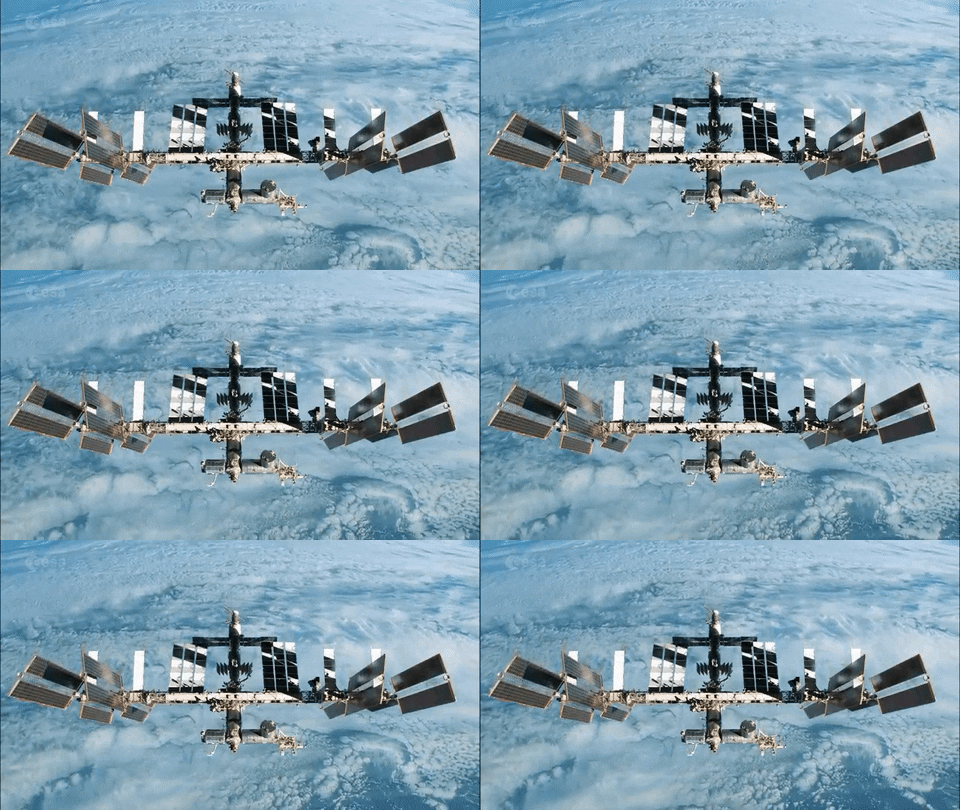
jeudi 2 septembre 2021

NASA’s Perseverance Rover Successfully Cores Its First Rock


NASA - Mars 2020 Perseverance Rover logo.


Sep 02, 2021

Perseverance will obtain additional imagery of the sample tube before potentially completing the process of collecting its first scientifically-selected Mars sample.


Image above: The drill hole from Perseverance's second sample-collection attempt can be seen, in this composite of two images taken on Sept. 1, 2021, by one of the Perseverance rover's navigation cameras. Image Credits: NASA/JPL-Caltech.

Data received late Sept. 1 from NASA’s Perseverance rover indicate the team has achieved its goal of successfully coring a Mars rock. The initial images downlinked after the historic event show an intact sample present in the tube after coring. However, additional images taken after the arm completed sample acquisition were inconclusive due to poor sunlight conditions. Another round of images with better lighting will be taken before the sample processing continues.

Obtaining additional imagery prior to proceeding with the sealing and storing of Mars rock sample is an extra step the team opted to include based on its experience with the rover’s sampling attempt on Aug. 5. Although the Perseverance mission team is confident that the sample is in the tube, images in optimal lighting conditions will confirm its presence.
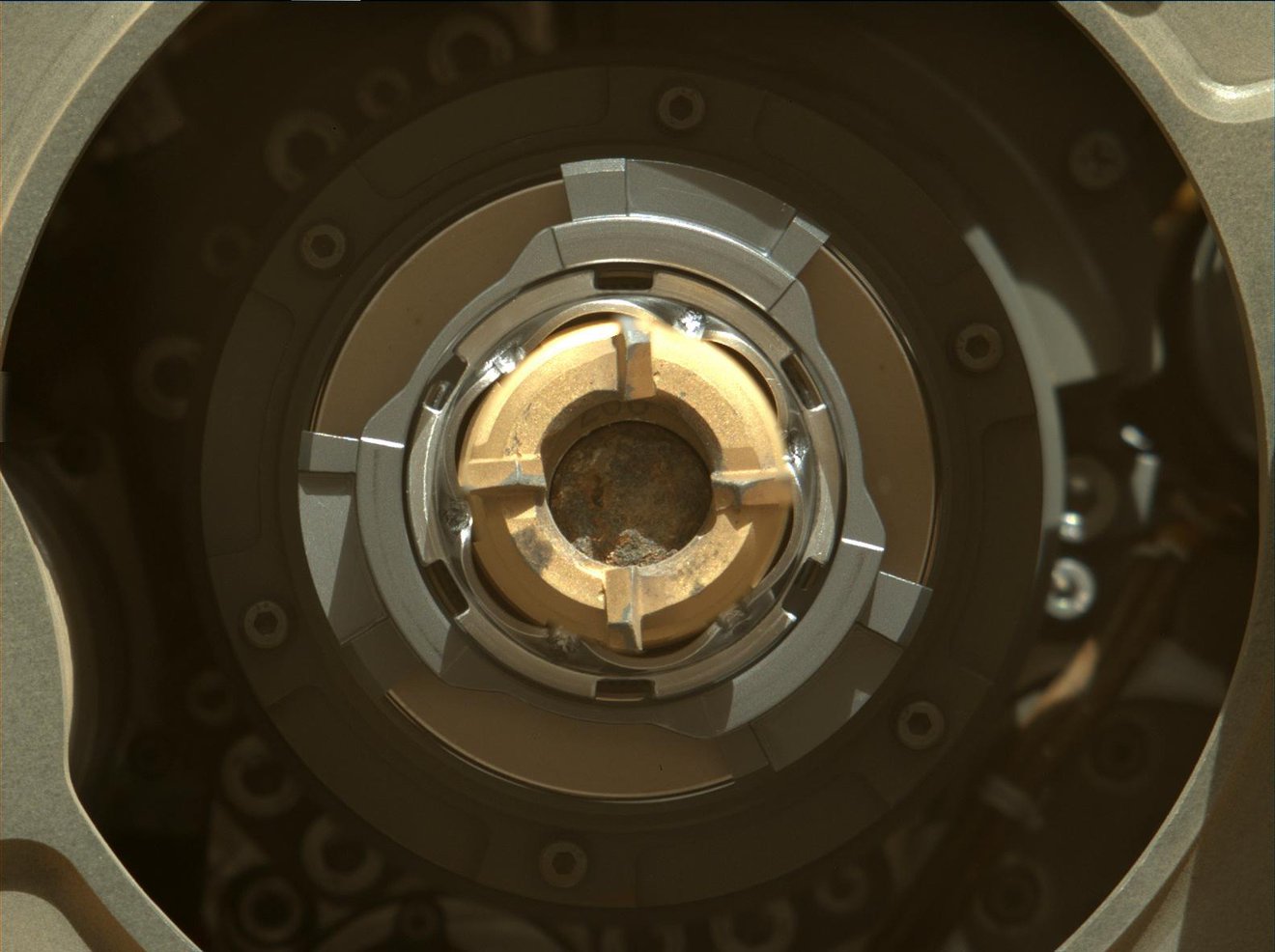

Image above: This Sept. 1, 2021 image from NASA's Perseverance rover shows a sample tube with its cored-rock contents inside. Image Credits: NASA/JPL-Caltech/ASU/MSSS.

Perseverance’s Sampling and Caching System uses a rotary-percussive drill and a hollow coring bit at the end of its 7-foot-long (2-meter-long) robotic arm to extract samples slightly thicker than a pencil. Within the bit during coring is a sample tube. After completing yesterday’s coring, Perseverance maneuvered the corer, bit, and open end of the sample tube in order to be imaged by the rover’s Mastcam-Z instrument. The target for the sample collection attempt was a briefcase-size rock belonging to a ridgeline that is more than half-a-mile (900 meters) long and contains rock outcrops and boulders.

The initial set of images from Mastcam-Z showed the end of a cored rock within the sample tube. After taking these images, the rover began a procedure called “percuss to ingest,” which vibrates the drill bit and tube for one second, five separate times. The movement is designed to clear the lip of the sample tube of any residual material. The action can also cause a sample to slide down farther into the tube. After the rover finished the percuss-to-ingest procedure, it took a second set of Mastcam-Z images. In these images, the lighting is poor, and internal portions of the sample tube are not visible.


Image above: Taken Sept. 1, 2021 by Mastcam-Z after Perseverance's sample-coring activities, this image shows the rover's drill with no cored rock sample evident in the sample tube. Image Credits: NASA/JPL-Caltech/ASU/MSSS.

“The project got its first cored rock under its belt, and that’s a phenomenal accomplishment,” said Jennifer Trosper, project manager at NASA’s Jet Propulsion Laboratory in Southern California. “The team determined a location, and selected and cored a viable and scientifically valuable rock. We did what we came to do. We will work through this small hiccup with the lighting conditions in the images and remain encouraged that there is sample in this tube.”

Commands uplinked to the rover earlier today will result in images of the corer and tube to be acquired tomorrow, Sept. 3, at times of day on Mars when the Sun is angled in a more favorable position. Photos will also be taken after sunset to diminish point-sources of light that can saturate an image. The photos will be returned to Earth early in the morning of Sept. 4.

Perseverance Rover Sampling Operation. Animation Credits: NASA/JPL-Caltech

If the results of this additional imaging remain inconclusive, the Perseverance team still has several options to choose from going forward, including using the Sampling and Caching System’s volume probe (located inside the rover’s chassis) as a final confirmation of the sample being in the tube.

The Sept. 1 coring is the second time that Perseverance has employed its Sampling and Caching System since landing in Jezero Crater on Feb. 18, 2021.

More About Perseverance

A key objective for Perseverance’s mission on Mars is astrobiology, including the search for signs of ancient microbial life. The rover will characterize the planet’s geology and past climate, pave the way for human exploration of the Red Planet, and be the first mission to collect and cache Martian rock and regolith.

Subsequent NASA missions, in cooperation with ESA, would send spacecraft to Mars to collect these sealed samples from the surface and return them to Earth for in-depth analysis.

The Mars 2020 Perseverance mission is part of NASA’s Moon to Mars exploration approach, which includes Artemis missions to the Moon that will help prepare for human exploration of the Red Planet.

JPL, which is managed for NASA by Caltech in Pasadena, California, built and manages operations of the Perseverance rover.

For more about Perseverance:

https://mars.nasa.gov/mars2020/ and https://nasa.gov/perseverance

Images (mentioned), Animation (mentioned), Text, Credits: NASA/Karen Fox/Alana Johnson/JPL/DC Agle.

Best regards, Orbiter.ch

Cosmonauts Get Ready for Friday Spacewalk, New Science Kicks Off & Dragon Cargo Docking


ISS - Expedition 65 Mission patch.


September 2, 2021

Two cosmonauts will exit the International Space Station on Friday to begin powering up the new Russian science module. While they prepare today for the excursion, the rest of the Expedition 65 crew focused on new science experiments and reviewed an upcoming U.S. spacewalk.

International Space Station (ISS). Animation Credit: ESA

Russia’s Nauka multipurpose laboratory module, attached to the station since July 29, will be connected to the station’s ethernet and power systems during a spacewalk set to start Friday at 10:35 a.m. EDT. Roscosmos Flight Engineers Oleg Novitskiy and Pyotr Dubrov will exit the Poisk airlock to begin about seven hours of routing and mating cables on the outside of Nauka.

The spacewalking cosmonauts were joined on Thursday by NASA Flight Engineer Mark Vande Hei and Commander Akihiko Hoshide of the Japan Aerospace Exploration Agency (JAXA) for a review of Friday’s spacewalk procedures. Vande Hei will also assist the spacewalkers in and out of their Russian Orlan spacesuits inside the Poisk module.


Image above: Cosmonauts (from left) Pyotr Dubrov and Oleg Novitskiy prepare Russian Orlan spacesuits. Image Credits: ROSCOSMOS/NASA.

Novitskiy and Dubrov have another spacewalk scheduled on Sept. 9 to continue outfitting Nauka with handrails and cables. Both spacewalks will be broadcast live on NASA TV, the NASA app, and the agency’s website.

New space investigations recently delivered aboard the SpaceX Cargo Dragon are just getting under way aboard the orbiting lab. NASA Flight Engineer Megan McArthur kicked off the Genes In Space-8 study today to explore how medicines may act differently in microgravity. A student-designed experiment, started today by NASA Flight Engineer Shane Kimbrough, looks at the mating habits of tardigrades living inside mixture tubes and stowed in a NanoRacks research device.

Kimbrough also swapped out science components inside the Fluids Integrated Rack. Hoshide worked in the Electrostatic Levitation Furnace cleaning and removing sample cartridges. Vande Hei installed a new incubator, a temperature controlled device that supports a variety of biology and physics research, in JAXA’s Kibo laboratory module.

The next spacewalk following the Russian excursions is planned for Sept. 12 with Hoshide and Pesquet. The duo reviewed procedures today tasked for the scheduled six-and-a-half hour excursion. They will exit the U.S. Quest airlock to modify the Port-4 (P4) truss structure preparing it for a new Roll-Out Solar Array due to arrive next year aboard the Space Cargo Dragon space freighter.

On Approach to the Space Station


In this image from Aug, 30, 2021, the SpaceX Cargo Dragon vehicle approaches the International Space Station for an autonomous docking to the Harmony module's forward international docking adapter. Image Credit: NASA.

SpaceX CRS-23 Dragon docking

Cosmonauts will go to spacewalk on September 3, 2021

In accordance with the schedule of work on the Russian segment of the International Space Station on Friday, September 3, 2021, the 49th planned EVA is planned (EVA No. 49). It will be performed by Russian crew members of the ISS-65 expedition, Roscosmos cosmonauts Oleg Novitsky and Pyotr Dubrov.

Roscosmos cosmonauts Oleg Novitsky and Pyotr Dubrov

This spacewalk will be the first in a series devoted to the integration of the multipurpose laboratory module "Science", which became part of the International Space Station at the end of July 2021. The Russian cosmonauts will have to spend more than 7 hours on the outer board of the station. From the ground, from the Mission Control Center of TsNIIMash, they will be assisted by specialists of the Main Operational Control Group of the Rocket and Space Corporation Energia named after S.P. Queen (included in Roscosmos).

During EVA, the cosmonauts must connect the cables of the power supply system to the multipurpose laboratory module "Nauka", mount a cross-over handrail on the second instrument-cargo compartment of the module and two cross-over handrails to move from the second to the first instrument and cargo compartment, and connect an Ethernet cable to the new Russian module.

Multipurpose Laboratory Module "Nauka"

If the crew has time, they will install an installation platform with three Biorisk-MSN containers on the Poisk small research module. In the course of this experiment, the resistance of microorganisms to the extreme conditions of outer space is tested.

According to the plan, the exit hatch of the Search module is to be opened at 17:35 Moscow time, after which the cosmonauts will begin work. Oleg Novitsky and Pyotr Dubrov should return to the station at 00:10 Moscow time on September 4, 2021.

Cosmonauts Get Suits Ready for Next Spacewalk

The live broadcast will begin at 17:00 Moscow time on the official website (https://vk.com/video-30315369_456242564) and on the pages in the social networks of the State Corporation Roscosmos. As part of the broadcast, we will tell you what the multipurpose laboratory module "Science" (Nauka) is, how it will be integrated into the Russian segment of the ISS, how many spacewalks will be required for this, what experiments will be carried out later, and much more. We will be joined by test cosmonaut Mark Serov, first deputy editor-in-chief of the Russian space magazine Igor Marinin, cosmonaut instructor on extravehicular activities at the Yu.A. Gagarin, Anatoly Panin, Hero of Russia, pilot-cosmonaut of the Russian Federation, deputy director of the Institute of Biomedical Problems of the Russian Academy of Sciences Oleg Kotov.

Related article:

Cosmonauts & Astronauts will go into outer space eight times from January to May 2022
https://orbiterchspacenews.blogspot.com/2021/09/cosmonauts-astronauts-will-go-into.html

Related links:

ROSCOSMOS Press Release: https://www.roscosmos.ru/32415/

NASA TV: https://www.nasa.gov/multimedia/nasatv/index.html

Expedition 65: https://www.nasa.gov/mission_pages/station/expeditions/expedition65/index.html

Poisk airlock: https://www.nasa.gov/mission_pages/station/structure/elements/poisk-mini-research-module-2

Genes In Space-8: https://www.nasa.gov/mission_pages/station/research/experiments/explorer/Investigation.html?#id=8438

Mating habits of tardigrades: https://www.nasa.gov/mission_pages/station/research/experiments/explorer/Investigation.html?#id=8620

Fluids Integrated Rack: https://www.nasa.gov/mission_pages/station/research/experiments/explorer/Facility.html?#id=351

Electrostatic Levitation Furnace: https://www.nasa.gov/mission_pages/station/research/experiments/explorer/Facility.html?#id=1536

Incubator: https://www.nasa.gov/mission_pages/station/research/experiments/explorer/Facility.html?#id=8508

Kibo laboratory module: https://www.nasa.gov/mission_pages/station/structure/elements/japan-kibo-laboratory

U.S. Quest airlock: https://www.nasa.gov/mission_pages/station/structure/elements/joint-quest-airlock

Port-4 (P4) truss structure: https://www.nasa.gov/mission_pages/station/structure/elements/truss-structure

Space Station Research and Technology: https://www.nasa.gov/mission_pages/station/research/overview.html

International Space Station (ISS): https://www.nasa.gov/mission_pages/station/main/index.html

Images, Video, Text, Credits: NASA/Mark Garcia/Yvette Smith/NASA TV/SciNews/ROSCOSMOS/Orbiter.ch Aerospace/Roland Berga.

Greetings, Orbiter.ch

Cosmonauts & Astronauts will go into outer space eight times from January to May 2022


ROSCOSMOS - Russian Cosmonauts patch.

Sep 2, 2021

Eight spacewalks will be required in 2022 to complete flight tests and integrate the Nauka Multipurpose Laboratory Module (MLM). This is stated in the materials of the Russian Space magazine (the official publication of Roscosmos).

Cosmonaut spacewalk

According to the materials, three exits will take place in January, they will be performed by cosmonauts Anton Shkaplerov and Peter Dubrov. One exit will take place in April (Oleg Artemiev and Denis Matveev or Sergei Korsakov with astronaut Matthias Mauer), three more in May, one in June.

Nauka (Science) Multipurpose Laboratory Module

The Nauka multipurpose laboratory module was launched from the Baikonur cosmodrome on July 21, and on July 29 it docked to the ISS. MLM is intended for the implementation of the Russian program of scientific and applied research and experiments. After its commissioning, the Russian segment will receive additional volumes for the arrangement of workplaces and storage of goods, placement of equipment for the regeneration of water and oxygen. With Nauka, Russian cosmonauts should receive a second toilet, a cabin for a third crew member, and a European manipulator ERA (in violet on the animation), which will allow them to perform some work without going into outer space.

Related links (in Russian):

ROSCOSMOS Press Release: https://www.roscosmos.ru/32396/

EVA: https://www.roscosmos.ru/tag/vkd/

Nauka: https://www.roscosmos.ru/tag/nauka/

International Space Station (ISS): https://www.roscosmos.ru/tag/mks/

Image, Animation, Text, Credits: ROSCOSMOS/NASA/Orbiter.ch Aerospace/Roland Berga.

Greetings, Orbiter.ch

New Augmented Reality Applications Assist Astronaut Repairs to Space Station


ISS - International Space Station emblem.


Sep 2, 2021

Most often, communications delays between the International Space Station crew and ground are nearly unnoticeable as they are routed from one Tracking and Data Relay Satellite to another as the station orbits about 250 miles above Earth. As NASA prepares to explore the Moon, about 240,000 miles away, and eventually Mars, which averages about 245 million miles away, NASA is developing tools to increase astronaut autonomy to operate spacecraft or systems without assistance from the Mission Control Center at NASA’s Johnson Space Center in Houston because communication delays from Earth will last longer.

The T2 Augmented Reality (T2AR) project demonstrates how station crew members can inspect and maintain scientific and exercise equipment critical to maintaining crew health and achieving research goals without assistance from ground teams.


Image above: Japan Aerospace Exploration Agency (JAXA) astronaut Soichi Noguchi prepares to conduct routine maintenance on the T2 Treadmill while receiving procedures through his augmented reality goggles. Image Credit: NASA.

To kick off the T2AR activities in orbit in April, astronaut Soichi Noguchi of the Japan Aerospace Exploration Agency (JAXA) was tasked with maintenance for one of the space station crew’s pieces of exercise equipment, the T2 Treadmill. The inspection procedure is typically available as a PDF document to be accessed on a computer or tablet, which can be hard to hold while also operating tools or flashlights or examining equipment in a tight space. This time, no extra handheld instructions or communication with ground teams in Mission Control were necessary since the information was all in plain sight. Using the Microsoft HoloLens augmented reality (AR) goggles and armed with novel procedure tracking software NASA developed, Noguchi had step-by-step guidance and cues to assist in the work without referring to a separate screen.

T2AR is the first in-space operational use of the HoloLens in combination with custom-built AR software, which enables an astronaut to perform unassisted maintenance and inspections on a major piece of crew support hardware. This investigation builds on the Sidekick experiment former NASA astronaut Scott Kelly conducted in 2016.

Astronaut Scott Kelly on Twitter

This novel demonstration used 3D directional cues to direct the astronaut’s gaze to the proper work sites and displayed the procedure instructions. The device followed an astronaut’s verbal instructions to navigate procedures and displayed AR cues and procedure text over the hardware as appropriate for the procedure step being performed. The system also provided supplemental information, such as instructional videos and system overlays, to assist in performing the procedure.

“AR tools hold the promise of allowing us to pre-package guidance and expertise,” says International Space Station associate scientist Bryan Dansberry at Johnson. “The space station is the perfect platform to test out AR systems and refine these tools so they will be ready when future astronauts need them. Closer to home, these tests help to mature software and AR technology now so expertise and support are available in remote locations around the world.”


Image above: This image from ground testing shows what guidance and information an astronaut might see when using augmented reality goggles to conduct maintenance on the space station. Image Credit: NASA.

Since that first activity with Noguchi, astronaut Thomas Pesquet of ESA (European Space Agency) and NASA astronaut Megan McArthur have also used the AR application aboard the space station. The tests provided researchers with information about how the technology does and does not work to assist crew inspection maintenance procedures. With the completion of this maintenance activity, nine more test sessions remain in the technology demonstration plan.

While this demonstration was currently limited to the critical T2 Treadmill, the platform is designed to be used across a wide variety of space station needs in the future, leading to increased crew efficiency and activity execution accuracy. In addition to use on the space station, this technology could aid astronauts on future journeys to the Moon and Mars, when communication delays are greater, by allowing them to conduct tasks without waiting for further direction from Earth.


Image above: NASA astronaut and Expedition 65 Flight Engineer Megan McArthur wears the specialized Sidekick headset and tests using augmented reality aboard the International Space Station. Image Credit: NASA.

NASA’s Advanced Exploration Systems division sponsors this technology demonstration aboard the microgravity laboratory to advance future human and robotic exploration missions as part of NASA’s Moon and Mars exploration approach.

Related links:

Tracking and Data Relay Satellite: https://www.nasa.gov/mission_pages/tdrs/home/index.html

T2 Augmented Reality (T2AR): https://www.nasa.gov/mission_pages/station/research/experiments/explorer/Investigation.html?#id=7587

Sidekick: https://www.nasa.gov/mission_pages/station/research/experiments/explorer/Investigation.html?#id=2018

Space Station Research and Technology: https://www.nasa.gov/mission_pages/station/research/overview.html

International Space Station (ISS): https://www.nasa.gov/mission_pages/station/main/index.html

Images (mentioned), Text, Credits: NASA/Ana Guzman/JSC/International Space Station Program Research Office/Leah Cheshier.

Best regards, Orbiter.ch

NASA Works to Give Satellite Swarms a Hive Mind


NASA - Hyper-Angular Rainbow Polarimeter (HARP) CubeSat logo.


Sep 2, 2021

Swarms of small satellites could communicate amongst themselves to collect data on important weather patterns at different times of the day or year, and from multiple angles. Such swarms, using machine learning algorithms, could revolutionize scientists’ understanding of weather and climate changes.

Engineer Sabrina Thompson is working on software to enable small spacecraft, or SmallSats, to communicate with each other, identify high-value observation targets, and coordinate attitude and timing to get different views of the same target.


Image above: Two satellites on similar orbits collect valuable perspectives on the same part of the atmosphere. Image Credits: NASA/Sabrina Thompson.

“We already know that Saharan dust blowing over to the Amazon rainforests affects cloud formation over the Atlantic Ocean during certain times of the year,” said Thompson, who works at NASA’s Goddard Space Flight Center in Greenbelt, Maryland. “How do you capture that cloud formation? How do you tell a swarm of satellites what region and time of day is the best to observe that phenomenon?”

Under Thompson’s plan, scientists would establish a set of requirements for observations and define high-value targets. Then the software would take over, enabling a spacecraft swarm to figure out how to move relative to one another to best observe these targets. Strategies might also change based on time of day, season, or the region being observed. The spacecraft also would use onboard machine learning to improve viewing strategies over time.


Image above: Setting the following spacecraft to maximize drag and the leader to minimize drag will cause the follower to drop in altitude and catch up to the leader. Image Credits: NASA/Sabrina Thompson.

“There are several types of swarm configuration being considered,” Thompson said. “One might be a swarm where satellites will be in different orbits, which will allow them to view a cloud or other phenomenon at different angles. Another swarm could view the same phenomena with similar view, but at different times of the day. A third type of swarm might combine both, with some satellites in the same orbit, following one another with some time offset, and other satellites which may be in orbits with different altitudes and/or inclinations.”

While a swarm would stay within the same orbit, individual spacecraft could even use something called differential drag control — manipulating the forces caused by Earth’s atmosphere dragging against the orbiting craft — to control the time separation between each spacecraft relative to others in the swarm, she said. “The length of time it takes to perform a differential drag maneuver depends on the spacecraft mass and area, as well as the orbital altitude. For instance, it can take as long as one year or as short as a couple of days, even hours.”

“With multiple spacecraft in one formation to view the same target,” Thompson said, “you can see a cloud, for instance, not just from the top, but from the sides as well.” In a different formation, you can see that cloud at different stages of its life-cycle from multiple SmallSats passing at different times.


Image above: A SmallSat like this one, working with a swarm of similar spacecraft with more narrow-angle, high-resolution polarimeters, could potentially revolutionize understanding of weather formation and processes. Image Credits: NASA/SDL/Jose Vanderlei Martins.

Working with University of Maryland – Baltimore County (UMBC) professor Jose Vanderlei Martins, Thompson helped develop the Hyper-Angular Rainbow Polarimeter (HARP) CubeSat that launched from the International Space Station (ISS) just over a year ago. An updated version of its instrumentation, called HARP2, will fly on the Plankton, Aerosol, Cloud, ocean Ecosystem (PACE) mission planned for launch in 2023.

A swarm of SmallSats like HARP, sharing information and coordinating coverage, could advance weather forecasting, disaster reporting, and climate modeling in the long term, Vanderlei Martins said. To get there, scientists need the combination of wide and narrow fields of view and high-resolution imagery to better understand the dynamics of weather system development.

“Ideally, I like to have a satellite with a wide field of view observing larger phenomenon,” he said. “However, a small satellite covering a large area cannot make high spatial resolution observations. Nevertheless, you can use it as a surveyor type of satellite to identify the area of interest. Then you have others with a narrower field of view, getting higher resolution, getting much more detail.”

Enabling the swarm to make decisions and share information is crucial. Vanderlei Martins said, “These sorts of decisions need to be made in minutes. You don’t have time for ground control to be involved.”

Thompson noted that reducing reliance on ground control and communications networks also frees up resources for SmallSat missions with limited budgets.

As an aerospace engineer working towards an atmospheric physics degree at the University of Maryland, Baltimore County, Thompson went back to school to learn more about the Earth science requirements that drive her work as an innovator. “I also really wanted to understand climate change.”

How aerosol particles and clouds interact is crucial to understanding climate change. Polarimeters can provide a wealth of data about particles suspended in the atmosphere -- from smoke, ash, and dust to water droplets and ice, each species of particle polarizes light reflected from it in detectable ways.  

“At a basic level, my research involves evaluating the geometry between instruments on the satellite and the sun,” Thompson said. “These instruments are passive. They require a certain geometry relative to the ground target and Sun to retrieve the science data we want.”

Her algorithms will determine the most suitable combinations of orbit and instrument field of views to give the largest probability of observing a cloud with the appropriate geometry to retrieve science data. Then it would plan and execute maneuvering schemes for each spacecraft to achieve those geometries relative to the other satellites in the swarm.

This work to understand the structure and development of clouds ties in with the Atmosphere Observing System, or AOS, (formerly the Aerosols and Clouds, Convection and Precipitation study identified as a priority in the 2017 Earth Decadal Survey. Vanderlei Martins and Thompson believe their swarm technology complements AOS's science objectives and could enhance upcoming NASA Earth science missions.

Related links:

Hyper-Angular Rainbow Polarimeter (HARP) CubeSat: https://www.nasa.gov/image-feature/goddard/2020/tiny-nasa-satellite-captures-first-image-of-clouds-and-aerosols

Plankton, Aerosol, Cloud, ocean Ecosystem (PACE) mission: https://pace.oceansciences.org/home.htm

Atmosphere Observing System, or AOS: http://vac.gsfc.nasa.gov/accp/

Images (mentioned), Text, Credits: NASA’s Goddard Space Flight Center, by Karl B. Hille.

Greetings, Orbiter.ch

mercredi 1 septembre 2021

New Dragon Science Under Way Ahead of Friday’s Spacewalk


ISS - Expedition 65 Mission patch.


September 1, 2021

The Expedition 65 crew continued unloading a variety of cargo including rodents from the SpaceX Cargo Dragon today. The International Space Station residents are also headlong into preparations for two Russian spacewalks and one U.S. spacewalk.

International Space Station (ISS). Animation Credit: NASA

Flight Engineers Shane Kimbrough of NASA and Thomas Pesquet of ESA (European Space Agency) spent Wednesday morning transferring rodents from the Cargo Dragon into a habitat in the U.S. Destiny laboratory module. The animals are being observed for the Rodent Research Demonstration-1 experiment that is exploring how microgravity affects the healing process.

Space botany is also a critical part of the station research program as scientists learn to support astronauts longer and farther in space. During a break in today’s rodent transfers, Kimbrough serviced petri plates for the new APEX-08 investigation that is studying how plants adapt to space-caused stress.

NASA Flight Engineers Megan McArthur and Mark Vande Hei also partnered together unpacking science gear from Dragon. McArthur installed a new NanoRacks module, recently delivered aboard the U.S. space freighter, during the morning that will soon host science experiments. Vande Hei helped out in the afternoon continuing to unload the more than 4,800 pounds of research, crew supplies and hardware.


Image above: The SpaceX Cargo Dragon vehicle approaches the International Space Station on Aug. 30, 2021. Image Credit: NASA.

Pesquet will join Commander Akihiko Hoshide of the Japan Aerospace Exploration Agency (JAXA) for a spacewalk on Sept. 12 to modify the station’s Port-4 (P4) truss structure. They will install a modification kit that will prepare the P4 for future Roll-Out Solar Array installation work. Hoshide worked Wednesday afternoon cleaning their U.S. spacesuit cooling loops today with assistance from Vande Hei.

The first two spacewalks will be conducted by Roscosmos Flight Engineers Oleg Novitskiy and Pyotr Dubrov. The duo will first exit the Poisk airlock on Friday at 10:35 a.m. EDT to route and mate power and ethernet cables on the Nauka multipurpose laboratory. The second spacewalk will be on Sept. 9 to install handrails and finish the cable work on Nauka. NASA TV will broadcast both excursions live.

Related links:

Expedition 65: https://www.nasa.gov/mission_pages/station/expeditions/expedition65/index.html

U.S. Destiny laboratory module: https://www.nasa.gov/mission_pages/station/structure/elements/us-destiny-laboratory

Rodent Research Demonstration-1: https://www.nasa.gov/mission_pages/station/research/experiments/explorer/Investigation.html?#id=8584

APEX-08: https://www.nasa.gov/mission_pages/station/research/experiments/explorer/Investigation.html?#id=8300

Port-4 (P4) truss structure: https://www.nasa.gov/mission_pages/station/structure/elements/truss-structure

Poisk airlock: https://www.nasa.gov/mission_pages/station/structure/elements/poisk-mini-research-module-2

NASA TV: https://www.nasa.gov/multimedia/nasatv/index.html

Space Station Research and Technology: https://www.nasa.gov/mission_pages/station/research/overview.html

International Space Station (ISS): https://www.nasa.gov/mission_pages/station/main/index.html

Image (mentioned), Animation (mentioned), Text, Credits: NASA/Mark Garcia.

Greetings, Orbiter.ch

Planned correction of the ISS orbit altitude is scheduled for September 11


ROSCOSMOS - Russian Vehicles patch.


Sep 1, 2021

In order to form ballistic conditions before the launch of the Soyuz MS-19 manned transport spacecraft and the landing of the Soyuz MS-18 spacecraft on September 11, 2021, the next correction of the orbital altitude of the International Space Station is planned.

International Space Station (ISS). Image Credit: ROSCOSMOS

According to preliminary data from the ballistic and navigation support service of the Flight Control Center TsNIIMash (part of the Roscosmos State Corporation), at 21:54 Moscow time, a command will be issued to turn on the engines of the Zvezda service module of the ISS Russian segment, which will operate for 27 seconds. The impulse will be 0.37 m / s. After carrying out the corrective maneuver, the station's orbit height will increase by 650 meters.

ISS orbit parameters after the corrective maneuver:

- Circulation period: 92.93 min.
- Orbital inclination: 51.66 deg.
- Minimum orbit altitude: 419.27 km
- Maximum orbital altitude: 439.54 km.


Currently, the 65th expedition consisting of Roscosmos cosmonauts Oleg Novitsky and Peter Dubrov (Roscosmos), NASA astronauts Mark Vande Hei, Shane Kimbrough and Megan MacArthur, astronaut of the Japan Aerospace Research Agency (JAXA) Akihiko Hoshide (station commander) and astronaut of the European Space Agency (ESA) Thomas Pesquet.

Related links:

ROSCOSMOS Press Release: https://www.roscosmos.ru/32384/

TsNIIMash: https://www.roscosmos.ru/tag/cniimash/

International Space Station (ISS): https://www.roscosmos.ru/tag/mks/

Image (mentioned), Text, Credits: ROSCOSMOS/Orbiter.ch Aerospace/Roland Berga.

Best regards, Orbiter.ch