mercredi 15 décembre 2021

NASA’s Ingenuity Mars Helicopter Reaches a Total of 30 Minutes Aloft


NASA - Ingenuity Mars Helicopter logo.


Dec 15, 2021

With its recent 17th flight, the Red Planet rotorcraft reaches an airborne milestone the team never considered achievable. Its 18th flight is scheduled for no earlier than today.


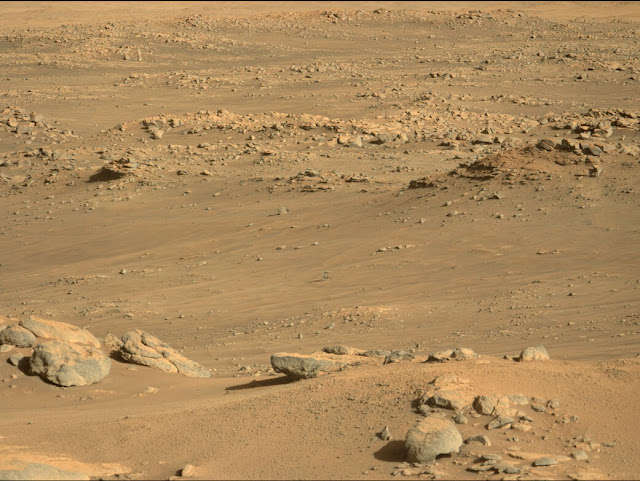
Images above: Ingenuity sits on a slightly inclined surface with about 6-degree tilt at the center of the frame, just north of the southern ridge of “Séíitah” geologic unit. The Perseverance rover’s Mastcam-Z instrument took this image on Dec. 1, 2021, when the rotorcraft was about 970 feet (295 meters) away. Images Credits: NASA/JPL-Caltech/ASU/MSSS.

The 17th flight of NASA’s Ingenuity Mars Helicopter on Dec. 5 pushed the total flight time past the 30-minute mark. The 117-second sortie brought history’s first aircraft to operate from the surface of another world closer to its original airfield, “Wright Brothers Field,” where it will await the arrival of the agency’s Perseverance Mars rover, currently exploring “South Séítah” region of Mars’ Jezero Crater.

Along with accumulating 30 minutes and 48 seconds of flight time, the trailblazing helicopter has traveled over the surface a distance of 2.2 miles (3,592 meters), flying as high as 40 feet (12 meters) and as fast as 10 mph (5 meters per second).

The rotorcraft’s status after the Dec. 5 flight was previously unconfirmed due to an unexpected cutoff to the in-flight data stream as the helicopter descended toward the surface at the conclusion of its flight. Perseverance serves as the helicopter’s communications base station with controllers on Earth. A handful of data radio packets the rover received later suggested a healthy helicopter on the surface but did not provide enough information for the team to declare a flight success.

But data downlinked to mission engineers at NASA’s Jet Propulsion Laboratory in Southern California on Friday, Dec. 10, indicates that Flight 17 was a success and that Ingenuity is in excellent condition.

The 30-minute mark far surpasses the original plans for the 4-pound (1.8-kilogram) rotorcraft. Designed as a technology demonstration to perform up to five experimental test flights, Ingenuity first flew on April 19, 2021, with a short up-and-down hop to prove powered, controlled flight on Mars was possible. The next four experimental flights expanded the rotorcraft’s flight envelope, making increasingly longer flights with more complicated maneuvering, which further helped engineers at JPL better understand its performance.

Perseverance Rover & Ingenuity Mars Helicopter. Animation Credits: NASA/JPL-Caltech

With the sixth flight, the helicopter embarked on a new operations demonstration phase, investigating how aerial scouting and other functions could benefit future exploration of Mars and other worlds. In this new chapter, the helicopter has operated from airfields well south of Wright Brothers Field, scouting rocky outcrops and other geologic features of interest to the Perseverance rover’s science team.

“Few thought we would make it to flight one, fewer still to five. And no one thought we would make it this far,” said Ingenuity Team Lead Teddy Tzanetos of JPL. “On the way to accumulating over a half-hour aloft Ingenuity has survived eight months of bitter cold, and operated out of nine unique Martian airfields. The aircraft’s continued operations speaks to the robustness the design and the diligence and passion of our small operations team.”

Flight 18

Flight 18 is scheduled to take place no earlier than today, Dec. 15, with Ingenuity covering another 754 feet (230 meters) at a speed of 5.6 mph (2.5 meters per second) over 125 seconds. The new airfield, close to the northern boundary of Séítah, will be the rotorcraft’s 10th on Mars. Data from the flight is expected to be received at JPL no earlier than in the late afternoon today.

As with the previous effort, Flight 18 will push the limits of Ingenuity’s radio range and performance. To provide it with the best chance of maintaining a link throughout landing, the Mars Helicopter team has modified the flight sequence to communicate in a low-data-rate mode, which will provide an additional signal-strength boost to the radio link.

“If we do lose radio link on landing, it may be several days or weeks until the line-of-sight between Ingenuity and Perseverance improves enough to attempt a communication session,” said Tzanetos. “While delaying our post-flight data analysis is an inconvenience, it is not unexpected and becoming the new normal as we continue to operate in challenging terrain in the weeks ahead.”

More About Ingenuity

The Ingenuity Mars Helicopter was built by JPL, which also manages this technology demonstration project for NASA Headquarters. It is supported by NASA’s Science, Aeronautics, and Space Technology mission directorates. NASA’s Ames Research Center in California’s Silicon Valley and NASA’s Langley Research Center in Hampton, Virginia, provided significant flight performance analysis and technical assistance during Ingenuity’s development. AeroVironment Inc., Qualcomm, and SolAero also provided design assistance and major vehicle components. Lockheed Space in designed and manufactured the Mars Helicopter Delivery System.

At NASA Headquarters, Dave Lavery is the program executive for the Ingenuity Mars Helicopter.

More About Perseverance

A key objective for Perseverance’s mission on Mars is astrobiology, including the search for signs of ancient microbial life. The rover will characterize the planet’s geology and past climate, pave the way for human exploration of the Red Planet, and be the first mission to collect and cache Martian rock and regolith (broken rock and dust).

Subsequent NASA missions, in cooperation with ESA (European Space Agency), would send spacecraft to Mars to collect these sealed samples from the surface and return them to Earth for in-depth analysis.

The Mars 2020 Perseverance mission is part of NASA’s Moon to Mars exploration approach, which includes Artemis missions to the Moon that will help prepare for human exploration of the Red Planet.

JPL, which is managed for NASA by Caltech in Pasadena, California, built and manages operations of the Perseverance rover.

For more information about Ingenuity:

https://mars.nasa.gov/technology/helicopter

For more about Perseverance:

https://mars.nasa.gov/mars2020/

Images (mentioned), Animation (mentioned), Text, Credits: NASA/Tony Greicius/Karen Fox/Alana Johnson/JPL/DC Agle.

Best regards, Orbiter.ch

NASA’s Perseverance Mars Rover Makes Surprising Discoveries


NASA - Mars 2020 Perseverance Rover logo.


Dec 15, 2021

The findings by rover scientists highlight the diversity of samples geologists and future scientists associated with the agency’s Mars Sample Return program will have to study.

Spanning the Delta of Mars’ Jezero Crater (video)

Video above: Taken by Perseverance’s Mastcam-Z instrument, this video features an enhanced-color composite image that pans across Jezero Crater’s delta on Mars. The delta formed billions of years ago from sediment an ancient river carried to the mouth of a lake that once existed in the crater. Video Credits: NASA/JPL-Caltech/ASU/MSSS.

Scientists with NASA’s Perseverance Mars rover mission have discovered that the bedrock their six-wheeled explorer has been driving on since landing in February likely formed from red-hot magma. The discovery has implications for understanding and accurately dating critical events in the history of Jezero Crater – as well as the rest of the planet.

The team has also concluded that rocks in the crater have interacted with water multiple times over the eons and that some contain organic molecules.

These and other findings were presented today during a news briefing at the American Geophysical Union fall science meeting in New Orleans.

Even before Perseverance touched down on Mars, the mission’s science team had wondered about the origin of the rocks in the area. Were they sedimentary – the compressed accumulation of mineral particles possibly carried to the location by an ancient river system? Or where they igneous, possibly born in lava flows rising to the surface from a now long-extinct Martian volcano?

“I was beginning to despair we would never find the answer,” said Perseverance Project Scientist Ken Farley of Caltech in Pasadena. “But then our PIXL instrument got a good look at the abraded patch of a rock from the area nicknamed ‘South Séítah,’ and it all became clear: The crystals within the rock provided the smoking gun.”

The drill at the end of Perseverance’s robotic arm can abrade, or grind, rock surfaces to allow other instruments, such as PIXL, to study them. Short for Planetary Instrument for X-ray Lithochemistry, PIXL uses X-ray fluorescence to map the elemental composition of rocks. On Nov. 12, PIXL analyzed a South Séítah rock the science team had chosen to take a core sample from using the rover’s drill. The PIXL data showed the rock, nicknamed “Brac,” to be composed of an unusual abundance of large olivine crystals engulfed in pyroxene crystals.

“A good geology student will tell you that such a texture indicates the rock formed when crystals grew and settled in a slowly cooling magma – for example a thick lava flow, lava lake, or magma chamber,” said Farley. “The rock was then altered by water several times, making it a treasure trove that will allow future scientists to date events in Jezero, better understand the period in which water was more common on its surface, and reveal the early history of the planet. Mars Sample Return is going to have great stuff to choose from!”  

The multi-mission Mars Sample Return campaign began with Perseverance, which is collecting Martian rock samples in search of ancient microscopic life. Of Perseverance’s 43 sample tubes, six have been sealed to date – four with rock cores, one with Martian atmosphere, and one that contained “witness” material to observe any contamination the rover might have brought from Earth. Mars Sample Return seeks to bring select tubes back to Earth, where generations of scientists will be able to study them with powerful lab equipment far too large to send to Mars.

Still to be determined is whether the olivine-rich rock formed in a thick lava lake cooling on the surface or in a subterranean chamber that was later exposed by erosion.


Image above: This graphic depicts Perseverance’s entry into “Séítah” from both an orbital and subsurface perspective. The lower image is a subsurface “radargram” from the rover’s RIMFAX instrument; the red lines indicate link subsurface features to erosion-resistant rocky outcrops visible above the surface. Image Credits: NASA/JPL-Caltech/University of Arizona/USGS/FFI.

Organic Molecules

Also great news for Mars Sample Return is the discovery of organic compounds by the SHERLOC (Scanning Habitable Environments with Raman & Luminescence for Organics & Chemicals) instrument. The carbon-containing molecules are not only in the interiors of abraded rocks SHERLOC analyzed, but in the dust on non-abraded rock.

Confirmation of organics is not a confirmation that life once existed in Jezero and left telltale signs (biosignatures). There are both biological and non-biological mechanisms that create organics.

“Curiosity also discovered organics at its landing site within Gale Crater,” said Luther Beegle, SHERLOC principal investigator at NASA’s Jet Propulsion Laboratory in Southern California. “What SHERLOC adds to the story is its capability to map the spatial distribution of organics inside rocks and relate those organics to minerals found there. This helps us understand the environment in which the organics formed. More analysis needs to be done to determine the method of production for the identified organics.”

The preservation of organics inside ancient rocks – regardless of origin – at both Gale and Jezero Craters does mean that potential biosignatures (signs of life, whether past or present) could be preserved, too. “This is a question that may not be solved until the samples are returned to Earth, but the preservation of organics is very exciting. When these samples are returned to Earth, they will be a source of scientific inquiry and discovery for many years,” Beegle said.


Image above: Six facsimile sample tubes hang on the sample tube board in this image taken in the offices of NASA’s Perseverance Mars rover. Image Credits: NASA/JPL-Caltech.

‘Radargram’

Along with its rock-core sampling capabilities, Perseverance has brought the first ground-penetrating radar to the surface of Mars. RIMFAX (Radar Imager for Mars' Subsurface Experiment) creates a “radargram” of subsurface features up to about 33 feet (10 meters) deep. Data for this first released radargram was collected as the rover drove across a ridgeline from the “Crater Floor Fractured Rough” geologic unit into the Séítah geologic unit.

The ridgeline has multiple rock formations with a visible downward tilt. With RIMFAX data, Perseverance scientists now know that these angled rock layers continue at the same angle well below the surface. The radargram also shows the Séítah rock layers project below those of Crater Floor Fractured Rough. The results further confirm the science team’s belief that the creation of Séítah preceded Crater Floor Fractured Rough. The ability to observe geologic features even below the surface adds a new dimension to the team’s geologic mapping capabilities at Mars.

More About Perseverance

A key objective for Perseverance’s mission on Mars is astrobiology, including the search for signs of ancient microbial life. The rover will characterize the planet’s geology and past climate, pave the way for human exploration of the Red Planet, and be the first mission to collect and cache Martian rock and regolith (broken rock and dust).

Subsequent NASA missions, in cooperation with ESA (European Space Agency), would send spacecraft to Mars to collect these sealed samples from the surface and return them to Earth for in-depth analysis.

The Mars 2020 Perseverance mission is part of NASA’s Moon to Mars exploration approach, which includes Artemis missions to the Moon that will help prepare for human exploration of the Red Planet.

JPL, which is managed for NASA by Caltech in Pasadena, California, built and manages operations of the Perseverance rover.

For more about Perseverance:

https://mars.nasa.gov/mars2020/ and https://nasa.gov/perseverance

Images (mentioned), Video (mentioned), Text, Credits: NASA/Tony Greicius/Karen Fox/Alana Johnson/JPL/DC Agle.

Greetings, Orbiter.ch

ExoMars discovers hidden water in Mars’ Grand Canyon


ESA - ExoMars Mission logo.


Dec 15, 2021

The ESA-Roscosmos ExoMars Trace Gas Orbiter has spotted significant amounts of water at the heart of Mars’ dramatic canyon system, Valles Marineris.

Valles Marineris

The water, which is hidden beneath Mars’ surface, was found by the Trace Gas Orbiter (TGO)’s FREND instrument, which is mapping the hydrogen – a measure of water content – in the uppermost metre of Mars’ soil.

While water is known to exist on Mars, most is found in the planet’s cold polar regions as ice. Water ice is not found exposed at the surface near the equator, as temperatures here are not cold enough for exposed water ice to be stable.

Missions including ESA’s Mars Express have hunted for near-surface water – as ice covering dust grains in the soil, or locked up in minerals – at lower latitudes of Mars, and found small amounts. However, such studies have only explored the very surface of the planet; deeper water stores could exist, covered by dust.

“With TGO we can look down to one metre below this dusty layer and see what’s really going on below Mars’ surface – and, crucially, locate water-rich ‘oases’ that couldn’t be detected with previous instruments,” says Igor Mitrofanov of the Space Research Institute of the Russian Academy of Sciences in Moscow, Russia; lead author of the new study; and principal investigator of the FREND (Fine Resolution Epithermal Neutron Detector) neutron telescope.

Trace Gas Orbiter at Mars

“FREND revealed an area with an unusually large amount of hydrogen in the colossal Valles Marineris canyon system: assuming the hydrogen we see is bound into water molecules, as much as 40% of the near-surface material in this region appears to be water.”

The water-rich area is about the size of the Netherlands and overlaps with the deep valleys of Candor Chaos, part of the canyon system considered promising in our hunt for water on Mars.

Tracking neutrons

Igor and colleagues analysed FREND observations ranging from May 2018 to February 2021, which mapped the hydrogen content of Mars’ soil by detecting neutrons rather than light.

“Neutrons are produced when highly energetic particles known as ‘galactic cosmic rays’ strike Mars; drier soils emit more neutrons than wetter ones, and so we can deduce how much water is in a soil by looking at the neutrons it emits,” adds co-author Alexey Malakhov, also of the Space Research Institute of the Russian Academy of Sciences. “FREND’s unique observing technique brings far higher spatial resolution than previous measurements of this type, enabling us to now see water features that weren’t spotted before.

“We found a central part of Valles Marineris to be packed full of water – far more water than we expected. This is very much like Earth’s permafrost regions, where water ice permanently persists under dry soil because of the constant low temperatures.”

ExoMars Trace Gas Orbiter maps water-rich region of Valles Marineris

This water could be in the form of ice, or water that is chemically bound to other minerals in the soil. However, other observations tell us that minerals seen in this part of Mars typically contain only a few percent water, much less than is evidenced by these new observations. “Overall, we think this water more likely exists in the form of ice,” says Alexey.

Water ice usually evaporates in this region of Mars due to the temperature and pressure conditions near the equator. The same applies to chemically bound water: the right combination of temperature, pressure and hydration must be there to keep minerals from losing water. This suggests that some special, as-yet-unclear mix of conditions must be present in Valles Marineris to preserve the water – or that it is somehow being replenished.

“This finding is an amazing first step, but we need more observations to know for sure what form of water we’re dealing with,” adds study co-author Håkan Svedhem of ESA’s ESTEC in the Netherlands, and former ESA project scientist for the ExoMars Trace Gas Orbiter.

“Regardless of the outcome, the finding demonstrates the unrivalled abilities of TGO’s instruments in enabling us to ‘see’ below Mars’ surface – and reveals a large, not-too-deep, easily exploitable reservoir of water in this region of Mars.”

Future exploration

As most future missions to Mars plan to land at lower latitudes, locating such a reservoir of water here is an exciting prospect for future exploration.

While Mars Express has found hints of water deeper underground in Mars’ mid-latitudes, alongside deep pools of liquid water under Mars’ south pole, these potential stores lie up to a few kilometres below ground, making them less exploitable and accessible to exploration than any found just below the surface.

The finding also makes Valles Marineris an even more promising target for future human exploration missions to the planet. The largest canyon in the Solar System, Valles Marineris is arguably Mars’ most dramatic landscape, and a feature that is often compared to Earth’s Grand Canyon – despite being some ten times longer and five times deeper.

Perspective view of Candor Chasma

“This result really demonstrates the success of the joint ESA-Roscosmos ExoMars programme,” says Colin Wilson, ESA's ExoMars Trace Gas Orbiter project scientist.

“Knowing more about how and where water exists on present-day Mars is essential to understand what happened to Mars’ once-abundant water, and helps our search for habitable environments, possible signs of past life, and organic materials from Mars’ earliest days.”

TGO launched in 2016 as the first of two launches under the ExoMars programme. The orbiter will be joined in 2022 by a European rover, Rosalind Franklin, and a Russian surface platform, Kazachok, and all will work together to understand whether life has ever existed on Mars.

Notes for editors

“The evidence for unusually high hydrogen abundances in the central part of Valles Marineris on Mars” by I. Mitrofanov et al. is published in the journal Icarus: https://doi.org/10.1016/j.icarus.2021.114805

Related links:

ExoMars: https://www.esa.int/Science_Exploration/Human_and_Robotic_Exploration/Exploration/ExoMars

ESA’s Mars Express: https://www.esa.int/Science_Exploration/Space_Science/Mars_Express

ESA’s ESTEC: https://www.esa.int/About_Us/ESTEC

Images, Text, Credits: ESA/DLR/FU Berlin (G. Neukum), CC BY-SA 3.0 IGO/ATG medialab/I. Mitrofanov et al. (2021).

Best regards, Orbiter.ch

Swarm and Cluster get to the bottom of geomagnetic storms


ESA - Swarm Mission logo.


Dec 15, 2021

Earth's protective shield

The notion of living in a bubble is usually associated with negative connotations, but all life on Earth is dependent on the safe bubble created by our magnetic field. Understanding how the field is generated, how it protects us and how it sometimes gives way to charged particles from the solar wind is not just a matter of scientific interest, but also a matter of safety. Using information from ESA’s Cluster and Swarm missions along with measurements from the ground, scientists have, for the first time, been able to confirm that curiously named bursty bulk flows are directly connected to abrupt changes in the magnetic field near Earth’s surface, which can cause damage to pipelines and electrical power lines.

Bursty bulk flows linked to magnetic field perturbations near Earth

The magnetosphere is a teardrop-shaped region in space that begins some 65 000 km from Earth on the day side and extends to over 6 000 000 km on the night side. It is formed through interactions between Earth’s magnetic field and supersonic wind flowing from the Sun.

These interactions are extremely dynamic and comprise complicated magnetic field configurations and electric current systems. Certain solar conditions, known as space weather, can play havoc with the magnetosphere by driving highly energetic particles and currents around the system, sometimes disrupting space-based hardware, ground-based communication networks and power systems.

In an elliptical orbit around Earth, up to 100 000 km away, ESA’s unique four-spacecraft Cluster mission has been revealing the secrets of our magnetic environment since 2000. Remarkably, the mission is still in excellent health and is still enabling new discoveries in the field of heliophysics – the science examining the relationship between the Sun and bodies in the Solar System, in this case, Earth.

4-satellite Cluster mission

Launched in 2013, ESA’s trio of Swarm satellites orbit much closer to Earth and are used largely to understand how our magnetic field is generated by measuring precisely the magnetic signals that stem from Earth’s core, mantle, crust and oceans, as well as from the ionosphere and magnetosphere. However, Swarm is also leading to new insights into weather in space.

The complementarity of these two missions, forming part of the ESA Heliophysics Observatory, gives scientists a unique opportunity to dig deep into Earth’s magnetosphere and further understand the risks of space weather.

In a paper published in Geophysical Research Letters, scientists describe how they used data from both Cluster and Swarm along with measurements from ground-based instruments to examine the connection between solar storms, bursty bulk flows in the inner magnetosphere and perturbations in the ground level magnetic field which drive ‘geomagnetically induced currents’ on and below Earth’s surface.

Swarm constellation

The theory was that intense changes in the geomagnetic field driving geomagnetically induced currents are associated with currents flowing along the magnetic field direction, driven by bursty bulk flows, which are fast bursts of ions typically travelling at more than 150 km per second. These field-aligned currents link the ionosphere and magnetosphere and pass through the locations of both the Cluster and Swarm. Until now this theory had not been confirmed.

Malcolm Dunlop, from the Rutherford Appleton Laboratory in the UK, explained, “We used the example of a solar storm in 2015 for our research. Data from Cluster allowed us to examine bursty bulk flows – bursts of particles in the magnetotail – which contribute to large-scale convection of material towards Earth during geomagnetically active times, and which are associated with features in the northern lights known as auroral streamers. Data from Swarm showed corresponding large perturbations closer to Earth associated with connecting field-aligned currents from the outer regions containing the flows.      

“Together with other measurements taken from Earth’s surface, we were able to confirm that intense magnetic field perturbations near Earth are connected to the arrival of bursty bulk flows further out in space.”

Magnetic reconnection in Earth's magnetosphere

ESA’s Swarm mission manager, Anja Strømme, added, “It’s thanks to having both missions extended well beyond their planned lives, and hence are having both missions in orbit simultaneously, that allowed us to realise these findings.”

While this scientific discovery might appear somewhat academic, there are real benefits for society.

The Sun bathes our planet with the light and heat to sustain life, but it also bombards us with dangerous charged particles in the solar wind. These charged particles can damage communication networks and navigation systems such as GPS, and satellites – all of which we rely on for services and information in our daily lives.

As the paper discusses, these storms can affect Earth’s surface and subsurface, leading to power outages, such as the major blackout that Quebec in Canada suffered in 1989.

Space weather effects

With a rapidly growing infrastructure, both on the ground and in space, that supports modern life, there is an increasing need to understand and monitor weather in space to adopt appropriate mitigation strategies.

Alexi Glover, from ESA’s Space Weather Office, said, “These new results help further our understanding of processes within the magnetosphere which may lead to potentially hazardous space weather conditions. Understanding these phenomena and their potential effects is essential to develop reliable services for end users operating potentially sensitive infrastructure.”

Related links:

Swarm: https://www.esa.int/Applications/Observing_the_Earth/Swarm

Geophysical Research Letters: https://agupubs.onlinelibrary.wiley.com/doi/full/10.1029/2020GL091781

Images, Animation, Video, Text, Credits: ESA/ATG medialab/Science Office, CC BY-SA 3.0 IGO.

Greetings, Orbiter.ch

mardi 14 décembre 2021

Crew Studies Vision, Psychology and Services Soyuz Crew Ships


ISS - Expedition 66 Mission patch.


Dec 14, 2021

The seven-member Expedition 66 crew focused on spacesuits, eye checks and an array of microgravity science aboard the International Space Station today. Meanwhile, the lab’s three visitors filmed a station tour and continued a space biology study.

Maintaining the orbiting lab and its systems is a top priority for NASA and its international partners to keep astronauts safe and continue critical space research. NASA Flight Engineer Mark Vande Hei worked in the U.S. Quest airlock cleaning cooling loops inside a pair of U.S. spacesuits. He also prepared suit components for return on the next SpaceX Cargo Dragon mission. Over in the Columbus laboratory module, Flight Engineer Matthias Maurer of ESA (European Space Agency) worked on electrical connections behind an EXPRESS science rack.


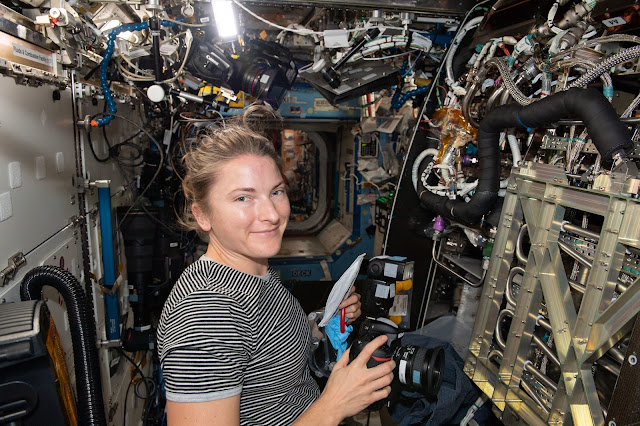
Image above: NASA astronaut Kayla Barron is pictured inspecting and photographing components inside the space station’s Materials Science Research Rack. Image Credit: NASA.

Vision and psychology are crucial to space exploration as doctors explore how long-term weightlessness impacts the human eye as well as crew dynamics. NASA Flight Engineer Raja Chari took on the crew medical officer role today and scanned NASA Flight Engineer Kayla Barron’s eyes using medical imaging gear. The duo also took turns on a robotics test for the Behavioral Core Measures space psychology study.

Astronaut Thomas Marshburn of NASA also participated in the robotics test that measures crew performance at various points during a mission. The three-time station resident continued working in the Kibo laboratory module setting up hardware that will house rodents for an upcoming visual function study.

International Space Station (ISS). Animation Credit: NASA

The three cosmonauts aboard the station worked on Soyuz activities and conducted Russian research. Expedition 66 Commander Anton Shkaplerov charged camera batteries inside the Soyuz MS-19 crew ship and tested water samples from Russian drink bags. Roscosmos Flight Engineer Pyotr Dubrov worked on computers and electrical connections in the Nauka multipurpose laboratory module. Veteran cosmonaut Alexander Misurkin packed hardware inside the Soyuz MS-20 crew ship that will return him and two Japanese space guests to Earth on Dec. 19.

Misurkin also partnered with spaceflight participants Yusaku Maezawa and Yozo Hirano filming a space station tour. The visiting trio then continued researching how microgravity affects the human circulatory system.

Related links:

Expedition 66: https://www.nasa.gov/mission_pages/station/expeditions/expedition66/index.html

U.S. Quest airlock: https://www.nasa.gov/mission_pages/station/structure/elements/joint-quest-airlock

Columbus laboratory module: https://www.nasa.gov/mission_pages/station/structure/elements/europe-columbus-laboratory

EXPRESS science rack: https://www.nasa.gov/mission_pages/station/research/experiments/explorer/Facility.html?#id=598

Behavioral Core Measures: https://www.nasa.gov/mission_pages/station/research/experiments/explorer/Investigation.html?#id=7537

Kibo laboratory module: https://www.nasa.gov/mission_pages/station/structure/elements/japan-kibo-laboratory

Visual function study: https://www.nasa.gov/mission_pages/station/research/experiments/explorer/Investigation.html?#id=7930

Nauka multipurpose laboratory module: https://www.roscosmos.ru/tag/nauka/

Space Station Research and Technology: https://www.nasa.gov/mission_pages/station/research/overview.html

International Space Station (ISS): https://www.nasa.gov/mission_pages/station/main/index.html

Image (mentioned), Animation (mentioned), Text, Credits: NASA/Mark Garcia.

Greetings, Orbiter.ch

Watch stars move around the Milky Way’s supermassive black hole in deepest images yet


ESO - European Southern Observatory logo.


Dec 14, 2021

ESO’s VLTI images of stars at the centre of the Milky Way

The European Southern Observatory’s Very Large Telescope Interferometer (ESO’s VLTI) has obtained the deepest and sharpest images to date of the region around the supermassive black hole at the centre of our galaxy. The new images zoom in 20 times more than what was possible before the VLTI and have helped astronomers find a never-before-seen star close to the black hole. By tracking the orbits of stars at the centre of our Milky Way, the team has made the most precise measurement yet of the black hole’s mass.

Stars around Sgr A* in March 2021

“We want to learn more about the black hole at the centre of the Milky Way, Sagittarius A*: How massive is it exactly? Does it rotate? Do stars around it behave exactly as we expect from Einstein’s general theory of relativity? The best way to answer these questions is to follow stars on orbits close to the supermassive black hole. And here we demonstrate that we can do that to a higher precision than ever before,” explains Reinhard Genzel, a director at the Max Planck Institute for Extraterrestrial Physics (MPE) in Garching, Germany who was awarded a Nobel Prize in 2020 for Sagittarius A* research. Genzel and his team’s latest results, which expand on their three-decade-long study of stars orbiting the Milky Way's supermassive black hole, are published today in two papers in Astronomy & Astrophysics.

Stars around Sgr A* in May 2021

On a quest to find even more stars close to the black hole, the team, known as the GRAVITY collaboration, developed a new analysis technique that has allowed them to obtain the deepest and sharpest images yet of our Galactic Centre. “The VLTI gives us this incredible spatial resolution and with the new images we reach deeper than ever before. We are stunned by their amount of detail, and by the action and number of stars they reveal around the black hole,” explains Julia Stadler, a researcher at the Max Planck Institute for Astrophysics in Garching who led the team’s imaging efforts during her time at MPE. Remarkably, they found a star, called S300, which had not been seen previously, showing how powerful this method is when it comes to spotting very faint objects close to Sagittarius A*.

Stars around Sgr A* in June 2021

With their latest observations, conducted between March and July 2021, the team focused on making precise measurements of stars as they approached the black hole. This includes the record-holder star S29, which made its nearest approach to the black hole in late May 2021. It passed it at a distance of just 13 billion kilometres, about 90 times the Sun-Earth distance, at the stunning speed of 8740 kilometres per second. No other star has ever been observed to pass that close to, or travel that fast around, the black hole.

Stars around Sgr A* in July 2021

The team’s measurements and images were made possible thanks to GRAVITY, a unique instrument that the collaboration developed for ESO’s VLTI, located in Chile. GRAVITY combines the light of all four 8.2-metre telescopes of ESO’s Very Large Telescope (VLT) using a technique called interferometry. This technique is complex, “but in the end you arrive at images 20 times sharper than those from the individual VLT telescopes alone, revealing the secrets of the Galactic Centre,” says Frank Eisenhauer from MPE, principal investigator of GRAVITY.

Wide-field view of the centre of the Milky Way

“Following stars on close orbits around Sagittarius A* allows us to precisely probe the gravitational field around the closest massive black hole to Earth, to test General Relativity, and to determine the properties of the black hole,” explains Genzel. The new observations, combined with the team’s previous data, confirm that the stars follow paths exactly as predicted by General Relativity for objects moving around a black hole of mass 4.30 million times that of the Sun. This is the most precise estimate of the mass of the Milky Way’s central black hole to date. The researchers also managed to fine-tune the distance to Sagittarius A*, finding it to be 27 000 light-years away.

Sagittarius A* in the constellation of Sagittarius

To obtain the new images, the astronomers used a machine-learning technique, called Information Field Theory. They made a model of how the real sources may look, simulated how GRAVITY would see them, and compared this simulation with GRAVITY observations. This allowed them to find and track stars around Sagittarius A* with unparalleled depth and accuracy. In addition to the GRAVITY observations, the team also used data from NACO and SINFONI, two former VLT instruments, as well as measurements from the Keck Observatory and NOIRLab’s Gemini Observatory in the US.

Animated sequence of the VLTI images of stars around the Milky Way’s central black hole

GRAVITY will be updated later this decade to GRAVITY+, which will also be installed on ESO’s VLTI and will push the sensitivity further to reveal fainter stars even closer to the black hole. The team aims to eventually find stars so close that their orbits would feel the gravitational effects caused by the black hole’s rotation. ESO’s upcoming Extremely Large Telescope (ELT), under construction in the Chilean Atacama Desert, will further allow the team to measure the velocity of these stars with very high precision. “With GRAVITY+’s and the ELT’s powers combined, we will be able to find out how fast the black hole spins,” says Eisenhauer. “Nobody has been able to do that so far.”

Zooming into the black hole at the centre of our galaxy

More information

This research was presented in two GRAVITY Collaboration papers to appear in Astronomy & Astrophysics.

The team who authored the paper “The mass distribution in the Galactic Centre from interferometric astrometry of multiple stellar orbits” (doi:10.1051/0004-6361/202142465) is composed of: R. Abuter (European Southern Observatory, Garching, Germany [ESO]), A. Amorim (Universidade de Lisboa - Faculdade de Ciências, Portugal and Centro de Astrofísica e Gravitação, IST, Universidade de Lisboa, Portugal [CENTRA]),  M. Bauböck (Max Planck Institute for Extraterrestrial Physics, Garching, Germany [MPE] and Department of Physics, University of Illinois, USA), J. P. Berger (Univ. Grenoble Alpes, CNRS, Grenoble, France [IPAG] and ESO), H. Bonnet (ESO), G. Bourdarot (IPAG and MPE), W. Brandner (Max Planck Institute for Astronomy, Heidelberg, Germany [MPIA]), V. Cardoso (CENTRA and CERN, Genève, Switzerland), Y. Clénet (Observatoire de Paris, Université PSL, CNRS, Sorbonne Université, Université de Paris, Meudon, France [LESIA]), Y. Dallilar (MPE), R. Davies (MPE), P. T. de Zeeuw (Sterrewacht Leiden, Leiden University [Leiden], The Netherlands and MPE), J. Dexter (Department of Astrophysical & Planetary Sciences, JILA, Duane Physics Bldg.,University of Colorado [Colorado], Boulder, USA), A. Drescher (MPE), A. Eckart (1st Institute of Physics, University of Cologne, Germany [Cologne] and Max Planck Institute for Radio Astronomy, Bonn, Germany), F. Eisenhauer (MPE), N. M. Förster Schreiber (MPE), P. Garcia (Faculdade de Engenharia, Universidade do Porto, Portugal and CENTRA), F. Gao (Hamburger Sternwarte, Universität Hamburg, Germany and MPE), E. Gendron (LESIA), R. Genzel (MPE and Departments of Physics and Astronomy, Le Conte Hall, University of California, Berkeley, USA), S. Gillessen (MPE), M. Habibi (MPE), X. Haubois (European Southern Observatory, Santiago, Chile [ESO Chile]), G. Heißel (LESIA), T. Henning (MPIA), S. Hippler (MPIA), M. Horrobin (Cologne), L. Jochum (ESO Chile), L. Jocou (IPAG), A. Kaufer (ESO Chile), P. Kervella (LESIA), S. Lacour (LESIA), V. Lapeyrère (LLESIA), J.-B. Le Bouquin (IPAG), P. Léna (LESIA), D. Lutz (MPE), T. Ott (MPE), T. Paumard (LESIA), K. Perraut (IPAG), G. Perrin (LESIA), O. Pfuhl (ESO and MPE), S. Rabien (MPE), G. Rodríguez-Coira (LESIA), J. Shangguan (MPE), T. Shimizu (MPE), S. Scheithauer (MPIA), J. Stadler (MPE), O. Straub (MPE), C. Straubmeier (Cologne), E. Sturm (MPE), L. J. Tacconi (MPE), K. R. W. Tristram (ESO Chile), F. Vincent (LESIA), S. von Fellenberg (MPE), F. Widmann (MPE), E. Wieprecht (MPE), E. Wiezorrek (MPE), J. Woillez (ESO), S. Yazici MPE and Cologne), and A. Young (MPE).

The team who authored the paper “Deep images of the Galactic Center with GRAVITY” (doi:10.1051/0004-6361/202142459) is composed of: R. Abuter (ESO), P. Arras (Max Planck Institute for Astrophysics [MPA], Garching, Germany and Department of Physics, Technical University Munich [TUM], Garching, Germany), M. Bauböck (MPE and Department of Physics, University of Illinois, USA), H. Bonnet (ESO), W. Brandner (MPIA), G. Bourdarot (IPAG and MPE), V. Cardoso (CENTRA and CERN), Y. Clénet (LESIA), P. T. de Zeeuw (Leiden and MPE), J. Dexter (Colorado and MPE), Y. Dallilar (MPE), A. Drescher (MPE), A. Eckart (Cologne and Max Planck Institute for Radio Astronomy, Bonn, Germany), F. Eisenhauer (MPE), T. Enßlin (MPA), N. M. Förster Schreiber (MPE), P. Garcia (Faculdade de Engenharia, Universidade do Porto, Portugal and CENTRA), F. Gao (Hamburger Sternwarte, Universität Hamburg, Germany and MPE),  E. Gendron (LESIA), R. Genzel (MPE and Departments of Physics and Astronomy, Le Conte Hall, University of California, Berkeley, USA), S. Gillessen (MPE), M. Habibi (MPE), X. Haubois (ESO Chile), G. Heißel (LESIA), T. Henning (MPIA), S. Hippler (MPIA), M. Horrobin (Cologne), A. Jiménez-Rosales (MPE), L. Jochum (ESO Chile), L. Jocou (IPAG), A. Kaufer (ESO Chile), P. Kervella (LESIA), S. Lacour (LESIA), V. Lapeyrère (LESIA), J.-B. Le Bouquin (IPAG), P. Léna (LESIA), D. Lutz (MPE), T. Ott (MPE) , T. Paumard (LESIA) , K. Perraut (IPAG) , G. Perrin (LESIA) , O. Pfuhl (ESO and MPE), S. Rabien (MPE), J. Shangguan (MPE), T. Shimizu (MPE), S. Scheithauer (MPIA), J. Stadler (MPE , O. Straub (MPE), C. Straubmeier (Cologne), E. Sturm (MPE), L.J. Tacconi (MPE), K. R. W. Tristram (ESO Chile), F. Vincent (LESIA), S. von Fellenberg (MPE), I. Waisberg (Department of Particle Physics & Astrophysics, Weizmann Institute of Science, Israel and MPE), F. Widmann (MPE), E. Wieprecht (MPE), E. Wiezorrek (MPE), J. Woillez (ESO), S. Yazici (MPE and Cologne), A. Young (MPE) and G. Zins (ESO).

The European Southern Observatory (ESO) enables scientists worldwide to discover the secrets of the Universe for the benefit of all. We design, build and operate world-class observatories on the ground — which astronomers use to tackle exciting questions and spread the fascination of astronomy — and promote international collaboration in astronomy. Established as an intergovernmental organisation in 1962, today ESO is supported by 16 Member States (Austria, Belgium, the Czech Republic, Denmark, France, Finland, Germany, Ireland, Italy, the Netherlands, Poland, Portugal, Spain, Sweden, Switzerland and the United Kingdom), along with the host state of Chile and with Australia as a Strategic Partner. ESO’s headquarters and its visitor centre and planetarium, the ESO Supernova, are located close to Munich in Germany, while the Chilean Atacama Desert, a marvellous place with unique conditions to observe the sky, hosts our telescopes. ESO operates three observing sites: La Silla, Paranal and Chajnantor. At Paranal, ESO operates the Very Large Telescope and its Very Large Telescope Interferometer, as well as two survey telescopes, VISTA working in the infrared and the visible-light VLT Survey Telescope. Also at Paranal ESO will host and operate the Cherenkov Telescope Array South, the world’s largest and most sensitive gamma-ray observatory. Together with international partners, ESO operates APEX and ALMA on Chajnantor, two facilities that observe the skies in the millimetre and submillimetre range. At Cerro Armazones, near Paranal, we are building “the world’s biggest eye on the sky” — ESO’s Extremely Large Telescope. From our offices in Santiago, Chile we support our operations in the country and engage with Chilean partners and society.

Links:

Watch Stars Move Around our Galaxy’s Central Black Hole (ESOcast 248 Light):
https://www.eso.org/public/videos/eso2119a/

Research paper 1: https://www.eso.org/public/archives/releases/sciencepapers/eso2119/eso2119a.pdf

Research paper 2: https://www.eso.org/public/archives/releases/sciencepapers/eso2119/eso2119b.pdf

Photos of the VLT/VLTI: http://www.eso.org/public/images/archive/category/paranal/

Find out more about ESO's Extremely Large Telescope: https://elt.eso.org/

For journalists: subscribe to receive our releases under embargo in your language: https://www.eso.org/public/outreach/pressmedia/#epodpress_form

For scientists: got a story? Pitch your research: http://eso.org/sci/publications/announcements/sciann17369.html

Images Credits: ESO/GRAVITY collaboration/IAU and Sky & Telescope/Videos Credits: ESO/GRAVITY collaboration/L. Calçada/ESO/GRAVITY collaboration/L. Calçada, N. Risinger (skysurvey.org), DSS. Music: Johan Monel/Text Credits: ESO/Bárbara Ferreira/Max Planck Institute for Extraterrestrial Physics/Stefan Gillessen/Frank Eisenhauer/Max Planck Institute for Astrophysics/Julia Stadler/Director, Max Planck Institute for Extraterrestrial Physics/Reinhard Genzel.

Best regards, Orbiter.ch

CASC - Long March-3B launches TianLian-2 02


CASC - China Aerospace Science and Technology Corporation (CASC) logo.


Dec 14, 2021

Long March-3B carrying TianLian-2 02 liftoff

A Long March-3B rocket launched the TianLian-2 02 satellite (天链二号02星) from the Xichang Satellite Launch Center, Sichuan Province, southwest China, on 13 December 2021, at 16:09 UTC (14 December, at 00:09 local time).

Long March-3B launches TianLian-2 02

According to official sources, the satellite entered the desired orbit. TianLian-2 02 is the second satellite of China’s second-generation data relay satellite system.

TianLian-2 02 satellite

The satellite will form a network with TianLian-1 01, 02, 03, 04, 05 and TianLian-2 01, providing global coverage for data relay and transmission services, supporting communications between the China Space Station and the mission control center in Beijing.

For more information about China Aerospace Science and Technology Corporation (CASC): http://english.spacechina.com/n16421/index.html

Images, Video, Text, Credits: China Media Group(CMG)/China Central Television (CCTV)/China Aerospace Science and Technology Corporation (CASC)/SciNews/Gunter's Space Page/Orbiter.ch Aerospace/Roland Berga.

Greetings, Orbiter.ch