jeudi 9 juin 2022

Comet Interceptor approved for construction


ESA - Comet Interceptor Mission patch.


June 9, 2022

ESA’s Comet Interceptor mission to visit a pristine comet or other interstellar object just starting its journey into the inner Solar System has been ‘adopted’ this week; the study phase is complete and, following selection of the spacecraft prime contractor, work will soon begin to build the mission.

Comet Interceptor concept

Comet Interceptor will share a ride into space with ESA’s Ariel exoplanet mission in 2029. The mission will build upon the successes of Rosetta and Giotto, ESA missions that both visited ‘short-period’ comets. Though these missions completely transformed our understanding of comets, their targets had already swung round the Sun many times and had therefore changed significantly since their creation.

Comet Interceptor aims to scrutinise a comet that has spent little time in the inner Solar System, or is possibly visiting it for the first time. Whilst Rosetta’s target hailed from the rocky Kuiper Belt just beyond Neptune, Comet Interceptor’s could originate from the vast Oort Cloud, over a thousand times further from the Sun.

Kuiper Belt and Oort Cloud in context

Although they’re much rarer, a different potential target could be an ‘interstellar interloper’ from outside the Solar System – something similar to ‘Oumuamua that unexpectedly flew past the Sun in 2017. Studying such an object could offer the chance to explore how comet-like bodies form and evolve in other star systems.

Comet Interceptor was adopted by ESA during the Agency’s Science Programme Committee meeting on 8 June. The mission is led by ESA with support from the Japanese Space Agency (JAXA).

Comet 67P/Churyumov-Gerasimenko, target of ESA’s Rosetta mission

“The adoption of Comet Interceptor builds upon the breakthroughs of our visionary Giotto and Rosetta missions, accelerating us towards next-level comet science,” says Günther Hasinger ESA’s Director of Science. “It will keep European scientists at the forefront of cometary research and position ESA as a leader in this exciting field.”

Comet Interceptor will be made up of a main spacecraft and two probes, which will surround the comet to observe it from multiple angles. In this way, the innovative mission will build up a 3D profile of its as-yet-undiscovered target. ESA is responsible for the main spacecraft and one of the probes, while JAXA is responsible for the second probe.

“A comet on its first orbit around the Sun would contain unprocessed material from the dawn of the Solar System,” explains ESA’s Comet Interceptor study scientist Michael Küppers. “Studying such an object and sampling this material will help us understand not only more about comets, but also how the Solar System formed and evolved over time.”

Journey to a comet

Comet Interceptor was proposed to ESA in July 2018 and selected in June 2019. It is an example of a ‘fast’ or F-class mission, which only take about eight years from selection to launch. These smaller missions weigh less than 1000 kg.

The mission is expected to launch together with ESA’s exoplanet-studying Ariel mission in 2029. The two missions will travel together to L2 – a location 1.5 million km ‘behind’ Earth as viewed from the Sun. There, Comet Interceptor will wait for a suitable target. Once one is spotted and selected, the mission will continue its journey.

Location of Lagrangian point (L2)

With recent advancements in ground-based telescopes, ‘new’ comets are now typically detected more than a year before their closest approach to the Sun. This is still too short notice to plan, build and launch a dedicated space mission. But it is enough time for the ready-and-waiting Comet Interceptor to travel from L2 to the comet’s location.

Operating spacecraft across millions of kilometres of space is always a challenge, but Comet Interceptor has a truly unique flight profile. Navigating the spacecraft towards the target comet, releasing the probes at the right time and performing a flyby will require steady hands and calm heads from ESA’s mission operations team.

A visionary mission – with benefits in space and on Earth

The three flight elements – the main spacecraft and two smaller probes – that make up Comet Interceptor will each be equipped with different high-tech instruments that will help us discover more about the dynamic nature of a pristine comet. ESA will lead the development of the main spacecraft and one of the probes, both carrying unique instruments built mainly by European industry. The other probe will be developed by JAXA.

Comet Interceptor has ground-breaking aims to characterise the surface composition, shape and structure of a pristine comet for the first time ever, and investigate the composition of its gas and dust coma. In some cases, this will require existing technologies to be refined, boosting the space and engineering industries in many ESA Member States.

Artist impression of ‘Oumuamua

“As with most ESA missions, Comet Interceptor will motivate collaboration between different companies, institutes, and countries, and will accelerate the development of innovative technologies that may have completely different applications in the future,” says ESA’s Comet Interceptor project manager Nicola Rando.

Comet Interceptor is also contributing to ESA’s planetary defence efforts. We know of almost 120 comets and more than 29 000 asteroids that come close to Earth in their orbit around the Sun. By studying these objects, we not only uncover secrets of the Solar System but also become better equipped to protect our planet if and when one is discovered on a collision course with Earth. Comet Interceptor joins a fleet of worldwide missions related to planetary defence, including ESA’s Hera mission, which is involved in the world’s first asteroid deflection test.

Nicola concludes: “Having spent the last few years devising and developing the Comet Interceptor concept, we are now ready to take the mission to the next stage, selecting the prime contractor and then starting the implementation phase.”

Related links:

ESA's Rosetta mission: https://www.esa.int/Science_Exploration/Space_Science/Rosetta

ESA's Giotto mission: https://www.esa.int/Science_Exploration/Space_Science/Giotto_overview

ESA's Ariel mission: https://sci.esa.int/web/ariel

ESA’s Hera mission: https://www.esa.int/Safety_Security/Hera

ESA’s planetary defence: https://www.esa.int/Safety_Security/Planetary_Defence

Japanese Space Agency (JAXA): https://global.jaxa.jp/

Images, Text, Credits: ESA/Rosetta/MPS for OSIRIS Team MPS/UPD/LAM/IAA/SSO/INTA/UPM/DASP/IDA/ESA/Hubble, NASA, ESO, M. Kornmesser.

Greetings, Orbiter.ch

mercredi 8 juin 2022

Daylong Robotics as Crew Tests Advanced Attire aboard Station


ISS - Expedition 67 Mission patch.


June 8, 2022

Wednesday saw daylong automated robotics activities as the crew tested advanced attire while working aboard the International Space Station. The Expedition 67 crew also ensured communications and life support systems continued operating in tip-top shape today.

The Kibo laboratory module from the Japan Aerospace Exploration Agency (JAXA) is the site of a pair of robotics free-flyers, known as Astrobees, autonomously navigating and performing maneuvering techniques today. NASA astronaut Jessica Watkins cleared Kibo of obstacles in the morning then activated the Astrobees for a day full of automated robotics operations.


Image above: Expedition 67 crew members pose with fresh fruit flying weightlessly in microgravity delivered recently aboard the Progress 81 cargo craft. Image Credit: NASA.

The toaster-sized, cube-shaped devices are using uplinked command algorithms while downlinking video so scientists can monitor their automated abilities in real-time from the ground. Researchers are testing the robotic assistants for their ability to aid astronauts with routine tasks and monitor station systems, thus increasing mission effectiveness in space.

Watkins also continued testing the comfort and mobility of wearing a specialized radiation protection vest while working aboard the orbiting lab. She then serviced hardware supporting advanced combustion and physics experiments.

International Space Station (ISS). Animation Credit: NASA

ESA (European Space Agency) astronaut Samantha Cristoforetti tested another experimental garment today that monitors crew health. She wore a smart-shirt that is integrated with sensors and wirelessly transmits data about the performance of a crew member’s cardiovascular system in microgravity.

NASA Flight Engineers Kjell Lindgren and Bob Hines worked throughout Wednesday on a variety of station maintenance activities. Lindgren replaced components on the advanced resistive exercise device before inspecting hatch seals in the station’s U.S. segment. Hines measured airflows throughout the station then installed a scratch pane on a window inside the cupola.


Image above: The International Space Station orbits into a dawn 261 miles above a cloudy Pacific Ocean in this image from April 2022. Image Credit: NASA.

Cosmonauts Oleg Artemyev and Sergey Korsakov were back on exercise research duty today studying ways to maximize the effectiveness of a workout in microgravity. Artemyev then set up Earth observation hardware while Korsakov checked out life support gear inside the Nauka multipurpose laboratory module. Flight Engineer Denis Matveev tested different methods of communicating with students on Earth then worked on ventilation systems and video recording hardware.

CRS-25 Cargo Mission Targeted for No Earlier Than June 28, 2022.

Related links:

Expedition 67: https://www.nasa.gov/mission_pages/station/expeditions/expedition67/index.html

Kibo laboratory module: https://www.nasa.gov/mission_pages/station/structure/elements/japan-kibo-laboratory

Astrobees: https://www.nasa.gov/mission_pages/station/research/experiments/explorer/Facility.html?#id=1891

Specialized radiation protection vest: https://www.nasa.gov/mission_pages/station/research/experiments/explorer/Investigation.html?#id=7803

Cardiovascular system in microgravity: https://www.nasa.gov/mission_pages/station/research/experiments/explorer/Investigation.html?#id=8563

Advanced resistive exercise device: https://www.nasa.gov/mission_pages/station/research/experiments/explorer/Facility.html?#id=973

Earth observation hardware: https://www.energia.ru/en/iss/researches/study/09.html

Nauka multipurpose laboratory module: https://www.roscosmos.ru/tag/nauka/

Space Station Research and Technology: https://www.nasa.gov/mission_pages/station/research/overview.html

International Space Station (ISS): https://www.nasa.gov/mission_pages/station/main/index.html

Images (mentioned), Animation (mentioned), Text, Credits: NASA/Mark Garcia.

Best regards, Orbiter.ch

NASA, FEMA Release Comprehensive Climate Action Guide


NASA logo.


June 8, 2022

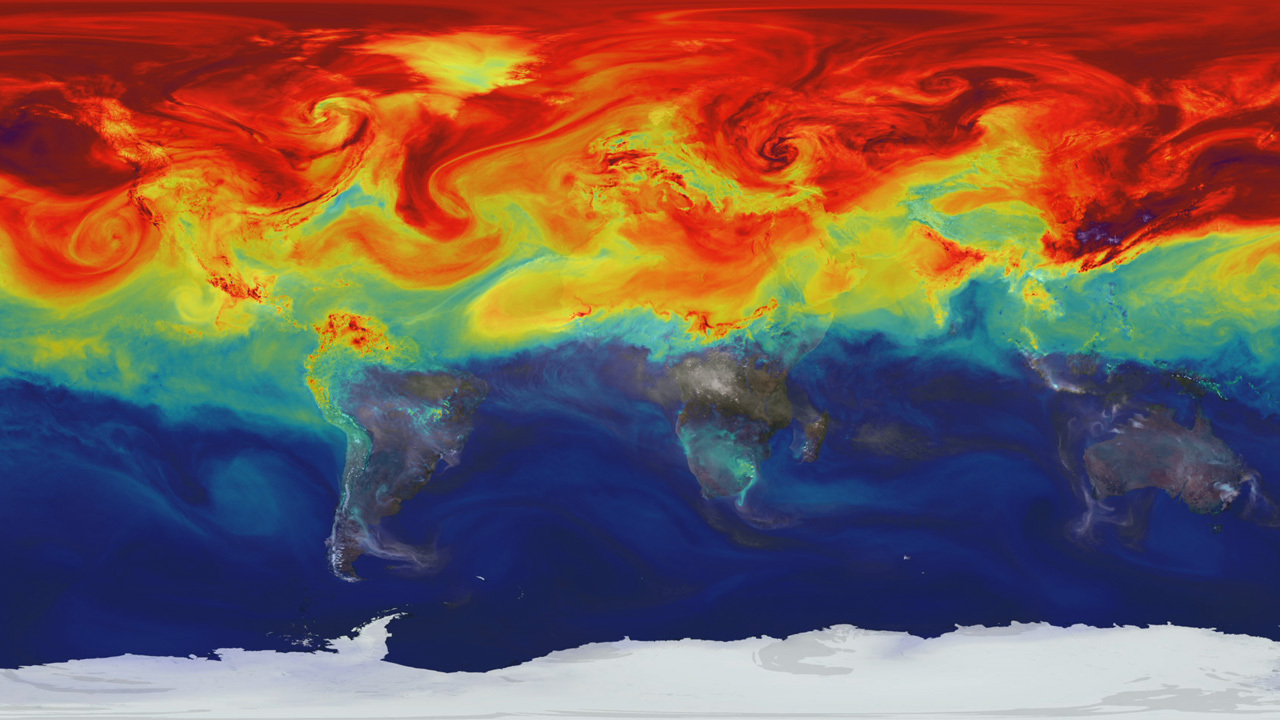
NASA and the Federal Emergency Management Agency (FEMA) have released a guide which provides resources for adapting to and mitigating impacts of climate change. The guide, Building Alliances for Climate Action, includes various perspectives, stories, insights, and resources about climate change to help individuals and organizations make informed decisions.


Image above: NASA supercomputer model shows how greenhouse gases like carbon dioxide (CO2) – a key driver of global warming – fluctuate in Earth’s atmosphere throughout the year. Higher concentrations are shown in red. Image Credits: NASA’s Scientific Visualization Studio / NASA’s Global Modeling and Assimilation Office.

“NASA’s Earth observation and research supports the Biden-Harris Administration’s climate agenda, which outlines putting the climate crisis at the center of our nation’s foreign policy and national security,” said NASA Administrator Bill Nelson. “NASA is working hand in hand with FEMA to ensure communities across the U.S. and around the world have the resources they need to adapt in the face of extreme weather – which is increasing due to climate change.”

The guide is a result of the Alliances for Climate Action, which NASA and FEMA co-hosted last year, a virtual series aimed at addressing rising demand for accurate, timely, and actionable information at a time of rapid global climate change. During the series, speakers shared their perspectives and paths to bolstering collective climate action.

“To meet this moment, we need to invest in initiatives to break the cycles of disaster, damage and reconstruction,” said FEMA Administrator Deanne Criswell. “Our actions now will directly impact the future. In the past, FEMA was criticized for insufficient action on climate change. This will not be our future.”

NASA also partners with FEMA in other ways related to climate and Earth science. Before, during and after disasters occur, NASA's Disasters Program coordinates with FEMA and other response agencies, decision-makers, and local governments to provide Earth-observing data and applied research results. NASA data informs choices, supports decisions, and guides actions to build resilient communities. NASA’s Disasters Mapping Portal provides near-real time data on current events.

To improve access to key information, Nelson announced a concept for NASA’s Earth Information Center, which is an opportunity for the agency to leverage its data and modeling capabilities to work with trusted government and community partners with longstanding engagement in communities most affected by climate change.

Supporting this effort are the Earth-observing missions we are flying today and building for the future. The center will complement the next generation of Earth observation satellites – NASA’s Earth System Observatory – to be launched by the end of this decade. As the next generation of missions to observe our planet, NASA’s observatory will provide a 3D, holistic view of Earth to help us better understand what our planet’s changes mean for humanity.

For more information about NASA’s Earth science programs, visit: https://www.nasa.gov/earth

Related links:

Building Alliances for Climate Action: http://www.fema.gov/rnpn/building-alliances

Alliances for Climate Action: https://alliances-for-climate-action.heysummit.com/

NASA’s Disasters Mapping Portal: https://maps.disasters.nasa.gov/

NASA’s Earth System Observatory: https://www.nasa.gov/press-release/new-nasa-earth-system-observatory-to-help-address-mitigate-climate-change

Climate: https://www.nasa.gov/subject/3127/climate

Image (mentioned), Text, Credits: NASA/Gerelle Dodson/Tylar Greene.

Greetings, Orbiter.ch

NASA’s Lucy Mission Continues Solar Array Deployment Process


NASA - LUCY Mission patch.


June 8, 2022

NASA’s Lucy mission team is in the midst of a multi-stage effort to further deploy the spacecraft’s unlatched solar array. On May 9, the team commanded the spacecraft to operate the array’s deployment motor using both the primary and back-up motor windings simultaneously to generate more torque, i.e. a harder pull. The motor operated as expected, further reeling in the lanyard that pulls the solar array open. After running the motor for a series of short intervals to avoid overheating, the team paused to analyze the results. Data from the spacecraft showed that the deployment was proceeding similarly to engineering ground tests, allowing the team to move forward with the second stage of the attempt. Analysis of the data also suggested that there was still additional lanyard to be retracted. The team sent the same commands again on May 12. Although this series of commands did not latch the solar array fully open, it did advance the deployment enough to increase the tension that stabilizes the arrays as was hoped.

Lucy solar array deployment

On May 26, the spacecraft was again commanded to deploy the solar array. As in the first two attempts, both motor windings were operated simultaneously for short periods of time to avoid overheating. Afterwards the team again analyzed the data from the event, which again showed that the array was continuing to open. The team repeated the deployment command sequence a fourth time on June 2. While the array still did not latch, the data indicates that it continued to further deploy and stiffen throughout the attempt.

The team has several more opportunities to repeat these deployment commands. While there is no guarantee that additional attempts will latch the array, there is strong evidence that the process is putting the array under more tension, further stabilizing it. Even if the array does not ultimately latch, the additional stiffening may be enough to fly the mission as planned.

NASA's Lucy spacecraft Solar Array deployed

The spacecraft completed a trajectory correction maneuver on June 7. This was the first in a series of maneuvers the spacecraft will take in preparation for the mission’s first Earth gravity assist scheduled for October 16, 2022.

Related articles:

NASA Zeroing in on Path Forward for Lucy Solar Array
https://orbiterchspacenews.blogspot.com/2022/01/nasa-zeroing-in-on-path-forward-for.html

NASA Team Remains Focused on Lucy’s Solar Arrays
https://orbiterchspacenews.blogspot.com/2021/10/nasa-team-remains-focused-on-lucys.html

Related link:

Lucy (Asteroid Mission): https://www.nasa.gov/lucy

Animation, Image, Text, Credits: NASA/Erin Morton/JPL-Caltech.

Best regards, Orbiter.ch

Mars sleeps with one eye open


ESA - Mars Express Mission patch.


June 8, 2022

This scarred and colourful (by martian standards!) landscape shows part of Aonia Terra, an upland region in the southern highlands of Mars. The image was taken by ESA’s Mars Express on 25 April 2022.

Aonia Terra on Mars

The 30 km-wide unnamed crater at the centre of the image is nestled within a landscape of winding channels. Conjuring images of veins running through a human eyeball, these channels are likely to have carried liquid water across the surface of Mars around 3.5–4 billion years ago.

Topography of Aonia Terra

The channels appear to be partly filled with a dark material, and in some places, seem to actually be raised above the surrounding land. There are a variety of possible explanations for this. Perhaps erosion-resistant sediment settled at the bottom of the channels when water flowed through them. Or perhaps the channels were filled in with lava later on in Mars’ history.

A cacophony of colours

This Mars Express image reveals many different colours in the surface around the crater, suggesting that this region of Mars is made up of a variety of materials. South of the crater (on the left of the true-colour image above), the surface is a warm red, melting into a darker brownish-grey closer to the crater. In this region, many buttes are visible – these flat-topped towers of rock are created when land is gradually worn away by water, wind or ice.

Perspective view of Tantalus Fossae

Inside the crater, a dark dune field rests on a lighter surface. Upon closer inspection, it becomes apparent that the crater is filled with more buttes and cone-shaped hills. These are evidence that many different materials accumulated inside the crater.

Second perspective view of Tantalus Fossae

To the north of the crater (right of the wide view image), the surface is lighter and smoother. The rims of the main crater and the channels appear less defined. To the far right of the image, the surface becomes even smoother.

Aonia Terra

Aonia Terra is known for its impressive craters. Close to the crater shown in this image is the 200 km-wide Lowell crater. Lowell is thought to have been formed almost four billion years ago, during the Solar System’s ‘Late Heavy Bombardment’ period, when a large number of asteroids crashed into the rocky planets.

Aonia Terra in context

Aonia Terra is named after a feature called Aonia, a dark patch on the surface of Mars that can be seen from Earth, even with rudimentary telescopes. Aonia was also a region in ancient Greece, a location sacred to the Muses, the goddesses of literature, science and the arts.

Exploring Mars

Mars Express has been orbiting the Red Planet since 2003, imaging Mars’ surface, mapping its minerals, identifying the composition and circulation of its tenuous atmosphere, probing beneath its crust, and exploring how various phenomena interact in the martian environment.

Tantalus Fossae in 3D

The mission’s High Resolution Stereo Camera (HRSC), responsible for these new images, has revealed much about Mars’ diverse surface features, with recent images showing everything from wind-sculpted ridges and grooves to volcanoes, impact craters, tectonic faults, river channels and ancient lava pools.

Related link:

ESA’s Mars Express: https://www.esa.int/Science_Exploration/Space_Science/Mars_Express

Images, Text, Credits: ESA/DLR/FU Berlin, CC BY-SA 3.0 IGO/NASA/MGS/MOLA Science Team.

Greetings, Orbiter.ch

mardi 7 juin 2022

Crew Checks Station Sound Levels, Tests Radiation Protection Vest


ISS - Expedition 67 Mission patch.


June 7, 2022

A variety of research operations were on the schedule for the Expedition 67 crew today including hearing checks, radiation protection, and space botany. The four astronauts and three cosmonauts also focused on cargo operations and International Space Station maintenance throughout the day.

NASA and SpaceX now are targeting no earlier than June 28 for the launch of the cargo Dragon spacecraft flight, designated CRS-25, to the International Space Station, pending variables, including availability on the Eastern Range and space station scheduling. The joint teams stood down from a launch attempt this week after elevated vapor readings were measured during propellant loading of the Dragon.


Image above: The waxing crescent Moon is pictured above Earth’s atmosphere illuminated by an orbital sunset as the International Space Station flew 258 miles above the Atlantic Ocean. Image Credit: NASA.

Flight Engineers Samantha Cristoforetti of ESA (European Space Agency) and Kjell Lindgren of NASA took turns monitoring the noise levels they are exposed to while working on the orbiting lab. Cristoforetti attached the Acoustic Diagnostics device to herself in the morning capturing and recording sound level data. She then handed over the audio hardware to Lindgren in the afternoon so he could begin his acoustic monitoring session.

NASA Flight Engineer Jessica Watkins tried on the AstroRad radiation protection vest Tuesday morning. The specialized vest is being tested for its ability to protect against solar particle events while providing comfort during normal station activities.

International Space Station (ISS). Animation Credit: NASA

NASA Flight Engineer Bob Hines was back on gardening duty as he replaced seed cartridges and tended to radishes and mizuna greens growing for the XROOTS space botany study. Hines and Watkins then partnered together in the afternoon for packing activities inside the Cygnus space freighter ahead of its departure planned for late June.

Cosmonauts Oleg Artemyev and Sergey Korsakov continued their exercise research today learning how to maximize the effectiveness of a workout in microgravity. The duo then split up and serviced a variety of communications and life support gear. Roscosmos Flight Engineer Denis Matveev started his day with an Earth photography session then moved on to cargo transfer tasks inside the Progress 80 resupply ship docked to the Poisk module.

Related article:

NASA to Highlight Climate Research on Cargo Launch, Sets TV Coverage
https://www.nasa.gov/press-release/nasa-to-highlight-climate-research-on-cargo-launch-sets-tv-coverage

Related links:

Expedition 67: https://www.nasa.gov/mission_pages/station/expeditions/expedition67/index.html

Acoustic Diagnostics: https://www.nasa.gov/mission_pages/station/research/experiments/explorer/Facility.html?#id=8600

AstroRad: https://www.nasa.gov/mission_pages/station/research/experiments/explorer/Investigation.html?#id=7803

XROOTS: https://www.nasa.gov/mission_pages/station/research/experiments/explorer/Investigation.html?#id=8088

Poisk module: https://www.nasa.gov/mission_pages/station/structure/elements/poisk-mini-research-module-2

Space Station Research and Technology: https://www.nasa.gov/mission_pages/station/research/overview.html

International Space Station (ISS): https://www.nasa.gov/mission_pages/station/main/index.html

Image (mentioned), Animation (mentioned), Text, Credits: NASA/Mark Garcia.

Best regards, Orbiter.ch

Jupiter’s moon Europa to obscure distant star


ESA - Gaia Mission patch.


June 7, 2022

On 19 June 2022, Jupiter’s intriguing moon Europa will pass in front of a distant star, making that star appear to disappear for at least a minute. This event will be easy to see with any size of telescope from certain parts of Africa.

New evidence of watery plumes on Jupiter’s moon Europa

By timing the event and then comparing the observations from different viewing locations astronomers will be able to refine their understanding of Europa’s orbit in preparation for ESA’s JUpiter ICy moons Explorer (Juice) mission, which is scheduled to arrive at the system during 2031. They may also be able to investigate the way the starlight interacts with the tenuous envelope of gasses that surround Europa.

When one celestial object blocks the light of a more distant one, it is called an occultation. The prediction for this particular occultation has been made using data from ESA’s Gaia mission.

Operational since late 2013, Gaia is a star mapping mission that is recording the precise positions of more than a billion stars in our home galaxy, the Milky Way. On 13 June, its much anticipated third full data release (DR3) will be made publicly available.

Gaia

DR3 will contain almost 2 billion celestial objects. Using data from previous Gaia releases has already allowed improved predictions to be made for several previous occultations, increasing the chances of observational success.

For example, in 2017, Gaia data was used to predict a Europa occultation that was to occur on 31 March. At the time, the only Jovian moons that had been observed in this way were Io and Ganymede. So, thanks to Gaia’s prediction, astronomers on Earth observed a Europa occultation for the first time.

Gaia data were subsequently used to predict further occultations involving all four of Jupiter's largest moons. Known as the Galilean moons because they were discovered by Galileo Galilei, they are Io, Europa, Ganymede and Callisto.

What makes the upcoming occultation of Europa special is that this moon will be in Jupiter’s shadow at the time and so it is impossible to see Europa directly because it does not generate any light of its own. Instead, it is visible only when it reflects sunlight. As Jupiter will be blocking that sunlight during the occultation, observers will only know Europa is there when it makes the star temporarily disappear.

Jupiter’s moon Europa to obscure distant star

The occultation takes place at 03:05:57 UTC, and it is only visible across a rather narrow track of the Earth’s surface. The centre line of that track passes through the African countries of Namibia, Botswana and Zimbabwe. Eastwards from here, it will be lost from view by the rising Sun.

The occulted star is below the limits of visibility to the naked eye but is not too faint. With an apparent brightness of magnitude 9, it will be easily visible in any size of telescope. To find it on the sky, astronomers should look at coordinates RA: 00:23:46.52, Dec: +01:13:18.92.

Observations of the event can be sent to europaocc2022.imcce@obspm.fr.

Being able to refine the orbital position of Europa, and the other moons of Jupiter, will make ESA’s Juice mission more productive. It will help spacecraft operators navigate between these icy worlds more accurately, and it will help the scientists extract conclusions from the flyby data. For example, knowing the spacecraft’s exact altitude above a moon’s surface will make calculations about the moon’s interior more precise.

This prediction is a reminder of the many facets of astronomy that Gaia data can be used for and how star data can help out with the study of asteroids and moons in our Solar System. Some details for Europa and some of the other moons of Jupiter will be part of the upcoming Gaia data release 3, to be released on 13 June.

Related links:

ESA’s Jupiter ICy moons Explorer (Juice): https://www.esa.int/Science_Exploration/Space_Science/Juice

ESA's Gaia: https://www.esa.int/Science_Exploration/Space_Science/Gaia

Images, Animation, Text, Credits: ESA/NASA/JPL-Caltech/SETI Institute/Josselin Desmars (IPSA/IMCCE).

Greetings, Orbiter.ch