jeudi 23 juin 2022

CASC - Long March-2D launches Yaogan-35 02 satellites


CASC - CZ-2D / Y61 XLSC (Yaogan) Mission patch.


June 23, 2022

Long March-2D carrying Yaogan-35 02 satellites liftoff

A Long March-2D launch vehicle launched the second group of three Yaogan-35 satellites from the Xichang Satellite Launch Center, Sichuan Province, southwest China, on 23 June 2022, at 02:22 UTC (10:22 local time).

Long March-2D launches Yaogan-35 02 satellites

According to official sources, the satellites (遥感三十五号02组卫星A星、B星、C星, Yaogan-35 02 A, B and C) have entered the planned orbits successfully and will be “mainly used in scientific experiments, land and resources surveys, agricultural production estimates, and disaster prevention and mitigation.”

For more information about China Aerospace Science and Technology Corporation (CASC), visit: http://english.spacechina.com/n16421/index.html

Image, Video, Text, Credits: China Media Group(CMG)/China Central Television (CCTV)/China Aerospace Science and Technology Corporation (CASC)/SciNews/Orbiter.ch Aerospace/Roland Berga.

Greetings, Orbiter.ch

Methane levels surged in 2020 despite lockdowns


ESA - Sentinel-5P Mission logo.


June 23, 2022

Levels of methane, the second most important greenhouse gas in our atmosphere, continued their unrelenting rise in 2020 despite the economic slowdown caused by the COVID-19 pandemic.

A team of scientists, from the University of Leeds, have used data from the Copernicus Sentinel-5P satellite to pinpoint locations with large surges of methane emissions. These findings were presented during ESA’s Living Planet Symposium which took place last month in Bonn, Germany.

Sentinel-5P

Methane has a mixture of both natural and anthropogenic sources. Around 40% of methane emissions comes from natural sources, while 60% comes from anthropogenic sources such as agriculture, fossil fuel exploitation and landfills.

One of the largest sources of methane emissions comes from wetlands – an area of land that is either covered by water or saturated with water – yet there is still uncertainty in how they respond to changes in climate and short-term variations, such as the El Niño-Southern Oscillation.

The combination of methane’s high global warming potential and relatively short lifetime in our atmosphere of approximately nine years, means if we reduce our methane emissions, we can partially mitigate the human impact of climate change on a relatively short timescale – while global emissions of carbon dioxide are reduced.

In situ methane measurements from 2020 showed the largest annual increase of methane concentrations since the 1980s, with this record surpassed in 2021. The year of 2020 was unique owing to the global pandemic, yet methane concentrations continued to rise despite a reduction in economic activity.

Anthropogenic emissions of methane have contributed to an additional 23% to the radiative forcing – a direct measure of the amount of Earth’s energy budget that is out of balance – in the troposphere since 1750.

Methane growth anomaly

It is not fully understood what is driving the recent trends in global methane concentrations owing to the uncertainty surrounding the sources and sinks. This is why it is important to monitor changes in atmospheric methane using satellites such as Copernicus Sentinel-5P. The satellite maps a wide range of pollutants such as nitrogen dioxide, ozone, formaldehyde, sulphur dioxide, carbon monoxide, and of course, methane.

Using observations obtained from Sentinel-5P, the team found that satellite measurements show the same increase of methane as demonstrated in surface measurements. Using the global coverage capability of Sentinel-5P, the team identified regions which showed large increases throughout 2020.

These regions include South Sudan and Uganda in Central Africa, along with high-latitude northern regions including Canada and Russia. During 2019, emissions related to large positive rainfall anomalies from Sudd wetlands in South Sudan were found to be over a quarter of the growth in global emissions.

The positive rainfall anomalies over South Sudan and Uganda continued into 2020. In addition to large amounts of precipitation, there was a high rate of dam releases from Lake Victoria resulting in increased water flow into the White Nile which feeds the Ugandan and Sudd wetlands.

Monthly methane concentration over South Sudan

The data obtained from Sentinel-5P indicates that 2020 was likely to have been a period of large methane fluxes in these regions. Satellite data was also compared with a chemical transport model called TOMCAT, which simulates methane in our atmosphere.

In South Sudan, there is a mismatch in the seasonal cycle between the TOMCAT model and the satellite observations, which previous studies have related to the wetlands model used in the study. This implies that wetlands could be a dominant factor in driving the large methane concentrations over South Sudan during 2020.

In Canada, high concentrations of methane in 2020 are found in the east, where more wetlands are situated. The regions of strong methane growth measured in these satellite observations indicate that wetlands may have been significant contributors to the large rise in methane during 2020, however work using TOMCAT is still ongoing to further explore these findings.

Emily Dowd, PhD student from the University of Leeds, said, “Copernicus Sentinel-5P observations have shown that global wetlands continue to be a large contributor to the atmospheric methane budget, and it is important that further work is carried out to fully understand how they will respond to changes in our climate.”

Related link:

Copernicus Sentinel-5P: https://www.esa.int/Applications/Observing_the_Earth/Copernicus/Sentinel-5P

Images, Text, Credits: ESA/Contains modified Copernicus Sentinel data (2020), processed by ESA, CC BY-SA 3.0 IGO/Emily Dowd/University of Leeds.

Greetings, Orbiter.ch

mercredi 22 juin 2022

First Ariane 5 launch of 2022 is a success


Arianespace - Ariane 5 ECA Flight VA257 Mission logo.


June 22, 2022

First Ariane 5 launch of 2022 is a success, supporting two loyal clients of Arianespace: MEASAT (Malaysia) and NSIL (India)

 - The Ariane 5, operated by Arianespace, has successfully placed two telecommunications satellites into geostationary orbit: MEASAT-3d for the Malaysian operator MEASAT, and GSAT-24 built by the Indian Space Agency ISRO on behalf of NSIL.

– Carrying out its first mission of the year, and the 113th overall, Ariane 5 once again demonstrates its exceptional reliability.

– Mission VA257 will improve broadband coverage in the Asia-Pacific region and represents another commercial success for Ariane 5 in the Asia-Pacific market.

On Wednesday, June 22, 2022 at 06:50 pm local time, an Ariane 5 launcher lifted off from the Guiana Space Center, Europe’s Spaceport in Kourou, French Guiana (South America), successfully orbiting two geostationary telecommunication satellites, MEASAT-3d and GSAT-24.

Ariane 5 carrying MEASAT-3d and GSAT-24 liftoff

“With this Ariane 5 mission, Arianespace is honored to support the ambitions of two key actors in the Asia-Pacific region: MEASAT, the leading Malaysian satellite operator and NewSpace India Limited (NSIL), a Government of India company within the Department of Space (DOS) acting in concert with the Indian Space Agency ISRO. With the orbiting of both MEASAT-3d, the fourth satellite that we’ve launched for the benefit of Malaysia, and GSAT-24, the 25th Indian satellite we’ve delivered for them, we are affirming our long term partnership with these two great actors,” declared Stéphane Israël, CEO of Arianespace.

MEASAT-3d, to be co-located with MEASAT-3a and MEASAT-3b in the 91.5°E orbital slot, is a multi-mission telecommunications satellite built by Airbus Defence and Space. It will significantly enhance broadband speeds of up to 100 Mbps per user in areas with limited or no terrestrial network throughout Malaysia, while continuing to provide redundancy and additional capacity for video distribution in HD, 4K, and ultimately 8K in the Asia-Pacific region.

Ariane 5 launches MEASAT-3d and GSAT-24

MEASAT-3d will also carry an extremely innovative payload on behalf of the Korean operator KTSAT.  Conceived by Airbus Defense and Space, it will be used by the Korean Augmentation System (KASS), a project of the Ministry of Land, Infrastructure and Transport led by KARI, the Korean Space Agency, to significantly improve air traffic control in South Korea.

GSAT-24 is a Ku-band 4-ton class communications satellite built by the Indian Space Research Organization (ISRO) for NewSpace India Limited (NSIL) that will provide high-quality television, telecommunications and broadcasting services across India. It will be the first “Demand Driven” communications satellite mission undertaken by NSIL.

“After the successful launch of the James Webb Space Telescope, this new achievement helps Ariane 5 write a new chapter in space history”, said André-Hubert Roussel, CEO of ArianeGroup. “Ariane 5 demonstrates its reliability once again, justifying the trust of Arianespace’s customers worldwide. Its successes are tied to Ariane 6, which benefits from the same reliability along with increased competitiveness and versatility.”

The Ariane 5 heavy-lift launcher is an ESA program carried out in cooperation between public institutions and industry across 12 European partner states.

ArianeGroup is the lead contractor for the development and production of Ariane 5, and is responsible for campaign operations and preparation of the launch vehicle up to lift-off. ArianGroup hands over a “ready to fly” rocket to its subsidiary Arianespace, which sells the Ariane 5 and operates it from the Guiana Space Center in French Guiana. During launch campaigns, Arianespace works closely with CNES, who is the design authority for the Ariane 5 and controls the satellite preparation facilities at the CSG.

After this launch, four Ariane 5 vehicles remain before the Ariane 6 takes up the baton, supporting Europe’s institutional missions, while meeting the growing needs of the commercial market.


MEASAT-3d is a multi-mission telecommunications satellite built by Airbus Defence and Space for MEASAT, the leading Malaysian satellite operator. This new satellite will significantly enhance broadband speeds of up to 100 Mbps in areas with limited or no terrestrial network throughout Malaysia while continuing to provide redundancy and additional capacity for video distribution in HD, 4K, and ultimately 8K in the Asia-Pacific region.

MEASAT-3d

Planned for more than 18 years of operation, MEASAT-3d is designed to have electrical power of 12 kW. It will carry C- and Ku-band payloads for direct-to-home (DTH) services and a high-throughput Ka-band payload with multiple user spot beams optimised to deliver high speed broadband communications over Malaysia for internet connectivity.  Apart from this, the satellite will also host a Q/V band payload, the first of its kind in the Asia-Pacific region, which allows MEASAT to study propagation effects in high rainfall regions like Malaysia, to enable the design of its next generation satellites.

MEASAT-3d will be co-located with MEASAT-3a and MEASAT-3b at the 91.5°E orbital slot.

GSAT-24 is a Ku-band 4-tonne class communications satellite built for NSIL by ISRO. This satellite will provide high-quality television, telecommunications and broadcasting services and will meet the DTH needs  of Indian customers. GSAT-24 is configured on ISRO’s proven I-3k Bus with a mission life of 15 years.

GSAT-24

Satellite capacity on-board GSAT-24 has been leased by NSIL to M/s Tata Play, a leader in Direct-To-Home (DTH) services. Thanks to this satellite, M/s Tata Play will be able to offer better and reliable services to its customers.

About Arianespace

Arianespace uses space to make life better on Earth by providing launch services for all types of satellites into all orbits. It has orbited over 1,100 satellites since 1980. Starting in 2022, Arianespace will operate the new-generation Ariane 6 and Vega C launchers, developed by ESA. Arianespace is headquartered in Evry, near Paris, and has a technical facility at the Guiana Space Center in French Guiana, plus local offices in Washington, D.C., Tokyo and Singapore. Arianespace is a subsidiary of ArianeGroup, which holds 74% of its share capital, with the balance held by 15 other shareholders from the European launcher industry. https://www.arianespace.com/

Images, Video, Text, Credits: Arianespace/Airbus Defence and Space/ISRO/SciNews/Orbiter.ch Aerospace/Roland Berga.

Greetings, Orbiter.ch

Space Gardening, Digestion, and Robotics Top Crew Schedule


ISS - Expedition 67 Mission patch.


June 22, 2022

Space gardening and the human digestive system were at the top of the science schedule aboard the International Space Station on Wednesday. The seven Expedition 67 residents also worked throughout the day filming their activities, inspecting station hardware, and testing a new robotic arm.

Space agriculture is a way to sustain healthy astronauts on future missions to the Moon, Mars and beyond without relying on packed cargo missions traveling farther in space. The XROOTS experiment on the orbiting lab is exploring growing radishes and mizuna greens using hydroponic and aeroponic techniques. NASA Flight Engineer Bob Hines nourished those plants today and checked seed cartridges and wicks to ensure they germinate and grow.


Hines also inspected and photographed the condition of windows in the Destiny laboratory and the Kibo laboratory modules. NASA Flight Engineer Kjell Lindgren continued testing a headset that enables 3-D high definition holograms in real-time for immersive and innovative communication and research techniques. He also swapped hard drives on a station laptop computer.

Flight Engineers Jessica Watkins and Samantha Cristoforetti joined each other today inspecting and cleaning hatch components on the U.S. modules. Watkins also audited, inspected, and stowed hardware in the Tranquility module and the Quest airlock. Cristoforetti checked smoke detectors in the Columbus laboratory module and tested a specialized garment that can monitor an astronaut’s health wirelessly.

All four astronauts have also been filming their activities this week to prepare future crews training for upcoming station missions. The quartet have been recording, narrating, and downlinking videos documenting the operation of exercise equipment, network communications gear, and cargo stowage aboard the space station.

International Space Station (ISS). Animation Credit: ESA

The lack of gravity affects the human body in a multitude of ways. Scientists observe station crew members during long-term missions to understand and counteract the undesired effects of weightlessness. Commander Oleg Artemyev and Flight Engineer Denis Matveev once again scanned their digestive system using an ultrasound device after breakfast. Researchers are exploring how organs and vessels in the gastrointestinal tract adapt to spaceflight.

Robotics testing is still ongoing this week in the station’s Russian segment. Roscosmos Flight Engineer Sergey Korsakov continued checking out and filming the European robotic arm, the station’s third and newest robotic manipulator, and its ability to maneuver on the Nauka multipurpose laboratory module.

NASA and Northrop Grumman are continuing to work on a plan for Cygnus to try another reboost attempt as early as Saturday, June 25, that would lead to Cygnus potentially departing the station next Tuesday, June 28. The plan is being discussed with the International Space Station partners this week and a forward plan is expected as early as Thursday.

The reboost is designed to provide Cygnus with an enhanced capability for station operations as a standard service for NASA.

Related links:

Expedition 67: https://www.nasa.gov/mission_pages/station/expeditions/expedition67/index.html

XROOTS: https://www.nasa.gov/mission_pages/station/research/experiments/explorer/Investigation.html?#id=8088

Destiny laboratory module: https://www.nasa.gov/mission_pages/station/structure/elements/us-destiny-laboratory

Kibo laboratory module: https://www.nasa.gov/mission_pages/station/structure/elements/japan-kibo-laboratory

3-D high definition holograms: https://www.nasa.gov/mission_pages/station/research/experiments/explorer/Investigation.html?#id=2018

Tranquility module: https://www.nasa.gov/mission_pages/station/structure/elements/tranquility/

Quest airlock: https://www.nasa.gov/mission_pages/station/structure/elements/joint-quest-airlock

Columbus laboratory module: https://www.nasa.gov/mission_pages/station/structure/elements/europe-columbus-laboratory

Specialized garment: https://www.nasa.gov/mission_pages/station/research/experiments/explorer/Investigation.html?#id=8563

Digestive system: https://www.energia.ru/en/iss/researches/human/09.html

Nauka multipurpose laboratory module: https://www.roscosmos.ru/tag/nauka/

Space Station Research and Technology: https://www.nasa.gov/mission_pages/station/research/overview.html

International Space Station (ISS): https://www.nasa.gov/mission_pages/station/main/index.html

Image, Animation (mentioned), Text, Credits: NASA/Mark Garcia.

Best regards, Orbiter.ch

A Sea of Stars Like Sequins


NASA - Hubble Space Telescope patch.


June 22, 2022


The Hubble Space Telescope captured this glittering scene using its Wide Field Camera 3 and Advanced Camera for Surveys.

Globular clusters are stable, tightly bound groups of tens of thousands to millions of stars. As this image demonstrates, the hearts of globular clusters are densely packed with stars. Terzan 9 is dotted with so many glittering stars that it resembles a sea of sequins.

This starry snapshot is from a Hubble program investigating globular clusters located toward the heart of the Milky Way, in which its central region holds a tightly packed group of stars known as the galactic bulge, an area rich in interstellar dust. This dust makes globular clusters near the galaxy’s center difficult to study, as it absorbs starlight and can even change the apparent colors of stars in these clusters. Hubble's sensitivity at both visible and infrared wavelengths allows astronomers to measure how star colors change due to interstellar dust. Knowing a star’s true color and brightness allows astronomers to estimate its age, and thereby estimate the globular cluster’s age.

Hubble Space Telescope (HST)

Related article:

Hubble Snaps a Sea of Sequins
https://orbiterchspacenews.blogspot.com/2022/06/hubble-snaps-sea-of-sequins.html

For more information about Hubble, visit:

http://hubblesite.org/

http://www.nasa.gov/hubble

https://esahubble.org/

Image, Animation Credits: ESA/Hubble & NASA, R. Cohen/Text Credits: NASA/Yvette Smith.

Greetings, Orbiter.ch

NASA’s Curiosity Captures Stunning Views of a Changing Mars Landscape


NASA - Mars Science Laboratory (MSL) patch.


Jun 22, 2022

Striking rock formations documented by the rover provide evidence of a drying climate in the Red Planet’s ancient past.


Image above: NASA’s Curiosity Mars rover captured this view of a sulfate-bearing region using its Mastcam on May 2, 2022, the 3,462nd Martian day, or sol, of the mission. Dark boulders seen near the center are thought to have formed from sand deposited in ancient streams or ponds. Image Credits: NASA/JPL-Caltech/MSSS.

For the past year, NASA’s Curiosity Mars rover has been traveling through a transition zone from a clay-rich region to one filled with a salty mineral called sulfate. While the science team targeted the clay-rich region and the sulfate-laden one for evidence each can offer about Mars’ watery past, the transition zone is proving to be scientifically fascinating as well. In fact, this transition may provide the record of a major shift in Mars’ climate billions of years ago that scientists are just beginning to understand.

The clay minerals formed when lakes and streams once rippled across Gale Crater, depositing sediment at what is now the base of Mount Sharp, the 3-mile-tall (5-kilometer-tall) mountain whose foothills Curiosity has been ascending since 2014. Higher on the mountain in the transition zone, Curiosity’s observations show that the streams dried into trickles and sand dunes formed above the lake sediments.


Image above: NASA’s Curiosity Mars rover captured this view of layered, flaky rocks believed to have formed in an ancient streambed or small pond. The six images that make up this mosaic were captured using Curiosity’s Mast Camera, or Mastcam, on June 2, 2022, the 3,492nd Martian day, or sol, of the mission. Image Credits: NASA/JPL-Caltech/MSSS.

“We no longer see the lake deposits that we saw for years lower on Mount Sharp,” said Ashwin Vasavada, Curiosity’s project scientist at NASA’s Jet Propulsion Laboratory in Southern California. “Instead, we see lots of evidence of drier climates, like dry dunes that occasionally had streams running around them. That’s a big change from the lakes that persisted for perhaps millions of years before.”

As the rover climbs higher through the transition zone, it is detecting less clay and more sulfate. Curiosity will soon drill the last rock sample it will take in this zone, providing a more detailed glimpse into the changing mineral composition of these rocks.


Image above: NASA’s Curiosity Mars rover captured this 360-degree panorama near a location nicknamed “Sierra Maigualida” on May 22, 2022, the 3,481st Martian day, or sol, of the mission. The panorama is made up of 133 individual images captured by Curiosity’s Mast Camera, or Mastcam. Image Credits: NASA/JPL-Caltech/MSSS.

Unique geologic features also stand out in this zone. The hills in the area likely began in a dry environment of large, wind-swept sand dunes, hardening into rock over time. Interspersed in the remains of these dunes are other sediments carried by water, perhaps deposited in ponds or small streams that once wove among the dunes. These sediments now appear as erosion-resistant stacks of flaky layers, like one nicknamed “The Prow.”

Making the story richer yet more complicated is the knowledge that there were multiple periods in which groundwater ebbed and flowed over time, leaving a jumble of puzzle pieces for Curiosity’s scientists to assemble into an accurate timeline.

How Scientists Study Wind on Mars (NASA Mars News Report June 22, 2022)

Video above: NASA's spacecraft on Mars are all affected by the winds of the Red Planet, which can produce a tiny dust devil or a global dust storm. Video Credits: NASA/JPL-Caltech/ASU/MSSS/University of Arizona.

Ten Years On, Going Strong

Curiosity will celebrate its 10th year on Mars Aug. 5. While the rover is showing its age after a full decade of exploring, nothing has prevented it from continuing its ascent.

On June 7, Curiosity went into safe mode after detecting a temperature reading on an instrument control box within the body of the rover that was warmer than expected. Safe mode occurs when a spacecraft senses an issue and automatically shuts down all but its most essential functions so that engineers can assess the situation.


Image above: NASA’s Curiosity Mars rover captured evidence of layers that built up as windblown sand both accumulated and was scoured away at a location nicknamed “Las Claritas.” This image was captured using Curiosity’s Mast Camera, or Mastcam, on May 19, 2022, the 3,478th Martian day, or sol, of the mission. Image Credits: NASA/JPL-Caltech/MSSS.

Although Curiosity exited safe mode and returned to normal operations two days later, JPL’s engineers are still analyzing the exact cause of the issue. They suspect safe mode was triggered after a temperature sensor provided an inaccurate measurement, and there’s no sign it will significantly affect rover operations since backup temperature sensors can ensure the electronics within the rover body aren’t getting too hot.

The rover’s aluminum wheels are also showing signs of wear. On June 4, the engineering team commanded Curiosity to take new pictures of its wheels – something it had been doing every 3,281 feet (1,000 meters) to check their overall health.

The team discovered that the left middle wheel had damaged one of its grousers, the zig-zagging treads along Curiosity’s wheels. This particular wheel already had four broken grousers, so now five of its 19 grousers are broken.

The previously damaged grousers attracted attention online recently because some of the metal “skin” between them appears to have fallen out of the wheel in the past few months, leaving a gap.
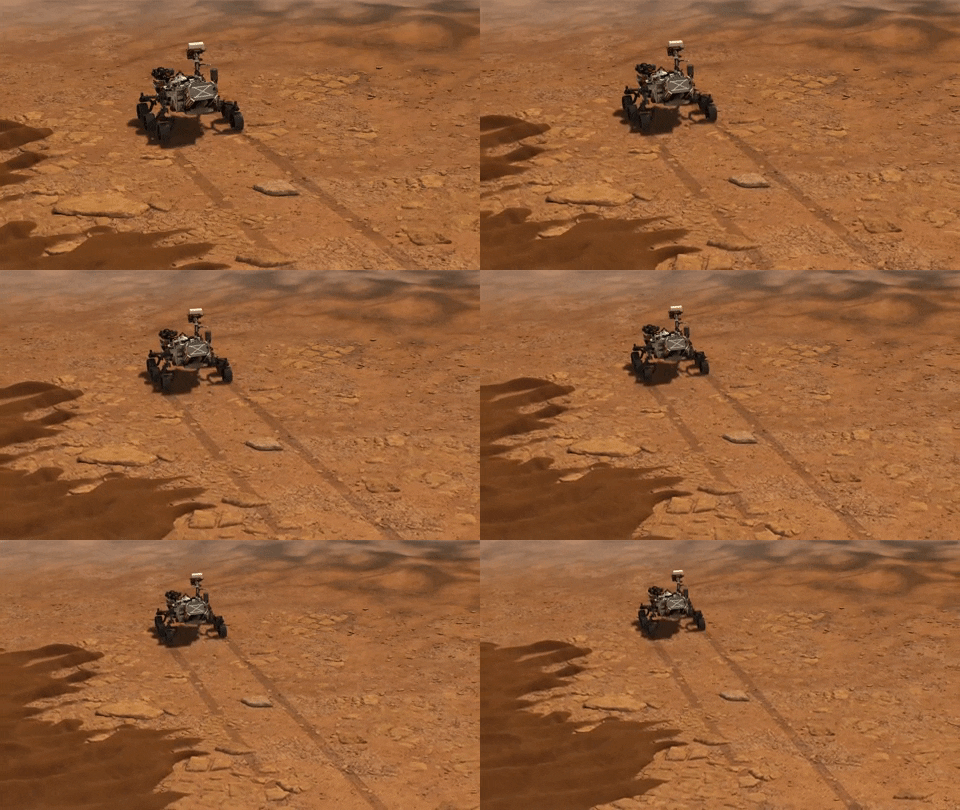
Mars Science Laboratory (MSL) or Curiosity rover. Animation Credits: NASA/JPL-Caltech

The team has decided to increase its wheel imaging to every 1,640 feet (500 meters) – a return to the original cadence. A traction control algorithm had slowed wheel wear enough to justify increasing the distance between imaging.

“We have proven through ground testing that we can safely drive on the wheel rims if necessary,” said Megan Lin, Curiosity’s project manager at JPL. “If we ever reached the point that a single wheel had broken a majority of its grousers, we could do a controlled break to shed the pieces that are left. Due to recent trends, it seems unlikely that we would need to take such action. The wheels are holding up well, providing the traction we need to continue our climb.”

For more information about Curiosity, visit:

https://mars.nasa.gov/msl/home/ and https://nasa.gov/curiosity

Images (mentioned), Animation (mentioned), Video (mentioned), Text, Credits: NASA/Tony Greicius/Karen Fox/Alana Johnson/JPL/Andrew Good.

Best regards, Orbiter.ch

CASIC - Kuaizhou-1A launches Tianxing-1


CASIC - China Aerospace Science and Industry Corporation logo.


June 22, 2022

Kuaizhou-1A carrying Tianxing-1 liftoff

A Kuaizhou-1A (KZ-1A) launch vehicle launched the Tianxing-1 test satellite from the Jiuquan Satellite Launch Center, Gansu Province, northwest China, on 22 June 2022, at 02:08 UTC (10:08 local time).

Kuaizhou-1A launches Tianxing-1

According to official sources, the Tianxing-1 experimental satellite (天行一号试验卫星) has successfully entered the predetermined orbit and will be “mainly used for experiments such as space environment detection”.

China Aerospace Science and Industry Corporation (CASIC): http://www.cccme.org.cn/shop/tools043/index.aspx

Image, Video, Text, Credits: CASIC/China Media Group(CMG)/China Central Television (CCTV)/SciNews/Orbiter.ch Aerospace/Roland Berga.

Greetings, Orbiter.ch