jeudi 6 avril 2023

Webb adds another ringed world with new image of Uranus


NASA / ESA - James Webb Space Telescope (JWST) patch.


April 6, 2023

Webb’s infrared image highlights the planet’s dramatic rings and dynamic atmosphere.

Zoomed-in image of Uranus

Following in the footsteps of the Neptune image released in 2022, the NASA/ESA/CSA James Webb Space Telescope has taken a stunning image of the Solar System’s other ice giant, the planet Uranus. The new image features dramatic rings as well as bright features in the planet’s atmosphere. The Webb data demonstrate the observatory’s unprecedented sensitivity by revealing the faintest dusty rings, which have only ever been imaged by two other facilities: the Voyager 2 spacecraft as it flew past the planet in 1986, and the Keck Observatory with advanced adaptive optics.

Zoomed-in image of Uranus (Annotated)

The seventh planet from the Sun, Uranus is unique: it rotates on its side, at a nearly 90-degree angle from the plane of its orbit. This causes extreme seasons since the planet’s poles experience many years of constant sunlight followed by an equal number of years of complete darkness. (Uranus takes 84 years to orbit the Sun.) Currently, it is late spring at the northern pole, which is visible here; Uranus’s northern summer will be in 2028. In contrast, when Voyager 2 visited Uranus it was summer at the south pole. The south pole is now on the ‘dark side’ of the planet, out of view and facing the darkness of space.

Wider view of the Uranian system

This infrared image from Webb’s Near-Infrared Camera (NIRCam) combines data from two filters at 1.4 and 3.0 microns, shown here in blue and orange, respectively. The planet displays a blue hue in the resulting representative-colour image.

When Voyager 2 looked at Uranus, its camera saw an almost featureless blue-green ball at visible wavelengths. At infrared wavelengths, and with Webb’s greater sensitivity, we see more detail, showing how dynamic the atmosphere of Uranus really is.

Wider view of the Uranian system (Annotated)

On the right side of the planet is an area of brightening at the pole facing the Sun, known as a polar cap. This polar cap is unique to Uranus — it seems to appear when the pole enters direct sunlight in the summer and vanishes in the autumn; these Webb data will help scientists understand the currently mysterious mechanism behind this feature. Webb has revealed a surprising aspect of the polar cap: a subtle enhanced brightening at the centre of the cap. The sensitivity of Webb’s NIRCam and the longer wavelengths it can see may explain why we can see this enhanced polar feature of Uranus when it has not been seen with other powerful telescopes like the NASA/ESA Hubble Space Telescope and the Keck Observatory.

At the edge of the polar cap lies a bright cloud and a few fainter extended features can be seen just beyond the cap’s edge; a second very bright cloud is seen at the planet’s left limb. Such clouds are typical for Uranus at infrared wavelengths, and are likely connected to storm activity.

This planet is characterised as an ice giant because of the chemical make-up of its interior. Most of its mass is thought to be a hot, dense fluid of ‘icy’ materials — water, methane and ammonia — above a small rocky core.

Webb shares new image of Uranus

Uranus has 13 known rings and 11 of them are visible in this Webb image. Some of these rings are so bright as seen by Webb that when they are close together, they appear to merge into a larger ring. Nine are classed as the main rings of the planet, and two are the fainter dusty rings (such as the diffuse zeta ring closest to the planet) that weren’t discovered until the 1986 flyby by Voyager 2. Scientists expect that future Webb images of Uranus will reveal the two faint outer rings that were discovered with Hubble during the 2007 ring-plane crossing.

Webb also captured many of Uranus’s 27 known moons (most of which are too small and faint to be seen here); the six brightest are identified in the wide-view image. This was only a short (12-minute) exposure image of Uranus with just two filters. It is just the tip of the iceberg of what Webb can do when observing this mysterious planet. Additional studies of Uranus are happening now, and more are planned in Webb’s first year of science operations.


James Webb Space Telescope (JWST). Animation Credit: ESA

More information

Webb is the largest, most powerful telescope ever launched into space. Under an international collaboration agreement, ESA provided the telescope’s launch service, using the Ariane 5 launch vehicle. Working with partners, ESA was responsible for the development and qualification of Ariane 5 adaptations for the Webb mission and for the procurement of the launch service by Arianespace. ESA also provided the workhorse spectrograph NIRSpec and 50% of the mid-infrared instrument MIRI, which was designed and built by a consortium of nationally funded European Institutes (The MIRI European Consortium) in partnership with JPL and the University of Arizona.

Webb is an international partnership between NASA, ESA and the Canadian Space Agency (CSA).

Links

ESA Webb Seeing Farther Interactive Brochure:
https://www.esa.int/About_Us/ESA_Publications/ESA_BR-348_Webb_Seeing_farther

Webb’s view of Neptune (September 2022): https://esawebb.org/news/weic2214/

Release on STScI website:
https://webbtelescope.org/contents/news-releases/2023/news-2023-117

Release on ESA website:
https://www.esa.int/Science_Exploration/Space_Science/Webb/Webb_scores_another_ringed_world_with_new_image_of_Uranus

Release on NASA website:
https://www.nasa.gov/feature/goddard/2023/nasa-s-webb-scores-another-ringed-world-with-new-image-of-uranus/

Webb’s Near-Infrared Camera (NIRCam):
https://esawebb.org/about/instruments/nircam-niriss/

ESA's Webbsite: https://esawebb.org/

Animation Credit: (mentioned), Images Credits: NASA, ESA, CSA, STScI, J. DePasquale (STScI)/Video Credits: NASA, ESA, CSA, STScI, J. DePasquale (STScI), N. Bartmann/Music: Stellardrone – The Belt of Orion/Text Credits: ESA/Webb/Bethany Downer/Ninja Menning.

Best regards, Orbiter.ch

Crewmates Relocate Soyuz MS-23 Crew Ship to New Docking Port


ROSCOSMOS - Soyuz MS-23 patch.


April 6, 2023

Soyuz Crew Ship Undocks for Short Ride to New Port

Image above: The Soyuz MS-23 crew ship slowly backs away from the station carrying three Expedition 69 crewmates to a new docking port. Image Credit: NASA TV.

The Soyuz MS-23, with Expedition 69 crew members Frank Rubio of NASA, and Roscosmos cosmonauts Sergey Prokopyev and Dmitri Petelin aboard, has undocked from the Poisk module on the space-facing side of the complex, and is on its way to redock to the Prichal module on the Earth-facing side of the outpost.

Crewmates Relocate Soyuz Crew Ship to New Docking Port

Image above: The Soyuz MS-23 crew ship with three Expedition 69 crewmates aboard is pictured shortly after docking to the Prichal docking module. Image Credit: NASA TV.

This was the 26th spacecraft relocation in space station history. The move makes room for the arrival of the uncrewed Roscosmos Progress 84 cargo spacecraft later this year and frees the Poisk airlock for the upcoming Roscosmos spacewalks in April and May.

Soyuz MS-23 relocation

Rubio, Prokopyev, and Petelin are scheduled to return to Earth aboard the Soyuz MS-23 spacecraft upon undocking Sept. 27.

Related article:

Expedition 69 Trio Preps for Soyuz Ride Around Station
https://orbiterchspacenews.blogspot.com/2023/04/expedition-69-trio-preps-for-soyuz-ride.html

Related links:

Expedition 69: https://www.nasa.gov/mission_pages/station/expeditions/expedition69/index.html

International Space Station (ISS): https://www.nasa.gov/mission_pages/station/main/index.html

Images (mentioned), Video, Text, Credits: NASA/Mark Garcia/NASA TV/SciNews.

Greetings, Orbiter.ch

mercredi 5 avril 2023

Expedition 69 Trio Preps for Soyuz Ride Around Station


ISS - Expedition 69 Mission patch.


April , 2023

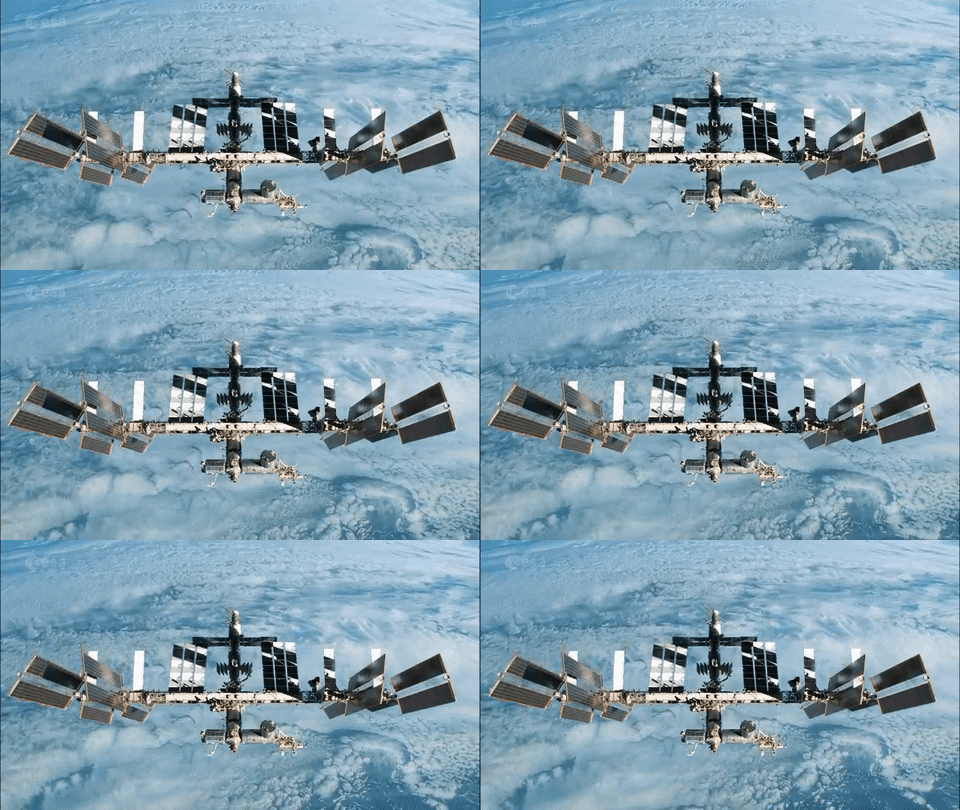
International Space Station (ISS). Animation Credit: ESA

Three Expedition 69 crew members had a short day on Wednesday and went to sleep early ahead of the relocation of their Soyuz crew ship on Thursday morning. The rest of the International Space Station crew had its hands full throughout the day conducting biology research and packing a cargo craft.

Two Roscosmos cosmonauts and a NASA astronaut will take a short ride around the space station inside the Soyuz MS-23 crew ship relocating it from the Poisk module to the Prichal docking module early Thursday. Commander Sergey Prokopyev will guide the MS-23 to its new docking port flanked by flight engineers Dmitri Petelin and Frank Rubio. The relocation opens up Poisk’s airlock for future Roscosmos spacewalks in Orlan spacesuits and frees its docking port for the upcoming ISS Progress 84 resupply mission.

Image above: (From left) NASA astronaut Frank Rubio and Roscosmos cosmonauts Sergey Prokopyev and Dmitri Petelin will take a short ride around the space station inside the Soyuz MS-23 crew ship. Image Credit: NASA.

The Soyuz vehicle with the three crewmates will undock from Poisk’s space-facing port at 4:45 a.m. EDT on Thursday, maneuver behind and under the space station, then dock to Prichal’s Earth-facing port at 5:23 a.m. After leak and pressure checks are performed, the trio will reenter the orbiting lab, and go to bed early before continuing their space research mission on Friday. NASA TV, on the agency’s app and website, begins its live coverage at 4:15 a.m. on Thursday.

A U.S. space freighter is being packed with cargo ahead of its departure and return to Earth later this month. Rubio and Flight Engineer Sultan Alneyadi of UAE (United Arab Emirates) have begun loading the SpaceX Dragon cargo craft with completed science experiments and used station hardware for retrieval and analysis by scientists and engineers on the ground. Dragon docked to the orbiting lab on March 16 packed with 6,200 pounds of research gear, crew supplies, and other cargo to replenish the station crew.

Image above: The Soyuz MS-23 spacecraft is seen approaching the Poisk module of the International Space Station prior to docking Feb. 25, 2023. Image Credit: NASA.

NASA Flight Engineers Stephen Bowen and Woody Hoburg spent their day on biology research to understand how the human body changes in space. Hundreds of investigations have taken place aboard the orbital outpost since Expedition One to gain increasing knowledge about how humans adapt to long-term weightlessness and learn more effective ways to counteract space-caused symptoms.

Roscosmos Flight Engineer Andrey Fedyaev participated in a pair of heart studies and a crew behavior experiment on Wednesday. The first-time space flyer first completed a 24-hour session that monitored his heart activity and blood pressure. Afterward, he attached sensors to himself for another study observing his blood circulation. In the afternoon, Fedyaev submitted his answers to a questionnaire to learn how international crews and mission controllers from around the world communicate. Fedyaev will also be up early on Thursday assisting and monitoring his crewmates during their Soyuz relocation maneuver.

Related article (NASA):

NASA TV Coverage Set for Crew to Move Soyuz Space Station Location
https://www.nasa.gov/press-release/nasa-tv-coverage-set-for-crew-to-move-soyuz-space-station-location

Related links:

NASA TV: https://www.nasa.gov/nasalive

Expedition One: https://www.nasa.gov/mission_pages/station/expeditions/expedition01/index.html

Expedition 69: https://www.nasa.gov/mission_pages/station/expeditions/expedition69/index.html

Prichal docking module: https://orbiterchspacenews.blogspot.com/2021/11/new-module-heads-to-station-during.html

Space Station Research and Technology: https://www.nasa.gov/mission_pages/station/research/overview.html

International Space Station (ISS): https://www.nasa.gov/mission_pages/station/main/index.html

Images (mentioned), Animation (mentioned), Text, Credits: NASA/Mark Garcia.

Best regards, Orbiter.ch

Hubble Unexpectedly Finds Double Quasar in Distant Universe


NASA / ESA - Hubble Space Telescope (HST) patch.


April 5, 2023

The early universe was a rambunctious place where galaxies often bumped into each other and even merged together. Using NASA's Hubble Space Telescope and other space and ground-based observatories, astronomers investigating these developments have made an unexpected and rare discovery: a pair of gravitationally bound quasars, both blazing away inside two merging galaxies. They existed when the universe was just 3 billion years old.

Quasars are bright objects powered by voracious, supermassive black holes blasting out ferocious fountains of energy as they engorge themselves on gas, dust, and anything else within their gravitational grasp.

"We don't see a lot of double quasars at this early time in the universe. And that's why this discovery is so exciting," said graduate student Yu-Ching Chen of the University of Illinois at Urbana-Champaign, lead author of this study.

Image above: This artist's concept shows the brilliant glare of two quasars residing in the cores of two galaxies that are in the chaotic process of merging. The gravitational tug-of-war between the two galaxies ignites a firestorm of star birth. Quasars are brilliant beacons of intense light from the centers of distant galaxies. They are powered by supermassive black holes voraciously feeding on infalling matter. This feeding frenzy unleashes a torrent of radiation that can outshine the collective light of billions of stars in the host galaxy. In a few tens of millions of years, the black holes and their galaxies will merge, and so will the quasar pair, forming an even more massive black hole. Image Credits: NASA, ESA, Joseph Olmsted (STScI).

Finding close binary quasars is a relatively new area of research that has just developed in the past 10 to 15 years. Today's powerful new observatories have allowed astronomers to identify instances where two quasars are active at the same time and are close enough that they will eventually merge.

There is increasing evidence that large galaxies are built up through mergers. Smaller systems come together to form bigger systems and ever larger structures. During that process there should be pairs of supermassive black holes formed within the merging galaxies. "Knowing about the progenitor population of black holes will eventually tell us about the emergence of supermassive black holes in the early universe, and how frequent those mergers could be," said Chen.

"We're starting to unveil this tip of the iceberg of the early binary quasar population," said Xin Liu of the University of Illinois at Urbana-Champaign. "This is the uniqueness of this study. It is actually telling us that this population exists, and now we have a method to identify double quasars that are separated by less than the size of a single galaxy."

This was a needle-in-haystack search that required the combined power of NASA's Hubble Space Telescope and the W.M. Keck Observatories in Hawaii. Multi-wavelength observations from the International Gemini Observatory in Hawaii, NSF's Karl G. Jansky Very Large Array in New Mexico, and NASA's Chandra X-ray Observatory also contributed to understanding the dynamic duo. And, ESA (European Space Agency)'s Gaia space observatory helped identify this double quasar in the first place.

"Hubble's sensitivity and resolution provided pictures that allow us to rule out other possibilities for what we are seeing," said Chen. Hubble shows, unequivocally, that this is indeed a genuine pair of supermassive black holes, rather than two images of the same quasar created by a foreground gravitational lens. And, Hubble shows a tidal feature from the merging of two galaxies, where gravity distorts the shape of the galaxies forming two tails of stars.

Image above: A Hubble Space Telescope photograph of a pair of quasars that existed when the universe was just 3 billion years old. They are embedded inside a pair of colliding galaxies. The quasars are separated by less than the size of a single galaxy. Quasars are powered by voracious, supermassive black holes blasting out ferocious fountains of energy as they engorge themselves on gas, dust, and anything else within their gravitational grasp. The black holes will eventually merge. Image Credits: NASA, ESA, Yu-Ching Chen (UIUC), Hsiang-Chih Hwang (IAS), Nadia Zakamska (JHU), Yue Shen (UIUC).

However, Hubble's sharp resolution alone isn't good enough to go looking for these dual light beacons. The researchers enlisted Gaia, which launched in 2013, to pinpoint potential double-quasar candidates. Gaia measures the positions, distances, and motions of nearby celestial objects very precisely. But in a novel technique, it can be used to explore the distant universe. Gaia's huge database can be used to search for quasars that mimic the apparent motion of nearby stars. The quasars appear as single objects in the Gaia data because they are so close together. However, Gaia can pick up a subtle, unexpected "jiggle" that mimics an apparent change in position of some of the quasars it observes.

In reality, the quasars aren't moving through space in any measurable way. Instead, their jiggle could be evidence of random fluctuations of light as each member of the quasar pair varies in brightness on timescales of days to months, depending on their black hole's feeding schedule. This alternating brightness between the quasar pair is similar to seeing a railroad crossing signal from a distance. As the lights on both sides of the stationary signal alternately flash, the sign gives the illusion of "jiggling."

Another challenge is that because gravity warps space like a funhouse mirror, a foreground galaxy could split the image of a distant quasar into two, creating the illusion it was really a binary pair. The Keck telescope was used to make sure there's no lensing galaxy in between us and the suspected double quasar.

Because Hubble peers into the distant past, this double quasar no longer exists. Over the intervening 10 billion years, their host galaxies have likely settled into a giant elliptical galaxy, like the ones seen in the local universe today. And, the quasars have merged to become a gargantuan, supermassive black hole at its center. The nearby giant elliptical galaxy, M87, has a monstrous black hole weighing 6.5 billion times the mass of our Sun. Perhaps this black hole was grown from one or more galaxy mergers over the past billions of years.

Hubble Space Telescope (HST)

The upcoming NASA Nancy Grace Roman Space Telescope, having the same visual acuity as Hubble, is ideal for binary quasar hunting. Hubble has been used to painstakingly take data for individual targets. But Roman's very wide-angle infrared view of the universe is 200 times larger than Hubble's. "A lot of quasars out there could be binary systems. The Roman telescope can do huge improvements in this research area," said Liu.

The results will be published in the April 5 journal Nature:
https://www.nature.com/articles/s41586-023-05766-6

The Hubble Space Telescope is a project of international cooperation between NASA and ESA. NASA's Goddard Space Flight Center in Greenbelt, Maryland, manages the telescope. The Space Telescope Science Institute (STScI) in Baltimore, Maryland, conducts Hubble and Webb science operations. STScI is operated for NASA by the Association of Universities for Research in Astronomy, in Washington, D.C.

Related links:

W.M. Keck Observatories: https://www.keckobservatory.org/

International Gemini Observatory: https://www.gemini.edu/

NSF's Karl G. Jansky Very Large Array: https://science.nrao.edu/facilities/vla

NASA's Chandra X-ray Observatory: https://www.nasa.gov/mission_pages/chandra/main/index.html

ESA's Gaia: https://www.esa.int/Science_Exploration/Space_Science/Gaia

NASA / ESA Hubble Space Telescope (HST): https://www.nasa.gov/mission_pages/hubble/main/index.html

Images (mentioned), Animation, Text, Credits: NASA/Andrea Gianopoulos/GSFC/Claire Andreoli/Space Telescope Science Institute/Ray Villard/University of Illinois Urbana-Champaign/Yu-Ching Chen and Xin Liu/ESA.

Greetings, Orbiter.ch

New Interactive Mosaic Uses NASA Imagery to Show Mars in Vivid Detail


NASA - Mars Reconnaissance Orbiter (MRO) patch.


April 5, 2023

Both scientists and the public can navigate a new global image of the Red Planet that was made at Caltech using data from NASA’s Mars Reconnaissance Orbiter.

Image above: The Global CTX Mosaic of Mars allows scientists and the public to explore the planet like never before. It includes different layers of data that can be turned on or off, like these labels for named geographic features on the planet. Image Credits: NASA/JPL-Caltech/MSSS.

Cliffsides, impact craters, and dust devil tracks are captured in mesmerizing detail in a new mosaic of the Red Planet composed of 110,000 images from NASA’s Mars Reconnaissance Orbiter (MRO). Taken by the veteran spacecraft’s black-and-white Context Camera, or CTX, the images cover nearly 270 square feet (25 square meters) of surface per pixel.

That makes the Global CTX Mosaic of Mars the highest-resolution global image of the Red Planet ever created. If it were printed out, this 5.7 trillion pixel (or 5.7 terapixel) mosaic would be large enough to cover the Rose Bowl Stadium in Pasadena, California.

The product of Caltech’s Bruce Murray Laboratory for Planetary Visualization, the mosaic took six years and tens of thousands of hours to develop. It is so detailed that more than 120 peer-reviewed science papers have already cited a beta version. But the mosaic is also easy enough for anyone to use.

Image above: The Mars Reconnaissance Orbiter’s Context Camera, which captured the 110,000 images that make up the interactive global mosaic, is especially useful for spotting impact craters like those seen here. Image Credits: NASA/JPL-Caltech/MSSS.

“I wanted something that would be accessible to everyone,” said Jay Dickson, the image processing scientist who led the project and manages the Murray Lab. “Schoolchildren can use this now. My mother, who just turned 78, can use this now. The goal is to lower the barriers for people who are interested in exploring Mars.”

CTX is among three cameras aboard MRO, which is led by NASA’s Jet Propulsion Laboratory in Southern California. One of those cameras, the High-Resolution Imaging Science Experiment (HiRISE) provides color images of surface features as small as a dining room table. In contrast, CTX provides a broader view of terrain around those features, helping scientists understand how they’re related. Its ability to capture larger expanses of the landscape has made CTX especially useful for spotting impact craters on the surface. A third camera, the Mars Color Imager (MARCI), led by the same team that operates CTX, produces a daily global map of Mars weather at much lower spatial resolution.

Image above: The new global mosaic, shown in a detail example at left, is stitched together from images taken by MRO’s Context Camera, which captures the Martian surface in long strips. The process is revealed in the image at right, showing how portions of CTX images were combined. Image Credits: NASA/JPL-Caltech/MSSS.

Mars Up Close

Snapping away since MRO arrived at Mars in 2006, CTX has documented nearly all of the Red Planet, making its images an optimal starting point for scientists when they’re creating a map. A bit like hunting for a needle in a haystack and putting together a puzzle at the same time, mapmaking requires downloading and sifting through a large selection of images to find those with the same lighting conditions and clear skies.

To create the new mosaic, Dickson developed an algorithm to match images based on the features they captured. He manually stitched together the remaining 13,000 images that the algorithm couldn’t match. The remaining gaps in the mosaic represent parts of Mars that hadn’t been imaged by CTX by the time Dickson started working on this project, or areas obscured by clouds or dust.

Laura Kerber, a Mars scientist at JPL, provided feedback on the new mosaic as it took shape. “I’ve wanted something like this for a long time,” Kerber said. “It’s both a beautiful product of art and also useful for science.”

Kerber recently used the image to visit her favorite spot on Mars: Medusae Fossae, a dusty region about the size of Mongolia. Scientists are unsure exactly how it formed; Kerber has proposed it might be a pile of ash from a nearby volcano. At the click of a button on the CTX mosaic, she can zoom in and admire ancient river channels, now dry, winding through the landscape there.

CTX mosaic: https://murray-lab.caltech.edu/CTX/V01/SceneView/MurrayLabCTXmosaic.html

The Global CTX Mosaic of Mars lets anyone with an internet connection browse the Red Planet. The buttons at the bottom let you jump to notable locations, like Gale Crater and Jezero Crater, areas being explored by NASA’s Curiosity and Perseverance rovers.

Users can also jump to regions like Gale Crater and Jezero Crater – areas being explored by NASA’s Curiosity and Perseverance rovers – or visit Olympus Mons, the tallest volcano in the solar system, adding topographic data from NASA’s Mars Global Surveyor mission. One of the mosaic’s coolest features highlights impact craters across the entire planet, allowing viewers to see just how scarred Mars is.

“For 17 years, MRO has been revealing Mars to us as no one had seen it before,” said the mission’s project scientist, Rich Zurek of JPL. “This mosaic is a wonderful new way to explore some of the imagery that we’ve collected.”

The mosaic was funded as part of NASA’s Planetary Data Archiving, Restoration and Tools (PDART) program, which helps develop new ways to use existing NASA data. The scientific products of extended missions like MRO are exactly what the program was designed to make more accessible.

More About MRO

Mars Reconnaissance Orbiter (MRO). Image Credits: NASA/JPL-Caltech

JPL manages MRO for NASA’s Science Mission Directorate in Washington. Caltech, in Pasadena, manages JPL for NASA. The University of Arizona, in Tucson, operates HiRISE, which was built by Ball Aerospace & Technologies Corp., in Boulder, Colorado. The Context Camera was built by, and is operated by, Malin Space Science Systems in San Diego.

Related links:

Global CTX Mosaic of Mars: https://murray-lab.caltech.edu/CTX/V01/SceneView/3dViewer.html

Caltech’s Bruce Murray Laboratory for Planetary Visualization:
https://murray-lab.caltech.edu/

High-Resolution Imaging Science Experiment (HiRISE): https://mars.nasa.gov/mro/mission/instruments/hirise/

Mars Color Imager (MARCI): https://mars.nasa.gov/mro/mission/instruments/marci/

Mars Reconnaissance Orbiter (MRO): http://www.nasa.gov/mission_pages/MRO/main/index.html

Mars: https://www.nasa.gov/topics/journeytomars/index.html

Jet Propulsion Laboratory (JPL): https://www.nasa.gov/centers/jpl/home/index.html

Images (mentioned), Text, Credits: NASA/Tony Greicius/Karen Fox/Alana Johnson/JPL/Andrew Good/Caltech/Robert Perkins.

Best regards, Orbiter.ch

How Juice was made ready for Jupiter


ESA - Juice Mission patch.


April 5, 2023

Deciding to go to Jupiter was the easy part: it’s by far the largest planet around the Sun, resembling a Solar System in its own right with its many moons, three of which may well be home to hidden oceans beneath their icy surfaces. Then came the practical question: how do we actually put together a mission to go there? It was here that ESA’s Directorate of Technology, Engineering and Quality lent its support to the Juice team, tackling numerous technical challenges that threatened to bar Europe’s way to the king of planets.

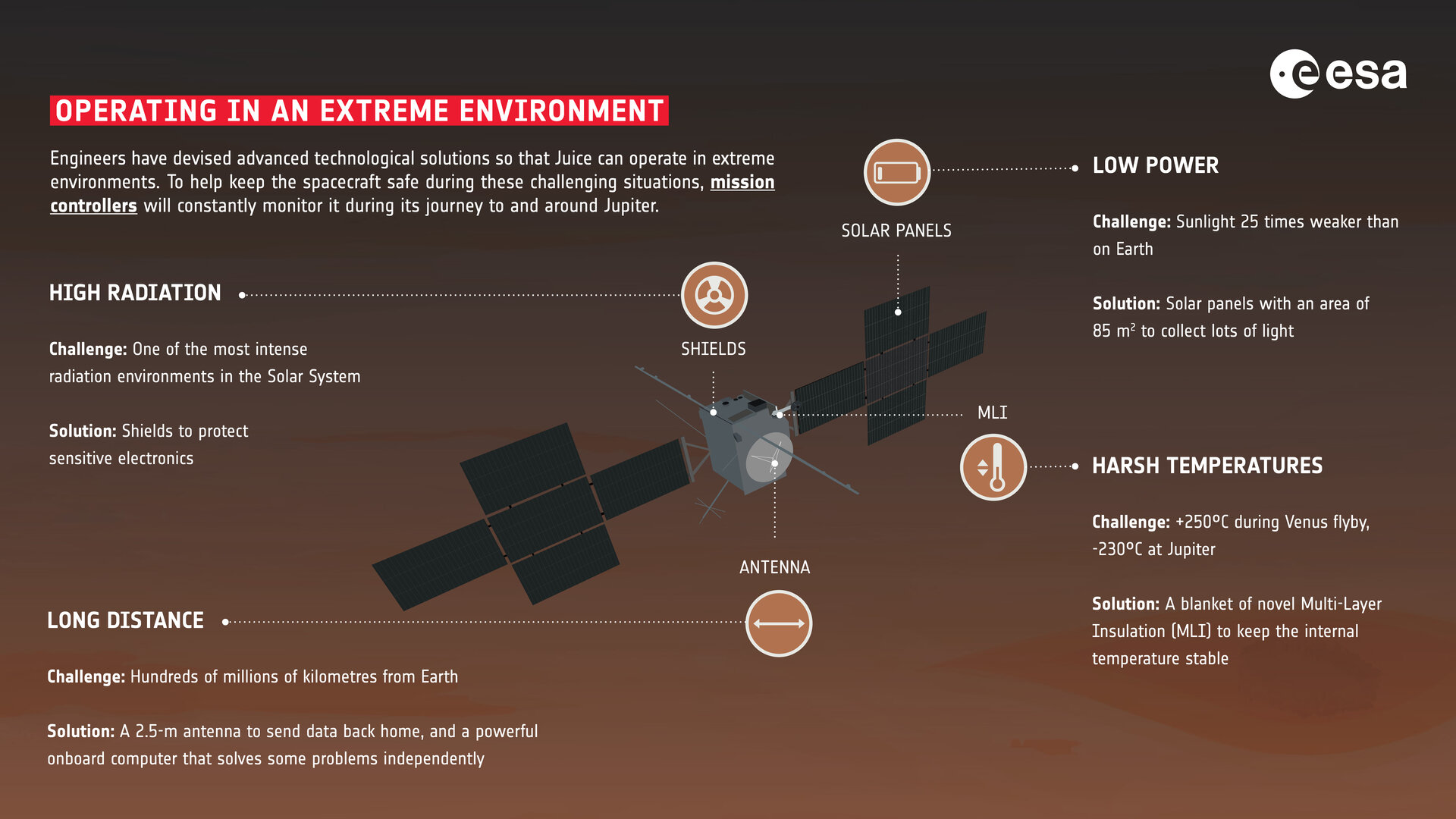
“When it comes to planning any new mission, you start by looking at the place it’s going to,” says Christian Erd, ESA’s Jupiter Icy Moons Explorer (Juice) spacecraft and system manager. “In the case of Jupiter, that’s very far away from the Sun, in relatively gloomy illumination, with a high level of radiation.”

Juice prepared for launch

Jupiter’s surrounding magnetic field forms the largest structure in the Solar System, nearly 15 times bigger than the Sun. If it were visible to the naked eye it would appear larger than the full Moon in the night sky. And, in the same way that Earth’s magnetosphere traps belts of radioactive particles – the Van Allen Belts – Jupiter has its own equivalent radiation belts around it, except these are thousands of times more intense than those surrounding our homeworld.

The most energetic parts of these radiation belts form effective no-go zones for either robotic or human explorers.

Jupiter's magnetosphere

Christian adds: “One of the first things we needed was a detailed radiation model for Jupiter, which could then serve as the basis of our mission requirements and analysis. This was where ESA’s Space Environment and Effects section came in, creating what became known as the the ‘Jovian Specification Environment’ or JOSE model.

“A key achievement of this model for us was to show that what at first seemed to be a dangerous place was not completely out of reach. Around three and a half years at Jupiter will involve the equivalent radiation exposure of a telecommunications satellite in geostationary Earth orbit for 20 years – which we have plenty of experience in managing.”

Sealing one of Juice's lead-lined vaults

“Once we had that model, we could move towards implementation, planning orbital trajectories to minimise radiation doses, setting rad-hard requirements for payloads and subsystems, and plan the testing of candidate components.”

Sensitive electronics are protected inside a pair of lead-lined vaults within the body of the Juice spacecraft, whose mission trajectory has been set out with survivability in mind. So for example, Juice will fly past 21 Callisto times, and end up in orbit around Ganymede, but will only fly past Europa twice, because this icy moon orbits closest to Jupiter and its halo of radiation. Even so, these two flybys will cause Juice to sustain around a third of its overall radiation exposure in one go.

Power in a cold, dark place

Operating in an extreme environment

Another priority was to investigate if Juice could receive adequate solar power out at Jupiter – an average 778 million km from Earth, receiving just 3% of the solar illumination available at Earth orbit. The projected operating temperature of the solar arrays will drop as low as 30 degrees from absolute zero at points when the arrays are coming out of an eclipse state.

ESA’s Rosetta spacecraft ventured out to an equivalent distance during its mission to rendezvous with a comet, but had to enter a 31-month hibernation phase before reaching its target.

The good news was that solar cell technology had moved on a generation since then, but ESA’s Solar Generators section still needed to tailor today’s state-of-the-art gallium arsenide triple-junction cells (actually three layers of cells working together) would operate in Jupiter’s cold darkness.

Juice solar panels

Juice will fly 10 instruments in all, ranging from optical and radar observation through to magnetic and plasma sampling, so that lorry-sized spacecraft bristles with booms and antennas.  

That threw up another challenge – to ensure that the spacecraft itself remained as ‘clean’ as possible in magnetic and plasma terms, to be sure that Juice’s instruments are actually gathering data on Jupiter space, rather than perturbations from the spacecraft hosting them.

Unstoppable software

Once Juice is at Jupiter it will have to be self-reliant like few European missions before it. “It will take about 45 minutes to send a one-way signal to Juice, so if something goes wrong we cannot recover it in anything like real time,” adds Christian.

Magnetic testing of Juice spacecraft

“In particular we have two pivotal orbital insertion manoeuvres – first to enter Jupiter’s orbit and then to orbit Ganymede in turn – which absolutely have to happen as planned.”

The concern of the Juice team: what if something goes wrong? When a standard mission experiences sufficient system failures then it enters ‘safe mode’, switching into a secure fall-back mode where it waits for a restart from the ground.

Juice encounters Ganymede

This will not be an option during Juice’s orbital insertion phases, since any interruption could lead to mission loss. So ESA’s Flight Software Systems section worked on a ‘Failure, Detection, Isolation and Recovery’ strategy based on a hierarchical approach, trying wherever possible to achieve a local or subsystem reconfiguration limited to the area having trouble.

Jorge Lopez Trescastro of ESA’s Flight Software Systems Section explains: “Only when this fails to solve a faulty situation would the spacecraft go into safe mode. This is called ‘fail-operational behaviour’ - meaning that a single failure should not interrupt the main engine or thruster firings. And if going into safe mode ends up being unavoidable, then the spacecraft should still be capable of resuming its critical manoeuvres autonomously.”

Safe mode and how to avoid it

Juice is also able to switch automatically between nominal and redundant units to avoid switching into safe mode – for instance if the gyroscopes used to measure spacecraft attitude go out of action for any reason, then the spare gyroscopes can begin operations within 20 seconds – considered the maximum time that the spacecraft can go without such vital inputs. During crucial mission phases the redundant units will be kept ‘warm’ – ready to activate – to facilitate such a speedy switch.

The same approach is also being taken for other key systems during these phases, such as the antenna pointing, solar array drive mechanism, star trackers used for navigation and reaction wheels, employed to change attitude. In the event both sets of reaction wheels fail, then the spacecraft would switch to using thrusters in their place.

Juice in orbit around Ganymede

Finally, the mission has not one safe mode but would switch into multiple safe mode configurations keeping different units active, to try and avoid a total shut down. A full Juice safe mode would trigger a reboot of the mission’s Command and Data Management Unit - the spacecraft’s main computer and mass memory.  

The software would then use a minimum of context data for its configuration: its main antenna would attempt to pick up the signal from Earth while also applying its star trackers to orient itself, to try and speed up its return to nominal functioning.

Coming next?

Juice’s legacy

The full range of ESA Directorate of Technology, Engineering and Quality contributions to Juice ranged from components shielding to atomic oxygen countermeasures, onboard data processing to customising the SpaceWire interface linking instruments and subsystems.

Juice will become ESA’s reference mission for deep space, just as Rosetta was before it, serving as a starting point for planning still more ambitious future efforts headed further into the outer Solar System.

Related links:

Watch The Making of Juice video series: https://www.esa.int/ESA_Multimedia/Sets/The_making_of_JUICE/(result_type)/videos

ESA’s Directorate of Technology, Engineering and Quality: https://technology.esa.int/

JOSE model: https://www.spenvis.oma.be/help/background/planetary/traprad_jup.html

SpaceWire: https://www.esa.int/Enabling_Support/Space_Engineering_Technology/Onboard_Computers_and_Data_Handling/SpaceWire

ESA’s Jupiter Icy Moons Explorer (Juice): https://www.esa.int/Science_Exploration/Space_Science/Juice

Images, Animation, Text, Credits: ESA/ATG Medialab/CNES/Arianespace/Optique video du CSG – P. Baudon/Airbus Defence and Space Netherlands.

Greetings, Orbiter.ch

mardi 4 avril 2023

Crew Health Checks, Space Physics Top Tuesday Research Schedule


ISS - Expedition 69 Mission patch.


April 4, 2023

Human research activities dominated the Expedition 69 crew’s schedule aboard the International Space Station on Tuesday with ultrasound scans, vision checks, and hearing exams. Space physics also rounded out the science schedule while the orbital residents also continued ongoing cargo and maintenance operations.

Living long-term in weightlessness is suspected of increasing cardiovascular health risks such as aging-like symptoms in blood vessels observed in astronauts on previous missions. Researchers regularly evaluate the health of station crew members to gain insights into space-caused and Earth-bound heart conditions. NASA Flight Engineer Stephen Bowen contributed to that research on Tuesday attaching electrodes to himself and marking his neck, leg, and heart veins for the Vascular Aging investigation. He then scanned his veins using an ultrasound device and measured his blood pressure with inputs from doctors on the ground.

Image above: Astronaut Sultan Alneyadi receives a haircut from astronaut Frank Rubio aboard the space station with a hair trimmer containing a suction device collecting loose hair. Image Credit: NASA.

Bowen then swapped roles as Crew Medical Officer with flight engineers Frank Rubio of NASA and Dmitri Petelin of Roscosmos for eye checks during the afternoon. The trio took turns imaging the eyes of fellow crewmates Woody Hoburg of NASA, Sultan Alneyadi of UAE (United Arab Emirates), and Sergey Prokopyev of Roscosmos using standard medical imaging gear found in an optometrist’s office on Earth. Additionally, Prokopyev, who is also commander of the orbiting lab, and Petelin participated in a hearing test to evaluate the condition of their ear drums.

Space physics is also a key research topic as scientists and engineers learn how Earth-created materials react to the microgravity environment under a variety of conditions. Observations may advance the design and safety of spacecraft and space habitats as well as improve a host of ground-based industries and products.

International Space Station (ISS). Animation Credit: NASA

Rubio and Hoburg worked on a pair of different physics experiments on Tuesday, one exploring extreme temperatures and the other foams and emulsions. Rubio serviced samples inside the Electrostatic Levitation Furnace, a research device that safely investigates the thermophysical properties of high temperature phenomena using a containerless, levitation technique. Hoburg studied the dispersion of bubbles and droplets in liquids for the Foams and Emulsions experiment using a specialized microscope that uses fluorescence imagery analysis.

Alneyadi focused mainly on cargo work continuing to offload some of the 6,200 pounds of new science experiments, crew supplies, and station hardware delivered March 16 aboard the SpaceX Dragon resupply ship. Roscosmos Flight Engineer Andrey Fedyaev worked on life support maintenance before supporting Petelin during a cardiac research study.

Related article (NASA):

NASA TV Coverage Set for Crew to Move Soyuz Space Station Location
https://www.nasa.gov/press-release/nasa-tv-coverage-set-for-crew-to-move-soyuz-space-station-location

Related links:

Expedition 69: https://www.nasa.gov/mission_pages/station/expeditions/expedition69/index.html

Vascular Aging: https://www.nasa.gov/mission_pages/station/research/experiments/explorer/Investigation.html?#id=7644

Electrostatic Levitation Furnace: https://www.nasa.gov/mission_pages/station/research/experiments/explorer/Facility.html?#id=1536

Foams and Emulsions: https://www.nasa.gov/mission_pages/station/research/experiments/explorer/Investigation.html?#id=8455

Specialized microscope: https://www.nasa.gov/mission_pages/station/research/experiments/explorer/Facility.html?#id=8120

Space Station Research and Technology: https://www.nasa.gov/mission_pages/station/research/overview.html

International Space Station (ISS): https://www.nasa.gov/mission_pages/station/main/index.html

Image (mentioned), Animation (mentioned), Text, Credits: NASA/Mark Garcia.

Greetings, Orbiter.ch