mercredi 7 avril 2021

SpaceX Starlink 24 launch


SpaceX - Falcon 9 / Starlink Mission patch.


April 7, 2021

SpaceX Starlink 24 launch

A SpaceX Falcon 9 rocket launched 60 Starlink satellites (Starlink-24) from Space Launch Complex 40 (SLC-40) at Cape Canaveral Space Force Station, Florida, on 7 April 2021, at 16:34 UTC (12:34 EDT).

SpaceX Starlink 24 launch & Falcon 9 first stage landing, 7 April 2021

Following stage separation, Falcon 9’s first stage landed on the “Of Course I Still Love You” droneship, stationed in the Atlantic Ocean. Falcon 9’s first stage (B1058) previously supported six missions: Demo-2, ANASIS-II, CRS-21, Transporter-1 and two Starlink mission.

Related links:

SpaceX: https://www.spacex.com/

Starlink: https://www.starlink.com/
 
Image, Video, Text, Credits: SpaceX/SciNews/Orbiter.ch Aerospace/Roland Berga.

Greetings, Orbiter.ch

Exodus of civilization into space - Biological End of the World. Part 4


Species extinctions logo.


April 7, 2021

Preamble

Here the fourth article of a series of articles by Ph.D. Morozov Sergey Lvovich, expert in chronology and calendar systems, as well as space biology and medicine, Parliamentarian of Asgardia (AMP) the first space Nation.

Ph.D. Morozov Sergey Lvovich

Biological End of the World (Species extinctions)

Fossilized dinosaur eggs

Earlier, we considered the relationship of climatic periods on Earth with the survival of the species Homo Sapiens and showed the primary influence of Milankovitch cycles on natural selection.

In total, in the history of our planet, as a result of "natural selection", there are 5 massive changes of flora and fauna.

1. Ordovician-Silurian - death of invertebrates, 450 million BC
2. Devonian - death of marine animals, 370 million years BC
3. Permian - death of sea and land animals, 250 million years BC
4. Triassic - death of archosaurs, 200 million years BC
5. Cretaceous-Paleogene I - death of dinosaurs, 65 million years BC

Photo by Mike Beauregard. Royal Tyrrell Museum of Paleontology. Canada

Currently, according to the author, civilization is in transition to the sixth mass change of flora and fauna:

6. Cretaceous-Paleogene II - (?) The beginning of the death of human civilization, 2020 AD.

What species will replace humanity on Earth? We run the risk of never knowing the answer to this question, if we do not timely move the human civilization of our time to Space.

Coming soon to read the continuation of the cycle "The Exodus of Civilization into Space".

Related articles:

Exodus of civilization into space - Geochronological Ice Ages, periods, eras. Part 3
https://orbiterchspacenews.blogspot.com/2021/04/exodus-of-civilization-into-space_5.html

Exodus of civilization into space - Astrophysical End of the World. Part 2
https://orbiterchspacenews.blogspot.com/2021/04/exodus-of-civilization-into-space.html

The ideology of space expansion - Space calendar. Part 1
https://orbiterchspacenews.blogspot.com/2021/03/the-ideology-of-space-expansion-space.html

Related links:

About Ph.D. Morozov Sergey Lvovich: https://zen.yandex.ru/media/id/5fbb90753e3ad265054f930a/ob-avtore-kanala-5fbd2bf80b4af80149fb12c2

Original article in Russian on Zen.Yandex:
https://zen.yandex.ru/media/id/5fbb90753e3ad265054f930a/ishod-civilizacii-v-kosmos-chast-4--biologicheskii-konec-sveta-5fc60e00e8c5ae189c33e90d

Asgardia website: https://asgardia.space/

Author: Ph.D. Morozov Sergey Lvovich / Zen.Yandex. Editor / Translation: Roland Berga. 

Best regards, Orbiter.ch

Station Readies for Expanded Crew as Science Stays in Focus


ISS - Expedition 64 Mission patch.


April 7, 2021

The Expedition 64 crew is getting ready to welcome three new crew members who are due to launch on Friday to the International Space Station. Meanwhile, a variety of space research activities are underway aboard the orbiting lab today.

One NASA astronaut and two Roscosmos cosmonauts are in final preparations for their liftoff on a Soyuz rocket set for Friday at 3:42 a.m. EDT. Flight Engineers Mark Vande Hei and Pyotr Dubrov will flank Soyuz Commander Oleg Novitskiy for the short trip to the station inside the new Soyuz MS-18 crew ship.


Image above: A waning gibbous Moon is pictured above the Earth’s horizon as the space station orbited 269 miles above the Atlantic Ocean. Image Credit: NASA.

Docking of the new Expedition 65 trio to the Rassvet module is planned for 7:07 a.m. The crew will open the hatch after leak and pressure checks and enter the station about 9 a.m. A welcoming ceremony with the expanded 10-person crew along with participants on the ground will occur shortly afterward. NASA TV will broadcast the launch and docking activities beginning at 2:45 a.m.

NASA Flight Engineers Michael Hopkins, Victor Glover and Shannon Walker are busy readying the station to temporarily accommodate the new crew members. The trio is setting up extra sleep stations for this month’s crew swaps when there will be as many as 11 people occupying the space station.

International Space Station (ISS). Animation Credit: ESA

Biomedical studies, or human research, is always ongoing aboard the station. Saliva and blood sample collections were the first tasks of the day for Hopkins, Roscosmos Flight Engineer Sergey Kud-Sverchkov and station Commander Sergey Ryzhikov. Glover scanned his own neck, leg and cardiac veins with an ultrasound device then checked his blood pressure for the Vascular Aging study.

NASA Flight Engineer Kate Rubins installed the new TangoLab-2 biology research hardware, delivered in February aboard the Cygnus space freighter, inside the U.S. Destiny laboratory module. Japanese astronaut Soichi Noguchi readied a materials space exposure study for placement outside the Kibo laboratory module.

Related links:

Expedition 64: https://www.nasa.gov/mission_pages/station/expeditions/expedition64/index.html

Expedition 65: https://www.nasa.gov/mission_pages/station/expeditions/expedition65/index.html

NASA TV: https://www.nasa.gov/nasatv

Rassvet module: https://www.nasa.gov/mission_pages/station/structure/elements/rassvet

Saliva and blood sample: https://www.nasa.gov/mission_pages/station/research/experiments/explorer/Investigation.html?#id=7711

https://www.energia.ru/en/iss/researches/human/22.html

Vascular Aging: https://www.nasa.gov/mission_pages/station/research/experiments/explorer/Investigation.html?#id=7644

TangoLab-2: https://www.nasa.gov/mission_pages/station/research/experiments/explorer/Facility.html?#id=7519

U.S. Destiny laboratory module: https://www.nasa.gov/mission_pages/station/structure/elements/us-destiny-laboratory

Materials space exposure study: https://www.nasa.gov/mission_pages/station/research/experiments/explorer/Investigation.html?#id=8349

Kibo laboratory module: https://www.nasa.gov/mission_pages/station/structure/elements/japan-kibo-laboratory

Space Station Research and Technology: https://www.nasa.gov/mission_pages/station/research/overview.html

International Space Station (ISS): https://www.nasa.gov/mission_pages/station/main/index.html

Image (mentioned), Animation (mentioned), Text, Credits: NASA/Mark Garcia.

Greetings, Orbiter.ch

Say Cheese on Mars: Perseverance’s Selfie With Ingenuity


NASA - Mars 2020 Perseverance Rover Mission logo.


Apr 7, 2021

NASA’s newest Mars rover used a camera on the end of its robotic arm to snap this shot of itself with the Ingenuity helicopter nearby.


Image above: NASA’s Perseverance Mars rover took a selfie with the Ingenuity helicopter, seen here about 13 feet (3.9 meters) from the rover. This image was taken by the WASTON camera on the rover’s robotic arm on April 6, 2021, the 46th Martian day, or sol, of the mission. Image Credits: NASA/JPL-Caltech/MSSS.

NASA’s Perseverance Mars rover took a selfie with the Ingenuity helicopter, seen here about 13 feet (4 meters) away in this image from April 6, 2021, the 46th Martian day, or sol, of the mission. Perseverance captured the image using a camera called WATSON (Wide Angle Topographic Sensor for Operations and eNgineering), part of the SHERLOC (Scanning Habitable Environments with Raman and Luminescence for Organics and Chemicals) instrument, located at the end of the rover’s robotic arm.

Perseverance’s selfie with Ingenuity was stitched together from 62 individual images taken while the rover was looking at the helicopter, then again while it was looking at the WATSON camera. Videos explaining how NASA’s Perseverance and Curiosity rovers take their selfies can be found here:

https://mars.nasa.gov/news/8631/nasas-curiosity-mars-rover-takes-a-new-selfie-before-record-climb/?site=msl

Once the team is ready to attempt the first flight, Perseverance will receive and relay to Ingenuity the final flight instructions from JPL mission controllers. Several factors will determine the precise time for the flight, including modeling of local wind patterns informed by measurements taken by the MEDA (Mars Environmental Dynamics Analyzer) instrument aboard Perseverance. Ingenuity will run its rotors to 2,537 rpm and, if all final self-checks look good, lift off. After climbing at a rate of about 3 feet per second (1 meter per second), the helicopter will hover at 10 feet (3 meters) above the surface for up to 30 seconds. Then, Ingenuity will descend and touch back down on the Martian surface.

Mars Perseverance Rover rolls back after dropping Ingenuity helicopter. Animation Credits: NASA/JPL

Several hours after the first flight has occurred, Perseverance will downlink Ingenuity’s first set of engineering data and, possibly, images and video from the rover’s Navigation Cameras and Mastcam-Z, a pair of zoomable cameras. From the data downlinked that first evening after the flight, the Ingenuity team expects to be able to determine if its first attempt to fly at Mars was a success. Flight test results will be discussed by the Ingenuity team in a media conference that same day.

NASA’s Jet Propulsion Laboratory built and manages operations of Perseverance and Ingenuity for the agency. Caltech in Pasadena, California, manages JPL for NASA. WATSON was built by Malin Space Science Systems (MSSS) in San Diego, and is operated jointly by MSSS and JPL.


Image above: NASA’s Ingenuity Mars helicopter is seen in a close-up taken by Mastcam-Z, a pair of zoomable cameras aboard the Perseverance rover. This image was taken on April 5, 2021, the 45th Martian day, or sol, of the mission. Image Credits: NASA/JPL-Caltech/ASU.

The Mars helicopter technology demonstration activity is supported by NASA's Science Mission Directorate, Aeronautics Research Mission Directorate, and Space Technology Mission Directorate.

A key objective for Perseverance’s mission on Mars is astrobiology, including the search for signs of ancient microbial life. The rover will characterize the planet's geology and past climate, pave the way for human exploration of the Red Planet, and be the first mission to collect and cache Martian rock and regolith (broken rock and dust).

Subsequent NASA missions, in cooperation with ESA (European Space Agency), would send spacecraft to Mars to collect these sealed samples from the surface and return them to Earth for in-depth analysis.

The Mars 2020 Perseverance mission is part of NASA’s Moon to Mars exploration approach, which includes Artemis missions to the Moon that will help prepare for human exploration of the Red Planet.

Related links:

Scanning Habitable Environments with Raman and Luminescence for Organics and Chemicals (SHERLOC): https://mars.nasa.gov/news/8678/the-detective-aboard-nasas-perseverance-rover/

Mars Environmental Dynamics Analyzer (MEDA): https://www.jpl.nasa.gov/news/mars-is-getting-a-new-robotic-meteorologist

For more about Perseverance: http://www.nasa.gov/perseverance

For more about Ingenuity: https://mars.nasa.gov/technology/helicopter/

Images (mentioned), Animation (mentioned), Text, Credits: NASA/Naomi Hartono/Karen Fox/Alana Johnson/JPL/Andrew Good.

Best regards, Orbiter.ch

NASA’s Odyssey Orbiter Marks 20 Historic Years of Mapping Mars


NASA - 2001 Mars Odyssey Mission patch.


Apr 7, 2021

For two decades, the longest-lived spacecraft at the Red Planet has helped locate water ice, assess landing sites, and study the planet’s mysterious moons.

2001 Mars Odyssey spacecraft. Animation Credits: NASA/JPL

NASA’s 2001 Mars Odyssey spacecraft launched 20 years ago on April 7, making it the oldest spacecraft still working at the Red Planet. The orbiter, which takes its name from Arthur C. Clarke’s classic sci-fi novel “2001: A Space Odyssey” (Clarke blessed its use before launch), was sent to map the composition of the Martian surface, providing a window to the past so scientists could piece together how the planet evolved.

But it’s done far more than that, uncovering troves of water ice, serving as a crucial communications link for other spacecraft, and helping to pave the way not just for safer landings but also future astronauts.

Here’s a partial list of Odyssey’s many accomplishments:


Image above: At 11:02 a.m. EDT on April 7, 2001, crowds watch a Boeing Delta II rocket lift off from Cape Canaveral Air Force Station, Florida, carrying NASA's 2001 Mars Odyssey spacecraft into space on its seven-month journey to Mars. Image Credit: NASA.

Mapping Martian Ice

Odyssey’s two decades of data have been a boon for researchers working to determine where water ice is locked up on the planet. Understanding the water cycle on Mars – a planet that was once much wetter, like Earth – offers insights into the way it has changed over time: How does water move around the planet today? Does the tilt of the planet affect where ice is stable? Odyssey’s discoveries have helped chip away at those questions.

“Before Odyssey, we didn’t know where this water was stored on the planet,” said Project Scientist Jeffrey Plaut of NASA’s Jet Propulsion Laboratory in Southern California, which leads the Odyssey mission. “We detected it for the first time from orbit and later confirmed it was there using the Phoenix lander.”

Stores of water ice are also needed to help astronauts survive on Mars and to provide fuel for their spacecraft. (In fact, astronauts were the focus of an instrument aboard Odyssey that measured how much space radiation they would have to contend with before it stopped working in 2003.) The orbiter finds the water ice using its gamma-ray spectrometer (GRS) detector, which has proven to be a capable hunter of near-surface hydrogen – a proxy for water ice. The GRS measures the amount of different elements on the Martian surface and also serves as a node in NASA’s interplanetary gamma-ray burst (GRB) detection network, which identifies source locations of GRB’s for follow-up astronomical observations.


Image above: Six views of the Martian moon Phobos captured by THEMIS as of March 2020. The camera measures surface temperature day and night. Studying each moon’s thermophysics helps scientists determine the properties of materials on their surfaces, just as they did for the Martian surface. Image Credits: NASA/JPL-Caltech/ASU/NAU.

What Mars Is Made Of

Look at almost any mapping study of the Martian surface, and it probably includes Odyssey data. For many years, the most complete global maps of Mars were made using Odyssey’s infrared camera, called the Thermal Emission Imaging System, or THEMIS. The camera measures the surface temperature day and night, allowing scientists to determine what physical materials, such as rock, sand, or dust, exist. Its data reveals the presence of these materials based on how they heat up or cool down over the course of a Martian day.

The net effect of two decades’ worth of all that mapping? Scientists haven’t just used the data to map valley networks and craters, they’ve also been able to spot sandstone, iron-rich rocks, salts, and more – findings that help lend deeper insight to Mars’ story. “It’s hard to overstate how the THEMIS global map has filled gaps in our knowledge,” said Laura Kerber of JPL, Odyssey’s deputy project scientist.


Image above: Pictures taken between 2002 and 2004 by Odyssey’s THEMIS imager up this wind-sculpted sea of dark dunes that covers an area as big as Texas at Mars’ northern polar cap. In this enhanced-color image, cooler areas have in bluer tints, while warmer features are depicted in yellows and oranges. Image Credits: NASA/JPL-Caltech/ASU.

Safer Landings

THEMIS has sent back more than 1 million images since it began circling Mars. The images and maps it’s produced highlight the presence of hazards, such as topographic features and boulders, but they also help ensure the safety of future astronauts by showing the location of resources such as water ice. This aids the Mars science community and NASA in deciding where to send landers and rovers – including the Perseverance rover, which touched down on Feb. 18, 2021.


Image above: This THEMIS image shows a double-bowl crater. If a meteorite breaks in two shortly before hitting the surface, the typical bowl shape of a single impact crater gains a twin. The two circular blast regions intersect, creating a straight wall separating the pair of craters, while “wings” of ejected debris shoot out to the side. The image covers an area 8 miles (13 kilometers) wide. Image Credits: NASA/JPL-Caltech/ASU.

Routine Calls Home

From early on, Odyssey has served as a long-distance call center for NASA’s rovers and landers, sending their data back to Earth as part of the Mars Relay Network. The idea of Mars relay goes back to the 1970’s, when the two Viking landers sent science data and images through an orbiter back to Earth. An orbiter can carry radios or antennas capable of sending back more data than a surface spacecraft. But Odyssey made the process routine when it began conveying data to and from NASA’s Spirit and Opportunity rovers.

“When the twin rovers landed, the success of relaying data using UHF frequency was a gamechanger,” said Chris Potts of JPL, Odyssey’s mission manager.

Each day, the rovers could go somewhere new and send fresh images back to Earth. Through a relay like Odyssey, scientists got more data sooner, while the public got more Mars images to be excited over. Odyssey has supported over 18,000 relay sessions. These days, it shares the communications task with NASA’s Mars Reconnaissance Orbiter and MAVEN, along with the ESA (European Space Agency) Trace Gas Orbiter.

Candy-Colored Moons

Odyssey has done such a thorough job of studying the Martian surface that scientists have started turning its THEMIS camera to capture unique views of Mars’ moons Phobos and Deimos. As with the Martian surface, studying each moon’s thermophysics helps scientists determine the properties of materials on their surfaces. Such information can offer glimmers into their past: It’s unclear whether the moons are captured asteroids or chunks of Mars, blasted off the surface by an ancient impact.

Future missions, like the Japanese Space Agency’s Martian Moons eXploration (MMX) spacecraft, will seek to land on these moons. In the distant future, missions might even create bases on them for astronauts. And if they do, they’ll rely on data from an orbiter that began its odyssey at the start of the millennium.

THEMIS was built and is operated by Arizona State University in Tempe. Odyssey's Gamma Ray Spectrometer was provided by the University of Arizona, Tucson, Los Alamos National Laboratory, and the Russian Space Research Institute. The prime contractor for the Odyssey project, Lockheed Martin Space in Denver, developed and built the orbiter. Mission operations are conducted jointly from Lockheed Martin and from JPL, a division of Caltech in Pasadena.

For more about Odyssey, visit:

https://mars.nasa.gov/odyssey/

https://www.nasa.gov/mission_pages/odyssey/index.html

NASA’s interplanetary gamma-ray burst (GRB) detection network: https://heasarc.gsfc.nasa.gov/docs/heasarc/missions/ipn.html

Images (mentioned), Animation (mentioned), Text, Credits: NASA/Naomi Hartono/Karen Fox/Alana Johnson/JPL/Andrew Good.

Greetings, Orbiter.ch

Trio of Fast-Spinning Brown Dwarfs May Reveal a Rotational Speed Limit


NASA - Spitzer Space Telescope patch.


Apr 7, 2021

Brown dwarfs, sometimes known as “failed stars,” can spin at upwards of 200,000 mph, but there may be a limit to how fast they can go.


Image above: The faster a brown dwarf spins, the narrower the different-colored atmospheric bands on it likely become, as shown in this illustration. Some brown dwarfs glow in visible light, but they are typically brightest in infrared wavelengths, which are longer than what human eyes can see. Image Credits: NASA/JPL-Caltech.

Using data from NASA’s Spitzer Space Telescope, scientists have identified the three fastest-spinning brown dwarfs ever found. More massive than most planets but not quite heavy enough to ignite like stars, brown dwarfs are cosmic in-betweeners. And though they aren’t as well known as stars and planets to most people, they are thought to number in the billions in our galaxy.

In a study appearing in the Astronomical Journal, the team that made the new speed measurements argue that these three rapid rotators could be approaching a spin speed limit for all brown dwarfs, beyond which they would break apart. The rapidly rotating brown dwarfs are all about the same diameter as Jupiter but between 40 and 70 times more massive. They each rotate about once per hour, while the next-fastest known brown dwarfs rotate about once every 1.4 hours and Jupiter spins once every 10 hours. Based on their size, that means the largest of the three brown dwarfs whips around at more than 60 miles per second (100 kilometers per second), or about 220,000 miles per hour (360,000 kilometers per hour).

The speed measurements were made using data from Spitzer, which NASA retired in January 2020. (The brown dwarfs were discovered by the ground-based Two Micron All Sky Survey, or 2MASS, which ran until 2001.) The team then corroborated their unusual findings through observations with the ground-based Gemini North and Magellan telescopes.

NASA’s Spitzer Measures Fastest Spinning Brown Dwarf

Video above: NASA Spitzer Space Telescope has identified the fastest-spinning brown dwarf known. Brown dwarfs are generally more massive than planets but not massive enough to become stars. These cosmic in-betweeners are plentiful throughout the galaxy, but many mysteries about them remain. Image Credits: NASA/JPL-Caltech.

Brown dwarfs, like stars or planets, are already spinning when they form. As they cool down and contract, they spin faster, just like when a spinning ice skater draws her arms into her body. Scientists have measured the spin rates of about 80 brown dwarfs, and they vary from less than two hours (including the three new entries) to tens of hours.

With so much variety among the brown dwarf speeds already measured, it surprised the authors of the new study that the three fastest brown dwarfs ever found have almost the exact same spin rate (about one full rotation per hour) as each other. This cannot be attributed to the brown dwarfs having formed together or being at the same stage in their development, because they are physically different: One is a warm brown dwarf, one is cold, and the other falls between them. Since brown dwarfs cool as they age, the temperature differences suggest these brown dwarfs are different ages.

The authors aren’t chalking this up to coincidence. They think the members of the speedy trio have all reached a spin speed limit, beyond which a brown dwarf could break apart.

All rotating objects generate centripetal force, which increases the faster the object spins. On a carnival ride, this force can threaten to throw riders from their seats; in stars and planets, it can tear the object apart. Before a spinning object breaks apart, it will often start bulging around its midsection as it deforms under the pressure. Scientists call this oblation. Saturn, which rotates once every 10 hours like Jupiter, has a perceptible oblation. Based on the known characteristics of the brown dwarfs, they likely have similar degrees of oblation, according to the paper authors.


Image above: All spinning objects, from carousels to planets, generate centripetal force. If a planet rotates too fast, that force can pull it apart. Before that happens, the planet will experience “flattening,” or bulging around its midsection, as seen in this illustration of a brown dwarf, Jupiter, and Saturn.
Image Credits: NASA/JPL-Caltech.

Reaching the Speed Limit

Considering that brown dwarfs tend to speed up as they age, are these objects regularly exceeding their spin speed limit and being torn apart? In other rotating cosmic objects, like stars, there are there natural braking mechanisms that stop them from destroying themselves. It’s not clear yet if similar mechanisms exist in brown dwarfs.

“It would be pretty spectacular to find a brown dwarf rotating so fast it is tossing its atmosphere out into space,” said Megan Tannock, a Ph.D. candidate at Western University in London, Ontario, and lead author on the new study. “But so far, we haven’t found such a thing. I think that must mean that either something is slowing the brown dwarfs down before they hit that extreme or that they can’t get that fast in the first place. The result of our paper supports some sort of limit on the rotation rate, but we’re not sure of the reason yet.”


Image above: Brown dwarfs are more massive than most planets but not quite as massive as stars. Generally speaking, they have between 13 and 80 times the mass of Jupiter. A brown dwarf becomes a star if its core pressure gets high enough to start nuclear fusion. Image Credits: NASA/JPL-Caltech.

The maximum spin rate of any object is determined not only by its total mass but by how that mass is distributed. That’s why, when very rapid spin rates are involved, understanding a brown dwarf’s interior structure becomes increasingly important: The material inside likely shifts and deforms in ways that could change how fast the object can spin. Similar to gas planets such as Jupiter and Saturn, brown dwarfs are composed mostly of hydrogen and helium.

But they are also significantly denser than most giant planets. Scientists think the hydrogen in the core of a brown dwarf is under such tremendous pressures that it starts behaving like a metal rather than an inert gas: It has free-floating conducting electrons, much like a copper conductor. That changes how heat is conducted through the interior and with very fast spin rates, may also affect how the mass inside an astronomical object is distributed.

“This state of hydrogen, or any gas under such extreme pressure, is still very enigmatic,” said Stanimir Metchev, co-author on the paper and the Canada Research Chair in Extrasolar Planets at the Institute for Earth and Space Exploration at Western University. “It is extremely challenging to reproduce this state of matter even in the most advanced high-pressure physics laboratories.”

Physicists use observations, laboratory data, and mathematics to create models of what brown dwarf interiors should look like and how they should behave, even under extreme conditions. But current models show that the maximum brown dwarf spin speed should be about 50% to 80% faster than the one-hour rotation period described in the new study. 
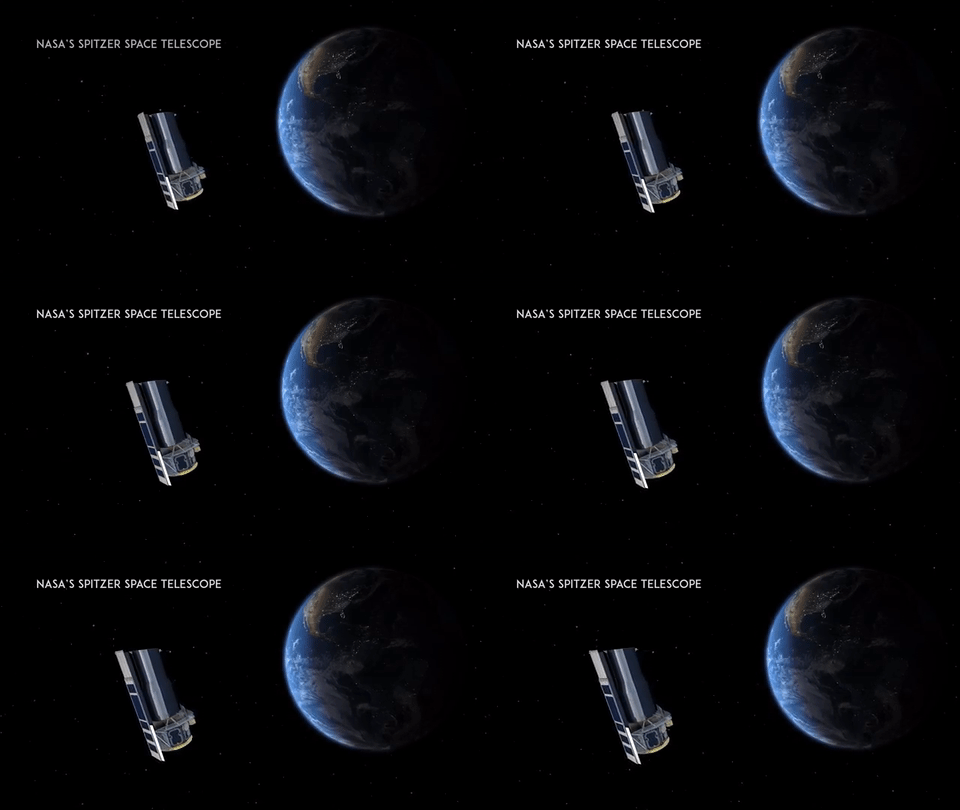
Spitzer Space Telescope. Animation Credit: NASA

“It is possible that these theories don’t have the full picture yet,” said Metchev. “Some unappreciated factor may be coming into play that doesn’t let the brown dwarf spin faster.” Additional observations and theoretical work may yet reveal whether there’s some braking mechanism that stops brown dwarfs from self-destruction and whether there are brown dwarfs spinning even faster in the darkness.

NASA's Jet Propulsion Laboratory, a division of Caltech, managed Spitzer mission operations for NASA's Science Mission Directorate in Washington. Science operations were conducted at the Spitzer Science Center at IPAC at Caltech. Spacecraft operations were based at Lockheed Martin Space in Littleton, Colorado. The Spitzer data archive is housed at the Infrared Science Archive at IPAC at Caltech in Pasadena, California. The international Gemini Observatory is a Program of the National Science Foundation’s NOIRLab.

For more information about NASA’s Spitzer mission go to:

https://www.jpl.nasa.gov/missions/spitzer-space-telescope

https://www.ipac.caltech.edu/project/spitzer

Images (mentioned), Animation (mentioned), Video (mentioned), Text, Credits: NASA/Tony Greicius/JPL/Calla Cofield.

Best regards, Orbiter.ch

NASA’s OSIRIS-REx Completes Final Tour of Asteroid Bennu


NASA - OSIRIS-REx Mission patch.


Apr 7, 2021

NASA’s OSIRIS-REx completed its last flyover of Bennu around 6 a.m. EDT (4 a.m. MDT) April 7 and is now slowly drifting away from the asteroid; however, the mission team will have to wait a few more days to find out how the spacecraft changed the surface of Bennu when it grabbed a sample of the asteroid.


Image above: This image shows a top-down view of asteroid Bennu, with a portion of the asteroid’s equatorial ridge and northern hemisphere illuminated. It was taken by the PolyCam camera on NASA’s OSIRIS-REx spacecraft on March 4, 2021, from a distance of about 186 miles (300 km). The spacecraft’s cameras are pointed directly at Bennu’s north pole. Two large equatorial craters are visible on the asteroid’s edge (center and center left). The image was obtained during the mission’s Post-TAG Operations phase, as the spacecraft slowly approached Bennu in preparation for a final observational flyby on April 7. Image Credits: NASA/Goddard/University of Arizona.

The OSIRIS-REx team added this flyby to document surface changes resulting from the Touch and Go (TAG) sample collection maneuver Oct. 20, 2020. “By surveying the distribution of the excavated material around the TAG site, we will learn more about the nature of the surface and subsurface materials along with the mechanical properties of the asteroid,” said Dr. Dante Lauretta, principal investigator for OSIRIS-REx at the University of Arizona.

During the flyby, OSIRIS-REx imaged Bennu for 5.9 hours, covering more than a full rotation of the asteroid. It flew within 2.1 miles’ (3.5 kilometers) distance to the surface of Bennu – the closest it’s been since the TAG sample collection event.


Image above: NASA invites the public to watch OSIRIS-REx depart from Bennu on NASA.gov and NASA TV, May 10, 2021, at 4 p.m. EDT. Image Credit: NASA.

It will take until at least April 13 for OSIRIS-REx to downlink all of the data and new pictures of Bennu’s surface recorded during the flyby. It shares the Deep Space Network antennas with other missions like Mars Perseverance, and typically gets 4–6 hours of downlink time per day. “We collected about 4,000 megabytes of data during the flyby,” said Mike Moreau, deputy project manager of OSIRIS-REx at NASA’s Goddard Space Flight Center in Greenbelt, Maryland. “Bennu is approximately 185 million miles from Earth right now, which means we can only achieve a downlink data-rate of 412 kilobits per second, so it will take several days to download all of the flyby data.”

Once the mission team receives the images and other instrument data, they will study how OSIRIS-REx jumbled up Bennu’s surface. During touchdown, the spacecraft’s sampling head sunk 1.6 feet (48.8 centimeters) into the asteroid’s surface and simultaneously fired a pressurized charge of nitrogen gas. The spacecraft’s thrusters kicked up a large amount of surface material during the back-away burn – launching rocks and dust in the process.


Image above: KinetX Flight Navigator Leilah McCarthy processes navigation images to help target NASA’s OSIRIS-REx final flyby of near-Earth asteroid Bennu. Image Credits: KinetX Inc./Coralie Adam.

OSIRIS-REx, with its pristine and precious asteroid cargo, will remain in the vicinity of Bennu until May 10 when it will fire its thrusters and begin its two-year cruise home. The mission will deliver the asteroid sample to Earth Sept. 24, 2023.

OSIRIS-REx at Bennu. Animation Credits: NASA/JPL

NASA’s Goddard Space Flight Center in Greenbelt, Maryland, provides overall mission management, systems engineering, and the safety and mission assurance for OSIRIS-REx (Origins Spectral Interpretation Resource Identification Security - Regolith Explorer). Dante Lauretta of the University of Arizona, Tucson, is the principal investigator, and the University of Arizona also leads the science team and the mission’s science observation planning and data processing. Lockheed Martin Space in Denver built the spacecraft and provides flight operations. Goddard and KinetX Aerospace are responsible for navigating the OSIRIS-REx spacecraft. OSIRIS-REx is the third mission in NASA’s New Frontiers Program, which is managed by NASA’s Marshall Space Flight Center in Huntsville, Alabama, for the agency’s Science Mission Directorate in Washington.

For more information about this story and OSIRIS-REx visit: https://www.nasa.gov/osiris-rex

Images (mentioned), Animation (mentioned), Text, Credits: NASA/Rob Garner/GSFC/By Rani Gran.

Greetings, Orbiter.ch