vendredi 21 janvier 2011

NASA Prepares To Launch Next Earth-Observing Satellite Mission


NASA - Glory Mission patch.

Jan. 21, 2011

Glory is scheduled to launch from Vandenberg Air Force Base in California on Feb. 23 at 5:09 a.m. EST. It will join a fleet called the Afternoon Constellation or "A-train" of satellites. This group of other Earth-observing satellites, including NASA's Aqua and Aura spacecraft, flies in tight formation.

"Glory is going to help scientists tackle one of the major uncertainties in climate change predictions identified by the United Nation's Intergovernmental Panel on Climate Change: the influence of aerosols on the energy balance of our planet," said Michael Freilich, director of NASA's Earth Science Division in the Science Mission Directorate at the agency's headquarters in Washington. "This mission also marks the first satellite launch under President Obama's climate initiative that will advance the United States' contribution to cutting-edge and policy-relevant climate change science."

Originally confirmed in 2005, Glory has been developed by a team of engineers and scientists at several government, industry and academic institutions across the country. The Glory spacecraft arrived at Vandenberg on Jan. 11 after a cross-country road trip from Orbital Sciences Corporation in Dulles, Va.

"The spacecraft is in place at the launch and all of the post-shipment inspections and electrical tests have been completed," said Bryan Fafaul, Glory project manager at NASA's Goddard Space Flight Center in Greenbelt, Md. The spacecraft will be mated to Orbital's Taurus XL 3110 rocket next month.

Glory will carry new technology designed to unravel some of the most complex elements of the Earth system. The mission carries two primary instruments, the Aerosol Polarimetry Sensor (APS) and the Total Irradiance Monitor (TIM). APS will improve measurement of aerosols, the airborne particles that can influence climate by reflecting and absorbing solar radiation and modifying clouds and precipitation.

Glory spacecraft in orbit (Artist's view)

TIM will extend a decades-long data record of the solar energy striking the top of Earth's atmosphere, or total solar irradiance. APS will collect data at nine different wavelengths, from the visible to short-wave infrared, giving scientists a much-improved understanding of aerosols. The instrument, NASA's first Earth-orbiting polarimeter, will help scientists distinguish between natural and human-produced aerosols. The information will be used to refine global climate models and help scientists determine how our planet is responding to human activities.

The TIM instrument will maintain and improve upon a 32-year record of total solar irradiance, a value that fluctuates slightly as the sun cycles through periods of varying intensity approximately every 11 years. While scientists have concluded that solar variability is not the main cause of the warming observed on Earth in recent decades, the sun has historically caused long-term climate changes. Having a baseline of the solar energy that reaches Earth gives us a way to evaluate future climate changes. Better measurements of total solar irradiance give scientists another way to test their climate models and understand the sun's longer cyclical changes and how they may impact the climate.

Glory will fly in a low-Earth orbit at an altitude of 438 miles, about the distance from Boston to Washington. After launch, mission operators will conduct verification tests for 30 days and then begin to collect data for at least three years.

Glory's Taurus launch rocket also will carry into orbit a secondary payload: NASA's Educational Launch of Nanosatellite, or ELaNA, mission. This mission will put three small research satellites, or CubeSats, into orbit for Montana State University, the University of Colorado and a consortium of state universities called Kentucky Space.

Glory is managed by Goddard for NASA's Science Mission Directorate in Washington. Launch management is provided by NASA's Launch Services Program at the agency's Kennedy Space Center in Florida.

Orbital is responsible for Glory's design, manufacture, payload integration, and testing, as well as spacecraft operations at its Mission Operations Complex in Dulles, Va. The Laboratory for Atmospheric and Space Physics at the University of Colorado at Boulder provided and will operate the TIM instrument. Raytheon Space and Airborne Systems in El Segundo, Calif., provided the APS instrument, which will be operated by Goddard's Institute for Space Studies in New York.

For more information about Glory, visit: http://www.nasa.gov/glory 

Related link:

earthzine.org, Changing Sun, Changing Earth: http://www.earthzine.org/2008/08/28/changing-sun-changing-earth/

Images, Text, Credits: NASA / Goddard.

Cheers, Orbiter.ch

jeudi 20 janvier 2011

Missing part delays space mission


ESA - LISA Pathfinder Mission patch.

20 January 2011

Schedule slips for European-led effort to blaze a trail for gravitational-wave detection

For Stefano Vitale, a principal investigator on the LISA Pathfinder mission, the situation is excruciating. Nearly all the instruments for the €300-million (US$400-million) spacecraft have been delivered for what was originally to have been a launch this year. But delays have pushed that target to 2013 and possibly later, with everything now held up by a small but crucial component. "All the rest is waiting for one part. It's heartbreaking," says Vitale, a physicist at the University of Trento in Italy.

It is a rougher-than-anticipated start for a mission that was created to find obstacles. LISA Pathfinder is a European-led test of the technology needed to run the Laser Interferometer Space Antenna (LISA), an ambitious effort to detect gravitational waves from sources in the distant Universe. Scientists hope that LISA can achieve this by measuring the precise separations between three pairs of masses free-floating inside three spacecraft positioned 5 million kilometres apart. The technical challenge along with the estimated cost of LISA (€1 billion to €2 billion) made a precursor mission a necessity. If LISA Pathfinder encounters significant problems it could sow doubts about the overall effort.


Image above: The LISA Pathfinder is missing the mechanism to hold two masses (yellow cubes) in place during launch. Credit: ESA.

LISA Pathfinder is not expected to detect gravitational waves, but it must deploy and measure the relative positions of two test masses with sufficient precision for LISA to move forward. The missing piece of the mission is part of a 'caging mechanism' consisting of two sets of eight fingers that will hold the two 1.96-kilogram gold–platinum masses during launch, and then, once the spacecraft reaches its orbit at the L1 Lagrangian point where the gravitational pull of Earth and Sun are balanced, delicately release them. The masses will then float freely inside their separate compartments while the spacecraft uses electrical microthrusters to maintain its position so precisely that the masses do not hit the sides of their containers.

The exacting requirement for a mechanism that can hold the masses firmly enough to withstand a force of 2,000 newtons but still release them without imparting a velocity of more than 5 micrometres per second (18 millimetres an hour) lies at the heart of the delay. A first prototype of the motor powering the fingers failed key tests, prompting the European Space Agency (ESA) to set up a task force to look into the problem. The motor is now being redesigned from scratch. "Little by little, the launch date is slipping," says Pierre Binétruy of Paris Diderot University, a physicist on the LISA international science team.

LISA Pathfinder (Artist view)

Scientists on the mission say that the important thing is to learn from the delay, to avoid similar problems on LISA. With LISA Pathfinder, ESA initially followed a conventional model for managing space missions, assigning science research groups outside the space agency to design the payload — including the caging mechanism — while industrial partners designed the spacecraft itself. But designers found that the spacecraft was operationally indistinguishable from its science payload, because the positioning of the masses inside it is coupled closely to the craft's ability to keep its place in space using the microthrusters. ESA then took on the design of the caging mechanism together with a contractor, Thales Alenia Space in Milan, Italy, which was unable to comment before Nature went to print.

On 10 February, the ESA Science Programme Committee is expected to assess options for the new design and chart a path forwards

Last August, the Astro2010 decadal survey of the US National Academy of Sciences ranked participation in LISA among its top priorities, above a competing project, the International X-ray Observatory (IXO). But that recommendation assumed a successful LISA Pathfinder. Xavier Barcons, a physicist at the Cantabria Institute of Physics in Santander, Spain, who works with IXO, says the problems on Pathfinder call into question the decision to rank it higher than his project. "We also have technical difficulties but we've mastered the basics. LISA is a completely new adventure," he says.

He says that it is not clear whether LISA can fly by 2025, as the decadal survey assumed. But Fabio Favata, head of ESA's science coordination office, says that by uncovering problems early, LISA Pathfinder could help LISA avoid delays. "The present situation, although unfortunate, does emphasize the importance of pathfinding," he says.

Images, Text, Credits: ESA / naturenews, Eugenie Samuel Reich.

Greetings, Orbiter.ch

Electro-L Reaches Targeted Orbit


ROSCOSMOS logo.

21.01.2011

Zenith-Electro-L Launch

Launched by Zenith-SB rocket from Baikonur yesterday, Russian weather satellite Electro-L has successfully separated from Fregat-SB upper stage and reached the targeted orbit  at 00.28 MSK, Jan. 21.

Electro-L

With this launch, Russia will have its own weather satellite in GSO. Within 10 years of orbital operations, Electro-L will provide Russian and world customers with weather prediction, sea and ocean status, ionosphere status, climate monitoring, ecological data.

Zenith-SB rocket rollout to the launch-pad

Electro-L overall mission objectives are to provide on an operational basis multispectral imagery (hydro-meteorological data) of the atmosphere (including the cloud-covered sky) and of the Earth's surface within the coverage region (visible disk) of the spacecraft, to collect heliospheric, ionospheric, and magnetospheric data, to provide the needed communication services for the transmission/exchange of all data with the ground segment.

To see launch video, visit: http://tvroscosmos.ru/frm/kosmostv/vesti/2011/vesti200111.php

Images, Video, Text, Credits: Roscosmos PAO / Photo credit: S.Sergeev (Yuzhny Space Center).

Best regards, Orbiter.ch

Galileo satellite undergoes launch check-up at ESTEC


ESA - GALILEO Mission logo.

20 January 2011


Galileo’s first satellite is undergoing testing at ESA’s technical centre in the Netherlands, checking its readiness to be launched into orbit. This marks a significant step for Europe’s Galileo satnav constellation.

The first part of Europe’s global satellite navigation system is due to be launched over the next two years – a total of four Galileo In-Orbit Validation (IOV) satellites.

First two Galileo IOV satellites

The following four years to 2015 will see Galileo brought up to its first operational configuration of 18 satellites in medium Earth orbit.

Before they are launched, the IOV satellites must be formally qualified for space operations by passing a rigorous series of tests that reproduce the heavy vibration, acoustic noise and shock they will experience during the violent rocket ride into orbit – plus a little extra for safety.

The venue for these tests is the ESTEC Test Centre in Noordwijk, the Netherlands. This unique European facility combines a complete portfolio of space simulation facilities under a single roof.

“From the point of view of mechanical qualification, the Galileo IOV satellites are identical,” said Pedro Cosma, Assembly Integration and Testing engineer for Galileo.

Galileo dispenser testing

“So we are employing one of the satellites for this qualification testing, the first to be built, known as the Protoflight Model (PFM). It will respond in practically the same way as the other Flight Models – FM2, FM3 and FM4.”

The satellites have been built by a consortium of European companies. Their payloads were designed, developed and assembled by EADS Astrium in Portsmouth, UK, with the overall satellite designed and developed by Astrium in Ottobrunn, Germany and assembled by Thales Alenia Space in Rome, Italy.

The first satellite will endure simulated launch vibrations on ESTEC’s Electrodynamic Shaker, followed by the sudden pyrotechnic shocks during separation from the launch vehicle.

Finally, it will take an acoustic battering matching the launcher’s sound pressure and frequency – imagine a squadron of fighter jets taking off 30 m away – in the Large European Acoustic Facility.

“We’re not anticipating any surprises,” added Pedro. “This is because we’ve previously carried out these tests on two Galileo structural/thermal models, but testing on an actual satellite remains an essential part of the official flight qualification process.”

Those models have also recently been reused for other tests at ESTEC. The Galileo IOV satellites are launched two at a time, so a dispenser is needed to hold them together within the launcher fairing and then, when the time is right, to release them in orbit.

Pyrotechnic devices will shoot them safely away from the dispenser and each other. Last December these models took part in a pyrotechnic shock test alongside a qualification model of the dispenser.

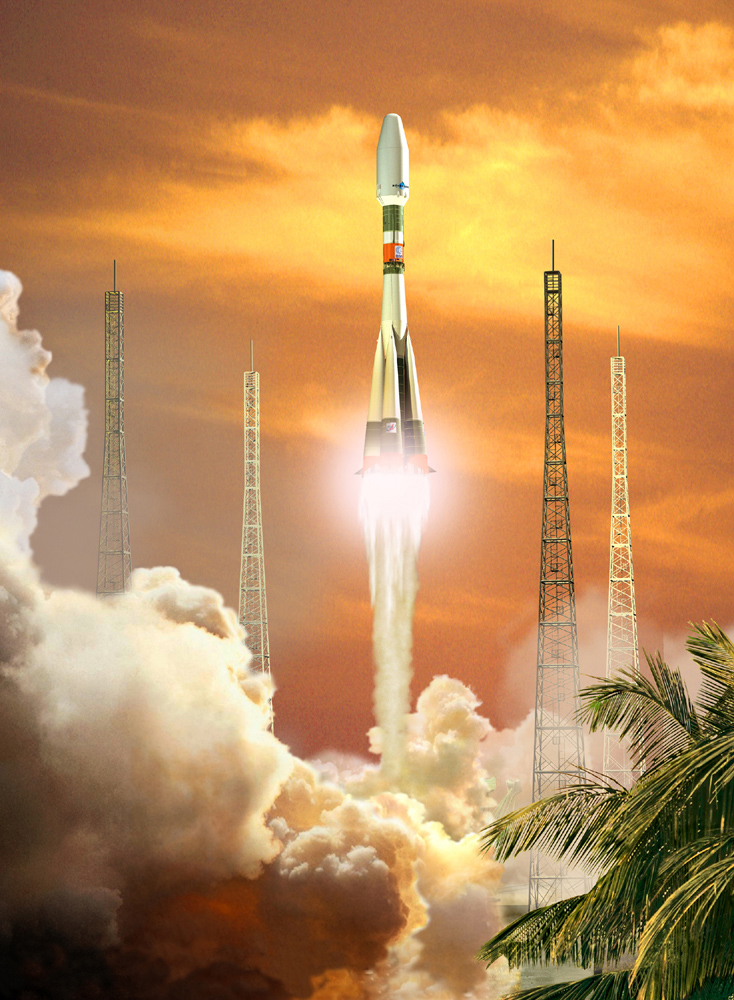
Soyuz launching from French Guiana

“The test’s success prepares us to perform a release test with the real dispenser and PFM satellite in our facilities later this month,” Pedro added.

Once ESTEC testing is complete in February, the PFM will be reunited with the rest of the IOV quartet in Italy for a follow-up round of thermal vacuum testing, to prove that they can withstand the temperature extremes of space.

Finally, the satellites will be transported to Europe’s Spaceport in Kourou, French Guiana to be launched on Soyuz rockets. The PFM and Flight Model 2 will be on the first flight of Soyuz from Kourou, marking a double first for ESA.

Related links:

EADS Astrium: http://www.astrium.eads.net/

Thales Alenia Space: http://www.thalesaleniaspace.com/

Images, Text, Credit: ESA.

Cheers, Orbiter.ch

Romania accedes to ESA Convention


ESA logo / ROSA logo.

20 January 2011

Romania took a step further in its relations with ESA by signing the Accession Agreement to the ESA Convention on 20 January 2011, to become the 19th ESA Member State.

The signing ceremony took place at the Romanian Ministry of Foreign Affairs in Bucharest, with the participation of Jean-Jacques Dordain, ESA Director General, Teodor Baconschi, Minister of Foreign Affairs, Marius-Ioan Piso, President and CEO of the Romanian Space Agency, and cosmonaut Dumitru Dorin Prunariu, Chairman of the Board of the Romanian Space Agency.

ESA's Director General and President of the Romanian Space Agency sign the accession agreement

Romania has a long aerospace tradition and has contributed to more than 30 scientific and technological space missions. During the 1970s and 1980s, Romania was an active member of the Soviet Union’s Interkosmos programme to involve fellow socialist nations in space exploration.

Romania’s cooperation with ESA is long-standing. In 1992, Romania was one of the first Eastern European countries to sign a Cooperation Agreement in the field of the peaceful use of outer space with ESA, paving the way for Romanian participation in several research projects with other European countries. Cooperation between ESA and Romania was strengthened further in October 1999 with the signing of a five-year Framework Cooperation Agreement, and the signature of the European Cooperating State Agreement in 2006.

ESA's Director General presents a gift to Romanian Foreign Minister

Romania has participated in several ESA missions, such as Cluster, Herschel, Planck, SOHO and Gaia with co-investigators, and in Earth Observation activities (EDUSPACE software), microgravity and exploration (SURE) and technology activities (the IAP telemedicine project).

Later this year, the Government of Romania will conclude the ratification process and once the ratification instrument is deposited with the Government of France, Romania will become officially the 19th ESA Member State and will make known its interest in ESA’s optional activities.

Related links:

Romania becomes third ESA European Cooperating State: http://www.esa.int/esaCP/SEMI2HMVGJE_index_0.html

The SURE project, a new opportunity for European research in space: http://www.esa.int/esaCP/SEM1JPTLWFE_index_0.html

ESA Convention: http://www.esa.int/SPECIALS/About_ESA/SEMFRMRRJHG_0.html

Images, Credit: Romanian Space Agency / Text, Credit: ESA.

Best regards, Orbiter.ch

mercredi 19 janvier 2011

JAXA - Commencement of initial analysis of particles in Hayabusa sampler container


JAXA - Hayabusa Mission patch.


January 17, 2011 (JST)

The Japan Aerospace Exploration Agency (JAXA) has been engaged in collecting and categorizing particles in the sampler container (*1), which was brought back by the instrumental module of the asteroid exploration spacecraft "Hayabusa."

 Hayabusa sampler container before the opening

JAXA decided to commence the initial analysis (*2) of particles indentified as rocky using scanning electron microscope (SEM) observations, which were collected through the free fall method from sample catcher compartment "A." Please see the attached list of researchers in charge of initial analysis.

*1 The Hayabusa sampler container consists of 2 compartments that are called Sample Catcher A and B.

*2 "Initial analysis" means the analysis of typical particles to obtain information necessary for categorizing
(identification, classification and numbering) as a part of curation activity (*3).

*3 "Curation activity" means the retrieval of particles, preservation, categorizing and allocation and their necessary analysis.

List of initial analysis plans

   
Note: This table shows overall plan for over the next several months. Michael Zolensky (NASA), Scott Sandford (NASA) and Trevor Ireland (ANU, Australia) will join as foreign researchers.

Mission website:

Asteroid Explorer "HAYABUSA" (MUSES-C): http://www.jaxa.jp/projects/sat/muses_c/index_e.html

High Energy Accelerator Research Organization: http://www.kek.jp/intra-e/

Images, Text, Credit: Japan Aerospace Exploration Agency (JAXA)

Cheers, Orbiter.ch

NASA Spacecraft Prepares For Valentine's Day Comet Rendezvous


NASA - STARDUST NEXT Mission patch.


Jan. 19, 2011

NASA's Stardust-NExT spacecraft is nearing a celestial date with comet Tempel 1 at approximately 11:37 p.m. EST, on Feb. 14. The mission will allow scientists for the first time to look for changes on a comet's surface that occurred following an orbit around the sun.


This is an artist's concept of the Stardust spacecraft beginning its flight through gas and dust around comet Wild 2. Credit: NASA / JPL.

The Stardust-NExT, or New Exploration of Tempel, spacecraft will take high-resolution images during the encounter, and attempt to measure the composition, distribution, and flux of dust emitted into the coma, or material surrounding the comet's nucleus. Data from the mission will provide important new information on how Jupiter-family comets evolved and formed.

The mission will expand the investigation of the comet initiated by NASA's Deep Impact mission. In July 2005, the Deep Impact spacecraft delivered an impactor to the comet's surface to study its composition. The Stardust spacecraft may capture an image of the crater created by the impactor. This would be an added bonus to the huge amount of data that mission scientists expect to obtain.


Deep Impact sent a 370-kg impactor into Comet Tempel 1 in July 2005, but the resulting dust obscured its view of the newly formed crater. Artist's impression: NASA / JPL / UMD / Pat Rawlings.

"Every day we are getting closer and closer and more and more excited about answering some fundamental questions about comets," said Joe Veverka, Stardust-NExT principal investigator at Cornell University. "Going back for another look at Tempel 1 will provide new insights on how comets work and how they were put together four-and-a-half billion years ago."

At approximately 209 million miles away from Earth, Stardust-NExT will be almost on the exact opposite side of the solar system at the time of the encounter. During the flyby, the spacecraft will take 72 images and store them in an on board computer.

Initial raw images from the flyby will be sent to Earth for processing that will begin at approximately 3 a.m. EST on Feb. 15. Images are expected to be available at approximately 4:30 a.m. EST.

As of today, the spacecraft is approximately 15.3 million miles away from its encounter. Since 2007, Stardust-NExT executed eight flight path correction maneuvers, logged four circuits around the sun and used one Earth gravity assist to meet up with Tempel 1.


This spectacular image of comet Tempel 1 was taken 67 seconds after it obliterated Deep Impact's impactor spacecraft. Credit: NASA / JPL-Caltech / UMD.

Another three maneuvers are planned to refine the spacecraft's path to the comet. Tempel 1's orbit takes it as close in to the sun as the orbit of Mars and almost as far away as the orbit of Jupiter. The spacecraft is expected to fly past the 3.7 mile-wide comet at a distance of approximately 124 miles.

In 2004, the Stardust mission became the first to collect particles directly from comet Wild 2, as well as interstellar dust. Samples were returned in 2006 for study via a capsule that detached from the spacecraft and parachuted to the ground southwest of Salt Lake City.

Mission controllers placed the still viable Stardust spacecraft on a trajectory that could potentially reuse the flight system if a target of opportunity presented itself. In January 2007, NASA re-christened the mission Stardust-NExT and began a four-and-a-half year journey to comet Tempel 1.

The Nucleus of Comet Tempel 1. Credit: NASA / JPL-Caltech /UMD

"You could say our spacecraft is a seasoned veteran of cometary campaigns," said Tim Larson, project manager for Stardust-NExT at NASA's Jet Propulsion Laboratory (JPL) in Pasadena, Calif. "It's been half-way to Jupiter, executed picture-perfect flybys of an asteroid and a comet, collected cometary material for return to Earth, then headed back out into the void again, where we asked it to go head-to-head with a second comet nucleus."

The mission team expects this flyby to write the final chapter of the spacecraft's success-filled story. The spacecraft is nearly out of fuel as it approaches 12 years of space travel, logging almost 3.7 billion miles since launch in 1999. This flyby and planned post-encounter imaging are expected to consume the remaining fuel.

JPL manages mission for the agency's Science Mission Directorate in Washington. Lockheed Martin Space Systems in Denver built the spacecraft and manages day-to-day mission operations.

For more information about the Stardust-NExt mission, visit: http://stardustnext.jpl.nasa.gov/

Images (mentioned), Text, Credit: NASA.

Greetings, Orbiter.ch