mercredi 25 mai 2011

NASA Concludes Attempts To Contact Mars Rover Spirit


NASA - Mars Exploration Rover (MER-A) "Spirit" Mission patch.

May 24, 2011

NASA is ending attempts to regain contact with the long-lived Mars Exploration Rover Spirit, which last communicated on March 22, 2010.

Mars Exploration Rover

A transmission that will end on Wednesday, May 25, will be the last in a series of attempts. Extensive communications activities during the past 10 months also have explored the possibility that Spirit might reawaken as the solar energy available to it increased after a stressful Martian winter without much sunlight. With inadequate energy to run its survival heaters, the rover likely experienced colder internal temperatures last year than in any of its prior six years on Mars. Many critical components and connections would have been susceptible to damage from the cold.

Engineers' assessments in recent months have shown a very low probability for recovering communications with Spirit. Communications assets that have been used by the Spirit mission in the past, including NASA's Deep Space Network of antennas on Earth, plus two NASA Mars orbiters that can relay communications, now are needed to prepare for NASA's Mars Science Laboratory mission. MSL is scheduled to launch later this year.

Mars Exploration Rover description

"We're now transitioning assets to support the November launch of our next generation Mars rover, Curiosity," said Dave Lavery, program executive for solar system exploration. "However, while we no longer believe there is a realistic probability of hearing from Spirit, the Deep Space Network may occasionally listen for any faint signals when the schedule permits."

Spirit landed on Mars on Jan. 3, 2004, for a mission designed to last three months. After accomplishing its prime-mission goals, Spirit worked to accomplish additional objectives. Its twin, Opportunity, continues active exploration of Mars.

For more information on the Mars rovers, visit:
http://www.nasa.gov/rovers or http://marsrovers.jpl.nasa.gov/home/index.html

Interactive feature: http://www.nasa.gov/externalflash/spirit_mission/

Images, Text, Credits: NASA / Jet Propulsion Laboratory, Pasadena, Calif.

Greetings, Orbiter.ch

Carina Nebula


NASA - Chandra X-Ray Observatory logo.

05.25.11


This Chandra image shows the Carina Nebula, a star-forming region in the Sagittarius-Carina arm of the Milky Way a mere 7,500 light years from Earth. Chandra's sharp X-ray vision has detected over 14,000 stars in this region, revealed a diffuse X-ray glow, and provided strong evidence that massive stars have already self-destructed in this nearby supernova factory.

The lower energy X-rays in this image are red, the medium energy X-rays are green, and the highest energy X-rays are blue. The Chandra survey has a large field of 1.4 square degrees, made of a mosaic of 22 individual Chandra pointings. In total, this image represents 1.2 million seconds -- or nearly two weeks -- of Chandra observing time. A great deal of multi-wavelength data has been used in combination with this new Chandra campaign, including infrared observations from the Spitzer Space Telescope and the Very Large Telescope (VLT).

Several pieces of evidence support the idea that supernova production has already begun in this star-forming region. Firstly, there is an observed deficit of bright X-ray sources in Trumpler 15, suggesting that some of the massive stars in this cluster were already destroyed in supernova explosions. Trumpler 15 is located in the northern part of the image, as shown in a labeled version, and is one of ten star clusters in the Carina complex. Several other well known clusters are shown in the labeled image.

The detection of six possible neutron stars, the dense cores often left behind after stars explode in supernovas, provides additional evidence that supernova activity is ramping up in Carina. Previous observations had only detected one neutron star in Carina. These six neutron star candidates are too faint to be easily picked out in this large-scale image of Carina.

Read more / access all images: http://chandra.harvard.edu/photo/2011/carina/

Image, Text, Credits:  credit: NASA/ CXC / Penn State / L. Townsley et al.

Cheers, Orbiter.ch

ESO's VLT Finds a Brilliant but Solitary Superstar


ESO - European Southern Observatory logo.

25 May 2011

The brilliant star VFTS 682 in the Large Magellanic Cloud

An extraordinarily bright isolated star has been found in a nearby galaxy — the star is three million times brighter than the Sun. All previous similar “superstars” were found in star clusters, but this brilliant beacon shines in solitary splendour. The origin of this star is mysterious: did it form in isolation or was it ejected from a cluster? Either option challenges astronomers’ understanding of star formation.

An international team of astronomers [1] has used ESO’s Very Large Telescope to carefully study the star VFTS 682 [2] in the Large Magellanic Cloud, a small neighbouring galaxy to the Milky Way. By analysing the star’s light, using the FLAMES instrument on the VLT, they have found that it is about 150 times the mass of the Sun. Stars like these have so far only been found in the crowded centres of star clusters, but VFTS 682 lies on its own.

“We were very surprised to find such a massive star on its own, and not in a rich star cluster,” notes Joachim Bestenlehner, the lead author of the new study and a student at Armagh Observatory in Northern Ireland. “Its origin is mysterious.”

This star was spotted earlier in a survey of the most brilliant stars in and around the Tarantula Nebula in the Large Magellanic Cloud. It lies in a stellar nursery: a huge region of gas, dust and young stars that is the most active star-forming region in the Local Group of galaxies [3]. At first glance VFTS 682 was thought to be hot, young and bright, but unremarkable. But the new study using the VLT has found that much of the star’s energy is being absorbed and scattered by dust clouds before it gets to Earth — it is actually more luminous than previously thought and among the brightest stars known.

Red and infrared light emitted by the star can get through the dust, but the shorter-wavelength blue and green light is scattered more and lost. As a result the star appears reddish, although if the view were unobstructed it would shine a brilliant blue-white.

The brilliant star VFTS 682 in the Large Magellanic Cloud (annotated)

As well as being very bright, VFTS 682 is also very hot, with a surface temperature of about 50 000 degrees Celsius [4]. Stars with these unusual properties may end their short lives not just as a supernova, as is normal for high-mass stars, but just possibly as an even more dramatic long-duration gamma-ray burst [5], the brightest explosions in the Universe.

Although VFTS 682 seems to now be alone it is not very far away from the very rich star cluster RMC 136 (often called just R 136), which contains several similar “superstars” (eso1030) [6].

“The new results show that VFTS 682 is a near identical twin of one of the brightest superstars at the heart of the R 136 star cluster,” adds Paco Najarro, another member of the team from CAB (INTA-CSIC, Spain).

Is it possible that VFTS 682 formed there and was ejected? Such “runaway stars” are known, but all are much smaller than VFTS 682 and it would be interesting to see how such a heavy star could be thrown from the cluster by gravitational interactions.

Zooming in on the brilliant star VFTS 682 in the Large Magellanic Cloud 
 
“It seems to be easier to form the biggest and brightest stars in rich star clusters,” adds Jorick Vink, another member of the team. “And although it may be possible, it is harder to understand how these brilliant beacons could form on their own. This makes VFTS 682 a really fascinating object.”

Notes:

[1] The VFTS 682 analysis was led by Jorick Vink, Götz Gräfener and Joachim Bestenlehner from the Armagh Observatory,

[2] The name VFTS is short for VLT-FLAMES Tarantula Survey, an ESO Large Programme led by Christopher Evans of the UK Astronomy Technology Centre, Edinburgh, UK.

[3] The Local Group is a small group of galaxies that includes the Milky Way and Andromeda galaxies, as well as the Magellanic Clouds and many smaller galaxies.

[4] For comparison the surface temperature of the Sun is about 5500 degrees Celsius.

[5] Gamma-ray bursts are among the most energetic events in the Universe and the high energy radiation that they produce can be detected by orbiting space craft. Gamma-ray bursts lasting longer than two seconds are referred to as long bursts and those with a shorter duration are known as short bursts. Long bursts are associated with the supernova explosions of massive young stars in star-forming galaxies. Short bursts are not well understood, but are thought to originate from the merger of two compact objects such as neutron stars.

[6] If VFTS 682 is at the same distance from the Earth as R 136 then it lies about 90 light-years from the centre of the cluster. If the distances are significantly different then the separation could be much greater.
More information

This research was presented in a paper, “The VLT-FLAMES Tarantula Survey III: A very massive star in apparent isolation from the massive cluster R136”, to appear in Astronomy & Astrophysics.

The team is composed of Joachim M. Bestenlehner (Armagh Observatory, UK), Jorick S.Vink (Armagh), G. Gräfener (Armagh), F. Najarro (Centre of Astrobiology, Madrid, Spain), C. J. Evans (UK Astronomy Technology Centre, Edinburgh, UK), N. Bastian (Excellence Cluster Universe, Garching, Germany; University of Exeter, UK), A. Z. Bonanos (National Observatory of

Athens, Greece), E. Bressert (Exeter; ESO; Harvard Smithsonian Center for Astrophysics, Cambridge, USA), P. A. Crowther (University of Sheffield, UK), E. Doran (Sheffield), K. Friedrich (Argelander Institute, University of Bonn, Germany), V.Hénault-Brunet (University of Edinburgh, UK), A. Herrero (University of La Laguna, Tenerife, Spain; ESO), A. de Koter (University of Amsterdam; Utrecht University, Netherlands), N. Langer (Argelander Institute), D. J. Lennon (ESA; Space Telescope Science Institute, Baltimore, USA), J. Maíz Apellániz (Institute of Astrophysics of Andalucia, Granada, Spain), H. Sana (University of Amsterdam), I. Soszynski (Warsaw University, Poland), and W. D. Taylor (University of Edinburgh).

ESO, the European Southern Observatory, is the foremost intergovernmental astronomy organisation in Europe and the world’s most productive astronomical observatory. It is supported by 15 countries: Austria, Belgium, Brazil, the Czech Republic, Denmark, France, Finland, Germany, Italy, the Netherlands, Portugal, Spain, Sweden, Switzerland and the United Kingdom. ESO carries out an ambitious programme focused on the design, construction and operation of powerful ground-based observing facilities enabling astronomers to make important scientific discoveries. ESO also plays a leading role in promoting and organising cooperation in astronomical research. ESO operates three unique world-class observing sites in Chile: La Silla, Paranal and Chajnantor. At Paranal, ESO operates the Very Large Telescope, the world’s most advanced visible-light astronomical observatory and VISTA, the world’s largest survey telescope. ESO is the European partner of a revolutionary astronomical telescope ALMA, the largest astronomical project in existence. ESO is currently planning a 42-metre European Extremely Large optical/near-infrared Telescope, the E-ELT, which will become “the world’s biggest eye on the sky”.

Links:

    Research paper: http://www.aanda.org/10.1051/0004-6361/201117043?

    Photos of the VLT: http://www.eso.org/public/images/archive/category/paranal/

Images, Text, Credits: ESO / M.-R. Cioni / VISTA Magellanic Cloud survey. Acknowledgment: Cambridge Astronomical Survey Unit  / Video: ESO / Digitized Sky Survey 2 / R. Gendler/S. Brunier. Music: John Dyson (from the album Moonwind).

Greetings, Orbiter.ch

mardi 24 mai 2011

NASA Announces Key Decision For Next Deep Space Transportation System


NASA logo / Multi-Purpose Crew Vehicle (MPCV) logo.

May 24, 2011

NASA has reached an important milestone for the next U.S. transportation system that will carry humans into deep space. NASA Administrator Charles Bolden announced today that the system will be based on designs originally planned for the Orion Crew Exploration Vehicle. Those plans now will be used to develop a new spacecraft known as the Multi-Purpose Crew Vehicle (MPCV).

Artist's rendering of the Multi-Purpose Crew Vehicle on a deep space mission. Image credit: NASA

"We are committed to human exploration beyond low-Earth orbit and look forward to developing the next generation of systems to take us there," Bolden said. "The NASA Authorization Act lays out a clear path forward for us by handing off transportation to the International Space Station to our private sector partners, so we can focus on deep space exploration. As we aggressively continue our work on a heavy lift launch vehicle, we are moving forward with an existing contract to keep development of our new crew vehicle on track."

Lockheed Martin Corp. will continue working to develop the MPCV. The spacecraft will carry four astronauts for 21-day missions and be able to land in the Pacific Ocean off the California coast. The spacecraft will have a pressurized volume of 690 cubic feet, with 316 cubic feet of habitable space. It is designed to be 10 times safer during ascent and entry than its predecessor, the space shuttle.

"This selection does not indicate a business as usual mentality for NASA programs," said Douglas Cooke, associate administrator for the agency's Exploration Systems Mission Directorate in Washington. "The Orion government and industry team has shown exceptional creativity in finding ways to keep costs down through management techniques, technical solutions and innovation."

Built On A Solid Foundation

Timeline for development of the Multi-Purpose Crew Vehicle. Image credit: NASA

Designating Orion as NASA's Multi-Purpose Crew Vehicle provides our nation with an affordable solution for multiple mission capability by continuing the technology innovations and spacecraft development the NASA-industry team has accomplished.

By designing for challenging deep space missions, the MPCV/Orion team has already passed rigorous human rating reviews and other critical milestones required for safe, successful human space flight. With a proven launch abort system and its inherent design to provide the highest level of safety for the crew during long-duration missions, the MPCV is poised to take on increasingly challenging missions that will take human space exploration beyond low Earth orbit and out into the cosmos.

To learn more about the development of the MPCV, visit: http://www.nasa.gov/exploration/systems/mpcv

About the Multi-Purpose Crew Vehicle (MPCV)

The Multi-Purpose Crew Vehicle (MCPV) is based on the Orion design requirements for traveling beyond Low Earth Orbit (LEO). The MPCV will serve as the exploration vehicle that will carry the crew to space, provide emergency abort capability, sustain the crew during the space travel, and provide safe re-entry from deep space return velocities.


Image above: The Multi-Purpose Crew Vehicle being assembled and tested at Lockheed Martin's Vertical Testing Facility in Colorado. (Photo credit: Lockheed Martin).

    - Spacecraft to serve as the primary crew vehicle for missions beyond LEO

    - Capable of conducting regular in-space operations (rendezvous, docking, extravehicular activity) in conjunction with payloads delivered by SLS for missions beyond LEO

    - Capability to be a backup system for ISS cargo and crew delivery

Explore the Exploration Vehicle

 Cutaway view of the Multi Purpose Crew Vehicle. Image credit: NASA

Launch Abort System

The launch abort system (LAS), positioned on a tower atop the crew module, activates within milliseconds to propel the crew module to safety in the event of an emergency during launch or climb to orbit. The system also protects the crew module from dangerous atmospheric loads and heating, then jettisons after the Multi Purpose Crew Vehicle (MPCV) is through the initial mission phase of ascent to orbit.

Crew Module

The crew module is the transportation capsule that provides a safe habitat for the crew, provides storage for consumables and research instruments, and serves as the docking port for crew transfers. The crew module is the only part of the MPCV that returns to Earth after each mission.

Service Module

The service module supports the crew module from launch through separation prior to reentry. It provides in-space propulsion capability for orbital transfer, attitude control, and high altitude ascent aborts. When mated with the crew module, it provides the water, oxygen and nitrogen needed for a habitable environment, generates and stores electrical power while on-orbit, and maintains the temperature of the vehicle's systems and components.

A New Era of Space Exploration

This module can also transport unpressurized cargo and scientific payloads.

More information about Orion, visit: http://www.nasa.gov/mission_pages/constellation/orion/index.html

Images (mentioned), Video, Text, Credits: NASA / Lockheed Martin.

Greetings, Orbiter.ch

lundi 23 mai 2011

Expedition 27 Crew Returns Home


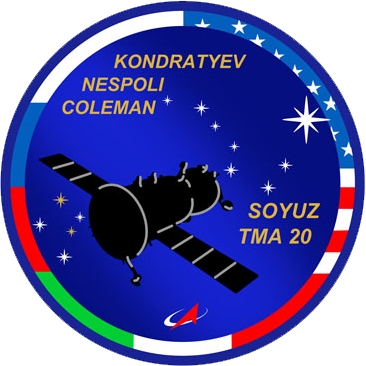
ISS - Expedition 27 Mission patch / ROSCOSMOS - Soyuz TMA-20 Mission patch.

May 24, 2011

Soyuz TMA-20 / Expedition 27 Crew landing

After spending 157 days aboard the International Space Station, Dmitry Kondratyev, NASA Flight Engineer Cady Coleman and European Space Agency Flight Engineer Paolo Nespoli undocked from the station's Rassvet module May 23, 2011, at 5:35 p.m. EDT. The crew landed safely at 10:27 p.m. EDT southeast of the town of Dzhezkazgan, Kazakhstan.


Image above: Cady Coleman is given flowers at the landing site in Kazkhstan. Photo credit: NASA TV.

Read more about Expedition 27: http://www.nasa.gov/mission_pages/station/expeditions/expedition27/index.html

Russian cosmonaut Kondratyev, the Soyuz commander, was at the controls of the spacecraft. He backed the Soyuz TMA-20 away from the station and halted it about 600 feet away. From there, Nespoli took still photographs and video of the complex with space shuttle Endeavour attached. The station slowly rotated 130 degrees to provide Nespoli with the best lighting and views during his photo opportunity.

Read more about STS-134: http://www.nasa.gov/mission_pages/shuttle/main/index.html

Once Nespoli completed taking pictures, the Soyuz performed a separation burn at 6:15 p.m. to increase the distance from the station before executing a deorbit burn at 9:36 p.m.

Expedition 27 / Soyuz TMA-20 landing

The departure of Kondratyev, Coleman and Nespoli marked the end of Expedition 27. Remaining aboard the station are Expedition 28 Russian Cosmonaut and Commander Andrey Borisenko, NASA Flight Engineer Ron Garan and Cosmonaut Alexander Samokutyaev. Three new crew members, Soyuz Commander Sergei Volkov, NASA Flight Engineer Mike Fossum and Japan Aerospace Exploration Agency Flight Engineer Satoshi Furukawa will launch from the Baikonur Cosmodrome on June 7. They will dock with the station and join its crew on June 9.

Read more about Expedition 28: http://www.nasa.gov/mission_pages/station/expeditions/expedition28/index.html

Images, Video, Text, Credit: NASA / NASA TV / ROSCOSMOS.

Best regards, Orbiter.ch

Expedition 27 Crew Undocks from Station


ISS - Expedition 27 Mission patch / ROSCOSMOS - Soyuz TMA-20 Mission patch.

23 May 2011

Expedition 27 Commander Dmitry Kondratyev, NASA Flight Engineer Cady Coleman and European Space Agency Flight Engineer Paolo Nespoli undocked from the International Space Station at 5:35 p.m. EDT Monday and will return to Earth inside their Soyuz TMA-20 spacecraft at 10:26 p.m.


Image above: The Expedition 27 crew conducts a change of comand ceremony. Credit: NASA TV.

At 11:41 a.m. Sunday, Kondratyev conducted a ceremonial change of command with Andrey Borisenko, who now commands Expedition 27 and will command Expedition 28. Kondratyev, Coleman and Nespoli launched to the station Dec. 15. Expedition 28 will begin officially at the moment of Soyuz undocking.


Image above: Flight Engineers Paolo Nespoli and Cady Coleman conduct a farewell ceremony with Flight Engineer Ron Garan. Credit: NASA TV.

After the undocking, the Soyuz will back away from the station as normal but hold in place about 200 meters away while the station is rotated 130 degrees so space shuttle Endeavour and the space station elements will be in the best position for Nespoli to acquire imagery of the station in its current configuration.


Image above: Attired in their Russian Sokol launch and entry suits, Russian cosmonaut Dmitry Kondratyev, Expedition 27 commander; and NASA astronaut Cady Coleman, flight engineer, prepare to perform a fit check in their body-contoured Kazbek couches in the Soyuz TMA-20 spacecraft docked to the International Space Station. Kondratyev, Coleman and European Space Agency astronaut Paolo Nespoli (out of frame) are scheduled to return to Earth on May 23.

Expedition 27 Undocking, Fantastic View of ISS
 
Remaining on the station are Borisenko, NASA astronaut Ron Garan and Russian cosmonaut Alexander Samokutyaev. Two weeks after the Expedition 27 crew lands, Soyuz Commander Sergei Volkov, NASA Flight Engineer Mike Fossum and Japan Aerospace Exploration Agency Flight Engineer Satoshi Furukawa will launch from the Baikonur Cosmodrome on June 7. They will dock with the station and join its crew on June 9.

Soyuz TMA-20 undocks from the Station

STS-134 Mission Specialists Andrew Feustel and Mike Fincke wrapped up their 8-hour, 7-minute spacewalk at 10:12 a.m EDT Sunday. They topped off ammonia in a cooling loop, lubricated a solar array joint on the port truss and one of the hands on Dextre, one of the station’s Canadian robotic arms, and installed stowage beams near the middle of the main truss.


Image above: Astronaut Andrew Feustel reenters the space station after completing n 8-hour, 7-minute spacewalk at 10-12 a.m. EDT Sunday, May 22, 2011.

The spacewalk was the fifth for Feustel and the seventh for Fincke. It was the 157th for station assembly and maintenance and the 246th by U.S. astronauts.

Read more about STS-134: http://www.nasa.gov/mission_pages/shuttle/main/index.html

Read more about Expedition 28: http://www.nasa.gov/mission_pages/station/expeditions/expedition28/index.html

Read more about Expedition 27: http://www.nasa.gov/mission_pages/station/expeditions/expedition27/index.html

Images, Video, Text, Credit: NASA / NASA TV.

Cheers, Orbiter.ch

LHC Experiments Present New Results at Quark Matter 2011 Conference


CERN - European Organization for Nuclear Research logo.

Geneva, 23 May 2011

The three LHC experiments that study lead ion collisions all presented their latest results today at the annual Quark Matter conference, held this year in Annecy, France. The results are based on analysis of data collected during the last two weeks of the 2010 LHC run, when the LHC switched from protons to lead-ions. All experiments report highly subtle measurements, bringing heavy-ion physics into a new era of high precision studies.


“These results from the LHC lead ion programme are already starting to bring new understanding of the primordial universe,” said CERN1 Director General Rolf Heuer. “The subtleties they are already seeing are very impressive.”

In its infancy, just microseconds after the Big Bang, the universe consisted of a plasma of quarks and gluons (QGP), the fundamental building blocks of matter. By colliding heavy ions, physicists can turn back time and recreate the conditions that existed back then, allowing us to understand the evolution of the early universe.

LHC tunnel

The LHC heavy-ion programme builds on experiments conducted over a decade ago at CERN’s Super Proton Synchrotron (SPS) accelerator, which saw hints that the plasma could be created and studied in the laboratory. Then, in 1999, the baton passed to the Relativistic Heavy-Ion Collider (RHIC) at the US Brookhaven National laboratory, which firmly established that QGP could be created on a miniscule scale. This year’s Quark Matter conference is the first in the series to feature results from the LHC.

Results from the ALICE experiment have provided evidence that the matter created in lead ion collisions is the densest ever observed, over 100000 times hotter than the interior of the sun and denser than neutron stars. These conditions allow the properties of the plasma to be studied with unprecedented detail.  ALICE has confirmed the RHIC experiments’ finding that QGP behaves almost like an ideal fluid with minimal viscosity. ALICE’s presentation also discussed the behaviour of energetic particles in the QGP medium.


Image above: Events recorded by the ALICE experiment from the first lead ion collisions, at a centre-of-mass energy of 2.76 TeV per nucleon pair. This is an offline reconstructed event from the GRID, showing tracks from the Inner Tracking System and the Time Projection Chamber of ALICE.

“We are very excited about the plethora of observables challenging many of the theoretical interpretations,” said ALICE spokesperson Paolo Giubellino. "The extraordinary capability of our detector to provide detailed information about the thousands of particles created in each collision proves to be essential for the understanding of the QGP.”


The ATLAS collaboration has performed a comprehensive study of heavy-ion collisions. The experiment’s analysis includes global properties, such as the number and distributions of charged particles emerging from the plasma, which elucidate the collision dynamics and transport properties of the medium, as well as so called hard-probes of the medium, which include measurements on the production of W and Z bosons, charmonium and particle jets.


Image above: New ATLAS Events from First 2011 Collisions with stable beams. A collision event seen in the ATLAS Experiment from the first 2011 fill with stable beams, which were declared at 18:04.

“The first LHC heavy-ion run was a great success for ATLAS,” said co-convener of the collaboration’s heavy-ion group, Peter Steinberg of Brookhaven. “Combining global measurements and hard probes in LHC heavy-ion collisions is leading to greater insight into both the nature of the hot, dense medium and the QCD processes that lead to jet quenching.”

Jet quenching is the phenomenon, first reported by ATLAS last year, whereby so-called jets of particles formed in the collision are broken up as they cross the turbulent region of plasma.


CMS has seen a number of new phenomena including the production of W and Z bosons. Novel studies have been produced on jet quenching and to characterize the behavior of matter that reproduces the extreme conditions just after the universe’s birth. The most striking observation from CMS is that weakly bound states of the b-quark are heavily suppressed in lead-lead collisions. This phenomenon is important for understanding the properties of the QGP.


Video above: Animation of one of the first heavy-ion collisions producing muons in the CMS experiment.

“We are entering a new era of high precision studies of strongly interacting matter at the highest energies ever,” said CMS spokesperson Guido Tonelli. “By deploying the full potential of the CMS detector we are producing unambiguous signatures of this new state of matter and unravelling many of its properties.”

Note:

CERN, the European Organization for Nuclear Research, is the world's leading laboratory for particle physics. It has its headquarters in Geneva. At present, its Member States are Austria, Belgium, Bulgaria, the Czech Republic, Denmark, Finland, France, Germany, Greece, Hungary, Italy, the Netherlands, Norway, Poland, Portugal, Slovakia, Spain, Sweden, Switzerland and the United Kingdom. Romania is a candidate for accession. India, Israel, Japan, the Russian Federation, the United States of America, Turkey, the European Commission and UNESCO have Observer status.

Websites of the three LHC experiments presenting at Quark Matter 2011:

ALICE: http://aliceinfo.cern.ch/Public/Welcome.html

ATLAS: http://atlas.ch/

CMS: http://cms.web.cern.ch/cms/

Follow CERN at:

    http://www.cern.ch
    http://twitter.com/cern/
    http://www.youtube.com/user/CERNTV
    http://www.quantumdiaries.org/

Images, Graphics, Text, Credit: CERN.

Greetings, Orbiter.ch