jeudi 16 juin 2011

NASA Spacecraft Confirms Theories, Sees Surprises at Mercury


NASA - MESSENGER Mission to Mercury patch.

June 16, 2011

NASA scientists are making new discoveries about the planet Mercury. Data from MESSENGER, the first spacecraft to orbit Mercury, is giving scientists important clues to the origin of the planet and its geological history and helping them better understand its dynamic interior and exterior processes.

Targeted color imaging: Degas crater

NASA's MErcury Surface, Space ENvironment, GEochemistry, and Ranging spacecraft, or MESSENGER, has been orbiting Mercury since March 18. To date the spacecraft has provided tens of thousands of images showing detailed planetary features. The planet's surface previously had been seen only at comparatively low resolution but is now in sharper focus.

The spacecraft also has collected extensive measurements of the chemical composition of Mercury's surface and topography and gathered global observations of the planet's magnetic field. Data now confirm that bursts of energetic particles in Mercury's magnetosphere are a continuing product of the interaction of Mercury's magnetic field with the solar wind.

Magnetic field lines differ at Mercury's north and south poles

"We are assembling a global overview of the nature and workings of Mercury for the first time," said MESSENGER principal investigator Sean Solomon of the Carnegie Institution of Washington. "Many of our earlier ideas are being cast aside as new observations lead to new insights. Our primary mission has another three Mercury years to run, and we can expect more surprises as our solar system's innermost planet reveals its long-held secrets."

Flyby images of Mercury had detected bright, patchy deposits on some crater floors. Without high-resolution images to obtain a closer look, these features remained only a curiosity. Now new detailed images have revealed these patchy deposits to be clusters of rimless, irregular pits varying in size from several hundred feet to a few miles wide. These pits are often surrounded by diffuse halos of more reflective material and are found on central peaks, peak rings, and rims of craters.

"The etched appearance of these landforms is unlike anything we've seen before on Mercury or the moon," said Brett Denevi, a staff scientist at the Johns Hopkins University Applied Physics Laboratory (APL) in Laurel, Md., and a member of the MESSENGER imaging team. "We are still debating their origin, but they appear to be relatively young and may suggest a more abundant than expected volatile component in Mercury's crust."

One of two instruments on the spacecraft designed to measure the quantity of key chemical elements on Mercury has made several important discoveries since the orbital mission began. Elemental ratios averaged over large areas of the planet's surface show that Mercury's surface differs markedly in composition from that of the moon.

Major-element composition of Mercury surface materials

Observations have revealed substantial amounts of sulfur at Mercury's surface, lending support to prior suggestions from ground-based telescopic observations that sulfide minerals are present. This discovery suggests that the original building blocks from which Mercury formed may have been less oxidized than those that formed the other terrestrial planets. The result also hints that sulfur-containing gases may have contributed to past explosive volcanic activity on Mercury.

Topography data of Mercury's northern hemisphere reveal the planet's large-scale shape and profiles of geological features in high detail. The north polar region is a broad area of low elevations, whereas the overall range in topographic heights seen to date exceeds 5 miles (9 kilometers).

Two decades ago, Earth-based radar images showed deposits thought to consist of water ice and perhaps other ices near Mercury's north and south poles. These deposits are preserved on the cold, permanently shadowed floors of high-latitude impact craters. MESSENGER is testing this idea by measuring the floor depths of craters near Mercury's north pole. The craters hosting polar deposits appear to be deep enough to be consistent with the idea that those deposits are in permanently shadowed areas.

During the first of three Mercury flybys in1974, Mariner 10 discovered bursts of energetic particles in the planet's Earth-like magnetosphere. Four bursts of particles were observed on that flyby. Scientists were puzzled that no such strong events were detected by MESSENGER during any of its three flybys of the planet in 2008 and 2009. But now that the spacecraft is in near-polar orbit around Mercury, energetic events are being seen regularly.

Locations of energetic electron events relative to Mercury’s magnetic field

The spacecraft was designed and built by APL. The lab manages and operates the mission for NASA's Science Mission Directorate (SMD) in Washington. The mission is part of NASA's Discovery Program, managed for SMD by the agency's Marshall Space Flight Center in Huntsville, Ala.

For more information about the mission, visit: http://www.nasa.gov/messenger

or more supporting materials, visit: http://messenger.jhuapl.edu/news_room/presscon9.html

Images, Text, Credits: NASA / Johns Hopkins University Applied Physics Laboratory / Carnegie Institution of Washington.

Best regards, Orbiter.ch

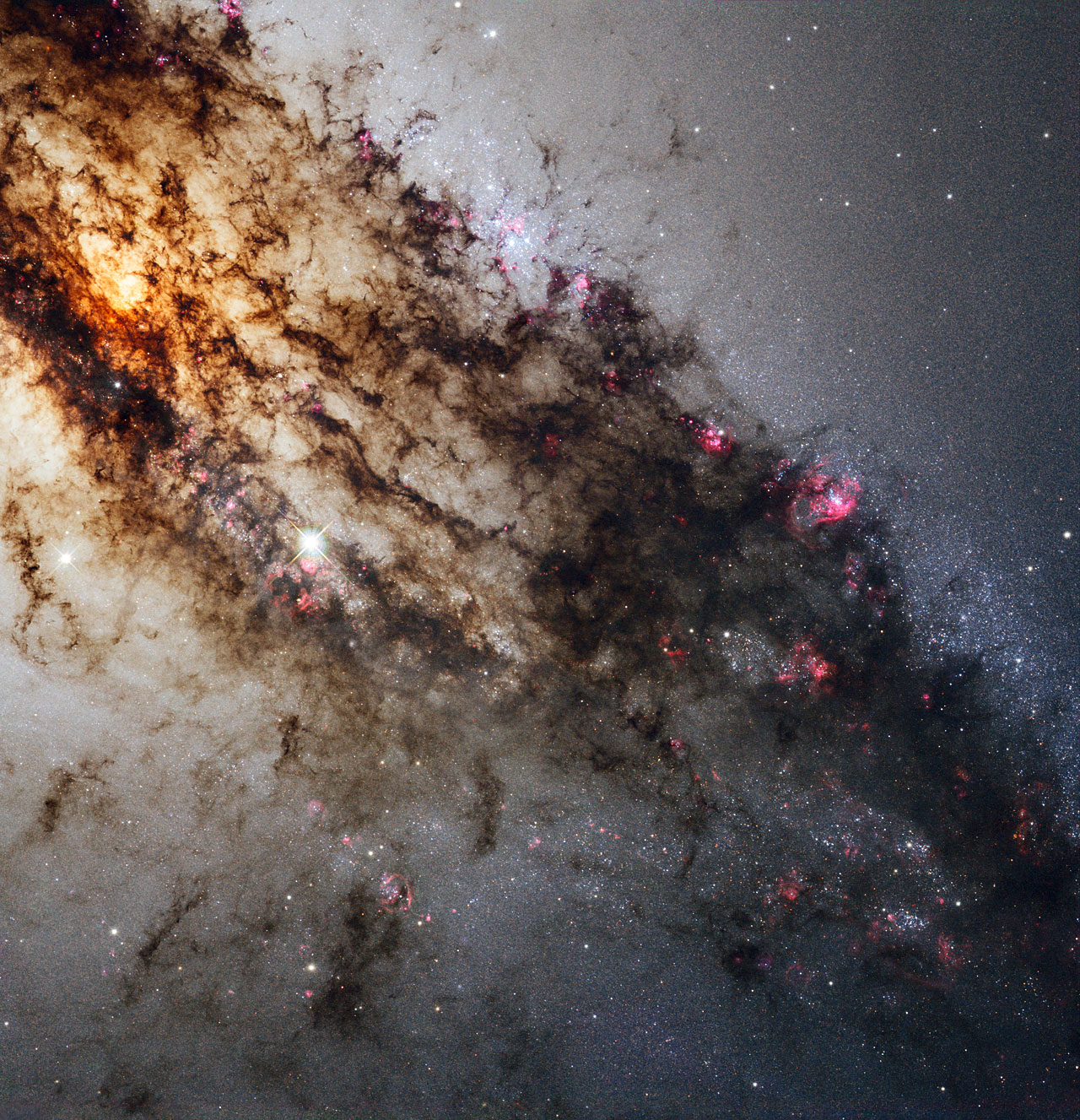
Spectacular Hubble View of Centaurus A


ESA - Hubble Space Telescope logo.

16 June 2011


The NASA/ESA Hubble Space Telescope has produced a close-up view of the galaxy Centaurus A. Hubble’s out-of-this-world location and world-class Wide Field Camera 3 instrument reveal a dramatic picture of a dynamic galaxy in flux.

Centaurus A, also known as NGC 5128, is well known for its dramatic dusty lanes of dark material. Hubble’s observations, using its most advanced instrument, the Wide Field Camera 3, are the most detailed ever made of this galaxy. They have been combined here in a multi-wavelength image that reveals never-before-seen detail in the dusty portion of the galaxy.

As well as features in the visible spectrum, this composite shows ultraviolet light from young stars, and near-infrared light, which lets us glimpse some of the detail otherwise obscured by the dust.

The dark dust lane that crosses Centaurus A does not show an absence of stars, but rather a relative lack of starlight, as the opaque clouds block the visible light from reaching us. Hubble’s Wide Field Camera 3 has focussed on these dusty regions, which span from corner to corner in this image. Wider views from ground-based telescopes show this stripe crossing the entire galaxy.

Interesting features such as the warped shape of its disc of gas and dust (outside the view) hint that at some point in the past, Centaurus A collided and merged with another galaxy. The shockwaves of this event caused hydrogen gas to coalesce and sparked intense areas of star formation, as seen in its outlying regions and in red patches visible in this Hubble close-up.

A tour of Centaurus A

The galaxy’s compact nucleus contains a highly active supermassive black hole at its centre. Powerful relativistic jets release vast amounts of radio and X-ray radiation — although these are invisible here as Hubble’s instruments are designed to study optical, ultraviolet and infrared wavelengths.

At just over 11 million light-years distant, Centaurus A is relatively nearby in astronomical terms. However, it is not only close, it is also bright. This makes it a very attractive target for amateur astronomers in the southern hemisphere, where it is visible. Stargazers can see the galaxy through binoculars, while larger amateur telescopes begin to unveil the distinctive dusty lanes.

Pan across Centaurus A

However it is only with the capabilities of the Hubble Space Telescope that many of the features in this image become visible: as well as providing unparalleled clarity and resolution, Hubble’s position in orbit means that it can see ultraviolet wavelengths which are blocked by the atmosphere and so invisible from the ground.

Notes:

The Hubble Space Telescope is a project of international cooperation between ESA and NASA.

Image credit: NASA, ESA, and the Hubble Heritage (STScI/AURA)-ESA/Hubble Collaboration. Acknowledgment: R. O’Connell (University of Virginia) and the WFC3 Scientific Oversight Committee

Links:

    Images of Hubble: http://www.spacetelescope.org/images/archive/category/spacecraft/

    Wide-field image of Centaurus A from the European Southern Observatory: http://www.eso.org/public/news/eso0315/

    NASA press release: http://hubblesite.org/newscenter/archive/releases/2011/18/

Images, Text, Credit: NASA / ESA, and the Hubble Heritage (STScI / AURA)-ESA / Hubble Collaboration. Acknowledgment: R. O’Connell (University of Virginia) and the WFC3 Scientific Oversight Committee / Videos: ESA / Hubble / The Hubble Heritage (STScI / AURA)-ESA/Hubble Collaboration. Acknowledgment: R. O’Connell (University of Virginia) and the WFC3 Scientific Oversight Committee.

Greetings, Orbiter.ch

A Green Ring Fit for a Superhero


NASA - SPITZER Space Telescope logo.

16 June 2011


This glowing emerald nebula seen by NASA's Spitzer Space Telescope is reminiscent of the glowing ring wielded by the superhero Green Lantern. In the comic books, the diminutive Guardians of the Planet "Oa" forged his power ring, but astronomers believe rings like this are actually sculpted by the powerful light of giant "O" stars, the most massive type of star known to exist.

Named RCW 120, this region of hot gas and glowing dust can be found in the murky clouds encircled by the tail of the constellation Scorpius. The ring of dust actually is glowing in infrared colors that our eyes cannot see, but show up brightly when viewed by Spitzer's infrared detectors. At the center of this ring are a couple of giant stars whose intense ultraviolet light has carved out the bubble, though they blend in with other stars when viewed in infrared.

This bubble is far from unique. Just as the Guardians of Oa have selected many beings to serve as Green Lanterns and patrol different sectors of space, Spitzer has found that such bubbles are common and an can be found around O stars throughout our Milky Way galaxy. The small objects at the lower right area of the image may themselves be similar regions seen at much greater distances across the galaxy.

Rings like this are so common in Spitzer's observations that astronomers have even enlisted the help of the public to help them find and catalog them all. Anyone interested in joining the search as a citizen scientist can visit "The Milky Way Project," part of the "Zooniverse" of public astronomy projects, at: http://www.milkywayproject.org/

Image, Text, Credit: NASA / JPL-Caltech.

Cheers, Orbiter.ch

mercredi 15 juin 2011

NASA'S Chandra Finds Massive Black Holes Common In Early Universe


NASA - Chandra X-Ray Observatory logo.

June 15, 2011

Using the deepest X-ray image ever taken, astronomers found the first direct evidence that massive black holes were common in the early universe. This discovery from NASA's Chandra X-ray Observatory shows that very young black holes grew more aggressively than previously thought, in tandem with the growth of their host galaxies.


Image above: Composite image of Chandra Deep Field South. (X-ray: NASA/CXC/U.Hawaii/ E.Treister et al; Infrared: NASA/STScI/UC Santa Cruz/G.Illingworth et al; Optical: NASA/STScI/S.Beckwith et al).

By pointing Chandra at a patch of sky for more than six weeks, astronomers obtained what is known as the Chandra Deep Field South (CDFS). When combined with very deep optical and infrared images from NASA's Hubble Space Telescope, the new Chandra data allowed astronomers to search for black holes in 200 distant galaxies, from when the universe was between about 800 million to 950 million years old.

"Until now, we had no idea what the black holes in these early galaxies were doing, or if they even existed," said Ezequiel Treister of the University of Hawaii, lead author of the study appearing in the June 16 issue of the journal Nature. "Now we know they are there, and they are growing like gangbusters."


Image above: Artist impression of a growing supermassive black hole located in the early universe. (NASA/CXC/A.Hobart).

The super-sized growth means that the black holes in the CDFS are less extreme versions of quasars -- very luminous, rare objects powered by material falling onto supermassive black holes. However, the sources in the CDFS are about a hundred times fainter and the black holes are about a thousand times less massive than the ones in quasars.

The observations found that between 30 and 100 percent of the distant galaxies contain growing supermassive black holes. Extrapolating these results from the small observed field to the full sky, there are at least 30 million supermassive black holes in the early universe. This is a factor of 10,000 larger than the estimated number of quasars in the early universe.


Image above: Artist impression of a very young galaxy located in the early universe less than one billion years after the Big Bang. (NASA/CXC/M.Weiss).

"It appears we've found a whole new population of baby black holes," said co-author Kevin Schawinski of Yale University. "We think these babies will grow by a factor of about a hundred or a thousand, eventually becoming like the giant black holes we see today almost 13 billion years later."

A population of young black holes in the early universe had been predicted, but not yet observed. Detailed calculations show that the total amount of black hole growth observed by this team is about a hundred times higher than recent estimates.

Watch an animation of a hidden black hole

Because these black holes are nearly all enshrouded in thick clouds of gas and dust, optical telescopes frequently cannot detect them. However, the high energies of X-ray light can penetrate these veils, allowing the black holes inside to be studied.

Physicists studying black holes want to know more how the first supermassive black holes were formed and how they grow. Although evidence for parallel growth of black holes and galaxies has been established at closer distances, the new Chandra results show that this connection starts earlier than previously thought, perhaps right from the origin of both.

"Most astronomers think in the present-day universe, black holes and galaxies are somehow symbiotic in how they grow," said Priya Natarajan, a co-author from Yale University. "We have shown that this codependent relationship has existed from very early times."

Watch a video of Chandra Deep Field South

It has been suggested that early black holes would play an important role in clearing away the cosmic "fog" of neutral, or uncharged, hydrogen that pervaded the early universe when temperatures cooled down after the Big Bang. However, the Chandra study shows that blankets of dust and gas stop ultraviolet radiation generated by the black holes from traveling outwards to perform this "reionization." Therefore, stars and not growing black holes are likely to have cleared this fog at cosmic dawn.

Chandra is capable of detecting extremely faint objects at vast distances, but these black holes are so obscured that relatively few photons can escape and hence they could not be individually detected. Instead, the team used a technique that relied on Chandra’s ability to accurately determine the direction from which the X-rays came to add up all the X-ray counts near the positions of distant galaxies and find a statistically significant signal.

NASA's Marshall Space Flight Center in Huntsville, Ala., manages the Chandra program for the agency's Science Mission Directorate in Washington. The Smithsonian Astrophysical Observatory controls Chandra's science and flight operations from Cambridge, Mass.

More information, including images and other multimedia, can be found at: http://www.nasa.gov/chandra and http://chandra.si.edu

Images (mentioned), Videos, Text, Credit: NASA / CXC / STScI.

Greetings, Orbiter.ch

mardi 14 juin 2011

Brussels - Paris,Solar Impulse landed at Le Bourget


Solar Impulse logo.

June 14, 2011

"Perfect approach, majestic and silent," Solar Impulse "touched down gently and slowly rolled gradually slowing until the team members on shore do not catch the ends of its wings - the hand - to prevent it lies on the side "is the description of the landing that can be read on the official blog of this adventure: http://www.solarimpulse.com/blog/

After an initial failed attempt on Saturday, the Swiss aircraft powered by solar energy has landed safely Tuesday at 9:15 p.m. at Paris, following a flight that lasted about 16 hours.

Video. Takeoff from Brussels on Tuesday at 5:10 am

He had indeed departed that morning at 5:10 from the airport of Brussels. The unit will be the guest of honor of the 49th International Exhibition of Aeronautics and Space, which opens June 20 in Paris airport.

"The pilot André Borschberg extract was painfully cramped cockpit, stretching his stiff limbs, before all the microphones to tell outstretched toward him how he was happy to land at Le Bourget airport in terms of a flight serene and beautiful, "says the blog. He still had to weave between the clouds.

Wait for hours in the clouds

Previously, a blog post that explained the experimental apparatus had arrived earlier in the Paris region. To 15 hours, he flew already Auxerre, south of Paris, but could arise for several reasons. On the one hand, day, land heats up and heat rises. And "the hottest areas - the roof of a shed, a highway, a railway station - will generate bubbles of rising air that may destabilize the aircraft." This danger is reduced over the sun, explained Raymond Clerc, Head of Mission on the blog of the adventure.


Image above: LE BOURGET AIRPORT PARIS, June 14, 2011. Solar Impulse landed at 21:15. He will headline the 49th International Exhibition of Aeronautics and Space. Credits. AFP / Eric Piermont.

On the other hand, air traffic is intense up to 21 hours over the airport Charles de Gaulle, near which the Solar Impulse should pass. An area of ​​traffic that also induces strong turbulence, "the drag generated by the wings of aircraft that can occur more than ten minutes after their passage," he added.

This flight will not be approved because the plane, supposed to work only on solar energy, had to recharge his batteries 40% staying with current conventional after the severe defeat on Saturday. This prototype has the wingspan of a Boeing - 64 meters - but the weight of a car, or 1.6 tonne.Ses wings are covered with 12,000 solar cells that power four electric motors of an output of 10 hp each . The ultimate goal of the team based in Duebendorf, Switzerland, is attempting a world tour in five stages, around 2013 or 2014.

Images, Video, Text, Credits. AFP / Eric Piermont / Translation: Orbiter.ch.

Cheers, Orbiter.ch

SMOS gains clearer view as illegal transmitters shut down


ESA - SMOS Mission logo.

14 June 2011

A major international effort to shut down radio signals that have, at times, been blinding the instrument on ESA’s SMOS water satellite is producing a marked improvement in the quality of the mission’s data.

The Soil Moisture and Ocean Salinity (SMOS) satellite was launched at the end of 2009 to improve our understanding of the water cycle.

Improving situation

The satellite carries a passive radiometer that operates in the 1400–1427 MHz frequency range (L-band) of the electromagnetic spectrum. It captures snapshots of ‘brightness temperature’ that correspond to microwave radiation emitted from Earth’s surface.

From this information, the amount of moisture held in the surface layers of soil and salinity in the surface waters of the oceans can be derived.

According to radio regulations set by the International Telecommunications Union (ITU), 1400–1427 MHz is allocated to the Earth Exploration Satellite Service, space research and radio astronomy – other transmissions in this band are prohibited.

SMOS

However, soon after SMOS was launched, the data revealed there were many signals being transmitted within this protected passive band, rendering some of the data unusable for scientific purposes.

SMOS is well on the way to meeting its research objectives over areas free of this radio-frequency interference. However, the mission has clearly not been reaching its full potential because significant amounts of data have had to be discarded.

The areas worst affected are in southern Europe, southern and eastern Asia and the Middle East.

To ensure the integrity of the mission, ESA has gone to considerable effort to investigate exactly where the interference comes from and to urge national authorities to take action.

SMOS ‘seeing’ clearer now

It transpired that interference is due to illegal signals being transmitted within the protected band and other signals from adjacent bands that leak into the protected region.

Investigations have revealed that most of the problems stem from unauthorised transmitters in the protected band such as TV and other radio links and wireless-camera monitoring systems.

Emissions from air surveillance radar and other radiolocation systems are also common sources of interference.

Interference over Greece a year ago

Through painstaking efforts by ESA teams and their collaboration with various international and national spectrum management authorities, the problem, although far from being completely resolved, is now much improved.

To date, 387 separate sources of interference have been detected worldwide, mostly from Asia and Europe.

This number should be treated with caution because strong signals mask weaker ones, which will only come to light as the stronger ones are turned off.

As a result of ESA’s strategies, which included developing a way of detecting a source to within just 5 km, 90 of these transmitters have been turned off. Most of these were in Europe but investigations continue in more than 35 countries worldwide.

Types of interference

While illegal transmissions can be resolved through cooperation with national authorities enforcing ITU regulations, the solution to interference caused by unwanted emission from neighbouring services requires further regulatory action.

This issue was addressed at the World Radio Conference in 2007 and recommendations on maximum 'out-of-band' levels were agreed. Furthermore, earlier this year the European Conference of Postal and Telecommunications Administrations adopted the decision to make these limits compulsory its member countries.

The problem of interference has been more of an issue over land, contaminating data on soil moisture. However, there are also problems with ocean salinity retrievals.

Interference over the ocean

For example, radar systems in North America are polluting large swathes of data from the northern oceans. However, the administrations involved are planning to refurbish some of these systems after the summer.

Although there has been a big improvement in the quality of SMOS data, ESA is set to continue its efforts, particularly in the Near and Middle East, China and southern Asia.

The efforts to reduce radio-frequency interference will also benefit other missions carrying L-band radar, such as NASA's new Aquarius satellite, which was launched on 10 June to measure ocean salinity.

Related links:

Access SMOS data: http://earth.esa.int/SMOS/

International Telecommunications Union: http://www.itu.int/en/pages/default.aspx

European Conference of Postal and Telecommunications Administrations: http://www.cept.org/

Images, Video, Text, Credits: ESA / AOES Medialab / CESBIO.

Best regards, Orbiter.ch

lundi 13 juin 2011

NASA Spacecraft Captures Video Of Asteroid Approach


NASA - Dawn Mission patch.

June 13, 2011

Scientists working with NASA's Dawn spacecraft have created a new video showing the giant asteroid Vesta as the spacecraft approaches this unexplored world in the main asteroid belt.

The video loops 20 images obtained for navigation purposes on June 1. The images show a dark feature near Vesta's equator moving from left to right across the field of view as Vesta rotates. Images also show Vesta's jagged, irregular shape, hinting at the enormous crater known to exist at Vesta's south pole.


Video above: This movie shows surface details beginning to resolve as NASA's Dawn spacecraft closes in on the giant asteroid Vesta. The framing camera aboard NASA's Dawn spacecraft obtained the images used for this animation on June 1, 2011, from a distance of about 300,000 miles (483,000 kilometers).

The images were obtained by a framing camera during a 30-minute period and show about 30 degrees of a rotation. The pixel size in these images is approaching the resolution of the best Hubble Space Telescope images of Vesta.

"Like strangers in a strange land, we're looking for familiar landmarks," said Jian-Yang Li, a Dawn participating scientist from the University of Maryland, College Park. "The shadowy spot is one of those – it appears to match a feature, known as 'Feature B,' from images of Vesta taken by NASA's Hubble Space Telescope."

Before orbiting Vesta on July 16, Dawn will gently slow down to about 75 mph (120 kph). NASA is expecting to release more images on a weekly basis, with more frequent images available once the spacecraft begins collecting science at Vesta.

"Vesta is coming more and more into focus," said Andreas Nathues, framing camera lead investigator, based at the Max Planck Institute for Solar System Research, Katlenburg-Lindau, Germany. "Dawn's framing camera is working exactly as anticipated."


The mission is managed by NASA's Jet Propulsion Laboratory in Pasadena, Calif., for the agency's Science Mission Directorate in Washington. Dawn is a project of the directorate's Discovery Program, managed by NASA's Marshall Space Flight Center in Huntsville, Ala. UCLA is responsible for overall Dawn mission science. Orbital Sciences Corp. of Dulles, Va., designed and built the Dawn spacecraft. The framing cameras were developed and built under the leadership of the Max Planck Institute for Solar System Research in Katlenburg-Lindau, Germay.

The German Aerospace Center (DLR) Institute of Planetary Research in Berlin made significant contributions in coordination with the Institute of Computer and Communication Network Engineering in Braunschweig. The framing camera project is funded by the Max Planck Society, DLR and NASA.

The video from Dawn also will air Monday afternoon on NASA Television's Video File. For NASA TV downlink information, schedules and links to streaming video, visit: http://www.nasa.gov/ntv

Image (mentioned), Video (mentioned), Text, Credit: NASA.

Greetings, Orbiter.ch