mardi 24 avril 2012

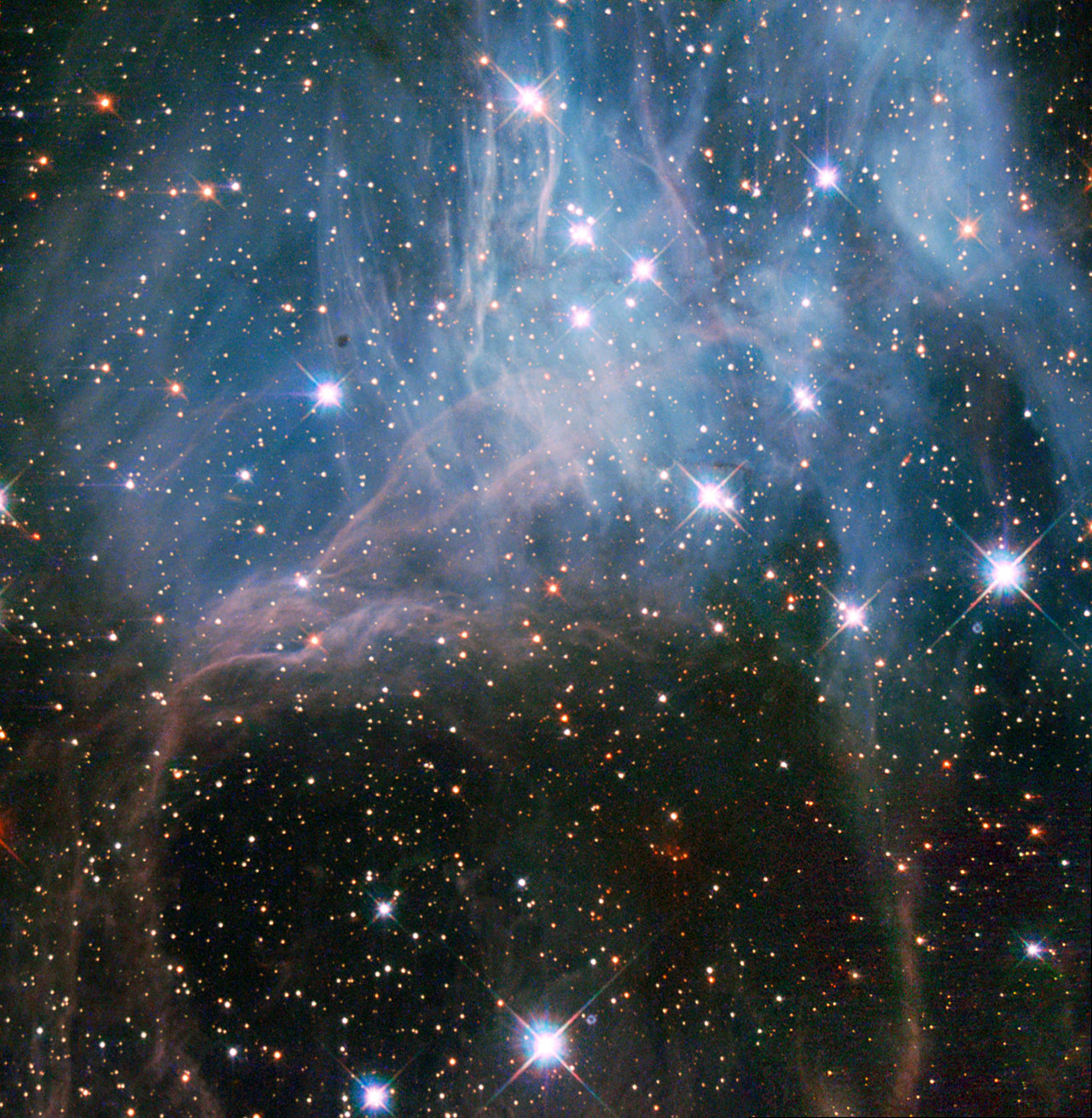
Hubble Peeks Inside a Stellar Cloud

NASA - Hubble Space Telescope patch.

04.24.12


Bright stars, shining through what looks like a haze in the night sky, are part of a young stellar grouping in one of the largest known star formation regions of the Large Magellanic Cloud, a dwarf satellite galaxy of the Milky Way. The image was captured by the NASA/ESA Hubble Space Telescope's Wide Field Planetary Camera 2.

The stellar grouping, known to stargazers as NGC 2040 or LH 88, is a loose star cluster whose stars have a common origin and are drifting together through space. There are three different types of stellar associations defined by their stellar properties. NGC 2040 is an OB association, a grouping that usually contains 10–100 stars of type O and B--these are high-mass stars that have short but brilliant lives. It is thought that most of the stars in the Milky Way were born in OB associations.

A version of this image was entered into the Hubble’s Hidden Treasures Image Processing Competition by contestant Eedresha Sturdivant. Hidden Treasures is an initiative to invite astronomy enthusiasts to search the Hubble archive for stunning images that have never been seen by the general public.

The Hubble Space Telescope is a project of international cooperation between NASA and the European Space Agency.

For more information about Hubble visit: http://www.nasa.gov/hubble and http://hubblesite.org/

ESA Hubble site: http://www.spacetelescope.org/

Image, Text, Credit: ESA / Hubble, NASA and D. A Gouliermis. Acknowledgement: Flickr user Eedresha Sturdivant.

Greetings, Orbiter.ch

NASA's Spitzer Finds Galaxy with Split Personality


NASA - Spitzer Space Telescope patch.

04.24.12


The infrared vision of NASA's Spitzer Space Telescope has revealed that the Sombrero galaxy -- named after its appearance in visible light to a wide-brimmed hat -- is in fact two galaxies in one. Image credit: NASA/JPL-Caltech.

While some galaxies are rotund and others are slender disks like our spiral Milky Way, new observations from NASA's Spitzer Space Telescope show that the Sombrero galaxy is both. The galaxy, which is a round elliptical galaxy with a thin disk embedded inside, is one of the first known to exhibit characteristics of the two different types. The findings will lead to a better understanding of galaxy evolution, a topic still poorly understood.

"The Sombrero is more complex than previously thought," said Dimitri Gadotti of the European Southern Observatory in Chile and lead author of a new paper on the findings appearing in the Monthly Notices of the Royal Astronomical Society. "The only way to understand all we know about this galaxy is to think of it as two galaxies, one inside the other."

The Sombrero galaxy, also known as NGC 4594, is located 28 million light-years away in the constellation Virgo. From our viewpoint on Earth, we can see the thin edge of its flat disk and a central bulge of stars, making it resemble a wide-brimmed hat. Astronomers do not know whether the Sombrero's disk is shaped like a ring or a spiral, but agree it belongs to the disk class.

"Spitzer is helping to unravel secrets behind an object that has been imaged thousands of times," said Sean Carey of NASA's Spitzer Science Center at the California Institute of Technology in Pasadena. "It is intriguing Spitzer can read the fossil record of events that occurred billions of years ago within this beautiful and archetypal galaxy."


Image above: New observations from NASA's Spitzer Space Telescope reveal the Sombrero galaxy is not simply a regular flat disk galaxy of stars as previously believed, but a more round elliptical galaxy with a flat disk tucked inside. Image credit: NASA/JPL-Caltech.

Spitzer captures a different view of the galaxy than visible-light telescopes. In visible views, the galaxy appears to be immersed in a glowing halo, which scientists had thought was relatively light and small. With Spitzer's infrared vision, a different view emerges. Spitzer sees old stars through the dust and reveals the halo has the right size and mass to be a giant elliptical galaxy.

While it is tempting to think the giant elliptical swallowed a spiral disk, astronomers say this is highly unlikely because that process would have destroyed the disk structure. Instead, one scenario they propose is that a giant elliptical galaxy was inundated with gas more than nine billion years ago. Early in the history of our universe, networks of gas clouds were common, and they sometimes fed growing galaxies, causing them to bulk up. The gas would have been pulled into the galaxy by gravity, falling into orbit around the center and spinning out into a flat disk. Stars would have formed from the gas in the disk.

"This poses all sorts of questions," said Rubén Sánchez-Janssen from the European Southern Observatory, co-author of the study. "How did such a large disk take shape and survive inside such a massive elliptical? How unusual is such a formation process?"

Spitzer Space Telescope

Researchers say the answers could help them piece together how other galaxies evolve. Another galaxy, called Centaurus A, appears also to be an elliptical galaxy with a disk inside it. But its disk does not contain many stars. Astronomers speculate that Centaurus A could be at an earlier stage of evolution than the Sombrero and might eventually look similar.

The findings also answer a mystery about the number of globular clusters in the Sombrero galaxy. Globular clusters are spherical nuggets of old stars. Ellipticals typically have a few thousand, while spirals contain a few hundred. The Sombrero has almost 2,000, a number that makes sense now but had puzzled astronomers when they thought it was only a disk galaxy.

NASA's Jet Propulsion Laboratory, Pasadena, Calif., manages the Spitzer Space Telescope mission for NASA's Science Mission Directorate, Washington. Science operations are conducted at the Spitzer Science Center at the California Institute of Technology in Pasadena. Data are archived at the Infrared Science Archive housed at the Infrared Processing and Analysis Center at Caltech. Caltech manages JPL for NASA. For more information about Spitzer, visit http://spitzer.caltech.edu/ and http://www.nasa.gov/spitzer 

Images (mentioned), Text, Credits: NASA / Whitney Clavin / JPL / J.D. Harrington.

Best regards, Orbiter.ch

lundi 23 avril 2012

Cassini Spacecraft Sees New Objects Blazing Trails in Saturn Ring


NASA / ESA - Cassini Mission to Saturn patch.

April 24, 2012

Scientists working with images from NASA's Cassini spacecraft have discovered strange, half-mile-sized objects punching through one of Saturn's rings and leaving glittering trails behind them. The results will be presented tomorrow at the European Geosciences Union meeting in Vienna, Austria.


Video above: Images from NASA's Cassini spacecraft have revealed half-mile-sized (kilometer-sized) objects punching through parts of Saturn's F ring, leaving glittering trails behind them. These trails in the rings, which scientists are calling "mini-jets," fill in a missing link in our story of the curious behavior of the F ring. NASA/JPL-Caltech.

The penetration occurred in the outermost of Saturn's main rings, called the F ring, which has a circumference of 550,000 miles (881,000 kilometers). Scientists are calling the trails in the F ring "mini-jets." Cassini scientists combed through 20,000 images and found 500 examples of these rogues during the seven years Cassini has been at Saturn.

"Beyond just showing us the strange beauty of the F ring, Cassini's studies of this ring help us understand the activity that occurs when solar systems evolve out of dusty disks that are similar to, but obviously much grander than, the disk we see around Saturn," said Linda Spilker, Cassini project scientist at NASA's Jet Propulsion Laboratory (JPL) in Pasadena, Calif.


Image above: This set of six images obtained by NASA's Cassini spacecraft shows trails that were dragged out from Saturn's F ring by objects about a half mile (1 kilometer) in diameter. NASA/JPL-Caltech/SSI/QMUL.

Scientists have known relatively large objects can create channels, ripples and snowballs, or clumps of icy material, in the F ring. However, scientists did not know what happened to these snowballs after they were created. Some were broken up by collisions or tidal forces in their orbit around Saturn. Scientists now have evidence some of the smaller ones survived, and their differing orbits mean they go on to strike through the F ring on their own.

"I think the F ring is Saturn's weirdest ring, and these latest Cassini results go to show how the F ring is even more dynamic than we ever thought," said Carl Murray, a Cassini imaging team member based at Queen Mary University of London, U.K. "These findings show us that the F ring region is like a bustling zoo of objects from a half-mile (0.8-kilometer) in size to moons like Prometheus a hundred miles (160.9 kilometers) in size, creating a spectacular show."


Image above: The constant change in Saturn's wavy, wiggly F ring is on display in this set of images obtained by NASA's Cassini spacecraft. Image credit: NASA/JPL-Caltech/SSI/QMUL.

These small objects appear to collide with the F ring at gentle speeds about 4 mph (2 meters per second). The collisions drag glittering ice particles out of the F ring with them, leaving a trail of 20-110 miles (40-180 kilometers) long.

In some cases, the objects traveled in packs, creating mini-jets that looked exotic, like the barb of a harpoon. Other new images show grand views of the entire F ring and the swirls and eddies from the different kinds of objects moving through and around it.


Image above: This image obtained by NASA's Cassini spacecraft around the time it went into orbit around Saturn in 2004 shows a short trail of icy particles dragged out from Saturn's F ring. Image Credit: NASA/JPL-Caltech/SSI/QMUL.

Saturn's rings are comprised primarily of water ice. The chunks of ice that make up the main rings spread out 85,000 miles (140,000 kilometers) from the center of Saturn. Scientists believe the rings' average thickness is approximately 30 feet (10 meters).


This set of four images obtained by NASA's Cassini spacecraft shows some of the more bizarre trails that were dragged out from Saturn's F ring by objects about a half mile (1 kilometer) in diameter. Image credit: NASA/JPL-Caltech/SSI/QMUL.

The Cassini-Huygens mission is a cooperative project of NASA, the European Space Agency and the Italian Space Agency. JPL manages the mission for NASA's Science Mission Directorate in Washington. The imaging team is based at the Space Science Institute in Boulder, Colo.

New images and movies of the mini-jets are available at: http://www.nasa.gov/mission_pages/cassini/whycassini/cassini20120423.html

For information about Cassini, visit: http://www.nasa.gov/cassini and http://www.esa.int/esaMI/Cassini-Huygens/

Images (mentioned), Video (mentioned), Text, Credits: NASA / Dwayne Brown / JPL / Jia-Rui C. Cook.

Greetings, Orbiter.ch

LHC reaches data milestone


CERN - European Organization for Nuclear Research logo.

24 April 2012

In just three weeks of operation in "stable beams" mode, the Large Hadron Collider (LHC) has already delivered approximately one inverse femtobarn of data to the experiments - a measure of accelerator performance equivalent to 100 trillion proton-proton collisions. Last year, the LHC took three months to reach that amount. Stable beams mode enables the experiments to collect data for physics analysis.

CERN grid computing center

The LHC is now operating at 1380 proton bunches per beam, the maximum value set for this year. It has also exceeded the maximum peak luminosity – a measure of the instantaneous collision rate – achieved last year: while the top value for 2011 was 3.6 × 1033 collisions per square centimetre per second, LHC has now reached 3.9 × 1033 cm-2 s-1.

Cross section of an LHC dipole in the CERN tunnel (click on the image for enlarge)

The higher collision energy of 4 TeV per beam (compared to 3.5 TeV per beam in 2011) and the resulting higher number of collisions expected both enhance the machine's discovery potential considerably, opening up new possibilities for searches for new and heavier particles.

Note:

CERN, the European Organization for Nuclear Research, is one of the world’s largest and most respected centres for scientific research. Its business is fundamental physics, finding out what the Universe is made of and how it works. At CERN, the world’s largest and most complex scientific instruments are used to study the basic constituents of matter — the fundamental particles. By studying what happens when these particles collide, physicists learn about the laws of Nature.

The instruments used at CERN are particle accelerators and detectors. Accelerators boost beams of particles to high energies before they are made to collide with each other or with stationary targets. Detectors observe and record the results of these collisions.

Founded in 1954, the CERN Laboratory sits astride the Franco–Swiss border near Geneva. It was one of Europe’s first joint ventures and now has 20 Member States.

More information:

    LHC homepage: http://lhc.web.cern.ch/lhc/

    ATLAS: http://atlas.ch/

    CMS: http://cms.web.cern.ch/

Images, Text, Credit: CERN.

Greetings, Orbiter.ch

Launched from Baikonur space rocket Proton-M spacecraft with YaSat-1B


ILS / ROSCOSMOS - YaSat-1B Mission poster.

24/04/2012

 Proton-M launch

April 24 at 2:00 Moscow time, 18 minutes from the launch pad area 200 Baikonur launch took place of a space rocket Proton-M with the upper block (RB), the Briz-M, designed for launching into orbit telecommunications spacecraft (SC) YaSat -1B.


In accordance with the flight cyclogram head unit in the Republic of Belarus the Briz-M and SC YaSat-1B cleanly separated from the third stage of the launch vehicle, followed by removal of the SC RB continued to the target orbit.

Proton-M with the upper block (RB), the Briz-M & satellite

Office of the spacecraft from the upper stage is scheduled for 11:00 Moscow time 30 minutes April 24 this year.

Proton-M & YaSat-1B launch

Original text in Russian: http://www.federalspace.ru/main.php?id=2&nid=19000

Images, Video, Text, Credits: Press Service of the Russian Space Agency (Roscosmos PAO) / Roscosmos TV / ILS /  Astrium / Translation: Orbiter.ch.

Regards, Orbiter.ch

ESA’s long-term technology plans for space exploration


ESA logo.

23 April 2012

Make it to low-Earth orbit and you’re halfway to anywhere, observed science fiction writer Robert Heinlein. A workshop at ESA’s technical heart has been assessing the technologies needed to make the other half of the trip.

ESA’s technical experts have prepared long-term roadmaps of technologies required for advanced robotic and human exploration.

On 13 April the people who will actually be developing these technologies for current and future space missions had their say.

Mars Sample Return mission

A one-day Space Exploration Technologies Workshop at ESTEC, the Netherlands, co-organised with industry body Eurospace, gathered representatives from leading European aerospace companies and ESA delegations to give their own reactions to the draft technology plans. 

More than 70 participants representing a variety of European industrial expertise and experience ranging from primes and large integrators to more specialised smaller companies spanning many ESA Member States were present.

“We are here to listen to your comments and ideas,” said ESA’s Giorgio Saccoccia, head of the Agency’s Propulsion and Aerothermodynamics division plans and coordinator for Exploration in the Directorate of Technical and Quality Management.

Exploration Technologies workshop

Nicolas Peter, Secretary of the Human Spaceflight, Microgravity and Exploration Programme Board, added that, “this workshop is part of a process aiming to initiate a dialogue with industry to prepare the future steps in exploration technology development and procurement.”

Technology roadmaps covering ten major technology areas were presented and discussed. It was highlighted by ESA specialists and industrialists that:

    - Advanced propulsion technologies will be required to meet the new requirements for space exploration cargo and human long-distance travel and planetary landing and return.

    - Robotic missions will need advanced autonomy, because signals from Earth will take long periods to reach them.

    - The Automation and Robotics plan includes a new generation of surface rovers. The workshop discussed whether development should extend beyond wheeled rovers to other modes of locomotion, such as walkers or aerostats.

    - Missions will venture farther from the Sun, and beneath planetary atmospheres. Solar energy may no longer be available at useable levels. So the Novel Energy Production and Storage plan includes the development of European nuclear power sources, as well as fuel cells.

    - Human crews will have to be kept alive and comfortable for years at a time. A self-sufficient closed-loop life-support system will be required – the long-term aim of ESA’s Micro-Ecological Life Support System Alternative (MELiSSA) programme – and effective radiation protection will be essential.

    - Inflatable habitats will be key to roomy space living, both for orbital missions and planetary exploration, ideally with portholes.

    - Planetary explorers will face a new class of threat that has so far only been encountered very briefly: surface dust.

    - The single most difficult class of missions, short of human expeditions, is sample return. An international Mars sample return mission remains a long-term plan, with other missions being considered.

    - Landing safely and precisely and then taking off will be extremely difficult, along with docking to a waiting ‘mothership’ for return to Earth.

    - The long distances that sample-return missions will travel means they will return to Earth very rapidly, requiring sophisticated thermal control.

Presenting draft roadmaps

The technology plans have been prepared by the Directorate of Technical and Quality Management, in coordination with mission designers in the Directorates of Science and Robotic Exploration and Human Spaceflight and Operations.

ESA Aurora Exploration  Program

Based on the comments provided by industry, the plans will be consolidated for ESA’s upcoming Ministerial Council and will form the basis for the preparation of an ESA coordinated procurement plan.

Related links:

Eurospace: http://www.eurospace.org/

Space Exploration Technologies Workshop: http://www.congrexprojects.com/12C22

Technology: http://www.esa.int/SPECIALS/Technology/index.html

Images, Video, Text, Credit: Credits: ESA / AOES Medialab / Anneke Le Floc'h.

Cheers, Orbiter.ch

Progress M-15M: there is docked!


ROSCOSMOS - ISS "Russian Vehicles" patch.

04/23/2012

April 22 at 18.40 Moscow time, carried out docking cargo vehicle (THC), "Progress M-15M" to the International Space Station (ISS).

Progress-15 arriving at Space Station

THC docked to a docking bay (CO) "Pierce". Convergence process was carried out in automatic mode controlled by the Mission Control Center specialists of FSUE TsNIIMash and Russian crew members of ISS cosmonauts Space Agency Anton Shkaplerova, Anatoly Ivanishin and Oleg Kononenko.

Progress-M15 docking

The ship delivered cargo to the station needed to keep the ISS in manned mode and the program of applied research on its board. Among the goods - fuel, water, food, equipment, systems management, communications and life support, supplies of compressed oxygen, medical equipment, personal hygiene and control of purity of the atmosphere and cleaning stations, equipment for scientific research and experiments, additional equipment for the Russian and segments of the American station, as well as parcels for the crew of the ISS.

The ISS crew continues to work 30/31 long expedition in the Commander Daniel Burbank (NASA), flight engineers Anton Shkaplerova (Roscosmos), Anatoly Ivanishin (Roscosmos), Oleg Kononenko (Roscosmos), Andre Cowper (ESA) and Donald Pettit (NASA .)

Original text in Russian: http://www.federalspace.ru/main.php?id=2&nid=18994

Image, Video, Text, Credits: Press Service of the Russian Space Agency (Roscosmos PAO) / NASA / Translation: Orbiter.ch.

Greetings, Orbiter.ch