mercredi 3 octobre 2012

Comet crystals found in a nearby planetary system


ESA - Herschel Mission patch.

3 October 2012

Pristine material that matches comets in our own Solar System have been found in a dust belt around the young star Beta Pictoris by ESA’s Herschel space observatory.

Twelve-million-year-old Beta Pictoris resides just 63 light-years from Earth and hosts a gas giant planet along with a dusty debris disc that could, in time, evolve into a torus of icy bodies much like the Kuiper Belt found outside the orbit of Neptune in our Solar System.

Olivine crystals

Thanks to the unique observing capabilities of Herschel, the composition of the dust in the cold outskirts of the Beta Pictoris system has been determined for the first time.

Of particular interest was the mineral olivine, which crystallises out of the protoplanetary disc material close to newborn stars and is eventually incorporated into asteroids, comets and planets.

“As far as olivine is concerned, it comes in different ‘flavours’,” explains Ben de Vries from KU Leuven and lead author of the study reported in Nature.

“A magnesium-rich variety is found in small and primitive icy bodies like comets, whereas iron-rich olivine is typically found in large asteroids that have undergone more heating, or ‘processing’.”

Herschel detected the pristine magnesium-rich variety in the Beta Pictoris system at 15–45 astronomical units (AUs) from the star, where temperatures are around –190ºC.

For comparison, Earth lies at 1 AU from our Sun and the Solar System’s Kuiper Belt extends from the orbit of Neptune at about 30 AU out to 50 AU from the Sun.

Beta Pictoris system

The Herschel observations allowed astronomers to calculate that the olivine crystals make up around 4% of the total mass of the dust found in this region.

In turn, this finding led them to conclude that the olivine was originally bound up inside comets and released into space by collisions between the icy objects.

“The 4% value is strikingly similar to that of Solar System comets 17P/Holmes and 73P/Schwassmann-Wachmann 3, which contain 2–10% magnesium-rich olivine,” says Dr de Vries.

“Since olivine can only crystallise within about 10 AU of the central star, finding it in a cold debris disc means that it must have been transported from the inner region of the system to the outskirts.”

The ‘radial mixing’ transport mechanism is known from models of the evolution of swirling protoplanetary discs as they condense around new stars.

The mixing is stimulated in varying amounts by winds and heat from the central star pushing materials away, along with temperature differences and turbulent motion created in the disc during planet formation.

Herschel

“Our findings are an indication that the efficiency of these transport processes must have been similar between the young Solar System and within the Beta Pictoris system, and that these processes are likely independent of the detailed properties of the system,” says Dr de Vries.

Indeed, Beta Pictoris is over one and a half times the mass of our Sun, eight times as bright, and its planetary system architecture is different to our own Solar System today.

“Thanks to Herschel, we were able to measure the properties of pristine material left over from the initial planet-building process in another solar system with a precision that is comparable to what we could achieve in the laboratory if we had the material here on Earth,” says ESA’s Herschel project scientist Göran Pilbratt.

Related links:

Herschel: ESA's giant infrared observatory: http://www.esa.int/SPECIALS/Herschel/index.html

Herschel in depth: http://sci.esa.int/science-e/www/area/index.cfm?fareaid=16

Herschel Science Centre: http://herschel.esac.esa.int/

Images, Text, Credits: ESA / J. Debosscher, KU Leuven / ESO / A-M. Lagrange et al.

Best regards, Orbiter.ch

The Helix Nebula - Bigger in Death than Life


NASA - Spitzer Space Telescope patch / NASA - GALEX Mission patch.

October 3, 2012


Image above: A dying star is throwing a cosmic tantrum in this combined image from NASA's Spitzer Space Telescope and the Galaxy Evolution Explorer (GALEX), which NASA has lent to the California Institute of Technology in Pasadena. Image credit: NASA/JPL-Caltech.

A dying star is refusing to go quietly into the night, as seen in this combined infrared and ultraviolet view from NASA's Spitzer Space Telescope and the Galaxy Evolution Explorer (GALEX), which NASA has lent to the California Institute of Technology in Pasadena. In death, the star's dusty outer layers are unraveling into space, glowing from the intense ultraviolet radiation being pumped out by the hot stellar core.

Artist's impression of GALEX. Credit: NASA.

This object, called the Helix nebula, lies 650 light-years away in the constellation of Aquarius. Also known by the catalog number NGC 7293, it is a typical example of a class of objects called planetary nebulae. Discovered in the 18th century, these cosmic works of art were erroneously named for their resemblance to gas-giant planets.

Planetary nebulae are actually the remains of stars that once looked a lot like our sun. These stars spend most of their lives turning hydrogen into helium in massive runaway nuclear fusion reactions in their cores. In fact, this process of fusion provides all the light and heat that we get from our sun. Our sun will blossom into a planetary nebula when it dies in about five billion years.

Spitzer Space Telescope. Image credit: NASA / JPL-Caltech.

When the hydrogen fuel for the fusion reaction runs out, the star turns to helium for a fuel source, burning it into an even heavier mix of carbon, nitrogen and oxygen. Eventually, the helium will also be exhausted, and the star dies, puffing off its outer gaseous layers and leaving behind the tiny, hot, dense core, called a white dwarf. The white dwarf is about the size of Earth, but has a mass very close to that of the original star; in fact, a teaspoon of a white dwarf would weigh as much as a few elephants!

The intense ultraviolet radiation from the white dwarf heats up the expelled layers of gas, which shine brightly in the infrared. GALEX has picked out the ultraviolet light pouring out of this system, shown throughout the nebula in blue, while Spitzer has snagged the detailed infrared signature of the dust and gas in red, yellow and green. Where red Spitzer and blue GALEX data combine in the middle, the nebula appears pink. A portion of the extended field beyond the nebula, which was not observed by Spitzer, is from NASA's all-sky Wide-field Infrared Survey Explorer (WISE). The white dwarf star itself is a tiny white pinprick right at the center of the nebula.

More information about Spitzer is online at http://spitzer.caltech.edu and http://www.nasa.gov/spitzer . More information about GALEX is at http://www.galex.caltech.edu

Images (mentioned), Text, Credits: NASA / JPL / Whitney Clavin.

Greetings, Orbiter.ch

mardi 2 octobre 2012

'Bathurst Inlet' Rock on Curiosity's Sol 54, Context View


NASA - Mars Science Laboratory (MSL) patch.

October 2, 2012


Image above: NASA's Mars rover Curiosity held its Mars Hand Lens Imager (MAHLI) camera about 10.5 inches (27 centimeters) away from the top of a rock called "Bathurst Inlet" for a set of eight images combined into this merged-focus view of the rock. This context image covers an area roughly 6.5 inches by 5 inches (16 centimeters by 12 centimeters). Resolution is about 105 microns per pixel.

MAHLI took the component images for this merged-focus view, plus closer-up images of Bathurst Inlet, during Curiosity's 54th Martian day, or sol (Sept. 30, 2012). The instrument's principal investigator had invited Curiosity's science team to "MAHLI it up!" in the selection of Sol 54 targets for inspection with MAHLI and with the other instrument at the end of Curiosity's arm, the Alpha Particle X-Ray Spectrometer.

A merged-focus MAHLI view from closer to the rock, providing even finer resolution, is at http://photojournal.jpl.nasa.gov/catalog/14763 .

The Bathurst Inlet rock is dark gray and appears to be so fine-grained that MAHLI cannot resolve grains or crystals in it. This means that the grains or crystals, if there are any at all, are smaller than about 80 microns in size. Some windblown sand-sized grains or dust aggregates have accumulated on the surface of the rock but this surface is clean compared to, for example, the pebbly substrate below the rock (upper left and lower right in this context image).

MAHLI can do focus merging onboard. The full-frame versions of the eight separate images that were combined into this view were not even returned to Earth -- just the thumbnail versions. Merging the images onboard reduces the volume of data that needs to be downlinked to Earth.

Mars Streambed

Video above: Curiosity science team member Sanjeev Gupta explains how rounded pebbles spotted by the rover are convincing evidence of an ancient streambed on Mars. Credit: NASA/JPL-Caltech.

Curiosity's latest images are available at: http://1.usa.gov/MfiyD0

For more about NASA's Curiosity mission, visit: http://www.nasa.gov/mars and http://marsprogram.jpl.nasa.gov/msl

Follow the mission on Facebook and Twitter at: http://www.facebook.com/marscuriosity and http://www.twitter.com/marscuriosity

Image credit: NASA/JPL-Caltech/Malin Space Science Systems.

Best regards, Orbiter.ch

Mars Rover Opportunity Working at 'Matijevic Hill'


NASA - Mars Exploration Rover B "Opportunity" (MER-B) patch.

October 2, 2012

 (Click on the image for enlarge)

Image above: Rock fins up to about about 1 foot (30 centimeters) tall dominate this scene from the panoramic camera (Pancam) on NASA's Mars Exploration Rover Opportunity. Image credit: NASA/JPL-Caltech/Cornell Univ./Arizona State Univ.

NASA's Mars rover Opportunity, well into its ninth year on Mars, will work for the next several weeks or months at a site with some of the mission's most intriguing geological features.

The site, called "Matijevic Hill," overlooks 14-mile-wide (22-kilometer-wide) Endeavour Crater. Opportunity has begun investigating the site's concentration of small spherical objects reminiscent of, but different from, the iron-rich spheres nicknamed "blueberries" at the rover's landing site nearly 22 driving miles ago (35 kilometers).

The small spheres at Matijevic Hill have different composition and internal structure. Opportunity's science team is evaluating a range of possibilities for how they formed. The spheres are up to about an eighth of an inch (3 millimeters) in diameter.

The "blueberries" found earlier are concretions formed by the action of mineral-laden water inside rocks, but that is only one of the ways nature can make small, rounded particles. One working hypothesis, out of several, is that the new-found spherules are also concretions but with a different composition. Others include that they may be accretionary lapilli formed in volcanic ash eruptions, impact spherules formed in impact events, or devitrification spherules resulting from formation of crystals from formerly melted material. There are other possibilities, too.

"Right now we have multiple working hypotheses, and each hypothesis makes certain predictions about things like what the spherules are made of and how they are distributed," said Opportunity's principal investigator, Steve Squyres, of Cornell University, Ithaca, N.Y. "Our job as we explore Matijevic Hill in the months ahead will be to make the observations that will let us test all the hypotheses carefully, and find the one that best fits the observations."

The team chose to refer to this important site as Matijevic Hill in honor of Jacob Matijevic (1947-2012), who led the engineering team for the twin Mars Exploration Rovers Spirit and Opportunity for several years before and after their landings. He worked at NASA's Jet Propulsion Laboratory, Pasadena, Calif., from 1981 until his death last month, most recently as chief engineer for surface operations systems of NASA's third-generation Mars rover, Curiosity. In the 1990s, he led the engineering team for the first Mars rover, Sojourner.

Mars Exploration Rover B "Opportunity" (MER-B)

A different Mars rover team, operating Curiosity, has also named a feature for Matijevic: a rock that Curiosity recently investigated about halfway around the planet from Matijevic Hill.

"We wouldn't have gotten to Matijevic Hill, eight-and-a-half years after Opportunity's landing, without Jake Matijevic," Squyres said.

Opportunity's project manager, John Callas, of JPL, said, "If there is one person who represents the heart and soul of all three generations of Mars rovers -- Sojourner, Spirit and Opportunity, Curiosity -- it was Jake."

JPL, a division of the California Institute of Technology in Pasadena, manages the Mars Exploration Rover Project for NASA's Science Mission Directorate in Washington. For more information about Opportunity, visit: http://www.nasa.gov/rovers and http://marsrovers.jpl.nasa.gov .

You can follow the project on Twitter and on Facebook at: http://twitter.com/MarsRovers and http://www.facebook.com/mars.rovers .

Images (mentioned), Text, Credits: NASA / JPL / Guy Webster.

Cheers, Orbiter.ch

lundi 1 octobre 2012

A curious cold layer in the atmosphere of Venus


ESA - Venus Express Mission patch.

1 October 2012

Venus Express has spied a surprisingly cold region high in the planet’s atmosphere that may be frigid enough for carbon dioxide to freeze out as ice or snow.

The planet Venus is well known for its thick, carbon dioxide atmosphere and oven-hot surface, and as a result is often portrayed as Earth’s inhospitable evil twin.

But in a new analysis based on five years of observations using ESA’s Venus Express, scientists have uncovered a very chilly layer at temperatures of around –175ºC in the atmosphere 125 km above the planet’s surface.

The curious cold layer is far frostier than any part of Earth’s atmosphere, for example, despite Venus being much closer to the Sun.

Venus terminator

The discovery was made by watching as light from the Sun filtered through the atmosphere to reveal the concentration of carbon dioxide gas molecules at various altitudes along the terminator – the dividing line between the day and night sides of the planet.

Armed with information about the concentration of carbon dioxide and combined with data on atmospheric pressure at each height, scientists could then calculate the corresponding temperatures.

“Since the temperature at some heights dips below the freezing temperature of carbon dioxide, we suspect that carbon dioxide ice might form there,” says Arnaud Mahieux of the Belgian Institute for Space Aeronomy and lead author of the paper reporting the results in the Journal of Geophysical Research. 

Clouds of small carbon dioxide ice or snow particles should be very reflective, perhaps leading to brighter than normal sunlight layers in the atmosphere.

“However, although Venus Express indeed occasionally observes very bright regions in the Venusian atmosphere that could be explained by ice, they could also be caused by other atmospheric disturbances, so we need to be cautious,” says Dr Mahieux.

Terminator temperature profile

The study also found that the cold layer at the terminator is sandwiched between two comparatively warmer layers.

“The temperature profiles on the hot dayside and cool night side at altitudes above 120 km are extremely different, so at the terminator we are in a regime of transition with effects coming from both sides.

“The night side may be playing a greater role at one given altitude and the dayside might be playing a larger role at other altitudes.”

Similar temperature profiles along the terminator have been derived from other Venus Express datasets, including measurements taken during the transit of Venus earlier this year.

Models are able to predict the observed profiles, but further confirmation will be provided by examining the role played by other atmospheric species, such as carbon monoxide, nitrogen and oxygen, which are more dominant than carbon dioxide at high altitudes.

“The finding is very new and we still need to think about and understand what the implications will be,” says Håkan Svedhem, ESA’s Venus Express project scientist.

“But it is special, as we do not see a similar temperature profile along the terminator in the atmospheres of Earth or Mars, which have different chemical compositions and temperature conditions.”

Related links:
Venus Express in-depth: http://sci.esa.int/venusexpress

Looking at Venus: http://www.esa.int/SPECIALS/Venus_Express/index.html

Images, Text, Credits: ESA / AOES–A.V. Bernus / MPS, Katlenburg-Lindau, Germany.

Greetings, Orbiter.ch

SMOS has a better look at salinity


ESA - SMOS Mission logo.

1 October 2012

Earth observation measurements shouldn’t be taken with a pinch of salt. ESA is comparing readings of sea-surface salinity from drifting floats to confirm the SMOS water mission’s measurements.

Since its launch in 2009, ESA’s Soil Moisture and Ocean Salinity (SMOS) satellite has been helping us to understand the water cycle.

As with any Earth observation mission, it is important to validate the readings acquired from space. This involves comparing the satellite data with measurements taken directly in the water.

SMOS vs Argo

For SMOS, that means comparing its readings to data from floats or drifters that measure ocean salinity at different depths. 

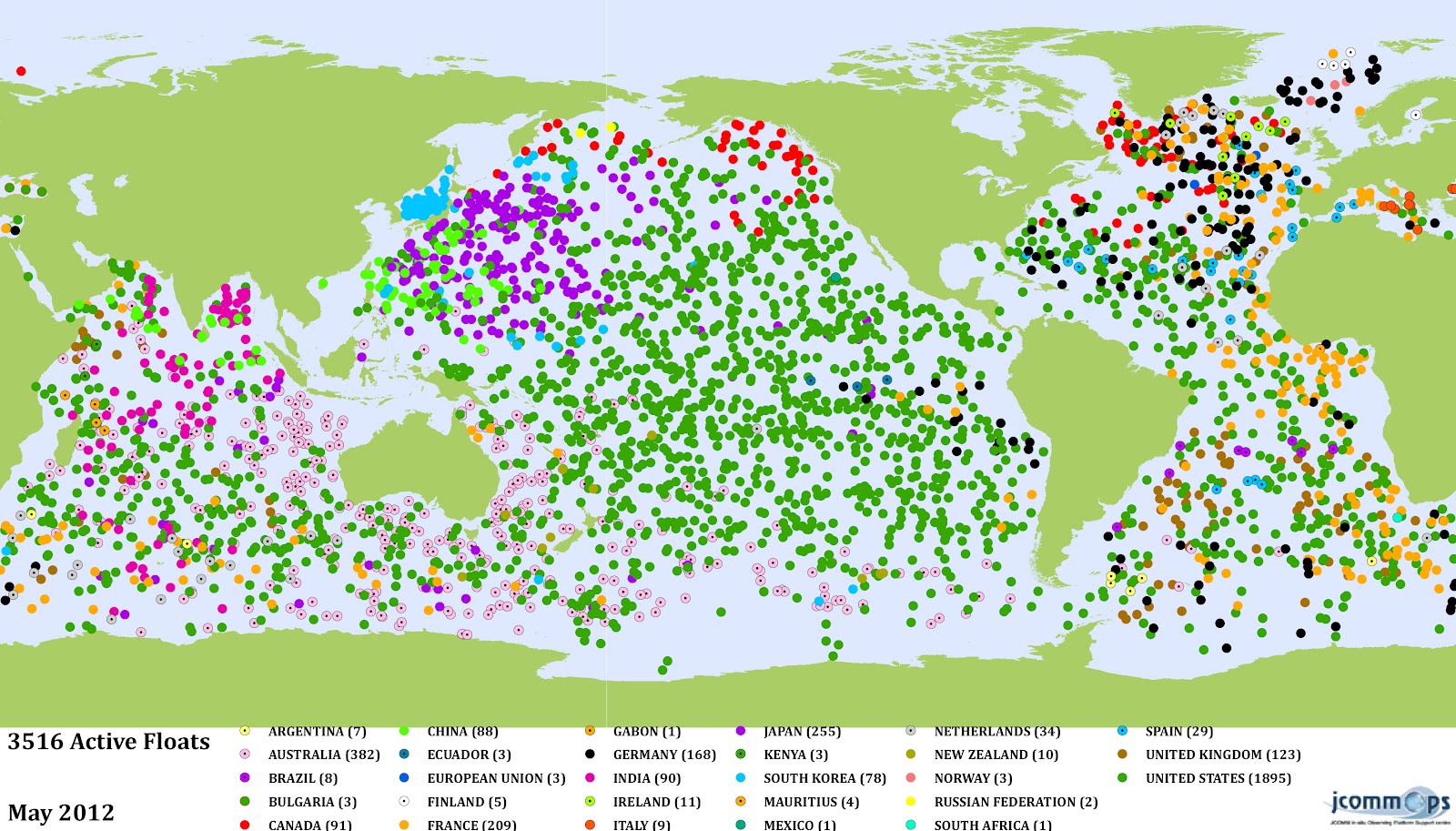
One of the major networks of in-situ drifters is Argo. The network, involving over 50 research and operational agencies in more than 30 countries, uses autonomous floats to collect temperature, salinity and deep current data.

With over 3500 active drifters, the Argo floats acquire in situ data in the upper 2000 m of the ocean.

These measurements are then directly compared to SMOS data, which in turn cover the global ocean and provide measurements of the salinity in the first centimetre of the sea surface.

Argo floats (click on the image for enlarge)

SMOS provides measurements averaged over a surface of 40x40 sq km, but the difference of the size of the area measured and other influencing factors like background noise lead to differences between SMOS and Argo measurements.

“Since Argo measurements are taken much deeper than SMOS’s, the stratification of the upper layer of the ocean needs to be taken into account when comparing the two salinities in rainy regions,” said Jacqueline Boutin from France’s Laboratory for Oceanography and Climate (LOCEAN).

Argo floats

“For example, rain over the ocean will cause SMOS to pick up lower salinity readings than Argo.”

The advantage that SMOS has over the Argo floats is that the satellite provides a complete view of the global ocean every five days.

Argo measurements, on the other hand, provide punctual salinity data sampled at a lower resolution than SMOS every 10 days.

The higher precision provided by the Argo floats, however, complements the SMOS measurements.

Related links:

SMOS ocean user meeting at EGU 2012: https://earth.esa.int/web/guest/smos-egu-2012

LOCEAN: https://www.locean-ipsl.upmc.fr/

Argo Information Centre: http://argo.jcommops.org/

Support to Science Element: http://www.esa.int/stse

Access SMOS data: http://earth.esa.int/SMOS/

SMOS: http://www.esa.int/SPECIALS/smos/index.html

Images, Text, Credits: ESA / Argo Information Centre (JCOMMOPS) / Southampton Oceanography Centre.

Best regards, Orbiter.ch

samedi 29 septembre 2012

Worldwide LHC Computing Grid tackles 270-year-old maths problem


CERN - European Organization for Nuclear Research logo.

Sept. 29, 2012

In 1742, Prussian mathematician Christian Goldbach wrote down a mathematical conjecture that in its simplest form states: "every even integer greater than 2 can be written as the sum of two primes". Despite the simple formulation, it is notoriously difficult to find a proof for this conjecture; 270 years later, one remains to be found.


Image above: Servers at the CERN Data Centre form Tier-0 of the Worldwide LHC Computing Grid. As well as LHC physics, the Grid is helping to verify the Golbach conjecture for high numbers (Image: CERN).

Now, computer-science technologist Silvio Pardi at the Italian National Institute for Nuclear Physics (INFN) and mathematicians Tomás Oliveira e Silva and Siegfried Herzog are using an algorithm on the Worldwide LHC Computing Grid (WLCG) to verify that the Goldbach conjecture holds for ever larger numbers.

Note:

CERN, the European Organization for Nuclear Research, is one of the world’s largest and most respected centres for scientific research. Its business is fundamental physics, finding out what the Universe is made of and how it works. At CERN, the world’s largest and most complex scientific instruments are used to study the basic constituents of matter — the fundamental particles. By studying what happens when these particles collide, physicists learn about the laws of Nature.

The instruments used at CERN are particle accelerators and detectors. Accelerators boost beams of particles to high energies before they are made to collide with each other or with stationary targets. Detectors observe and record the results of these collisions.

Founded in 1954, the CERN Laboratory sits astride the Franco–Swiss border near Geneva. It was one of Europe’s first joint ventures and now has 20 Member States.

Find out more:
International Science Grid This Week: "Researchers edge closer to solving 270-year-old math problem thanks to grid computing": http://www.isgtw.org/feature/researchers-edge-closer-solving-270-year-old-math-problem-thanks-grid-computing

National Institute for Nuclear Physics (INFN): http://www.infn.it/

Worldwide LHC Computing Grid (WLCG): http://www.isgtw.org/feature/happy-10th-birthday-wlcg

Image, Text, Credit: CERN.

Greetings, Orbiter.ch