mercredi 31 octobre 2012

Progress M-17M docked at the Station


ROSCOSMOS - Russian Vehicles patch.

Oct. 31, 2012

Traveling about 250 miles above Bogota, Colombia, the Progress 49 Russian cargo ship docked at 9:33 a.m. EDT to the Russian Segment (RS) of the International Space Station (at 17:33.46 Moscow time).

Progress-M cargo spacecraft approaching the Station

The craft is delivering almost 3 tons of supplies -- including propellant, oxygen, water, air, spare parts and experimental hardware -- to the six crew members on the orbital laboratory. Progress 49 is scheduled to remain docked to the space station until mid-April.

Docking of Progress M-17M to ISS

A Progress resupply spacecraft performed a same-day rendezvous and docking to the International Space Station for the second time. Progress 48 and 49 verified an abbreviated launch-to-rendezvous schedule designed to reduce the typical two-day flight between a launch and docking. The data may be applied for a similar single-day operation for manned Soyuz missions to the station beginning in 2013.

Docking location at the ISS on the Russian Orbital Segment

Currently, the International Space Station crew works 33/34-y long expedition consisting of commander Sanita Williams (NASA), the flight engineer Yuri Malenchenko (Roscosmos), Akihiko Hoshide (JAXA), Oleg Novitsky (Roscosmos), Eugene Tarelkin (Roscosmos) Kevin Ford (NASA).

For information on the International Space Station and the Expedition 33/34 crew, visit: http://www.nasa.gov/station

Report of Press Service of the Russian Federal Space Agency (Roscosmos PAO): http://www.federalspace.ru/main.php?id=2&nid=19655

Press Service of the Russian Federal Space Agency (Roscosmos PAO) / NASA / NASA TV / Translation: Orbiter.ch.

Greetings, Orbiter.ch

Stars Ancient and Modern?


ESO - European Southern Observatory logo.

31 October 2012

 The globular star cluster NGC 6362

This colourful view of the globular star cluster NGC 6362 was captured by the Wide Field Imager attached to the MPG/ESO 2.2-metre telescope at ESO’s La Silla Observatory in Chile. This new picture, along with a new image of the central region from the NASA/ESA Hubble Space Telescope, provide the best view of this little-known cluster ever obtained. Globular clusters are mainly composed of tens of thousands of very ancient stars, but they also contain some stars that look suspiciously young.

The globular star cluster NGC 6362 in the constellation of Ara (The Altar)

Globular star clusters are among the oldest objects in the Universe, and NGC 6362 cannot hide its age in this picture. The many yellowish stars in the cluster have already run through much of their lives and become red giant stars. But globular clusters are not static relics from the past —  some curious stellar activities are still going on in these dense star cities.

Wide-field view of the sky around the globular cluster NGC 6362

For instance, NGC 6362 is home to many blue stragglers — old stars that really do succeed in passing for a younger age. All of the stars in a globular cluster formed over a fairly short period of time, typically about 10 billion years ago for most globulars. Yet blue stragglers are bluer and more luminous — and hence more massive — than they should be after ten billion years of stellar evolution. Blue stars are hot and consume their fuel quickly, so if these stars had formed about ten billion years ago, then they should have fizzled out long ago. How did they survive?

Hubble image of the globular star cluster NGC 6362

Astronomers are keen to understand the secret of the youthful appearance of blue stragglers. Currently, there are two main theories: stars colliding and merging, and a transfer of material between two companion stars. The basic idea behind both of these options is that the stars were not born as big as we see them today, but that they received an injection of extra material at some point during their lifetimes and this then gave them a new lease of life.

Comparison of views of the globular star cluster NGC 6362 from WFI and Hubble

Although less well known than some brighter globular clusters, NGC 6362 holds much that is of interest to astronomers and has been well studied over the years. It was selected as one of the 160 stellar fields for the Pre-FLAMES Survey — a preliminary survey conducted between 1999 and 2002 using the 2.2-metre telescope at La Silla to find suitable stars for follow-up observations with the VLT’s spectroscopic instrument FLAMES. The picture here comes from data collected as part of this survey.

Zooming in on the globular star cluster NGC 6362

The new image shows the entire cluster against a rich background of the carpet of stars in the Milky Way. The central parts of NGC 6362 have also been studied in detail by the NASA/ESA Hubble Space Telescope. The Hubble view shows a much smaller area of sky in much greater detail. The two views — one wide-angle and one zoomed in — complement each other perfectly.

Panning across the globular star cluster NGC 6362

This brilliant ball of stars lies in the southern constellation of Ara (The Altar). It can be easily seen in a small telescope. It was first spotted in 1826 by the Scottish astronomer James Dunlop using a 22-centimetre telescope in Australia.

More information:

The year 2012 marks the 50th anniversary of the founding of the European Southern Observatory (ESO). ESO is the foremost intergovernmental astronomy organisation in Europe and the world’s most productive astronomical observatory. It is supported by 15 countries: Austria, Belgium, Brazil, the Czech Republic, Denmark, France, Finland, Germany, Italy, the Netherlands, Portugal, Spain, Sweden, Switzerland and the United Kingdom. ESO carries out an ambitious programme focused on the design, construction and operation of powerful ground-based observing facilities enabling astronomers to make important scientific discoveries. ESO also plays a leading role in promoting and organising cooperation in astronomical research. ESO operates three unique world-class observing sites in Chile: La Silla, Paranal and Chajnantor. At Paranal, ESO operates the Very Large Telescope, the world’s most advanced visible-light astronomical observatory and two survey telescopes. VISTA works in the infrared and is the world’s largest survey telescope and the VLT Survey Telescope is the largest telescope designed to exclusively survey the skies in visible light. ESO is the European partner of a revolutionary astronomical telescope ALMA, the largest astronomical project in existence. ESO is currently planning the 39-metre European Extremely Large optical/near-infrared Telescope, the E-ELT, which will become “the world’s biggest eye on the sky”.

Links:

    Photos of the MPG/ESO 2.2-metre telescope: http://www.eso.org/public/images/archive/search/?adv=&subject_name=mpg

    Other photos taken with the MPG/ESO 2.2-metre telescope: http://www.eso.org/public/images/archive/search/?adv=&facility=15

    Photos of La Silla: http://www.eso.org/public/images/archive/category/lasilla/

Images, Text, Credits: ESO / Richard Hook / IAU and Sky & Telescope / Digitized Sky Survey 2 / Acknowledgement: Davide De Martin / ESA/ Hubble & NASA / Videos: ESO/NASA/ESA/Hubble, Nick Risinger (skysurvey.org), Digitized Sky Survey 2 / Music: delmo "acoustic".

Best regards, Orbiter.ch

The launch of the cargo spacecraft Progress M-17M


ROSCOSMOS - Russian Vehicles patch.

31/10/2012

 Soyuz-U & Progress M-17M launch

October 31 at 11:41.18 MSK (MSK - Moscow Time) from the launch complex of the platform 1 was launched Baikonur Launch Vehicle (ILV) Soyuz-U to transport cargo ship (THC) Progress M-17M.

Russian Cargo Craft Launches

According to the RCN in flight cyclogram 11:50.07 MSK spacecraft separated from the third stage of the launch vehicle and placed into the desired orbit.

Docking THC Progress M-17M from the International Space Station (service module Zvezda of the Russian segment of the ISS) is scheduled today at 17:40 MSK (3:41 a.m. EDT Wednesday).

Progress-M space cargo

Cargo ship should be delivered to the ISS more than 2.5 tonnes of cargo - scientific equipment and spare parts for the station, the fuel to maintain its orbit, food, water and air for the astronauts.

Original text in  Russian: http://www.federalspace.ru/main.php?id=2&nid=19653

For more information about International Space Station (ISS), visit: http://www.nasa.gov/mission_pages/station/main/index.html

Images, Video, Text, Credits: ROSCOSMOS / NASA / NASA TV / Translation: Orbiter.ch.

Cheers, Orbiter.ch

mardi 30 octobre 2012

The space adventure comes to a conference at CERN


CERN - European Organization for Nuclear Research logo.

30 October 2012


Image above: The Alpha Magnetic Spectrometer experiment, assembled at CERN, currently operates as an external module of the ISS (Image: NASA).

The 4th International Conference on Particle and Fundamental Physics in Space (SpacePart12) will take place at CERN from 5 November to 7 November 2012. Space scientists and space policy makers from around the world have registered for this year's conference, which coincides with the centenary of the discovery of cosmic rays. Two of the biggest names in space exploration have been invited to give special talks open to the general public at CERN on 5 and 6 November.

At 8pm (CET) on 5 November, Edward Stone, professor at the California Institute of Technology and project scientist for the Voyager probes since 1972, will give a talk on the extraordinary story of these two probes, launched 35 years ago. His talk will be preceded by an introduction from Samuel Ting, principal investigator for the Alpha Magnetic Spectrometer experiment installed on the International Space Station (ISS).


Image above: The Alpha Magnetic Spectrometer experiment, currently operates as an external module of the ISS (Image: NASA).

At 8pm (CET) on 6 November William Gerstenmaier, associate administrator for Human Exploration and Operations for NASA and former manager of the ISS Program, will discuss the scientific work being conducted on the space station.

The talks will be webcast in English, with French interpretation provided.

Note:

CERN, the European Organization for Nuclear Research, is one of the world’s largest and most respected centres for scientific research. Its business is fundamental physics, finding out what the Universe is made of and how it works. At CERN, the world’s largest and most complex scientific instruments are used to study the basic constituents of matter — the fundamental particles. By studying what happens when these particles collide, physicists learn about the laws of Nature.

The instruments used at CERN are particle accelerators and detectors. Accelerators boost beams of particles to high energies before they are made to collide with each other or with stationary targets. Detectors observe and record the results of these collisions.

Founded in 1954, the CERN Laboratory sits astride the Franco–Swiss border near Geneva. It was one of Europe’s first joint ventures and now has 20 Member States.

Find out more & Related links:

Spacepart12: https://spacepart12.web.cern.ch/spacepart12/

CERN Webcast: http://webcast.cern.ch/

California Institute of Technology: http://www.caltech.edu/

Alpha Magnetic Spectrometer experiment: http://ams.nasa.gov/

International Space Station (ISS): http://www.nasa.gov/mission_pages/station/main/index.html

Images, Text, Credits: CERN / NASA.

Greetings, Orbiter.ch

NASA Rover's First Soil Studies Help Fingerprint Martian Minerals


NASA - Mars Science Laboratory (MSL) patch.

Oct. 30, 2012

NASA's Mars rover Curiosity has completed initial experiments showing the mineralogy of Martian soil is similar to weathered basaltic soils of volcanic origin in Hawaii.

The minerals were identified in the first sample of Martian soil ingested recently by the rover. Curiosity used its Chemistry and Mineralogy instrument (CheMin) to obtain the results, which are filling gaps and adding confidence to earlier estimates of the mineralogical makeup of the dust and fine soil widespread on the Red Planet.


This graphic shows results of the first analysis of Martian soil by the Chemistry and Mineralogy (CheMin) experiment on NASA's Curiosity rover. Image credit: NASA/JPL-Caltech/Ames.

"We had many previous inferences and discussions about the mineralogy of Martian soil," said David Blake of NASA Ames Research Center in Moffett Field, Calif., who is the principal investigator for CheMin. "Our quantitative results provide refined and in some cases new identifications of the minerals in this first X-ray diffraction analysis on Mars."

The identification of minerals in rocks and soil is crucial for the mission's goal to assess past environmental conditions. Each mineral records the conditions under which it formed. The chemical composition of a rock provides only ambiguous mineralogical information, as in the textbook example of the minerals diamond and graphite, which have the same chemical composition, but strikingly different structures and properties.

CheMin uses X-ray diffraction, the standard practice for geologists on Earth using much larger laboratory instruments. This method provides more accurate identifications of minerals than any method previously used on Mars. X-ray diffraction reads minerals' internal structure by recording how their crystals distinctively interact with X-rays. Innovations from Ames led to an X-ray diffraction instrument compact enough to fit inside the rover.


This pair of images from the Mast Camera on NASA's Curiosity rover shows the upper portion of a wind-blown deposit dubbed "Rocknest." Image credit: NASA/JPL-Caltech/MSSS.

These NASA technological advances have resulted in other applications on Earth, including compact and portable X-ray diffraction equipment for oil and gas exploration, analysis of archaeological objects and screening of counterfeit pharmaceuticals, among other uses.

"Our team is elated with these first results from our instrument," said Blake. "They heighten our anticipation for future CheMin analyses in the months and miles ahead for Curiosity."

The specific sample for CheMin's first analysis was soil Curiosity scooped up at a patch of dust and sand that the team named Rocknest. The sample was processed through a sieve to exclude particles larger than 0.006 inch (150 micrometers), roughly the width of a human hair. The sample has at least two components: dust distributed globally in dust storms and fine sand originating more locally. Unlike conglomerate rocks Curiosity investigated a few weeks ago, which are several billion years old and indicative of flowing water, the soil material CheMin has analyzed is more representative of modern processes on Mars.


This image shows a "bite mark" where NASA's Curiosity rover scooped up some Martian soil. Image credit: NASA/JPL-Caltech/MSSS.

"Much of Mars is covered with dust, and we had an incomplete understanding of its mineralogy," said David Bish, CheMin co-investigator with Indiana University in Bloomington. "We now know it is mineralogically similar to basaltic material, with significant amounts of feldspar, pyroxene and olivine, which was not unexpected. Roughly half the soil is non-crystalline material, such as volcanic glass or products from weathering of the glass. "

Bish said, "So far, the materials Curiosity has analyzed are consistent with our initial ideas of the deposits in Gale Crater recording a transition through time from a wet to dry environment. The ancient rocks, such as the conglomerates, suggest flowing water, while the minerals in the younger soil are consistent with limited interaction with water."

Curiosity Cameras Description. Image credit: NASA/JPL-Caltech

During the two-year prime mission of the Mars Science Laboratory Project, researchers are using Curiosity's 10 instruments to investigate whether areas in Gale Crater ever offered environmental conditions favorable for microbial life.

NASA's Jet Propulsion Laboratory, a division of Caltech in Pasadena, manages the project for NASA's Science Mission Directorate, Washington, and built Curiosity and CheMin.

For more information about Curiosity and its mission, visit: http://www.nasa.gov/msl and http://mars.jpl.nasa.gov/msl .

For more information about a commercial application of the CheMin technology, visit: http://blogs.getty.edu/iris/mars-rover-technology-helps-unlock-art-mysteries/ .

You can follow the mission on Facebook and Twitter at: http://www.facebook.com/marscuriosity and http://www.twitter.com/marscuriosity .

Images (mentioned), Text, Credits: NASA / Dwayne Brown / NASA Ames Research Center / Rachel Hoover / JPL / Guy Webster / D.C. Agle.

Best regards, Orbiter.ch

lundi 29 octobre 2012

Fire burn and cauldron bubble


ESA - XMM-Newton Mission patch.

29 October 2012

 Wolf-Rayet bubble

The cosmic cauldron has brewed up a Halloween trick in the form of a ghostly face that glows in X-rays, as seen by ESA’s XMM-Newton space telescope. The eerie entity is a bubble bursting with the fiery stellar wind of a ‘live fast, die young’ star.

The bubble lies 5000 light-years from Earth in the constellation of Canis Major, the ‘greater dog’, and can be imagined to take on a dog- or wolf-like face.

It spans nearly 60 light-years across and was blown by the powerful stellar wind of the Wolf-Rayet star HD 50896 – the pink star near the centre of the image that makes up one of the object’s piercing eyes.

Wolf-Rayet bubbles are the result of a hot, massive star – typically greater than 35 the mass of our Sun – expelling material through a strong stellar wind. This star’s howling wind is a million-degree plasma potion that emits X-rays, represented in blue in this image.

ESA's XMM-Newton

Where this fierce wind ploughs into surrounding material it is lit up in red tones as seen in the ‘cheek’ of the face.

The green halo is a result of a shock wave racing out from the star and colliding with the layers of stellar material already ejected into space.

A ‘blow-out’ of X-ray emission at the top left gives the wolf an ear, and a denser region to the bottom right can be likened to a snout.

The witching hour will soon come for this bubble and its star. The bubble will burst and disperse into the surrounding environment, while the star will end its life in a dramatic supernova explosion.

X-Ray Emission from the Wolf-Rayet Bubble S 308 by J. Toala et al is published in the Astrophysical Journal 755, 77 (2012). 

More about: 

XMM-Newton overview: http://www.esa.int/esaSC/120385_index_0_m.html

XMM-Newton factsheet: http://www.esa.int/esaSC/SEM14YS1VED_index_0.html

XMM-Newton operations: http://www.esa.int/SPECIALS/Operations/SEMI2HZTIVE_0.html

XMM-Newton in-depth: http://sci.esa.int/science-e/www/area/index.cfm?fareaid=23

Images, Text, Credits: ESA, J. Toala & M. Guerrero (IAA-CSIC), Y.-H. Chu & R. Gruendl (UIUC), S. Arthur (CRyA–UNAM), R. Smith (NOAO/CTIO), S. Snowden (NASA/GSFC) and G. Ramos-Larios (IAM).

Greetings, Orbiter.ch

dimanche 28 octobre 2012

Dragon Unberthed From Station


SpaceX - Dragon / CRS-1 Mission patch.

Oct. 28, 2012

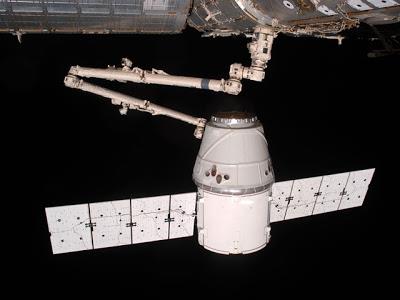
The SpaceX Dragon spacecraft was unberthed from the International Space Station at 7:19 a.m. EDT Sunday, wrapping up 18 days attached to the complex for the cargo craft on its first contracted resupply mission.

The ground team at Mission Control Houston remotely commanded the station’s robotic arm to uninstall Dragon from the Earth-facing port of the Harmony node after Expedition 33 Commander Suni Williams removed the bolts and latches of the Common Berthing Mechanism that had secured the cargo craft to the station since Oct 10.


Image above: The International Space Station's robotic arm unberths the SpaceX Dragon cargo craft. Credit: NASA TV.

A set of programmed commands to Canadarm2 will maneuver Dragon out to the 15-meter release point, where Williams and Flight Engineer Aki Hoshide will ungrapple Dragon at 9:26 a.m. and back the arm away. Dragon will perform three burns to place it on a trajectory away from the station. Mission Control Houston then will confirm that Dragon is on a safe path away from the complex.

 Dragon Departs Space Station

A 10-minute deorbit burn beginning at 2:28 p.m. will slow Dragon down for its descent back to Earth, culminating in a parachute-assisted splashdown at 250 miles off the coast of southern California at 3:20 p.m. Dragon is the only space station cargo craft capable of returning a significant amount of supplies back to Earth, including experiments.


Image above: The International Space Station's robotic arm unberths the SpaceX Dragon cargo craft. Credit: NASA TV.

Dragon delivered 882 pounds of supplies to the orbiting laboratory, including 260 pounds of crew supplies, 390 pounds of scientific research, 225 pounds of hardware and several pounds of other supplies. Dragon is returning a total of 1,673 pounds, including 163 pounds of crew supplies, 866 pounds of scientific research, and 518 pounds of vehicle hardware and other hardware.

 Dragon on Canadarm2 Leaves Station

Dragon launched atop a Falcon 9 rocket Oct. 7 at 8:35 p.m. from Cape Canaveral Air Force Station in Florida, beginning NASA's first contracted cargo delivery flight, designated SpaceX CRS-1, to the station.

For NASA TV downlink information, up-to-date schedules and links to streaming video, visit: http://www.nasa.gov/ntv

For information on the International Space Station and the Expedition 33 crew, visit: http://www.nasa.gov/station

For more information about SpaceX, visit: http://www.spacex.com/

Images, Video, Text, Credits: SpaceX / NASA / NASA TV.

Best regards, Orbiter.ch