jeudi 25 avril 2013

Galileo starts to tell UTC, the world’s time


ESA - GALILEO Mission logo.

25 April 2013

Europe’s four Galileo satellites are now working as clocks accurate to a few billionths of a second, disseminating the exact time through their signals expressed as the UTC Universal Coordinated Time global standard.

“A billionth of a second equals a nanosecond, a time interval far beyond our own human capacity of appreciation,” explains Marco Falcone, ESA’s Galileo System Manager.

Galileo for timing

“A single lightning flash across the sky during a thunderstorm lasts about ten milliseconds, which is already 10 000 000 nanoseconds. But for high-tech applications, as well as navigation services, nanosecond accuracy is essential.”

The replacement for Greenwich Mean Time, UTC is part of all our daily lives: it is the timing used for Internet, banking and aviation standards as well as precise scientific experiments, maintained by the Paris-based Bureau International de Poids et Mesures (BIPM).

The BIPM computes UTC based on inputs from collections of atomic clocks maintained by institutions around the world, including ESA’s ESTEC technical centre in Noordwijk, the Netherlands.

‘Galileo time’ is derived independently of UTC but is being kept close to it, with a precise ‘offset’ between the two values being calculated continuously and then disseminated through Galileo’s navigation message.

Galileo's UTC offset

Galileo, like all other satellite navigation systems, is based on the highly precise measurement of time. A receiver on the ground pinpoints its position by calculating how long signals from satellites in orbit take to reach it.

Matching the receiver and satellite clocks then multiplying the time taken by the speed of light gives the range between user and satellite, allowing the receiver to fix its own location relative to four or more satellites.

“Each navigation system has its internal reference system time used to synchronise all system clocks and maintain overall coherence,” adds Marco. 

“Galileo runs on Galileo System Time, GST, which is fixed on the ground at the Galileo Control Centre in Fucino, Italy, by the Precise Timing Facility, based on the average of different atomic clocks.

Galileo signals

“Strictly speaking, for navigation purposes alone this internal reference system time does not need to be in agreement with UTC at the highest level of accuracy but with this agreement being the case, it is therefore possible to immediately disseminate UTC to the users to the best  accuracy and this is the aim of Galileo.”

The offset between GST and UTC is currently estimated in Turin, Italy, by the Istituto Nazionale di Ricerca Metrologica (INRIM), where time measurements are performed every day with the most precise techniques available to check GST status.

Galileo Control Centre in Fucino

INRIM has been supporting ESA’s Galileo development since the early phases of the project. More recently INRIM has overseen the creation of a ‘Time Validation Facility’ for Galileo in collaboration with five other European time-measurement institutions: the Physikalisch Technische Bundesanstalt in Germany, the National Physics Laboratory in the UK, the Systeme de References Temps Espace/Observatoire de Paris in France, the Real Instituto y Observatorio de la Armada in Spain and Observatoire Royale de Belgique.

Each day, the most precise European clocks and national time scales are compared to GST and the offset compared to UTC is estimated and provided to the Galileo Control Centre. This offset is then uploaded to the Galileo satellites for transmission in the navigation message available to users.

As explained by Patrizia Tavella from INRIM, “The UTC value available to the user via Galileo is expected to be accurate within 26 nanoseconds, but in the last two months it was even better, with a prediction error in the last two months of less than five nanoseconds.”

Related links:

ESA’s Navigation Lab helps set global time: http://www.esa.int/Our_Activities/Space_Engineering/ESA_s_Navigation_Lab_helps_set_global_time

Galileo’s clocks: http://www.esa.int/Our_Activities/Navigation/The_future_-_Galileo/Galileo_IOV_Launch/Galileo_s_clocks

International Bureau of Weights and Measures (BIPM): http://www.bipm.org/

Istituto Nazionale di Ricerca Metrologica (INRIM): http://www.inrim.it/

Images, Text, Credit: ESA.

Cheers, Orbiter.ch

Global experts agree action needed on space debris


Space Debris.

25 April 2013

There is an urgent need to remove orbiting space debris and to fly satellites in the future without creating new fragments, Europe’s largest-ever space-debris conference announced today.

The findings from the 6th European Conference on Space Debris were released during the concluding press briefing at ESA’s European Space Operations Centre in Darmstadt, Germany.

Concept for future deorbit mission

Future space missions must be sustainable, including safe disposal when they are completed. The current levels mean that we must soon begin removing debris from orbit, with research and development urgently needed for pilot ‘cleaning’ missions.

The removal of space debris is an environmental problem of global dimensions that must be assessed in an international context, including the UN.

These results were presented to over 350 worldwide participants representing almost all the major national space agencies, industry, governments, academia and research institutes.

Expert consensus on the need to act

“There is a wide and strong expert consensus on the pressing need to act now to begin debris removal activities,” says Heiner Klinkrad, Head of ESA’s Space Debris Office.

Future debris density at poles with and without active debris removal

“Our understanding of the growing space debris problem can be compared with our understanding of the need to address Earth’s changing climate some 20 years ago.”

There was wide agreement that the continuing growth in space debris poses an increasing threat to economically and scientifically vital orbital regions.

In addition to providing daily benefits to citizens and economies, today’s satellite infrastructure has immense value. The replacement cost for the approximately 1000 active satellites in orbit today is estimated to be around €100 billion. The impact on the overall economy of losing these satellites would be several orders of magnitude higher. Society would be severely damaged.

“While measures against further debris creation and actively deorbiting defunct satellites are technically demanding and potentially costly, there is no alternative to protect space as a valuable resource for our critical satellite infrastructure,” he notes.

“Their direct costs and the costs of losing them will by far exceed the cost of remedial activities.”

The findings were delivered by senior researchers and specialists from the DLR German Aerospace Center, France’s CNES space agency, Italy’s ASI space agency, the UK Space Agency, the Committee on Space Research, the International Academy of Astronautics and ESA.

ESA accelerates space debris research and development

Satellite operators worldwide, including those flying telecom, weather, navigation, broadcast and climate-monitoring missions, are now focusing their efforts on controlling space debris.

The ultimate goal is to prevent a cascade of self-sustaining collisions from setting in over the next few decades.

ESA, as a space technology and operations agency, has identified the development of active removal technologies as a strategic goal.

Sixth European Conference on Space Debris

A number of long-standing space debris-related research activities are being reinforced by the Agency. This includes improving our understanding of the debris environment and its evolution using novel, sensitive measurements and improved modelling of debris sources.

The new Clean Space initiative includes maturing technology to approach, capture and deorbit targets – a mission is already under study.

Clean Space will also develop techniques to mitigate the problem, such as passive and active deorbiting devices and the means to ‘passivate’ retiring satellites.

More information:

International Academy of Astronautics: http://www.iaaweb.org/

Background for media briefing 2013 Space Debris conference (PDF): http://www.slideshare.net/esaops/backgrounder-media-briefing-at-6th-european-conference-on-space-debris

Background:

About debris: http://www.esa.int/Our_Activities/Operations/Space_Debris/Global_experts_agree_action_needed_on_space_debris

Analysis and prediction: http://www.esa.int/Our_Activities/Operations/Space_Debris/Analysis_and_prediction

Scanning & observing: http://www.esa.int/Our_Activities/Operations/Space_Debris/Scanning_observing

Re-entry and collision avoidance: http://www.esa.int/Our_Activities/Operations/Space_Debris/Re-entry_and_collision_avoidance

Mitigating space debris generation: http://www.esa.int/Our_Activities/Operations/Space_Debris/Mitigating_space_debris_generation

Debris removal: http://www.esa.int/Our_Activities/Operations/Space_Debris/Debris_removal

Hypervelocity impacts and protecting spacecraft: http://www.esa.int/Our_Activities/Operations/Space_Debris/Hypervelocity_impacts_and_protecting_spacecraft

International cooperation: http://www.esa.int/Our_Activities/Operations/Space_Debris/International_cooperation

Images, Text, Credits: ESA / J. Mai.

Best regards, Orbiter.ch

mercredi 24 avril 2013

Russian Space Freighter Heads to ISS Despite Antenna Glitch


ROSCOSMOS - Russian Vehicle patch.

April 24, 2013

The unmanned Russian Progress-M19M cargo spacecraft is continuing its journey to the International Space Station (ISS) despite its failure to deploy one of its navigation antennas, Russia’s Mission Control said on Wednesday.

Progress-M19M launch

“Our main goal is to ensure that the spacecraft arrives at the orbital station,” a Mission Control spokesman said.

“We have failed so far to deploy the antenna [after two attempts], but we consider this a secondary issue at this point,” the official said.

The Progress M-19M freighter was launched earlier today from the Baikonur space center in Kazakhstan.

Russia’s Federal Space Agency Roscosmos reported a failure to deploy an antenna of the Kurs navigation system responsible for guiding the spacecraft to the docking module on the ISS shortly after the freighter reached the desired orbit.

Progress-M navigation antennas

The Progress-M19M is expected to reach the orbital outpost on April 26, making dozens of revolutions around the Earth before arriving at the ISS.

Russian space experts will continue to analyze the situation and attempt to fix the antenna glitch every 90 minutes, the spokesman said, adding that if continuing attempts are unsuccessful, the craft can dock automatically.

The Progress is on a resupply mission to deliver over 2.5 tons of cargo to the ISS, including payloads for the crew’s work and fuel for the space station, as well as food supplies, water and oxygen for the crew.

For more information about the Russian Federal Space Agency (ROSCOSMOS), visit: http://www.federalspace.ru/main.php?lang=ru

Images, Text, Credits: ROSCOSMOS / Orbiter.ch Aerospace / RIA Novosti.

Greetings, Orbiter.ch

Launch of the space rocket Soyuz-U with THC Progress M-19M


ROSCOSMOS - Russian Vehicles patch.

April 24, 2013

 Progress M-19M launch

Carrier rocket Soyuz-U brought transport cargo ship Progress M-19M into orbit, where it is two days to get to the International Space Station (ISS). "There was a cargo ship from the third stage rocket", - stated in the Federal Space Agency.

Launch of the space rocket Soyuz-U with THC Progress M-19M

It is interesting that the "Progress M-19M" will fly to the station is not six o'clock (already flown several ships), but under the old scheme - two days. It is expected that the docking of Progress to the service module Zvezda will happen on Friday, April 26 at 16:26 Moscow time. With the cargo ship to the ISS will be delivered about 2.5 tons of cargo, including fuel to maintain orbit of the station, scientific equipment for the crew, as well as food, water and air for cosmonauts and astronauts.

Progress M-19M schema launch

On the eve of the head of the nutrition department of the Institute of Biomedical Problems, Russian Academy of Sciences Alexander Agureev told Interfax that astronauts receive the products they ordered, as well as fresh fruits and vegetables. "It's apples, grapefruit, oranges, lemons, onions. On request, we send to the station sausages with garlic and chili pepper" - listed Agureev.


Start of Progress M-19M was approved on April 24, so as not to interfere with a satellite launch biological "Bion-M", held on April 19.

ROSCOSMOS Press Release (in Russian): http://www.federalspace.ru/main.php?id=2&nid=20059

Images, Video, Text, Credits: ROSCOSMOS / ROSCOSMOS TV / G. De Chiara, Mars Center / Translation: Orbiter.ch Aerospace.

Greetings, Orbiter.ch

mardi 23 avril 2013

CERN - CMS prepares for the future


CERN - European Organization for Nuclear Research logo.

April 23, 2013


Image above: Disc three, equipped with the muon chambers for the third muon station, was lowered into position in November 2006 (Image: CERN).

While the Large Hadron Collider (LHC) takes a break for its first long shutdown, the CMS collaboration are busy maintaining and consolidating the detector to be sure to handle the collider’s improved performance from 2015 onwards.

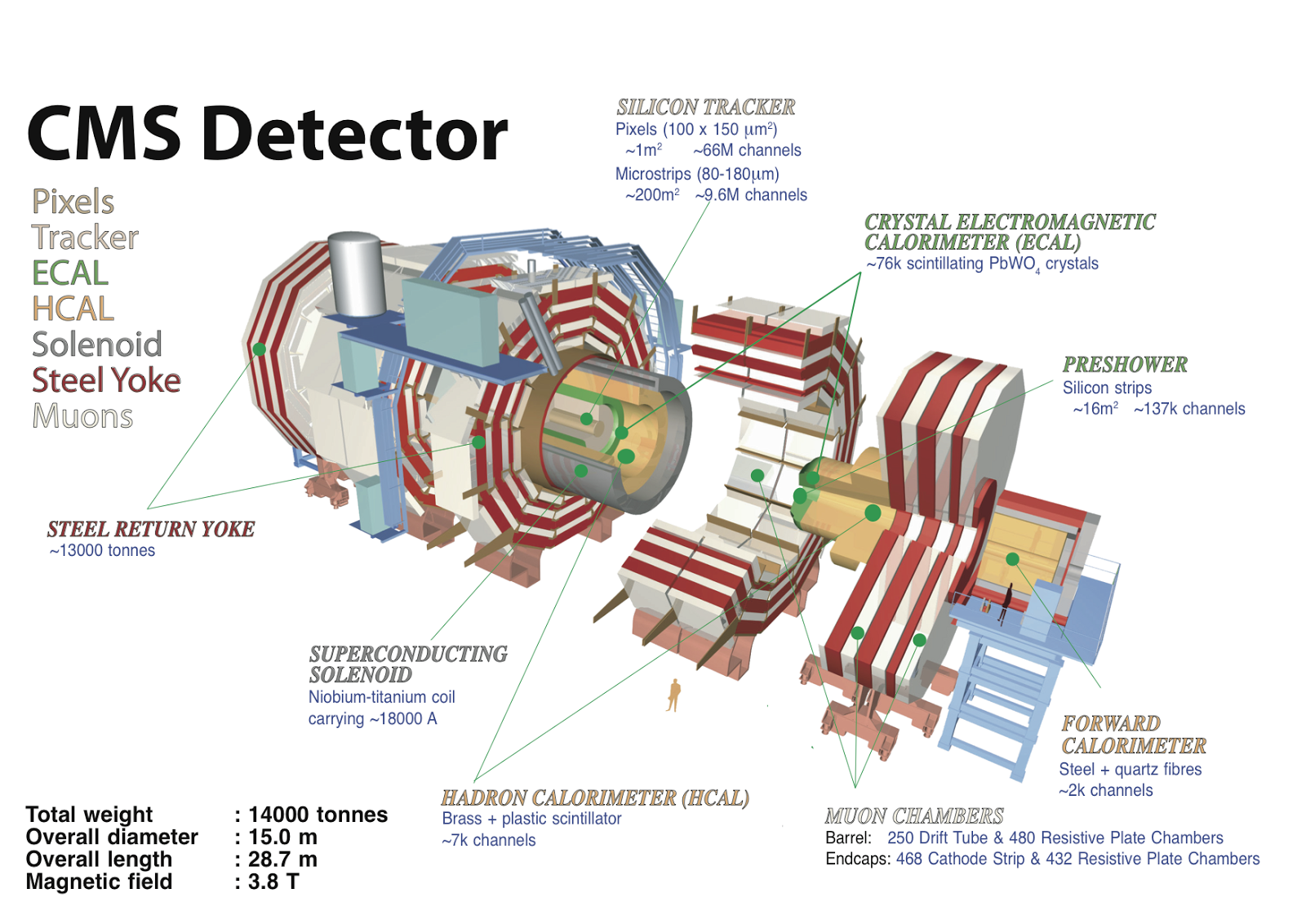
The biggest priority for CMS is the tracker performance. The CMS tracking system forms the innermost subdetector and fits snugly round the LHC beampipe. It must withstand an onslaught of some 1010 particles a second and the aggressive field of mixed radiation that this produces.

Another major element is to improve the muon detectors with a fourth endcap layer to help discriminate between interesting muons and fake signatures or background. New shielding discs, 10 centimetres deep, are to be installed on either end of the detector. Each shielding disc is made of 12 iron sector-casings filled with a special concrete. The concrete, developed for this specific application by CERN’s civil engineers, is almost 50% denser than normal concrete – it is made using haematite (or ferric oxide) instead of the usual sand – and it is loaded with boron to absorb low-energy neutrons that would otherwise give rise to unwanted hits in the detector.

The CMS detector description (click on the image for enlarge)

The new 100-tonne shielding discs represent the first large mechanical elements of CMS to be constructed entirely underground in the experimental cavern. Each disc will have to be taken apart into its 12 component sectors for lowering and then be rebuilt in a vertical position underground. The shielding discs will have an installed clearance to the new detector layer of around 10–20 millimetres, so it will be a delicate operation and the logical course of action is to install the discs before the detectors.

The schedule for 2013 is planned in fine detail with a list of hundreds of tasks that are currently being translated into day-to-day planning schematics. Amid this important technical work, the CMS collaboration will attempt to welcome around 20,000 visitors to the site at Point 5 over the course of the year. The coming two years might be described as a shutdown period for the LHC and its experiments, but life at Point 5 will be as busy as it has ever been.

This edited extract is from an article in the CERN Courier April issue. Read the full article: http://cerncourier.com/cws/article/cern/52743

Note:

CERN, the European Organization for Nuclear Research, is one of the world’s largest and most respected centres for scientific research. Its business is fundamental physics, finding out what the Universe is made of and how it works. At CERN, the world’s largest and most complex scientific instruments are used to study the basic constituents of matter — the fundamental particles. By studying what happens when these particles collide, physicists learn about the laws of Nature.

The instruments used at CERN are particle accelerators and detectors. Accelerators boost beams of particles to high energies before they are made to collide with each other or with stationary targets. Detectors observe and record the results of these collisions.

Founded in 1954, the CERN Laboratory sits astride the Franco–Swiss border near Geneva. It was one of Europe’s first joint ventures and now has 20 Member States.

Related links:

Large Hadron Collider (LHC): http://home.web.cern.ch/about/accelerators/large-hadron-collider

CMS: http://home.web.cern.ch/about/experiments/cms

Images, Text, Credits: CERN /  Austin Ball, Achintya Rao.

Cheers, Orbiter.ch

Hubble Captures Comet ISON


NASA - Hubble Space Telescope patch.

April 23, 2013


Image above: NASA’s Hubble Space Telescope provides a close-up look of Comet ISON (C/2012 S1), as photographed on April 10, when the comet was slightly closer than Jupiter’s orbit at a distance of 386 million miles from the sun. Credit:NASA, ESA, J.-Y. Li (Planetary Science Institute), and the Hubble Comet ISON Imaging Science Team.

This NASA Hubble Space Telescope image of Comet (C/2012 S1) ISON was photographed on April 10, when the comet was slightly closer than Jupiter’s orbit at a distance of 386 million miles from the Sun (394 million miles from Earth).

Even at that great distance the comet is already active as sunlight warms the surface and causes frozen volatiles to sublimate. A detailed analysis of the dust coma surrounding the solid, icy nucleus reveals a strong, jet blasting dust particles off the sunward-facing side of the comet’s nucleus.

Preliminary measurements from the Hubble images suggest that the nucleus of ISON is no larger than three or four miles across. This is remarkably small considering the high level of activity observed in the comet so far, said researchers. Astronomers are using these images to measure the activity level of this comet and constrain the size of the nucleus, in order to predict the comet’s activity when it skims 700,000 miles above the sun's roiling surface on November 28.

The comet’s dusty coma, or head of the comet, is approximately 3,100 miles across, or 1.2 times the width of Australia. A dust tail extends more than 57,000 miles, far beyond Hubble’s field of view.

More careful analysis is currently underway to improve these measurements and to predict the possible outcome of the sungrazing perihelion passage of this comet.

This image was taken in visible light. The blue false color was added to bring out details in the comet structure.

Hubble Space Telescope. Image credit: NASA / ESA

ISON stands for International Scientific Optical Network, a group of observatories in ten countries who have organized to detect, monitor, and track objects in space. ISON is managed by the Keldysh Institute of Applied Mathematics, part of the Russian Academy of Sciences.

The Hubble Space Telescope is a project of international cooperation between NASA and the European Space Agency. NASA's Goddard Space Flight Center in Greenbelt, Md., manages the telescope. The Space Telescope Science Institute (STScI) in Baltimore, Md., conducts Hubble science operations. STScI is operated by the Association of Universities for Research in Astronomy, Inc., in Washington, D.C.

For more information about Hubble visit:

NASA Hubble sites: http://www.nasa.gov/hubble and http://hubblesite.org/

ESA Hubble site: http://www.spacetelescope.org/

Images (mentioned), Text, Credit: NASA / Space Science Telescope Institute.

Greetings, Orbiter.ch

Three Years of SDO Images


NASA - Solar Dynamics Observatory (SDO) patch.

April 23, 2013

In the three years since it first provided images of the sun in the spring of 2010, NASA’s Solar Dynamics Observatory has had virtually unbroken coverage of the sun's rise toward solar maximum, the peak of solar activity in its regular 11-year cycle. This video shows those three years of the sun at a pace of two images per day.

Three Years of SDO Images

Video Credit: NASA's Goddard Space Flight Center.

SDO’s Atmospheric Imaging Assembly captures a shot of the sun every 12 seconds in 10 different wavelengths. The images shown here are based on a wavelength of 171 angstroms, which is in the extreme ultraviolet range and shows solar material at around 600,000 kelvins (about 1.08 million F). In this wavelength it is easy to see the sun’s 25-day rotation as well as how solar activity has increased over three years.

During the course of the video, the sun subtly increases and decreases in apparent size. This is because the distance between the SDO spacecraft and the sun varies over time. The image is, however, remarkably consistent and stable despite the fact that SDO orbits Earth at 6,876 mph and Earth orbits the sun at 67,062 mph.


Image above: This image is a composite of 25 separate images spanning the period of April 16, 2012, to April 15, 2013. It uses the SDO AIA wavelength of 171 angstroms and reveals the zones on the sun where active regions are most common during this part of the solar cycle. Credit: NASA/SDO/AIA/S. Wiessinger.

Such stability is crucial for scientists, who use SDO to learn more about our closest star. These images have regularly caught solar flares and coronal mass ejections in the act, types of space weather that can send radiation and solar material toward Earth and interfere with satellites in space. SDO’s glimpses into the violent dance on the sun help scientists understand what causes these giant explosions -- with the hopes of some day improving our ability to predict this space weather.

Solar Dynamics Observatory (SDO) spacecraft. Credit: NASA/SDO

For more information about Solar Dynamics Observatory (SDO), visit: http://sdo.gsfc.nasa.gov/ and http://www.nasa.gov/mission_pages/sdo/main/index.html

Images (mentioned), Video (mentioned), Text, Credits: NASA's Goddard Space Flight Center / Karen C. Fox and Scott Wiessinger.

Best regards, Orbiter.ch