jeudi 2 mai 2013

An Anarchic Region of Star Formation


ESO - European Southern Observatory logo.

2 May 2013

 The star formation region NGC 6559

The Danish 1.54-metre telescope located at ESO’s La Silla Observatory in Chile has captured a striking image of NGC 6559, an object that showcases the anarchy that reigns when stars form inside an interstellar cloud.

NGC 6559 is a cloud of gas and dust located at a distance of about 5000 light-years from Earth, in the constellation of Sagittarius (The Archer). The glowing region is a relatively small object, just a few light-years across, in contrast to the one hundred light-years and more spanned by its famous neighbour, the Lagoon Nebula (Messier 8, eso0936). Although it is usually overlooked in favour of its distinguished companion, NGC 6559 has the leading role in this new picture.

The gas in the clouds of NGC 6559, mainly hydrogen, is the raw material for star formation. When a region inside this nebula gathers enough matter, it starts to collapse under its own gravity. The centre of the cloud grows ever denser and hotter, until thermonuclear fusion begins and a star is born. The hydrogen atoms combine to form helium atoms, releasing energy that makes the star shine.

The star formation region NGC 6559 in the constellation of Sagittarius

These brilliant hot young stars born out of the cloud energise the hydrogen gas still present around them in the nebula [1]. The gas then re-emits this energy, producing the glowing threadlike red cloud seen near the centre of the image. This object is known as an emission nebula.

But NGC 6559 is not just made out of hydrogen gas. It also contains solid particles of dust, made of heavier elements, such as carbon, iron or silicon. The bluish patch next to the red emission nebula shows the light from the recently formed stars being scattered — reflected in many different directions — by the microscopic particles in the nebula. Known to astronomers as a reflection nebula, this type of object usually appears blue because the scattering is more efficient for these shorter wavelengths of light [2].

Zooming in on the star formation region NGC 6559

In regions where it is very dense, the dust completely blocks the light behind it, as is the case for the dark isolated patches and sinuous lanes to the bottom left-hand side and right-hand side of the image. To look through the clouds at what lies behind, astronomers would need to observe the nebula using longer wavelengths that would not be absorbed.

The Milky Way fills the background of the image with countless yellowish older stars. Some of them appear fainter and redder because of the dust in NGC 6559.

Panning across the star formation region NGC 6559

This eye-catching image of star formation was captured by the Danish Faint Object Spectrograph and Camera (DFOSC) on the 1.54-metre Danish Telescope at La Silla in Chile. This national telescope has been in use at La Silla since 1979 and was recently refurbished to turn it into a remote-controlled state-of-the-art telescope.

Notes:

[1] These young stars are usually of spectral type O and B, with temperatures between 10 000 and 60 000 K, which radiate huge amounts of high energy ultraviolet light that ionises the hydrogen atoms.

[2] Rayleigh scattering, named after the British physicist Lord Rayleigh, happens when light is scattered off particles of material that are much smaller than the wavelength of the light. It is much more effective for short wavelengths of light, that is, wavelengths corresponding to the blue end of the visible spectrum, so the result is a bluish diffuse light. This is the same mechanism that explains the blue colour of the daytime cloud-free sky.

More information:

ESO is the foremost intergovernmental astronomy organisation in Europe and the world’s most productive ground-based astronomical observatory by far. It is supported by 15 countries: Austria, Belgium, Brazil, the Czech Republic, Denmark, France, Finland, Germany, Italy, the Netherlands, Portugal, Spain, Sweden, Switzerland and the United Kingdom. ESO carries out an ambitious programme focused on the design, construction and operation of powerful ground-based observing facilities enabling astronomers to make important scientific discoveries. ESO also plays a leading role in promoting and organising cooperation in astronomical research. ESO operates three unique world-class observing sites in Chile: La Silla, Paranal and Chajnantor. At Paranal, ESO operates the Very Large Telescope, the world’s most advanced visible-light astronomical observatory and two survey telescopes. VISTA works in the infrared and is the world’s largest survey telescope and the VLT Survey Telescope is the largest telescope designed to exclusively survey the skies in visible light. ESO is the European partner of a revolutionary astronomical telescope ALMA, the largest astronomical project in existence. ESO is currently planning the 39-metre European Extremely Large optical/near-infrared Telescope, the E-ELT, which will become “the world’s biggest eye on the sky”.

Links:

Photos of the Danish telescope: http://www.eso.org/public/images/archive/search/?adv=&subject_name=1.54

Photos taken with the Danish telescope: http://www.eso.org/public/images/archive/search/?adv=&facility=18

ESO press releases with results from the Danish telescope: http://www.eso.org/public/news/archive/search/?adv=&facility=18

Images, Text, Credits: ESO, IAU and Sky & Telescope / Videos: ESO/Nick Risinger (skysurvey.org)/S. Guisard. Music: movetwo.

Greetings, Orbiter.ch

Landslides and lava flows at Olympus Mons on Mars


ESA - Mars Express Mission patch.

2 May 2013

 Sulci Gordii

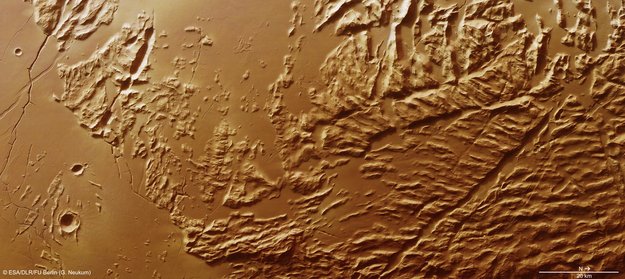
Giant landslides, lava flows and tectonic forces are behind this dynamic scene captured recently by ESA’s Mars Express of a region scarred by the Solar System’s largest volcano, Olympus Mons.

The image was taken on 23 January by the spacecraft’s high-resolution stereo camera, and focuses on a region known as Sulci Gordii, which lies about 200 km east of Olympus Mons.

Sulci Gordii is an ‘aureole’ deposit – from the Latin for ‘circle of light’ – and is one of many that form a broken ring around the giant volcano, as hinted at in the context map.

Sulci Gordii in context

The aureoles tell the story of the catastrophic collapse of the lower flanks of Olympus Mons in its distant past. Today, it stands with steep cliff edges that rise 2 km above the surrounding plains.

The collapse was brought about by weakening in the rocks supporting the volcanic edifice, perhaps influenced by subsurface water. During the collapse, rocky debris slid down and out over hundreds of kilometres of the surrounding volcanic plains, giving rise to the rough-textured aureole seen today.

Inside Sulci Gordii

Similar avalanches of debris are also seen surrounding some volcanoes on Earth, including Mauna Loa in Hawaii, which, like Olympus Mons, is a smooth-sided ‘shield’ volcano built up from successive lava flows.

The smooth plains surrounding Sulci Gordii suggest that the massive landslide was later partially buried by lava flows. Indeed, faint outlines of ancient lava flows can be seen by zooming into the upper centre-left portion of the lead high-resolution image.

Sulci Gordii close-up

The characteristic corrugated appearance of the ‘sulci’ – a geological term used to describe roughly parallel hills and valleys on Mars – likely resulted during the landslide as material slid away from the volcano and became compressed or pulled apart as it travelled across the surface. Over time, erosion of weaker material between the peaks accentuated this effect.

The corrugated effect is best seen in the close-up perspective views. Zooming in on these images reveals that the hills and ridges are also covered by fine wind-blown dust, and that many small-scale landslides have occurred down the sides of the valleys between them.

Similarly, on close inspection of the smooth plains, subtle ripples in the martian dust blanket can be seen. Here, thin undulating dunes have been whipped into shape by the prevailing wind.

Channels and fractures in Sulci Gordii

Numerous sinuous channels and jagged fracture networks also crisscross the scene, in particular at the southern (left) end of the main image and in close-up in the perspective view above. The channels range in length from around 50 km to 300 km and were probably widened by short-lived lava flows, or perhaps even by water.

An impressive sight on the left side of the perspective view is a sinuous channel that is suddenly truncated by a tectonic fault. Another channel running across the centre foreground clearly has a complex fracturing history.

Sulci Gordii topography

In rougher terrain towards the south (top centre-right of the main image), tectonic forces have torn apart the martian crust, most clearly visible in the colour-coded topography map.

By studying complex regions like this – and by comparing them to similar examples here on Earth – planetary scientists learn more about the geological processes that dominated ancient Mars, when it was an active planet.

Sulci Gordii in 3D

Just as on Earth, the scene at Sulci Gordii tells us that volcanoes can suffer dramatic collapses that transport vast quantities of material across hundreds of kilometres, where it is subsequently sculpted by wind, water and tectonic forces.

Related links:

Mars Express mission facts: http://www.esa.int/Our_Activities/Space_Science/Mars_Express/Mars_Express_mission_facts

Mars Express instruments: http://www.esa.int/Our_Activities/Space_Science/Mars_Express/Mars_Express_instruments

The mission: http://www.esa.int/Our_Activities/Space_Science/Mars_Express/The_mission

The spacecraft: http://www.esa.int/Our_Activities/Space_Science/Mars_Express/The_spacecraft

Images, Text, Credits: ESA/DLR/FU Berlin (G. Neukum).

Best regards, Orbiter.ch

mercredi 1 mai 2013

Circular Coronal Mass Ejection


NASA - Solar Dynamics Observatory (SDO) patch.

May 1, 2013

 Circular Coronal Mass Ejection

A coronal mass ejection (CME) erupted from just around the edge of the sun on May 1, 2013, in a gigantic rolling wave. CMEs can shoot over a billion tons of particles into space at over a million miles per hour. This CME occurred on the sun’s limb and is not headed toward Earth. The video, taken in extreme ultraviolet light by NASA’s Solar Dynamics Observatory (SDO), covers about two and a half hours. Credit: NASA/SDO.

What is a solar prominence?

A solar prominence (also known as a filament when viewed against the solar disk) is a large, bright feature extending outward from the Sun's surface. Prominences are anchored to the Sun's surface in the photosphere, and extend outwards into the Sun's hot outer atmosphere, called the corona. A prominence forms over timescales of about a day, and stable prominences may persist in the corona for several months, looping hundreds of thousands of miles into space. Scientists are still researching how and why prominences are formed.

The red-glowing looped material is plasma, a hot gas comprised of electrically charged hydrogen and helium. The prominence plasma flows along a tangled and twisted structure of magnetic fields generated by the sun’s internal dynamo. An erupting prominence occurs when such a structure becomes unstable and bursts outward, releasing the plasma.


Image above: A solar eruptive prominence as seen in extreme UV light on March 30, 2010 with Earth superimposed for a sense of scale. Credit: NASA/SDO.

What is a coronal mass ejection or CME?

The outer solar atmosphere, the corona, is structured by strong magnetic fields. Where these fields are closed, often above sunspot groups, the confined solar atmosphere can suddenly and violently release bubbles of gas and magnetic fields called coronal mass ejections. A large CME can contain a billion tons of matter that can be accelerated to several million miles per hour in a spectacular explosion. Solar material streams out through the interplanetary medium, impacting any planet or spacecraft in its path. CMEs are sometimes associated with flares but can occur independently.

For answers to these and other space weather questions, please visit the Spaceweather Frequently Asked Questions page: http://www.nasa.gov/mission_pages/sunearth/spaceweather/index.html

Images, Video, Text, Credits: NASA / SDO.

NASA Spacecraft Will Visit Asteroid with New Name


NASA - OSIRIS-Rex Mission patch.

May 1, 2013

An asteroid that will be explored by a NASA spacecraft has a new name, thanks to a third-grade student in North Carolina.

OSIRIS-REx asteroid samples return mission

NASA's Origins-Spectral Interpretation-Resource Identification-Security-Regolith Explorer (OSIRIS-REx) spacecraft will visit the asteroid now called Bennu, named after an important ancient Egyptian avian deity. OSIRIS-Rex is scheduled to launch in 2016, rendezvous with Bennu in 2018 and return a sample of the asteroid to Earth in 2023.

The name for the carbon-rich asteroid, designated in the scientific community as (101955) 1999 RQ36, is the winning entry in an international student contest. Nine-year-old Michael Puzio suggested the name because he imagined the Touch-and-Go Sample Mechanism (TAGSAM) arm and solar panels on OSIRIS-REx look like the neck and wings in drawings of Bennu, which Egyptians usually depicted as a gray heron. Puzio wrote the name suits the asteroid because it means "the ascending one," or "to shine."

(101955) 1999 RQ36

TAGSAM will collect a sample from Bennu and store it for return to Earth. The sample could hold clues to the origin of the solar system and the source of water and organic molecules that may have contributed to the development of life on Earth. The mission will be a vital part of NASA's plans to find, study, capture and relocate an asteroid for exploration by astronauts. NASA recently announced an asteroid initiative proposing a strategy to leverage human and robotic activities for the first human mission to an asteroid while also accelerating efforts to improve detection and characterization of asteroids.

"There were many excellent entries that would be fitting names and provide us an opportunity to educate the world about the exciting nature of our mission," said Dante Lauretta of the University of Arizona in Tucson, a contest judge and the principal investigator of the OSIRIS-REx mission. "The information about the composition of Bennu and the nature of its orbit will enable us to explore our past and better understand our future."

More than 8,000 students, all younger than 18, from more than 25 countries worldwide entered the "Name that Asteroid!" contest last year. Each contestant submitted one name with a maximum of 16 characters and a short explanation for the name.

OSIRIS-REx spacecraft description

The contest was a partnership with The Planetary Society in Pasadena, Calif.; the Massachusetts Institute of Technology Lincoln Laboratory in Lexington, Mass.; and the University of Arizona. The partners assembled a panel to review the submissions and submit a top choice to the International Astronomical Union (IAU) Committee for Small Body Nomenclature. The IAU is the governing body that officially names a celestial object.

"Bennu struck a chord with many of us right away," said Bruce Betts, director of projects for the Planetary Society and a contest judge. "While there were many great entries, the similarity between the image of the heron and the TAGSAM arm of OSIRIS-REx was a clever choice. The parallel with asteroids as both bringers of life and as destructive forces in the solar system also created a great opportunity to teach."

OSIRIS-REx spacecraft

The Lincoln Near Earth Asteroid Research Program survey team discovered the asteroid in 1999, early in NASA's Near-Earth Objects Observation Program, which detects and catalogs near-Earth asteroids and comets.

"The samples of Bennu returned by OSIRIS-REx will allow scientists to peer into the origin of the solar system and gain insights into the origin of life," said Jason Dworkin, an OSIRIS-REx project scientist at NASA's Goddard Space Flight Center in Greenbelt, Md.

Goddard will provide overall mission management, systems engineering, and safety and mission assurance. The University of Arizona is the principal investigator institution. Lockheed Martin Space Systems of Denver will build the spacecraft. OSIRIS-REx is the third mission in NASA's New Frontiers Program. NASA's Marshall Space Flight Center in Huntsville, Ala., manages New Frontiers for NASA's Science Mission Directorate in Washington.

For more information on OSIRIS-REx, visit: http://osiris-rex.lpl.arizona.edu/

For information about the contest, visit: http://planetary.org/name

For more information about NASA's other asteroid-related missions, visit: http://www.nasa.gov

Images, Text, Credits: NASA.

Greetings, Orbiter.ch

mardi 30 avril 2013

Giant Gas Cloud in System NGC 6240


NASA - Chandra X-ray Observatory patch.

March 30, 2013

 Giant Gas Cloud in System NGC 6240

Scientists have used Chandra to make a detailed study of an enormous cloud of hot gas enveloping two large, colliding galaxies. This unusually large reservoir of gas contains as much mass as 10 billion Suns, spans about 300,000 light years, and radiates at a temperature of more than 7 million degrees.

This giant gas cloud, which scientists call a "halo," is located in the system called NGC 6240. Astronomers have long known that NGC 6240 is the site of the merger of two large spiral galaxies similar in size to our own Milky Way. Each galaxy contains a supermassive black hole at its center. The black holes are spiraling toward one another, and may eventually merge to form a larger black hole.

Another consequence of the collision between the galaxies is that the gas contained in each individual galaxy has been violently stirred up. This caused a baby boom of new stars that has lasted for at least 200 million years. During this burst of stellar birth, some of the most massive stars raced through their evolution and exploded relatively quickly as supernovas.

The scientists involved with this study argue that this rush of supernova explosions dispersed relatively high amounts of important elements such as oxygen, neon, magnesium, and silicon into the hot gas of the newly combined galaxies. According to the researchers, the data suggest that this enriched gas has slowly expanded into and mixed with cooler gas that was already there.

During the extended baby boom, shorter bursts of star formation have occurred. For example, the most recent burst of star formation lasted for about five million years and occurred about 20 million years ago in Earth’s timeframe. However, the authors do not think that the hot gas was produced just by this shorter burst.

What does the future hold for observations of NGC 6240? Most likely the two spiral galaxies will form one young elliptical galaxy over the course of millions of years. It is unclear, however, how much of the hot gas can be retained by this newly formed galaxy, rather than lost to surrounding space. Regardless, the collision offers the opportunity to witness a relatively nearby version of an event that was common in the early Universe when galaxies were much closer together and merged more often.

In this new composite image of NGC 6240, the X-rays from Chandra that reveal the hot gas cloud are colored purple. These data have been combined with optical data from the Hubble Space Telescope, which shows long tidal tails from the merging galaxies, extending to the right and bottom of the image.

Chandra X-ray Observatory spacecraft

A paper describing these new results on NGC 6240 is available online and appeared in the March 10, 2013 issue of The Astrophysical Journal. The authors in this study were Emanuele Nardini (Harvard-Smithsonian Center for Astrophysics, or CfA, Cambridge, MA and currently at Keele University, UK), Junfeng Wang (CfA and currently at Northwestern University, Evanston, IL), Pepi Fabbiano (CfA), Martin Elvis (CfA), Silvia Pellegrini (University of Bologna, Italy), Guido Risalti (INAF-Osservatorio Astrofisico di Arcetri, Italy and CfA), Margarita Karovska (CfA), and Andreas Zezas (University of Crete, Greece and CfA).

NASA's Marshall Space Flight Center in Huntsville, Ala., manages the Chandra program for NASA's Science Mission Directorate in Washington. The Smithsonian Astrophysical Observatory controls Chandra's science and flight operations from Cambridge, Mass.

Read more/access all images: http://www.chandra.harvard.edu/photo/2013/ngc6240/

Chandra's Flickr photoset: http://www.flickr.com/photos/nasamarshall/sets/72157606205297786/

For more information about Chandra X-ray Observatory, visit: http://www.nasa.gov/mission_pages/chandra/main/index.html

Images, Credits: X-ray: NASA / CXC / SAO / E. Nardini et al; Optical: NASA / STScI / Text, Credits: NASA / J.D. Harrington / Marshall Space Flight Center / Janet Anderson / Chandra X-ray Center / Megan Watzke.

Best regards, Orbiter.ch

lundi 29 avril 2013

Virgin Galactic Breaks Speed of Sound in First Rocket-Powered Flight of SPACESHIPTWO


Virgin Galactic logo.

April 29, 2013

Sir Richard Branson witnesses vehicle-proving milestone as company sets year-end goal for spaceflight 

First Rocket-Powered Flight of SPACESHIPTWO

Today, Virgin Galactic, the world’s first commercial spaceline owned by Sir Richard Branson’s Virgin Group and Abu Dhabi’s aabar Investments PJS, completed the first rocket-powered flight of its space vehicle, SpaceShipTwo (SS2). The test, conducted by teams from Scaled Composites (Scaled) and Virgin Galactic, officially marks Virgin Galactic’s entrance into the final phase of vehicle testing prior to commercial service from Spaceport America in New Mexico.

Spaceport America in New Mexico

“The first powered flight of Virgin Spaceship Enterprise was without any doubt, our single most important flight test to date,” said Virgin Galactic Founder Sir Richard Branson, who was on the ground in Mojave to witness the occasion. “For the first time, we were able to prove the key components of the system, fully integrated and in flight. Today’s supersonic success opens the way for a rapid expansion of the spaceship’s powered flight envelope, with a very realistic goal of full space flight by the year’s end. We saw history in the making today and I couldn’t be more proud of everyone involved.”

The test began at 7.02am local time when SS2 took off from Mojave Air and Space Port mated to WhiteKnightTwo (WK2), Virgin Galactic’s carrier aircraft. Piloting SS2 were Mark Stucky, pilot, and Mike Alsbury, co-pilot, who are test pilots for Scaled, which built SS2 for Virgin Galactic. At the WK2 controls were Virgin Galactic’s Chief Pilot Dave Mackay, assisted by Clint Nichols and Brian Maisler, co-pilot and flight test engineer, respectively, for Scaled.

First Rocket-Powered Flight of SPACESHIPTWO

Upon reaching 47,000 feet altitude and approximately 45 minutes into the flight, SS2 was released from WK2. After cross-checking data and verifying stable control, the pilots triggered ignition of the rocket motor, causing the main oxidizer valve to open and igniters to fire within the fuel case. At this point, SS2 was propelled forward and upward to a maximum altitude of 55,000 feet. The entire engine burn lasted 16 seconds, as planned. During this time, SS2 went supersonic, achieving Mach 1.2.

“We partnered with Virgin Galactic several years ago with the aspiration to transform and commercialize access to space for the broader public,” said His Excellency Khadem Al Qubaisi, Chairman of aabar Investments PJS. “Today’s test is another key milestone in realizing that aspiration. Our partnership goes from strength to strength, and is an excellent example of aabar’s desire to participate in the development of world class technologies that are commercially viable and strategically important, both for the company, its shareholders, and for Abu Dhabi.”

The entire rocket-powered flight test lasted just over 10 minutes, culminating in a smooth landing for SS2 in Mojave at approximately 8am local time.

“The rocket motor ignition went as planned, with the expected burn duration, good engine performance and solid vehicle handling qualities throughout,” said Virgin Galactic President & CEO George Whitesides. “The successful outcome of this test marks a pivotal point for our program. We will now embark on a handful of similar powered flight tests, and then make our first test flight to space.”

Virgin Galactic SpaceShip flight description (click on the image for enlarge)

In the coming months, the Virgin Galactic and Scaled test team will expand the spaceship’s powered flight envelope culminating in full space flight, which the companies anticipate will take place before the end of 2013.

“I’d like to congratulate the entire team,” said President of Scaled Kevin Mickey. “This milestone has been a long time coming and it’s only through the hard work of the team and the tremendous support of Virgin Galactic that we have been able to witness this important milestone. We look forward to all our upcoming tests and successes.”

About Virgin Galactic:

Virgin Galactic, owned by Sir Richard Branson’s Virgin Group and aabar Investments PJS , is on track to be the world’s first commercial spaceline. To date, the company has accepted more than $70 million in deposits from approximately 580 individuals, which is approximately 10% more than the total number of people who have ever gone to space. The new spaceship (SpaceShipTwo, VSS Enterprise) and carrier craft (WhiteKnightTwo, VMS Eve) have both been developed for Virgin Galactic’s vehicle fleet by Mojave-based Scaled Composites . Founded by Burt Rutan, Scaled developed SpaceShipOne, which in 2004 claimed the $10 million Ansari X Prize as the world’s first privately developed manned spacecraft. Virgin Galactic’s new vehicles, which will be manufactured by Virgin Galactic in Mojave, Calif., share much of the same basic design, but are being built to carry six customers, or the equivalent scientific research payload, on suborbital space flights. The vehicles will allow an out-of-the-seat, zero-gravity experience with astounding views of the planet from the black sky of space for tourist astronauts and a unique microgravity platform for researchers. The VSS Enterprise and VMS Eve test flight program is well under way, leading to Virgin Galactic commercial operations, which will be based at Spaceport America in New Mexico.

About aabar Investments PJS:

Headquartered in Abu Dhabi, aabar Investments PJS invests in various sectors including infrastructure, aviation, real estate, automotive, commodities, energy and financial services. IPIC acquired a stake in aabar in 2008 and has since progressively increased its stake to the current level of 95%. Since IPIC’s initial investment, aabar has made numerous investments including stakes in Daimler AG, Falcon Private Bank Ltd., Mercedes-Benz Grand Prix Limited, UniCredit S.p.A., Galactic Ventures LLC, XOJET, Inc., Glencore International plc and a portfolio of real estate projects.

For more information about Virgin Galactic, visit: http://www.virgingalactic.com/

Images, Video, Text, Credits: Virgin Galactic / MarsScientific.com and Clay Center Observatory.

Cheers, Orbiter.ch

Herschel Completes Its 'Cool' Journey in Space


NASA / ESA - Herschel Exploring the Cold Universe patch.

April 29, 2013


Andromeda, also known as M31, is the nearest major galaxy to our own Milky Way. Sensitive to infrared light from cool dust mixed in with the gas, Herschel seeks out clouds of gas where stars are born. Andromeda is host to several hundred billion stars, and this Herschel image clearly shows that many more will soon spark into existence. Image credit: ESA/Herschel/PACS & SPIRE Consortium, O. Krause, HSC, H. Linz.

The Herschel observatory, a European space telescope for which NASA helped build instruments and process data, has stopped making observations after running out of liquid coolant as expected.


The Large Magellanic Cloud galaxy is captured in this stunning infrared view from Herschel and NASA's Spitzer Space Telescope. This nearby "dwarf" galaxy looks like a fiery circular explosion. The ribbons are actually giant ripples of dust, spanning tens or hundreds of light-years. Image credit: ESA/NASA/JPL-Caltech/STScI.

The European Space Agency mission, launched almost four years ago, revealed the universe's "coolest" secrets by observing the frigid side of planet, star and galaxy formation.

"Herschel gave us the opportunity to peer into the dark and cold regions of the universe that are invisible to other telescopes," said John Grunsfeld, associate administrator for NASA's Science Mission Directorate at NASA headquarters in Washington. "This successful mission demonstrates how NASA and ESA can work together to tackle unsolved mysteries in astronomy."

Confirmation the helium is exhausted came today, at the beginning of the spacecraft's daily communication session with its ground station in Western Australia. A clear rise in temperatures was measured in all of Herschel's instruments.


This view of the Orion nebula, taken by the Herschel and Spitzer space telescopes, highlights fledgling stars hidden in the gas and dust clouds. In several hundred thousand years, some of these dense clumps of dust and gas will gather enough material to trigger nuclear fusion at their cores and blaze into stardom. Image credit: NASA/ESA/JPL-Caltech/IRAM.

Herschel launched aboard an Ariane 5 rocket from French Guiana in May 2009. NASA's Jet Propulsion Laboratory in Pasadena, Calif., built components for two of Herschel's three science instruments. NASA also supports the U.S. astronomical community through the agency's Herschel Science Center, located at the California Institute of Technology's Infrared Processing and Analysis Center in Pasadena.

Herschel's detectors were designed to pick up the glow from celestial objects with infrared wavelengths as long as 625 micrometers, which is 1,000 times longer than what we can see with our eyes. Because heat interferes with these devices, they were chilled to temperatures as low as 2 kelvins (minus 271 degrees Celsius, or 456 Fahrenheit) using liquid helium. The detectors also were kept cold by the spacecraft's orbit, which is around a stable point called the second Lagrange point about 930,000 miles (1.5 million kilometers) from Earth. This location gave Herschel a better view of the universe.


This composite image of the peculiar galaxy Centaurus A shows longer-infrared wavelengths captured by Herschel and X-rays from the European Space Agency's XMM-Newton. The inner structural and jet features are helping scientists understand the mechanisms and interactions within the galaxy. Image credit: Far-infrared: ESA/Herschel/PACS/SPIRE/C.D. Wilson, MacMaster University, Canada; X-ray: ESA/XMM-Newton/EPIC.

"Herschel has improved our understanding of how new stars and planets form, but has also raised many new questions," said Paul Goldsmith, NASA Herschel project scientist at JPL. "Astronomers will be following up on Herschel's discoveries with ground-based and future space-based observatories for years to come."

The mission will not be making any more observations, but discoveries will continue. Astronomers still are looking over the data, much of which already is public and available through NASA's Herschel Science Center. The final batch of data will be public in about six months.

"Our goal is to help the U.S. community exploit the nuggets of gold that lie in that data archive," said Phil Appleton, project scientist at the science center.


Dense filaments of gas in this space cloud, called IC5146, are seen clearly in Herschel's infrared view. Herschel has revealed that clouds between stars contain networks of these tangled gaseous filaments, stretching for tens of light-years through space, and that the filaments may result from interstellar sonic booms throughout our Milky Way galaxy. Image credit: ESA/Herschel/SPIRE/PACS/D. Arzoumanian (CEA Saclay).

Highlights of the mission include:

-- Discovering long, filamentary structures in space, dotted with dense star-making knots of material.

-- Detecting definitively, for the first time, oxygen molecules in space, in addition to other never-before-seen molecules. By mapping the molecules in different regions, researchers are learning more about the life cycles of stars and planets and the origins of life.

-- Discovering high-speed outflows around central black holes in active galaxies, which may be clearing out surrounding regions and suppressing future star formation.

-- Opening new views on extremely distant galaxies that could be seen only with Herschel, and providing new information about their high rates of star formation.

-- Following the trail of water molecules from distant galaxies to the clouds of gas between stars to planet-forming solar systems.

-- Examining a comet in our own solar system and finding evidence comets could have brought a substantial fraction of water to Earth.

-- Together with NASA's Spitzer Space Telescope, discovering a large asteroid belt around the bright star Vega.

Herschel and Aquila. Image credit: ESA.

Other findings from the mission include the discovery of some of the youngest stars ever seen in the nearby Orion "cradle," and a peculiar planet-forming disk of material surrounding the star TW Hydra, indicating planet formation may happen over longer periods of time than expected. Herschel also has shown stars interact with their environment in many surprising ways, including leaving trails as they move through clouds of gas and dust.

More information is online at http://www.herschel.caltech.edu , http://www.nasa.gov/herschel and http://www.esa.int/SPECIALS/Herschel

Images (mentioned), Text, Credits: ESA / NASA / J.D. Harrington / JPL / Whitney Clavin.

Greetings, Orbiter.ch