dimanche 27 octobre 2013

ATV-4: all good missions must come to an end


ESA - Automated Transport Vehicle (ATV) 4 patch.

27 October 2013

ESA’s supply and support ferry ATV Albert Einstein has served the International Space Station faithfully since it was launched from Europe’s spaceport in French Guiana in June. Its mission comes to an end next week when it undocks on Monday and enters Earth’s atmosphere five days later.

Albert Einstein is the fourth in the series of ESA’s Automated Transfer Vehicles that delivers supplies to the Station, reboosts its orbit and frees up space on the orbital outpost when it undocks with waste.

ATV-4

This year, the ATV team has planned a special departure. After undocking at 09:00 GMT on 28 October, Albert Einstein will be instructed by ATV Control Centre in Toulouse, France to perform delicate manoeuvres over the course of five days to position itself directly below the Station.

Controllers will start the reentry procedure around noon GMT 2 November when ATV-4 is 120 km below the Station – so astronauts will observe the craft from above as it disintegrates over the Pacific Ocean. This procedure will provide valuable information to calibrate future spacecraft reentries.

“This mission has gone without a hitch and is an excellent performance by the operations team at the control centre and our industrial partners that built the machine,” says ATV-4’s mission manager, Alberto Novelli.

ATV Control Centre

“To close the mission with such a delicate but spectacular operation is a fitting end to all the hard work of the people involved,” adds Jean-Michel Bois, heading the operations team at the control centre.

ATV-4 is the heaviest payload ever launched by an Ariane rocket. The vessel also carried the most cargo by weight as well as the most individual items ever in the ATV series.
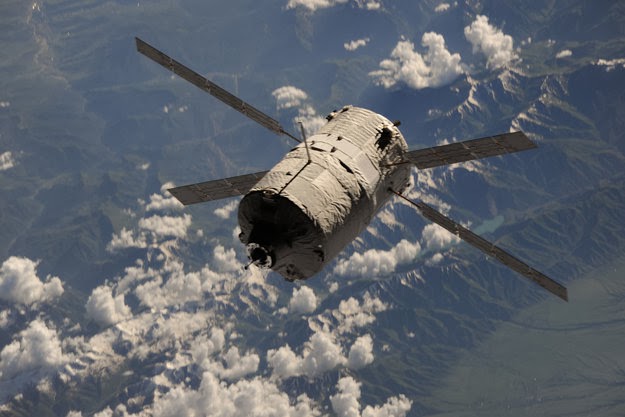
ATV-4 docking

The record-breaking craft has one more achievement up its sleeve: it will leave the Station packed with the largest amount of waste ever.

Watch the undocking live and follow ATV’s final moments with updates as they happen on ESA’s ATV blog: http://www.esa.int/Links/ATV_blog3

More information:

Automated Transfer Vehicle: http://www.esa.int/Our_Activities/Human_Spaceflight/ATV

ATV Control Centre: http://www.esa.int/Our_Activities/Human_Spaceflight/ATV/ATV_Control_Centre

ATV-4 factsheet: http://download.esa.int/HSO/ATV/esa_atv-4_mission_factsheet_18042013.pdf

Images, Text, Credits: ESA / NASA.

Cheers, Orbiter.ch

samedi 26 octobre 2013

The upper stage Breeze-M spacecraft brought Sirius FM-6 to the target orbit


ILS / ROSCOSMOS - Srius FM-6 launch Mission poster / Sirius XM Satellite Radio logo.

26.10.2013

October 26 at 07:20 MSK spacecraft (SC), satellite radio, Sirius FM-6 cleanly separated from the upper stage (RB) Breeze-M. Spacecraft launched into the target orbit.

Breeze-M powered in to the target orbit satellite radio Sirius FM-6

Earlier, on October 25 at 22:08 MSK from the launch complex area 200 Baikonur calculations of rocket launchers and space industry Russia conducted a successful launch Vehicle (ILV) Proton-M with the upper stage Breeze-M and SC Sirius FM-6.

After the separation of the head unit in the Republic of Belarus Breeze-M and SC Sirius FM-6 from the third stage RKN further removal of spacecraft into the target orbit was carried out by the operation of the propulsion system booster.

Sirius FM-6 satellite

Sirius FM-6 is a high-power geostationary satellite for SiriusXM, America’s largest radio broadcaster measured by revenue and one of the world’s largest pure-play audio entertainment companies. Sirius FM-6 will help with the delivery of commercial-free music, and premier sports, news, talk, entertainment and Latin programming, traffic and weather to more than 25.6 million subscribers. Sirius FM-6 will also help in the delivery of traffic and other data service information to markets across North America for vehicles with navigational systems.

Coverage area of ​​the Sirius FM-6 satellite

SiriusXM is installed in vehicles of every major automaker and available for sale at retail locations nationwide. Sirius FM-6 will ensure SiriusXM’s array of audio and data services are received by vehicles, mobile devices and home receivers and will play an important role in bolstering the continuity of service for years to come.

ROSCOSMOS Press Release: http://www.federalspace.ru/19938/

Images, Text, Credits: Press Service of the Russian Federal Space Agency / ILS / ROSCOSMOS / Screen captures, Translation: Orbiter.ch Aerospace.

Greetings, Orbiter.ch

vendredi 25 octobre 2013

Ghostly Specter Haunts the ‘Coldest Place in the Universe’


ALMA - Atacama Large Millimeter / submillimeter Array telescope logo.

Oct. 25, 2013

 Ghostly 'Boomerang'

Image above: The Boomerang nebula, called the "coldest place in the universe," reveals its true shape to the Atacama Large Millimeter/submillimeter Array (ALMA) telescope. Image Credit: NRAO/AUI/NSF/NASA/STScI/JPL-Caltech.

At a cosmologically crisp one degree Kelvin (minus 458 degrees Fahrenheit), the Boomerang nebula is the coldest known object in the universe -- colder, in fact, than the faint afterglow of the Big Bang, the explosive event that created the cosmos.

Astronomers using the Atacama Large Millimeter/submillimeter Array (ALMA) telescope in Chile have taken a new look at this object to learn more about its frigid properties and to determine its true shape, which has an eerily ghost-like appearance.

"This ultra-cold object is extremely intriguing and we're learning much more about its true nature with ALMA," said Raghvendra Sahai, a researcher and principal scientist at NASA's Jet Propulsion Laboratory in Pasadena, Calif., and lead author of a paper published in the Astrophysical Journal. “What seemed like a double lobe, or boomerang shape, from Earth-based optical telescopes, is actually a much broader structure that is expanding rapidly into space."

As originally observed with ground-based telescopes, this nebula appeared lopsided, which is how it got its name. Later observations with NASA's Hubble Space Telescope revealed a bow-tie-like structure. The new ALMA data, however, reveal that the Hubble image tells only part of the story, and the twin lobes seen in that image may actually be a trick of light as seen at visible wavelengths.

The researchers discovered a dense lane of millimeter-sized dust grains surrounding the star, which explains why its outer cloud has an hourglass shape in visible light. These minute dust grains have created a mask that shades a portion of the central star and allows its light to leak out only in narrow but opposite directions into the cloud, giving it an hourglass appearance.

"This is important for the understanding of how stars die and become planetary nebulas,” said Sahai. “Using ALMA, we were quite literally, and figuratively, able to shed new light on the death throes of a sun-like star."

Atacama Large Millimeter/submillimeter Array (ALMA) telescope. Image credit: ALMA

The Boomerang nebula, located about 5,000 light-years away in the constellation Centaurus, is a relatively young example of an object known as a planetary nebula. Planetary nebulas, contrary to their name, are actually the end-of-life phases of stars like our sun that have sloughed off their outer layers. What remains at their centers are white dwarf stars, which emit intense ultraviolet radiation that causes the gas in the nebulae to glow and emit light in brilliant colors.

Read the full ALMA release online at https://public.nrao.edu/news/pressreleases/alma-reveals-coldest-place-in-the-universe .

Additional authors on this paper include Wouter Vlemmings, Chalmers University of Technology, Onsala, Sweden; Patrick Huggins, New York University, New York; Lars-Ake Nyman, Joint ALMA Observatory, Santiago de Chile; and Yiannis Gonidakis, CSIRO, Australia Telescope National Facility.

ALMA, an international astronomy facility, is a partnership of Europe, North America and East Asia in cooperation with the Republic of Chile. ALMA construction and operations are led on behalf of Europe by European Southern Observatory, on behalf of North America by the National Radio Astronomy Observatory (NRAO), and on behalf of East Asia by the National Astronomical Observatory of Japan (NAOJ). The Joint ALMA Observatory (JAO) provides the unified leadership and management of the construction, commissioning and operation of ALMA.

The National Radio Astronomy Observatory is a facility of the National Science Foundation, operated under cooperative agreement by Associated Universities, Inc.

The California Institute of Technology in Pasadena manages JPL for NASA.

Images (mentioned), Text, Credits: NASA / JPL / Whitney Clavin.

Cheers, Orbiter.ch

Carbon Worlds May be Waterless, Finds NASA Study


NASA logo / NASA - Kepler Mission patch.

Oct. 25, 2013

 A Tale of Two Worlds: Silicate Versus Carbon Planets

Image above: This artist's concept illustrates the fate of two different planets: the one on the left is similar to Earth, made up largely of silicate-based rocks with oceans coating its surface. Image Credit: NASA/JPL-Caltech.

Planets rich in carbon, including so-called diamond planets, may lack oceans, according to NASA-funded theoretical research.

Our sun is a carbon-poor star, and as result, our planet Earth is made up largely of silicates, not carbon. Stars with much more carbon than the sun, on the other hand, are predicted to make planets chock full of carbon, and perhaps even layers of diamond.

By modeling the ingredients in these carbon-based planetary systems, the scientists determined they lack icy water reservoirs thought to supply planets with oceans.

"The building blocks that went into making our oceans are the icy asteroids and comets," said Torrence Johnson of NASA's Jet Propulsion Laboratory in Pasadena, Calif, who presented the results Oct. 7 at the American Astronomical Society Division of Planetary Sciences meeting in Denver. Johnson, a team member of several NASA planetary missions, including Galileo, Voyager and Cassini, has spent decades studying the planets in our own solar system.

"If we keep track of these building blocks, we find that planets around carbon-rich stars come up dry," he said.

Johnson and his colleagues say the extra carbon in developing star systems would snag the oxygen, preventing it from forming water.

"It's ironic that if carbon, the main element of life, becomes too abundant, it will steal away the oxygen that would have made water, the solvent essential to life as we know it," said Jonathan Lunine of Cornell University, Ithaca, N.Y., a collaborator on the research.

One of the big questions in the study of planets beyond our solar system, called exoplanets, is whether or not they are habitable. Researchers identify such planets by first looking for those that are situated within the "habitable zone" around their parent stars, which is where temperatures are warm enough for water to pool on the surface. NASA's Kepler mission has found several planets within this zone, and researchers continue to scrutinize the Kepler data for candidates as small as Earth.

But even if a planet is found in this so-called "Goldilocks" zone, where oceans could, in theory, abound, is there actually enough water available to wet the surface? Johnson and his team addressed this question with planetary models based on measurements of our sun's carbon-to-oxygen ratio. Our sun, like other stars, inherited a soup of elements from the Big Bang and from previous generations of stars, including hydrogen, helium, nitrogen, silicon, carbon and oxygen.

"Our universe has its own top 10 list of elements," said Johnson, referring to the 10 most abundant elements in our universe.

These models accurately predict how much water was locked up in the form of ice early in the history of our solar system, billions of years ago, before making its way to Earth. Comets and/or the parent bodies of asteroids are thought to have been the main water suppliers, though researchers still debate their roles. Either way, the objects are said to have begun their journey from far beyond Earth, past a boundary called the "snow line," before impacting Earth and depositing water deep in the planet and on its surface.

When the researchers applied the planetary models to the carbon-rich stars, the water disappeared. "There's no snow beyond the snow line," said Johnson.

"All rocky planets aren't created equal," said Lunine. "So-called diamond planets the size of Earth, if they exist, will look totally alien to us: lifeless, ocean-less desert worlds."

The computer model results supporting these conclusions were published in the Astrophysical Journal last year (http://arxiv.org/abs/1208.3289).  The implications for habitability in these systems were the focus of the Division of Planetary Sciences meeting.

The California Institute of Technology, Pasadena, manages JPL for NASA.

Image (mentioned), Text, Credits: NASA  JPL / Whitney Clavin.

Best regards, Orbiter.ch

Antarctic Ozone Hole Slightly Smaller than Average This Year


NASA - EOS AURA Mission patch.

Oct. 25, 2013


Image above: The Antarctic ozone hole reached its maximum single-day area for 2013 on Sept. 16. The ozone hole (purple and blue) is the region over Antarctica with total ozone at or below 220 Dobson units (a common unit for measuring ozone concentration). Image Credit: NASA's Goddard Space Flight Center.

The ozone hole that forms each year in the stratosphere over Antarctica was slightly smaller in 2013 than average in recent decades, according to NASA satellite data.

The ozone hole is a seasonal phenomenon that starts to form during the Antarctic spring (August and September). The September-October 2013 average size of the hole was 8.1 million square miles (21 million square kilometers). For comparison, the average size measured since the mid-1990s when the annual maximum size stopped growing is 8.7 million square miles (22.5 million square kilometers). However, the size of the hole in any particular year is not enough information for scientists to determine whether a healing of the hole has begun.

"There was a lot of Antarctic ozone depletion in 2013, but because of above average temperatures in the Antarctic lower stratosphere, the ozone hole was a bit below average compared to ozone holes observed since 1990," said Paul Newman, an atmospheric scientist and ozone expert at NASA's Goddard Space Flight Center in Greenbelt, Md.

The ozone hole forms when the sun begins rising again after several months of winter darkness. Polar-circling winds keep cold air trapped above the continent, and sunlight-sparked reactions involving ice clouds and chlorine from manmade chemicals begin eating away at the ozone. Most years, the conditions for ozone depletion ease before early December when the seasonal hole closes.

Levels of most ozone-depleting chemicals in the atmosphere have gradually declined as the result of the 1987 Montreal Protocol, an international treaty to protect the ozone layer by phasing out production of ozone-depleting chemicals. As a result, the size of the hole has stabilized, with variation from year to year driven by changing meteorological conditions.

Daily Ozone from July 1 to Oct 15, 2013

Video above: Daily images from Jul. 1 to Oct. 15 show the evolution of the 2013 ozone hole. The ozone hole maximum occurred on Sept. 16, 2013. Image Credit: NASA/Robert Simmon/Ozone Hole Watch.

The single-day maximum area this year was reached on Sept. 16 when the maximum area reached 9.3 million square miles (24 million square kilometers), about equal to the size of North America. The largest single-day ozone hole since the mid-1990s was 11.5 million square miles (29.9 million square kilometers) on Sept. 9, 2000.

Science teams from NASA and the National Oceanic and Atmospheric Administration (NOAA) have been monitoring the ozone layer from the ground and with a variety of instruments on satellites and balloons since the 1970s. These ozone instruments capture different aspects of ozone depletion. The independent analyses ensure that the international community understands the trends in this critical part of Earth's atmosphere. The resulting views of the ozone hole have differences in the computation of the size of the ozone hole, its depth, and record dates.

AURA satellite. Image Credit: NASA's Goddard Space Flight Center

NASA observations of the ozone hole during 2013 were produced from data supplied by the Ozone Monitoring Instrument on NASA's Aura satellite and the Ozone Monitoring and Profiler Suite instrument on the NASA-NOAA Suomi National Polar-orbiting Partnership satellite. Long-term satellite ozone-monitoring instruments have included the Total Ozone Mapping Spectrometer, the second generation Solar Backscatter Ultraviolet Instrument, the Stratospheric Aerosol and Gas Experiment series of instruments, and the Microwave Limb Sounder.

Related Links:

NASA's Ozone Hole Watch: http://ozonewatch.gsfc.nasa.gov/

2012 Antarctic Ozone Hole Second Smallest in 20 years: http://orbiterchspacenews.blogspot.ch/search?q=2012+Antarctic+Ozone+Hole+Second+Smallest+in+20+years

NASA, NOAA Data Show Significant Antarctic Ozone Hole Remains: http://www.nasa.gov/topics/earth/features/ozone-2011.html

Images (mentioned), Video (mentioned), Text, Credits: NASA / Steve Cole / Goddard Space Flight Center / Kathryn Hansen.

Cheers, Orbiter.ch

SIRIUS FM-6 carried by Proton-M Liftoff!


ILS / ROSCOSMOS - Sirius Fm-6 launch Mission poster.

October 25, 2013

Liftoff of the ILS Proton M Breeze M rocket and the SIRIUS FM-6 satellite

ILS / ROSCOSMOS - At 08:22:54 MSK (Moscow Time) liftoff of the ILS Proton M Breeze M rocket and the SIRIUS FM-6 satellite.

The three stages of the Proton vehicle have performed as planned, and it is up to the Breeze M upper stage to complete the mission.

Launch of Sirius FM-6 on Proton-M Rocket

According to the flight cyclogram head unit in the Republic of Belarus Breeze-M and SC Sirius FM-6 cleanly separated from the third stage rocket to 22:18 MSK.

Further removal of the spacecraft to the target orbit at the expense of the propulsion upper stage.

Sirius FM-6 satellite

Satellite Use:
  
Sirius FM-6 is a high-power geostationary satellite for SiriusXM, America’s largest radio broadcaster measured by revenue and one of the world’s largest pure-play audio entertainment companies. Sirius FM-6 will help with the delivery of commercial-free music, and premier sports, news, talk, entertainment and Latin programming, traffic and weather to more than 25.6 million subscribers. Sirius FM-6 will also help in the delivery of traffic and other data service information to markets across North America for vehicles with navigational systems. SiriusXM is installed in vehicles of every major automaker and available for sale at retail locations nationwide. Sirius FM-6 will ensure SiriusXM’s array of audio and data services are received by vehicles, mobile devices and home receivers and will play an important role in bolstering the continuity of service for years to come.

ROSCOSMOS Press Release: http://www.federalspace.ru/19936/

Images, Video, Text, Credits: ILS / ROSCOSMOS / Orbiter.ch Aerospace.

Greetings, Orbiter.ch

Sun Emits 2nd Solar Flare in 2 Days


NASA - Solar Dynamics Observatory (SDO) patch.

Oct. 25, 2013

The sun emitted a significant solar flare, peaking at 4:01 a.m. EDT on Oct. 25, 2013. Solar flares are powerful bursts of radiation. Harmful radiation from a flare cannot pass through Earth's atmosphere to physically affect humans on the ground, however -- when intense enough -- they can disturb the atmosphere in the layer where GPS and communications signals travel. This disrupts the radio signals for as long as the flare is ongoing, anywhere from minutes to hours.


Image above: NASA's Solar Dynamics Observatory captured this image of an X1.7 class flare on Oct. 25, 2013. The image shows light in the 131-angstrom wavelength, which is good for seeing material at the intense temperatures of a solar flare, and which is typically colorized in teal. Image Credit: NASA/SDO.

To see how this event may impact Earth, please visit NOAA's Space Weather Prediction Center at http://spaceweather.gov, the U.S. government's official source for space weather forecasts, alerts, watches and warnings.

This flare is classified as an X1.7 class flare. "X-class" denotes the most intense flares, while the number provides more information about its strength. An X2 is twice as intense as an X1, an X3 is three times as intense, etc. In the past, X-class flares of this intensity have caused degradation or blackouts of radio communications for about an hour.

Increased numbers of flares are quite common at the moment, since the sun's normal 11-year activity cycle is currently near solar maximum conditions. Humans have tracked this solar cycle continuously since it was discovered in 1843, and it is normal for there to be many flares a day during the sun's peak activity. The first X-class flare of the current solar cycle occurred in February 2011. The largest X-class flare in this cycle was an X6.9 on Aug. 9, 2011.

Updates will be provided as needed.

Related Links:

Frequently Asked Questions Regarding Space Weather: http://www.nasa.gov/mission_pages/sunearth/spaceweather/index.html

View Other Past Solar Activity: http://www.nasa.gov/mission_pages/sunearth/multimedia/Solar-Events.html

Image (mentioned), Text, Credit: NASA's Goddard Space Flight Center / Karen C. Fox.

Best regards, Orbiter.ch