mardi 19 novembre 2013

Formation of Massive Stars from Giant, Turbulent Molecular Clouds


NASA patch.

Nov. 19, 2013


In their quest to understand the origins of stars and galaxies in our universe, astrophysicists use supercomputers to model extremely complex phenomena on an immense scale. Massive stars 10-100 times more massive than our sun, are central to the key phenomena that shape the universe, but the processes involved in their formation remain elusive. To investigate these processes, University of California-Berkeley researchers perform large-scale supercomputing simulations of massive stars forming from the collapse of giant, turbulent molecular clouds.    

In this image, a simulation shows the gas filaments that formed in an infrared dark cloud 800,000 years after the region began gravitational collapse. The extent of the main filament is about 4.5 parsecs in length. In the highest density fragments in the filament (red), molecular cloud cores are developing and will collapse further until they form stars.

Pleiades Supercomputer - NASA Advanced Supercomputing Facility (NAS)

Each simulation in this project used 1,000 - 4,000 processors on the Pleiades supercomputer at the NASA Advanced Supercomputing (NAS) facility, for a total of 1 million processor-hours over several months of computation.

Related: NASA will showcase more than 30 of the agency's exciting computational achievements at SC13, the international supercomputing conference, Nov. 17-22, 2013 in Denver: http://www.nasa.gov/ames/nasa-experts-showcase-science-technology-at-supercomputing-conference/

NASA Advanced Supercomputing (NAS) facility: http://www.nas.nasa.gov/

Images, Text, Credit: Richard Klein, Lawrence Livermore National Laboratory; Pak Shing Li, University of California, Berkeley; Tim Sandstrom, NASA Ames Research Center.

Cheers, Orbiter.ch

Celebrate the Space Station’s 15th birthday


ISS - International Space Station patch.

19 November 2013

 International Space Station (ISS) salutes the Sun

Zarya, the first module of the International Space Station, was launched on 20 November 1998. Five space agencies representing 16 nations have worked together to build the orbiting research complex – one of the most complex scientific and technological endeavours ever undertaken.

Celebrate with us on Wednesday as we launch a worldwide wave on Twitter to cheer the Space Station.

Starting midnight GMT, the Station’s official time zone, ESA and the US, Japanese and Canadian space agencies will tweet over 24 hours – one every hour, on the hour.

Space Station seen from Japan

Join the wave by following the hashtag #ISS15. Keep the wave rolling by telling us what the International Space Station – its science, technology and astronauts – means to you.

You can post your photos, comments or even poems and join the conversation on the Google+ community page: ISS15 – join the world-wide wave: https://plus.google.com/u/0/communities/109246621268779478914

Christer Fuglesang spacewalk

Head outside and take a picture of the Space Station to share with us. Who is your favourite astronaut? What image captures the spirit of the Space Station?

ESA and its partner agencies will share their favourite pictures, stories and videos. Get involved and join the #ISS15 wave!

Current status:

Where is the International Space Station?: http://www.esa.int/Our_Activities/Human_Spaceflight/International_Space_Station/Where_is_the_International_Space_Station

Related links:

About the International Space Station: http://www.esa.int/Our_Activities/Human_Spaceflight/International_Space_Station/About_the_International_Space_Station

International Space Station - NASA website: http://www.nasa.gov/mission_pages/station/main/index.html

International Space Station - CSA-ASC website:
French - http://www.asc-csa.gc.ca/fra/iss/default.asp
English - http://www.asc-csa.gc.ca/eng/iss/default.asp

International Space Station - ROSCOSMOS website: (Only in Russian) http://www.federalspace.ru/154/1/

International Space Station - JAXA website: http://www.jaxa.jp/topics/2013/11_e.html

Building the International Space Station: http://www.esa.int/Our_Activities/Human_Spaceflight/International_Space_Station/Building_the_International_Space_Station3

International Space Station Benefits for Humanity: http://www.esa.int/Our_Activities/Human_Spaceflight/International_Space_Station_Benefits_for_Humanity

International Space Station legal framework: http://www.esa.int/Our_Activities/Human_Spaceflight/International_Space_Station/International_Space_Station_legal_framework

Europe's partners: http://www.esa.int/Our_Activities/Human_Spaceflight/International_Space_Station/Europe_s_partners

Images, Text, Credits: ESA / NASA / Yujiro Suzuki.

Greetings, Orbiter.ch

Debris from stellar explosions in the Galaxy's fast lane


ESA - Integral Mission patch.

19 November 2013

Astronomers looking at the radioactive afterglow of supernovae with ESA's INTEGRAL mission have revealed that the remains of stellar explosions move through the Milky Way much faster, on average, than stars and most of the Galaxy's gas. This stellar debris is most likely ejected by winds and supernova explosions in large groups of massive stars located primarily on the leading edges of the Galaxy's spiral arms.

While the night sky delivers a peaceful and almost immutable cosmic view, the picture belies a Universe alive with ceaseless motion from the smallest to the largest scales. All structures in the Milky Way, both the stars and the diffuse interstellar medium, swirl around the centre of the Galaxy at velocities as high as hundreds of kilometres per second, taking about one hundred million years to complete a revolution.

Artist's impression of our Galaxy

By studying how these objects move, astronomers can figure out the structure of the Milky Way at large and, in particular, of the spiral arms – a prominent characteristic of our Galaxy. These investigations are key in the challenge of understanding the history of the Milky Way's evolution.

Using data from ESA's INTEGRAL mission, a team of astronomers has mapped out galactic motions, exploiting a new tracer that follows stellar debris both through space and time. With this new method, they revealed that the remains of stellar explosions move, on average, much faster than stars and most of the gas in the Milky Way.

"The stellar winds blown by a massive star, and the supernova explosions at the end of its life, are powerful agents. They release large amounts of matter and energy into interstellar space, and we managed to trace some of this matter during its very long journey," explains Karsten Kretschmer from the Laboratoire APC in Paris, France. Kretschmer is the lead author of the paper reporting on the new results, published in Astronomy & Astrophysics.

The astronomers traced the path of the supernova debris by tracking its velocity relative to us through the Galaxy. They sought the light emitted at a specific gamma-ray wavelength by the radioactive decay of aluminium-26 (26Al), an isotope produced in the supernova explosions. Matter ejected by a supernova is richer in heavy elements than the raw material from which the parent star formed, because many new atomic nuclei are created in the star's interior as well as during the explosion.

Part of the ejected material is in the form of nuclei of radioactive isotopes, and the majority of them decay over short timescales – ranging between a few days and several years. But not 26Al. With a half-life of about 700 000 years, 26Al nuclei can travel very long distances before they decay. When they do so, astronomers can exploit the gamma rays emitted during the decay to trace the long-term reach of stellar explosions.

"Looking at the radioactive afterglow of supernovae about a million years after the explosions, we followed how their debris has spread across the Galaxy. This is not possible with observations at other wavelengths, which only show the remnants of more recent supernovae," adds Kretschmer.

Kretschmer and his collaborators used the SPectrometer on INTEGRAL (SPI) instrument to search for the emission from the radioactive decay of 26Al. With these data, they could map the distribution and velocity of this isotope across the Milky Way.

"Surprisingly, during the first million years of their journey, the ejecta from supernovae seem to move, on average, twice as fast as stars and the diffuse gas we see at other wavelengths in the Galaxy," comments co-author Roland Diehl from the Max-Planck Institut für Extraterrestrische Physik in Munich, Germany.

"We expected such high velocities in the initial phase after the explosion, but not after a million years. Our measurements are unique as they can detect the motion of the debris on such a long time scale, but still before it is slowed down as it ploughs through the surrounding gas that moves with the general flow."

The astronomers also found that supernovae tend to be more abundant in the inner parts of the Milky Way, where the spiral arms stem from the central regions of the Galaxy, rather than at the periphery.

"We conclude that the ejecta from supernovae are mainly concentrated towards the leading edges of the arms, while most of the gas and dust from which stars take shape are located in the core of the arms," he adds.

This offset in velocity and location between the cradles of star formation and the graveyard of stellar remains suggests the existence of strong asymmetries in the outflows from massive stars and supernovae within the Galaxy.

Stars form deep within the spiral arms, but may migrate outwards during their lifetime. The most massive of them blow intense winds during their lifetime and eventually die as supernovae. The material ejected during these events proceeds faster towards the regions of the Milky Way between the arms, creating gigantic bubbles that expand more easily in those directions where interstellar material is less dense.

"From the images of nearby spiral galaxies at optical and ultraviolet wavelengths, previous studies had already suggested that massive stars and supernovae may be preferentially located on the edges of spiral arms. Now, we have obtained direct proof," says Kretschmer.

The result will help astronomers piece together the turbulent journey of matter across the Galaxy, from one generation of stars to the next. It is also a valuable clue to investigate how the complex structure of arms arises in spiral galaxies.

Artist's impression of  ESA's INTEGRAL spacecraft

Many observations were needed in this study to gain optimal control over the spectral resolution of the SPI instrument, which varies over time.

"We had to collect data over almost ten years to achieve the spectral resolution required for this study," notes Diehl.

"This velocity measurement is an unprecedented technical result at these wavelengths: with such a high spectral resolution, SPI is and will remain a unique instrument for years to come."

The motion of 26Al nuclei rotating in the Galaxy was already evident in the results from an earlier study, based on INTEGRAL data and published in 2006. But longer monitoring and improved spectral resolution were crucial to pinpoint the velocity of these nuclei to great precision.

"The goal of this study was very ambitious: looking at stellar aftermaths that only INTEGRAL can see. And we've succeeded, revealing that they move much faster than we could imagine," concludes Erik Kuulkers, ESA's INTEGRAL Project Scientist.

Background information:

The results described in this article are reported in "Kinematics of massive star ejecta in the Milky Way as traced by 26Al", by K. Kretschmer et al., published in Astronomy & Astrophysics, 559, A99, 2013; 10.1051/0004-6361/201322563. The study is based on data collected with the SPI (Spectrometer on INTEGRAL) instrument on board ESA's INTEGRAL mission. The data were collected between February 2003 and February 2012.

The International Gamma-ray Astrophysics Laboratory (INTEGRAL) was launched on 17 October 2002. It is an ESA project with the instruments and a science data centre funded by ESA Member States (especially the Principal Investigator countries: Denmark, France, Germany, Italy, Spain, Switzerland) and Poland, and with the participation of Russia and the USA. The mission is dedicated to the fine spectroscopy (E/∆E = 500) and fine imaging (angular resolution: 12 arcmin FWHM) of celestial gamma-ray sources in the energy range 15 keV to 10 MeV with concurrent source monitoring in the X-ray (4-35 keV) and optical (V-band, 550 nm) energy ranges.

For more information about Integral Mission, visit: http://sci.esa.int/integral/

Image, Text, Credit: ESA / C. Carreau / INTEGRAL Project Scientist, Erik Kuulkers / Max-Planck Institute for Extraterrestrial Physics, Roland Diehl / Laboratoire APC - AstroParticule et Cosmologie
Université Paris Diderot, Karsten Kretschmer.

Best regards, Orbiter.ch

lundi 18 novembre 2013

New Cassini Image of Sunlit Clouds on Saturn


NASA / ESA - Cassini Mission to Saturn patch.

Nov. 18, 2013

Impressionistic Saturn

To the Cassini spacecraft's infrared eyes, Saturn's graceful clouds sometimes take on the appearance of an impressionist's painting of the giant planet.

This view looks toward the sunlit side of the rings from about 18 degrees above the ringplane. The image was taken with the Cassini spacecraft wide-angle camera on Aug. 12, 2013 using a spectral filter sensitive to wavelengths of near-infrared light centered at 728 nanometers.

The view was acquired at a distance of approximately 994,000 miles (1.6 million kilometers) from Saturn. Image scale is 57 miles (92 kilometers) per pixel.

The Cassini-Huygens mission is a cooperative project of NASA, the European Space Agency and the Italian Space Agency. The Jet Propulsion Laboratory, a division of the California Institute of Technology in Pasadena, manages the mission for NASA's Science Mission Directorate, Washington, D.C. The Cassini orbiter and its two onboard cameras were designed, developed and assembled at JPL. The imaging operations center is based at the Space Science Institute in Boulder, Colo.

For more information about the Cassini-Huygens mission visit http://www.nasa.gov/cassini, http://saturn.jpl.nasa.gov . The Cassini imaging team homepage is at http://ciclops.org and http://www.esa.int/Our_Activities/Space_Science/Cassini-Huygens

Image, Text, Credit: NASA / JPL-Caltech / Space Science Institute.

Greetings, Orbiter.ch

MAVEN Launches on Ten-Month Journey to Mars Orbit


NASA - MAVEN Mission patch.

Nov. 18, 2013


At 1:28 p.m. EST, NASA's Mars Atmosphere and Volatile EvolutioN (MAVEN) spacecraft launched aboard a United Launch Alliance Atlas V rocket from Cape Canaveral Air Force Station in Florida, beginning a 10-month journey to Mars orbit. MAVEN will take critical measurements of the Martian upper atmosphere to help scientists understand climate change over the Red Planet's history.

Liftoff of MAVEN

NASA's next Mars explorer leave Earth on a mission to answer one of the Red Planet's greatest conundrums: If our arid celestial neighbor once had a thicker atmosphere and a surface flowing with water, as evidence suggests, how did the climate change so dramatically?

Jakosky, of the Laboratory for Atmospheric and Space Physics (LASP) at the University of Colorado at Boulder, leads the mission and has been involved in the flight since its inception. The mission is designed to search for clues into the thinning of Mars' atmosphere and the disappearance of surface water over time. Scientists theorize the sun may have had a role in the escape of gas from the planet's upper atmosphere -- a region that hasn't yet been studied.

Since 1964, NASA has flown a series of orbiters, landers and rovers to Mars, searching for chemical traces of water or signs that the planet once could harbor life. MAVEN stands apart from these because it's the first to focus exclusively on the upper reaches of the planet's atmosphere.

"Mars is a complicated system, just as complicated as the Earth in its own way," Jakosky said. "You can't hope, with a single spacecraft, to study all aspects and to learn everything there is to know about it. With MAVEN, we're exploring the single biggest unexplored piece of Mars so far."

The spacecraft will arrive at the Red Planet on Sept. 22, 2014, and slip into an elliptical orbit ranging from a low of 93 miles above the surface to a high of 3,728 miles. It also will take five "deep dips" during the course of the mission, flying as low as 77 miles in altitude and providing a cross-section of the top of the atmosphere.

MAVEN spacecraft in orbit around Mars

MAVEN is an eight-foot cube weighing about 5,400 pounds at launch -- as much as a fully loaded sport utility vehicle. With its twin pairs of gull-wing-shaped solar panels extended, it stretches 37 feet from wingtip to wingtip.

The spacecraft is outfitted with a trio of instrument suites. The Particles and Fields Package, built by the University of California at Berkeley Space Sciences Laboratory, contains six individual instruments that characterize the solar wind and ionosphere of the planet. The Remote Sensing Package, built by LASP, will determine global characteristics of the upper atmosphere and ionosphere. The Neutral Gas and Ion Mass Spectrometer, built by NASA's Goddard Space Flight Center, will measure the composition and isotopes of neutrals and ions.

Planning the MAVEN mission has been a team effort involving several partners. NASA Goddard in Greenbelt, Md., manages the project and provided two of the science instruments for the mission. Lockheed Martin built the spacecraft and is responsible for mission operations. The University of California at Berkeley's Space Sciences Laboratory provided science instruments for the mission. NASA's Jet Propulsion Laboratory in Pasadena, Calif., provides navigation support, Deep Space Network support, and Electra telecommunications relay hardware and operations.

For more information about MAVEN Mission, visit: http://www.nasa.gov/mission_pages/maven/main/

Images, Video, Text, Credits: NASA / NASA TV.

Best regards, Orbiter.ch

Galactic cauldron


ESA - XMM-Newton Mission patch.

Nov. 18, 2013

Hot gas sloshing in a galactic cauldron

Galaxies are social beasts that are mostly found in groups or clusters – large assemblies of galaxies that are permeated by even larger amounts of diffuse gas. With temperatures of 10 million degrees or more, the gas in galaxy groups and clusters is hot enough to shine brightly in X-rays and be detected by ESA’s XMM-Newton X-ray observatory.

As galaxies speed through these gigantic cauldrons, they occasionally jumble the gas and forge it into lop-sided shapes. An example is revealed in this composite image of the galaxy group NGC 5044, the brightest group in X-rays in the entire sky.

The group is named after the massive and bright elliptical galaxy at its centre, surrounded by tens of smaller spiral and dwarf galaxies. The galaxies are shown in a combination of optical images from the Digitized Sky Survey with infrared and ultraviolet images from NASA’s WISE and Galex satellites, respectively. Foreground stars are also sprinkled across the image.

The large blue blob shows the distribution of hot gas filling the space between NGC 5044’s galaxies as imaged by XMM-Newton. From the X-ray observations, astronomers can also see the glow of iron atoms that were forged in stellar explosions within the galaxies of the group but streamed beyond. The distribution of iron atoms is shown in purple.

Embedded within the hot gas are clouds of even more energetic plasma that emit radio waves – a reminder of the past activity of a supermassive black hole lurking at the centre of the group. These are the green filament extending from the central galaxy to the lower right and the larger green region to its lower left, which were imaged with the Giant Metrewave Radio Telescope, near Pune in India.

The distribution of the intergalactic gas and its ingredients is asymmetric, with a larger splotch in the upper right part of the image and a smaller one in the lower left.

XMM-Newton spacecraft

Astronomers believe that gas in NGC 5044 is sloshing as a consequence of a galaxy that passed through it several millions of years ago. The culprit is the spiral galaxy NGC 5054, which is not visible here, instead hiding beyond its lower left corner.

The transit of NGC 5054 through the centre of the group may have also caused the twisted shape of the radio-bright filament.

This image was first published in the XMM-Newton Image Gallery in October 2013. The analysis is reported in the paper by E. O’Sullivan et al. “The impact of sloshing on the intra-group medium and old radio lobe of NGC 5044.”

For more information about XMM-Newton Mission, Visit: http://sci.esa.int/xmm-newton/ and XMM-Newton Operations Centre: http://xmm.esac.esa.int/

Images, Text, Credits: ESA / E. O’Sullivan.

Greetings, Orbiter.ch

New Image of Comet ISON


ESO - European Southern Observatory logo.

Nov. 18, 2013


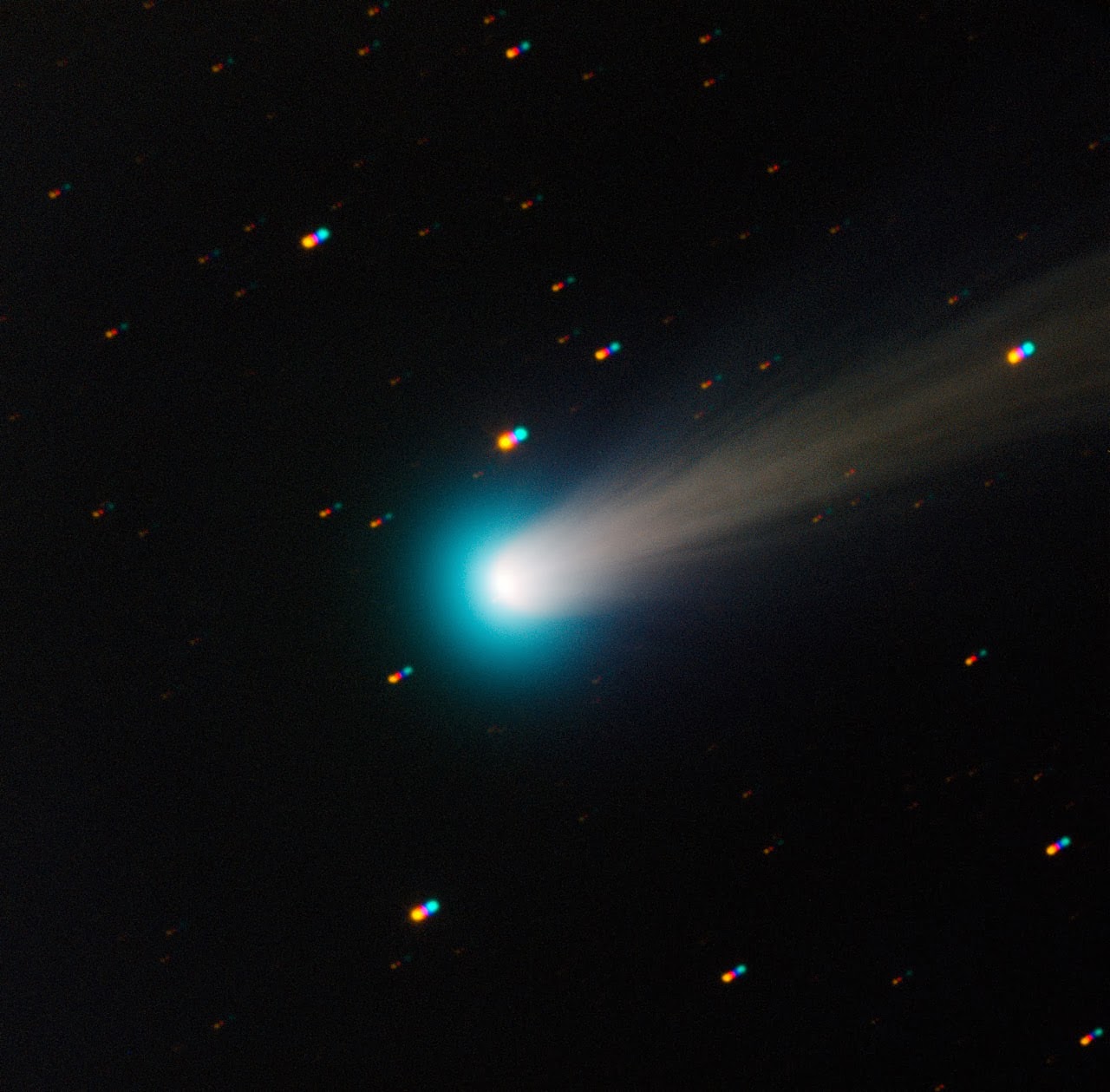
This new view of Comet C/2012 S1 (ISON) was taken with the TRAPPIST national telescope at ESO's La Silla Observatory on the morning of Friday 15 November 2013. Comet ISON was first spotted in our skies in September 2012, and will make its closest approach to the Sun in late November 2013.

TRAPPIST has been monitoring comet ISON since mid-October, using broad-band filters like those used in this image. It has also been using special narrow-band filters which isolate the emission of various gases, allowing astronomers to count how many molecules of each type are released by the comet.

Comet ISON was fairly quiet until 1 November 2013, when a first outburst doubled the amount of gas emitted by the comet. On 13 November, just before this image was taken, a second giant outburst shook the comet, increasing its activity by a factor of ten. It is now bright enough to be seen with a good pair of binoculars from a dark site, in the morning skies towards the East. Over the past couple of nights, the comet has stabilised at its new level of activity.

These outbursts were caused by the intense heat of the Sun reaching ice in the tiny nucleus of the comet as it zooms toward the Sun, causing the ice to sublimate and throwing large amounts of dust and gas into space. By the time ISON makes its closest approach to the Sun on 28 November (at only 1.2 million kilometres from its surface — just a little less than the diameter of the Sun!), the heat will cause even more ice to sublimate. However, it could also break the whole nucleus down into small fragments, which would completely evaporate by the time the comet moves away from the Sun's intense heat. If ISON survives its passage near the Sun, it could then become spectacularly bright in the morning sky.

The image is a composite of four different 30-second exposures through blue, green, red, and near-infrared filters. As the comet moved in front of the background stars, these appear as multiple coloured dots.

TRAPPIST (TRAnsiting Planets and PlanetesImals Small Telescope) is devoted to the study of planetary systems through two approaches: the detection and characterisation of planets located outside the Solar System (exoplanets), and the study of comets orbiting around the Sun. The 60-cm national telescope is operated from a control room in Liège, Belgium, 12 000 km away.

Links:

TRAPPIST page at University of Liège: http://www.orca.ulg.ac.be/TRAPPIST

Image, Text, Credits: ESO / TRAPPIST / E. Jehin.

Cheers, Orbiter.ch