samedi 22 février 2014

United Launch Alliance (ULA) Delta IV successfully launches with GPS IIF-5


ULA - Delta IV / GPS IIF-5 launch poster.

February 22, 2014

 United Launch Alliance (ULA) Delta IV rocket on the launch-pad

The US Air Force’s fifth GPS Block IIF navigation satellite was launched on Thursday night. Liftoff, from Cape Canaveral Air Force Station in Florida, via the United Launch Alliance (ULA) Delta IV rocket, came at the end of a nineteen-minute window, resulting in a T-0 of 8:59 pm Eastern (01:59 UTC on Friday 21 February 2014). The delay in the window was caused by high solar activity.

United Launch Alliance (ULA) Delta IV rocket liftoff

Built by Boeing, GPS IIF-5 is the fifth of twelve Block IIF satellites intended to replace older satellites in the Global Positioning System and introduce new capabilities ahead of the Block III series scheduled to begin launching in the next few years. Each satellite has a mass of 1,630 kilograms (3,534 lb) and is designed for twelve years’ service life.

Launch of GPS IIF-5 Satellite on Delta IV Medium Rocket

GPS satellites operate in semi-synchronous orbits with periods of twelve hours, making two revolutions per day. The constellation consists of six planes, designated A to F. In theory each plane should have four primary satellites in slots one to four, with a spare in slot five, however some planes have more than one backup; some of these satellites are kept operational in “slot six”, while others are in standby status.

Destined for slot 3 of plane A of the GPS constellation, GPS IIF-5 is scheduled to replace the USA-135 satellite, also known as GPS IIA-28, which was launched in November 1997. The nineteenth and final Block IIA satellite to fly, USA-135 will likely be moved to slot 5, which is typically occupied by an older, backup satellite.

Artist's view of the GPS IIF-5 satellite

The rocket that launched GPS IIF-5, United Launch Alliance’s Delta IV, conducted its twenty-fifth flight. Flying in the Medium+(4,2) configuration – its most-used variant – the rocket consists of a Common Booster Core (CBC) augmented by a pair of GEM-60 solid rocket motors, with a four-meter Delta Cryogenic Second Stage (DCSS) mounted atop the CBC.

The Common Booster Core is powered by a single RS-68 engine, while the DCSS makes use of an RL10B. Both core stages make use of cryogenic propellents, burning liquid hydrogen in a liquid oxygen oxidiser.

Delta IV rocket description

Originally developed by the US Air Force for military applications, President Ronald Reagan ordered that the Global Positioning System be made available to civilian users after a Korean Air Lines Boeing 747 was shot down after going off course and entering restricted Soviet airspace. The satellites broadcast freely-available civilian signals, and military ones with greater precision.

For more information about United Launch Alliance (ULA), visit: http://www.ulalaunch.com/site/default.shtml

For more information about GPS satellites, visit: http://en.wikipedia.org/wiki/Global_Positioning_System

Images, Video, Text, Credits: United Launch Alliance (ULA) / Orbiter.ch Aerospace.

Greetings, Orbiter.ch

vendredi 21 février 2014

NASA's IRIS Spots Its Largest Solar Flare


NASA - Interface Region Imaging Spectrograph (IRIS) logo.

February 21, 2014

IRIS Spots Its Largest Solar Flare

Video above: On Jan. 28, 2014, NASA's newly-launched Interface Region Imaging Spectrometer, or IRIS, observed its strongest solar flare to date. Image Credit: NASA/IRIS/SDO/Goddard Space Flight Center.

On Jan. 28, 2014, NASA's Interface Region Imaging Spectrograph, or IRIS, witnessed its strongest solar flare since it launched in the summer of 2013. Solar flares are bursts of x-rays and light that stream out into space, but scientists don't yet know the fine details of what sets them off.

IRIS peers into a layer of the sun's lower atmosphere just above the surface, called the chromosphere, with unprecedented resolution. However, IRIS can't look at the entire sun at the same time, so the team must always make decisions about what region might provide useful observations. On Jan. 28, scientists spotted a magnetically active region on the sun and focused IRIS on it to see how the solar material behaved under intense magnetic forces. At 2:40 p.m. EST, a moderate flare, labeled an M-class flare -- which is the second strongest class flare after X-class – erupted from the area, sending light and x-rays into space.


Image above: On Jan. 28, 2014, NASA's IRIS witnessed its strongest solar flare since it launched in the summer of 2013. Image Credit: NASA/IRIS.

IRIS studies the layer of the sun’s atmosphere called the chromosphere that is key to regulating the flow of energy and material as they travel from the sun's surface out into space. Along the way, the energy heats up the upper atmosphere, the corona, and sometimes powers solar events such as this flare.

IRIS is equipped with an instrument called a spectrograph that can separate out the light it sees into its individual wavelengths, which in turn correlates to material at different temperatures, velocities and densities. The spectrograph on IRIS was pointed right into the heart of this flare when it reached its peak, and so the data obtained can help determine how different temperatures of material flow, giving scientists more insight into how flares work.

Interface Region Imaging Spectrograph (IRIS)spacecraft. Image Credit: NASA

The IRIS mission is managed by the Lockheed Martin Solar and Astrophysics Laboratory of the ATC in Palo Alto, Calif. NASA’s Ames Research Center in Moffett Field, Calif., is responsible for mission operations and the ground data system. The Ames Pleiades supercomputer is used to carry out many of the numerical simulations that are led by the University of Oslo. The IRIS telescope was designed and built by the Smithsonian Astrophysical Observatory while Montana State University faculty and students assisted in the design of the spectrograph. A large volume of science data is downlinked via Kongsberg Satellite Services, (KSAT) facilities through a cooperative agreement between NASA and the Norwegian Space Centre.  NASA’s Goddard Space Flight Center in Greenbelt, Md., oversees the Explorers Program from which IRIS evolved.

For more information about IRIS mission, visit: http://iris.gsfc.nasa.gov/ and http://science.nasa.gov/missions/iris/

Images (mentioned), Video (mentioned), Text, Credits: NASA's Goddard Space Flight Center / Karen C. Fox.

Best regards, Orbiter.ch

The Shocking Behavior of a Speedy Star


NASA - Spitzer Space Telescope patch.

February 20, 2014


Image above: The red arc in this infrared image from NASA's Spitzer Space Telescope is a giant shock wave, created by a speeding star known as Kappa Cassiopeiae. Image Credit: NASA/JPL-Caltech.

Roguish runaway stars can have a big impact on their surroundings as they plunge through the Milky Way galaxy. Their high-speed encounters shock the galaxy, creating arcs, as seen in this newly released image from NASA’s Spitzer Space Telescope.

In this case, the speedster star is known as Kappa Cassiopeiae, or HD 2905 to astronomers. It is a massive, hot supergiant moving at around 2.5 million mph relative to its neighbors (1,100 kilometers per second). But what really makes the star stand out in this image is the surrounding, streaky red glow of material in its path. Such structures are called bow shocks, and they can often be seen in front of the fastest, most massive stars in the galaxy.

Bow shocks form where the magnetic fields and wind of particles flowing off a star collide with the diffuse, and usually invisible, gas and dust that fill the space between stars. How these shocks light up tells astronomers about the conditions around the star and in space. Slow-moving stars like our sun have bow shocks that are nearly invisible at all wavelengths of light, but fast stars like Kappa Cassiopeiae create shocks that can be seen by Spitzer’s infrared detectors.

Incredibly, this shock is created about 4 light-years ahead of Kappa Cassiopeiae, showing what a sizable impact this star has on its surroundings. (This is about the same distance that we are from Proxima Centauri, the nearest star beyond the sun.)

The Kappa Cassiopeiae bow shock shows up as a vividly red color. The faint green features in this image result from carbon molecules, called polycyclic aromatic hydrocarbons, in dust clouds along the line of sight that are illuminated by starlight.

Delicate red filaments run through this infrared nebula, crossing the bow shock. Some astronomers have suggested these filaments may be tracing out features of the magnetic field that runs throughout our galaxy. Since magnetic fields are completely invisible themselves, we rely on chance encounters like this to reveal a little of their structure as they interact with the surrounding dust and gas.

Spitzer Space Telescope. Image Credit: NASA/JPL-Caltech

Kappa Cassiopeiae is visible to the naked eye in the Cassiopeia constellation (but its bow shock only shows up in infrared light.)

For this Spitzer image, infrared light at wavelengths of 3.6 and 4.5 microns is rendered in blue, 8.0 microns in green, and 24 microns in red.

NASA's Jet Propulsion Laboratory, Pasadena, Calif., manages the Spitzer Space Telescope mission for NASA's Science Mission Directorate, Washington. Science operations are conducted at the Spitzer Science Center at the California Institute of Technology in Pasadena. Spacecraft operations are based at Lockheed Martin Space Systems Company, Littleton, Colorado. Data are archived at the Infrared Science Archive housed at the Infrared Processing and Analysis Center at Caltech. Caltech manages JPL for NASA. For more information about Spitzer, visit http://spitzer.caltech.edu and http://www.nasa.gov/spitzer

Images (mentioned), Text, Credits: NASA / JPL / Whitney Clavin.

Greetings, Orbiter.ch

How to catch a satellite


ESA - Clean Space logo.

21 February 2014

Standard space dockings are difficult enough, but a future ESA mission plans to capture derelict satellites adrift in orbit. Part of an effort to control space debris, the shopping list of new technologies this ambitious mission requires is set for discussion with industry experts.

Netting a derelict satellite

ESA’s Clean Space initiative is studying the e.DeOrbit mission for removing debris, aiming to reduce the environmental impact of the space industry on Earth and space alike. 

Earth's debris halo

Decades of launches have left Earth surrounded by a halo of space junk: more than 17 000 trackable objects larger than a coffee cup, which threaten working missions with catastrophic collision. Even a 1 cm nut could hit with the force of a hand grenade.

The only way to control the debris population across key low orbits is to remove large items such as derelict satellites and launcher upper stages.

Such uncontrolled multi-tonne items are not only collision risks but also time bombs: they risk exploding due to leftover fuel or partially charged batteries heated up by orbital sunlight.

The resulting debris clouds would make these vital orbits much more hazardous and expensive to use, and follow-on collisions may eventually trigger a chain reaction of break-ups.

Targeting key orbits

e.DeOrbit is designed to target debris items in well-trafficked polar orbits, between 800 km to 1000 km altitude. At around 1600 kg, e.DeOrbit will be launched on ESA’s Vega rocket.

The first technical challenge the mission will face is to capture a massive, drifting object left in an uncertain state, which may well be tumbling rapidly. Sophisticated imaging sensors and advanced autonomous control will be essential, first to assess its condition and then approach it.

Distribution of space debris

Making rendezvous and then steady stationkeeping with the target is hard enough but then comes the really difficult part: how to secure it safely ahead of steering the combined satellite and salvage craft down for a controlled burn-up in the atmosphere?

Several capture mechanisms are being studied in parallel to minimise mission risk. Throw-nets have the advantage of scalability – a large enough net can capture anything, no matter its size and attitude. Tentacles, a clamping mechanism that builds on current berthing and docking mechanisms, could allow the capture of launch adapter rings of various different satellites.

Grabbing a target

Harpoons work no matter the target’s attitude and shape, and do not require close operations. Robotic arms are another option: results from the DLR German space agency's forthcoming DEOS orbital servicing mission will be studied with interest.

Strong drivers for the platform design are not only the large amount of propellant required, but also the possible rapid tumbling of the target – only so much spin can be absorbed without the catcher craft itself going out of control.

Apart from deorbit options based on flexible and rigid connections, techniques are being considered for raising targets to higher orbits, including tethers and  electric propulsion.

A symposium on 6 May in the Netherlands will cover studies and technology developments related to e.DeOrbit, with ESA and space industry representatives presenting their research and outlining their plans. For further information, or to register, go here: http://space-env.esa.int/indico/conferenceDisplay.py?confId=46

Related links:

e.DeOrbit symposium – 6 May 2014 in Noordwijk, the Netherlands: http://space-env.esa.int/indico/conferenceDisplay.py?confId=46

Technologies for space debris remediation: http://www.esa.int/Our_Activities/Space_Engineering/Clean_Space/Technologies_for_space_debris_remediation

DLR DEOS mission (in German): http://www.dlr.de/rd/desktopdefault.aspx/tabid-2266/3398_read-36724/

Images, Text, Credit: European Space Agency (ESA).

Best regards, Orbiter.ch

Proba-2 view of post-eruptive loops on Sun


ESA - Proba-2 Mission logo.

Feb. 21, 2014


ESA’s Sun-watching Proba-2 minisatellite shows the aftermath of 18 February’s ‘coronal mass ejection’.

Acquired at 0445 GMT, a little more than three hours after the initial eruption, the image demonstrates the Sun’s magnetic field reconnecting in the form of loops. Look down and left of the centre of the solar disc to clearly see this distinctive belt of loops.

Coronal mass ejections are powered by energy stored in the magnetic field of the Sun’s corona. This energy that can be released by the process of reconnection, in which oppositely oriented field lines are reconfigured to a more relaxed state and stored magnetic energy is converted into the heat and kinetic energy needed to drive huge outward eruptions.

Fields that have recently reconnected are heated to many millions of degrees, then cooling to the one million degree temperatures that are visible to Proba-2’s SWAP imager. A second Proba-2 sensor, LYRA, measures the Sun’s energy intensity at the same time. Both instruments are operated for ESA by the Royal Observatory of Belgium.

18 February sun CME and its aftermath

All the latest solar images from ESA and NASA are fed to the Helioviewer website, where you can make your own images and animations – see here: http://www.helioviewer.org/

Related links:

ESA - Proba-2: http://www.esa.int/Our_Activities/Technology/Proba_Missions/About_Proba-2

Royal Observatory of Belgium: http://proba2.sidc.be/

Image, Video, Text, Credits: ESA / ROB.

Cheers, Orbiter.ch

jeudi 20 février 2014

Smart SPHERES Are About to Get A Whole Lot Smarter


NASA - Space Robotics logo.

February 20, 2014

Smart devices – such as tablets and phones – increasingly are an essential part of everyday life on Earth. The same can be said for life off-planet aboard the International Space Station. From astronaut tweets to Google+ Hangouts, our reliance on these mobile and social technologies means equipment and software upgrades are an everyday occurrence – like buying a new pair of shoes to replace a pair of well-worn ones.

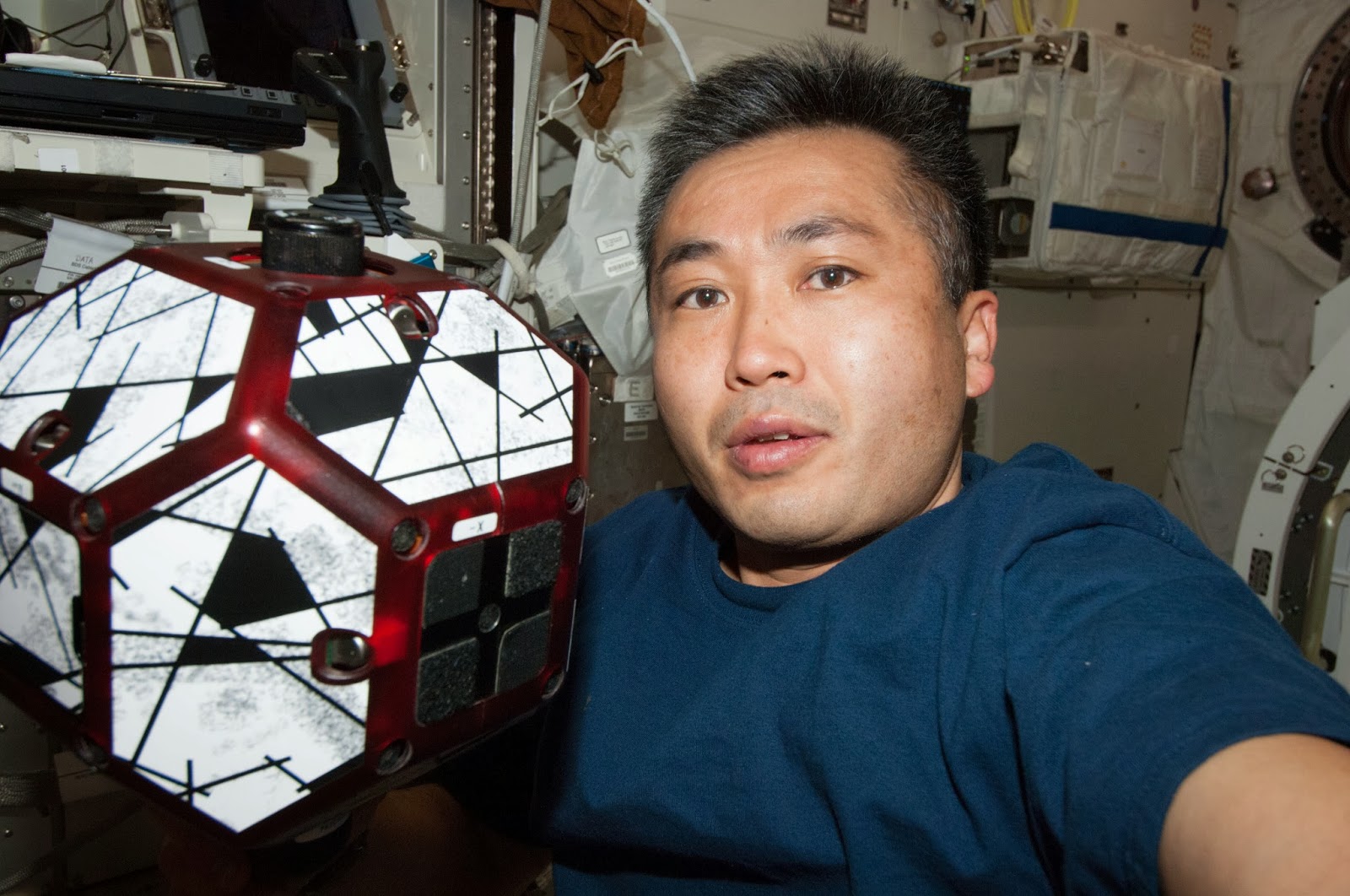
That’s why the Intelligent Robotics Group at NASA’s Ames Research Center in Moffett Field, Calif., with funding from the Technology Demonstration Missions Program in the Space Technology Mission Directorate, is working to upgrade the smartphones currently equipped on a trio of volleyball-sized free-flying satellites on the space station called Synchronized Position Hold, Engage, Reorient, Experimental Satellites (SPHERES). In 2011 on the final flight of space shuttle Atlantis, NASA sent the first smartphone to the station and mounted it to SPHERES.


Image above: Japan Aerospace Exploration Agency astronaut Koichi Wakata, Expedition 38 flight engineer, conducting a session with a pair of bowling-ball-sized free-flying satellites known as Synchronized Position Hold, Engage, Reorient, Experimental Satellites (SPHERES) aboard the International Space Station. Image Credit: NASA.

Each SPHERE satellite is self-contained with power, propulsion, computing and navigation equipment as well as expansion ports for additional sensors and appendages, such as cameras and wireless power transfer systems. This is where the SPHERES' smartphone upgrades are attached.

By connecting a smartphone, the SPHERES become Smart SPHERES. They now are more intelligent because they have built-in cameras to take pictures and video, sensors to help conduct inspections, powerful computing units to make calculations and Wi-Fi connections to transfer data in real time to the computers aboard the space station and at mission control.

"With this latest upgrade, we believe the Smart SPHERES will be a step closer to becoming a ‘mobile assistant' for the astronauts,” said DW Wheeler, lead engineer with SGT Inc. in the Intelligent Robotics Group at Ames. "This ability for Smart SPHERES to independently perform inventory and environmental surveys on the space station can free up time for astronauts and mission control to perform science experiments and other work.”

Later this year, NASA will launch a Project Tango prototype Android smartphone developed by Google’s Advanced Technology and Projects division of Mountain View, Calif. The prototype phone includes an integrated custom 3-D sensor, which means the device is capable of tracking its own position and orientation in real time as well as generating a full 3-D model of the environment.


Image above: NASA astronaut Mike Fossum puts one of the Smart SPHERES through its paces during Expedition 29 aboard the International Space Station. The addition of the smartphone helped turn the SPHERES into mobile data acquisition assistants. Image Credit: NASA.

“The Project Tango prototype incorporates a particularly important feature for the Smart SPHERES – a 3-D sensor,” said Terry Fong, director of the Intelligent Robotics Group at Ames. “This allows the satellites to do a better job of flying around on the space station and understanding where exactly they are.”

Later this month, Ames engineers will fly the prototype phone several times aboard an airplane that is capable of simulating microgravity by performing a parabolic flight path. The team has modified the motion-tracking and positioning code developed by Google that tells the phone where it is to work in the microgravity conditions of the space station. To verify that the phone will work, they must take the phone out of the lab at Ames and test it in a microgravity environment.

The SPHERES facility aboard the space station provides affordable opportunities to test a wide range of hardware and software. It acts as a free-flying platform that can accommodate various mounting features and mechanisms in order to test and examine the physical or mechanical properties of materials in microgravity. SPHERES also provides a test bed for space applications including physical sciences investigations, free-flying spatial analyses, multi-body formation flying and various multi-spacecraft control algorithm verifications and analyses. SPHERES also is used for the annual Zero Robotics student software programming competition. Ames operates and maintains the SPHERES facility, which is funded by the Human Exploration and Operations Mission Directorate at NASA Headquarters in Washington.

To date, astronauts have conducted 77 investigations using SPHERES to test techniques to advance automated dockings, satellite servicing, spacecraft assembly and emergency repairs. Now researchers are preparing to control the SPHERES in real time from ground control stations on Earth and from space.

In the long run, free-flying robots like SPHERES could also be used to inspect the exterior of the space station or future deep space vehicles. Robots like the smartphone-enhanced SPHERES and NASA's Robonaut 2, will provide some of the help of another crew member; SPHERES' cameras can act as another set of eyes, while Robonaut 2 literally adds another set of hands to act as an assistant with small and bulky items alike. An added bonus is that robots do not require any additional life support.


Image above: Humanoid robot “Robonaut 2" in the Destiny laboratory of the International Space Station. Image Credit: NASA.

As with Robonaut 2, all tests to date have occurred in the safety of the space station's interior. However, in the future, upgraded SPHERES may venture outside the orbiting outpost.

“This is no ordinary upgrade – we’ve customized cutting-edge commercial technologies to help us answer questions like: How can robots help humans live and work in space? What will happen when humans explore other worlds with robots by their side? Can we make this happen sooner, rather than later?" said Fong. "Building on our experience in controlling robots on the space station, one day we'll be able to apply what we've learned and have humans and robots working together everywhere from Earth's orbit, to the moon, asteroids and Mars."

Related links:

International Space Station: http://www.nasa.gov/mission_pages/station/main/index.html

Reorient, Experimental Satellites (SPHERES): http://www.nasa.gov/mission_pages/station/research/experiments/128.html

Space Technology Mission Directorate: http://www.nasa.gov/telerobotics

NASA's Robonaut 2: http://www.nasa.gov/robonaut

NASA’s Ames Research Center: http://www.nasa.gov/centers/ames/home/

Images (mentioned), Text, Credits: NASA / Ames Research Center / Rachel Hoover.

Greetings, Orbiter.ch

With A Deadly Embrace, 'Spidery' Pulsars Consume Their Mates


NASA - Fermi Gamma-ray Space Telescope logo.

February 20, 2014

Black widow spiders and their Australian cousins, known as redbacks, are notorious for their tainted love, expressed as an unsettling tendency to kill and devour their male partners. Astronomers have noted similar behavior among two rare breeds of binary system that contain rapidly spinning neutron stars, also known as pulsars.

"The essential features of black widow and redback binaries are that they place a normal but very low-mass star in close proximity to a millisecond pulsar, which has disastrous consequences for the star," said Roger Romani, a member of the Kavli Institute for Particle Astrophysics and Cosmology, an institute run jointly by Stanford and SLAC National Accelerator Laboratory in Menlo Park, Calif. Black widow systems contain stars that are both physically smaller and of much lower mass than those found in redbacks.

So far, astronomers have found at least 18 black widows and nine redbacks within the Milky Way, and additional members of each class have been discovered within the dense globular star clusters that orbit our galaxy.

A Black Widow Pulsar Consumes its Mate

Video above: Learn how astronomers discovered PSR J1311-3430, a record-breaking black widow binary and the first of its kind discovered solely through gamma-ray observations. Image Credit: NASA's Goddard Space Flight Center.

One black widow system, named PSR J1311-3430 and discovered in 2012, sets the record for the tightest orbit of its class and contains one of the heaviest neutron stars known. The pulsar's featherweight companion, which is only a dozen or so times the mass of Jupiter and just 60 percent of its size, completes an orbit every 93 minutes – less time than it takes to watch most movies. Initial estimates put the neutron star at about 2.7 solar masses, but more recent studies allow a range of values extending down to 2 solar masses, still among the highest-known for neutron stars. (Watch the video above to learn more about this system and its discovery from some of the scientists involved.)

When a massive star explodes as a supernova, the crushed core it leaves behind – a neutron star -- squeezes more mass than the sun into a ball no larger than Washington, D.C. When young, an isolated neutron star rotates tens of times each second -- or  a few thousand revolutions per minute -- and generates beams of radio, visible light, X-rays and gamma rays that astronomers observe as pulsed emission whenever the beams sweep past Earth. They also generate powerful outflows, or "winds," of high-energy particles. The power for all this derives from the neutron star's rapidly spinning magnetic field, and over time, as solitary pulsars wind down, their emissions fade.

Thirty-two years ago, astronomers discovered a new, much faster class of pulsars.  With rotation periods of 10 milliseconds or less, these neutron stars spin at astonishing speeds, up to 43,000 rpm. Today, more than 300 of these so-called millisecond pulsars have been cataloged. While young pulsars usually appear in isolation, more than half of millisecond pulsars have a stellar partner, suggesting that interactions with a normal star can rejuvenate an older, slower neutron star. But how did isolated millisecond pulsars get their groove back?

Enter black widows and their kin.

"The high-energy emission and wind from the pulsar basically heats and blows off the normal star's material and, over millions to billions of years, can eat away the entire star," said Alice Harding, an astrophysicist at NASA's Goddard Space Flight Center in Greenbelt, Md. "These systems can completely consume their companion stars, and that's how we think solitary millisecond pulsars form."

NASA's Fermi Gamma-ray Space Telescope excels at locating millisecond pulsars, with more than four dozen found to date. Pulsars stand out as prominent gamma-ray sources to Fermi's Large Area Telescope (LAT), but searching for their pulsations in Fermi data is extraordinarily difficult without knowing more about the system. Follow-up surveys with radio telescopes are usually the first to pick up pulses, providing confirmation that the object is indeed a pulsar. By narrowing down the timing and other parameters, radio studies also enable Fermi scientists to tease out the gamma-ray pulses from LAT data.

"Almost all of the black widows and redbacks known in our galaxy have been detected by Fermi, and more than half were actually discovered by targeting Fermi sources with various radio telescopes," said Mallory Roberts, a researcher for Eureka Scientific, Inc. who is currently a visiting professor at New York University in Abu Dhabi, United Arab Emirates. He has participated in several radio surveys of Fermi sources and led one with the Robert C. Byrd Green Bank Telescope in West Virginia that uncovered five of these systems.

Pulsars emit intense radiation because their rapid rotation and strong magnetic fields accelerate particles to tremendous energies. For astronomers, an exciting aspect of the black widow and redback systems is the opportunity to observe how the stellar companion intercepts energy from the pulsar. In effect, the star serves as a vanity mirror, showing the pulsar's emissions in tremendous detail.

When Romani began investigating the Fermi source now known as PSR J1311-3430 (J1311, for short), he imaged the system in visible light. This revealed a faint star that changed color from an intense blue to a dull red – hot and cold, for stars -- every hour and a half. Romani conjectured that the star was orbiting and being dramatically heated by a compact object, most likely a pulsar, and suggested that the system was a new black widow.


Image above: Spinning 390 times a second, PSR J1311-3430 periodically swings its radio (green) and gamma-ray (magenta) beams past Earth in this artist's concept. The pulsar heats the facing side of its stellar partner to temperatures twice as hot as the sun's surface and slowly evaporates it. Image Credit: NASA's Goddard Space Flight Center.

His measurements indicate that the side of the star facing the pulsar is heated to more than 21,000 degrees Fahrenheit (nearly 12,000 C), or more than twice as hot as the sun's surface. The cool red side reveals the true color of the pipsqueak star, glowing at a temperature of 5,000 F (2,700 C) -- half the sun's surface temperature – or lower.

Simple models used for other black widows assume that the pulsar blowtorch heats its partner uniformly; when applied to J1311, they indicate a very large mass for the neutron star. However, additional observations made in 2013 with the Gemini Telescope in Chile and the Keck Telescope in Hawaii show spectacular flares on the companion, indicating variable heating. This allows somewhat lower pulsar masses down to twice the mass of the sun. Reflecting this adjustment, the companion scales up to between 12 to 17 times the mass of Jupiter.

A search of archival observations with the Green Bank Telescope failed to turn up any radio pulsations, but Holger Pletsch at the Albert Einstein Institute in Hannover, Germany, led an international team on an effort to comb through four years of Fermi LAT data in a search for gamma-ray pulses. The orbital information established by Romani's work significantly narrowed the search, but the unknown pulsar parameters still left 100 million billion combinations to explore. Nevertheless, armed with a new, more efficient method, they detected a clear signal soon after the analysis began.

"This was the first time a millisecond pulsar has ever been detected solely by pulsed gamma rays," Pletsch said. "Seeing this signal was extremely exciting and satisfying for our team, and it's another triumph for Fermi." Spinning at 390 times a second – more than 23,000 rpm -- J1311 rotates on average about a million times between every gamma ray detected by the LAT.

After this discovery, a team led by Paul Ray at the Naval Research Laboratory in Washington took a long look at the system with the Green Bank Telescope and other radio observatories. They found that the system does indeed emit radio pulses, but only during brief, irregular intervals. "The pulsar heating is ablating its companion, literally blowing it away, so ionized gas fills the system, and this scatters or absorbs the radio emission most of the time," Ray said. Higher-energy gamma rays easily punch through the veil.

Black widow and redback binaries offer unique natural laboratories for studying pulsars up close through the disastrous effects on their partners, which are distorted by the neutron star's tidal pull, inflamed by its gamma rays, pummeled with particles accelerated to near the speed of light, and ultimately evaporated in a breakup of cosmic proportions.

Related Links:

Download additional images and HD animation sequences from NASA Goddard's Scientific Visualization Studio: http://svs.gsfc.nasa.gov/goto?11215

Interactive: Fermi Pulsar Explorer: http://www.nasa.gov/externalflash/fermipulsar/

Paper: Radio Detection of the Fermi LAT Blind Search Millisecond Pulsar J1311-3430: http://arxiv.org/abs/1210.6676

Paper: PSR J1311-3430: A Heavyweight Neutron Star with a Flyweight Helium Companion: http://pubman.mpdl.mpg.de/pubman/item/escidoc:1563464:2/component/escidoc:1563463/science.1229054.full.pdf

Paper: Binary Millisecond Pulsar Discovery via Gamma-Ray Pulsations: http://pubman.mpdl.mpg.de/pubman/item/escidoc:1563464:2/component/escidoc:1563463/science.1229054.full.pdf

Paper: 2FGL J1311.7-3429 Joins the Black Widow Club: http://iopscience.iop.org/2041-8205/754/2/L25/pdf/2041-8205_754_2_L25.pdf

List of rotation- and accretion-powered millisecond pulsars: http://apatruno.wordpress.com/about/millisecond-pulsar-catalogue/

"NASA's Fermi Finds Youngest Millisecond Pulsar, 100 Pulsars To-Date" (11.03.11): http://orbiterchspacenews.blogspot.ch/2011/11/nasas-fermi-finds-youngest-millisecond.html

Images (mentioned), Video (mentioned), Text, Credits: NASA's Goddard Space Flight Center / Francis Reddy.

Best regards, Orbiter.ch