vendredi 25 avril 2014

Hubble's Messier 5


NASA - Hubble Space Telescope patch.

April 25, 2014


"Beautiful Nebula discovered between the Balance [Libra] & the Serpent [Serpens] ..." begins the description of the 5th entry in 18th century astronomer Charles Messier's famous catalog of nebulae and star clusters. Though it appeared to Messier to be fuzzy and round and without stars, Messier 5 (M5) is now known to be a globular star cluster, 100,000 stars or more, bound by gravity and packed into a region around 165 light-years in diameter. It lies some 25,000 light-years away. Roaming the halo of our galaxy, globular star clusters are ancient members of the Milky Way. M5 is one of the oldest globulars, its stars estimated to be nearly 13 billion years old. The beautiful star cluster is a popular target for Earthbound telescopes. Of course, deployed in low Earth orbit on April 25, 1990, the Hubble Space Telescope has also captured its own stunning close-up view that spans about 20 light-years near the central region of M5. Even close to its dense core at the left, the cluster's aging red and blue giant stars and rejuvenated blue stragglers stand out in yellow and blue hues in the sharp color image.

Hubble orbiting Earth

The Hubble Space Telescope is a project of international cooperation between NASA and the European Space Agency. NASA's Goddard Space Flight Center in Greenbelt, Md., manages the telescope. STScI in Baltimore conducts Hubble science operations. STScI is operated for NASA by the Association of Universities for Research in Astronomy, Inc., in Washington.

For images and more information about Hubble, visit: http://www.nasa.gov/hubble and http://www.spacetelescope.org/

Image, Video, Text, Credits: NASA, Hubble Space Telescope, ESA.

Cheers, Orbiter.ch

X-class Flare Erupts from Sun on April 24


NASA - Solar Dynamics Observatory (SDO) patch.

April 25, 2014


Image above: NASA's Solar Dynamics Observatory sees an X-class flare exploding off the right side of the sun. This image shows light in the 131-angstrom wavelength, which is particularly good for seeing material at the high temperatures present in solar flares and which is typically colorized in teal.
Image Credit: NASA/SDO.

The sun emitted a significant solar flare, peaking at 8:27 p.m. EDT on April 24, 2014. Images of the flare were captured by NASA's Solar Dynamics Observatory. Solar flares are powerful bursts of radiation. Harmful radiation from a flare cannot pass through Earth's atmosphere to physically affect humans on the ground, however -- when intense enough -- they can disturb the atmosphere in the layer where GPS and communications signals travel.

To see how this event may impact Earth, please visit NOAA's Space Weather Prediction Center at http://spaceweather.gov, the U.S. government's official source for space weather forecasts, alerts, watches and warnings.

This flare is classified as an X1.4 flare. X-class denotes the most intense flares, while the number provides more information about its strength. An X2 is twice as intense as an X1, an X3 is three times as intense, etc.

Updates will be provided as needed.

For more information about Solar Dynamics Observatory (SDO), visit: http://sdo.gsfc.nasa.gov/ and http://www.nasa.gov/mission_pages/sdo/main/

Image (mentioned), Text, Credits: NASA's Goddard Space Flight Center / Karen C. Fox.

Greetings, Orbiter.ch

jeudi 24 avril 2014

Asteroids as Seen From Mars; A Curiosity Rover First


NASA - Mars Science Laboratory (MSL) logo.

April 24, 2014


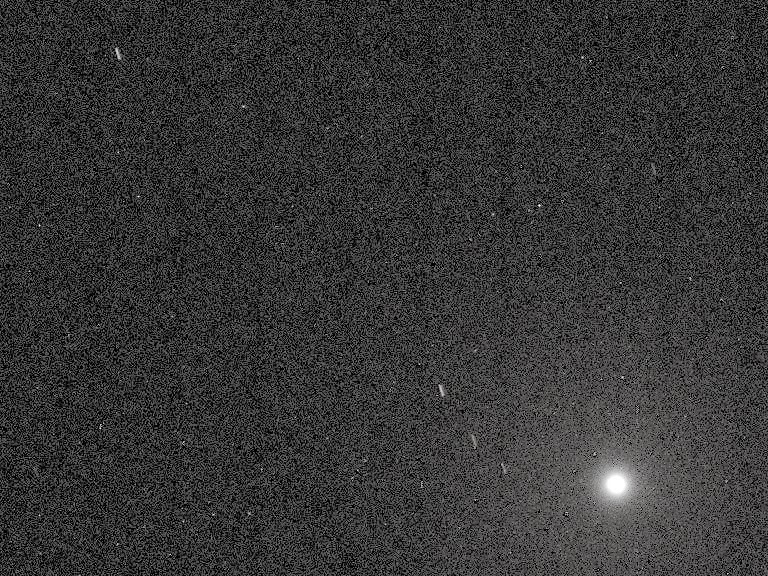
Image above: NASA's Curiosity Mars rover has caught the first image of asteroids taken from the surface of Mars. The image includes two asteroids, Ceres and Vesta. This version includes Mars' moon Deimos in a circular, exposure-adjusted inset and square insets at left from other observations the same night. Image Credit: NASA/JPL-Caltech/MSSS/Texas A&M.

A new image from NASA's Curiosity Mars rover is the first ever from the surface of Mars to show an asteroid, and it shows two: Ceres and Vesta.

These two -- the largest and third-largest bodies in the asteroid belt between Mars and Jupiter -- are the destinations of NASA's Dawn mission.  Dawn orbited Vesta in 2011 and 2012, and is on its way to begin orbiting Ceres next year. Ceres is a dwarf planet, as well as an asteroid.

Ceres and Vesta appear as short, faint streaks in a 12-second exposure taken by Curiosity's Mast Camera (Mastcam) on April 20, 2014, PDT (April 21, UTC).  An annotated version of the image, also including insets from other observations the same night, is online at: http://www.jpl.nasa.gov/spaceimages/details.php?id=PIA17937

"This imaging was part of an experiment checking the opacity of the atmosphere at night in Curiosity's location on Mars, where water-ice clouds and hazes develop during this season," said camera team member Mark Lemmon of Texas A&M University, College Station. "The two Martian moons were the main targets that night, but we chose a time when one of the moons was near Ceres and Vesta in the sky."


Image above: First Asteroid Image from the Surface of Mars (Unannotated Version). Image Credit: NASA/JPL-Caltech/MSSS/Texas A&M.

Ceres and Vesta are much larger and farther from Earth's orbit than the types of near-Earth asteroids under consideration for NASA's asteroid initiative. That initiative includes two separate, but related activities: the asteroid redirect mission and the grand challenge. NASA is currently developing concepts for the redirect mission that will employ a robotic spacecraft, driven by an advanced solar electric propulsion system, to capture a small near-Earth asteroid or remove a boulder from the surface of a larger asteroid. The spacecraft then will attempt to redirect the object into a stable orbit around the moon.

Astronauts will travel aboard NASA's Orion spacecraft, launched on the Space Launch System rocket, to rendezvous in lunar orbit with the captured asteroid. Once there, they will collect samples to return to Earth for study.

The grand challenge is a search for the best ideas for finding asteroids that pose a potential threat to human populations, and to accelerate the work NASA already is doing for planetary defense.

NASA's Mars Science Laboratory Project is using Curiosity to assess ancient habitable environments and major changes in Martian environmental conditions. JPL, a division of the California Institute of Technology in Pasadena, built the rover and manages the project for NASA's Science Mission Directorate in Washington. Malin Space Science Systems, San Diego, built and operates the rover's Mastcam.

More information about the Dawn mission is available at these websites: http://www.nasa.gov/dawn and http://dawn.jpl.nasa.gov

For more information about Curiosity, visit http://www.nasa.gov/msl and http://mars.jpl.nasa.gov/msl/ . You can follow the mission on Facebook at http://www.facebook.com/marscuriosity and on Twitter at: http://www.twitter.com/marscuriosity

Images (mentioned), Text, Credits: NASA / JPL / Guy Webster.

Best regards, Orbiter.ch

Astronomical Forensics Uncover Planetary Disks in NASA's Hubble Archive


NASA - Hubble Space Telescope patch.

April 24, 2014

Astronomers using NASA's Hubble Space Telescope have applied a new image processing technique to obtain near-infrared scattered light photos of five disks observed around young stars in the Mikulski Archive for Space Telescopes database. These disks are telltale evidence for newly formed planets.

If astronomers initially miss something in their review of data, they can make new discoveries by revisiting earlier data with new image processing techniques, thanks to the wealth of information stored in the Hubble data archive. This is what Rémi Soummer, of the Space Telescope Science Institute (STScI) in Baltimore, Md., and his team recently did while on a hunt for hidden Hubble treasures.

The stars in question initially were targeted with Hubble's Near Infrared Camera and Multi-Object Spectrometer (NICMOS) based on unusual heat signatures obtained from NASA's Spitzer Space Telescope and the Infrared Astronomical Satellite that flew in 1983. The previous data provided interesting clues that dusty disks could exist around these stars. Small dust particles in the disks might scatter light and therefore make the disks visible. But when Hubble first viewed the stars between 1999 and 2006, no disks were detected in the NICMOS pictures.


Imaes above: The two images at top reveal debris disks around young stars uncovered in archival images taken by NASA’s Hubble Space Telescope. The illustration beneath each image depicts the orientation of the debris disks. Image Credit: NASA/ESA, R. Soummer, Ann Feild (STScI).

Recently, with improvements in image processing, including algorithms used for face-recognition software, Soummer and his team reanalyzed the archived images. This time, they could unequivocally see the debris disks and even determine their shapes.

The NICMOS instrument, which began collecting data in 1997, has been so cutting-edge that ground-based technology only now is beginning to match its power. Because Hubble has been in operation for almost 24 years, it provides a long baseline of high-quality archival observations.

"Now, with such new technologies in image processing, we can go back to the archive and conduct research more precisely than previously possible with NICMOS data," said Dean Hines of STScI.

"These findings increase the number of debris disks seen in scattered light from 18 to 23. By significantly adding to the known population and by showing the variety of shapes in these new disks, Hubble can help astronomers learn more about how planetary systems form and evolve," said Soummer.

The dust in the disks is hypothesized to be produced by collisions between small planetary bodies such as asteroids. The debris disks are composed of dust particles formed from these grinding collisions. The tiniest particles are constantly blown outward by radiation pressure from the star. This means they must be replenished continuously though more collisions. This game of bumper cars was common in the solar system 4.5 billion years ago. Earth's moon and the satellite system around Pluto are considered to be collisional byproducts.

"One star that is particularly interesting is HD 141943," said Christine Chen, debris disk expert and team member. "It is an exact twin of our sun during the epoch of terrestrial planet formation in our own solar system."

Hubble Space Telescope. Image Credit: NASA

Hubble found the star exhibits an asymmetrical, edge-on disk. This asymmetry could be evidence the disk is being gravitationally sculpted by the tug of one or more unseen planets.

"Being able to see these disks now also has let us plan further observations to study them in even more detail using other Hubble instruments and large telescopes on the ground," added Marshall Perrin of STScI.

"We also are working to implement the same techniques as a standard processing method for NASA's upcoming James Webb Space Telescope," said STScI teammate Laurent Pueyo. "These disks will also be prime targets for the Webb telescope."

Soummer's team has just begun its work. They next will search for structures in the disks that suggest the presence of planets.

The Hubble Space Telescope is a project of international cooperation between NASA and the European Space Agency. NASA's Goddard Space Flight Center in Greenbelt, Md., manages the telescope. STScI in Baltimore conducts Hubble science operations. STScI is operated for NASA by the Association of Universities for Research in Astronomy, Inc., in Washington.

For images and more information about Hubble, visit: http://www.nasa.gov/hubble and http://www.spacetelescope.org/

Images (mentioned), Text, Credits: NASA / J.D. Harrington / Space Science Telescope Institute / Ray Villard.

Cheers, Orbiter.ch

NASA Tests Orion’s Parachute Performance over Arizona while Work Progresses in Florida


NASA - Orion MPCV patch.

April 24, 2014

The team designing the parachute system for NASA’s Orion spacecraft has demonstrated almost every parachute failure they could imagine. But on April 23, they tested how the system would perform if the failure wasn’t in the parachutes.

Orion is the safest spacecraft ever built to carry humans, and its Launch Abort System can take a good deal of the credit for that distinction. In an emergency on the launch pad or during the early stages of ascent, it can activate in milliseconds to pull the crew to safety. Once it has pulled the crew away from the emergency, it’s up to the parachutes to bring them down for a safe landing.

Test Version of Orion is Dropped C-17

Video above: A test version of Orion is dropped from a C-17, while flying 13,000 feet above the Arizona desert at the U.S. Army’s Yuma Proving Ground on April 23. Image Credit: NASA TV.

“We hope we never have to use the parachutes this way,” said Chris Johnson, project manager for the parachutes. “We want to see them deploy after a successful mission every time. But we need to know they can perform in an emergency, too.”

In a pad abort or a low altitude launch abort, Orion’s three main parachutes would be called on to lower the crew module to the ground without the help of the two drogues that normally precede them. The parachute system won’t have as long to do the job since the spacecraft will be at much lower altitude than for a nominal reentry mission, and with the vehicle going slower, they won’t deploy as quickly. And on top of all of these factors, the crew module will be flying sideways when the parachutes deploy, instead of falling straight down as it does during reentry.

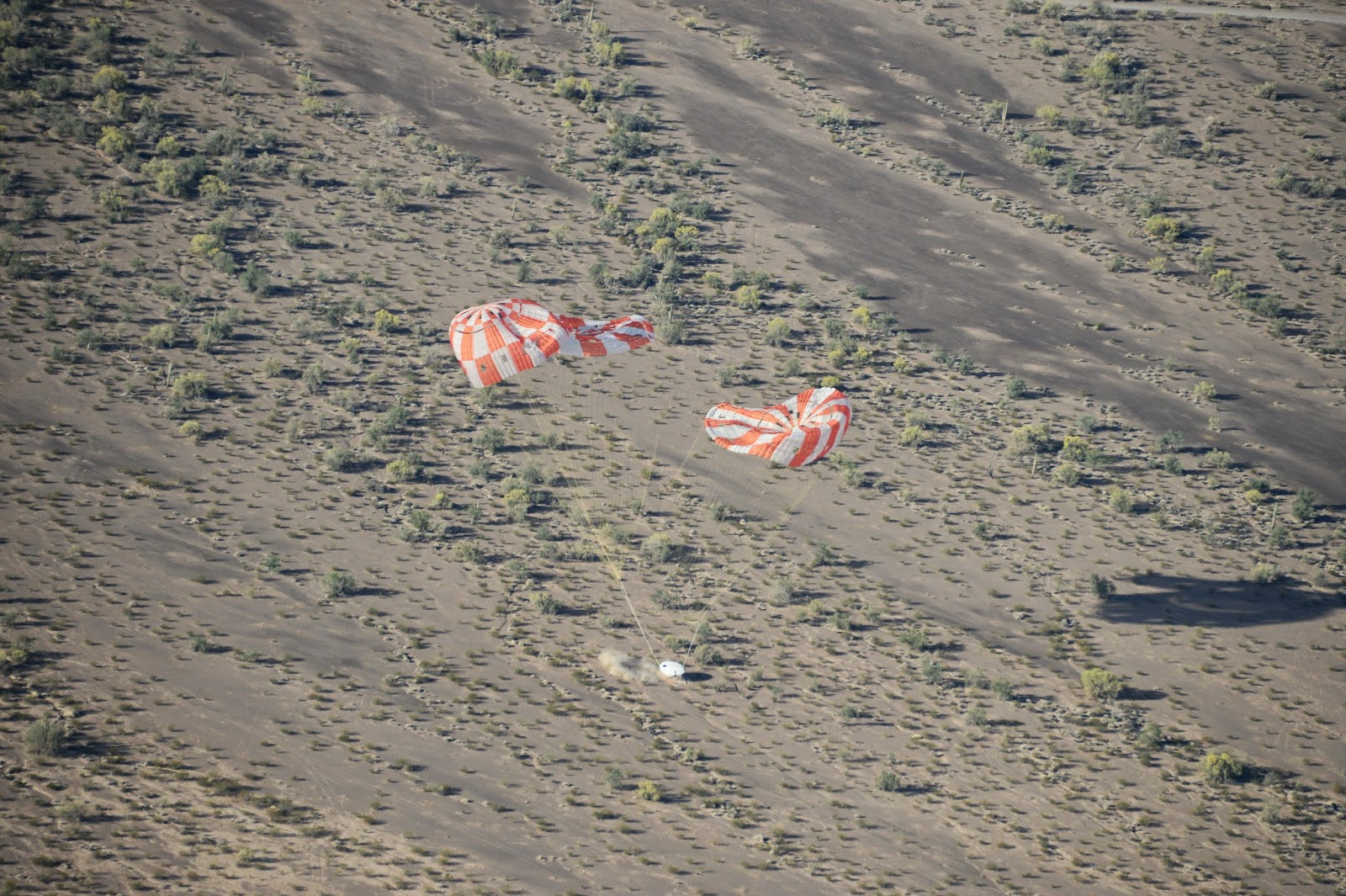
To simulate those conditions, a test version of Orion was dropped from a C-17 at 13,000 feet above the U.S. Army’s Yuma Proving Ground, with the main parachutes deploying soon after leaving the plane, before the capsule had a chance to straighten out. All the elements worked together and the parachutes reached a fully open state setting up a soft landing as expected. But the real value of the test will come with the data the engineers were able to gather from it.


Image above: A test version of Orion descends under its three massive main parachutes, which together would cover almost all of a football field. Image Credit: NASA.

“We wanted to record how long it took to inflate the parachutes in a launch pad abort scenario and collect data on how the different conditions affected the quality of the parachute deployment,” Johnson said. “With this test successfully completed, our next step is to dig into that information and use it to fine tune the launch abort trajectories for flight.”

In addition to the new test conditions, this was also the first time that the steel risers connecting the parachute lines to Orion were replaced with the textile risers that will be incorporated into future Orion spacecraft after Orion’s first flight this year. The new risers are lighter and more flexible – two qualities that will come in particularly handy when Orion is ready to carry humans into space.


Image above: Orion's parachutes deflate after a successful touchdown following a test at the U.S. Army's Yuma Proving Ground on April 23. Image Credit: NASA.

While engineers continue to test Orion's parachutes for future missions, engineers at NASA's Kennedy Space Center in Florida continue to make progress on the Orion spacecraft being prepared for its December trip to space. Inside the Operations and Checkout Building high bay, the crew module is positioned on a special portable test chamber for multi-point random vibration testing. Accelerometers and strain gauges have been attached to Orion in various locations. During a series of tests, each lasting only 30 seconds, Orion is being subjected to gradually increasing levels of vibrations that simulate levels the vehicle will experience during launch, orbit and descent. The data will be reviewed to assess the health of the crew module.

Orion’s first flight will launch an uncrewed capsule 3,600 miles into space for a four-hour mission to test several of its most critical systems, including its parachutes. After making two orbits, Orion will return to Earth at almost 20,000 miles per hour and endure temperatures near 4,000 degrees Fahrenheit, before its parachutes slow it down for a landing in the Pacific Ocean.

For more information about Orion MPCV (Multi-Purpose Crew Vehicle), visit: http://www.nasa.gov/exploration/systems/mpcv/

Images (mentioned), Video (mentioned), Text, Credit: NASA.

Greetings, Orbiter.ch

Professional and Amateur Astronomers Join Forces


NASA - Chandra X-ray Observatory pach / NASA - Spitzer Space Telescope logo.

April 24, 2014


Long before the term "citizen science" was coined, the field of astronomy has benefited from countless men and women who study the sky in their spare time. These amateur astronomers devote hours exploring the cosmos through a variety of telescopes that they acquire, maintain, and improve on their own. Some of these amateur astronomers specialize in capturing what is seen through their telescopes in images and are astrophotographers.

What happens when the work of amateur astronomers and astrophotographers is combined with the data from some of the world's most sophisticated space telescopes? Collaborations between professional and amateur astronomers reveal the possibilities and are intended to raise interest and awareness among the community of the wealth of data publicly available in NASA's various mission archives. This effort is particularly appropriate for this month because April marks Global Astronomy Month, the world's largest global celebration of astronomy.

The images in this quartet of galaxies represent a sample of composites created with X-ray data from NASA's Chandra X-ray Observatory, infrared data from the Spitzer Space Telescope, and optical data collected by an amateur astronomer. In these images, the X-rays from Chandra are shown in pink, infrared emission from Spitzer is red, and the optical data are in red, green, and blue. The two astrophotographers who donated their images for these four images -- Detlef Hartmann and Rolf Olsen -- used their personal telescopes of 17.5 inches and 10 inches in diameter respectively. More details on how these images were made can be found in this blog post: http://chandra.harvard.edu/blog/node/497

Starting in the upper left and moving clockwise, the galaxies are M101 (the "Pinwheel Galaxy"), M81, Centaurus A, and M51 (the "Whirlpool Galaxy"). M101 is a spiral galaxy like our Milky Way, but about 70% bigger. It is located about 21 million light years from Earth. M81 is a spiral galaxy about 12 million light years away that is both relatively large in the sky and bright, making it a frequent target for both amateur and professional astronomers. Centaurus A is the fifth brightest galaxy in the sky -- making it an ideal target for amateur astronomers -- and is famous for the dust lane across its middle and a giant jet blasting away from the supermassive black hole at its center. Finally, M51 is another spiral galaxy, about 30 million light years away, that is in the process of merging with a smaller galaxy seen to its upper left.

For many amateur astronomers and astrophotographers, a main goal of their efforts is to observe and share the wonders of the Universe. However, the long exposures of these objects may help to reveal phenomena that may otherwise be missed in the relatively short snapshots taken by major telescopes, which are tightly scheduled and often oversubscribed by professional astronomers. Therefore, projects like this Astro Pro-Am collaboration might prove useful not only for producing spectacular images, but also contributing to the knowledge of what is happening in each of these cosmic vistas.

NASA's Marshall Space Flight Center in Huntsville, Ala., manages the Chandra program for NASA's Science Mission Directorate in Washington. The Smithsonian Astrophysical Observatory in Cambridge, Mass., controls Chandra's science and flight operations.

View large image: http://chandra.harvard.edu/photo/2014/proam/

Chandra on Flickr: http://www.flickr.com/photos/nasamarshall/sets/72157606205297786/

Related links:

Citizen Science: http://en.wikipedia.org/wiki/Citizen_science

Astrophotographers: http://www.fromearthtotheuniverse.org/Enlarged_images/comet_hale_bopp.php

Global Astronomy Month: http://astronomerswithoutborders.org/global-astronomy-month-2014.html

Image, Text, Credits: X-ray: NASA / CXC / SAO; Optical: Detlef Hartmann; Infrared: NASA / JPL-Caltech.

Greetings, Orbiter.ch

mercredi 23 avril 2014

NASA Satellites Show Drought May Take Toll on Congo Rainforest

NASA patch.

April 23, 2014

Congo Forest Cover

Video above: A view of the entire African rainforest area (green) transitions into a view of the Congo region (mostly brown) that is the subject of new research published in Nature. The study area represents intact areas in the Congo rainforest where satellite data are high quality. Image Credit: NASA Goddard's Scientific Visualization Studio.

A new analysis of NASA satellite data shows Africa's Congo rainforest, the second-largest tropical rainforest in the world, has undergone a large-scale decline in greenness over the past decade.

The study, led by Liming Zhou of University at Albany, State University of New York, shows between 2000 and 2012 the decline affected an increasing amount of forest area and intensified. The research, published Wednesday in Nature, is one of the most comprehensive observational studies to explore the effects of long-term drought on the Congo rainforest using several independent satellite sensors.

"It's important to understand these changes because most climate models predict tropical forests may be under stress due to increasing severe water shortages in a warmer and drier 21st century climate," Zhou said.

Scientists use the satellite-derived "greenness" of forest regions as one indicator of a forest's health. While this study looks specifically at the impact of a persistent drought in the Congo region since 2000, researchers say that a continued drying trend might alter the composition and structure of the Congo rainforest, affecting its biodiversity and carbon storage.

Previous research used satellite-based measurements of vegetation greenness to investigate changes in the Amazon rainforest, notably the effects of severe short-term droughts in 2005 and 2010. Until now, little attention has been paid to African rainforests, where ground measurements are even sparser than in the Amazon and where droughts are less severe but last longer.

To clarify the impact of long-term drought on the Congo rainforest, Zhou and colleagues set out to see whether they could detect a trend in a satellite measure of vegetation greenness called the Enhanced Vegetation Index. This measure is developed from data produced by the Moderate Resolution Imaging Spectroradiometer (MODIS) instrument on NASA's Terra satellite. The scientists focused their analysis on intact, forested regions in the Congo basin during the months of April, May and June each year – the first of the area's two peak rainy and growing seasons each year.

The study found a gradually decreasing trend in Congo rainforest greenness, sometimes referred to as "browning," suggesting a slow adjustment to the long-term drying trend. This is in contrast to the more immediate response seen in the Amazon, such as large-scale tree mortality, brought about by more episodic drought events.

The browning of the forest canopy is consistent with observed decreases in the amount of water available to plants, whether that is in the form of rainfall, water stored in the ground, water in near-surface soils, or water within the vegetation.

These changes in available water were detected in part with NASA satellites including the NASA/JAXA Tropical Rainfall Measuring Mission, NASA's Quick Scatterometer (QuikScat), and NASA's Gravity Recovery and Climate Experiment, a joint mission with the German Aerospace Center.


Image above: In the Congo rainforest, a browning trend (brown) dominates smaller areas that show a greening trend (green) during April, May and June each year from 2000 to 2012. Image Credit: NASA Goddard's Scientific Visualization Studio.

"Combining measurements from different sensors has given us more confidence in the results of the MODIS data and provided us with insights into the environmental and physiological mechanisms of the browning observed by the MODIS data," said co-author Sassan Saatchi of NASA's Jet Propulsion Laboratory (JPL) in Pasadena, Calif.

Climate factors known to affect vegetation growth were also in line with the observed browning. Land surface temperatures, for example, were observed to increase over most of the study area. Decreased cloudiness allowed more solar radiation to reach the plants, which typically promotes photosynthesis, but in this case it likely posed an extra stress on the plants from the resulting depletion of soil moisture.

"Forests of the Congo basin are known to be resilient to moderate climate change because they have been exposed to dry conditions in the past few hundred years," Saatchi said. "However, the recent climate anomalies as a result of climate change and warming of the Atlantic Ocean have created severe droughts in the tropics, causing major impacts on forests."

How the changes affect individual plant species in the area remains to be seen. For example, drier conditions may favor deciduous trees at the expense of evergreen trees.

"Our assessment is a step toward an improved understanding of how African rainforests respond to increasing drought," Zhou said. "We need to consider the complex range of processes affecting different tropical rainforest species before we can fully assess the future resilience of tropical forests."

The other authors for this research include Yuhong Tian at I.M. Systems Group, Inc. at the Center for Satellite Applications and Research, the science arm of National Oceanic and Atmospheric Administration's Satellite and Information Service; Ranga Myneni at Boston University; Philippe Ciais at Laboratoire des Sciences du Climat et de l'Environnement, Gif sur Yvette Cedex, France; Yi Y. Liu at University of New South Wales, Australia; Shilong Piao at Peking University, China; Haishan Chen at Nanjing University of Information Science and Technology, China; Eric Vermote of NASA's Goddard Space Flight Center, Greenbelt, Md.; and Conghe Song and Taehee Hwang at University of North Carolina at Chapel Hill.

NASA monitors Earth's vital signs from land, air and space with a fleet of satellites and ambitious airborne and ground-based observation campaigns. NASA develops new ways to observe and study Earth's interconnected natural systems with long-term data records and computer analysis tools to better see how our planet is changing. The agency shares this unique knowledge with the global community and works with institutions in the United States and around the world that contribute to understanding and protecting our home planet.

For more information about NASA's Earth science activities in 2014, visit:
http://www.nasa.gov/earthrightnow

For more information about NASA programs, visit: http://www.nasa.gov

Image (mentioned), Video (mentioned), Text, Credits: NASA / Steve Cole / Goddard Space Flight Center / Kathryn Hansen / JPL / Alan Buis.

Best regards, Orbiter.ch