mercredi 13 mai 2015

The Dark Side of Star Clusters


ESO - European Southern Observatory logo.

13 May 2015

VLT discovers new kind of globular star cluster

The giant elliptical galaxy Centaurus A (NGC 5128) and its strange globular clusters

Observations with ESO’s Very Large Telescope in Chile have discovered a new class of “dark” globular star clusters around the giant galaxy Centaurus A. These mysterious objects look similar to normal clusters, but contain much more mass and may either harbour unexpected amounts of dark matter, or contain massive black holes — neither of which was expected nor is understood.

Globular star clusters are huge balls of thousands of stars that orbit most galaxies. They are among the oldest known stellar systems in the Universe and have survived through almost the entire span of galaxy growth and evolution.

The strange galaxy Centaurus A in the constellation of Centaurus

Matt Taylor, a PhD student at the Pontificia Universidad Catolica de Chile, Santiago, Chile, and holder of an ESO Studentship, is lead author of the new study. He sets the scene: “Globular clusters and their constituent stars are keys to understanding the formation and evolution of galaxies. For decades, astronomers thought that the stars that made up a given globular cluster all shared the same ages and chemical compositions — but we now know that they are stranger and more complicated creatures.”

The elliptical galaxy Centaurus A (also known as NGC 5128) is the closest giant galaxy to the Milky Way and is suspected to harbour as many as 2000 globular clusters. Many of these globulars are brighter and more massive than the 150 or so orbiting the Milky Way.

Wide-field view of the giant galaxy Centaurus A

Matt Taylor and his team have now made the most detailed studies so far of a sample of 125 globular star clusters around Centaurus A using the FLAMES instrument on ESO’s Very Large Telescope at the Paranal Observatory in northern Chile [1].

They used these observations to deduce the mass of the clusters [2] and compare this result with how brightly each of the clusters shines.

For most of the clusters in the new survey, the brighter ones had more mass in the way that was expected — if a cluster contains more stars it has greater total brightness and more total mass. But for some of the globulars something strange showed up: they were many times more massive than they looked. And even more strangely, the more massive these unusual clusters were, the greater the fraction of their material was dark. Something in these clusters was dark, hidden and massive. But what?


Video above: Panning across the giant elliptical galaxy Centaurus A (NGC 5128) and its strange globular clusters.

There were several possibilities. Perhaps the dark clusters contain black holes, or other dark stellar remnants in their cores? This may be a factor that explains some of the hidden mass, but the team concludes that it cannot be the whole story. What about dark matter? Globular clusters are normally considered to be almost devoid of this mysterious substance, but perhaps, for some unknown reason, some clusters have retained significant dark matter clumps in their cores. This would explain the observations but does not fit into conventional theory.

Co-author Thomas Puzia adds: “Our discovery of star clusters with unexpectedly high masses for the amount of stars they contain hints that there might be multiple families of globular clusters, with differing formation histories. Apparently some star clusters look like, walk like, and smell like run-of-the-mill globulars, but there may quite literally be more to them than meets the eye.”

These objects remain a mystery. The team is also engaged in a wider survey of other globular clusters in other galaxies and there are some intriguing hints that such dark clusters may also be found elsewhere.

Matt Taylor sums up the situation: “We have stumbled on a new and mysterious class of star cluster! This shows that we still have much to learn about all aspects of globular cluster formation. It’s an important result and we now need to find further examples of dark clusters around other galaxies.”

Notes:

[1] Up to now astronomers have studied star clusters to this detail only in the Local Group. The relatively small distances make direct measurements of their masses possible. Looking at NGC 5128, which is an isolated, massive elliptical galaxy just outside the Local Group about 12 million light-years away, they were able to estimate masses of globular clusters in a completely different environment by pushing VLT/FLAMES to its limits.

[2] The FLAMES observations provide information about the motions of the stars in the clusters. This orbital information depends on the strength of the gravitational field and can hence be used to deduce the mass of the cluster — astronomers call such estimates dynamical masses. The light gathering power of a 8.2-metre VLT Unit Telescope mirror and FLAMES’s ability to observe more than 100 clusters simultaneously was the key to collecting the data necessary for the study.

More information:

This research was presented in a paper entitled “Observational evidence for a dark side to NGC 5128’s globular cluster system”, by M. Taylor et al., to appear in the Astrophysical Journal.

The team is composed of Matthew A. Taylor (Pontificia Universidad Catolica de Chile, Santiago, Chile; ESO, Santiago, Chile), Thomas H. Puzia (Pontificia Universidad Catolica de Chile), Matias Gomez (Universidad Andres Bello, Santiago, Chile) and Kristin A. Woodley (University of California, Santa Cruz, California, USA).

ESO is the foremost intergovernmental astronomy organisation in Europe and the world’s most productive ground-based astronomical observatory by far. It is supported by 16 countries: Austria, Belgium, Brazil, the Czech Republic, Denmark, France, Finland, Germany, Italy, the Netherlands, Poland, Portugal, Spain, Sweden, Switzerland and the United Kingdom, along with the host state of Chile. ESO carries out an ambitious programme focused on the design, construction and operation of powerful ground-based observing facilities enabling astronomers to make important scientific discoveries. ESO also plays a leading role in promoting and organising cooperation in astronomical research. ESO operates three unique world-class observing sites in Chile: La Silla, Paranal and Chajnantor. At Paranal, ESO operates the Very Large Telescope, the world’s most advanced visible-light astronomical observatory and two survey telescopes. VISTA works in the infrared and is the world’s largest survey telescope and the VLT Survey Telescope is the largest telescope designed to exclusively survey the skies in visible light. ESO is a major partner in ALMA, the largest astronomical project in existence. And on Cerro Armazones, close to Paranal, ESO is building the 39-metre European Extremely Large Telescope, the E-ELT, which will become “the world’s biggest eye on the sky”.

Links:

Science paper: http://www.eso.org/public/archives/releases/sciencepapers/eso1519/eso1519a.pdf

Images of the VLT: http://www.eso.org/public/images/archive/category/paranal/

ESO’s Very Large Telescope (VLT): http://www.eso.org/paranal/

Images, Text, Credits: ESO/Digitized Sky Survey. Acknowledgement: Davide de Martin/IAU and Sky & Telescope/ESA/Hubble, NASA. Digitized Sky Survey. Acknowledgement: Davide de Martin/Video: ESO/Digitized Sky Survey. Acknowledgement: Davide de Martin/Music: Johan B Monell (www.johanmonell.com).

Greetings, Orbiter.ch

Space fever


ESA - European Astronauts patch.

13 May 2015

ESA Astronaut André Kuipers

It started with a simple question that ended with a surprising answer and new technology that is being used in cutting-edge heart surgery and could save millions of euros in hospital bills.

Hanns-Christian Gunga, working at the Center for Space Medicine and Extreme Environments in Berlin, Germany, has spent a lifetime working on how humans adapt to extreme environments and he wanted to know: what happens to an astronaut’s body temperature in space?

Astronaut André Kuipers exercising

People on Earth lose much of their body heat through convection – air around you is replaced by cooler air as it heats on the skin of your warm body and rises. Turning on a fan on a hot day can speed up the process and cool you down quicker as the air passes over and whisks some of the body heat away.

On the International Space Station there is no convection because of weightlessness and astronauts have reported feeling hot since the earliest days of spaceflight. ESA astronaut André Kuipers recounts: “Especially during exercise I would feel hot, afterwards I would always float to a fan to cool down.”

Thermolab

To understand what is happening you would need to continuously monitor astronaut’s body temperatures in space for a long period of time. The Thermolab experiment was born, but first a practical problem needed to be overcome.

Depending on where and when you measure your temperature a thermometer will give a different reading. Your body temperature is lower in your feet and lowest between four and six in the morning. Researchers and doctors refer to core body temperature – the temperature in your chest – to compare readings.

ESA Astronaut Alexander Gerst, forehead thermometer

Measuring core body temperature is not straightforward because a thermometer must be placed as close to your heart for best results. Many types of thermometers exist, from the under-your-tongue to the stick-in-your-ear variety but unfortunately the most accurate way of reading a core temperature was to insert a thermometer into your rectum.

Aside from the discomfort, this method has many impracticalities: it is time-consuming and asking astronauts to stop their work to insert a thermometer was not considered an option.

Professor Gunga decided to use a new technique he had developed and tested on firefighters, measuring the difference in heat radiated from the forehead. A simple calculation then reveals core body temperature with great accuracy.

Thermolab equipment

Eleven astronauts strapped with these sensors recorded their temperature over two sessions after three months in space and just before returning to Earth.

The sensor works so well that it is used in extreme environments by firefighters and in Antarctica, as well as during the Mars500 study.

A thermometer that can be read from a distance and continuously records very accurate data has enormous potential. The sensor is already being used in open-heart surgery on children but as a general instrument in hospitals it offers better and cheaper monitoring of patients.

Don't forget the astronauts

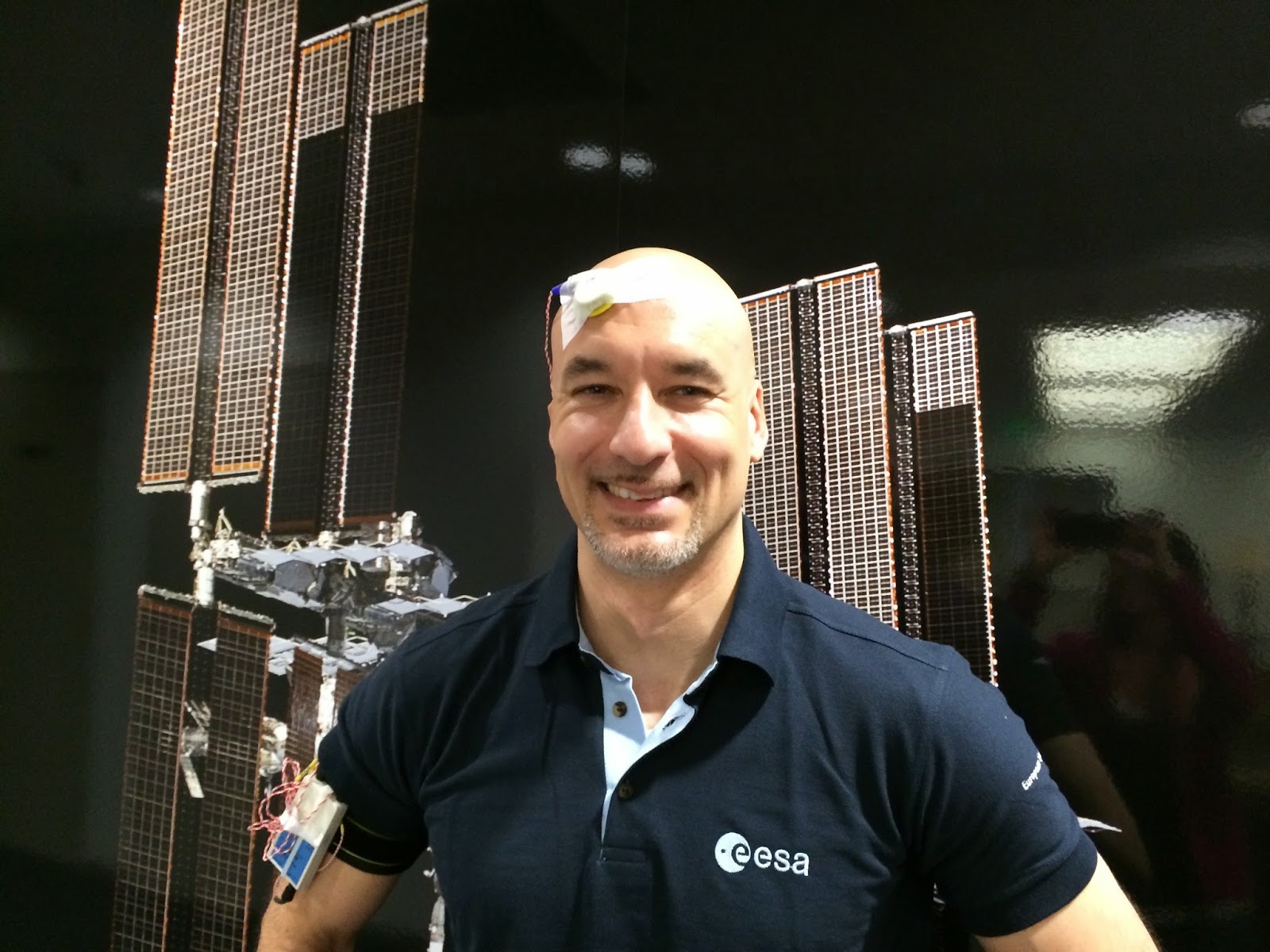
ESA Astronaut Luca Parmitano with temperature sensor

The experiment shows that astronauts develop a 1ºC higher temperature that never goes away after staying in space for two months. What causes this ‘space fever’ is not clear, but it has far-reaching consequences.

Space Station Live: Circadian Rhythms

Video above: Professor Gunga explains the temperature sensor used in the Circadian Rhythms follow-up study.

Comparing data to other studies shows a correlation with Interleukin-1, a hormone that causes fever when sick. Raising body temperature by a degree requires 20% more energy, derived from food, so mission planners need to know more about this phenomenon in order to estimate the required food supplies for long missions.

Related links:

Charite in Space – Center for Space Medicine and Extreme Environments: http://charite-in-space.de/

Thermolab experiment details: http://eea.spaceflight.esa.int/portal/exp/?id=9165

Experiment archive: http://eea.spaceflight.esa.int/

International Space Station Benefits for Humanity: http://www.esa.int/Our_Activities/Human_Spaceflight/International_Space_Station_Benefits_for_Humanity

Columbus: http://www.esa.int/Our_Activities/Human_Spaceflight/Columbus

Images, Video, Text, Credits: ESA/NASA/Charite, ZWMB/NASA TV.

Best regards, Orbiter.ch

mardi 12 mai 2015

LHC Season 2: Follow the people at the frontiers of physics


CERN - European Organization for Nuclear Research logo.

May 12, 2015

Welcome to LHC season 2: new frontiers in physics at #13TeV

What do physicists dream of? What do they hope to discover when they harvest new data from the world's most powerful particle accelerator, the Large Hadron Collider (LHC)? In the new video series "LHC Season 2: New frontiers in physics" the camera follows 11 physicists from the four large LHC experiments ALICE, ATLAS, CMS and LHCb.

The physicists tell of their hopes for new discoveries during the LHC's second run, now at the record-breaking energy of 13 teraelectronvolts (TeV). They speak of dark matter, supersymmetry, the Higgs boson, antimatter, current theory in particle physics and its limits as well as new theoretical models that could extend it. As they explore the nature of matter in the universe, they will soon discover a new energy frontier. Follow their search – a new video will be posted on this blog weekly.

CERN - Large Hadron Collider (LHC)

Note:

CERN, the European Organization for Nuclear Research, is one of the world’s largest and most respected centres for scientific research. Its business is fundamental physics, finding out what the Universe is made of and how it works. At CERN, the world’s largest and most complex scientific instruments are used to study the basic constituents of matter — the fundamental particles. By studying what happens when these particles collide, physicists learn about the laws of Nature.

The instruments used at CERN are particle accelerators and detectors. Accelerators boost beams of particles to high energies before they are made to collide with each other or with stationary targets. Detectors observe and record the results of these collisions.

Founded in 1954, the CERN Laboratory sits astride the Franco–Swiss border near Geneva. It was one of Europe’s first joint ventures and now has 22 Member States.

Related article:

LHC: Preparations for collisions at 13 TeV: http://orbiterchspacenews.blogspot.ch/2015/04/cern-lhc-preparations-for-collisions-at.html

Related links:

Large Hadron Collider (LHC): http://home.web.cern.ch/topics/large-hadron-collider

ALICE experiments: http://home.web.cern.ch/about/experiments/alice

ATLAS experiments: http://home.web.cern.ch/about/experiments/atlas

CMS experiments: http://home.web.cern.ch/about/experiments/cms

LHCb experiments: http://home.web.cern.ch/about/experiments/lhcb

For more information about the European Organization for Nuclear Research (CERN), visit: http://home.web.cern.ch/

Image, Video, Text, Credits: CERN/Cian O'Luanaigh.

Greetings, Orbiter.ch

Space Launch System Program Moving Forward with Critical Design Review


NASA - Space Launch System (SLS) logo.

May 12, 2015

NASA's Space Launch System (SLS) Program is kicking off its critical design review May 11 at NASA's Marshall Space Flight Center in Huntsville, Alabama.


Image above: Artist concept of NASA's Space Launch System wireframe design. The SLS Program is kicking off its critical design review May 11 at NASA's Marshall Space Flight Center in Huntsville, Alabama. Image Credits: NASA/MSFC.

This new rocket will be the most powerful launch vehicle ever built. It is designed to be sustainable and evolve to carry crew and cargo on deep space missions, including an asteroid and ultimately to Mars.

Milestone reviews like the critical design review are just that -- critical. The critical design review demonstrates that the SLS design meets all system requirements with acceptable risk, and accomplishes that within cost and schedule constraints. It also proves that the rocket should continue with full-scale production, assembly, integration, and testing and that the program is ready to begin the next major review covering design certification.

"We've never said building a rocket is easy," said SLS Program Manager Todd May. "We pore over every part of this rocket during these reviews. Thousands of documents and months of time are put into making sure the design is sound, safe and sustainable, and will make NASA's mission of furthering human spaceflight possible. We are making advances every day on this vehicle."

Each element for the rocket -- including boosters, engines, stages and Spacecraft and Payload Integration & Evolution (SPIE) -- undergo their own reviews before this week’s kickoff of the integrated program review. Boosters, stages and engines have passed their critical design reviews, and the SPIE Office is in the process of completing its critical design review. SPIE is responsible for the design and development of several parts of the top of the rocket, including:

- Orion stage adapter – connects the Orion spacecraft to the SLS

- Interim cryogenic propulsion stage -- gives the Orion spacecraft the big push needed to fly beyond the moon before the spacecraft returns to Earth during the first flight test of SLS

- Launch vehicle stage adapter -- used to connect the core stage and interim cryogenic propulsion stages


Image above: Artist concept highlighting the upper stage of the Block 1 configuration of NASA’s Space Launch System. The Spacecraft and Payload Integration & Evolution Office (SPIE) at NASA’s Marshall Space Flight Center in Huntsville, Alabama, is responsible for the design and development of the Orion stage adapter, interim cryogenic propulsion stage and launch vehicle stage adapter. Image Credits: NASA/MSFC.

SPIE also works to prepare for the future evolution of SLS to provide the capabilities needed for human missions to Mars. The office oversees in-house research and partners with academia, industry and other government agencies to develop new technologies and systems that will benefit not only SLS, but also the larger U.S. launch industry.

The SLS Program critical design review is targeted to conclude in late July.

Artist's view of the SLS launch. Image Credit: NASA

The first flight test of the SLS will be configured for a 70-metric-ton (77-ton) lift capacity and carry an uncrewed Orion spacecraft beyond low-Earth orbit to test the performance of the integrated system. As the SLS evolves, it will be the most powerful rocket ever built and provide an unprecedented lift capability of 130 metric tons (143 tons) to enable missions even farther into our solar system.

For more information on SLS, visit: http://www.nasa.gov/sls

Images (mentioned), Text, Credits: NASA/Marshall Space Flight Center/Kim Henry/Lee Mohon.

Best regards, Orbiter.ch

Kepler's Six Years In Science (and Counting)


NASA - Kepler Mission patch.

May 12, 2015


The graphic tells NASA's Kepler spacecraft's story by the numbers from the moment it began hunting for planets outside our solar system on May 12, 2009. From the trove of data collected, we have learned that planets are common, that most sun-like stars have at least one planet and that nature makes planets with unimaginable diversity.

Kepler launched on March 6, 2009. Its mission was to survey a portion of our galaxy to determine what fraction of stars might harbor potentially habitable, Earth-sized exoplanets or planets that orbit other stars. Of particular interest are exoplanets orbiting in the habitable zone -- the range of distance from a star in which the surface temperature of an orbiting planet might sustain liquid water. For life as we know it, liquid water is a necessary ingredient.

Of the more than 1,000 confirmed planets found by Kepler, eight are less than twice Earth-sized and in their stars' habitable zone. All eight orbit stars cooler and smaller than our sun.

During its four-year prime mission, Kepler simultaneously and continuously measured the brightness of more than 150,000 stars, looking for the telltale dimming that would indicate the presence of an orbiting planet. From these dimmings, or transits, and information about the parent star, researchers can determine a planet's size (radius), the time it takes to orbit its star and the amount of energy received from the host star.

Kepler's exquisitely precise photometer, or light sensor, was designed to detect minute changes in brightness, to infer the presence of an Earth-sized planet. For a remote observer, Earth transiting the sun would dim its light by less than 1/100th of one percent, or the equivalent of the amount of light blocked by a gnat crawling across a car’s headlight viewed from several miles away.

In May 2014, the Kepler spacecraft began a new mission, K2, to observe parts of the sky along the ecliptic plane, the orbital path of the Earth about the sun, where the familiar constellations of the zodiac lie. This new mission provides scientists with an opportunity to search for even more exoplanets, as well as opportunities to observe notable star clusters, young and old stars, active galaxies and supernovae. The spacecraft continues to collect data in its new mission.

For more information on Kepler, please visit: http://www.nasa.gov/kepler

Graphic, Text, Credits: NASA Ames/W Stenzel/Michele Johnson.

Greetings, Orbiter.ch

NASA’s New Horizons Spots Pluto’s Faintest Known Moons


NASA - New Horizons Misson logo.

May 12, 2015


It’s a complete Pluto family photo – or at least a photo of the family members we’ve already met. 

For the first time, NASA’s New Horizons spacecraft has photographed Kerberos and Styx – the smallest and faintest of Pluto’s five known moons. Following the spacecraft’s detection of Pluto’s giant moon Charon in July 2013, and Pluto’s smaller moons Hydra and Nix in July 2014 and January 2015, respectively, New Horizons is now within sight of all the known members of the Pluto system.

“New Horizons is now on the threshold of discovery,” said mission science team member John Spencer, of the Southwest Research Institute in Boulder, Colorado. “If the spacecraft observes any additional moons as we get closer to Pluto, they will be worlds that no one has seen before.”

Drawing ever closer to Pluto in mid-May, New Horizons will begin its first search for new moons or rings that might threaten the spacecraft on its passage through the Pluto system. The images of faint Styx and Kerberos shown here are allowing the search team to refine the techniques they will use to analyze those data, which will push the sensitivity limits even deeper.

Kerberos and Styx were discovered in 2011 and 2012, respectively, by New Horizons team members using the Hubble Space Telescope. Styx, circling Pluto every 20 days between the orbits of Charon and Nix, is likely just 4 to 13 miles (approximately 7 to 21 kilometers) in diameter, and Kerberos, orbiting between Nix and Hydra with a 32-day period, is just 6 to 20 miles (approximately 10 to 30 kilometers) in diameter. Each is 20 to 30 times fainter than Nix and Hydra.

The images detecting Kerberos and Styx shown here were taken with New Horizons’ most sensitive camera, the Long Range Reconnaissance Imager (LORRI), from April 25-May 1. Each observation consists of five 10-second exposures that have been added together to make the image in the left panel. Images were extensively processed to reduce the bright glare of Pluto and Charon and largely remove the dense field of background stars (center and right panels). This reveals the faint satellites, whose positions and orbits - along with those of brighter moons Nix and Hydra -  are given in the right panel.

“Detecting these tiny moons from a distance of more than 55 million miles is amazing, and a credit to the team that built our LORRI long-range camera and John Spencer’s team of moon and ring hunters,” added New Horizons Principal Investigator Alan Stern, of the Southwest Research Institute.

Artist's view of Pluto from New Horizons Spacecraft. Image Credit: NASA

Kerberos is visible in all of the images, though is partially obscured in the second image. Styx is not visible in the first image, only in subsequent ones; on April 25 it was obscured by electronic artifacts in the camera – the black and white streaks extending to the right of the extremely overexposed images of Pluto and Charon in the center of the frame. These artifacts point in different directions in different images due to the varying orientation of the spacecraft. Other unlabeled features in the processed images include the imperfectly removed images of background stars and other residual artifacts.

Although Styx and Kerberos are more visible in some frames than others, perhaps due to brightness fluctuations as they rotate on their axes, their identity is confirmed by their positions being exactly where they are predicted to be (in the center of the circles in the right panel).

The Johns Hopkins University Applied Physics Laboratory (APL) designed, built, and operates the New Horizons spacecraft, and manages the mission for NASA’s Science Mission Directorate. SwRI leads the science team, payload operations and encounter science planning. New Horizons is part of the New Frontiers Program managed by NASA’s Marshall Space Flight Center in Huntsville, Alabama.

To view images from New Horizons and learn more about the mission, visit:
http://www.nasa.gov/newhorizons

Images & Animations (mentioned), Text, Credits: NASA/Tricia Talbert.

Greetings, Orbiter.ch

NASA Research Reveals Europa's Mystery Dark Material Could Be Sea Salt


NASA Galileo Mission patch.

May 12, 2015

Jupiter's moon Europa. Image Credits: NASA/JPL-Caltech

NASA laboratory experiments suggest the dark material coating some geological features of Jupiter's moon Europa is likely sea salt from a subsurface ocean, discolored by exposure to radiation. The presence of sea salt on Europa's surface suggests the ocean is interacting with its rocky seafloor -- an important consideration in determining whether the icy moon could support life.

The study is accepted for publication in the journal Geophysical Research Letters and is available online.


Image above: A "Europa-in-a-can" laboratory setup at NASA-JPL mimics conditions of temperature, near vacuum and heavy radiation on the surface of Jupiter's icy moon. Image Credits: NASA/JPL-Caltech.

“We have many questions about Europa, the most important and most difficult to answer being is there life? Research like this is important because it focuses on questions we can definitively answer, like whether or not Europa is inhabitable,” said Curt Niebur, Outer Planets Program scientist at NASA Headquarters in Washington. “Once we have those answers, we can tackle the bigger question about life in the ocean beneath Europa’s ice shell.”

For more than a decade, scientists have wondered about the nature of the dark material that coats long, linear fractures and other relatively young geological features on Europa’s surface. Its association with young terrains suggests the material has erupted from within Europa, but with limited data available, the material's chemical composition has remained elusive.

"If it's just salt from the ocean below, that would be a simple and elegant solution for what the dark, mysterious material is," said research lead Kevin Hand, a planetary scientist at NASA's Jet Propulsion Laboratory (JPL) in Pasadena, California.


Image above: A close-up of salt grains discolored by radiation following exposure in a "Europa-in-a-can" test setup at JPL. Image Credits: NASA/JPL-Caltech.

One certainty is that Europa is bathed in radiation created by Jupiter's powerful magnetic field. Electrons and ions slam into the moon's surface with the intensity of a particle accelerator. Theories proposed to explain the nature of the dark material include this radiation as a likely part of the process that creates it.

Previous studies using data from NASA's Galileo spacecraft, and various telescopes, attributed the discolorations on Europa's surface to compounds containing sulfur and magnesium. While radiation-processed sulfur accounts for some of the colors on Europa, the new experiments reveal that irradiated salts could explain the color within the youngest regions of the moon's surface.


Image above: A salt sample inside a JPL test chamber is bathed in an eerie blue glow as an electron beam scans across it many times each second, delivering a powerful dose of radiation. Image Credits: NASA/JPL-Caltech.

To identify the dark material, Hand and his co-author Robert Carlson, also at JPL, created a simulated patch of Europa's surface in a laboratory test apparatus for testing possible candidate substances. For each material, they collected spectra -- which are like chemical fingerprints -- encoded in the light reflected by the compounds.

"We call it our 'Europa in a can,'" Hand said. "The lab setup mimics conditions on Europa's surface in terms of temperature, pressure and radiation exposure. The spectra of these materials can then be compared to those collected by spacecraft and telescopes."

For this particular research, the scientists tested samples of common salt -- sodium chloride -- along with mixtures of salt and water, in their vacuum chamber at Europa's chilly surface temperature of minus 280 degrees Fahrenheit (minus 173 Celsius). They then bombarded the salty samples with an electron beam to simulate the intense radiation on the moon's surface.


Image above: After tens of hours of exposure to Europa-like conditions, sodium chloride samples turned a yellowish-brown color. The color is spectrally similar to that of dark features on Europa imaged by NASA's Galileo spacecraft.
Credits: NASA/JPL-Caltech

After a few tens of hours of exposure to this harsh environment, which corresponds to as long as a century on Europa, the salt samples, which were initially white just like table salt, turned a yellowish-brown color similar to features on the icy moon. The researchers found the color of these samples, as measured in their spectra, showed a strong resemblance to the color within fractures on Europa that were imaged by NASA's Galileo mission.

"This work tells us the chemical signature of radiation-baked sodium chloride is a compelling match to spacecraft data for Europa's mystery material," Hand said.

Additionally, the longer the samples were exposed to radiation, the darker the resulting color. Hand thinks scientists could use this type of color variation to help determine the ages of geologic features and material ejected from any plumes that might exist on Europa.


Image above: A salt sample, baked to a brownish color by radiation, after exposure to Europa-like conditions. Image Credits: NASA/JPL-Caltech.

Previous telescope observations have shown tantalizing hints of the spectral features seen by the researchers in their irradiated salts. But no telescope on or near Earth can observe Europa with sufficiently high resolving power to identify them with certainty. The researchers suggest this could be accomplished by future observations with a spacecraft visiting Europa.

JPL built and managed NASA's Galileo mission for the agency's Science Mission Directorate in Washington, and is developing a concept for a future mission to Europa. The California Institute of Technology in Pasadena, manages JPL for NASA.

For more information about Europa, visit: http://europa.jpl.nasa.gov

For more information about Galileo mission, visit: http://science.nasa.gov/missions/galileo/

Images (mentioned), Text, Credits: NASA/Dwayne Brown/JPL/Preston Dyches/Sarah Ramsey.

Cheers, Orbiter.ch