lundi 1 juin 2015

50th Anniversary of EVAs in human spaceflight


NASA - 50th Anniversary of EVAs in human spaceflight logo.

June 1, 2015

Gemini IV -- Learning to Walk in Space

Image above: Astronaut Ed White floats in the microgravity of space outside the Gemini IV spacecraft. Behind him is the brilliant blue Earth and its white cloud cover. White is wearing a specially-designed space suit. The visor of the helmet is gold plated to protect him against the unfiltered rays of the sun. In his left hand is a Hand-Held Self-Maneuvering Unit with which he controls his movements in space. Image Credits: NASA/Jim McDivitt.

Building on the success of the first piloted Gemini mission, NASA prepared to launch its most ambitions flight to date – Gemini IV. During June 1965, two astronauts would not only stay in orbit four days, one would attempt America's first spacewalk. It was another example of advancing technology enabling new avenues of exploration.

Since the Soviet Union launched the world's first satellite, Sputnik 1, in Oct. 4, 1957, the United States had been attempting to catch up in the space race. The Russians passed the Americans again on March 18, 1965, when cosmonaut Alexei Leonov performed the first spacewalk during the one-day Voskhod 2 mission. However, with Gemini IV, NASA was quickly catching up.


Image above: Gemini IV astronauts Ed White, left, and Jim McDivitt, pose at Cape Kennedy's Launch Pad 19 on June 1, 1965. Image Credits: NASA.

Air Force pilots Jim McDivitt and Ed White were selected as the crew for the upcoming flight. Like John Young on Gemini III, they were members of the agency's second group of astronauts. McDivitt went on to command Apollo 9, the first piloted test of the lunar module, and he later became manager of Lunar Landing Operations and Apollo Spacecraft Program manager.

During Gemini IV, White would become the first American to venture outside his spacecraft for what is officially known as an extravehicular activity, or EVA. The world has come to know it as a spacewalk. In the following years, it was a skill that allowed Apollo explorers to walk on the moon and American astronauts and their partners from around the world to build the International Space Station.

EVA is an example of NASA's sustained investments to mature capabilities required to reach challenging destinations such as an asteroid, Mars and other planets. Agency administrator Charlie Bolden spoke of the 50th anniversary of Gemini IV and how its legacy remains a crucial part of spaceflight today.


Image above: An overall view of Mission Control at the Manned Spacecraft Center in Houston during the early hours of the Gemini IV flight. In 1973, the center was renamed in honor of the late U.S. president and Texas native, Lyndon B. Johnson. Image Credits: NASA.

"This year we celebrate 50 years since Edward White left his Gemini capsule to become America’s first spacewalker," said Bolden speaking in his "State of NASA" address at the Kennedy Space Center on Feb. 2. "It was only a few years later that we landed humans on the moon."

Four days of Gemini IV would not only come close to the Russian record, but almost double NASA astronauts' previous time in space.

Before June 1965, the longest American spaceflight was Gordon Cooper's 34 hours in space during May 1963 aboard Mercury 9. Soviet cosmonaut Valery Bykovsky spent five days in orbit a month later aboard Vostok 5.

Lifting off from Launch Pad 19 at Cape Kennedy (now Cape Canaveral) Air Force Station on June 3, 1965, Gemini 4 was the first flight to be followed by the mission control at the new Manned Spacecraft Center (MSC) in Houston. MSC grew out of the Space Task Group formed soon after the creation of NASA and originally located at the Langley Research Center in Virginia. Beginning with Project Mercury, that complex was the center of U.S. human spaceflight training and management through Gemini III.


Image above: "This is the greatest experience, it's just tremendous," said astronaut Ed White as he spacewalks outside the Gemini IV spacecraft on June 3, 1965. On his chest is an emergency oxygen pack. He is secured to the spacecraft by a 25-foot umbilical line and tether wrapped in gold tape. Image Credits: NASA/Jim McDivitt.

The 1,620-acre MSC complex became the primary flight control center for all subsequent U.S. manned space missions from Project Gemini forward. On Feb. 19, 1973, the center was renamed in honor of the late U.S. president and Texas native, Lyndon B. Johnson.

The new setup also required Julian Scheer, NASA's assistant administrator for Public Affairs, to develop a new approach to how the agency reported mission progress to the world. The original plan was to have MSC Public Affairs Director Paul Haney do both the launch and mission commentary from Houston, just like he did for Gemini III. For all previous Mercury and Gemini missions the control center was at the Cape Kennedy launch site.

Scheer directed that Jack King, NASA's first chief of Public Information at the Florida spaceport, would do the countdown commentary from the Pad 19 blockhouse at the Cape with Haney taking over from Houston at liftoff. This set the precedent for all future human spaceflights with the exception that, beginning with Apollo, the commentary hand-off would be at the point when the rocket cleared the launch tower.


Image above: Gemini IV astronauts Ed White, left, and Jim McDivitt talk to officials on the USS Wasp recovery aircraft carrier on June 7, 1965. Image Credits: NASA.

Once in orbit, the first order of business was an attempt to rendezvous with the Titan II booster rocket's second stage. It proved more difficult than originally thought. There were only two running lights on the stage, and there was no radar on board to give a precise range to the target. McDivitt then decided to concentrate on the more important EVA objective.

While flying over the tracking station in Hawaii, White pulled the handle to open his hatch.

"Okay, I'm out," said White. He floated outside the capsule attached by an umbilical cord tether providing oxygen and communications from the spacecraft.

"You look beautiful, Ed," said McDivitt as he began taking pictures of White tumbling around outside his window.

"I feel like a million dollars," White said.

As White floated outside Gemini IV, he used a Hand-Held Maneuvering Unit, informally called a "zip gun." The device expelled pressurized oxygen to provide thrust for controlling his movements outside the capsule.

"The gun works great, Jim," White said to his command pilot. "It's very easy to maneuver with the gun. The only problem I have is that I haven't got enough fuel. I was able to maneuver myself around the front of the spacecraft and maneuver right up to the top of the adapter, and came back into Jim's view."


Image above: Experience during spacewalks in orbit around the Earth, proved valuable in preparing for lunar extravehicular activities, better known as moonwalks. On July 20, 1969, Apollo 11 lunar module pilot Buzz Aldrin deploys the Passive Seismic Experiment Package in the Sea of Tranquility. Image Credits: NASA/Neil Armstrong.

McDivitt and White also had time for some sightseeing, reporting back to capsule communicator Gus Grissom in mission control.

"Hey, Gus, we're right over Houston," said White. "We're looking right down on Galveston Bay."

At the end of the 20-minute spacewalk, White was exuberant.

"This is the greatest experience," he said. "It's just tremendous."

During the remainder of the four-day mission, McDivitt and White conducted 11 scientific experiments. One investigation involved spacecraft navigation using a sextant to measure their position using the stars. The objective was to investigate the feasibility of using this technique for lunar flights on the Apollo program.

Another focused on photography with a 70-millimeter Hasselblad camera taking images of the weather and terrain on Earth. From the agency's earliest efforts, NASA has been an innovative leader in studies of Earth science.

Re-entry took place June 7, 1965, on the 62nd orbit, with the spacecraft landing 43 miles short of the intended landing target, about 390 miles east of Cape Kennedy. The crew of a helicopter from the aircraft carrier USS Wasp was able to see them land.

Minutes after pickup, McDivitt and White stepped off the helicopter onto the deck of the recovery ship, receiving a tremendous ovation from the sailors on the deck of the Wasp.

Following the recovery of Gemini IV, Dr. George Mueller, NASA's associate administrator for Manned Space Flight, had high praise for those supporting the mission.


Image above: Backdropped by the islands of New Zealand, astronaut Robert Curbeam Jr., left, and European Space Agency astronaut Christer Fuglesang of Sweden, participate in an STS-116 spacewalk on Dec. 12, 2006. The extravehicular activities in support of construction of the International Space Station were crucial in assembly of elements such as the truss segment delivered by the space shuttle Discovery. Image Credits: NASA.

"I would like to congratulate the launch crew and the launch vehicle and spacecraft checkout crew for doing a splendid job," he said. "I particularly want to say the support for the range, for the spacecraft and for the launch vehicle were tremendous."

EDITOR'S NOTE: This is the second in a series of feature articles marking the 50th anniversary of Project Gemini. During 1965 and 1966, NASA developed many innovative solutions that dramatically advanced the agency’s capabilities for living and working in space. In August, read about Gemini V and developing the technology for long-term spaceflight.

Suit Up - 50 Years of Spacewalks

Video above: This NASA documentary celebrates 50 years of extravehicular activity (EVA) or spacewalks that began with the first two EVAs conducted by Russian Alexey Leonov in March 1965 and American astronaut Edward White in June 1965 . The documentary features interviews with NASA Administrator and astronaut, Charles Bolden, NASA Deputy Administrator and spacesuit designer, Dava Newman, as well as other astronauts, engineers, technicians, managers and luminaries of spacewalk history. They share their personal stories and thoughts that cover the full EVA experience-- from the early spacewalking experiences, to spacesuit manufacturing, to modern day spacewalks aboard the International Space Station as well as what the future holds for humans working on a tether in space. "Suit Up," is narrated by actor and fan of space exploration Jon Cryer. Cryer recently traveled to Star City, NASA Headquarters and the Johnson Space Center to film an upcoming Travel Channel documentary series.

As 2015 marks the 50th Anniversary of EVAs in human spaceflight, this NASA video at http://go.nasa.gov/1HSfazi reviews the history of spacewalks and looks ahead to exploration of Mars. Check out a Website at http://www.nasa.gov/suitup also dedicated to interesting facts and information about the history of spacewalking as it relates to current capabilities and development efforts for exploration.

Images (mentioned), Video, Text, Credits: NASA/Bob Granath.

Best regards, Orbiter.ch

NASA's Exploration Plans Include Living Off the Land


NASA logo.

June 1, 2015

When early explorers crossed vast oceans to reach new worlds, they traveled with only what they needed to get there. After arriving at their destination, the pioneers planned to live off the land. NASA engineers and scientists now are developing capabilities needed once astronauts reach destinations such as an asteroid, the moon or Mars.

At NASA's Kennedy Space Center in Florida, researchers are studying how to best practice in-situ resource utilization (ISRU), that is, harvesting and relying on available raw materials as astronauts visit deep-space destinations.


Image above: A close-up view of Apollo 11 commander Neil Armstrong's boot and boot print in the lunar soil, showing the makeup of regolith on the moon. Basalt in the soft, powdery soil could be useful in building structures on the lunar surface. Image Credits: NASA/ Neil Armstrong.

Josephine Burnett, director of Kennedy's new Exploration Research and Technology Programs organization, points out the significance of creating new capabilities.

"Pioneering space will require several game changing technologies, some of which are being developed here at Kennedy," said Burnett. "These new technological capabilities will enable NASA to become less dependent on Earth-based logistics and instead use local resources to maintain a sustained human presence in space."

According to Jack Fox, chief of the Science and Technology Projects Division of the Exploration Research and Technology Programs Directorate at Kennedy, ISRU could reduce the weight of an outfitted exploration spacecraft by 40 percent.

"The purpose of our in-situ resource utilization research is to harness these resources," he said. "When the early settlers came to North America, they brought only ax heads. They knew they could make ax handles from trees they would find when they reached their destination. We believe learning to live off available resources will significantly reduce the mass, cost and risk of near and long-term space exploration."

Fox explained that resources such as water ice, metals and regolith will be available in great supplies whether planning to work on the moon, Mars or other destinations.

Regolith is a layer of loose material covering solid rock. It includes dust, soil, broken rock, and other related materials and is present on Earth, the moon, some asteroids and Mars.


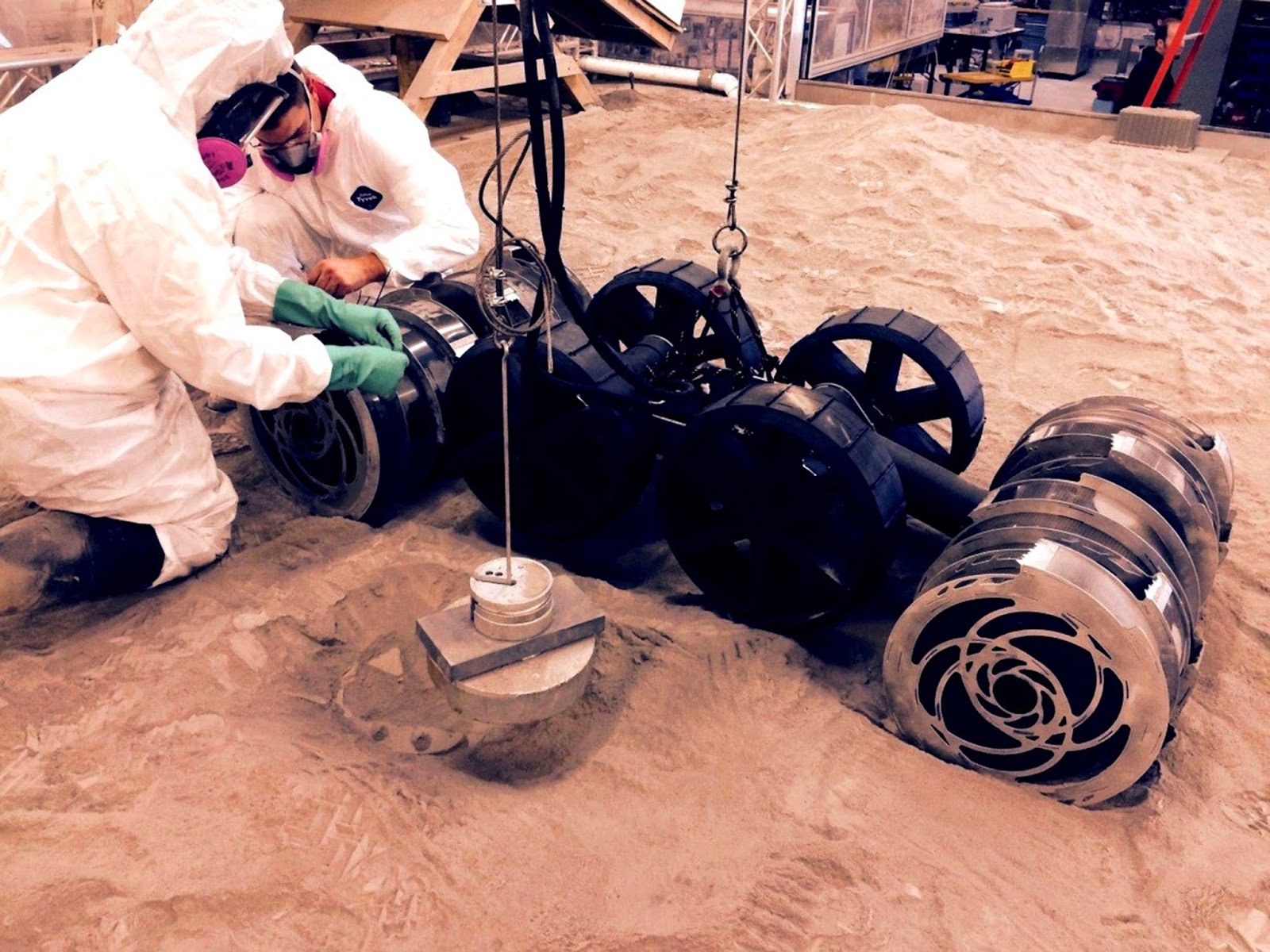
Image above: Engineers make adjustments to the second generation Regolith Advanced Surface Systems Operations Robot prior to a test at the Kennedy Space Center's Swamp Works. As a resource, regolith shows promise for construction due to the extensive presence of basalt in the surface soil. The mineral is widespread among all igneous rocks and comprises more than 90 percent of all volcanic material and it is commonly found on both the moon and Mars. Image Credits: NASA.

One resource that is key to numerous applications is water.

"Several recent planetary missions have sent back data that points to lunar water representing a significant resource that could be used by future explorers," Fox said.

The Clementine mission, launched from Vandenberg Air Force Base in 1994, conducted a bistatic radar experiment that showed water might exist in the Shackelton crater near the lunar south pole.

 Artist's concept of the Clementine spacecraft. Image Credit: NASA
 
Officially called the Deep Space Program Science Experiment, the objective of the Clementine mission was to test sensors and spacecraft components under extended exposure to the space environment and to make scientific observations of the moon and an asteroid.

Launched from Cape Canaveral Air Force Station in 1998, the Lunar Prospector mission detected elevated amounts of hydrogen in both of the moon's polar regions, but could not distinguish its chemical form. Other data returned during the mission also helped scientists construct a detailed map of the lunar surface composition.

NASA's mini-RF and M3 instruments on the Indian Space Research Organization's Chandrayaan-1 lunar orbiter provided more information on the moon's water resources. Chandrayaan-1 was India's first lunar probe, launched in 2008.

 Artist's concept of Chandrayaan-1. Image Credit: ISRO

Flown from the Cape in 2009, more potential water resources were located by the Lunar Reconnaissance Orbiter and the Lunar Crater Observation and Sensing Satellite (LCROSS) missions.

Besides the obvious benefits of water itself, it is made up of hydrogen and oxygen.

"By separating these elements, we have what it takes to operate fuel cells to create electricity," Fox said. "That gives us a power plant on a distant destination."

A fuel cell converts energy from an element, such as liquid hydrogen, into electricity through a chemical reaction with liquid oxygen or another oxidizing agent.

Such technology is under development at Kennedy. The Regolith and Environment Science and Oxygen and Lunar Volatiles Extraction (RESOLVE) payload is in development for a planned Resource Prospector probe. This ISRU-driven mission features a rover that would map lunar volatiles, drill to extract samples and process water and other volatiles.

In planetary science, volatiles are chemical elements and compounds with low boiling points that are associated with a planet or moon's crust or atmosphere.

"RESOLVE is an important first step in enabling long-duration human exploration by actually extracting water from under the lunar surface," Fox said.

Hydrogen and oxygen are the most efficient chemical rocket propellants know. Therefore, extracting these elements from local lunar resources might permit using the moon as a "gas station" for a spacecraft to explore further into the solar system. Oxygen and water, obviously represents a valuable life support commodity.

Since 1965, a fleet of robotic spacecraft have flown by, orbited and landed on Mars. Collectively, they have dramatically increased the knowledge-base about the Red Planet, helping pave the way for human pioneers.

Robotic scientific rovers now are being developed to further determine what raw materials are available and in what quantities. A prototype rover called RASSOR, for Regolith Advanced Surface System Operations Robot, has been tested at Kennedy's Swamp Works. Established to provide rapid, innovative and cost effective exploration mission solutions, Swamp Works leverages partnerships across NASA, industry and academia.


Image above: Rob Mueller, NASA senior technologist in the Surface Systems Office at the Kennedy Space Center, left, talks with former NASA Gemini and Apollo astronaut Buzz Aldrin during a demonstration of the Regolith Advanced Surface Systems Operations Robot, or RASSOR. The robot has been tested at Kennedy's Swamp Works. A similar spacecraft could be used to collect samples or excavate a landing pad for future landers. Image Credits: NASA/Ben Smegelsky.

"RASSOR is designed to climb over difficult terrain," Fox said. "It has wheels with scoops that pick up regolith. It could be used to collect samples or excavate a landing pad for future landers. While the first generation RASSOR has been very successful, we now are working on RASSOR 2 which will be lighter in weight and use less energy."

As a resource, regolith shows promise for construction partly due to the extensive presence of volcanic basalt in the surface soil.

"Construction materials containing basalt and a bonding agent would be two to three times stronger in compression than normal cement concrete typically used here on Earth," Fox said. "It would be an excellent raw material for construction on the moon or Mars."


Image above: In the Kennedy Space Center's Swamp Works laboratory, scientists and engineers are developing robotic concepts for building structures on the moon or Mars focusing on in-situ resource utilization, or living off the land. This robotic arm could be the basis of a system to construct basic shelters for future explorers. Image Credits: NASA/Dan Casper.

Fox noted that the strength of basalt in construction is demonstrated in second-century Roman architecture which has withstood the elements for centuries.

"We recently teamed with researchers at the Marshall Space Flight Center and the U.S. Army to study how to use regolith to build structures to support exploration of Mars," he said.

Planetary surface construction and mining tasks that may be possible using planetary regolith include launch and landing pads, equipment shelters, regolith mining for oxygen production, and water ice mining from shadowed craters.

While NASA develops ways of to use available resources at deep-space destinations, crews aboard the International Space Station (ISS) are performing human research experiments and testing advance environmental and life support systems.

The ability to grow food and recycle carbon dioxide into breathable oxygen may prove crucial for astronauts and add to the body of knowledge as they live in space for months or years at a time. A plant habitat with a large growth chamber also is being studied by Kennedy engineers to determine the affect long-duration microgravity exposure has on plants in space. Similarly, projects such as NASA's Veggie pave the way to growing and eating food in space.

 NASA's Veggie, providing food in space. Image Credits: NASA Ames Research Center

The Veggie experiment is being used aboard the ISS to study the in-orbit function and performance of a new expandable plant growth facility.

To continue research into the availability and accessibility of raw materials for human exploration of Mars, NASA is planning the Mars 2020 mission, building on the success of the Curiosity mission. Scheduled for launch in 2020, the rover mission goals include detecting and characterizing ancient environments that could have harbored life, caching samples for a future sample return mission and testing the ability to extract oxygen from the Red Planet's carbon-dioxide atmosphere to prepare for future human exploration.

The Mars Oxygen ISRU Experiment (MOXIE) will test a solid oxide electrolysis technology that could be scaled up to meet human mission requirements, while the Mars Environment Dynamics Analyzer (MEDA) will improve understanding of atmospheric dust.


Image above: This artist's concepts depicts an example of a construction strategy from Contour Crafting and University of Southern California. The approach was selected by the NASA Innovative Advanced Concepts (NIAC) Project. Contour Crafting technology has potential for building safe, reliable and affordable lunar and Martian structures, habitats, laboratories and other facilities. Contour Crafting construction systems are being developed that exploit in-situ resources and can utilize regolith as construction material. Image Credits: Contour Crafting and University of Southern California.

In addition to NASA and space agencies of other nations, Fox believes there will be future commercial interest in utilization of resources on the moon or planets.

"There are so many possibilities for mining raw materials and putting resources to work, industries may find it economically useful to join this effort," he said.

Technology investments in space can create new markets, thus stimulating growth of the nation’s economy.

"We know there are solvable challenges for human missions to Mars," Fox said. "We have multiple programs in progress that will allow us to overcome the unknowns and make the best use of what we need to take along and what we'll find when we get there."

Related links:

The Regolith and Environment Science and Oxygen and Lunar Volatiles Extraction (RESOLVE): http://www.nasa.gov/resource-prospector

The Mars Oxygen ISRU Experiment (MOXIE): http://mars.jpl.nasa.gov/mars2020/mission/instruments/

Images (mentioned), Text, Credits: NASA's Kennedy Space Center/Bob Granath.

Cheers, Orbiter.ch

Unscheduled stop for Solar Impulse 2


SolarImpulse - Around the World patch.

June 1, 2015

Solar Impulse 2, piloted by André Borschberg, landed in Monday night shortly after 16:30 (Swiss time) on Nagoya Airport in Japan.

The solar plane had to interrupt its journey which will take him to Hawaii because of the weather.


Image above: Solar plane does not rally Hawaii from China. After a little more than a day flight, Solar Impulse 2 was forced to land in Japan.

Bertrand Piccard, who oversees operations from the control center in Monaco, said that while "we left China, the weather conditions were acceptable to Hawaii. They have deteriorated. Crossing an active front with icing, rain, turbulence, it is not at all intended for our plane. This is an aircraft that flies slowly, sensitive to turbulence, which needs sun to recharge its batteries, "said he said.

"Around the world may not advance as fast as we would like, but it is not a race. The goal is to get there, " said Bertrand Piccard, the second pilot alternately to the airplane.

Intermediate landing

"At security level, it was much better to make an intermediate landing in Nagoya, and there wait for weather conditions to improve. It was the last place where one could land safely. Small islands here and there in the Pacific are not alternatives at all ", further detailed the Swiss pilot.


Image above: Solar Impulse 2, which began early Sunday its long Pacific crossing off from China, suffered a setback in prevision of bad weather.

"The weather window has deteriorated. We decided to make an intermediate landing in Nagoya! " He had earlier announced on the official website of the organizers with a Tweet. Their spokesman, Marc Baumgartner, for his part said the ats that this forced stopover in Japan was in no way due to a battery problem.

Japan thanked

First announced Monday at 15:00 (Swiss time), landing there was a hour and a half later, the aircraft having had to wait over the archipelago. The organizers thanked the Japanese authorities have been able to organize emergency arrival in Japan of this aircraft powered by photovoltaic cells.

Landing in Nagoya for Solar Impulse 2

Video above: two Solar Impulse, the solar-powered plane attempting a round-the-world flight, has landed in Japan safely after having to change course due to adverse weather conditions.

"We say thank you to our Japanese friends who have been very accommodating to give us permission at the last minute, ask their territory," added Bertrand Piccard.

Slight disappointment

Advanced disappointment was evident in the words of Bertrand Piccard: "We are a bit disappointed not to make the non-stop journey from China to Hawaii. But it is already a special plane flying 40 hours without fuel, just with solar energy. We are extremely pleased with the behavior of the aircraft. The demonstration of the technical feasibility is there. This aircraft shows what can be done with clean technologies, "he said.

"We try to make a historic first and the first historical have never made easily. Often it takes several attempts. We'll see if we succeed this year. But the team is super motivated, "said Bertrand Piccard again.

Solar Impulse 2 took off Sunday at 2:39 (Swiss 8:39 p.m. Saturday) Nanjing (Eastern China) to the most dangerous stage of its world tour. The pilot had to take six days and six nights. This departure from Nanjing, where the plane was parked since April 21, had already been postponed several times due to inclement weather.

Never the unit has flown over an ocean or only stayed in the air more than 24 hours. This means if the Pacific crossing is a technological challenge and a historical aeronautical feat.

For more information about Solar Imapulse Around the World, visit: http://www.solarimpulse.com/

Images, Video, Text, Credits: SolarImpulse/ATS/Orbiter.ch Aerospace.

Greetings, Orbiter.ch

Dione Dwarfing Rhea


NASA - Cassini Mission to Saturn patch.

June 1, 2015

Dione Dwarfing Rhea. Animation Credit: NASA/JPL-Caltech/Space Science Institute

Is Dione (698 miles or 1123 kilometers across) suddenly larger than Rhea (949 miles or 1527 kilometers across)? No, of course not. Cassini simply captured an image when Dione was much closer to the camera, making the moon appear much bigger than her larger sister moon.

Besides their beauty, images like these can help Cassini's navigators determine exactly where the spacecraft is and confirm that it's on course.

This view looks toward the trailing hemisphere of Dione. North on Dione is up. The image was taken in visible light with the Cassini spacecraft narrow-angle camera on April 11, 2015.

The view was obtained at a distance of approximately 68,000 miles (110,000 kilometers) from Dione and at a Sun-Dione-spacecraft, or phase, angle of 29 degrees. Image scale at Dione is 2,165 feet (660 meters) per pixel. Rhea was 300,000 miles (500,000 kilometers) away at a phase (Sun-Rhea-spacecraft) angle of 30 degrees. The image scale at Rhea is 2 miles (3 kilometers) per pixel.

Artist's view of Cassini spacecraft traveling on the Saturnian System. Image Credits: NASA/ESA

The Cassini mission is a cooperative project of NASA, ESA (the European Space Agency) and the Italian Space Agency. The Jet Propulsion Laboratory, a division of the California Institute of Technology in Pasadena, manages the mission for NASA's Science Mission Directorate, Washington. The Cassini orbiter and its two onboard cameras were designed, developed and assembled at JPL. The imaging operations center is based at the Space Science Institute in Boulder, Colorado.

For more information about the Cassini-Huygens mission visit http://saturn.jpl.nasa.gov or http://www.nasa.gov/cassini . The Cassini imaging team homepage is at http://ciclops.org and http://www.esa.int/Our_Activities/Space_Science/Cassini-Huygens

Image & Animation (mentioned), Text, Credits: NASA/JPL/Tony Greicius.

Best regards, Orbiter.ch

Hubble Video Shows Shock Collision inside Black Hole Jet


NASA - Hubble Space Telescope patch.

June 1, 2015

When you’re blasting though space at more than 98 percent of the speed of light, you may need driver’s insurance. Astronomers have discovered for the first time a rear-end collision between two high-speed knots of ejected matter. This discovery was made while piecing together a time-lapse movie of a plasma jet blasted from a supermassive black hole inside a galaxy located 260 million light-years from earth.

The finding offers new insights into the behavior of “light saber-like” jets that are so energized that they appear to zoom out of black hole at speeds several times the speed of light. This “superluminal” motion is an optical illusion due to their being pointed very close to our line of sight and very fast speeds.

Hubble Time-lapse Shows Shock Collision in Black Hole Jet

Video above: This time-lapse movie of an extragalactic jet was assembled from 20 years of Hubble Space Telescope observations of the core of the elliptical galaxy NGC 3862. Video Credits: NASA, ESA, and E. Meyer STScI.

Such extragalactic jets are not well understood. They appear to transport energetic plasma in a confined beam from the active nucleus of the host galaxy. The new analysis suggests that shocks produced by collisions within the jet further accelerate particles and brighten the regions of colliding material.   

The video of the jet was assembled with two decades’ worth of NASA Hubble Space Telescope images of the elliptical galaxy NGC 3862, the sixth brightest galaxy and one of only a few active galaxies with jets seen in visible light. The jet was discovered in optical light by Hubble in 1992. NGC 3862 is in a rich cluster of galaxies known as Abell 1367, located in the constellation Leo.

The jet from NGC 3862 has a string-of-pearls structure of glowing knots of material. Taking advantage of Hubble's sharp resolution and long-term optical stability, Eileen Meyer of the Space Telescope Science Institute (STScI) in Baltimore, Maryland assembled a video from archival data to better understand jet motions. Meyer was surprised to see a fast knot with an apparent speed of seven times the speed of light catch up with the end of a slower moving, but still superluminal, knot along the string.


Images above: In the central region of galaxy NGC 3862 an extragalactic jet of material can be seen at the 3 o'clock position (left). Hubble images (right) of knots (outlined in red, green and blue) shows them moving along the jet over 20 years. The "X" is the black hole. Images Credits: NASA, ESA, and E. Meyer STScI.

The resulting “shock collision” caused the merging blobs to brighten significantly.

“Something like this has never been seen before in an extragalactic jet,” said Meyer. As the knots continue merging they will brighten further in the coming decades. “This will allow us a very rare opportunity to see how the energy of the collision is dissipated into radiation.”

It’s not uncommon to see knots of material in jets ejected from gravitationally compact objects, but it is rare that motions have been observed with optical telescopes, and so far out from the black hole, thousands of light-years away. In addition to black holes, newly forming stars eject narrowly collimated streamers of gas that have a knotty structure. One theory is that material falling onto the central object is superheated and ejected along the object’s spin axis. Powerful magnetic fields constrain the material into a narrow jet. If the flow of the infalling material is not smooth, blobs are ejected like a string of cannon balls rather than a steady hose-like flow.

Whatever the mechanism, the fast-moving knot will burrow its way out into intergalactic space. A knot launched later, behind the first one, may have less drag from the shoveled-out interstellar medium and catch up to the earlier knot, rear-ending it in a shock collision.

Beyond the collision, which will play out over the next few decades, this discovery marks only the second case of superluminal motion measured at hundreds to thousands of light-years from the black hole where the jet was launched. This indicates that the jets are still very, very close to the speed of light even on distances that start to rival the scale of the host galaxy. These measurements can give insights into how much energy jets carry out into their host galaxy and beyond, which is important for understanding how galaxies evolve as the universe ages.

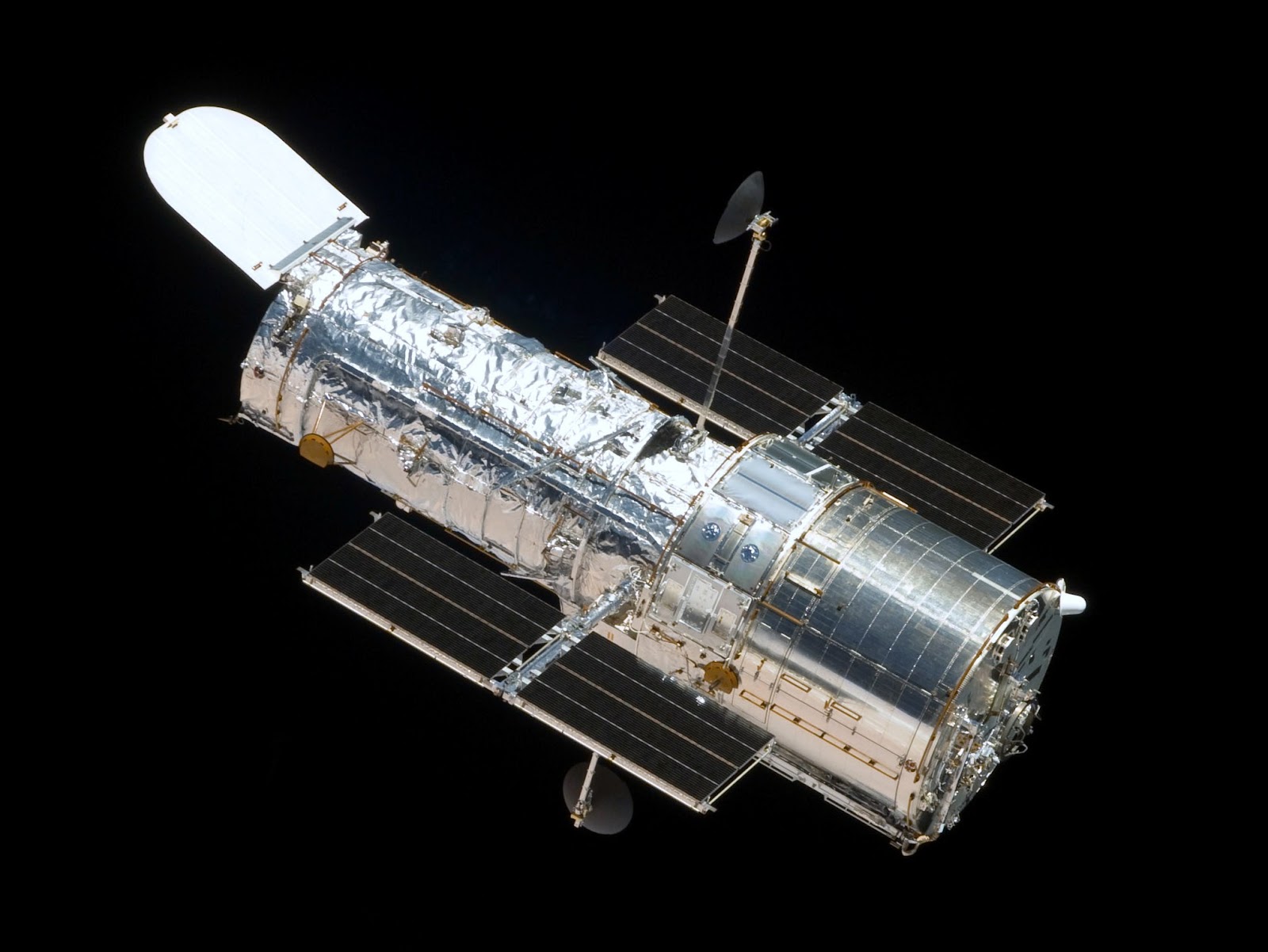
Hubble Space Telescope (HST). Image Credit: NASA

Meyer is currently making a Hubble-image video of two more jets in the nearby universe, to look for similar fast motions. She notes that these kinds of studies are only possible because of the long operating lifetime of Hubble, which has now been looking at some of these jets for over 20 years.

Extragalactic jets have been detected at X-ray and radio wavelengths in many active galaxies powered by central black holes, but only a few have been seen in optical light. Astronomers do not yet understand why some jets are seen in visible light and others are not.

Meyer’s results are being reported in the May 28 issue of the journal Nature.

The Hubble Space Telescope is a project of international cooperation between NASA and the European Space Agency. NASA's Goddard Space Flight Center in Greenbelt, Maryland, manages the telescope. STScI conducts Hubble science operations. STScI is operated for NASA by the Association of Universities for Research in Astronomy, Inc., in Washington, D.C.

For images and more information about the Hubble Space Telescope, visit:
http://www.nasa.gov/hubble and http://hubblesite.org/ and http://www.spacetelescope.org/

Images & video (mentioned), Text, Credits: NASA/Felicia Chou/Space Telescope Science Institute/Ray Villard/Rob Garner.

Greetings, Orbiter.ch

Gravitational lensing of the cosmic microwave background by galaxy clusters


SPT - South Pole Telescope logo.

June 1, 2015

The photons that make up the cosmic microwave background (CMB) have traversed the universe almost freely for 13.8 billion years, thereby carrying information about the state of the universe when it was only 380,000 years old. "Almost freely" refers to two ways that these photons are disturbed along their long journeys: They are sometimes scattered by hot electrons and they are deflected by deep gravitational wells.


Images above: The left panel shows a simulated map of an unlensed cosmic microwave background. The center panel shows the same map if a large galaxy cluster were along the line of sight. Note that the scale on these two panels goes to 100 microKelvin. The right panel shows the difference between the first two panels. The scale is now down to 10 microKelvin. (Plots are in units of arcminutes.) Images Credits: Antony Lewis and Lindsay King, Institute of Astronomy.

It is this latter deflection, called gravitational lensing, that offers immense promise as a tool to weigh massive objects such as galaxy clusters. Clusters are very important because their abundance offers insight into why the universe is currently accelerating. Extracting this insight, though, requires careful estimates of the masses of clusters. There are currently several techniques in play: X-ray emission, galaxy counts in the clusters, distortions of the shapes of background galaxies and the signal imprinted on the CMB by hot electrons in clusters.

Lensing of the CMB provides a new way to measure cluster masses, one that has just been demonstrated. A simulated signal from one cluster is shown above. Each panel represents about 35 square arcminutes, about 20 times smaller than the moon, so a CMB experiment must have excellent resolution to see the effect. Cluster lensing is the difference between the left and center panels, shown in the right panel. The signal is roughly several microKelvin, much smaller than the typical hot and cold spots that have made the CMB famous. So the resolution must be coupled with exquisite sensitivity.


Image above: The 10-meter South Pole Telescope and the BICEP (Background Imaging of Cosmic Extragalactic Polarization) Telescope at Amundsen-Scott South Pole Station, against the night sky with the Milky Way. Image Credit: NSF.

Large ground-based telescopes such as the 10-meter South Pole Telescope are beginning to attain this dual capability. The noise levels are still too high to measure lensing by a single cluster, so the SPT team performed a likelihood analysis using 513 clusters, detected over three years of the telescope's operation, to measure the weighted mass. The result was a 3-sigma measurement of the lensing of the CMB, with the mass consistent with those obtained with other methods. A paper on this result has recently been accepted for publication in The Astrophysical Journal.

The team is now optimistic that this effect will lead to competitive constraints on cluster masses with upcoming surveys, such as SPT-3G and CMB-S4.

Related links:

South Pole Telescope (SPT): https://pole.uchicago.edu/spt/

A Measurement of Gravitational Lensing of the Cosmic Microwave Background by Galaxy Clusters Using Data from the South Pole Telescope: http://arxiv.org/abs/1412.7521

Institute of Astronomy: http://arxiv.org/pdf/astro-ph/0512104v2.pdf

Images (mentioned), Text, Credits: Fermilab/Scott Dodelson.

Greetings, Orbiter.ch

Smaller LHC collaborations to analyse collisions at 13 TeV


CERN - European Organization for Nuclear Research logo.

June 1, 2015

Some 100 metres underground, on the 27-kilometre ring of the Large Hadron Collider (LHC), sit four experiments the size of buildings. ATLAS and CMS are general-purpose detectors designed to investigate a wide range of physics phenomena from Higgs bosons to dark matter; ALICE specializes in studying quark-gluon plasma – a state of matter thought to have existed moments after the Big Bang – and LHCb is investigating the difference between matter and antimatter by analysing beauty quarks.

But these are not the only experiments at the world's most powerful particle accelerator. Three smaller experiments – TOTEM, LHCf and MoEDAL – will be among those searching for new physics when data taking begins, in early June, at the LHC's new energy frontier of 13 teraelectronvolts (TeV).

The TOTEM experiment takes precise measurements of protons as they emerge from collisions in the LHC at small angles to the beampipe. This region is known as the 'forward' direction. TOTEM detectors on both sides of the interaction point at CMS are spread across a total distance of almost half a kilometre. For the LHC's second run, the TOTEM and CMS collaborations plan to coordinate the use of their detectors to perform combined measurements with unprecedented accuracy.


Image above: TOTEM,Roman Pot,Pot Romain. In the TOTEM experiment, detectors called 'Roman pots' localise the trajectories of protons (Image: Maximilien Brice/CERN).

"TOTEM will continue to give insights on the structure of the proton, as well as diffractive processes relevant in forward and cosmic-ray physics," says TOTEM spokesperson Simone Giani. "Combining TOTEM data with those of CMS will allow measurements of 'missing energy' with discovery potential in a phase space not accessible to former experiments."

The Large Hadron Collider forward (LHCf) experiment measures neutral particles emitted at nearly zero degrees to the direction of the proton beam. Because these 'very forward' particles carry a large fraction of the collision energy, they are important for understanding the development of showers of particles produced in the atmosphere by high-energy cosmic rays. To measure these particles, two detectors, Arm1 and Arm2, sit along the LHC beamline, at 140 metres either side of the ATLAS collision point.

"Since their birth around 2004 the LHCf detectors have been upgraded year after year, in such a way that their performance and radiation hardness have been greatly improved in view of the 13 TeV proton-proton run," says Lorenzo Bonechi, who leads a team for the LHCf collaboration in Florence, Italy. "The LHCf results at 7 TeV collisions are in good agreement with model predictions for forward photon and neutral pion productions but not for forward neutrons. The operation at 13 TeV collisions give us a great opportunity to confirm the results with collisions of about factor four higher energy in the laboratory frame and to test models more precisely than at 7 TeV."


Image above: CERN - The Large Hadron Collider (LHC), in search of the secrets of matter and the Universe. Image Credit: CERN.

MoEDAL, the LHC's newest experiment, is designed to search for highly ionizing avatars of new physics such as magnetic monopoles. Its physics programme defines numerous scenarios that yield insights into such questions as: are there extra dimensions or new symmetries; does magnetic charge exist; and what is the nature of dark matter.

The largely passive MoEDAL detector, deployed at Point 8 on the LHC ring, has a dual nature. First, it acts like a giant camera, comprised of over 200 square metres of nuclear track detectors – analysed offline by ultra-fast scanning microscopes – sensitive only to new physics. Second, with roughly one tonne of trapping detectors, it is able to capture particle messengers of physics beyond the Standard Model for further study.

"The MoEDAL experiment will begin to take data for the first time in June 2015," says MoEDAL spokesperson James Pinfold. "Any MoEDAL discovery would have a revolutionary impact comparable to that of the Higgs boson."

With data taking to start in early June, LHC experiments large and small are rearing to explore new frontiers in physics.

Note:

CERN, the European Organization for Nuclear Research, is one of the world’s largest and most respected centres for scientific research. Its business is fundamental physics, finding out what the Universe is made of and how it works. At CERN, the world’s largest and most complex scientific instruments are used to study the basic constituents of matter — the fundamental particles. By studying what happens when these particles collide, physicists learn about the laws of Nature.

The instruments used at CERN are particle accelerators and detectors. Accelerators boost beams of particles to high energies before they are made to collide with each other or with stationary targets. Detectors observe and record the results of these collisions.

Founded in 1954, the CERN Laboratory sits astride the Franco–Swiss border near Geneva. It was one of Europe’s first joint ventures and now has 22 Member States.

Related links:

Large Hadron Collider (LHC): http://home.web.cern.ch/topics/large-hadron-collider

ALICE experiment: http://home.web.cern.ch/about/experiments/alice

ATLAS experiment: http://home.web.cern.ch/about/experiments/atlas

CMS experiment: http://home.web.cern.ch/about/experiments/cms

LHCb experiment: http://home.web.cern.ch/about/experiments/lhcb

Large Hadron Collider forward (LHCf): http://home.web.cern.ch/about/experiments/lhcf

TOTEM experiment: http://home.web.cern.ch/about/experiments/totem

MoEDAL experiment: http://home.web.cern.ch/about/experiments/moedal

The Higgs bosons: http://home.web.cern.ch/topics/higgs-boson

The Big Bang: http://home.web.cern.ch/about/physics/early-universe

The antimatter: http://home.web.cern.ch/topics/antimatter

The Physics Standard Model: http://home.web.cern.ch/about/physics/standard-model

For more information about the European Organization for Nuclear Research (CERN), visit: http://home.web.cern.ch/

Images (mentioned), Text, Credits: CERN/Cian O'Luanaigh.

Greetings, Orbiter.ch