mardi 14 juillet 2015

New Horizons - Three-Billion-Mile Journey to Pluto Reaches Historic Encounter


NASA - New Horizons Mission logo.

July 14, 2015

Pluto and Charon Shine in False Color. Image Credits: NASA/APL/SwRI.

The images were obtained using three of the color filters of the “Ralph” instrument on July 13 at 3:38 am EDT. New Horizons has seven science instruments on board the spacecraft—including “Ralph” and “Alice”, whose names are a throwback to the “Honeymooners,” a popular 1950s sitcom. 

“These images show that Pluto and Charon are truly complex worlds.  There's a whole lot going on here,” said New Horizons co-investigator Will Grundy, Lowell Observatory, Flagstaff, Arizona.  “Our surface composition team is working as fast as we can to identify the substances in different regions on Pluto and unravel the processes that put them where they are.”

The color data helps scientists understand the molecular make-up of ices on the surfaces of Pluto and Charon, as well as the age of geologic features such as craters. They can also tell us about surface changes caused by space “weather,” such as radiation.

The new color images reveal that the “heart” of Pluto actually consists of two remarkably different-colored regions.  In the false-color image, the heart consists of a western lobe shaped like an ice cream cone that appears peach color in this image.  A mottled area on the right (east) side looks bluish.  A mid-latitude band appears in shades ranging from pale blue through red.  Even within the northern polar cap, in the upper part of the image, various shades of yellow-orange indicate subtle compositional differences. This image was obtained using three of the color filters of the Ralph instrument on July 13 at 3:38 am EDT and received on the ground on at 12:25 pm.


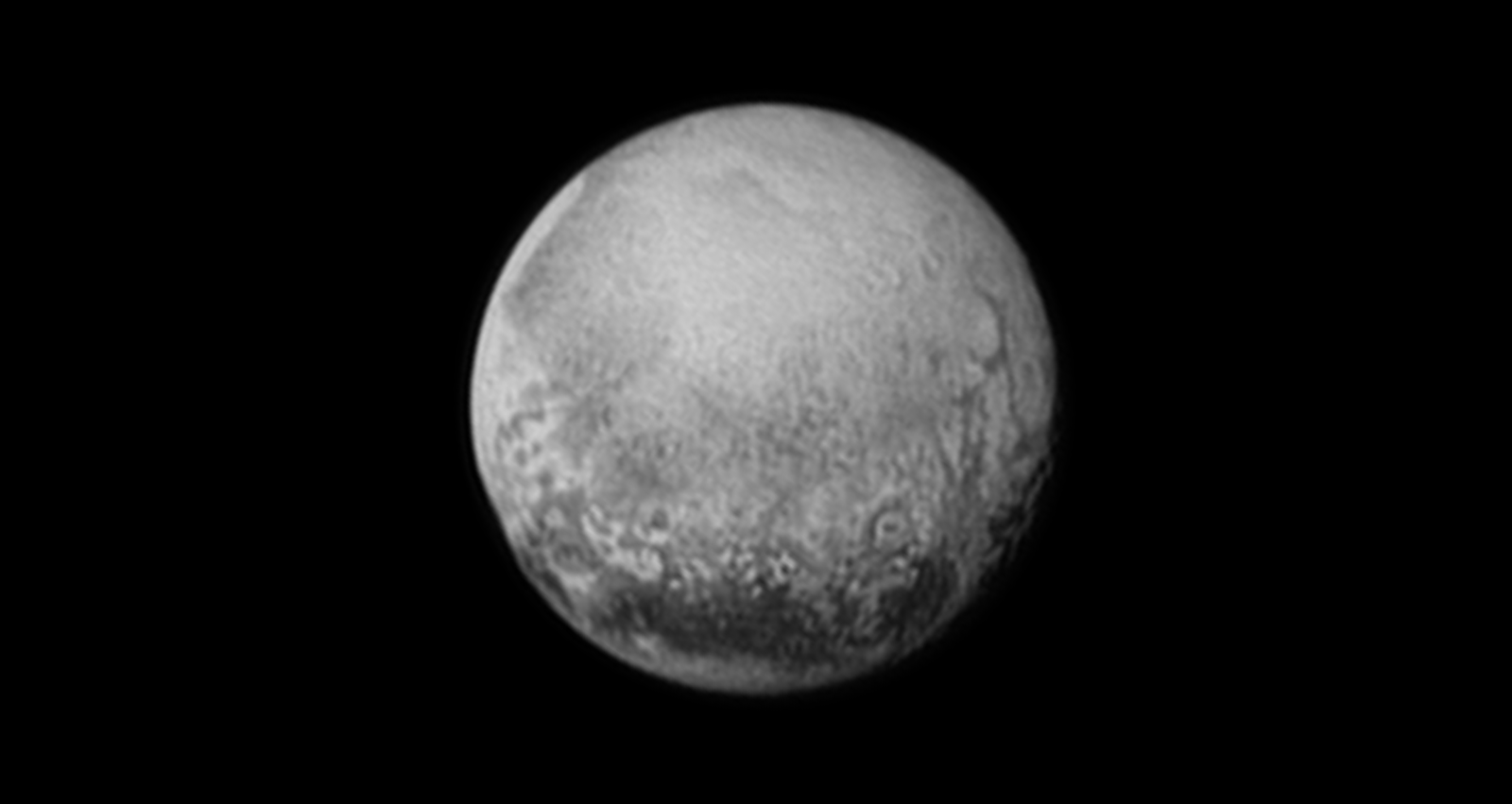
Image above: Pluto nearly fills the frame in this image from the Long Range Reconnaissance Imager (LORRI) aboard NASA’s New Horizons spacecraft, taken on July 13, 2015 when the spacecraft was 476,000 miles (768,000 kilometers) from the surface. This is the last and most detailed image sent to Earth before the spacecraft’s closest approach to Pluto on July 14. The color image has been combined with lower-resolution color information from the Ralph instrument that was acquired earlier on July 13. This view is dominated by the large, bright feature informally named the “heart,” which measures approximately 1,000 miles (1,600 kilometers) across. The heart borders darker equatorial terrains, and the mottled terrain to its east (right) are complex. However, even at this resolution, much of the heart’s interior appears remarkably featureless—possibly a sign of ongoing geologic processes. Image Credits: NASA/APL/SwRI.

NASA’s New Horizons spacecraft is at Pluto.

After a decade-long journey through our solar system, New Horizons made its closest approach to Pluto Tuesday, about 7,750 miles above the surface -- roughly the same distance from New York to Mumbai, India – making it the first-ever space mission to explore a world so far from Earth.

“I’m delighted at this latest accomplishment by NASA, another first that demonstrates once again how the United States leads the world in space,” said John Holdren, assistant to the President for Science and Technology and director of the White House Office of Science and Technology Policy. “New Horizons is the latest in a long line of scientific accomplishments at NASA, including multiple missions orbiting and exploring the surface of Mars in advance of human visits still to come; the remarkable Kepler mission to identify Earth-like planets around stars other than our own; and the DSCOVR satellite that soon will be beaming back images of the whole Earth in near real-time from a vantage point a million miles away. As New Horizons completes its flyby of Pluto and continues deeper into the Kuiper Belt, NASA's multifaceted journey of discovery continues."


Image above: Members of the New Horizons science team react to seeing the spacecraft's last and sharpest image of Pluto before closest approach later in the day, Tuesday, July 14, 2015 at the Johns Hopkins University Applied Physics Laboratory in Laurel, Maryland. Image Credits: NASA/Bill Ingalls.

“The exploration of Pluto and its moons by New Horizons represents the capstone event to 50 years of planetary exploration by NASA and the United States," said NASA Administrator Charles Bolden. “Once again we have achieved a historic first. The United States is the first nation to reach Pluto, and with this mission has completed the initial survey of our solar system, a remarkable accomplishment that no other nation can match.”

Per the plan, the spacecraft currently is in data-gathering mode and not in contact with flight controllers at the Johns Hopkins University Applied Physical Laboratory (APL) in Laurel, Maryland. Scientists are waiting to find out whether New Horizons “phones home,” transmitting to Earth a series of status updates that indicate the spacecraft survived the flyby and is in good health. The “call” is expected shortly after 9 p.m. EDT tonight.

The Pluto story began only a generation ago when young Clyde Tombaugh was tasked to look for Planet X, theorized to exist beyond the orbit of Neptune. He discovered a faint point of light that we now see as a complex and fascinating world.

"Pluto was discovered just 85 years ago by a farmer's son from Kansas, inspired by a visionary from Boston, using a telescope in Flagstaff, Arizona,” said John Grunsfeld, associate administrator for NASA's Science Mission Directorate in Washington. "Today, science takes a great leap observing the Pluto system up close and flying into a new frontier that will help us better understand the origins of the solar system.”

New Horizons’ flyby of the dwarf planet and its five known moons is providing an up-close introduction to the solar system's Kuiper Belt, an outer region populated by icy objects ranging in size from boulders to dwarf planets. Kuiper Belt objects, such as Pluto, preserve evidence about the early formation of the solar system.

New Horizons principal investigator Alan Stern of the Southwest Research Institute (SwRI) in Boulder, Colorado, says the mission now is writing the textbook on Pluto.

"The New Horizons team is proud to have accomplished the first exploration of the Pluto system,” Stern said. “This mission has inspired people across the world with the excitement of exploration and what humankind can achieve.”

New Horizons’ almost 10-year, three-billion-mile journey to closest approach at Pluto took about one minute less than predicted when the craft was launched in January 2006. The spacecraft threaded the needle through a 36-by-57 mile (60 by 90 kilometers) window in space -- the equivalent of a commercial airliner arriving no more off target than the width of a tennis ball.

Because New Horizons is the fastest spacecraft ever launched – hurtling through the Pluto system at more than 30,000 mph, a collision with a particle as small as a grain of rice could incapacitate the spacecraft. Once it reestablishes contact Tuesday night, it will take 16 months for New Horizons to send its cache of data – 10 years’ worth -- back to Earth.

 Artist's view of New Horizons passing over Pluto. Image Credit: NASA

New Horizons is the latest in a long line of scientific accomplishments at NASA, including multiple rovers exploring the surface of Mars, the Cassini spacecraft that has revolutionized our understanding of Saturn and the Hubble Space Telescope, which recently celebrated its 25th anniversary. All of this scientific research and discovery is helping to inform the agency’s plan to send American astronauts to Mars in the 2030’s.

“After nearly 15 years of planning, building, and flying the New Horizons spacecraft across the solar system, we’ve reached our goal,” said project manager Glen Fountain at APL. “The bounty of what we’ve collected is about to unfold.”

APL designed, built and operates the New Horizons spacecraft and manages the mission for NASA’s Science Mission Directorate. SwRI leads the mission, science team, payload operations and encounter science planning. New Horizons is part of NASA’s New Frontiers Program, managed by the agency’s Marshall Space Flight Center in Huntsville, Alabama.

Stay in touch with the New Horizons mission with #PlutoFlyby and on Facebook at: https://www.facebook.com/new.horizons1

For more information on the New Horizons mission, including fact sheets, schedules, video and images, visit: http://www.nasa.gov/newhorizons and http://solarsystem.nasa.gov/planets/plutotoolkit.cfm

Images (mentioned), Text, Credits: NASA/Dwayne Brown/Laurie Cantillo/Johns Hopkins University Applied Physics Laboratory/Mike Buckley/Southwest Research Institute/Maria Stothoff/Karen Northon.

Best regards, Orbiter.ch

lundi 13 juillet 2015

Not So Titanic


NASA - Cassini Mission to Saturn patch.

July 13, 2015


Titan may be a "large" moon - its name even implies it! - but it is still dwarfed by its parent planet, Saturn. As it turns out, this is perfectly normal.

Although Titan (3200 miles or 5150 kilometers across) is the second-largest moon in the solar system, Saturn is still much bigger, with a diameter almost 23 times larger than Titan’s. This disparity between planet and moon is the norm in the solar system. Earth’s diameter is “only” 2.3 times our moon’s diameter, making our natural satellite something of an oddity. (Another exception to the rule: dwarf planet Pluto’s diameter is just under two times that of its moon.) So the question isn't why is Titan so small (relatively speaking), but why is Earth’s moon so big?

This view looks toward the anti-Saturn hemisphere of Titan. North on Titan is up. The image was taken with the Cassini spacecraft wide-angle camera on April 18, 2015 using a near-infrared spectral filter with a passband centered at 752 nanometers.

The view was acquired at a distance of approximately 930,000 miles (1.5 million kilometers) from Titan. Image scale is 56 miles (90 kilometers) per pixel.

Cassini spacecraft orbiting Saturn

The Cassini mission is a cooperative project of NASA, ESA (the European Space Agency) and the Italian Space Agency. The Jet Propulsion Laboratory, a division of the California Institute of Technology in Pasadena, manages the mission for NASA's Science Mission Directorate, Washington. The Cassini orbiter and its two onboard cameras were designed, developed and assembled at JPL. The imaging operations center is based at the Space Science Institute in Boulder, Colorado.

For more information about the Cassini-Huygens mission visit http://saturn.jpl.nasa.gov or http://www.nasa.gov/cassini . The Cassini imaging team homepage is at http://ciclops.org and http://www.esa.int/Our_Activities/Space_Science/Cassini-Huygens

Images, Text, Credits: NASA/JPL-Caltech/Space Science Institute/Tony Greicius.

Cheers, Orbiter.ch

How Big Is Pluto? New Horizons Settles Decades-Long Debate


NASA - New Horizons Mission logo.

July 13, 2015


Image above: A portrait from the final approach. Pluto and Charon display striking color and brightness contrast in this composite image from July 11, showing high-resolution black-and-white LORRI images colorized with Ralph data collected from the last rotation of Pluto. Color data being returned by the spacecraft now will update these images, bringing color contrast into sharper focus. Image Credits: NASA-JHUAPL-SWRI.


Image above: Pluto’s bright, mysterious “heart” is rotating into view, ready for its close-up on close approach, in this image taken by New Horizons on July 12 from a distance of 1.6 million miles (2.5 million kilometers). It is the target of the highest-resolution images that will be taken during the spacecraft’s closest approach to Pluto on July 14. The intriguing “bulls-eye” feature at right is rotating out of view, and will not be seen in greater detail. Image Credits: NASA/JHUAPL/SWRI.


Image above: Charon’s newly-discovered system of chasms, larger than the Grand Canyon on Earth, rotates out of view in New Horizons’ sharpest image yet of the Texas-sized moon. It’s trailed by a large equatorial impact crater that is ringed by bright rays of ejected material. In this latest image, the dark north polar region is displaying new and intriguing patterns. This image was taken on July 12 from a distance of 1.6 million miles (2.5 million kilometers). Image Credits: NASA/JHUAPL/SWRI.

NASA’s New Horizons mission has answered one of the most basic questions about Pluto—its size.

Mission scientists have found Pluto to be 1,473 miles (2,370 kilometers) in diameter, somewhat larger than many prior estimates. Images acquired with the Long Range Reconnaissance Imager (LORRI) were used to make this determination. This result confirms what was already suspected: Pluto is larger than all other known solar system objects beyond the orbit of Neptune.

“The size of Pluto has been debated since its discovery in 1930. We are excited to finally lay this question to rest,” said mission scientist Bill McKinnon, Washington University, St. Louis.

Pluto’s newly estimated size means that its density is slightly lower than previously thought, and the fraction of ice in its interior is slightly higher. Also, the lowest layer of Pluto’s atmosphere, called the troposphere, is shallower than previously believed.

Measuring Pluto’s size has been a decades-long challenge due to complicating factors from its atmosphere. Its largest moon Charon lacks a substantial atmosphere, and its diameter was easier to determine using ground-based telescopes. New Horizons observations of Charon confirm previous estimates of 751 miles (1208 km) kilometers) across

LORRI has also zoomed in on two of Pluto’s smaller moons, Nix and Hydra.

“We knew from the time we designed our flyby that we would only be able to study the small moons in detail for just a few days before closest approach,” said New Horizons Principal Investigator Alan Stern of the Southwest Research Institute, Boulder, Colorado. “Now, deep inside Pluto’s sphere of influence, that time has come.”


Image above: The approximate sizes of Pluto’s moons Nix and Hydra compared to Denver, Colorado. While Nix and Hydra are illustrated as circles in this diagram, mission scientists anticipate that future observations by New Horizons will show that they are irregular in shape. Image Credits: JHUAPL/Google.

Nix and Hydra were discovered using the Hubble Space Telescope in 2005. Even to Hubble, they appeared as points of light, and that’s how they looked to New Horizons until the final week of its approach to Pluto. Now, the latest LORRI images show the two diminutive satellites not as pinpoints, but as moons seen well enough to measure their sizes. Nix is estimated to be about 20 miles (about 35 kilometers) across, while Hydra is roughly 30 miles (roughly 45 kilometers) across. These sizes lead mission scientists to conclude that their surfaces are quite bright, possibly due to the presence of ice.

What about Pluto’s two smallest moons, Kerberos and Styx? Smaller and fainter than Nix and Hydra, they are harder to measure. Mission scientists should be able to determine their sizes with observations New Horizons will make during the flyby and will transmit to Earth at a later date.

Pluto’s North Pole, Equator, and Central Meridian

 
Image above: On July 11, 2015, New Horizons captured a world that is growing more fascinating by the day. For the first time on Pluto, this view reveals linear features that may be cliffs, as well as a circular feature that could be an impact crater. Rotating into view is the bright heart-shaped feature that will be seen in more detail during New Horizons’ closest approach on July 14. The annotated version includes a diagram indicating Pluto’s north pole, equator, and central meridian. Image Credits: NASA/JHUAPL/SWRI.

The Johns Hopkins University Applied Physics Laboratory in Laurel, Maryland, designed, built, and operates the New Horizons spacecraft, and manages the mission for NASA's Science Mission Directorate. The Southwest Research Institute, based in San Antonio, leads the science team, payload operations and encounter science planning. New Horizons is part of the New Frontiers Program managed by NASA's Marshall Space Flight Center in Huntsville, Alabama.

At 7:49 AM EDT on Tuesday, July 14 New Horizons will zip past Pluto at 30,800 miles per hour (49,600 kilometers per hour), with a suite of seven science instruments busily gathering data. The mission will complete the initial reconnaissance of the solar system with the first-ever look at the icy dwarf planet.

Follow the path of the spacecraft in coming days in real time with a visualization of the actual trajectory data, using NASA’s online Eyes on Pluto: http://eyes.jpl.nasa.gov/eyes-on-pluto.html

Stay in touch with the New Horizons mission with #PlutoFlyby and on Facebook at: https://www.facebook.com/new.horizons1

For more information about New Horizons mission, visit: http://www.nasa.gov/mission_pages/newhorizons/main/index.html

Images (mentioned), Text, Credits: NASA/Tricia Talbert.

Best regards, Orbiter.ch

Weekly Recap From the Expedition Lead Scientist


ISS - Expedition 44 Mission patch.

July 13, 2015

The International Space Station crew continued investigations into liquid crystals in microgravity while studying a small worm to learn about how organisms age during space flight, which could lead to new therapies for people with muscle atrophy problems on Earth.

NASA astronaut Scott Kelly completed the Space Aging investigation, removing it from the Cell Biology Experiment Facility (CBEF). The JAXA (Japan Aerospace Exploration Agency) study uses the small roundworm Caenorhabditis elegans to investigate the effects of spaceflight on the aging of an organism. C. elegans is widely used as a model for larger organisms. This particular investigation records the movements of worms in both microgravity and simulated gravity to compare the health and longevity against control specimens kept on Earth. Kelly retrieved the samples from the observation experiment units, placing them in moisture bags and stowing them for a return flight.


Image above: NASA astronaut Scott Kelly works with the Space Aging investigation on the International Space Station. The Japan Aerospace Exploration Agency investigation uses small roundworms raised in space to compare how cells age in microgravity to how they age on Earth. Understanding the physical changes could lead to treatments to counteract muscle atrophy or osteoporosis on Earth and for astronauts on long space voyages. Image Credit: NASA.

The worms will be compared to similar batches grown in a laboratory in Japan. Understanding the molecular changes that take place in microgravity could help researchers develop treatments or therapies to counteract the physical changes associated with aging and extended bed rest, such as muscle atrophy or osteoporosis, and could help develop treatments or exercises for astronauts on long voyages.

The first liquid crystal sample of the Observation and Analysis of Smectic Islands in Space (OASIS) was installed and ground scientists began their set of experiments and observations. The OASIS investigation studies the unique behavior of liquid crystals in microgravity including overall motion and the merging of crystal layers known as smectic islands. Earth scientists induced airflow in the liquid crystal matrix, successfully creating a liquid crystal bubble and generating the smectic islands.

Liquid crystals are used for display screens in televisions and clocks, but also occur in soap and cell membranes. OASIS allows detailed study of the behavior of these structures, including how microgravity affects its unique ability to act like both a liquid and a solid crystal. Data from the investigation could impact our understanding of complex fluid physics and diffusion in microgravity, leading to improved displays in space -- including heads-up displays in helmets -- or various LCD devices on Earth.


Image above: Russian cosmonaut Gennady Padalka talks to flight controllers on the ground while setting up the Observation and Analysis of Smectic Islands in Space (OASIS) investigation on the International Space Station. Scientists hope to learn more about the unique structure of liquid crystals and results could lead to improved displays (LCDs) for use in space and on Earth. Image Credit: NASA.

Kelly spent the day before Independence Day replacing the damaged Multi-user Droplet Combustion Apparatus (MDCA) Igniter Tip in the Igniter Base and the MDCA Fiber Arm. Once these repairs are complete, the ground team will perform checkouts and begin the next round of the Flame Extinguishment Experiment (FLEX-2). This investigation burns small droplets of fuel to study the spherical characteristics of burning fuel droplets in space. Researchers are examining how quickly fuel burns, the conditions required for soot to form, how the interactions of droplets in a fuel spray affect soot formation, flame extinction, burning rate, flame shape, size and color. Data from this investigation may help build more efficient engines that produce less pollution. Understanding these processes could lead to the production of a safer spacecraft as well as increased fuel efficiency for engines using liquid fuel on Earth.

Human research investigations on the orbiting laboratory continuing this week include Habitability, Journals, and Sleep ISS-12.

Related links:

International Space Station (ISS): http://www.nasa.gov/station

Space Aging investigation: http://www.nasa.gov/mission_pages/station/research/experiments/1081.html

Cell Biology Experiment Facility (CBEF): http://www.nasa.gov/mission_pages/station/research/experiments/CBEF.html

Observation and Analysis of Smectic Islands in Space (OASIS): http://www.nasa.gov/mission_pages/station/research/experiments/773.html

Multi-user Droplet Combustion Apparatus (MDCA): https://spaceflightsystems.grc.nasa.gov/sopo/ihho/psrp/fcf/fcf-investigations/mdca/

Flame Extinguishment Experiment (FLEX-2): http://www.nasa.gov/mission_pages/station/research/experiments/480.html

Japan Aerospace Exploration Agency (JAXA): http://global.jaxa.jp/

Images (mentioned), Text, Credits: NASA/Jorge Sotomayor, Lead Increment Scientist Expedition 43-44/Kristine Rainey.

Greetings, Orbiter.ch

Apollo-Soyuz: An Orbital Partnership Begins


NASA & Soviet Union Space Program (actual ROSCOSMOS) Apollo - Soyuz Rendez-vous Mission patch's.

July 13, 2015

Most of us take it for granted today that American astronauts and Russian cosmonauts live and work together in Earth orbit. They've been doing it for years, first in the Shuttle-Mir program, and now on the International Space Station. This orbital cooperation has grown to include partners in the European and Japanese space agencies, and will continue well into the next decade, as humanity learns about living off the home planet to prepare for longer journeys beyond Earth orbit.

Artist's impression of the Apollo-Soyuz Rendez-vous. Image Credit: NASA

But before the two Cold War-rivals first met in orbit in 1975, such a partnership seemed unlikely. Since Sputnik bleeped into orbit in 1957, the superpowers were driven by the Space Race, with the U.S. and then-Soviet Union driven more by competition than cooperation. When President Kennedy called for a manned moon landing in 1961, he spoke of "battle that is now going on around the world between freedom and tyranny" and referred to the "head start obtained by the Soviets with their large rocket engines."

But by the mid-70s things had changed. The U.S. had "won" the race to the Moon, with six Apollo landings between 1969 and 1972. Both nations had launched space stations, the Russian Salyut and American Skylab. With the Space Shuttle still a few years off and the diplomatic chill thawing, the time was right for a joint mission.


Image above: The Apollo-Soyuz crew, from left: American astronauts "Deke" Slayton, Tom Stafford, Vance Brand, Russian cosmonauts Aleksey Leonov, Valeriy Kubasov. Image Credit: NASA.

The Apollo-Soyuz Test Project would send NASA astronauts Tom Stafford, Deke Slayton and Vance Brand in an Apollo Command and Service Module to meet Russian cosmonauts Aleksey Leonov and Valeriy Kubasov in a Soyuz capsule. A jointly designed, U.S.-built docking module fulfilled the main technical goal of the mission, demonstrating that two dissimilar craft could dock in orbit. But the human side of the mission went far beyond that.

The training leading up to the mission exposed the two crews to each other's nations, helping to break down cultural and language barriers. As Brand said in a 2000 interview, amid the Cold War tensions, "we thought they were pretty aggressive people and ... they probably thought we were monsters. So we very quickly broke through that, because when you deal with people that are in the same line of work as you are, and you're around them for a short time, why, you discover that, well, they're human beings."

"We were a little of a spark or a foot in the door that started better communications." - Astronaut Vance Brand.

In a 1997 interview, Stafford described how they got around the language problem. "Each crew would speak his own language, and the other would have to understand," he said. It just wasn't working, until Stafford and the Russian backup commander had the idea to speak in the other's language. "So we started," he said, "and boy, it worked slick as a whistle."

'Hello, Darlin'


Image above: Astronaut Donald K. "Deke" Slayton embraces cosmonaut Aleksey Leonov in the Soyuz spacecraft. Image Credit: NASA.

On July 17, 1975, the five explorers and the two craft -launched two days before - approached each other for docking. As Stafford guided the Apollo forward, Soyuz commander Leonov quipped "Tom, please don't forget about your engine." Just after noon on the East Coast in the U.S., with a live TV audience watching, the two craft finally met. "Soyuz and Apollo are shaking hands now."

A few hours later it was the crew members who were literally shaking hands, exchanging hugs and ceremonial gifts, including U.S., Soviet and United Nations flags, commemorative plaques, medallions, certificates and tree seeds.

Apollo-Soyuz Docking: July 17, 1975

Video above: Video footage shows the docking and historic handshake as NASA Astronauts Tom Stafford, Vance Brand and Deke Slayton meet Russian cosmonauts Aleksey Leonov and Valeriy Kubasov.

The crews received a congratulatory message from Soviet premier Leonid Brezhnev and a phone call from U.S. President Gerald Ford, who joked with astronaut Slayton about being the "world's oldest space rookie."

President Ford Calls Apollo-Soyuz Crew

Video above: Excerpts from a phone call President Gerald R. Ford made to U.S. and Soviet astronauts aboard the docked Apollo-Soyuz spacecraft during their historic mission in July 1975.

The 51-year old Slayton had been one of the "Original Seven" Mercury astronauts, but was grounded due to a heart condition. Finally cleared to fly on Apollo-Soyuz, Slayton reported, "it's been a great experience. I don't think there's any way anybody can express how beautiful it is up here."

Apollo Commander Stafford had another unique cultural exchange for the cosmonauts. He'd gotten country music star Conway Twitty to record "Privet Radost," a Russian version of his hit "Hello, Darlin'." About an hour before the two craft undocked, the song was played from orbit and heard all over the world. Mission Control quipped that it "sounded like it was from far Western Oklahoma, around Kiev."

The Apollo crew returned to Earth on July 19, their Russian counterparts two days later. It would be two decades until the countries teamed up again with the Shuttle-Mir program, but the seed was planted. As Brand said, "I really believe that we were sort of an example … to the countries. We were a little of a spark or a foot in the door that started better communications."

Related links:

Apollo Program: http://www.nasa.gov/mission_pages/apollo/index.html

Apollo-Soyuz mission: http://www.nasa.gov/mission_pages/apollo-soyuz/

Images (mentioned), Videos (mentioned), Text, Credits: NASA/Jim Wilson.

Greetings, Orbiter.ch

Here comes the Sun


NASA & ESA - SOHO Mission patch.

13 July 2015

20 SOHO views of the Sun

The Solar and Heliospheric Observatory (SOHO) has been watching the Sun for almost 20 years. In that time it has seen solar activity ramp up and die down repeatedly. Its Extreme ultraviolet Imaging Telescope has taken images of the resulting waxing and waning of the Sun’s corona – its atmosphere – that are impossible to record from the ground.

Our atmosphere blocks more than 75% of ultraviolet radiation from reaching Earth’s surface, and extreme ultraviolet is entirely absorbed. To see it, spacecraft such as SOHO must be used.

The individual images in this composition show gas with a temperature of about 2 million degrees celsius in the Sun’s atmosphere. This atmosphere, known as the corona after the Latin word for crown, extends millions of kilometres from the Sun.

The corona carries away the particles of the solar wind. If accelerated streams of particles reach Earth and strike our atmosphere, they can spark colourful displays of the aurora.

In this composition, brighter images show times when there was more activity on the Sun. This activity is driven by the Sun’s magnetic field and follows a cycle of about 11 years. The brightest images occur around the time of solar maximum. At these times, the magnetic field of the Sun is highly dynamic, changing its configuration and releasing energy, partly in the form of ultraviolet radiation into space.

Solar and Heliospheric Observatory (SOHO) spacecraft

The high temperature of the corona is a puzzle to solar physicists since the bright ‘surface’ of the Sun is only about 5700ºC and therefore is incapable of directly heating the corona to over a million degrees. Although scientists think that magnetic activity may be responsible, the exact mechanism is still under investigation.

Each of the images shown here was taken in the springtime. The most recent SOHO images can be accessed here: http://soho.esac.esa.int/data/realtime-images.html$

For more information about Solar and Heliospheric Observatory (SOHO) mission, visit: http://soho.esac.esa.int/ and http://www.nasa.gov/mission_pages/soho/index.html

Images, Text, Credits: ESA & NASA/SOHO.

Greetings, Orbiter.ch

Rosetta: preparing for perihelion


ESA - Rosetta Mission patch.

13 July 2015

Rosetta’s investigations of its comet are continuing as the mission teams count down the last month to perihelion – the closest point to the Sun along the comet’s orbit – when the comet’s activity is expected to be at its highest.

Rosetta has been studying Comet 67P/Churyumov–Gerasimenko for over a year now, with observations beginning during the approach to the comet in March 2014. This included witnessing an outburst in late April 2014* and the revelation of the comet’s curious shape in early July**.

Comet around perihelion

After arriving at a distance of 100 km from the double-lobed comet on 6 August***, Rosetta has spent an intense year analysing the properties of this intriguing body – the interior, surface and surrounding dust, gas and plasma.

Comets are known to be made of dust and frozen ices. As these ices are warmed by the Sun, they turn directly to vapour, with the gases dragging the comet’s dust along with it. Together, the gas and dust create a fuzzy atmosphere, or coma, and often-spectacular tails extend tens or hundreds of thousands of kilometres into space.

 Comets are known to be made of dust and frozen ices. As these ices are warmed by the Sun, they turn directly to vapour, with the gases dragging the comet’s dust along with it. Together, the gas and dust create a fuzzy atmosphere, or coma, and often-spectacular tails extend tens or hundreds of thousands of kilometres into space.

While ground-based observations can monitor the development of the coma and tail from afar, Rosetta has a ringside seat for studying the source of this activity directly from the nucleus. One important aspect of Rosetta’s long-term study is watching how the activity waxes and wanes along the comet’s orbit.

Comet on 25 June 2015 – NavCam

The comet has a 6.5 year commute around the Sun from just beyond the orbit of Jupiter at its furthest, to between the orbits of Earth and Mars at it closest.

Rosetta rendezvoused with the comet around 540 million km from the Sun. Today, 13 July, a month from perihelion, this distance is much smaller: 195 million km. Currently travelling at around 120 000 km/h around their orbit, Rosetta and the comet will be 186 million km from the Sun by 13 August.

“Perihelion is an important milestone in any comet’s calendar, and even more so for the Rosetta mission because this will be the first time a spacecraft has been following a comet from close quarters as it moves through this phase of its journey around the Solar System,” notes Matt Taylor, ESA’s Rosetta project scientist.

“We’re looking forward to reaching perihelion, after which we’ll be continuing to monitor how the comet’s nucleus, activity and plasma environment changes in the year after, as part of our long-term studies.”

See our FAQ below for more on what can you expect from perihelion and the activities planned around it.

Perihelion basics:

Comet’s orbit

What is perihelion exactly?
Perihelion is the closest point a Solar System object gets to the Sun along its orbit (aphelion is the term given to the most distant point). The term derives from ancient Greek, where ‘peri’ means near and ‘helios’ means Sun.

How close to the Sun will the comet be at perihelion?
Comet 67P/Churyumov–Gerasimenko is on a 6.5 year elliptical orbit around the Sun which takes it between 850 million km (5.68 AU) from the Sun at its most distant, just beyond the orbit of Jupiter, and 186 million km (1.24 AU) at its nearest, between the orbits of Earth and Mars. As a comparison, Earth orbits the Sun at an average distance of 149 million km (1 Astronomical Unit, or AU).

At what moment does perihelion occur?
For this comet, the upcoming perihelion occurs at 02:03 GMT on 13 August 2015. The previous perihelion took place on 28 February 2009.

The comet during perihelion:

What happens to the comet during perihelion? Will there be a big difference in activity in the coming weeks?
The comet’s activity has been growing over the last year that Rosetta has been at the comet. This is an incremental process brought about by the increase in solar energy incident on the comet, warming up its frozen ices that subsequently sublimate. Rosetta has been witnessing this gradual rise, and scientists expect that this activity will reach a peak during August and September. Outbursts are possible, but unpredictable.

Comet activity 31 January – 25 March 2015

Other comets plunge into the Sun at perihelion, what about this one?
Comet 67P/Churyumov–Gerasimenko does not get close enough to the Sun to be destroyed by it; its closest point is actually further than Earth ever gets to the Sun and, furthermore, the comet has survived many previous orbits. It is not, for example, classed as a ‘sungrazer’ like Comet C/2012 S1 ISON, which broke apart during its perihelion passage in November 2013.

Will Comet 67P/C-G break apart during perihelion?

The comet has not broken apart during its many previous orbits, so it is not expected to do so this time, but it cannot be ruled out. Scientists are keen to watch the possible evolution of a 500 m-long fracture that runs along the surface of the neck on the comet during the peak activity.

What happens to the comet after perihelion?
As with the last observed perihelia, we expect the comet to continue on its orbit as normal, away from the Sun and back towards the outer Solar System again. Thanks to the heat absorbed during perihelion, the activity is expected to remain high for a couple of months before gently decreasing towards the moderate activity levels seen earlier in the mission, allowing Rosetta to get closer to the nucleus again.

Rosetta and Philae during perihelion:

Does Rosetta have to do any special manoeuvres for perihelion?
Perihelion is a very different milestone to the other events such as waking up from hibernation, arriving at or landing on the comet where critical operations had to be carried out. Perihelion is simply a moment in time, and in terms of operations, it is business as usual – no special manoeuvres are required. The mission team hopes to have Rosetta as close as possible to the comet during perihelion to perform science observations without jeopardising the safety of the spacecraft, but this distance is currently decided on a twice-weekly basis for the week ahead, so the exact distance for perihelion is not currently known. During the last few months, it has not been possible to operate closer than 150 km without running into difficulties caused by the vast amounts of dust around the comet at the present time.

Rosetta approaching comet

Are there any special science observations that will be done at the time of perihelion?
As with operations, it is also business as usual for science observations – monitoring of the comet and its dust, gas and plasma environment will continue during perihelion. Scientists are particularly keen to study the southern hemisphere of the comet, which has been in full sunlight only since May.

How long will it take Rosetta to communicate with Earth on 13 August?
The one-way signal travel time on 13 August is 14 min 44 sec.

When will we see an image from the moment of perihelion?
Rosetta’s Navigation Camera takes images several times during each 24 hour Earth day for navigation purposes, while the science camera OSIRIS has dedicated imaging slots. While the imaging schedule is not currently known for perihelion, we are hoping to be able to share both NavCam and OSIRIS image(s) with you from around the time of perihelion, during the afternoon of 13 August. Note that for OSIRIS this will depend on the data prioritisation on that day and the time it takes to downlink so this cannot be guaranteed. Time is also needed to check and process the images for release (for both NavCam and OSIRIS). We will update this section if/when more information about the timing of the image release(s) is known.

Will Rosetta and Philae be safe during perihelion?
Owing to the large amounts of dust, Rosetta will continue to operate at a safe distance from the comet throughout perihelion. We cannot predict any sudden increases in activity of the comet in advance, but the spacecraft safety remains – as always – a priority.

Philae is on the surface of the comet, although its exact location remains unknown. Having regained communications with Rosetta on 13 June the link has been unpredictable and intermittent. The mission teams are carefully analysing the situation and hope that Philae will be operational during perihelion (separate updates on Philae’s condition will be made via the Rosetta Blog).

What will happen to the mission after perihelion?
Rosetta will continue to follow the comet as it moves back towards the outer Solar System, watching how the activity decreases over time and monitoring any post-perihelion changes that may occur. The Rosetta mission is scheduled to continue until September 2016, when the nominal planning would see Rosetta spiral down to the surface of the comet, where operations would likely end.

Observing the comet from Earth during perihelion:

Comet from Earth – 22 May 2015

Why is perihelion interesting for astronomers?
Near perihelion, comets reach their highest level of brightness, releasing large amounts of gas and dust. Possible outbursts and other unpredictable events might also take place around perihelion, so it is extremely important to obtain as many observations as possible during this period. While ground-based observations provide large-scale context for Rosetta’s measurements, Rosetta’s close-up data provide in turn the possibility to calibrate many of the observations made from the ground. This unique opportunity will also improve the study and interpretation of ground-based observations of other comets.

How close to Earth will the comet be at perihelion? Is this the closest it gets to Earth?
While the distance between the comet and the Sun decreases steadily until perihelion, before increasing again afterwards up to aphelion, the distance between Earth and the comet depends on their relative positions in the Solar System. At perihelion, the comet is 265 million km from Earth, but it will be closer (222 million km) during January–February 2016. Follow the positions of Rosetta and the comet through the Solar System using our Where is Rosetta? tool.

Will astronomers be observing the comet at perihelion?
Yes, a large network of professional and amateur astronomers has been observing the comet from across the globe in the past months. Observations with professional telescopes are planned every night around perihelion, relying on several robotic telescopes in many locations, and spectroscopic observations will be performed once a week. More details of the professional campaign are available here: http://www.esa.int/%20http://www.rosetta-campaign.net

How can I observe the comet at perihelion?
Unfortunately, even at perihelion, the comet is too faint to be seen with the naked eye. To observe the comet, you will need a good telescope: a minimum of a 20 cm-aperture telescope is recommended. Guidance on how amateur astronomers can observe the comet is available here: http://rosetta.jpl.nasa.gov/rosetta-ground-based-campaign

Until when is it possible to observe the comet from Earth?
The comet is currently passing from the southern sky to the northern sky, so its visibility depends on where you live. Around the time of perihelion, it can be observed from Earth in the early morning hours, just before sunrise. It will remain relatively close to the Sun in the sky, and thus observable in the early morning, for several months. Then, the comet will be in the night sky between December 2015 and March 2016, which will be the prime time for ground-based observations. By the middle of 2016 it will likely be too faint to see except by large telescopes owing to its distance from the Sun and Earth, and it will also start moving behind the Sun as seen from Earth.

Media:

Will there be any special events to mark the occasion of perihelion?
Members of the public and media are invited to join an online Google+ Hangout on 13 August, during which we hope to have one or more images on the ground from around the time of perihelion. Time and guests to be announced nearer the time.

How can I follow online?
You can follow the mission in a number of ways (see http://rosetta.esa.int/ for an overview). On Twitter, official updates will be made by @ESA_Rosetta using the hashtag #perihelion2015. Information will also be provided by the Rosetta blog and on the Rosetta Mission Facebook page. The image(s) from perihelion will be published on our main ESA web portal, http://www.esa.int/, in an official press release. The Google+ Hangout will also be advertised on esa.int and will be available to watch live via ESA’s G+ page and later as a replay on G+ and ESA’s YouTube channel.

Related articles:

*Rosetta’s target comet is becoming active: http://orbiterchspacenews.blogspot.ch/2014/05/rosettas-target-comet-is-becoming-active.html

**Rosetta arrives at comet destination: http://orbiterchspacenews.blogspot.ch/2014/08/rosetta-arrives-at-comet-destination.html

***The dual personality of comet 67/C-G: http://orbiterchspacenews.blogspot.ch/2014/07/the-dual-personality-of-comet-67c-g.html

Related links:

Rosetta blog: http://blogs.esa.int/rosetta/

Rosetta Mission Facebook page: https://www.facebook.com/RosettaMission

ESA’s G+ page: https://plus.google.com/+EuropeanSpaceAgency/posts

ESA’s YouTube channel: https://www.youtube.com/user/ESA

About Rosetta:

Rosetta is an ESA mission with contributions from its Member States and NASA. Rosetta's Philae lander is contributed by a consortium led by DLR, MPS, CNES and ASI.

For more information about Rosetta mission, visit: http://www.esa.int/Our_Activities/Space_Science/Rosetta

Where is Rosetta?: http://sci.esa.int/where_is_rosetta/

Rosetta overview: http://www.esa.int/Our_Activities/Space_Science/Rosetta_overview

Rosetta in depth:http://sci.esa.int/rosetta

Rosetta factsheet: http://www.esa.int/Our_Activities/Space_Science/Rosetta/Rosetta_factsheet

Frequently asked questions: http://www.esa.int/Our_Activities/Space_Science/Rosetta/Frequently_asked_questions

Images, Text, Credits: ESA/Rosetta/NAVCAM – CC BY-SA IGO 3.0/ATG medialab/Colin Snodgrass/Alan Fitzsimmons/ESO.

Best regards, Orbiter.ch