mardi 6 octobre 2015

ISS - Weekly Recap From the Expedition Lead Scientist


ISS - Expedition 45 Mission patch.

Oct. 6, 2015

Even though he won't return to Earth until the spring, NASA astronaut Scott Kelly prepared for the winter season in orbit by getting a flu shot this week on the International Space Station.

Kelly self-administered an influenza vaccine as part of NASA’s Twins Study, a compilation of multiple investigations that take advantage of a unique opportunity to study identical twin astronauts Scott and Mark Kelly, while Scott spends a year in space on the orbiting laboratory and Mark remains on Earth. Mark was injected with the same vaccine. Blood was drawn before and after the injections to compare how their systems respond to the inoculation.


Image above: NASA astronaut Scott Kelly gives himself a flu shot for an ongoing study on the human immune system. The vaccination is part of NASA's Twins Study, a compilation of multiple investigations that take advantage of a unique opportunity to study identical twin astronauts Scott and Mark Kelly, while Scott spends a year aboard the International Space Station and Mark remains on Earth. Image Credit: NASA.

Understanding exactly which parts of the immune system are altered during spaceflight will help scientists know how to ensure that crew members maintain a healthy immune system during long flights, and stay protected against infections from Earth when visitors arrive at the space station. The data also could be used to help develop new treatments and preventative measures for immune dysfunction and related health issues on Earth. A better understanding of how the immune system is activated or suppressed may help in treating a range of auto-immune diseases such as arthritis and diabetes, and in treating the natural decline of the immune system as people age.

Kelly concluded the latest run of the RaDI-N2 Neutron Field Study (RaDI-N2) investigation by recovering eight detectors in predetermined locations throughout the space station and turning them over to the Russian crew to stow for a return flight later in the year. The Canadian Space Agency's bubble spectrometers measure neutron radiation levels while ignoring all other radiation. This investigation will better characterize the station neutron environment, define the risk posed to crew members’ health and provide the data necessary to develop advanced protective measures for future spaceflight. Because neutrons carry no electrical charge, they have greater potential to penetrate the body and damage tissue. RaDI-N2 will help doctors better understand the connections between neutron radiation, DNA damage and mutation rates and can be applied to other radiation health issues on Earth.

International Space Station (ISS). Image Credit: NASA

NASA astronaut Kjell Lindgren adjusted the video feed and prepared the power supply for the ESA (European Space Agency) Magnetic Flux Experiment (MAGVECTOR) investigation. A ground team officially powered on the unit for its fifth science run. The MAGVECTOR investigation studies the interaction between a moving magnetic field and an electrical conductor.

Earth's magnetic field is constantly flowing around us. Aside from protecting us from solar winds, it also makes a compass work and birds find their destination when migrating. This same force can interact and interfere with equipment and experiments on the space station. Using extremely sensitive magnetic sensors placed around and above an electrical conductor, MAGVECTOR will help scientists gain insight into how the field influences conductors. The results will help protect future station experiments and electric equipment, and could offer insights into how magnetic fields influence electrical conductors -- the backbone of current technology.


Image above: JAXA astronaut Kimiya Yui (left) and NASA astronaut Kjell Lindgren work on removing items from a storage rack located inside the International Space Station's Destiny laboratory. The pair are making room for new communications hardware that will be used for future visiting vehicles arriving at the space station, including the new U.S. commercial crew vehicles currently in development. Image Credit: NASA.

Lindgren and JAXA (Japan Aerospace Exploration Agency) astronaut Kimiya Yui completed their flight day 60 Ocular Health exams. Altered vision is one of the numerous risks posed to crews living in space. Crew members' bodies change in a variety of ways during spaceflight, and some experience impaired vision. The Ocular Health investigation gathers data on crew members' visual health during and after long-duration space station missions. Ultrasound scans and tests monitor microgravity-induced visual impairment, as well as changes believed to arise from elevated intracranial pressure, to characterize how living in microgravity can affect the visual, vascular and central nervous systems. The investigation also measures how long it takes for crew members to return to normal after they return to Earth.

How the Human Body’s Immune System Responds in Microgravity

Video above: Many factors alter the human body’s immune system during spaceflight. This video explains what those factors are and how scientists are working to understand exactly what parts of the immune system are altered. Video Credit: NASA.

Ocular Health provides insight into structural changes that can occur in the eyes and nervous system, which could be relevant for patients on Earth suffering from a wide range of ocular diseases, such as glaucoma. It also provides data that could be used to help patients suffering from brain diseases, such as hydrocephalus and high blood pressure in the brain.

Other human research investigations continued this week, including Biochemical Profile, Cardio Ox, Cognition, Interactions, Journals, Microbiome, Space Headaches, and Sprint (links bellow).

Related links:

NASA’s Twins Study: https://www.nasa.gov/twins-study

RaDI-N2 Neutron Field Study (RaDI-N2): http://www.nasa.gov/mission_pages/station/research/experiments/898.html

Magnetic Flux Experiment (MAGVECTOR): http://www.nasa.gov/mission_pages/station/research/experiments/1176.html

Ocular Health exams: http://www.nasa.gov/mission_pages/station/research/experiments/204.html

Biochemical Profile: http://www.nasa.gov/mission_pages/station/research/experiments/1008.html

Cardio Ox: http://www.nasa.gov/mission_pages/station/research/experiments/931.html

Cognition: http://www.nasa.gov/mission_pages/station/research/experiments/1256.html

Interactions: http://www.nasa.gov/mission_pages/station/research/experiments/175.html

Microbiome: http://www.nasa.gov/mission_pages/station/research/experiments/1010.html

Space Headaches: http://www.nasa.gov/mission_pages/station/research/experiments/181.html

Sprint: http://www.nasa.gov/mission_pages/station/research/experiments/972.html

International Space Station (ISS), the space laboratory: http://www.nasa.gov/mission_pages/station/research/index.html

Canadian Space Agency (ASC-CSA): http://www.asc-csa.gc.ca/eng/

European Space Agency (ESA): http://www.esa.int/ESA

Japan Aerospace Exploration Agency (JAXA): http://global.jaxa.jp/

For more information about the current crew and the International Space Station, visit: http://www.nasa.gov/station.

Images (mentioned), Video (mentioned), Text, Credits: NASA/John Love, Lead Increment Scientist/Expeditions 45 & 46/Kristine Rainey.

Greetings, Orbiter.ch

lundi 5 octobre 2015

Pluto’s Small Moons Nix and Hydra


NASA - New Horizons Mission logo.

October 5, 2015

Today’s post is written by Simon Porter, a New Horizons postdoctoral researcher at the Southwest Research Institute in Boulder, Colorado. Simon’s work focuses on the small satellites of Pluto.

Artist's impression of New Horizons arrival at Pluto. Image Credit: NASA

This week’s beautiful Charon images remind us that Pluto is not just one body (link bellow the article); it’s a whole system of worlds.

Pluto and its largest moon Charon dance around each other, making circles around their common center of mass, which lies in an empty space between them. Around the dancing couple are four small moons. In order of increasing distance, their names are Styx (just beyond Charon), then Nix, Kerberos and Hydra. These tiny moons also orbit around the system’s center of mass. The orbits line up like a miniature solar system, except with a binary system at the center, similar to the planetary system around the star Kepler 47. All four of the small moons are less than about 30 miles (50 kilometers) in their longest dimension. Each has a lumpy shape because, unlike Pluto and Charon, they aren’t big enough for gravity to squish them into a ball.

Nix and Hydra were discovered in 2005, shortly before New Horizons launched in 2006, and their initials were a subtle nod to the New Horizons mission that started the search for them, just as the P and L in Pluto are a subtle nod to astronomer Percival Lowell, who began the search for Pluto.


Image above: The orbits of Pluto and its moons Charon, Styx, Nix, Kerberos and Hydra are illustrated around their common center of mass. Image Credit: SwRI/S. Porter.

Styx and Kerberos weren’t discovered until 2011 and 2012, well after the New Horizons spacecraft was on its way to Pluto. Although the mission’s observing plans were pretty well set by then, the New Horizons science team anticipated that new discoveries from other facilities might be made during the long cruise to Pluto and had left room for a handful of “TBD” observations, which became the only ones specifically devoted to Kerberos and Styx. That’s why New Horizons took many more pictures of Nix and Hydra than of Styx and Kerberos.

Nix is the second-largest of Pluto’s small moons and was the closest to New Horizons during the flyby, so we got better imaging of it than any of the other small moons. So far, we’ve been able to download close-up pictures of Nix taken at three different times by the Long Range Reconnaissance Imager (LORRI) high-resolution camera, but the best image is still on the spacecraft’s digital recorders waiting to come to Earth.

From looking at Nix as point of light with the Hubble Space Telescope and with New Horizons on approach, we knew that Nix’s brightness regularly changed over time, and therefore it was probably elongated. However, the first image (on the left) really surprised us, because Nix appeared to be round—not at all elongated.

Mark Showalter – who discovered Styx and Kerberos — pointed out that we were probably just looking down the long axis, and that the next images would look more “potato-ish.” Sure enough, the next image showed Nix looking far more elongated, but with one great surprise in it: a big crater! Nix isn’t very large, and there is a very fine line between an impact that will make a crater that big and one that will break Nix apart. So either Nix was very lucky in surviving that collision, or it’s a fragment of an older moon that was somehow destroyed.


Images above: Pluto’s moon Nix is viewed at three different times during the New Horizons July 2015 flyby. Images Credits: NASA/JHUAPL/SwRI.

The last Nix image we have so far was taken right after the spacecraft passed Pluto and started to look back on its crescent. Because Nix has no atmosphere, it isn’t as spectacular as the images looking back at Pluto, but measuring the brightness of that little crescent of light can help tell us about what the surface of Nix is made of, and whether its surface is smooth or covered in boulders.

What we do know about the big crater on Nix is that it appears to be a different color than the rest of the moon. The color image below was taken by New Horizons’ Ralph-Multispectral Visible Imaging Camera (MVIC) three minutes before the LORRI picture; MVIC has one-fourth of LORRI’s resolution, but it can see in four colors: blue, red, near-infrared, and methane. In this image, the RGB colors are mapped to near-IR, red and blue, just like the enhanced-color images of Pluto and Charon. While most of Nix is a neutral white, the crater and its ejecta blanket (the material thrown out by the crater) appear to be a much redder material. Craters excavate material from below and throw it on the surface. This tells us that under its white surface, Nix is probably made of much darker material. We don’t actually know what either the dark or the light material is, nor will we be able to tell until we download the Nix data from the Ralph-Linear Etalon Imaging Spectral Array (LEISA) composition mapping spectrometer.


Images above: Pluto’s moon Nix is shown in high-resolution black-and-white and lower resolution color. Images Credits: NASA/JHUAPL/SwRI.

New Horizons also imaged Hydra and has sent some of these images to Earth. Below is the best LORRI image of Hydra taken by New Horizons. Unfortunately, Hydra was on the opposite side of Pluto from New Horizons at closest approach, so the images of Hydra are from farther away and therefore are at lower resolution than the Nix images we have. Because Hydra’s orbit was still somewhat uncertain, the mission planners designed this observation to be a mosaic of six slightly-overlapping shots. As it turns out, we hit the jackpot and Hydra fell right at the intersection of four of those six shots, meaning we got two full and two half-views of Hydra for the price of one!

The composite of these images shows that Hydra has a much more complicated shape than Nix and looks a bit like a much bigger version of comet 67P/Churyumov-Gerasimenko, which is currently being orbited by the Rosetta spacecraft. As some have proposed for 67P, it is possible that Hydra is the result of a low-speed collision of two older moons. We haven’t yet had a chance to download the LORRI images of Styx and Kerberos, but they are coming soon, and will be of similar resolution to this image of Hydra.


Image above: Pluto’s moon Hydra as seen from NASA’s New Horizons spacecraft, July 14, 2015. Image Credits: NASA/JHUAPL/SwRI.

Finally, I want to tell you how I processed these images of Nix and Hydra. I created them in Python with AstroPy to read the images and translate from pixels to on-sky coordinates, and Scikit-Image to process and sharpen the images. LORRI’s pixels are smaller than the resolution limit of the imager, which makes the images appear a little bit blurry. But since the optics of LORRI are very stable, we can use a process called “deconvolution” to back out what the image would have been if the camera were perfectly sampled. This makes the images sharper, but also adds “noise.” We can minimize the noise by taking several deconvolved images and finding the median value at each pixel location; this keeps the real detail while throwing out much of the deconvolution noise. Both Astropy and Scikit-Image are free and open sources, and make astronomical image processing fun (and a bit addicting) for anyone with a basic knowledge of Python.


Image above: Simon Porter. Image Credits: Isaac Smith/SwRI.

New Horizons is part of NASA’s New Frontiers Program, managed by the agency’s Marshall Space Flight Center in Huntsville, Alabama.  APL designed, built, and operates the New Horizons spacecraft and manages the mission for NASA’s Science Mission Directorate. SwRI leads the science mission, payload operations, and encounter science planning.

Related article:

Pluto’s Big Moon Charon Reveals a Colorful and Violent History:
http://orbiterchspacenews.blogspot.ch/2015/10/plutos-big-moon-charon-reveals-colorful.html

Related links:

Kepler 47: http://www.nasa.gov/mission_pages/kepler/news/kepler-47.html

AstroPy: http://www.astropy.org/

Scikit-Image: http://scikit-image.org/

For more information and images, visit http://www.nasa.gov/newhorizons and http://pluto.jhuapl.edu.

Images (mentioned), Text, Credits: NASA/Simon Porter.

Greetings, Orbiter.ch

NASA Orbiter Views Sites of Fiction Film's Mars Landings


NASA - Mars Reconnaissance Orbiter (MRO) logo.

Oct. 5, 2015

Images from a NASA Mars orbiter's telescopic camera reveal details of real regions on Mars where a new Hollywood movie, "The Martian," places future astronaut adventures.


Image above: This May 2015 image from the HiRISE camera on NASA's Mars Reconnaissance Orbiter shows a location on Mars associated with the best-selling novel and Hollywood movie, "The Martian." It is in a region called Acidalia Planitia, at the landing site for the science-fiction tale's Ares 3 mission. Image Credits: NASA/JPL-Caltech/Univ. of Arizona.

The novel of the same name used actual locations on Mars for the landing sites for its "Ares 3" and "Ares 4" missions. The landing sites for "Ares 3" is on a Martian plain named Acidalia Planitia. The base for the "Ares 4" mission was set inside a crater named Schiaparelli.


Image above: This image from the HiRISE camera on NASA's Mars Reconnaissance Orbiter shows a location associated with the novel and movie, "The Martian." It is the tale's planned landing site for the Ares 4 mission. Image Credits: NASA/JPL-Caltech/Univ. of Arizona.

Views of these two sites, and other locations pertinent to the fictional story, are in the latest weekly release of images from the High Resolution Imaging Science Experiment (HiRISE) camera on NASA's Mars Reconnaissance Orbiter. They are available online at: http://uahirise.org/martian

Each observation by HiRISE covers an area of several square miles and shows details as small as a desk. More than 39,000 of them have been taken since the Mars Reconnaissance Orbiter reached Mars in 2006. They are available online for anyone to explore, from the comfort of home, at: http://hirise.lpl.arizona.edu


Image above: In the novel and movie "The Martian," an astronaut's adventures take him to the rim of Mawrth Crater. This image from the HiRISE camera on NASA's Mars Reconnaissance Orbiter shows the nature of this terrain. Image Credits: NASA/JPL-Caltech/Univ. of Arizona.

The HiRISE team has an online process through which anyone can register to submit suggestions for sites to be imaged on Mars, at: http://www.uahirise.org/hiwish

HiRISE has provided important information used in selection landing sites for NASA's Curiosity Mars rover and other robotic missions. Its observations will be used during an Oct. 27-30 workshop in Houston for consideration of landing areas for real future human missions. More information about the workshop is online at: http://www.hou.usra.edu/meetings/explorationzone2015

HiRISE is operated by the University of Arizona, Tucson. The instrument was built by Ball Aerospace & Technologies Corp., Boulder, Colorado. The Mars Reconnaissance Orbiter Project is managed by NASA's Jet Propulsion Laboratory, Pasadena, California, for NASA's Science Mission Directorate, Washington. JPL is a division of the California Institute of Technology in Pasadena.

(External link) The Martian - Teaser Trailer. Video Credits: 20th Century FOX/Youtube

For more information about the MRO, which has been studying Mars from orbit since 2006, visit: http://www.nasa.gov/mro

Images (mentioned), Video (mentioned), Text, Credits: NASA/Dwayne Brown/Laurie Cantillo/JPL/DC Agle/Guy Webster/University of Arizona, Tucson/Daniel Scholte.

Greetings, Orbiter.ch
ROSCOSMOS: October 4, 1957 - The space age


ROSCOSMOS - Vostok-1 Mission patch.

05.10.2015

October 4, 1957 launched the first artificial Earth satellite "Sputnik". This date is now belongs not only to Russia but also worldwide. It is from this date began the space age.

Sputnik 1, the first artificial satellite

Creation of the first spacecraft launched in the OKB-1 in November 1956, satellite was designed as a very simple device with two beacons for trajectory measurements.

Rocket R-7 number 8K71PS, which launched the first artificial satellite, was much easier than with regular missiles: massive warhead replaced by a transition at the satellite radio system equipment removed and one of the telemetry systems, simplified automatic engine shutdown. Mass missile has been reduced by 7 tons.

Sputnik launch, carried by a R-7 rocket

October 4, 1957 at 22 hours 28 minutes 34 seconds Moscow time (19 hours 28 minutes 34 seconds GMT) has been committed by the successful launch of R-7 rocket. After 295 seconds after the start of the first satellite and the central unit missiles were put into an elliptical orbit altitude at apogee 947 km, perigee 288 km. At 314.5 seconds after the start there was a separation of the satellite, and he gave his vote. "Beep! Beep! "- So sounded his call sign. On the training ground they were caught 2 minutes, then satellite "gone" beyond the horizon. On the first turn of his flight was made TASS: "... As a result, a large hard work of research institutes and design bureaus created the world's first artificial satellite of the Earth ..."

The Pravda announce the Sputnik successfully launched in orbit

Sputnik flew 92 days, until January 4, 1958 having made 1440 orbits around the Earth (flying about 60 million km.) And its transmitters working within two weeks after the launch.

ROSCOSMOS Press Release: http://www.federalspace.ru/21755/

Images, Text, Credits: Press Service of the Russian Federal Space Agency (Roscosmos)/Wikimedia/Orbiter.ch Aerospace.

Best regards, Orbiter.ch

NASA IMERG Measures Historic Rainfall from a Nor'easter and Joaquin


NASA & JAXA - Global Precipitation Measurement (GPM) logo.

Oct. 5, 2015

NASA IMERG Measures Historic Rainfall from a Nor'easter and Joaquin

NASA's Integrated Multi-satellite Retrievals for the Global Precipitation Measurement mission (IMERG) data were used to estimate the historic amount of rain that fell in the Carolinas and from Hurricane Joaquin over the Bahamas.

GPM Video of the Rainfall Totals from Joaquin

Video above: NASA/JAXA's GPM satellite measured record rainfall that fell over the Carolinas from September 26 to October 5 from a plume of moisture from Hurricane Joaquin when it was located over the Bahamas and moved to Bermuda. The IMERG showed highest rainfall totals near 1,000 mm (39.3 inches) in a small area of South Carolina and rainfall between 700 and 900 mm (27.5 and 37.4 inches) over a large area of South Carolina. Video Credits: SSAI/NASA/JAXA, Hal Pierce.

Record rainfall fell over the Carolinas from September 26 to October 5 from a plume of moisture from Hurricane Joaquin when it was located over the Bahamas and moved to Bermuda. The IMERG showed highest rainfall totals near 1,000 mm (39.3 inches) in a small area of South Carolina and rainfall between 700 and 900 mm (27.5 and 37.4 inches) over a large area of South Carolina.

The analysis, created at NASA's Goddard Space Flight Center in Greenbelt, Maryland, indicated that major Hurricane Joaquin also dropped over 700 mm (27.5 inches) and a large part of the south and central Bahamas. Hurricane Joaquin has weakened from a category four hurricane in the Bahamas and moved northeast toward Bermuda.

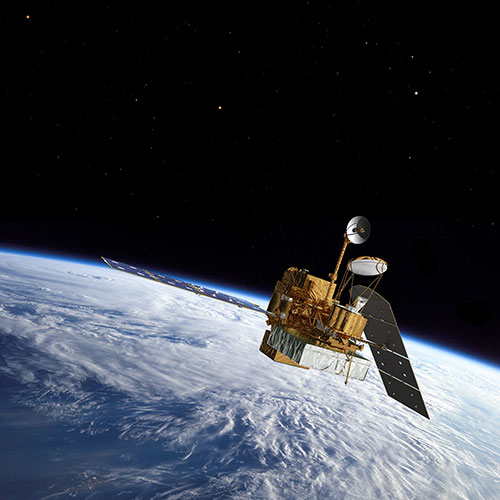
NASA/JAXA's GPM satellite. Image Credits: NASA/JAXA

The South Carolina Department of Transportation noted that hundreds of roads remain closed Monday across the state. On October 5, the National Weather Service (NWS) still carried Flash Flood warnings for portions of Charleston County, Berkeley County and Dorchester County all in southeastern South Carolina. NWS in Charleston, South Carolina said on Oct. 5 at 6:58 a.m. EDT, "low pressure off the northeast South Carolina coast will move slowly offshore through Tuesday [Oct. 6]."

GPM is the Global Precipitation Measurement mission core satellite, managed by both NASA and the Japan Aerospace Exploration Agency.

Related links:

The South Carolina Department of Transportation: http://dbw.scdot.org/RoadConditionsemr/default.aspx

National Weather Service (NWS): http://forecast.weather.gov/showsigwx.php?warnzone=SCZ052&warncounty=SCC015&firewxzone=SCZ052&local_place1=5%20Miles%20WNW%20Mount%20Pleasant%20SC&product1=Flash+Flood+Warning&lat=32.8588&lon=-79.9357#.VhKAKCuTLii

For more information about GPM (Global Precipitation Measurement), visit: http://www.nasa.gov/mission_pages/GPM/main/index.html and http://www.eorc.jaxa.jp/GPM/index_e.htm

Image (mentioned), Video (mentioned), Text, Credits: NASA's Goddard Space Flight Center/Hal Pierce.

Best regards, Orbiter.ch

Titan's Accent Mark


NASA - Cassini Mission to Saturn patch.

Oct. 5, 2015


A coincidence of viewing angle makes Pandora appear to be hovering over Titan, almost like an accent mark.

Little Pandora is much closer to Cassini than hazy Titan in this view. (Titan is nearly three times farther away.) Even so, Titan (3,200 miles or 5,150 kilometers across) dwarfs Pandora (50 miles or 81 kilometers across). This gives us some sense of the diversity in sizes, and shapes, of Saturn's many moons.

North on Titan is up and rotated 19 degrees to the right. The image was taken in visible green light with the Cassini spacecraft narrow-angle camera on July 4, 2015.

The view was acquired at a distance of approximately 1.2 million miles (1.9 million kilometers) from Titan. Image scale is 7 miles (12 kilometers) per pixel on Titan. Pandora is at a distance of 436,000 miles (698,000 kilometers) away from the spacecraft. The scale on Pandora is about 3 miles (4 kilometers) per pixel.

The Cassini mission is a cooperative project of NASA, ESA (the European Space Agency) and the Italian Space Agency. The Jet Propulsion Laboratory, a division of the California Institute of Technology in Pasadena, manages the mission for NASA's Science Mission Directorate, Washington. The Cassini orbiter and its two onboard cameras were designed, developed and assembled at JPL. The imaging operations center is based at the Space Science Institute in Boulder, Colorado.

For more information about the Cassini-Huygens mission visit http://saturn.jpl.nasa.gov or http://www.nasa.gov/cassini . The Cassini imaging team homepage is at http://ciclops.org and http://www.esa.int/Our_Activities/Space_Science/Cassini-Huygens

Image, Text, Credits: NASA/JPL-Caltech/Space Science Institute/Tony Greicius.

Greetings, Orbiter.ch

A Lunar Pox


ESA - SMART-1 Mission patch.

Oct. 5, 2015


The pockmarked landscape captured in this image from ESA’s SMART-1 mission is the surface of our Moon. Some of the many craters scattered across the lunar surface are clearly visible, records of the many impacts that have plagued it.

At the very centre of this image is the lunar north pole, captured in detail during ESA’s mission. The image shows the characteristic craters of the Moon, present in all shapes and sizes. The largest in view is Rozhdestvenskiy, sandwiched between Hermite to the northeast and Plaskett to the southwest.

SMART-1 orbited the moon from 2004 to 2006 collecting around 32 000 images of small areas. In order to create an image covering a large region like this one (60º in width) and showing the peaks and craters in context, hundreds of these individual images had to be pieced together into a mosaic – no easy task.

The biggest challenge in creating this mosaic was the changing lighting conditions. Despite the “dark side of the Moon” misnomer, both sides of the Moon do experience night and day in the same way. The far, or ‘dark’, side has ‘days’ of two weeks just like the nearside and is ‘dark’ only in the sense that it was unknown to humans before the arrival of space probes.

At the Moon’s north pole, pictured here, as is the case across all areas of the Moon, the Sun illuminates from different directions. As the Sun moves across the Moon’s sky, new areas are illuminated and shadows spread and move. This means that many of the images used for the mosaic are lit from different directions. This is why, on close inspection, faint squares can be found in the mosaic where two images of different illumination butt up against one another.

SMART-1

The overall effect however, was worth the labour, and the resulting image gives us a fresh perspective on our natural satellite. Astronomers can use images like these to identify peaks on the north pole that are almost always lit and areas deep inside its largest craters that may never see daylight. These areas of constant shadow are of particular interest because frozen within them could be water ice and clues to the history of the Solar System.

For more information about Smart-1, visit: http://www.esa.int/Our_Activities/Space_Science/SMART-1

Images, Text, Credits: ESA/SPACE-X (Space Exploration Institute). Acknowledgments: J. Manuel Fonseca, M. Costa & A. Mora (UNINOVA); B. Grieger & M. Almeida (ESA).

Greetings, Orbiter.ch