mercredi 21 septembre 2016

ALMA Uncovers Secrets of Giant Space Blob


ALMA - Atacama Large Millimeter/Submillimeter Array logo.

21 September 2016

Computer simulation of a Lyman-alpha Blob

An international team using ALMA, along with ESO’s Very Large Telescope and other telescopes, has discovered the true nature of a rare object in the distant Universe called a Lyman-alpha Blob. Up to now astronomers did not understand what made these huge clouds of gas shine so brightly, but ALMA has now seen two galaxies at the heart of one of these objects and they are undergoing a frenzy of star formation that is lighting up their surroundings. These large galaxies are in turn at the centre of a swarm of smaller ones in what appears to be an early phase in the formation of a massive cluster of galaxies. The two ALMA sources are expected to evolve into a single giant elliptical galaxy.

Lyman-alpha Blobs (LABs) are gigantic clouds of hydrogen gas that can span hundreds of thousands of light-years and are found at very large cosmic distances. The name reflects the characteristic wavelength of ultraviolet light that they emit, known as Lyman-alpha radiation [1]. Since their discovery, the processes that give rise to LABs have been an astronomical puzzle. But new observations with ALMA may now have now cleared up the mystery.

 Infographic explaining how a Lyman-alpha Blob functions

One of the largest Lyman-alpha Blobs known, and the most thoroughly studied, is SSA22-Lyman-alpha blob 1, or LAB-1. Embedded in the core of a huge cluster of galaxies in the early stages of formation, it was the very first such object to be discovered — in 2000 — and is located so far away that its light has taken about 11.5 billion years to reach us.

A team of astronomers, led by Jim Geach, from the Centre for Astrophysics Research of the University of Hertfordshire, UK, has now used the Atacama Large Millimeter/Submillimeter Array’s (ALMA) unparallelled ability to observe light from cool dust clouds in distant galaxies to peer deeply into LAB-1. This allowed them to pinpoint and resolve several sources of submillimetre emission [2].

 Giant space blob glows from within

They then combined the ALMA images with observations from the Multi Unit Spectroscopic Explorer (MUSE) instrument mounted on ESO’s Very Large Telescope (VLT), which map the Lyman-alpha light. This showed that the ALMA sources are located in the very heart of the Lyman-alpha Blob, where they are forming stars at a rate over 100 times that of the Milky Way.

Deep imaging with the NASA/ESA Hubble Space Telescope and spectroscopy at the W. M. Keck Observatory [3] showed in addition that the ALMA sources are surrounded by numerous faint companion galaxies that could be bombarding the central ALMA sources with material, helping to drive their high star formation rates.

 Closing in on a giant space blob

The team then turned to a sophisticated simulation of galaxy formation to demonstrate that the giant glowing cloud of Lyman-alpha emission can be explained if ultraviolet light produced by star formation in the ALMA sources scatters off the surrounding hydrogen gas. This would give rise to the Lyman-alpha Blob we see.

Jim Geach, lead author of the new study, explains: “Think of a streetlight on a foggy night — you see the diffuse glow because light is scattering off the tiny water droplets. A similar thing is happening here, except the streetlight is an intensely star-forming galaxy and the fog is a huge cloud of intergalactic gas. The galaxies are illuminating their surroundings.”

 Wide-field view of the sky around a giant space blob

Understanding how galaxies form and evolve is a massive challenge. Astronomers think Lyman-alpha Blobs are important because they seem to be the places where the most massive galaxies in the Universe form. In particular, the extended Lyman-alpha glow provides information on what is happening in the primordial gas clouds surrounding young galaxies, a region that is very difficult to study, but critical to understand.

Jim Geach concludes, “What’s exciting about these blobs is that we are getting a rare glimpse of what’s happening around these young, growing galaxies. For a long time the origin of the extended Lyman-alpha light has been controversial. But with the combination of new observations and cutting-edge simulations, we think we have solved a 15-year-old mystery: Lyman-alpha Blob-1 is the site of formation of a massive elliptical galaxy that will one day be the heart of a giant cluster. We are seeing a snapshot of the assembly of that galaxy 11.5 billion years ago.”

Zooming in on a giant space blob

Notes:

[1] The negatively charged electrons that orbit the positively charged nucleus in an atom have quantised energy levels. That is, they can only exist in specific energy states, and they can only transition between them by gaining or losing precise amounts of energy. Lyman-alpha radiation is produced when electrons in hydrogen atoms drop from the second-lowest to the lowest energy level. The precise amount of energy lost is released as light with a particular wavelength, in the ultraviolet part of the spectrum, which astronomers can detect with space telescopes or on Earth in the case of redshifted objects. For LAB-1, at redshift of z~3, the Lyman-alpha light is seen as visible light.

[2] Resolution is the ability to see that objects are separated. At low resolution, several bright sources at a distance would seem like a single glowing spot, and only at closer quarters would each source be distinguishable. ALMA’s high resolution has resolved what previously appeared to be a single blob into two separate sources.

[3] The instruments used were the Space Telescope Imaging Spectograph (STIS) on the NASA/ESA Hubble Space Telescope and the Multi-Object Spectrometer For Infra-Red Exploration (MOSFIRE) mounted on the Keck 1 telescope on Hawaii.

More information:

This research was presented in a paper entitled “ALMA observations of Lyman-α Blob 1: Halo sub-structure illuminated from within” by J. Geach et al., to appear in the Astrophysical Journal.

The team is composed of J. E. Geach (Centre for Astrophysics Research, University of Hertfordshire, Hatfield, UK), D. Narayanan (Department of Physics and Astronomy, Haverford College, Haverford PA, USA; Department of Astronomy, University of Florida, Gainesville FL, USA), Y. Matsuda (National Astronomical Observatory of Japan, Mitaka, Tokyo, Japan; The Graduate University for Advanced Studies, Mitaka, Tokyo, Japan), M. Hayes (Stockholm University, Department of Astronomy and Oskar Klein Centre for Cosmoparticle Physics, Stockholm, Sweden), Ll. Mas-Ribas (Institute of Theoretical Astrophysics, University of Oslo, Oslo, Norway), M. Dijkstra (Institute of Theoretical Astrophysics, University of Oslo, Oslo, Norway), C. C. Steidel (California Institute of Technology, Pasadena CA, USA ), S. C. Chapman (Department of Physics and Atmospheric Science, Dalhousie University, Halifax, Canada ), R. Feldmann (Department of Astronomy, University of California, Berkeley CA, USA ), A. Avison (UK ALMA Regional Centre Node; Jodrell Bank Centre for Astrophysics, School of Physics and Astronomy, The University of Manchester, Manchester, UK), O. Agertz (Department of Physics, University of Surrey, Guildford, UK), Y. Ao (National Astronomical Observatory of Japan, Mitaka, Tokyo, Japan), M. Birkinshaw (H.H. Wills Physics Laboratory, University of Bristol, Bristol, UK), M. N. Bremer (H.H. Wills Physics Laboratory, University of Bristol, Bristol, UK), D. L. Clements (Astrophysics Group, Imperial College London, Blackett Laboratory, London, UK), H. Dannerbauer (Instituto de Astrofísica de Canarias, La Laguna, Tenerife, Spain; Universidad de La Laguna, Astrofísica, La Laguna, Tenerife, Spain), D. Farrah (Department of Physics, Virginia Tech, Blacksburg VA, USA), C. M. Harrison (Centre for Extragalactic Astronomy, Department of Physics, Durham University, Durham, UK), M. Kubo (National Astronomical Observatory of Japan, Mitaka, Tokyo, Japan), M. J. Michałowski (Institute for Astronomy, University of Edinburgh, Royal Observatory, Edinburgh, UK), D. Scott (Department of Physics & Astronomy, University of British Columbia, Vancouver, Canada), M. Spaans (Kapteyn Astronomical Institute, University of Groningen, Groningen, Netherlands) , J. Simpson (Institute for Astronomy, University of Edinburgh, Royal Observatory, Edinburgh, UK), A. M. Swinbank (Centre for Extragalactic Astronomy, Department of Physics, Durham University, Durham, UK ), Y. Taniguchi (The Open University of Japan, Chiba, Japan), E. van Kampen (ESO, Garching, Germany), P. Van Der Werf (Leiden Observatory, Leiden University, Leiden, The Netherlands), A. Verma (Oxford Astrophysics, Department of Physics, University of Oxford, Oxford, UK) and T. Yamada (Astronomical Institute, Tohoku University, Miyagi, Japan).

The Atacama Large Millimeter/submillimeter Array (ALMA), an international astronomy facility, is a partnership of ESO, the US National Science Foundation (NSF) and the National Institutes of Natural Sciences (NINS) of Japan in cooperation with the Republic of Chile. ALMA is funded by ESO on behalf of its Member States, by NSF in cooperation with the National Research Council of Canada (NRC) and the National Science Council of Taiwan (NSC) and by NINS in cooperation with the Academia Sinica (AS) in Taiwan and the Korea Astronomy and Space Science Institute (KASI).

ALMA construction and operations are led by ESO on behalf of its Member States; by the National Radio Astronomy Observatory (NRAO), managed by Associated Universities, Inc. (AUI), on behalf of North America; and by the National Astronomical Observatory of Japan (NAOJ) on behalf of East Asia. The Joint ALMA Observatory (JAO) provides the unified leadership and management of the construction, commissioning and operation of ALMA.

ESO is the foremost intergovernmental astronomy organisation in Europe and the world’s most productive ground-based astronomical observatory by far. It is supported by 16 countries: Austria, Belgium, Brazil, the Czech Republic, Denmark, France, Finland, Germany, Italy, the Netherlands, Poland, Portugal, Spain, Sweden, Switzerland and the United Kingdom, along with the host state of Chile. ESO carries out an ambitious programme focused on the design, construction and operation of powerful ground-based observing facilities enabling astronomers to make important scientific discoveries. ESO also plays a leading role in promoting and organising cooperation in astronomical research. ESO operates three unique world-class observing sites in Chile: La Silla, Paranal and Chajnantor. At Paranal, ESO operates the Very Large Telescope, the world’s most advanced visible-light astronomical observatory and two survey telescopes. VISTA works in the infrared and is the world’s largest survey telescope and the VLT Survey Telescope is the largest telescope designed to exclusively survey the skies in visible light. ESO is a major partner in ALMA, the largest astronomical project in existence. And on Cerro Armazones, close to Paranal, ESO is building the 39-metre European Extremely Large Telescope, the E-ELT, which will become “the world’s biggest eye on the sky”.

Links:

Research paper: http://www.eso.org/public/archives/releases/sciencepapers/eso1632/eso1632a.pdf

Photos of ALMA: http://www.eso.org/public/images/archive/category/alma/

Photos of VLT: http://www.eso.org/public/images/archive/category/paranal/

Atacama Large Millimeter/Submillimeter Array’s (ALMA): http://www.eso.org/public/teles-instr/alma/

ESO’s Very Large Telescope (VLT): http://www.eso.org/public/teles-instr/vlt/

Multi Unit Spectroscopic Explorer (MUSE): http://www.eso.org/public/teles-instr/vlt/vlt-instr/muse/

Space Telescope Imaging Spectograph (STIS): http://www.spacetelescope.org/about/general/instruments/stis/

NASA/ESA Hubble Space Telescope: https://www.spacetelescope.org/

Multi-Object Spectrometer For Infra-Red Exploration (MOSFIRE): http://www2.keck.hawaii.edu/inst/mosfire/

Lyman-alpha Blobs (LABs): https://en.wikipedia.org/wiki/Lyman-alpha_blob

Lyman-alpha radiation: https://en.wikipedia.org/wiki/Lyman-alpha_line

Centre for Astrophysics Research of the University of Hertfordshire: http://www.herts.ac.uk/research/centres-and-groups/car

Images, Text, Credits: ESO/J.Geach/D.Narayanan/R.Crain/A. Fujii/M. Hayes and Digitized Sky Survey 2/Video Credits: ESO/A. Fujii/Digitized Sky Survey 2/M. Hayes
Music: John Dyson (from the album Moonwind).

Best regards, Orbiter.ch

mardi 20 septembre 2016

NASA Scientists Find ‘Impossible’ Cloud on Titan – Again


NASA - Cassini International logo.

Sept. 20, 2016

The puzzling appearance of an ice cloud seemingly out of thin air has prompted NASA scientists to suggest that a different process than previously thought -- possibly similar to one seen over Earth's poles -- could be forming clouds on Saturn's moon Titan.

Located in Titan's stratosphere, the cloud is made of a compound of carbon and nitrogen known as dicyanoacetylene (C4N2), an ingredient in the chemical cocktail that colors the giant moon's hazy, brownish-orange atmosphere.

Decades ago, the infrared instrument on NASA's Voyager 1 spacecraft spotted an ice cloud just like this one on Titan. What has puzzled scientists ever since is this: they detected less than 1 percent of the dicyanoacetylene gas needed for the cloud to condense.

Recent observations from NASA's Cassini mission yielded a similar result. Using Cassini's composite infrared spectrometer -- or CIRS, which can identify the spectral fingerprints of individual chemicals in the atmospheric brew -- researchers found a large high-altitude cloud made of the same frozen chemical. Yet, just as Voyager found, when it comes to the vapor form of this chemical, CIRS reported that Titan's stratosphere is as dry as a desert.


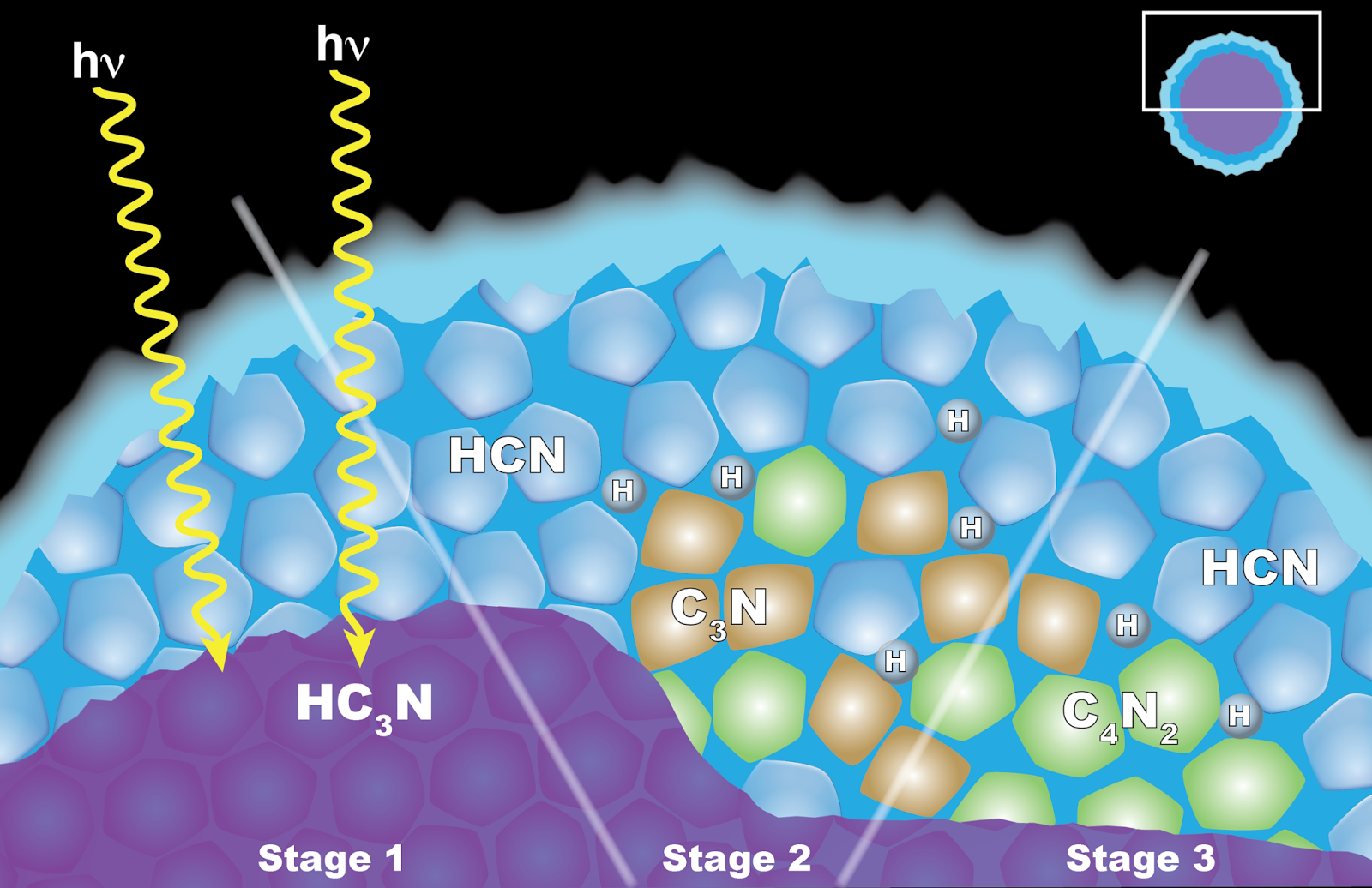
Image above: Scientists from NASA’s Cassini mission think the appearance of a cloud of dicyanoacetylene (C4N2) ice in Titan’s stratosphere is explained by “solid-state” chemistry taking place inside ice particles. The particles have an inner layer of cyanoacetylene (HC3N) ice coated with an outer layer of hydrogen cyanide (HCN) ice. (Left) When a photon of light penetrates the outer shell, it can interact with the HC3N, producing C3N and H. (Center) The C3N then reacts with HCN to yield (right) C4N2 and H. Another reaction that also yields C4N2 ice and H also is possible, but less likely. Image Credits: NASA's Goddard Space Flight Center.

"The appearance of this ice cloud goes against everything we know about the way clouds form on Titan," said Carrie Anderson, a CIRS co-investigator at NASA's Goddard Space Flight Center in Greenbelt, Maryland, and lead author of the study.

The typical process for forming clouds involves condensation. On Earth, we're familiar with the cycle of evaporation and condensation of water. The same kind of cycle takes place in Titan's troposphere -- the weather-forming layer of Titan's atmosphere -- but with methane instead of water.

A different condensation process takes place in the stratosphere -- the region above the troposphere -- at Titan's north and south winter poles. In this case, layers of clouds condense as the global circulation pattern forces warm gases downward at the pole. The gases then condense as they sink through cooler and cooler layers of the polar stratosphere.

Either way, a cloud forms when the air temperature and pressure are favorable for the vapor to condense into ice. The vapor and the ice reach a balance point -- an equilibrium -- that is determined by the air temperature and pressure. Because of this equilibrium, scientists can calculate the amount of vapor where ice is present.

"For clouds that condense, this equilibrium is mandatory, like the law of gravity," said Robert Samuelson, an emeritus scientist at Goddard and a co-author of the paper.

But the numbers don't compute for the cloud made from dicyanoacetylene. The scientists determined that they would need at least 100 times more vapor to form an ice cloud where the cloud top was observed by Cassini's CIRS.

One explanation suggested early on was that the vapor might be present, but Voyager's instrument wasn't sensitive enough in the critical wavelength range needed to detect it. But when CIRS also didn't find the vapor, Anderson and her Goddard and Caltech colleagues proposed an altogether different explanation. Instead of the cloud forming by condensation, they think the C4N2 ice forms because of reactions taking place on other kinds of ice particles. The researchers call this "solid-state chemistry," because the reactions involve the ice, or solid, form of the chemical.

The first step in the proposed process is the formation of ice particles made from the related chemical cyanoacetylene (HC3N). As these tiny bits of ice move downward through Titan's stratosphere, they get coated by hydrogen cyanide (HCN). At this stage, the ice particle has a core and a shell comprised of two different chemicals. Occasionally, a photon of ultraviolet light tunnels into the frozen shell and triggers a series of chemical reactions in the ice. These reactions could begin either in the core or within the shell. Both pathways can yield dicyanoacteylene ice and hydrogen as products.

Titan orbiting Saturn. Image Credits: NASA/JPL-Caltech/Space Science Institute

The researchers got the idea of solid-state chemistry from the formation of clouds involved in ozone depletion high above Earth's poles. Although Earth's stratosphere has scant moisture, wispy nacreous clouds (also called polar stratospheric clouds) can form under the right conditions. In these clouds, chlorine-bearing chemicals that have entered the atmosphere as pollution stick to crystals of water ice, resulting in chemical reactions that release ozone-destroying chlorine molecules.

"It's very exciting to think that we may have found examples of similar solid-state chemical processes on both Titan and Earth," said Anderson.

The researchers suggest that, on Titan, the reactions occur inside the ice particles, sequestered from the atmosphere. In that case, dicyanoacetylene ice wouldn't make direct contact with the atmosphere, which would explain why the ice and the vapor forms are not in the expected equilibrium.

"The compositions of the polar stratospheres of Titan and Earth could not differ more," said Michael Flasar, CIRS principal investigator at Goddard. "It is amazing to see how well the underlying physics of both atmospheres has led to analogous cloud chemistry."

The findings are published in the journal Geophysical Research Letters.

The Cassini-Huygens mission is a cooperative project of NASA, ESA (European Space Agency) and the Italian Space Agency. NASA's Jet Propulsion Laboratory, a division of Caltech in Pasadena, manages the mission for NASA's Science Mission Directorate, Washington. JPL designed, developed and assembled the Cassini orbiter. The CIRS instrument was built by Goddard.

For more information about Cassini, visit:

http://www.nasa.gov/cassini

http://saturn.jpl.nasa.gov

http://www.esa.int/Our_Activities/Space_Science/Cassini-Huygens

Images (mentioned), Text, Credits: NASA/Goddard Space Flight Center, written by Elizabeth Zubritsky/JPL/Preston Dyches/Karl Hille.

Greetings, Orbiter.ch

lundi 19 septembre 2016

Opinion: Can ‘useless’ knowledge be useful?


CERN - European Organization for Nuclear Research logo.

September 19, 2016


Image above: A tomography machine developed at CERN. Machines like this are used in PET (positron emission tomography) scanners for medical imaging. Technology to improve these techniques is being investigated at CERN. (Image: Maximilien Brice/ Samuel Morier-Genoud/CERN).

As far back as 1939, Abraham Flexner penned a stirring paean to basic research in Harpers magazine under the title: ‘The Usefulness of Useless Knowledge’. Flexner, perhaps being intentionally provocative, pointed out that Marconi’s contribution to the radio and wireless had been practically negligible. He went on to argue that the 1865 work of James Clerk Maxwell on the theoretical underpinnings of electricity and magnetism, and the subsequent experimental work of Heinrich Hertz on the detection of electromagnetic waves, was done with no concern about the practical utility of the work.

Maxwell and Hertz cared only about the adding to our shared pool of knowledge on the workings of the natural world. The knowledge they sought, in other words, was never targeted to a specific application. Without it, however, there could have been no Marconi, no wireless, no radio, no television and no mobile phones.

Nurturing scientific minds is child’s play

The history of innovation is full of such examples. Indeed, it is practically impossible to find a piece of technology that cannot be traced back to the work of scientists motivated purely by a desire to understand the world we inhabit.

But basic research goes further. There is something primordial about it. Every child is a natural scientist, imbued with curiosity, vivid imagination and a desire to learn. It is what sets us apart from any other species, and it is what has provided the wellspring of innovation since early humans harnessed fire and invented wheels. Children are always asking questions. Why is the sky blue? What are we made of? What are those specks of twinkling light in the night sky? It’s by investigating questions like these that science has advanced, and that we can inspire children to grow up into future scientists or scientifically aware citizens.


Image above: “Nurturing curious minds is one of CERN’s goals, and education and training are among our core missions,” says Fabiola Gianotti, CERN’s Director General. Here students build their own cloud chambers at S’Cool LAB, a new hands-on particle physics learning laboratory at CERN, which enables high-school children to conduct experiments and participate in workshops. (Image: Jeff Wiener/CERN).

Nurturing curious minds is one of CERN’s goals, and education and training are among our core missions. Over the years we have developed programmes that reach everyone from primary school children to professional physicists, accelerator scientists and computer scientists. We also keep tabs on the whereabouts of young people passing through CERN, and it is very enriching to follow their progress. About a thousand people a year receive higher degrees from universities around the world for work carried out at CERN.

Basic research therefore not only inspires young people to study science, it also provides a steady stream of qualified people for business and industry, where their high-tech, international experience allows them to make a positive impact around the world.

Global Goals

Turning to the UN’s admirably ambitious Global Goals, the focus on science and technology in Agenda 2030 is positive and encouraging. It testifies to a deeper understanding of the importance of science in driving progress that benefits all peoples and helps to overcome today’s most pressing development challenges.


Image above: CERN has a long history of knowledge transfer where technologies and ideas founded in the lab and basic research are translated into real-world businesses and products that benefit society. Here a new scanning electron microscope (SEM) developed in CERN engineering department's allows detailed optical observations to be carried out through Cryogenic Tensile Testing. This means the tensile properties of materials can be investigated to better understand how they behave under different conditions. (Image: Maximilien Brice/ Samuel Morier-Genoud/CERN).

But Agenda 2030’s potential  can only be fulfilled through sustained commitment and funding by governments. If we are to tackle issues from eliminating poverty and hunger to providing clean and affordable energy, we need science and we need scientifically aware citizens.

Places like CERN are a vitally important ingredient in the innovation chain. We contribute to the kind of knowledge that not only enriches humanity, but also provides the wellspring of ideas that become the technologies of the future. We develop technologies ourselves that have immediate applications for the benefit of society: technologies like the World Wide Web and the application of particle accelerators, one of CERN’s core areas of expertise, to fields as diverse as food sterilisation and cancer therapy. And we train the young people.

All this is possible because governments support STEM education and basic research. But we should do more: we should aim to ring-fence a minimum investment in STEM education and basic research in GDP terms for every country in the world. That is the way to long-term development and sustainability.


Image above: At the "Internet, Web, What's next?" conference on 26 June 1998 at CERN: Tim Berners-Lee, inventor of the World Wide Web and Director of the W3C, explains how the Web came to be and gave his views on the future. The WWW is one of the many inventions that came out of ideas born at CERN that have had huge implications and benefits for society. (Image: CERN).

The scientific community, including CERN, urged Agenda 2030 to ask that there be a minimum GDP percentage devoted by every nation to STEM education (Science, Technology, Engineering and Math education) and basic research. This is particularly important in times of economic downturn, when private funding naturally concentrates on short-term payback and governments focus on domains that offer immediate economic return, at the expense of longer-term investment in fundamental science.

Useless knowledge, as Flexner called it, is at the basis of human development. Humankind’s continuing pursuit of it will make the development goals achievable.

A longer version of this article was originally written and will be published as part of the Big Bet Initiative: http://www.bigbetinitiative.com/

Note:

CERN, the European Organization for Nuclear Research, is one of the world’s largest and most respected centres for scientific research. Its business is fundamental physics, finding out what the Universe is made of and how it works. At CERN, the world’s largest and most complex scientific instruments are used to study the basic constituents of matter — the fundamental particles. By studying what happens when these particles collide, physicists learn about the laws of Nature.

The instruments used at CERN are particle accelerators and detectors. Accelerators boost beams of particles to high energies before they are made to collide with each other or with stationary targets. Detectors observe and record the results of these collisions.

Founded in 1954, the CERN Laboratory sits astride the Franco–Swiss border near Geneva. It was one of Europe’s first joint ventures and now has 22 Member States.

For more information about European Organization for Nuclear Research (CERN), Visit: http://home.cern/

Images (mentioned), Text, Credits: CERN/Fabiola Gianotti.

Greetings, Orbiter.ch

Orbiting Trio Studies Circulatory System and Body Shape & Next Station Crew Launch Postponed


ISS - Expedition 49 Mission patch.

September 19, 2016


Image above: Portions of the International Space Station’s solar arrays and Japan’s Kibo lab module are seen as it orbits Sept. 13, 2016, over the mid-Atlantic Ocean. Image Credit: Gateway to Astronaut Photography of Earth.

Roscosmos decided to postpone the planned September 23, 2016 launch of the spacecraft “Soyuz MS – 02 ” for technical reasons after routine tests at the Baikonur Cosmodrome.

Please visit the Roscosmos website for the latest information: http://en.roscosmos.ru/20645/

The three Expedition 49 crew members orbiting Earth right now are moving ahead today with human research and the upkeep of the International Space Station. In the meantime, Roscosmos officials have decided to postpone the Sept. 23 launch of NASA astronaut Shane Kimbrough and Roscosmos cosmonauts Sergey Ryzhikov and Andrey Borisenko aboard the Soyuz MS-02 spacecraft.

Expedition 49 Commander Anatoly Ivanishin worked throughout the station’s Russian segment Monday working on life support systems, checking computers and testing video gear. He also set up an electrocardiogram to begin recording data for 24 hours for the Cosmocard blood circulation study.


Image above: Expedition 49-50 crew members (from left) Shane Kimbrough, Sergey Ryzhikov and Andrey Borisenko. Image Credit: ROSCOSMOS.

Astronauts Kate Rubins and Takuya Onishi partnered up for the Body Measures experiment exploring how living in space changes body shape and size. The study involves video-taping, photographing and tape measuring the circumference of a crew member’s arms, legs and chest and comparing it with data recorded before, during and after a space mission.

The pair also performed a series of interactive tasks on a touchscreen tablet for the Fine Motor Skills study. That experiment explores how astronauts interact with new technologies which may help engineers design new spacesuits and spacecraft for future long-term space missions.

Related links:

Cosmocard blood circulation study: http://www.energia.ru/en/iss/researches/human/12.html

Body Measures experiment: http://www.nasa.gov/mission_pages/station/research/experiments/1070.html

Fine Motor Skills study: http://www.nasa.gov/mission_pages/station/research/experiments/1767.html

International Space Station (ISS): https://www.nasa.gov/mission_pages/station/main/index.html

Space Station Research and Technology: https://www.nasa.gov/mission_pages/station/research/index.html

Images (mentioned), Text, Credits: NASA/Mark Garcia.

Greetings, Orbiter.ch

Where the Small Moon Rules


NASA - Cassini Mission to Saturn patch.

Sept. 19, 2016


Pan may be small as satellites go, but like many of Saturn's ring moons, it has a has a very visible effect on the rings.

Pan (17 miles or 28 kilometers across, left of center) holds open the Encke gap and shapes the ever-changing ringlets within the gap (some of which can be seen here). In addition to raising waves in the A and B rings, other moons help shape the F ring, the outer edge of the A ring and open the Keeler gap.

This view looks toward the sunlit side of the rings from about 8 degrees above the ring plane. The image was taken in visible light with the Cassini spacecraft narrow-angle camera on July 2, 2016.

The view was acquired at a distance of approximately 840,000 miles (1.4 million kilometers) from Saturn and at a sun-Saturn-spacecraft, or phase, angle of 128 degrees. Image scale is 5 miles (8 kilometers) per pixel. Pan has been brightened by a factor of two to enhance its visibility.

The Cassini mission is a cooperative project of NASA, ESA (the European Space Agency) and the Italian Space Agency. The Jet Propulsion Laboratory, a division of the California Institute of Technology in Pasadena, manages the mission for NASA's Science Mission Directorate, Washington. The Cassini orbiter and its two onboard cameras were designed, developed and assembled at JPL. The imaging operations center is based at the Space Science Institute in Boulder, Colorado.

For more information about the Cassini-Huygens mission visit http://saturn.jpl.nasa.gov and http://www.nasa.gov/cassini. The Cassini imaging team homepage is at http://ciclops.org and ESA's website http://www.esa.int/Our_Activities/Space_Science/Cassini-Huygens

Image, Text, Credits: NASA/JPL-Caltech/Space Science Institute/Tony Greicius.

Greetings, Orbiter.ch

vendredi 16 septembre 2016

Hubble Finds a Lenticular Galaxy Standing Out in the Crowd


NASA - Hubble Space Telescope patch.

Sept. 16, 2016


A lone source shines out brightly from the dark expanse of deep space, glowing softly against a picturesque backdrop of distant stars and colorful galaxies.

Captured by the NASA/ESA Hubble Space Telescope’s Advanced Camera for Surveys (ACS), this scene shows PGC 83677, a lenticular galaxy — a galaxy type that sits between the more familiar elliptical and spiral varieties.

It reveals both the relatively calm outskirts and intriguing core of PGC 83677. Here, studies have uncovered signs of a monstrous black hole that is spewing out high-energy X-rays and ultraviolet light.

Hubble and the sunrise over Earth

For more information about the Hubble Space Telescope, visit:

http://hubblesite.org/
http://www.nasa.gov/hubble
https://www.spacetelescope.org/

Image, Video, Credits: NASA/ESA/Hubble; acknowledgements: Judy Schmidt (Geckzilla)/Text credit: ESA (European Space Agency)/NASA/Rob Garner.

Best regards, Orbiter.ch

Vega Releases Five Satellites in Complex Mission

Arianespace - Flight VV07 Mission poster.

16 September 2016

Vega lifts off

Arianespace launched a Vega rocket on a complex mission early this morning that demonstrated the flexibility of its upper stage and multisatellite carrier.

In its first six flights, Vega delivered a wide range of satellites into very different orbits, demonstrating its flexibility.

Liftoff of the Vega mission with SkySats-4 to -7 and PerúSAT-1

Liftoff of the seventh mission from Europe’s Spaceport in Kourou, French Guiana came at 01:43 GMT on 16 September (03:43 CEST; 22:43 local time on 15 September).

Four SkySat microsatellites for Terra Bella, with a total mass at liftoff of 440 kg, were released into their target orbit about 40 minutes into the mission.

PerúSAT-1

This was followed about 62 minutes later by the release of the 430 kg PeruSAT-1, Peru’s first Earth observation satellite.

SkySats-4 to -7

Vega is a 30 m-high, four-stage vehicle designed to accommodate small scientific and Earth observation payloads of 300–2500 kg depending on the orbit and altitude.

Related link:

ESA's Vega rocket: http://www.esa.int/Our_Activities/Launchers/Launch_vehicles/Vega

Images, Video, Text, Credits: European Space Agency (ESA)/Arianespace.

Best regards, Orbiter.ch