jeudi 29 décembre 2016

NASA's NEOWISE Mission Spies One Comet, Maybe Two


NASA - NEOWISE Mission logo.

Dec. 29, 2016

NASA's NEOWISE mission has recently discovered some celestial objects traveling through our neighborhood, including one on the blurry line between asteroid and comet. Another--definitely a comet--might be seen with binoculars through next week.

An object called 2016 WF9 was detected by the NEOWISE project on Nov. 27, 2016. It's in an orbit that takes it on a scenic tour of our solar system. At its farthest distance from the sun, it approaches Jupiter's orbit. Over the course of 4.9 Earth-years, it travels inward, passing under the main asteroid belt and the orbit of Mars until it swings just inside Earth's own orbit. After that, it heads back toward the outer solar system. Objects in these types of orbits have multiple possible origins; it might once have been a comet, or it could have strayed from a population of dark objects in the main asteroid belt.


Image above: An artist’s rendition of 2016 WF9 as it passes Jupiter’s orbit inbound toward the sun. Image Credits: NASA/JPL-Caltech.

2016 WF9 will approach Earth's orbit on Feb. 25, 2017. At a distance of nearly 32 million miles (51 million kilometers) from Earth, this pass will not bring it particularly close. The trajectory of 2016 WF9 is well understood, and the object is not a threat to Earth for the foreseeable future.

A different object, discovered by NEOWISE a month earlier, is more clearly a comet, releasing dust as it nears the sun. This comet, C/2016 U1 NEOWISE, “has a good chance of becoming visible through a good pair of binoculars, although we can't be sure because a comet's brightness is notoriously unpredictable," said Paul Chodas, manager of NASA's Center for Near-Earth Object (NEO) Studies at the Jet Propulsion Laboratory in Pasadena, California.

As seen from the northern hemisphere during the first week of 2017, comet C/2016 U1 NEOWISE will be in the southeastern sky shortly before dawn. It is moving farther south each day and it will reach its closest point to the sun, inside the orbit of Mercury, on Jan. 14, before heading back out to the outer reaches of the solar system for an orbit lasting thousands of years. While it will be visible to skywatchers at Earth, it is not considered a threat to our planet either.

NEOWISE is the asteroid-and-comet-hunting portion of the Wide-Field Infrared Survey Explorer (WISE) mission. After discovering more than 34,000 asteroids during its original mission, NEOWISE was brought out of hibernation in December of 2013 to find and learn more about asteroids and comets that could pose an impact hazard to Earth. If 2016 WF9 turns out to be a comet, it would be the 10th discovered since reactivation. If it turns out to be an asteroid, it would be the 100th discovered since reactivation.

What NEOWISE scientists do know is that 2016 WF9 is relatively large: roughly 0.3 to 0.6 mile (0.5 to 1 kilometer) across.

It is also rather dark, reflecting only a few percent of the light that falls on its surface. This body resembles a comet in its reflectivity and orbit, but appears to lack the characteristic dust and gas cloud that defines a comet.

NASA's NEOWISE spacecraft. Image Credit: NASA

"2016 WF9 could have cometary origins," said Deputy Principal Investigator James "Gerbs" Bauer at JPL. "This object illustrates that the boundary between asteroids and comets is a blurry one; perhaps over time this object has lost the majority of the volatiles that linger on or just under its surface."

Near-Earth objects (NEOs) absorb most of the light that falls on them and re-emit that energy at infrared wavelengths. This enables NEOWISE's infrared detectors to study both dark and light-colored NEOs with nearly equal clarity and sensitivity.

"These are quite dark objects," said NEOWISE team member Joseph Masiero, "Think of new asphalt on streets; these objects would look like charcoal, or in some cases are even darker than that."

NEOWISE data have been used to measure the size of each near-Earth object it observes. Thirty-one asteroids that NEOWISE has discovered pass within about 20 lunar distances from Earth's orbit, and 19 are more than 460 feet (140 meters) in size but reflect less than 10 percent of the sunlight that falls on them.

The Wide-field Infrared Survey Explorer (WISE) has completed its seventh year in space after being launched on Dec. 14, 2009.

Data from the NEOWISE mission are available on a website for the public and scientific community to use. A guide to the NEOWISE data release, data access instructions and supporting documentation are available at: http://wise2.ipac.caltech.edu/docs/release/neowise/

Access to the NEOWISE data products is available via the on-line and API services of the NASA/IPAC Infrared Science Archive.

A list of peer-reviewed papers using the NEOWISE data is available at:

http://neowise.ipac.caltech.edu/publications.html

Images (mentioned), Text, Credits: NASA/Laurie Cantillo/Dwayne Brown/ony Greicius/JPL/DC Agle.

Greetings, Orbiter.ch

NASA Administrator Remembers NASA Scientist, Astronaut Piers Sellers


NASA logo.

Dec. 29, 2016

On Dec. 23, 2016, a statement from NASA Administrator Charles Bolden on Piers Sellers, who passed away Friday 23 December in Houston of pancreatic cancer:

“The entire NASA family mourns the passing of scientist and astronaut Piers Sellers.

“Piers was dedicated to all facets of exploration. His curiosity and drive to uncover new knowledge was generously shared with audiences around the world, both from space and in wide travels to reach as many people as possible with an essential understanding of our fragile planet.


Image above: Piers Sellers most recently served as the deputy director of the Sciences and Exploration Directorate and acting director of the Earth Sciences Division at NASA’s Goddard Space Flight Center in Greenbelt, Maryland. Image Credits: NASA/Rebecca Roth.

“Piers devoted his life to saving the planet. As a climate scientist, his work in computer modeling of the climate system, satellite remote sensing studies and field work using aircraft, satellites and ground teams broke new ground in our understanding of Earth’s systems. His legacy will be one not only of urgency that the climate is warming but also of hope that we can yet improve humanity’s stewardship of this planet. His cancer diagnosis became a catalyst for him to work even harder on efforts to save the planet from global warming for the benefit of future generations.

“Piers was an eternal optimist whose positive energy inspired all those who had the good fortune to know him. His laughter, humor, and lighthearted spirit are as much a part of his legacy as his work.

“In his three journeys to orbit as a NASA astronaut, he demonstrated robotics, performed research and helped build the International Space Station. These journeys and his ongoing dedication to scientific inquiry inspired a new generation to take up his challenge to become better caretakers of Earth and extend humanity’s reach in space. It was my great honor to present Piers with the Distinguished Service Medal in June 2016 in recognition of his service to our agency and the world.


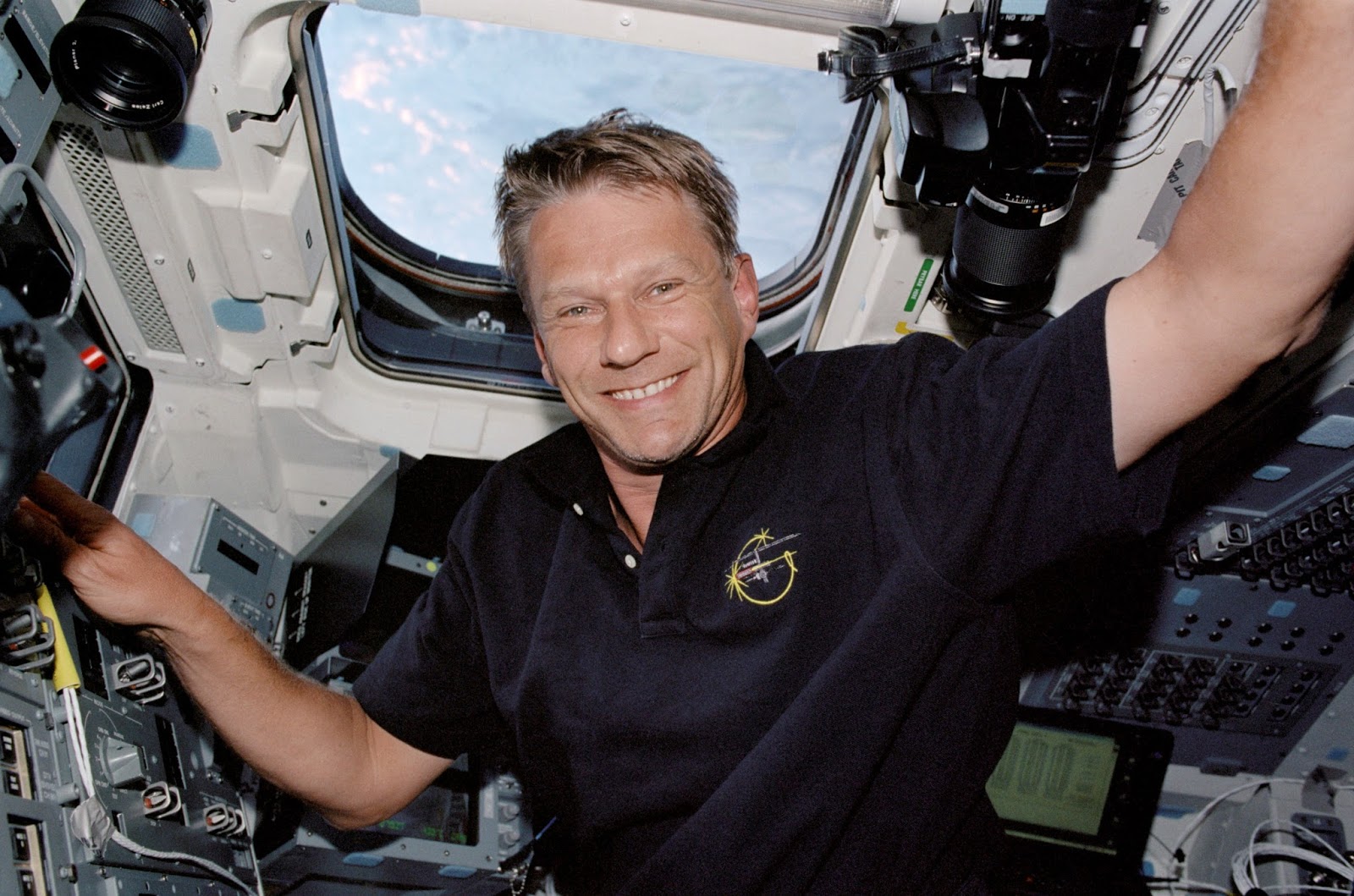
Image above: Piers Sellers joined the NASA astronaut corps in 1996 and flew to the International Space Station in 2002, 2006 and 2010, performing six spacewalks and various space station assembly tasks. As STS-112 mission specialist, Sellers is pictured above on the aft flight deck of the Space Shuttle Atlantis in 2002. Image Credit: NASA.

“In a New York Times opinion piece in 2016, he said, ‘As an astronaut, I spacewalked 220 miles above the Earth. Floating alongside the International Space Station, I watched hurricanes cartwheel across oceans, the Amazon snake its way to the sea through a brilliant green carpet of forest, and gigantic nighttime thunderstorms flash and flare for hundreds of miles along the Equator. From this God’s-eye-view, I saw how fragile and infinitely precious the Earth is. I’m hopeful for its future.’

“Today we lost a tremendous public servant who was dedicated to NASA, the nation and the world. He was a strident defender and eloquent spokesperson for our home planet, Earth. Spacewalker and scientist, free thinker and friend to our planet, and all who seek new knowledge, to say he will be missed would be a gross understatement."

For more information about Piers Sellers’ NASA career, visit:

http://science.gsfc.nasa.gov/sed/bio/piers.j.sellers and http://www.jsc.nasa.gov/Bios/htmlbios/sellers.html

Images (mentioned), Text, Credits: NASA/Bob Jacobs/Karen Northon.

Condolences. Orbiter.ch

mercredi 28 décembre 2016

NASA Preps for Space Station Power Upgrade Spacewalks; Live NASA TV Coverage


ISS - Expedition 50 Mission patch.

Dec. 28, 2016


Image above: Expedition 50 crew members Thomas Pesquet of ESA (European Space Agency) and Peggy Whitson and Shane Kimbrough of NASA capture a quick selfie during robotics training inside the Cupola of the International Space Station. Image Credit: NASA.

Expedition 50 astronauts will venture outside the International Space Station at 7 a.m. EST Jan. 6 and 13 to perform a complex upgrade to the orbital outpost’s power system. Coverage of the spacewalks will begin at 5:30 a.m. on NASA Television and the agency’s website.

On Wednesday, Jan. 4, NASA TV will air a briefing at 2 p.m. from the agency’s Johnson Space Center in Houston to preview the spacewalk activities. The briefing participants are:

-    Kenneth Todd, International Space Station Operations Integration Manager
-    Jud Frieling, flight director for Jan. 6 spacewalk
-    Gary Horlacher, flight director for Jan. 13 spacewalk
-    Troy McCracken, lead battery replacement robotics officer
-    Kieth Johnson, lead spacewalk officer

Working on the right side truss of the space station, the crew members will install adapter plates and hook up electrical connections for six new lithium-ion batteries that were delivered to the station in December.

Expedition 50 Commander Shane Kimbrough and Flight Engineer Peggy Whitson of NASA will perform the first spacewalk Jan. 6. The work will continue Jan. 13 during the second spacewalk, which will be conducted by Kimbrough and Flight Engineer Thomas Pesquet of ESA (European Space Agency).

ESA's Astronaut Tim Peake spacewalk selfie. Image Credits: NASA/ESA/Tim Peake

Prior to each spacewalk, the new batteries will be robotically extracted from a pallet to replace 12 older nickel-hydrogen batteries through a series of robotic operations. Nine of the older batteries will be stowed in a cargo resupply craft for later disposal, while three will remain on the station’s truss, disconnected from the power grid. The robotic operations will not air on NASA TV.

This will be the 196th and 197th spacewalks in support of space station assembly and maintenance. Kimbrough will be designated extravehicular crew member 1 (EV 1), wearing the suit bearing red stripes for both spacewalks, the third and fourth of his career.

Whitson will be making the seventh spacewalk of her career and match the record of NASA’s Suni Williams, for most spacewalks by a woman. She will be designated extravehicular crew member 2 (EV 2), wearing the suit with no stripes for the first spacewalk.

Pesquet, who will be making the first spacewalk of his career, will be extravehicular crew member 2 for the second spacewalk, also wearing a suit with no stripes.

Get NASA TV streaming video, schedule and downlink information at: http://www.nasa.gov/nasatv

For the latest on the International Space Station, its crew and their research, visit: http://www.nasa.gov/station

Images (mentioned), Text, Credits: NASA/Tabatha Thompson/Karen Northon/JSC/Dan Huot.

Best regards, Orbiter.ch

Basking in Light


NASA - Cassini International logo.

Dec. 28, 2016


Sunlight truly has come to Saturn's north pole. The whole northern region is bathed in sunlight in this view from late 2016, feeble though the light may be at Saturn's distant domain in the solar system.

The hexagon-shaped jet-stream is fully illuminated here. In this image, the planet appears darker in regions where the cloud deck is lower, such the region interior to the hexagon.  Mission experts on Saturn's atmosphere are taking advantage of the season and Cassini’s favorable viewing geometry to study this and other weather patterns as Saturn's northern hemisphere approaches Summer solstice.

This view looks toward the sunlit side of the rings from about 51 degrees above the ring plane. The image was taken with the Cassini spacecraft wide-angle camera on Sept. 9, 2016 using a spectral filter which preferentially admits wavelengths of near-infrared light centered at 728 nanometers.

The view was obtained at a distance of approximately 750,000 miles (1.2 million kilometers) from Saturn. Image scale is 46 miles (74 kilometers) per pixel.

The Cassini mission is a cooperative project of NASA, ESA (the European Space Agency) and the Italian Space Agency. The Jet Propulsion Laboratory, a division of the California Institute of Technology in Pasadena, manages the mission for NASA's Science Mission Directorate, Washington. The Cassini orbiter and its two onboard cameras were designed, developed and assembled at JPL. The imaging operations center is based at the Space Science Institute in Boulder, Colorado.

For more information about the Cassini-Huygens mission, visit http://saturn.jpl.nasa.gov and http://www.nasa.gov/cassini. The Cassini imaging team homepage is at http://ciclops.org and ESA's website http://www.esa.int/Our_Activities/Space_Science/Cassini-Huygens

Image, Text, Credits: NASA/JPL-Caltech/Space Science Institute/Sarah Loff.

Best regards, Orbiter.ch

S3 - Jaussi appeals to the Cantonal Court


S3 - Swiss Space Systems patch.

Dec. 28, 2016

The founder of the aerospace company based in Payerne (Switzerland) is trying everything to escape the bankruptcy.

The head of Swiss Space Systems Holdings (S3) Pascal Jaussi is appealing the decision to revoke the bankruptcy postponement pronounced by the Vaudois justice against his company. He filed an appeal with the Cantonal Court, said Wednesday the judicial order.

Pascal Jaussi, CEO & Founder of Swiss Space Systems or S3

On December 14, the District Court of the Broye and Northern Waldensian region made its decision, signing the bankruptcy of the aerospace company. Pascal Jaussi had announced that he would appeal the decision. The adjournment protected the company until March 2017. The company is the subject of numerous lawsuits exceeding 7 million francs.

Accounts not produced

After several extensions of the adjournments since February 2016, and following a hearing on December 6, the court finally declared bankruptcy two weeks ago, in view of the opinion of S3 over-indebtedness.

In this decision that the ats was able to consult on Wednesday, the civil court noted that no revised account had been produced, preventing any calculation of the exact amount of the over-indebtedness. He also notes that the transfer of $ 30 million in capital between daughter company S3 Solutions and S3 announced by Pascal Jaussi to recapitalize his company has not been finalized.

The court struggled to understand why, while the start-up had asserted that the only obstacle to this transfer was the FINMA investigation. The financial gendarme announced on 12 September to the Fribourg Public Prosecutor's Office that they had closed investigations against S3 for lack of concrete evidence of violations of financial market laws.

Aggression

The Court also found that the aggression suffered by Pascal Jaussi did not prevent the production of accounts. At the end of August, the boss of S3 claimed to have been very violently assaulted in the woods of Aumont (FR).

Following this decision, Pascal Jaussi told La Liberté that the documents requested had not been provided at the hearing because the closed session had been refused and he considered that he was entitled to business secrecy. The case is now in the hands of the Cantonal Court.

Swiss Space Systems concept launch of mini-space shuttle made by Dassault Aviation

For weeks, the company of Pascal Jaussi, which the ats failed to reach Wednesday, is at the center of the attention because of its financial difficulties. S3 wants to launch mini-satellites from a shuttle from an airplane. The company also announced plans to organize weightless flights.

Related article:

The bankruptcy of S3 is pronounced
http://orbiterchspacenews.blogspot.ch/2016/12/the-bankruptcy-of-s3-is-pronounced.html

For more information about Swiss Space Systems (S3), visit: http://www.s-3.ch/

Images, Text, Credits: Swiss Space Systems (S3)/ATS/Orbiter.ch Aerospace/Roland Berga.

Best regards, Orbiter.ch

China Long March 2D Launches SuperView 1 & 2


CASC - China Aerospace Science and Technology Corporation logo.

Dec. 28, 2016


The 1,234-pound-pound (560-kilogram) satellites lifted off at 0323 GMT Wednesday (10:23 p.m. EST Tuesday) from the Taiyuan space center in northern China’s Shanxi province on top of a 13-story Long March 2D rocket, according to China’s state-run Xinhua news agency.

The launch occurred at 11:23 a.m. Beijing time, marking China’s 22nd attempted space launch of the year, and the 21st rocket mission to reach orbit.

China Launches High-resolution Remote Sensing Satellites

Two commercial Earth-imaging satellites launched by a Chinese Long March 2D booster Wednesday are flying in lower-than-planned orbits after an apparent rocket mishap, according to tracking data published by the U.S. military.

The two SuperView 1, or Gaojing 1, satellites are flying in egg-shaped orbits ranging from 133 miles (214 kilometers) to 325 miles (524 kilometers) in altitude at an inclination of 97.6 degrees.


Artist’s concept of Beijing Space View’s planned constellation of optical and radar imaging satellites. The spacecraft illustrated at upper left is one of the SuperView 1 satellites launched Wednesday.

The high-resolution Earth-observing platforms were supposed to go into a near-circular orbit around 300 miles (500 kilometers) above the planet to begin their eight-year missions collecting imagery for Siwei Star Co. Ltd., a subsidiary of China Aerospace Science and Technology Corp., a government-owned entity.

The SuperView 1 satellites are designed to collect optical black-and-white imagery with a resolution of less than 20 inches (about 50 centimeters), making them the highest-resolution civilian Earth-observing satellites launched by China.

SuperView 1 & 2

The satellites can capture imagery in nearly 7.5-mile-wide (12-kilometer) swaths, turning to observe multiple locations on a single pass, or record images of the same point from multiple angles, allowing processors on the ground to generate stereo three-dimensional images.

For more information about China Aerospace Science and Technology Corporation (CASC) and China National Space Administration (CNSA), visit:

http://english.spacechina.com/n16421/index.html

http://www.cnsa.gov.cn/

Images, Video, Text, Credits: CASC/Beijing Space View/CCTV+/Spaceflight Now/Stephen Clark.

Greetings, Orbiter.ch

mardi 27 décembre 2016

The crew had a good Christmas with Spacewalk Preps


ISS - Expedition 50 Mission patch.

December 27, 2016

The six-member Expedition 50 crew from France, Russia and the U.S. had a good Christmas with spacesuit checks and eye studies. The international crew will share a Christmas meal, enjoy a light-duty weekend and take Dec. 26 off.

Commander Shane Kimbrough scrubbed cooling loops and tested the water in a pair of U.S. spacesuits today. Kimbrough and Flight Engineers Peggy Whitson and Thomas Pesquet are getting ready for a pair of spacewalks on Jan. 6 and 13. The spacewalks, in conjunction with remote robotics work, will complete the replacement of old nickel-hydrogen batteries with new lithium-ion batteries on the station’s truss structure.


Image above: All six members of the Expedition 50 crew aboard the International Space Station celebrated the holidays together with a festive meal. Image Credit: NASA.

Whitson, who is spending her second Christmas in space, and Pesquet drew blood, urine and saliva samples for the Fluid Shifts study. That experiment investigates the upward flow of body fluids in space potentially causing lasting vision changes in astronauts.

In the Russian segment of the International Space Station, the three cosmonauts primarily worked on maintenance tasks and science work. Oleg Novitskiy worked on communications gear and experimented with space photography techniques. Sergey Ryzhikov worked on water transfers and a cardiac study. Andrey Borisenko worked on life support equipment before studying how a crew member learns to orient themselves in microgravity.

Related links:

Fluid Shifts study: https://www.nasa.gov/mission_pages/station/research/experiments/1257.html

Space photography techniques: http://www.energia.ru/en/iss/researches/develop/04.html

Cardiac study: http://www.energia.ru/en/iss/researches/human/10.html

Orient themselves in microgravity: http://www.energia.ru/en/iss/researches/human/07.html

Space Station Research and Technology: https://www.nasa.gov/mission_pages/station/research/index.html

International Space Station (ISS): https://www.nasa.gov/mission_pages/station/main/index.html

Image (mentioned), Text, Credits: NASA/Mark Garcia.

Best regards, Happy Holidays, Orbiter.ch