mardi 23 mai 2017

Short Spacewalk Complete After Successful Installation Work


ISS - Expedition 51 Mission patch / EVA - Extra Vehicular Activities patch.

May 23, 2017

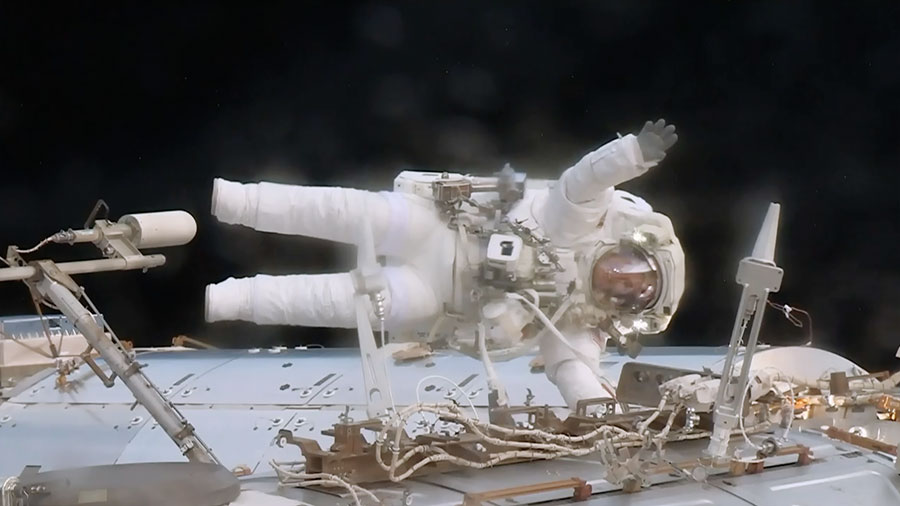
Expedition 51 Commander Peggy Whitson and Flight Engineer Jack Fischer of NASA concluded their spacewalk at 10:06 p.m. EDT. During the spacewalk, which lasted two hours and 46 minutes, the two astronauts successfully replaced a computer relay box, and installed a pair of antennas on station to enhance wireless communication for future spacewalks.


Image above: Astronaut Jack Fischer waves while attached to the Destiny laboratory during a spacewalk to replace a failed data relay box and install a pair wireless antennas. Image Credit: NASA.

Spacewalkers have now spent a total of 1,250 hours and 41 minutes working outside the station during 201 spacewalks in support of assembly and maintenance of the orbiting laboratory. This was the 10th spacewalk for Whitson, who moves into third place all-time for cumulative spacewalking time, and the second for Fischer.

Related links:

Space Station Research and Technology: https://www.nasa.gov/mission_pages/station/research/index.html

International Space Station (ISS): https://www.nasa.gov/mission_pages/station/main/index.html

Image (mentioned), Text, Credits: NASA/Mark Garcia.

Best regards, Orbiter.ch

NASA’s Mars 2020 Rover Artist’s Concept


NASA logo.

May 23, 2017


This artist's concept depicts NASA's Mars 2020 rover on the surface of Mars.

The mission takes the next step by not only seeking signs of habitable conditions on Mars in the ancient past, but also searching for signs of past microbial life itself.

The Mars 2020 rover introduces a drill that can collect core samples of the most promising rocks and soils and set them aside on the surface of Mars. A future mission could potentially return these samples to Earth.

Mars 2020 is targeted for launch in July/August 2020, aboard an Atlas V 541 rocket from Space Launch Complex 41 at Cape Canaveral Air Force Station in Florida.

NASA's Jet Propulsion Laboratory will build and manage operations of the Mars 2020 rover for the NASA Science Mission Directorate at the agency's headquarters in Washington.

Related articles:

Scientists Shortlist Three Landing Sites for Mars 2020
http://orbiterchspacenews.blogspot.ch/2017/02/scientists-shortlist-three-landing.html

NASA's Next Mars Rover Progresses Toward 2020 Launch
http://orbiterchspacenews.blogspot.ch/2016/07/nasas-next-mars-rover-progresses-toward.html

NASA Announces Mars 2020 Rover Payload to Explore the Red Planet as Never Before
http://orbiterchspacenews.blogspot.ch/2014/07/nasa-announces-mars-2020-rover-payload.html

For more information about the mission, go to: https://mars.nasa.gov/mars2020/

Image, Text, Credits: NASA/Tony Greicius/JPL-Caltech.

Greetings, Orbiter.ch

lundi 22 mai 2017

NASA TV Live Broadcasts Tuesday Spacewalk


ISS - Expedition 51 Mission patch.

May 22, 2017

Expedition 51 Commander Peggy Whitson and Flight Engineer Jack Fischer of NASA will venture outside the International Space Station for a 2.5-hour contingency spacewalk Tuesday, May 23. The spacewalk will begin about 8 a.m. EDT, with complete coverage on NASA Television and the agency’s website beginning at 6:30 a.m.

Whitson and Fischer will replace a critical computer relay box that failed on Saturday, May 20. The relay box, known as a multiplexer-demultiplexer (MDM), is one of two units that regulate the operation of radiators, solar arrays and cooling loops. They also will route commands to other vital station systems and install a pair of antennas to enhance wireless communication.


Image above: NASA astronauts Jack Fischer (left) and Peggy Whitson are outfitted in their U.S. spacesuits inside the U.S. Quest airlock before beginning the 200th spacewalk in support of International Space Station maintenance and assembly on May 12, 2017. Image Credit: NASA.

Because each MDM is capable of performing the critical station functions, the crew on the station was never in danger and station operations have not been affected.

The spacewalk will be the 201st in support of space station assembly and maintenance, the sixth spacewalk conducted from the Quest airlock this year, the 10th for Whitson and the second for Fischer.

Related links:

Expedition 51: https://www.nasa.gov/mission_pages/station/expeditions/expedition51/index.html

NASA TV: https://www.nasa.gov/multimedia/nasatv/index.html

Nasa website coverage: http://www.nasa.gov/live

Space Station Research and Technology: https://www.nasa.gov/mission_pages/station/research/index.html

International Space Station (ISS): https://www.nasa.gov/mission_pages/station/main/index.html

Image (mentioned), Text, Credits: NASA/Mark Garcia.

Best regards, Orbiter.ch

NASA's Juno Spacecraft Completes Fifth Science Pass of Jupiter


NASA - JUNO Mission logo.

May 22, 2017


Imsage above: This enhanced color view of Jupiter’s cloud tops was processed by citizen scientist Bjorn Jonsson using data from the JunoCam instrument on NASA’s Juno spacecraft. The image highlights a massive counterclockwise rotating storm that appears as a white oval in the gas giant’s southern hemisphere. Image Credits: NASA/JPL-Caltech/SwRI/MSSS/Bjorn Jonsson.

NASA's Juno mission accomplished a close flyby of Jupiter on May 19, successfully completing its fifth science orbit.

All of Juno's science instruments and the spacecraft's JunoCam were operating during the flyby, collecting data that is now being returned to Earth. Juno's next close flyby of Jupiter will occur on July 11, 2017, taking it over Jupiter’s Great Red Spot.

Juno Spacecraft orbiting Jupiter. Animation Credits: NASA/JPL

NASA's Jet Propulsion Laboratory, Pasadena, California, manages the Juno mission for the principal investigator, Scott Bolton, of Southwest Research Institute in San Antonio. The Juno mission is part of the New Frontiers Program managed by NASA's Marshall Space Flight Center in Huntsville, Alabama, for the Science Mission Directorate. Lockheed Martin Space Systems, Denver, built the spacecraft. JPL is a division of Caltech in Pasadena, California.

Related article:

Juno Scientists Prepare for Fifth Science Pass of Jupiter
http://orbiterchspacenews.blogspot.ch/2017/05/juno-scientists-prepare-for-fifth.html

More information on the Juno mission is available at:

https://www.nasa.gov/juno

http://missionjuno.org

The public can follow the mission on Facebook and Twitter at:

http://www.facebook.com/NASAJuno

http://www.twitter.com/NASAJuno

Image (mentioned), Animation (mentioned), Text, Credits: NASA/Tony Greicius/Dwayne Brown/Laurie Cantillo/JPL/DC Agle.

Best regards, Orbiter.ch

Astronomers Confirm Orbital Details of TRAPPIST-1’s Least Understood Planet


NASA - Kepler Space Telescope patch.

May 22, 2017

TRAPPIST-1 Three-body Resonance

Video above: The animation shows a simulation of the planets of TRAPPIST-1 orbiting for 90 Earth-days. After 15 Earth days, the animation focuses only on the outer three planets: TRAPPIST-1f, TRAPPIST-1g, TRAPPIST-1h. The motion freezes each time two adjacent planets pass each other; an arrow appears pointing to the location of the third planet. This complex but predictable pattern, called an orbital resonance, occurs when planets exert a regular, periodic gravitational tug on each other as they orbit their star. The three-body resonance of the outer three planets causes the planets to repeat the same relative positions, and expecting such a resonance was used to predict the orbital period of TRAPPIST-1h. Video Credits: Daniel Fabrycky/University of Chicago; with reference to Luger et al. 2017, Nature Astronomy.

Scientists using NASA's Kepler Space Telescope identified a regular pattern in the orbits of the planets in the TRAPPIST-1 system that confirmed suspected details about the orbit of its outermost and least understood planet, TRAPPIST-1h.

TRAPPIST-1 is only eight percent the mass of our sun, making it a cooler and less luminous star. It’s home to seven Earth-size planets, three of which orbit in their star's habitable zone—the range of distances from a star where liquid water could pool on the surface of a rocky planet. The system is located about 40 light-years away in the constellation of Aquarius and is estimated to be between 3 and 8 billion years old.

Scientists announced that the system has seven Earth-sized planets at a NASA press conference on Feb. 22. NASA's Spitzer Space Telescope, the TRAPPIST (Transiting Planets and Planetesimals Small Telescope) in Chile and other ground-based telescopes were used to detect and characterize the planets. But the collaboration only had an estimate for the period of TRAPPIST-1h.

TRAPPIST-1 system orbits. Image Credit: NASA.

Astronomers from the University of Washington have used data from the Kepler spacecraft to confirm that TRAPPIST-1h orbits its star every 19 days. At six million miles from its cool dwarf star, TRAPPIST-1h is located beyond the outer edge of the habitable zone, and is likely too cold for life as we know it. The amount of energy (per unit) planet h receives from its star is comparable to what the dwarf planet Ceres, located in the asteroid belt between Mars and Jupiter, gets from our sun.

“It’s incredibly exciting that we’re learning more about this planetary system elsewhere, especially about planet h, which we barely had information on until now,” said Thomas Zurbuchen, associate administrator of NASA’s Science Mission Directorate at Headquarters in Washington. “This finding is a great example of how the scientific community is unleashing the power of complementary data from our different missions to make such fascinating discoveries.”

"It really pleased me that TRAPPIST-1h was exactly where our team predicted it to be. It had me worried for a while that we were seeing what we wanted to see -- after all, things are almost never exactly what you expect them to be in this field," said Rodrigo Luger, doctoral student at UW in Seattle, and lead author of the study published in the journal Nature Astronomy. "Nature usually surprises us at every turn, but, in this case, theory and observation matched perfectly."

Orbital Resonance – Harmony Among Celestial Bodies

Using the prior Spitzer data, the team recognized a mathematical pattern in the frequency at which each of the six innermost planets orbits their star. This complex but predictable pattern, called an orbital resonance, occurs when planets exert a regular, periodic gravitational tug on each other as they orbit their star.

To understand the concept of resonance, consider Jupiter's moons Io, Europa and Ganymede, which is the farthest out of the three. For every time Ganymede orbits Jupiter, Europa orbits twice and Io makes four trips around the planet. This 1:2:4 resonance is considered stable and if one moon were nudged off course, it would self-correct and lock back into a stable orbit. It is this harmonious influence between the seven TRAPPIST-1 siblings that keeps the system stable.

 TRAPPIST-1 system. Image Credit: NASA

These relationships, said Luger, suggested that by studying the orbital velocities of its neighboring planets, they could predict the exact orbital velocity, and hence also orbital period, of planet h, even before the Kepler observations. The team calculated six possible resonant periods for planet h that would not disrupt the stability of the system, but only one was not ruled out by additional data. The other five possibilities could have been observed in the Spitzer and ground-based data collected by the TRAPPIST team.

“All of this”, Luger said, “indicates that these orbital relationships were forged early in the life of the TRAPPIST-1 system, during the planet formation process.”

"The resonant structure is no coincidence, and points to an interesting dynamical history in which the planets likely migrated inward in lock-step," said Luger. "This makes the system a great laboratory for planet formation and migration theories."

Worldwide Real-time Collaboration

The Kepler spacecraft stared at the patch of sky home to the TRAPPIST-1 system from Dec. 15, 2016 to March 4 collecting data on the star's minuscule changes in brightness due to transiting planets as part of its second mission, K2. On March 8, the raw, uncalibrated data was released to the scientific community to begin their follow-up studies.

The work to confirm TRAPPIST-1h's orbital period immediately began and scientists from around the world took to social media to share in real-time the new information gleaned about the star's behavior and its brood of planets. Within two hours of the data release, the team confirmed their prediction of a 19-day orbital period.

"Pulling results out of data is always stimulating, but it was a rare treat to watch scientists across the world collaborate and share their progress near-real time on social media as they analyzed the data and identified the transits of TRAPPIST-1h," said Jessie Dotson, project scientist for the K2 mission at NASA's Ames Research Center in California's Silicon Valley. "The creativity and expediency by which the data has been put to use has been a particular thrilling aspect of K2's community-focused approach."

Kepler Space Telescope or K2. Image Credit: NASA

TRAPPIST-1's seven-planet chain of resonances established a record among known planetary systems, the previous holders being the systems Kepler-80 and Kepler-223, each with four resonant planets.

The TRAPPIST-1 system was first discovered in 2016 by the TRAPPIST collaboration, and was thought to have just three planets at that time. Additional planets were found with Spitzer and ground-based telescopes. NASA's Hubble Space Telescope is following up with atmospheric observations, and the James Webb Space Telescope will be able to probe potential atmospheres in further detail.

Ames manages the Kepler and K2 missions for NASA’s Science Mission Directorate. NASA's Jet Propulsion Laboratory in Pasadena, California, managed Kepler mission development. Ball Aerospace & Technologies Corp. operates the flight system with support from the Laboratory for Atmospheric and Space Physics at the University of Colorado in Boulder.

Related articles:

Ultracool Dwarf and the Seven Planets
http://orbiterchspacenews.blogspot.ch/2017/02/ultracool-dwarf-and-seven-planets.html

NASA's Kepler Provides Another Peek At Ultra-cool Neighbor
http://orbiterchspacenews.blogspot.ch/2017/03/nasas-kepler-provides-another-peek-at.html

Light From An Ultra-Cool Neighbor
http://orbiterchspacenews.blogspot.ch/2017/03/light-from-ultra-cool-neighbor.html

For more information about the Kepler and K2 missions, visit: http://www.nasa.gov/kepler

For more information about the TRAPPIST-1 system, visit: http://exoplanets.nasa.gov/trappist1

Images (mentioned), Text, Credits: NASA/Ames Research Center/Michele Johnson/JPL/Elizabeth Landau.

Best regards, Orbiter.ch

Slim Crescent of Ice


NASA - Cassini International logo.

May 22, 2017


The low angle of sunlight along the slim crescent of Saturn's moon Enceladus (313 miles or 504 kilometers across) highlights the many fractures and furrows on its icy surface.

This view looks toward the Saturn-facing hemisphere of Enceladus, which is dimly illuminated in the image above by sunlight reflected off Saturn. North on Enceladus is up and rotated 14 degrees to the left. The image was taken in visible light with the Cassini spacecraft narrow-angle camera on Dec. 26, 2016.

The view was obtained at a distance of approximately 104,000 miles (168,000 kilometers) from Enceladus. Image scale is 3,303 feet (1 kilometer) per pixel.

The Cassini mission is a cooperative project of NASA, ESA (the European Space Agency) and the Italian Space Agency. The Jet Propulsion Laboratory, a division of the California Institute of Technology in Pasadena, manages the mission for NASA's Science Mission Directorate, Washington. The Cassini orbiter and its two onboard cameras were designed, developed and assembled at JPL. The imaging operations center is based at the Space Science Institute in Boulder, Colorado.

For more information about the Cassini-Huygens mission visit https://saturn.jpl.nasa.gov and http://www.nasa.gov/cassini . The Cassini imaging team homepage is at http://ciclops.org and ESA website: http://www.esa.int/Our_Activities/Space_Science/Cassini-Huygens

Image, Text, Credits: NASA/Tony Greicius/JPL-Caltech/Space Science Institute.

Greetings, Orbiter.ch

dimanche 21 mai 2017

Spacewalk Planned to Change Out Failed Relay Box & Station Managers Give Go for Tuesday Spacewalk


ISS - Expedition 51 Mission patch.

May 21, 2017


Image above: The Soyuz MS-03 crew ship (foreground) and the Progress 66 cargo craft are pictured as the International Space Station orbits about 250 miles above Earth. Image Credit: NASA.

International Space Station Program managers met Sunday and gave approval for a contingency spacewalk no earlier than Tuesday by two Expedition 51 crewmembers to change out a multiplexer-demultiplexer (MDM) data relay box on the S0 truss that failed on Saturday morning. The cause of the MDM failure is not known. A final decision on a firm date for the spacewalk and who will conduct the spacewalk will be made later in the day Sunday.

International Space Station Program managers have given the green light for a contingency spacewalk on Tuesday by two Expedition 51 crewmembers to change out a multiplexer-demultiplexer (MDM) data relay box on the S0 truss that failed on Saturday morning. The cause of the MDM failure is not known. After a review of spacewalk preparations and crew readiness throughout the day Sunday, the decision was made to press ahead with the spacewalk on Tuesday. It will be conducted by Expedition 51 Commander Peggy Whitson and Flight Engineer Jack Fischer of NASA.

The data relay box is one of two fully redundant systems housed in the truss that control the functionality of radiators, solar arrays, cooling loops and other station hardware. The other MDM in the truss is functioning perfectly, providing uninterrupted telemetry routing to the station’s systems. The crew has never been in any danger, and the MDM failure, believed to be internal to the box itself, has had no impact on station activities.


Image above: This picture of the International Space Station was photographed from the space shuttle Atlantis as the orbiting complex and the shuttle performed their relative separation in the early hours of July 19, 2011. Image Credit: NASA.

On Sunday morning, Whitson prepared a spare data relay box and tested components installed in the replacement. She reported that the spare MDM was ready to be brought outside to replace the failed unit. Back on March 30, Whitson and Expedition 50 commander Shane Kimbrough of NASA conducted a spacewalk to install the same MDM with upgraded software tat failed Saturday.

A similar MDM replacement spacewalk was conducted in April 2014 by Expedition 39 crewmembers Steve Swanson and Rick Mastracchio of NASA.

Tuesday’s spacewalk will last about two hours in duration to replace the failed box. An additional task was added for Fischer to install a pair of wireless communications antennas on the Destiny Lab while Whitson replaces the failed data relay box. The antenna installation task was originally planned for the last spacewalk on May 12.


Image above: Astronaut Peggy Whitson is pictured with the Orbital ATK Cygnus resupply ship behind her during a spacewalk on May 12, 2017. Image Credit: NASA.

The contingency spacewalk will be the 201st in support of space station assembly and maintenance and the sixth conducted from the Quest airlock this year.

This will be the 10th spacewalk in Whitson’s career and the second for Fischer. Whitson will be designated as extravehicular crewmember 1 (EV 1) and will wear the suit with the red stripes. Fischer will be extravehicular crewmember 2 (EV 2) and will wear the suit with no stripes.

Tuesday’s spacewalk is expected to begin around 8 a.m. EDT, or earlier, if the crew is running ahead of schedule with its spacewalking preparations. NASA Television coverage will begin at 6:30 a.m.

Related links:

Expedition 51: https://www.nasa.gov/mission_pages/station/expeditions/expedition51/index.html

NASA TV: https://www.nasa.gov/multimedia/nasatv/index.html

Space Station Research and Technology: https://www.nasa.gov/mission_pages/station/research/index.html

International Space Station (ISS): https://www.nasa.gov/mission_pages/station/main/index.html

Images (mentioned), Text, Credits: NASA/Mark Garcia.

Greetings, Orbiter.ch