jeudi 30 novembre 2017

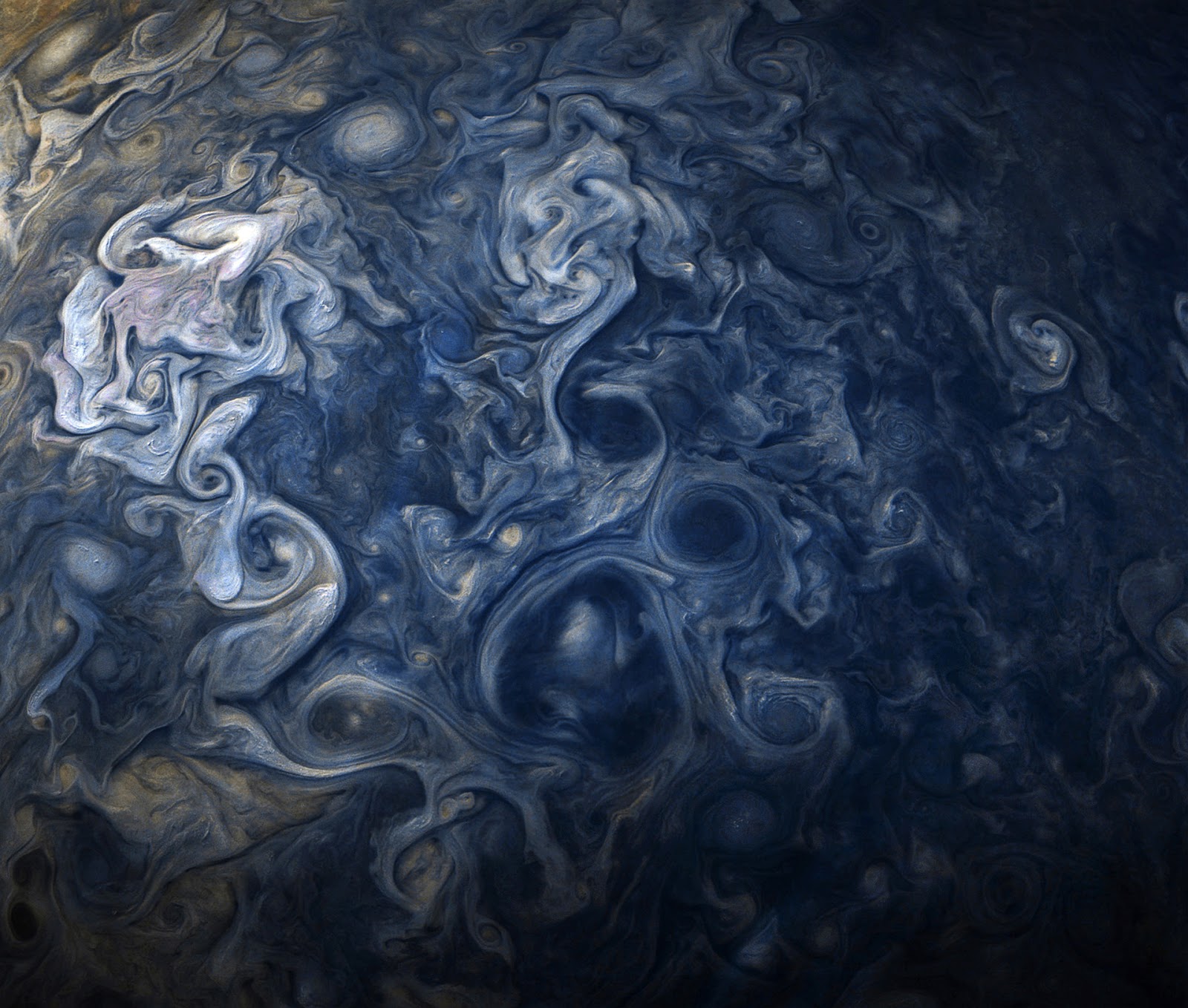
Jupiter Blues


NASA - JUNO Mission logo.

Nov. 30, 2017


See Jovian clouds in striking shades of blue in this new view taken by NASA’s Juno spacecraft.

The Juno spacecraft captured this image when the spacecraft was only 11,747 miles (18,906 kilometers) from the tops of Jupiter’s clouds — that’s roughly as far as the distance between New York City and Perth, Australia. The color-enhanced image, which captures a cloud system in Jupiter’s northern hemisphere, was taken on Oct. 24, 2017 at 10:24 a.m. PDT (1:24 p.m. EDT) when Juno was at a latitude of 57.57 degrees (nearly three-fifths of the way from Jupiter’s equator to its north pole) and performing its ninth close flyby of the gas giant planet.

The spatial scale in this image is 7.75 miles/pixel (12.5 kilometers/pixel).

Juno spacecraft orbiting Jupiter

Because of the Juno-Jupiter-Sun angle when the spacecraft captured this image, the higher-altitude clouds can be seen casting shadows on their surroundings. The behavior is most easily observable in the whitest regions in the image, but also in a few isolated spots in both the bottom and right areas of the image.

Citizen scientists Gerald Eichstädt and Seán Doran processed this image using data from the JunoCam imager.

JunoCam's raw images are available for the public to peruse and process into image products at:

http://www.missionjuno.swri.edu/junocam  

More information about Juno is at: https://www.nasa.gov/juno and http://missionjuno.swri.edu

Image, Animation, Text, Credits: NASA/Tony Greicius/JPL-Caltech/SwRI/MSSS/Gerald Eichstädt/Seán Doran.

Best regards, Orbiter.ch

Giant Black Hole Pair Photobombs Andromeda Galaxy


NASA - Chandra X-ray Observatory patch.

Nov. 30, 2017

It seems like even black holes can’t resist the temptation to insert themselves unannounced into photographs. A cosmic photobomb found as a background object in images of the nearby Andromeda galaxy has revealed what could be the most tightly coupled pair of supermassive black holes ever seen.

Astronomers made this remarkable discovery using X-ray data from NASA’s Chandra X-ray Observatory and optical data from ground-based telescopes, Gemini-North in Hawaii and the Caltech’s Palomar Transient Factory in California.


Image above: X-ray source J0045+41. Image Credits: X-ray: NASA/CXC/University of Washington/T. Dorn-Wallenstein et al.; Optical: NASA, ESA, J. Dalcanton et. al. and R. Gendler.

This unusual source, called LGGS J004527.30+413254.3 (J0045+41 for short), was seen in optical and X-ray images of Andromeda, also known as M31. Until recently, scientists thought J0045+41 was an object within M31, a large spiral galaxy located relatively nearby at a distance of about 2.5 million light years from Earth. The new data, however, revealed that J0045+41 was actually at a much greater distance, around 2.6 billion light years from Earth.

“We were looking for a special type of star in M31 and thought we had found one,” said Trevor Dorn-Wallenstein of the University of Washington in Seattle, WA, who led the paper describing this discovery. “We were surprised and excited to find something far stranger!”

Even more intriguing than the large distance of J0045+41 is that it likely contains a pair of giant black holes in close orbit around each other. The estimated total mass for these two supermassive black holes is about two hundred million times the mass of our Sun.

Previously, a different team of astronomers had seen periodic variations in the optical light from J0045+41, and, believing it to be a member of M31, classified it as a pair of stars that orbited around each other about once every 80 days.

The intensity of the X-ray source observed by Chandra revealed this original classification was incorrect. Rather, J0045+41 had to be either a binary system in M31 containing a neutron star or black hole that is pulling material from a companion — the sort of system Dorn-Wallenstein was originally searching for in M31 — or a much more massive and distant system that contains at least one rapidly growing supermassive black hole.

However, a spectrum from the Gemini-North telescope taken by the University of Washington team showed that J0045+41 must host at least one supermassive black hole and allowed the researchers to estimate the distance. The spectrum also provided possible evidence that a second black hole was present in J0045+41 and moving at a different velocity from the first, as expected if the two black holes are orbiting each other.

The team then used optical data from the Palomar Transient Factory to search for periodic variations in the light from J0045+41. They found several periods in J0045+41, including ones at about 80 and 320 days. The ratio between these periods matches that predicted by theoretical work on the dynamics of two giant black holes orbiting each other.

“This is the first time such strong evidence has been found for a pair of orbiting giant black holes,” said co-author Emily Levesque of the University of Washington.

The researchers estimate that the two putative black holes orbit each other with a separation of only a few hundred times the distance between the Earth and the Sun. This corresponds to less than one hundredth of a light year. By comparison, the nearest star to our Sun is about four light years away.

Such a system could be formed as a consequence of the merger, billions of years earlier, of two galaxies that each contained a supermassive black hole. At their current close separation, the two black holes are inevitably being drawn closer together as they emit gravitational waves.

“We're unable to pinpoint exactly how much mass each of these black holes contains,” said co-author John Ruan, also of the University of Washington. “Depending on that, we think this pair will collide and merge into one black hole in as little as 350 years or as much as 360,000 years.”

Chandra X-ray Observatory. Animation Credits: NASA/CXC

If J0045+41 indeed contains two closely orbiting black holes it will be emitting gravitational waves, however the signal would not be detectable with LIGO and Virgo. These ground-based facilities have detected the mergers of stellar-mass black holes weighing no more than about 60 Suns and, very recently, one between two neutron stars.

“Supermassive black hole mergers occur in slow motion compared to stellar-mass black holes”, said Dorn-Wallenstein. “The much slower changes in the gravitational waves from a system like J0045+41 can be best detected by a different type of gravitational wave facility called a Pulsar Timing Array.”

A paper describing this result was accepted for publication in the November 20th issue of The Astrophysical Journal and is available online. NASA's Marshall Space Flight Center in Huntsville, Alabama, manages the Chandra program for NASA's Science Mission Directorate in Washington. The Smithsonian Astrophysical Observatory in Cambridge, Massachusetts, controls Chandra's science and flight operations.

Read More from NASA's Chandra X-ray Observatory: http://chandra.harvard.edu/photo/2017/m31/

For more Chandra images, multimedia and related materials, visit:http://www.nasa.gov/chandra

Image (mentioned), Animation (mentioned), Text, Credits: NASA/Lee Mohon/Marshall Space Flight Center/Molly Porter/Chandra X-ray Center/Megan Watzke.

Greetings, Orbiter.ch

An Orbital Dance May Help Preserve Oceans on Icy Worlds


NASA - New Horizons Mission logo.

Nov. 30, 2017

Heat generated by the gravitational pull of moons formed from massive collisions could extend the lifetimes of liquid water oceans beneath the surface of large icy worlds in our outer solar system, according to new NASA research. This greatly expands the number of locations where extraterrestrial life might be found, since liquid water is necessary to support known forms of life and astronomers estimate there are dozens of these worlds.


Image above: Composite, enhanced-color image of Pluto (lower right) and its largest moon Charon (upper left) taken by NASA’s New Horizons spacecraft on July 14, 2015. Pluto and Charon are shown with approximately correct relative sizes, but their true separation is not to scale. Image Credits: NASA/JHUAPL/SwRI.

“These objects need to be considered as potential reservoirs of water and life,” said Prabal Saxena of NASA’s Goddard Space Flight Center in Greenbelt, Maryland, lead author of the research published in Icarus November 24. “If our study is correct, we now may have more places in our solar system that possess some of the critical elements for extraterrestrial life.”

These frigid worlds are found beyond the orbit of Neptune and include Pluto and its moons. They are known as Trans-Neptunian Objects (TNOs) and are far too cold to have liquid water on their surfaces, where temperatures are less than 350 degrees below zero Fahrenheit (below minus 200 Celsius). However, there is evidence that some may have layers of liquid water beneath their icy crusts. In addition to bulk densities that are similar to other bodies suspected to have subsurface oceans, an analysis of the light reflected from some TNOs reveals signatures of crystalline water ice and ammonia hydrates. At the extremely low surface temperatures on these objects, water ice takes a disordered, amorphous form instead of the regularly ordered crystals typical in warmer areas, such as snowflakes on Earth. Also, space radiation converts crystalline water ice to the amorphous form and breaks down ammonia hydrates, so they are not expected to survive long on TNO surfaces. This suggests that both compounds may have come from an interior liquid water layer that erupted to the surface, a process known as cryovolcanism.


Image above: Composite image of Wright Mons, one of two potential cryovolcanoes spotted on the surface of Pluto by the New Horizons spacecraft in July 2015. Image Credits: NASA/JHUAPL/SwRI.

Most of the long-lived heat inside TNOs comes from the decay of radioactive elements that were incorporated into these objects as they formed. This heat can be enough to melt a layer of the icy crust, generating a subsurface ocean and perhaps maintaining it for billions of years. But as the radioactive elements decay into more stable ones, they stop releasing heat and the interiors of these objects gradually cool, and any subsurface oceans will eventually freeze. However, the new research found that the gravitational interaction with a moon can generate enough additional heat inside a TNO to significantly extend the lifetime of a subsurface ocean.

The orbit of any moon will evolve in a gravitational “dance” with its parent object to achieve the most stable state possible – circular, aligned with the equator of its parent, and with the moon spinning at a rate where the same side always faces its parent. Large collisions between celestial objects can generate moons when material is splashed into orbit around the larger object and coalesces into one or more moons under its own gravity. Since collisions occur in a huge variety of directions and speeds, they are unlikely to produce moons with perfectly stable orbits initially. As a collision-generated moon adjusts to a more stable orbit, mutual gravitational attraction causes the interiors of the parent world and its new moon to repeatedly stretch and relax, generating friction that releases heat in a process known as tidal heating.

The team used the equations for tidal heating and calculated its contribution to the “heat budget” for a wide variety of discovered and hypothetical TNO-moon systems, including the Eris-Dysnomia system. Eris is second-largest of the currently known TNOs after Pluto.

“We found that tidal heating can be a tipping point that may have preserved oceans of liquid water beneath the surface of large TNOs like Pluto and Eris to the present day,” said Wade Henning of NASA Goddard and the University of Maryland, College Park, a co-author of the study.

“Crucially, our study also suggests that tidal heating could make deeply buried oceans more accessible to future observations by moving them closer to the surface,” said Joe Renaud of George Mason University, Fairfax, Virginia, a co-author on the paper. “If you have a liquid water layer, the additional heat from tidal heating would cause the next adjacent layer of ice to melt.”

New Horizons Pluto & Charon flyby. Animation Credit: NASA

Although liquid water is necessary for life, it is not enough by itself. Life also needs a supply of chemical building blocks and a source of energy. Deep under the ocean on Earth, certain geologically active places have entire ecosystems that thrive in total darkness because hydrothermal vents called “black smokers” supply the needed ingredients in the form of energy-rich chemicals dissolved in superheated water. Tidal heating or heat from the decay of radioactive elements could both create such hydrothermal vents, according to the team.

The team would like to develop and use even more accurate models of tidal heating and TNO interiors to determine how long tidal heating can extend the lifetime of a liquid water ocean and how the orbit of a moon evolves as tidal heating dissipates energy. The team would also like to discover at what point a liquid water ocean forms; whether it forms almost immediately or if it requires a significant buildup of heat first.

The research was funded by the NASA Postdoctoral Program, managed by the Universities Space Research Association, Columbia, Maryland, as well as the NASA Outer Planets Research Program grant NNX14AR42G. The research was conducted in collaboration with the Sellers Exoplanet Environments Collaboration at NASA Goddard.

Related links:

Icarus November 24: http://www.sciencedirect.com/science/article/pii/S0019103517303858

Solar System: https://www.nasa.gov/topics/solarsystem/index.html

Kuiper Belt: https://www.nasa.gov/subject/3151/kuiper-belt

Astrobiology: https://www.nasa.gov/content/the-search-for-life

NASA New Horizons: https://www.nasa.gov/mission_pages/newhorizons/main/index.html

Images (mentioned), Animation (mentioned), Text, Credits: NASA Goddard Space Flight Center/Bill Steigerwald/Nancy Jones.

Greetings, Orbiter.ch

mercredi 29 novembre 2017

Honeycomb-Textured Landforms in Northwestern Hellas Planitia


NASA - Mars Reconnaissance Orbiter (MRO) logo.

Nov. 29, 2017


This image from NASA's Mars Reconnaissance Orbiter (MRO) targets a portion of a group of honeycomb-textured landforms in northwestern Hellas Planitia, which is part of one of the largest and most ancient impact basins on Mars.

In a larger Context Camera image, the individual "cells" are about 5 to 10 kilometers wide. With HiRISE, we see much greater detail of these cells, like sand ripples that indicate wind erosion has played some role here. We also see distinctive exposures of bedrock that cut across the floor and wall of the cells. These resemble dykes, which are usually formed by volcanic activity.

Additionally, the lack of impact craters suggests that the landscape, along with these features, have been recently reshaped by a process, or number of processes that may even be active today. Scientists have been debating how these honeycombed features are created, theorizing from glacial events, lake formation, volcanic activity, and tectonic activity, to wind erosion.

The map is projected here at a scale of 50 centimeters (19.7 inches) per pixel. [The original image scale is 53.8 centimeters (21.2 inches) per pixel (with 2 x 2 binning); objects on the order of 161 centimeters (23.5 inches) across are resolved.] North is up.

The University of Arizona, Tucson, operates HiRISE, which was built by Ball Aerospace & Technologies Corp., Boulder, Colorado. NASA's Jet Propulsion Laboratory, a division of Caltech in Pasadena, California, manages the Mars Reconnaissance Orbiter Project for NASA's Science Mission Directorate, Washington.

Mars Reconnaissance Orbiter (MRO): http://www.nasa.gov/mission_pages/MRO/main/index.html

Image, Text, Credits: NASA/Tony Greicius/JPL-Caltech/Univ. of Arizona.

Greetings, Orbiter.ch

Station Boosts Orbit for December Crew Swap


ISS - Expedition 53 Mission patch.

Nov. 29, 2017

International Space Station (ISS). Animation Credit: NASA

The International Space Station is orbiting slightly higher today to get ready for a pair of crews swapping places on the orbital laboratory in December. A Progress 67 resupply ship docked to the rear of the station fired its engines for just over three minutes this morning boosting the orbital lab to its correct altitude for next month’s crew departure and arrival.

Three Expedition 53 crew members from the United States, Russia and Italy are getting ready to return home just in time for the holidays. Commander Randy Bresnik and his cohorts Sergey Ryazanskiy from Roscosmos and Paolo Nespoli from the European Space Agency are due to land Dec. 14 inside their Soyuz MS-05 spacecraft in Kazakhstan. From there, the veteran space trio will split up and return to their home space agencies about 24 hours later having just spent 139 days in space together.


Image above: The Expedition 52-53 trio will return to Earth Dec. 14. The crew members (from left) are European Space Agency astronaut Paolo Nespoli, Roscosmos cosmonaut Sergey Ryazanskiy and NASA astronaut Randy Bresnik. Image Credit: NASA.

Next up are three Expedition 54-55 crew members who will launch Dec. 17 for a two-day ride to the station inside the Soyuz MS-07 spacecraft. Veteran cosmonaut Anton Shkaplerov from Roscosmos will be conducting his third tour aboard the orbital complex. Scott Tingle from NASA and Norishige Kanai from the Japan Aerospace Exploration Agency will both be starting their first missions in space. All three will spend four months orbiting Earth.

Greeting the new crew when it arrives on Dec. 19 will be Expedition 54 Commander Alexander Misurkin of Roscosmos and NASA Flight Engineers Joe Acaba and Mark Vande Hei who have been in space since Sept. 12. Misurkin will open the Rassvet module’s hatch where the Soyuz spacecraft will be docked and welcome the new crew members when they come flying in the station.

Related links:

Expedition 53: https://www.nasa.gov/mission_pages/station/expeditions/expedition53/index.html

International Space Station (ISS): https://www.nasa.gov/mission_pages/station/main/index.html

Image (mentioned), Animation (mentioned), Text, Credits: NASA/Mark Garcia.

Best regards, Orbiter.ch

WASP-18b Has Smothering Stratosphere Without Water


NASA - Spitzer Space Telescope patch / NASA - Hubble Space Telescope patch.

Nov. 29, 2017

A NASA-led team has found evidence that the oversized planet WASP-18b is wrapped in a smothering stratosphere loaded with carbon monoxide and devoid of water. The findings come from a new analysis of observations made by the Hubble and Spitzer space telescopes.

The formation of a stratosphere layer in a planet’s atmosphere is attributed to “sunscreen”-like molecules, which absorb UV and visible radiation coming from the star and then release that energy as heat. The new study suggests that the “hot Jupiter” WASP-18b, a massive planet that orbits very close to its host star, has an unusual composition, and the formation of this world might have been quite different from that of Jupiter as well as gas giants in other planetary systems.


Image above: A NASA-led team of scientists determined that WASP-18b, a “hot Jupiter” located 325 light-years from Earth, has a stratosphere that’s loaded with carbon monoxide, or CO, but has no signs of water. Image Credits: NASA's Goddard Space Flight Center.

“The composition of WASP-18b defies all expectations,” said Kyle Sheppard of NASA’s Goddard Space Flight Center in Greenbelt, Maryland, lead author of the paper published in the Astrophysical Journal Letters. “We don’t know of any other extrasolar planet where carbon monoxide so completely dominates the upper atmosphere.”

On Earth, ozone absorbs UV in the stratosphere, protecting our world from a lot of the Sun’s harmful radiation. For the handful of exoplanets with stratospheres, the absorber is typically thought to be a molecule such as titanium oxide, a close relative of titanium dioxide, used on Earth as a paint pigment and sunscreen ingredient.

The researchers looked at data collected for WASP-18b, located 325 light-years from Earth, as part of a survey to find exoplanets with stratospheres. The heavyweight planet, which has the mass of 10 Jupiters, has been observed repeatedly, allowing astronomers to accumulate a relatively large trove of data. This study analyzed five eclipses from archived Hubble data and two from Spitzer.

Hubble Space Telescope (HST). Animation Credits: ESA/NASA

From the light emitted by the planet’s atmosphere at infrared wavelengths, beyond the visible region, it’s possible to identify the spectral fingerprints of water and some other important molecules. The analysis revealed WASP-18b’s peculiar fingerprint, which doesn’t resemble any exoplanet examined so far. To determine which molecules were most likely to match it, the team carried out extensive computer modeling.

“The only consistent explanation for the data is an overabundance of carbon monoxide and very little water vapor in the atmosphere of WASP-18b, in addition to the presence of a stratosphere,” said Nikku Madhusudhan a co-author of the study from the University of Cambridge. “This rare combination of factors opens a new window into our understanding of physicochemical processes in exoplanetary atmospheres.”

The findings indicate that WASP-18b has hot carbon monoxide in the stratosphere and cooler carbon monoxide in the layer of the atmosphere below, called the troposphere. The team determined this by detecting two types of carbon monoxide signatures, an absorption signature at a wavelength of about 1.6 micrometers and an emission signature at about 4.5 micrometers. This is the first time researchers have detected both types of fingerprints for a single type of molecule in an exoplanet’s atmosphere.

In theory, another possible fit for the observations is carbon dioxide, which has a similar fingerprint. The researchers ruled this out because if there were enough oxygen available to form carbon dioxide, the atmosphere also should have some water vapor.

Animation Credit: NASA

To produce the spectral fingerprints seen by the team, the upper atmosphere of WASP-18b would have to be loaded with carbon monoxide. Compared to other hot Jupiters, this planet's atmosphere likely would contain 300 times more “metals,” or elements heavier than hydrogen and helium. This extremely high metallicity would indicate WASP-18b might have accumulated greater amounts of solid ices during its formation than Jupiter, suggesting it may not have formed the way other hot Jupiters did.

“The expected launch of the James Webb Space Telescope and other future space-based observatories will give us the opportunity to follow up with even more powerful instruments and to continue exploring the amazing array of exoplanets out there,” said Avi Mandell, an exoplanet scientist at Goddard and the second author of the paper.

For more information about NASA’s Hubble Space Telescope, visit: http://www.nasa.gov/hubble

For more information about NASA’s Spitzer Space Telescope, visit: http://www.nasa.gov/spitzer

Image (mentioned), Animations (mentioned), Text, Credits: NASA/Karl Hille/Goddard Space Flight Center, by Elizabeth Zubritsky.

Greetings, Orbiter.ch

MUSE Probes Uncharted Depths of Hubble Ultra Deep Field


ESO - European Southern Observatory logo.

29 November 2017

Deepest ever spectroscopic survey completed

The Hubble Ultra Deep Field seen with MUSE

Astronomers using the MUSE instrument on ESO’s Very Large Telescope in Chile have conducted the deepest spectroscopic survey ever. They focused on the Hubble Ultra Deep Field, measuring distances and properties of 1600 very faint galaxies including 72 galaxies that have never been detected before, even by Hubble itself. This groundbreaking dataset has already resulted in 10 science papers that are being published in a special issue of Astronomy & Astrophysics. This wealth of new information is giving astronomers insight into star formation in the early Universe, and allows them to study the motions and other properties of early galaxies — made possible by MUSE’s unique spectroscopic capabilities.

The Hubble Ultra Deep Field 2012

The MUSE HUDF Survey team, led by Roland Bacon of the Centre de recherche astrophysique de Lyon (CNRS/Université Claude Bernard Lyon 1/ENS de Lyon), France, used MUSE (Multi Unit Spectroscopic Explorer) to observe the Hubble Ultra Deep Field (heic0406), a much-studied patch of the southern constellation of Fornax (The Furnace). This resulted in the deepest spectroscopic observations ever made; precise spectroscopic information was measured for 1600 galaxies, ten times as many galaxies as has been painstakingly obtained in this field over the last decade by ground-based telescopes.

Glowing haloes around distant galaxies

The original HUDF images were pioneering deep-field observations with the NASA/ESA Hubble Space Telescope published in 2004. They probed more deeply than ever before and revealed a menagerie of galaxies dating back to less than a billion years after the Big Bang. The area was subsequently observed many times by Hubble and other telescopes, resulting in the deepest view of the Universe to date [1]. Now, despite the depth of the Hubble observations, MUSE has — among many other results — revealed 72 galaxies never seen before in this very tiny area of the sky.

Roland Bacon takes up the story: “MUSE can do something that Hubble can’t — it splits up the light from every point in the image into its component colours to create a spectrum. This allows us to measure the distance, colours and other properties of all the galaxies we can see — including some that are invisible to Hubble itself.”

Zooming into the MUSE view of the Hubble Ultra Deep Field

The MUSE data provides a new view of dim, very distant galaxies, seen near the beginning of the Universe about 13 billion years ago. It has detected galaxies 100 times fainter than in previous surveys, adding to an already richly observed field and deepening our understanding of galaxies across the ages.

The survey unearthed 72 candidate galaxies known as Lyman-alpha emitters that shine only in Lyman-alpha light [2]. Current understanding of star formation cannot fully explain these galaxies, which just seem to shine brightly in this one colour. Because MUSE disperses the light into its component colours these objects become apparent, but they remain invisible in deep direct images such as those from Hubble.

Panning across the MUSE view of the Hubble Ultra Deep Field

“MUSE has the unique ability to extract information about some of the earliest galaxies in the Universe — even in a part of the sky that is already very well studied,” explains Jarle Brinchmann, lead author of one of the papers describing results from this survey, from the University of Leiden in the Netherlands and the Institute of Astrophysics and Space Sciences at CAUP in Porto, Portugal. “We learn things about these galaxies that is only possible with spectroscopy, such as chemical content and internal motions — not galaxy by galaxy but all at once for all the galaxies!”

Flying through the MUSE view of the Hubble Ultra Deep Field

Another major finding of this study was the systematic detection of luminous hydrogen halos around galaxies in the early Universe, giving astronomers a new and promising way to study how material flows in and out of early galaxies.

MUSE charts distances in the Hubble Ultra Dee Field

Many other potential applications of this dataset are explored in the series of papers, and they include studying the role of faint galaxies during cosmic reionisation (starting just 380 000 years after the Big Bang), galaxy merger rates when the Universe was young, galactic winds, star formation as well as mapping the motions of stars in the early Universe.

MUSE reveals glowing haloes around distant galaxies

“Remarkably, these data were all taken without the use of MUSE’s recent Adaptive Optics Facility upgrade. The activation of the AOF after a decade of intensive work by ESO’s astronomers and engineers promises yet more revolutionary data in the future,” concludes Roland Bacon [3].

Notes:

[1] The Hubble Ultra Deep Field is one of the most extensively studied areas of space. To date, 13 instruments on eight telescopes, including the ESO-partnered ALMA (eso1633), have observed the field from X-ray to radio wavelengths.

[2] The negatively-charged electrons that orbit the positively-charged nucleus in an atom have quantised energy levels. That is, they can only exist in specific energy states, and they can only transition between them by gaining or losing precise amounts of energy. Lyman-alpha radiation is produced when electrons in hydrogen atoms drop from the second-lowest to the lowest energy level. The precise amount of energy lost is released as light with a particular wavelength in the ultraviolet part of the spectrum, which astronomers can detect with space telescopes or on Earth in the case of redshifted objects. For this data, at redshift of z ~ 3–6.6, the Lyman-alpha light is seen as visible or near-infrared light.

[3] The Adaptive Optics Facility with MUSE has already revealed previously unseen rings around the planetary nebula IC 4406 (eso1724).

More information:

This research was presented in a series of 10 papers to appear in the journal Astronomy & Astrophysics.

The teams are composed of Roland Bacon (CRAL - CNRS, Université Claude Bernard Lyon 1, ENS de Lyon, Université de Lyon, Lyon, France), Hanae Inami (CRAL - CNRS, Université Claude Bernard Lyon 1, ENS de Lyon, Université de Lyon, Lyon, France), Jarle Brinchmann (Leiden Observatory, Leiden, the Netherlands; Instituto de Astrofísica e Ciências do Espaço, Porto, Portugal), Michael Maseda (Leiden Observatory, Leiden, the Netherlands), Adrien Guerou (IRAP, CNRS, Université Toulouse III – Paul Sabatier, CNES, Université de Toulouse, France; ESO, Garching, Germany), A. B. Drake (CRAL - CNRS, Université Claude Bernard Lyon 1, ENS de Lyon, Université de Lyon, Lyon, France), H. Finley (IRAP, Université de Toulouse, Toulouse, France), F. Leclercq (University of Lyon, Lyon, France), E. Ventou (IRAP, CNRS, Université Toulouse III – Paul Sabatier, CNES Université de Toulouse, Toulouse, France), T. Hashimoto (University of Lyon, Lyon, France), Simon Conseil (CRAL - CNRS, Université Claude Bernard Lyon 1, ENS de Lyon Université de Lyon, Lyon, France), David Mary (Laboratoire Lagrange, CNRS, Observatoire de la Côte d’Azur, Université de Nice, Nice, France), Martin Shepherd (University of Lyon, Lyon, France), Mohammad Akhlaghi (CRAL - CNRS, Université Claude Bernard Lyon 1, ENS de Lyon Université de Lyon, Lyon, France), Peter M. Weilbacher (Leibniz-Institut für Astrophysik Postdam, Postdam, Germany), Laure Piqueras (CRAL - CNRS, Université Claude Bernard Lyon 1, ENS de Lyon Université de Lyon, Lyon, France), Lutz Wisotzki (Leibniz-Institut für Astrophysik Potsdam, Potsdam, Germany), David Lagattuta (CRAL - CNRS, Université Claude Bernard Lyon 1, ENS de Lyon Université de Lyon, Lyon, France), Benoit Epinat (IRAP, CNRS, Université Toulouse III – Paul Sabatier, CNES, Université de Toulouse, Toulouse, France; and LAM, CNRS / Aix Marseille Université, Marseille, France), Sebastiano Cantalupo (ETH Zurich, Zurich, Switzerland), Jean Baptiste Courbot (University of Lyon, Lyon, France; ICube, Université de Strasbourg, Strasbourg, France), Thierry Contini (IRAP, CNRS, Université Toulouse III – Paul Sabatier, CNES Université de Toulouse, Toulouse, France), Johan Richard (CRAL - CNRS, Université Claude Bernard Lyon 1, ENS de Lyon Université de Lyon, Lyon, France), Rychard Bouwens (Leiden Observatory, Leiden, the Netherlands), Nicolas Bouché (IRAP, CNRS, Université Toulouse III – Paul Sabatier, CNES Université de Toulouse, Toulouse, France), Wolfram Kollatschny (AIG, Universität Göttingen, Göttingen, Germany), Joop Schaye (Leiden Observatory, Leiden, the Netherlands), Raffaella Anna Marino (ETH Zurich, Zurich, Switzerland), Roser Pello (IRAP, CNRS, Université Toulouse III – Paul Sabatier, CNES Université de Toulouse, Toulouse, France), Bruno Guiderdoni (CRAL - CNRS, Université Claude Bernard Lyon 1, ENS de Lyon Université de Lyon, Lyon, France), Marcella Carollo (ETH Zurich, Zurich, Switzerland), S. Hamer (University of Lyon, Lyon, France), B. Clément (University of Lyon, Lyon, France), G. Desprez (University of Lyon, Lyon, France), L. Michel-Dansac (CRAL - CNRS, Université Claude Bernard Lyon 1, ENS de Lyon Université de Lyon, Lyon, France), M. Paalvast (Leiden Observatory, Leiden, the Netherlands), L. Tresse (CRAL - CNRS, Université Claude Bernard Lyon 1, ENS de Lyon Université de Lyon, Lyon, France), L. A. Boogaard (Leiden Observatory, Leiden, the Netherlands), J. Chevallard (Scientific Support Office, ESA/ESTEC, Noordwijk, the Netherlands) S. Charlot (Sorbonne University, Paris, France), J. Verhamme (University of Lyon, Lyon, France), Marijn Franx (Leiden Observatory, Leiden, the Netherlands), Kasper B. Schmidt (Leibniz-Institut für Astrophysik Potsdam, Potsdam, Germany), Anna Feltre (CRAL - CNRS, Université Claude Bernard Lyon 1, ENS de Lyon Université de Lyon, Lyon, France), Davor Krajnović (Leibniz-Institut für Astrophysik Potsdam, Potsdam, Germany), Eric Emsellem (ESO, Garching, Germany; University of Lyon, Lyon, France), Mark den Brok (ETH Zurich, Zurich, Switzerland), Santiago Erroz-Ferrer (ETH Zurich, Zurich, Switzerland), Peter Mitchell (CRAL - CNRS, Université Claude Bernard Lyon 1, ENS de Lyon Université de Lyon, Lyon, France), Thibault Garel (University of Lyon, Lyon, France), Jeremy Blaizot (CRAL - CNRS, Université Claude Bernard Lyon 1, ENS de Lyon Université de Lyon, Lyon, France), Edmund Christian Herenz (Department of Astronomy, Stockholm University, Stockholm, Sweden), D. Lam (Leiden University, Leiden, the Netherlands), M. Steinmetz (Leibniz-Institut für Astrophysik Potsdam, Potsdam, Germany) and J. Lewis (University of Lyon, Lyon, France).

ESO is the foremost intergovernmental astronomy organisation in Europe and the world’s most productive ground-based astronomical observatory by far. It is supported by 16 countries: Austria, Belgium, Brazil, the Czech Republic, Denmark, France, Finland, Germany, Italy, the Netherlands, Poland, Portugal, Spain, Sweden, Switzerland and the United Kingdom, along with the host state of Chile and by Australia as a strategic partner. ESO carries out an ambitious programme focused on the design, construction and operation of powerful ground-based observing facilities enabling astronomers to make important scientific discoveries. ESO also plays a leading role in promoting and organising cooperation in astronomical research. ESO operates three unique world-class observing sites in Chile: La Silla, Paranal and Chajnantor. At Paranal, ESO operates the Very Large Telescope, the world’s most advanced visible-light astronomical observatory and two survey telescopes. VISTA works in the infrared and is the world’s largest survey telescope and the VLT Survey Telescope is the largest telescope designed to exclusively survey the skies in visible light. ESO is a major partner in ALMA, the largest astronomical project in existence. And on Cerro Armazones, close to Paranal, ESO is building the 39-metre Extremely Large Telescope, the ELT, which will become “the world’s biggest eye on the sky”.

Links:

- MUSE HUDF Special Issue in A&A
https://www.aanda.org/component/toc/?task=topic&id=868

- “The MUSE Hubble Ultra Deep Field Survey: I. Survey description, data reduction and source detection” by R. Bacon et al.
https://www.eso.org/public/archives/releases/sciencepapers/eso1738/eso1738a.pdf

- “The MUSE Hubble Ultra Deep Field Survey: II. Spectroscopic Redshift and Line Flux Catalog, and Comparisons to Color Selections of Galaxies at 3 < z < 7” by H. Inami et al.
https://www.eso.org/public/archives/releases/sciencepapers/eso1738/eso1738b.pdf

- “The MUSE Hubble Ultra Deep Field Survey: III. Testing photometric redshifts to 30th magnitude” by J. Brinchmann et al.
https://www.eso.org/public/archives/releases/sciencepapers/eso1738/eso1738c.pdf

- “The MUSE Hubble Ultra Deep Field Survey: IV. An Overview of C III] Emitters” by M. V. Maseda et al.
https://www.eso.org/public/archives/releases/sciencepapers/eso1738/eso1738d.pdf

- “The MUSE Hubble Ultra Deep Field Survey: V. Spatially resolved stellar kinematics of galaxies at redshift 0.2 ≲ z ≲ 0.8” b A. Guérou
https://www.eso.org/public/archives/releases/sciencepapers/eso1738/eso1738e.pdf

- “The MUSE Hubble Ultra Deep Field Survey: VI. The Faint-End of the Lyα Luminosity Function at 2.91 < z < 6.64 and Implications for Reionisation” by A. B. Drake et al.
https://www.eso.org/public/archives/releases/sciencepapers/eso1738/eso1738f.pdf

- “The MUSE Hubble Ultra Deep Field Survey:VII. Fe II* Emission in Star-Forming Galaxies” by H. Finley et al.
https://www.eso.org/public/archives/releases/sciencepapers/eso1738/eso1738g.pdf

- “The MUSE Hubble Ultra Deep Field Survey: VIII. Extended Lyman α haloes” by F. Leclercq et al.
https://www.eso.org/public/archives/releases/sciencepapers/eso1738/eso1738h.pdf

- “The MUSE Hubble Ultra Deep Field Survey: IX. evolution of galaxy merger fraction up to z ≈ 6” by E. Ventou et al.
https://www.eso.org/public/archives/releases/sciencepapers/eso1738/eso1738h.pdf

- “The MUSE Hubble Ultra Deep Field Survey: X. Lyα Equivalent Widths at 2.9 < z < 6.6” by T. Hashimoto et al.
https://www.eso.org/public/archives/releases/sciencepapers/eso1738/eso1738j.pdf

- MUSE
https://www.eso.org/public/teles-instr/paranal-observatory/vlt/vlt-instr/muse/

- MUSE and the Adaptive Optics Facility (eso1724)
https://www.eso.org/public/news/eso1724/

ESOcast 140 Light: MUSE Dives into the Hubble Ultra Deep Field: http://www.eso.org/public/videos/eso1738a/

Images, Videos, Text, Credits: (mentioned on "more information") ESO/Richard Hook/Institut de Recherche en Astrophysique et Planétologie France/Thierry Contini/Leibniz Institute for Astrophysics Potsdam/Davor Krajnovic/University of Leiden/Jarle Brinchmann/Lyon Centre for Astrophysics Research (CRAL)/Roland Bacon.

Best regards, Orbiter.ch