mardi 15 mai 2018
Science Launching to Space Station Looks Forward and Back
NASA / Orbital ATK - Cygnus OA-9 Mission patch.
May 15, 2018
Image above: Orbital ATK’s Cygnus spacecraft approach Canadarm2 to be grapped. Image Credit: NASA.
Some of the earliest human explorers used mechanical tools called sextants to navigate vast oceans and discover new lands. Today, high-tech tools navigate microscopic DNA to discover previously unidentified organisms. Scientists aboard the International Space Station soon will have both types of tools at their disposal.
Orbital ATK’s Cygnus spacecraft is scheduled to launch its ninth contracted cargo resupply mission to the space station no earlier than May 20. Science and research delivered by the spacecraft includes a test of centuries-old sextant navigation and forward-thinking work advancing the orbiting lab’s ability to support cutting-edge molecular research and its commercial capabilities.
For centuries, sailors navigated with sextants, which have an optical sight to take precise angle measurements from land or sea. NASA’s Gemini missions conducted the first sextant sightings from a spacecraft, and designers built a sextant into Apollo vehicles as a lost-communications navigation backup. Jim Lovell demonstrated on Apollo 8 that sextant navigation could return a space vehicle home.
Image above: The Cold Atom Lab (CAL) is a new facility that will create a spot ten billion times colder than the vacuum of space, and could help us answer some of the biggest questions in physics. Image Credits: NASA/iGoal Animation.
The Sextant Navigation investigation tests use of a hand-held sextant for emergency navigation on missions in deep space as humans begin to travel farther from Earth. The ability to sight angles between the moon or planets and stars offers crews another option to find their way home if communications and main computers are compromised.
“No need to reinvent the wheel when it comes to celestial navigation,” says principal investigator Greg Holt. “We want a robust, mechanical back-up with as few parts and as little need for power as possible to get you back home safely.”
The remoteness and constrained resources of living in space require simple but effective processes and procedures to monitor the presence of microbial life, some of which might be harmful.
Biomolecule Extraction and Sequencing Technology (BEST) advances the use of sequencing processes to identify microbes aboard the space station that current methods cannot detect and to assess mutations in the microbial genome that may be due to spaceflight.
Genes in Space 3 performed in-flight identification of bacteria on the station for the first time. BEST takes that one step farther, says principal investigator Sarah Wallace, identifying unknown microbial organisms using a process that sequences directly from a sample with minimal preparation, rather than with the traditional technique that requires growing a culture from the sample. “That way, we can identify microbes that cannot be detected using traditional culturing methods, and we aren’t increasing the number of potential pathogens that might be present on the station,” Wallace explains.
Adding these new processes to the proven technology opens new avenues for inflight research, such as how microorganisms on the station change or adapt to spaceflight.
Image above: NASA astronaut Alexander Gerst learns how to use a sextant. “I learned how to navigate after the stars using a sextant,” said Gerst. “It’s actually a test for a backup nav method for #Orion & future deep space missions.” Image Credit: NASA.
“With small modifications to our process, you can pretty much do any type of sequencing on the station,” says Wallace. “Until now, we had to bring samples back to the ground to see these changes. We know gene expression changes, but freezing a sample and bringing it back to the ground could result in alterations that not caused by the spaceflight environment. If we could look at it while on the station, it might look very different. There is so much to be gained from that real-time snapshot of gene expression. I think it will be key to a lot of research.”
The investigation’s sequencing components provide important information on the station’s microbial occupants, including which organisms are present and how they respond to the spaceflight environment -- insight that could help protect humans during future space exploration. Knowledge gained from BEST could also provide new ways to monitor the presence of microbes in remote locations on Earth.
Image above: Biomolecule Extraction and Sequencing Technology (BEST) seeks to advance use of sequencing in space via three objectives: identifying microbes aboard the space station that current methods cannot detect, assessing microbial mutations in the genome because of spaceflight, and performing direct RNA sequencing. Image Credit: NASA.
Moving on to science at a scale even smaller than a microbe, the new Cold Atom Lab (CAL) facility could help answer some big questions in modern physics. CAL creates a temperature ten billion times colder than the vacuum of space, then uses lasers and magnetic forces to slow down atoms until they are almost motionless. CAL makes it possible to observe these ultra-cold atoms for much longer in the microgravity environment on the space station than would be possible on the ground. Results of this research could potentially lead to a number of improved technologies, including sensors, quantum computers and atomic clocks used in spacecraft navigation.
The International Commercial Experiment, or ICE Cubes Service, tests and commissions the first European commercial system to increase access to this unique lab. A partnership between the European Space Agency (ESA) and Space Application Services (SpaceAps), ICE Cubes uses a sliding framework permanently installed in the Columbus module and “plug-and-play” Experiment Cubes. The Experiment Cubes are easy to install and remove, come in different sizes and can be built with commercial off-the-shelf components, significantly reducing the cost and time to develop experiments.
“The idea is to provide fast, direct and affordable access to space for research, technology and education for any organization or customer,” says Hilde Stenuit of SpaceAps, which designed and developed the facility and made it flight-ready.
ICE Cubes removes barriers that limit access to space, providing more people access to flight opportunities. Potential fields of research range from pharmaceutical development to experiments on stem cells, radiation, and microbiology, fluid sciences, and more.
Related links:
Sextant Navigation: https://www.nasa.gov/mission_pages/station/research/experiments/explorer/Investigation.html?#id=7646
Biomolecule Extraction and Sequencing Technology (BEST): https://www.nasa.gov/mission_pages/station/research/experiments/explorer/Investigation.html?#id=7687
Genes in Space 3: https://www.nasa.gov/mission_pages/station/research/experiments/explorer/Investigation.html?#id=7448
ICE Cubes Service: http://www.icecubesservice.com/
Commercial Resupply: http://www.nasa.gov/mission_pages/station/structure/launch/index.html
Spot the Station: https://spotthestation.nasa.gov/
Space Station Research and Technology: https://www.nasa.gov/mission_pages/station/research/index.html
International Space Station (ISS): https://www.nasa.gov/mission_pages/station/main/index.html
Images (mentioned), Text, Credits: NASA/Michael Johnson/JSC/Melissa Gaskill.
Best regards, Orbiter.ch
A Sunny Day
NASA - Solar Dynamics Observatory (SDO) patch.
May 15, 2018
Each and every day NASA's Solar Dynamics Observatory (SDO) observes our Sun and relays observational data to scientists on Earth in an effort to understand the causes of solar variability and its impacts on Earth. SDO is helping researchers understand the Sun's influence on Earth and Near-Earth space by studying the solar atmosphere on small scales of space and time and in many wavelengths simultaneously.
SDO's goal is to understand, driving towards a predictive capability, the solar variations that influence life on Earth and humanity's technological systems by determining how the Sun's magnetic field is generated and structured, and also how this stored magnetic energy is converted and released into the heliosphere and geospace in the form of solar wind, energetic particles, and variations in the solar irradiance.
This image of the Sun was taken on May 15, 2018, by SDO. See other images from today's SDO observations: https://sdo.gsfc.nasa.gov/data/
SDO (Solar Dynamics Observatory): http://www.nasa.gov/mission_pages/sdo/main/index.html
Image, Text, Credits: NASA/Yvette Smith/Solar Dynamics Observatory (SDO).
Greetings, Orbiter.ch
Investigation seeks to create self-assembling materials
ISS - International Space Station logo.
May 15, 2018
Particles of self-assembling materials. Image Credit: NASA
As we travel farther into space, clever solutions to problems like engine part malfunctions and other possible mishaps will be a vital part of the planning process. 3D printing, or additive manufacturing, is an emerging technology that may be used to custom-create mission-critical parts. An integral piece of this process is understanding how particle shape, size distribution and packing behavior affect the manufacturing process.
The Advanced Colloids Experiment-Temperature-7 investigation (ACE-T-7) aboard the International Space Station explores the feasibility of creating self-assembling microscopic particles for use in the manufacturing of materials during spaceflight. These microscopic particles come together like building blocks to create materials with tailored nanostructures, giving scientists the ability to change the behavioral properties of a material according to a set of instructions embedded within the particle.
Image above: NASA astronaut Scott Tingle works within the Light Microscopy Module (LMM), the facility in which ACE-T-7 will take place. Image Credit: NASA.
The ability for materials to self-assemble, and potentially self-repair following a breakdown, will be a key element as we head to deep space destinations, where bringing along extra engine parts and other necessary items may not be an option because of storage limitations aboard the spacecraft.
“You’re going to have to take along powders and colloids comprised of shape- and size-specific microscopic particles that fit together different ways; then a machine can use these novel materials to make replacement parts so people can survive and fix things,” said Paul Chaikin, the investigation’s primary investigator and a professor of physics at New York University.
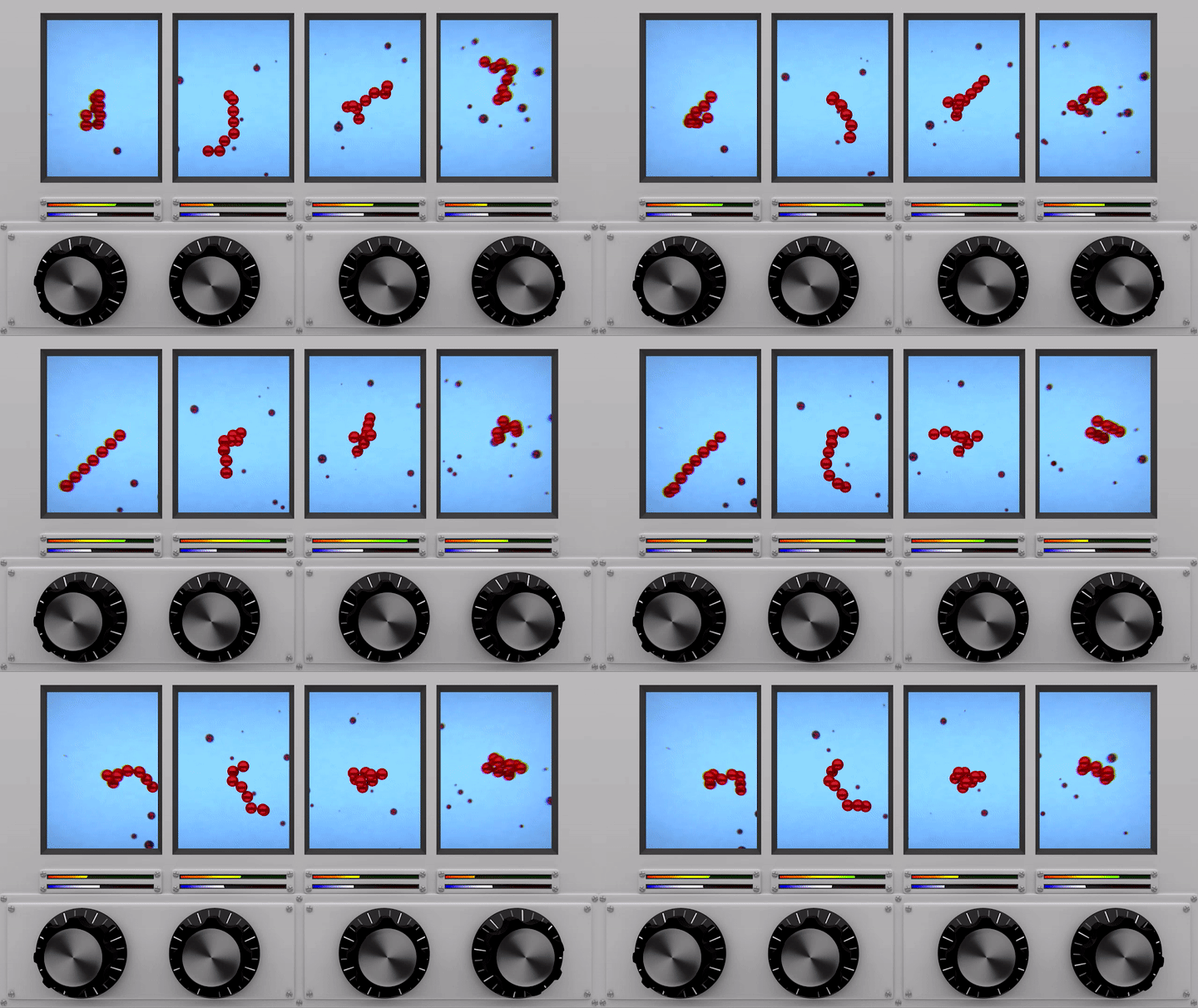
Animation above: NASA astronaut Ricky Arnold works within the Light Microscopy Module (LMM). Animation Credit: NASA.
Using different forms of energy as “control knobs,” scientists could embed a code at the nano-level of a material, giving it different instructions for various conditions. In the case of ACE-T-7, researchers are manipulating temperature to control the assembly and interactions of the particles. Suspended in a fluid medium, these particles are designed to bind to one another in specific ways to form 3D crystals when exposed to high or low temperatures.
“At one temperature, one crystallization phase is favored and at another, another crystallization phase is favored,” said New York University’s Stefano Sacanna, one of the project’s co-investigators. “Essentially temperature is an external stimuli to guide and help the particles bind in the right fashion. It is one way for us to guide them or control their assembly.”
This process is not much different from how living things are made in nature – building blocks that are strung together, behaving according to their genetic code.
Animation above: Researchers are manipulating temperature to control the assembly and interactions of the particles. Suspended in a fluid medium, these particles are designed to bind to one another in specific ways to form 3D crystals when exposed to high or low temperatures. Animation Credits: NASA/iGoal Animation.
“We try to understand the self-assembly of matter and potentially use this as a way to manufacture new materials,” said Sacanna.
On Earth, the force of gravity pulls all of the crystals to the bottom of the container, not allowing for observation. The microgravity environment of the space station allows researchers to observe how the crystals are growing, as well as separate the effects of gravity on the investigation.
“In the microgravity environment, the force on the particles is almost a million times smaller, so they will remain suspended in the fluid medium, and 3D crystals can be grown and observed without the damaging effects of sedimentation,” said New York University’s Andrew Hollingsworth, the one of the project’s co-investigators.
Investigation Seeks to Create Self-Assembling Materials
An increased understanding of how all of these particles interact together will help researchers bring this science to Earth in the form of additive manufacturing, in an effort to create evolvable materials with optimal properties.
This investigation was sponsored by the Space Life and Physical Sciences Research and Applications Division (SLPSRA) at NASA Headquarters in Washington.
Related links:
Advanced Colloids Experiment-Temperature-7 investigation (ACE-T-7): https://www.nasa.gov/mission_pages/station/research/experiments/explorer/Investigation.html?#id=1708
Space Life and Physical Sciences Research and Applications Division (SLPSRA): https://www.nasa.gov/directorates/heo/slpsra
Spot the Station: https://spotthestation.nasa.gov/
Space Station Research and Technology: https://www.nasa.gov/mission_pages/station/research/index.html
International Space Station (ISS): https://www.nasa.gov/mission_pages/station/main/index.html
Images (mentioned), Animations (mentioned), Video, Text, Credits: NASA/Michael Johnson/JSC/Jenny Howard.
Greetings, Orbiter.ch
lundi 14 mai 2018
45 Years Ago: Launch of Skylab, America's First Space Station
NASA - SkyLab Mission patch.
May 14, 2018
Skylab was America’s first space station and first manned research laboratory in space. Early visions of orbiting space stations predated the Space Age and the Soviet Union orbited its first experimental space station Salyut in 1971. The larger and more complex Skylab evolved out of the Apollo Applications Program of the late 1960s, which sought to repurpose any unused hardware from the Apollo Moon landing program.
Launch of Saturn V Carrying Skylab
Video above: Launch of Saturn V Skylab Space Station on May 14, 1973. Video Credit: NASA TV/NASA Videos Archives.
The Skylab complex consisted of four major components: the Orbital Workshop (OWS), the Airlock Module (AM), the Multiple Docking Adapter (MDA), and the Apollo Telescope Mount (ATM). The Apollo Command and Service Module transported crews to and from Skylab and remained attached to the station throughout a crew’s occupancy. The OWS, converted from the upper stage of a Saturn rocket, served as the main working, living and sleeping compartment for the crews, and contained exercise equipment, a galley, and many of the scientific experiments, in particular for the life sciences studies. Two large solar arrays on the OWS provided 12.4 kW of power to the station. The AM enabled astronauts to conduct spacewalks, while the MDA included a prime and backup docking port for the Apollo spacecraft and housed the Earth Resources Experiment Package. The ATM contained telescopes for solar observations and four solar arrays for additional power. Once in orbit, the complex weighed 170,000 pounds, by far the heaviest spacecraft to date.
Banner above: Skylab Program patch (left). Illustration of the Skylab space station and its components as it would have appeared without the damage incurred at launch (middle). Composite of the three three-person crews who completed long-duration missions aboard the space station (right). Banner Credit: NASA.
An unprecedented research laboratory in space, Skylab contained scientific equipment to conduct research in a variety of disciplines. Astronauts aboard the station conducted 270 experiments in biomedical and life sciences, Earth observations, solar astronomy and materials processing. Among the most important were investigations on the astronauts’ physiological responses to long-duration space flight. As originally envisioned, three successive three-person crews would spend 28, 56 and 56 days aboard the space station, launching in Apollo capsules atop Saturn 1B rockets. For the first time in human space flight, Skylab’s second docking port enabled a rescue capability. A second Apollo capsule carrying two astronauts could come to the aid of the resident three-person crew should their spacecraft become disabled, with all five returning to Earth in the new spacecraft.
Banner above: Rollout of Skylab atop its Saturn V rocket on April 16, 1973 (left). Two Saturn rockets on their respective pads (right): Skylab 1 atop its Saturn V on Pad 39A in the foreground and Skylab 2 atop its Saturn 1B on Pad 39B in the background. Banner Credit: NASA.
On May 14, 1973, the final Saturn V rocket thundered off Launch Pad 39A at Kennedy Space Center to lift the Skylab space station into orbit. At first, all appeared to be proceeding normally, but at about 63 seconds into the mission, flight controllers in Houston observed the first signs of trouble. Telemetry indicated premature deployment of the micrometeoroid shield, designed to protect the station from debris and also act as a thermal blanket, and at least one of the OWS solar arrays, events that should have taken place only once the station was in orbit. Less than 10 minutes after launch, Skylab reached orbit, separated from the Saturn V second stage and began a preprogrammed sequence to deploy the solar arrays and the ATM. Controllers noted that while the ATM and its arrays deployed normally, indications were that the main OWS arrays did not and were only generating 25 watts of power. Furthermore, with the loss of thermal protection from the missing micrometeoroid shield, temperatures inside the station were steadily rising to levels that would be intolerable for the crew, harmful to delicate equipment and ruin onboard consumables. Overheating and underpowered, Skylab was in serious trouble. Flight controllers faced a daunting challenge. To maximize power generation by the ATM solar arrays, the best attitude was to orient them toward the Sun but this caused maximal heating on the orbital workshop. Conversely, the optimal attitude to minimize the heat loads on the OWS significantly reduced power generation. After a day or so, controllers arrived at a compromise attitude to balance these competing factors while engineers and astronauts developed more permanent solutions.
Banner Above: Launch of the Skylab space station on May 14, 1973. It was the final launch of a Saturn V rocket. Banner Credit: NASA.
The launch of the first crew, planned to take place 24 hours after Skylab reached orbit, was delayed first by five days and, as troubleshooting continued, another five days until May 25. The crew, Commander Charles “Pete” Conrad, Pilot Paul J. Weitz, and Science Pilot Joseph P. Kerwin, flew back to Houston to begin training for what would become a seemingly impossible mission to rescue Skylab. Engineers, managers and astronauts at Marshall Space Flight Center and Johnson Space Center began working around the clock to find a solution to lower the station’s internal temperature and deploy the solar arrays to allow the Skylab program to continue.
NASA Administrator James C. Fletcher formed an investigation board to determine the cause of the failure of the micrometeoroid shield. They believed that the shield’s inability to withstand the supersonic air currents during launch was a contributing factor. Also, prelaunch testing focused on deployment of the shield in orbit, not surviving the aerodynamically stressful launch environment. Developers of the shield, the board concluded, did not spend enough time talking with aerodynamicists about the shield’s launch environment and its potential impacts on the hardware. Finally, managers treated the shield as a subsystem of the launch vehicle and therefore did not assign a dedicated project engineer to the shield to consider design and load concerns.
The next installment in this series will describe how NASA saved Skylab from its near-disastrous beginning and enabled its scientific potential to flourish.
Banner above: The backup Skylab workshop on display at the Smithsonian’s National Air and Space Museum (left). Image courtesy of NASM. View inside the Skylab trainer on display at Space Center Houston (right). Image courtesy of SCH. Banner Credit: NASA.
The backup Skylab OWS is displayed at the Smithsonian’s National Air and Space Museum in Washington, DC, while the Skylab training module is displayed at Space Center Houston.
Read Astronauts Paul Weitz’s and Joe Kerwin’s oral histories with the JSC History Office.
Related links:
Smithsonian’s National Air and Space Museum: https://airandspace.si.edu/collection-objects/orbital-workshop-skylab-backup-flight-unit
Space Center Houston: https://spacecenter.org/attractions/starship-gallery/skylab/
Astronaut Paul Weitz: https://www.jsc.nasa.gov/history/oral_histories/WeitzPJ/weitzpj.htm
Astronaut Joe Kerwin: https://www.jsc.nasa.gov/history/oral_histories/KerwinJP/kerwinjp.htm
Skylab: https://www.nasa.gov/mission_pages/skylab/
NASA History: https://www.nasa.gov/topics/history/index.html
Banners (mentioned), Video (mentioned), Text, Credits: NASA/Melanie Whiting.
Greetings, Orbiter.ch
Busy Astronauts Ramp Up for Spacewalk and Cygnus Cargo Mission
ISS - Expedition 55 Mission patch.
May 14, 2018
Veteran astronauts Ricky Arnold and Drew Feustel will embark on the 210th spacewalk Wednesday at the International Space Station to swap out thermal control gear. The experienced spacewalkers have a combined 10 spacewalks between them with Feustel having conducted seven and Arnold with a total of three.
Image above: The four astronauts who comprise the six-member Expedition 55 crew pose for a portrait inside the International Space Station. They are (clockwise from bottom right) NASA astronauts Ricky Arnold, Scott Tingle and Drew Feustel and Japan Aerospace Exploration Agency astronaut Norishige Kanai. Image Credit: NASA.
Flight Engineer Scott Tingle assisted the duo today getting spacewalk tools ready and recharging the U.S. spacesuits inside the U.S. Quest airlock. Tingle and Japanese astronaut Norishige Kanai will assist the spacewalkers in and out of the airlock Wednesday and guide the duo during their tasks.
Orbital ATK will launch their Cygnus space freighter on Sunday at 5:04 a.m. EDT to resupply the Expedition 55 crew just four days after Feustel and Arnold complete their fourth spacewalk together. After a four-day trip in space, Cygnus will deliver crew supplies, station hardware and experiments exploring a variety of subjects including life science and space physics.
Image above: Flying over South Pacific Ocean, seen by EarthCam on ISS, speed: 27'567 Km/h, altitude: 419,95 Km, image captured by Roland Berga (on Earth in Switzerland) from International Space Station (ISS) using ISS-HD Live application with EarthCam's from ISS on May 14, 2018 at 17:46 UTC. Image Credits: Orbiter.ch Aerospace/Roland Berga.
Arnold and Tingle practiced the robotics maneuvers today on a computer they will use to capture Cygnus after its approach and rendezvous with the station on May 24 at 5:20 a.m. NASA TV will broadcast the Cygnus launch and capture activities live at the orbital laboratory.
Related links:
Orbital ATK: https://www.nasa.gov/orbital
NASA TV: https://www.nasa.gov/multimedia/nasatv/index.html
Expedition 55: https://www.nasa.gov/mission_pages/station/expeditions/expedition55/index.html
Space Station Research and Technology: https://www.nasa.gov/mission_pages/station/research/index.html
International Space Station (ISS): https://www.nasa.gov/mission_pages/station/main/index.html
Images (mentioned), Text, Credits: NASA/Mark Garcia/Orbiter.ch Aerospace/Roland Berga.
Best regards, Orbiter.ch
Old Data Reveal New Evidence of Europa Plumes
NASA - Galileo Mission patch.
May 14, 2018
Scientists re-examining data from an old mission bring new insights to the tantalizing question of whether Jupiter’s moon Europa has the ingredients to support life. The data provide independent evidence that the moon’s subsurface liquid water reservoir may be venting plumes of water vapor above its icy shell.
Data collected by NASA’s Galileo spacecraft in 1997 were put through new and advanced computer models to untangle a mystery -- a brief, localized bend in the magnetic field -- that had gone unexplained until now. Previous ultraviolet images from NASA’s Hubble Space Telescope in 2012 suggested the presence of plumes, but this new analysis used data collected much closer to the source and is considered strong, corroborating support for plumes. The findings appear in Monday’s issue of the journal Nature Astronomy.
Image above: Artist’s illustration of Jupiter and Europa (in the foreground) with the Galileo spacecraft after its pass through a plume erupting from Europa’s surface. A new computer simulation gives us an idea of how the magnetic field interacted with a plume. The magnetic field lines (depicted in blue) show how the plume interacts with the ambient flow of Jovian plasma. The red colors on the lines show more dense areas of plasma. Image Credits: NASA/JPL-Caltech/Univ. of Michigan.
The research was led by Xianzhe Jia, a space physicist at the University of Michigan in Ann Arbor and lead author of the journal article. Jia also is co-investigator for two instruments that will travel aboard Europa Clipper, NASA’s upcoming mission to explore the moon’s potential habitability.
“The data were there, but we needed sophisticated modeling to make sense of the observation,” Jia said.
Jia’s team was inspired to dive back into the Galileo data by Melissa McGrath of the SETI Institute in Mountain View, California. A member of the Europa Clipper science team, McGrath delivered a presentation to fellow team scientists, highlighting other Hubble observations of Europa.
“One of the locations she mentioned rang a bell. Galileo actually did a flyby of that location, and it was the closest one we ever had. We realized we had to go back,” Jia said. “We needed to see whether there was anything in the data that could tell us whether or not there was a plume.”
At the time of the 1997 flyby, about 124 miles (200 kilometers) above Europa’s surface, the Galileo team didn't suspect the spacecraft might be grazing a plume erupting from the icy moon. Now, Jia and his team believe, its path was fortuitous.
When they examined the information gathered during that flyby 21 years ago, sure enough, high-resolution magnetometer data showed something strange. Drawing on what scientists learned from exploring plumes on Saturn’s moon Enceladus -- that material in plumes becomes ionized and leaves a characteristic blip in the magnetic field -- they knew what to look for. And there it was on Europa –- a brief, localized bend in the magnetic field that had never been explained.
Galileo carried a powerful Plasma Wave Spectrometer (PWS) to measure plasma waves caused by charged particles in gases around Europa’s atmosphere. Jia’s team pulled that data as well, and it also appeared to back the theory of a plume.
Image above: This image shows two views of the trailing hemisphere of Europa. The left image shows the approximate natural color appearance of Europa. The image on the right is a false-color composite version combining violet, green and infrared images to enhance color differences in the predominantly water-ice crust of Europa.
Image Credits: NASA/JPL-Caltech/DLR.
But numbers alone couldn’t paint the whole picture. Jia layered the magnetometry and plasma wave signatures into new 3D modeling developed by his team at the University of Michigan, which simulated the interactions of plasma with solar system bodies. The final ingredient was the data from Hubble that suggested dimensions of potential plumes.
The result that emerged, with a simulated plume, was a match to the magnetic field and plasma signatures the team pulled from the Galileo data.
“There now seem to be too many lines of evidence to dismiss plumes at Europa," said Robert Pappalardo, Europa Clipper project scientist at NASA’s Jet Propulsion Laboratory (JPL) in Pasadena, California. “This result makes the plumes seem to be much more real and, for me, is a tipping point. These are no longer uncertain blips on a faraway image."
The findings are good news for the Europa Clipper mission, which may launch as early as June 2022. From its orbit of Jupiter, Europa Clipper will sail close by the moon in rapid, low-altitude flybys. If plumes are indeed spewing vapor from Europa’s ocean or subsurface lakes, Europa Clipper could sample the frozen liquid and dust particles. The mission team is gearing up now to look at potential orbital paths, and the new research will play into those discussions.
“If plumes exist, and we can directly sample what’s coming from the interior of Europa, then we can more easily get at whether Europa has the ingredients for life,” Pappalardo said. “That’s what the mission is after. That’s the big picture.”
JPL manages the Europa Clipper mission for the agency's Science Mission Directorate.
Related links:
NASA’s Galileo spacecraft: https://solarsystem.nasa.gov/missions/galileo/in-depth/
Europa Clipper: http://www.nasa.gov/europa
Europa (Moon): https://www.nasa.gov/subject/3148/europa-moon
Images (mentioned), Text, Credits: NASA/Dwayne Brown/JoAnna Wendel/Sean Potter/JPL/Gretchen McCartney.
Greetings, Orbiter.ch
dimanche 13 mai 2018
Operation IceBridge Completes Survey Flights to Map Arctic Ice
NASA - Operation IceBridge Mission patch.
May 13, 2018
Operation IceBridge, NASA’s longest-running airborne mission to monitor polar ice change, concluded this year’s springtime survey of Arctic sea and land ice on May 2. The flights, which began on March 22, covered the western basin of the Arctic Ocean and Greenland’s fastest-changing glaciers.
Image above: A large iceberg floating among sea ice floes, as seen during an operation IceBridge survey flight on April 21, 2018. Image Credits: NASA/Linette Boisvert.
“This campaign achieved most of our primary objectives in surveying the state of Arctic ice," said IceBridge’s acting project scientist Joe MacGregor. “We’ve now flown many of these missions ten years in a row, a period that has included continued rapid change in both Arctic glaciers and sea ice."
The image above was taken during a research flight carried out on April 21 near Vestfjord Glacier in Scoresby Sund, along the eastern coast of Greenland. The photo shows a large iceberg that has broken the surrounding layer of consolidated sea ice. Flat floes of sea ice with fresh snow on top, areas of open water that are beginning to refreeze and neighboring smaller icebergs are visible.
During the first weeks of the campaign, IceBridge was based in Thule Air Base, in northwest Greenland, and in Fairbanks, Alaska. From these two bases, IceBridge mapped sea ice in the Chukchi and Beaufort seas and in the central Arctic Ocean as well as the quickly evolving Petermann Glacier in northeast Greenland. On April 20, the IceBridge team relocated to Kangerlussuaq – just north of the Arctic Circle in central west Greenland – from where it launched flights to measure land ice.
ESA's CryoSat-2 satellite. Image Credit: ESA
This Arctic season, IceBridge completed most of its sea and land ice baseline flights — surveys that are repeated year after year to monitor regions that have been changing rapidly over the last decades. In total, the campaign included 20 eight-hour flights: Eight flights focused on surveying sea ice, while the remaining 12 flights targeted land ice. Several flights included collaborations with international missions, such as underflights of the ESA's (European Space Agency) Sentinel-3A and CryoSat-2 satellites over sea ice, overflights of the U.S. Navy’s 2018 ICEX campaign over sea ice north of Alaska and of Danish PROMICE meteorological stations in Greenland, and an intercomparison of radar systems in northeast Greenland with Germany’s Alfred Wegener Institute. IceBridge also flew over an unusual polynya — an opening in the midst of the sea ice pack — north of Greenland shortly after it had frozen up, and the measurements it collected will help unravel the evolution of sea ice there.
NASA’s P-3 Orion refueling. Image Credit: NASA
For this field campaign, IceBridge flew on NASA’s P-3 Orion, which is based at NASA’s Wallops Flight Facility in Virginia. The plane carried a comprehensive instrument suite: a dual-color laser altimeter that measures surface elevation by transmitting both infrared and green laser pulses, three types of radar systems to study ice layers and the bedrock underneath, a high-resolution camera to create color maps of ice, a hyperspectral imager that takes measurements over hundreds of wavelengths, and infrared cameras to measure surface temperatures of sea and land ice.
“This was the last IceBridge campaign to occur before the expected launch of ICESat-2 [Ice, Cloud, and land Elevation Satellite-2]”, said Nathan Kurtz, who is IceBridge’s outgoing project scientist and the new deputy project scientist for ICESat-2. “We achieved good coverage of the Arctic sea ice pack, fast changing glacier areas and overflights of 4,550 miles of future ICESat-2 tracks to ensure continuity between multiple altimetry missions over a long time period.”
ICESat-2 satellite. Image Credit: NASA
The mission of Operation IceBridge is to collect data on changing polar land and sea ice and maintain continuity of measurements between NASA’s ICESat missions. The original ICESat mission launched in 2003 and ended in 2009, and its successor, ICESat-2, is scheduled for launch in September 2018. Operation IceBridge began in 2009 and is currently funded until 2020.
For more about Operation IceBridge and to follow future campaigns, visit: http://www.nasa.gov/icebridge
Click here for more photos: https://www.flickr.com/photos/nasa_ice/sets/72157668751858878
IceBridge: http://www.nasa.gov/mission_pages/icebridge/index.html
ICESat-2: http://www.nasa.gov/content/goddard/icesat-2
CryoSat: https://www.esa.int/Our_Activities/Observing_the_Earth/CryoSat
Wallops Flight Facility: https://www.nasa.gov/centers/wallops/home/
Goddard Space Flight Center: https://www.nasa.gov/centers/goddard/home/index.html
Images (mentioned), Text, Credits: NASA/Sara Blumberg/Earth Science News Team, by Maria-José Viñas.
Greetings, Orbiter.ch
Inscription à :
Articles (Atom)