lundi 29 octobre 2018

Launch Results of the H-IIA F40 Encapsulating GOSAT-2 and KhalifaSat


JAXA - Greenhouse Gases Observing Satellite GOSAT Project logo.

October 29, 2018

H-IIA Launches GOSAT-2 and KhalifaSat

Mitsubishi Heavy Industries, Ltd. and JAXA successfully launched H-IIA Launch Vehicle No. 40 (H-IIA F40) which encapsulates Second Greenhouse Gases Observing Satellite "IBUKI-2" (GOSAT-2) and KhalifaSat, a remote sensing Earth observation satellite. at 13:08:00 on October 29, 2018 JST (04:08 UTC) from the JAXA Tanegashima Space Center.

H-IIA F40 launches GOSAT-2 and KhalifaSat

The launch and flight of H-IIA F40 proceeded as planned. The separations of GOSAT-2 and KhalifaSat were confirmed respectively at approximately 16 minutes and 09 seconds and 24 minutes and 15 seconds after liftoff.

Greenhouse gases Observing SATellite-2 "IBUKI-2" (GOSAT-2)

GOSAT-2 or IBUKI-2 (いぶき2号) is JAXA's Second Greenhouse Gases Observing Satellite and KhalifaSat (خليفة سات) is a remote sensing Earth observation satellite, developed by the Mohammed bin Rashid Space Centre (MBRSC) in the United Arab Emirates.

GOSAT-2 deployment

JAXA we express sincere appreciation for all.

H-IIA Launch Vehicle No. 40 Flight Sequence (Quick Estimation): http://global.jaxa.jp/press/2018/10/files/H-IIA_F40_Flight_Sequence.pdf

MHI LAUNCH SERVICES: https://www.mhi.com/products/space/launch_service.html

H-IIA Launch Vehicle: http://global.jaxa.jp/projects/rockets/h2a/

Greenhouse gases Observing SATellite-2 "IBUKI-2" (GOSAT-2): http://global.jaxa.jp/projects/sat/gosat2/index.html

Special Website: Earth Observation Satellites: http://fanfun.jaxa.jp/eos/en/index.html

Images, Video, Text, Credits: Japan Aerospace Exploration Agency (JAXA)/National Research and Development Agency/Mitsubishi Heavy Industries, Ltd./SciNews.

Best regards, Orbiter.ch

dimanche 28 octobre 2018

LandSpace ZhuQue-1 first launch


LandSpace logo.

28 oct. 2018

LandSpace ZhuQue-1 rocket launch

LandSpace ZhuQue-1 rocket launched the Weilai-1 (Future-1) satellite from the Jiuquan Satellite Launch Center, Gansu Province, northwest China, on 27 October 2018, at 08:00 UTC (16:00 local time).

LandSpace ZhuQue-1 first launch

According to Zhang Changwu (CEO, LandSpace Technology Corporation), the spacecraft failed to achieve orbit due to an issue with the third stage.

Weilai-1 or “Future 1”

This was the first launch of the ZhuQue-1 (ZQ-1, 朱雀一号) launch vehicle, developed by LandSpace Technology Corporation (蓝箭, Blue Arrow), a private company located in Huzhou City, Zhejiang Province, east China. Weilai-1 or “Future 1” was a small satellite owned by China Central Television (CCTV) and intended for scientific experiments and Earth observation.

LandSpace ZhuQue-1 rocket

A Zhuque 1 rocket developed by the Chinese private launch company LandSpace lift off its inaugural flight carrying the Weilai 1 microsatellite into orbit for China Central Television.

For more information about LandSpace: http://www.landspace.com/

Images, Video, Text, Credits: LandSpace/Günter Space Page/CCTV/SciNews.

Greetings, Orbiter.ch

vendredi 26 octobre 2018

The Surprising Coincidence Between Two Overarchieving NASA Missions


NASA - Dawn Mission patch / NASA - Kepler Space Telescope patch.

Oct. 26, 2018

Two vastly different NASA spacecraft are about to run out of fuel: The Kepler spacecraft, which spent nine years in deep space collecting data that detected thousands of planets orbiting stars outside our solar system, and the Dawn spacecraft, which spent 11 years orbiting and studying the main asteroid belt's two largest objects, Vesta and Ceres.

However, the two record-setting missions have more in common than their coincidentally low fuel levels. Both missions gathered data that broke new scientific ground, searching for answers inside and outside our solar system.


Image above: Illustration of NASA's Dawn spacecraft, with its distinctive ion propulsion. Image Credit: NASA.

Launched in 2007, Dawn was the first spacecraft to orbit a body between Mars and Jupiter, and the first to orbit more than one deep-space destination. From 2011 to 2012, Dawn studied the asteroid Vesta before pulling off an unprecedented maneuver by leaving orbit and traveling to Ceres, which it observed for over 3.5 years. Dawn will remain in a stable orbit around Ceres for decades. Among its many findings, Dawn helped scientists discover organics on Ceres and evidence that dwarf planets could have hosted oceans over a significant part of their history — and possibly still do.


Image above: Illustration of NASA's Kepler spacecraft. Image Credit: NASA.

Kepler, meanwhile, launched in 2009 and revealed that there is statistically at least one planet around every star in our galaxy. It also opened our eyes to the variety of worlds beyond our solar system, with its discovery of more than 2,600 planets orbiting other stars. Among these worlds are rocky, Earth-size planets, some of which orbit within their stars' habitable zones, where liquid water could pool on the surface. Kepler also characterized a class of planets that don't exist in our solar system: worlds between the sizes of Earth and Neptune, or "super-Earths."

Both missions were extended past their originally anticipated lifetime because of the innovative work of their engineers and scientists. In 2016, Dawn's mission at Ceres was extended. In 2017, its mission at Ceres was extended again to study the dwarf planet from altitudes as low as 22 miles (35 kilometers) above Ceres's surface, with the main goal of understanding the evolution of Ceres and possibly active geology.

Dawn spacecraft traveling to Ceres. Animation Credit: NASA

In 2012, Kepler completed its primary mission and was awarded an extension. After the failure of a second gyroscope that kept the spacecraft steady in 2013, clever engineers found a way to use solar pressure to keep the spacecraft temporarily pointed in a desired direction. Starting in 2014, this new mission was dubbed K2. It has been running ever since, gathering science from 19 different patches of sky with populations of stars, galaxies and solar system objects.

Kepler Space Telescope. Animation Credit: NASA

Both missions, with their vastly distinct data sets, have given scientists here on Earth a lot to think about. From Dawn's mission, we found that Ceres may still be geologically active and could have had briny water rising and depositing salts on its surface. From Kepler's mission, we learned that planets are more common than stars in our galaxy and that many of them could be promising for life as we know it. It also showed us the diversity of planets and planetary systems out there, some of which are very different than ours.

As we prepare to say goodbye to these two record-breaking missions, we rejoice in the fact that discoveries will still arise from their data decades into the future.

Related articles:

The Legacy of NASA’s Dawn, Near End of Mission:
https://orbiterchspacenews.blogspot.com/2018/09/the-legacy-of-nasas-dawn-near-end-of.html

Rocky? Habitable? Sizing up a Galaxy of Planets:
https://orbiterchspacenews.blogspot.com/2018/10/rocky-habitable-sizing-up-galaxy-of.html

Kepler and K2: https://www.nasa.gov/mission_pages/kepler/main/index.html

Dawn: https://www.nasa.gov/dawn and https://dawn.jpl.nasa.gov

Images (mentioned), Animations (mentioned), Text, Credit: NASA.

Greetings, Orbiter.ch

Spacesuits and High-Temp, Fire Science Focus of Crew Today


ISS - Expedition 57 Mission patch.

October 26, 2018

U.S. spacesuits and hot, fiery research kept the Expedition 57 crew busy Friday. The three-member crew from around the world also continued the ongoing upkeep of the International Space Station’s systems.

A pair of spacesuits inside the Quest airlock had their cooling loops scrubbed today by station Commander Alexander Gerst of ESA (European Space Agency). The suit maintenance comes ahead of a pair of spacewalks being planned to connect new lithium-ion batteries on the space station’s port truss structure.


Image above: Official crew portrait of Expedition 57 crew members (from left) Serena Auñón-Chancellor of NASA, Alexander Gerst of ESA (European Space Agency) and Sergey Prokopyev of Roscosmos. Image Credit: NASA.

Fellow flight engineers Serena Auñón-Chancellor of NASA and Sergey Prokopyev of Roscosmos worked on advanced science hardware. The two devices, the Electrostatic Levitation Furnace (ELF) and the Combustion Integrated Rack (CIR), enable the safe research of high temperatures, flames and gases.

Auñón-Chancellor cleaned up the ELF inside the Kibo lab module after removing samples exposed to extremely high temperatures. Scientists are observing how microgravity affects the thermophysical properties of a variety materials at different temperatures.

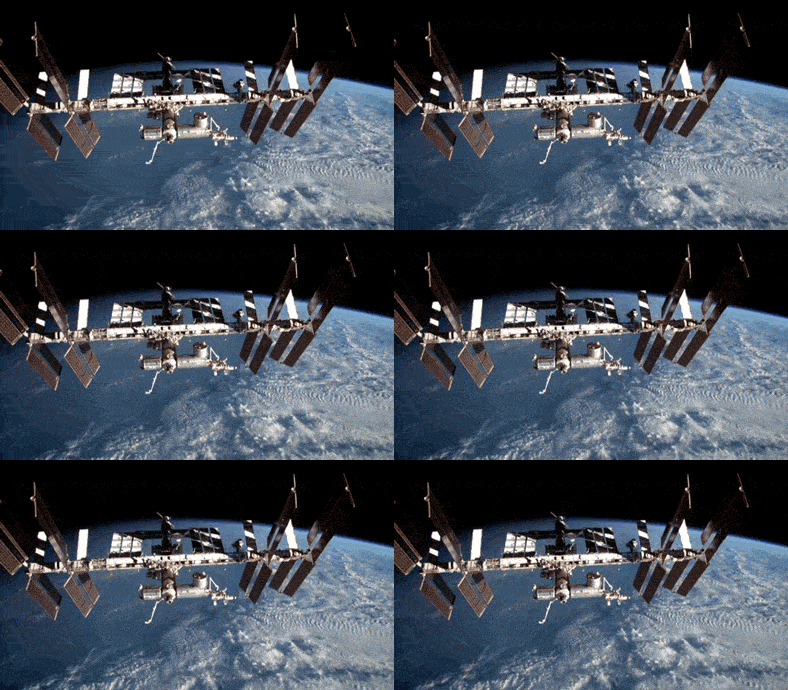
International Space Station (ISS). Animation Credit: NASA

Prokopyev worked in the Destiny lab module replacing fuel bottles for experiments inside the CIR researching how fuels and flames burn in space. Results may guide the development of rocket engines and fire safety aboard spacecraft.

Related links:

Expedition 57: https://www.nasa.gov/mission_pages/station/expeditions/expedition57/index.html

Electrostatic Levitation Furnace (ELF): https://www.nasa.gov/mission_pages/station/research/experiments/explorer/Facility.html?#id=1536

Combustion Integrated Rack (CIR): https://www.nasa.gov/mission_pages/station/research/experiments/explorer/Facility.html?#id=317

Space Station Research and Technology: https://www.nasa.gov/mission_pages/station/research/index.html

International Space Station (ISS): https://www.nasa.gov/mission_pages/station/main/index.html

Image (mentioned), Animation (mentioned), Text, Credits: NASA/Mark Garcia.

Best regards, Orbiter.ch

Scientists Take a New Look at Protecting Vision in Space


ISS - International Space Station logo.

Oct. 26, 2018

Mice that flew aboard the International Space Station contributed to a variety of scientific studies through an innovative program that shares tissue samples with researchers around the globe.

One participating investigation, Mouse Epigenetics, is the first study to identify specific changes in eye tissue, particularly blood vessels, in response to microgravity. These results were recently published in the International Journal of Molecular Sciences.


Image above: Glove Box set up on the Kobairo Rack for the Mouse Epigenetics experiment in the Kibo Japanese Experiment Pressurized Module (JPM). Image Credit: JAXA.

The group of mice spent 35 days in the Habitat Cage Unit (HCU) installed in the space station’s Japan Aerospace Exploration Agency (JAXA) Kibo facility. Some mice were kept in the space station’s microgravity environment and others in artificial Earth gravity, or 1 g, produced by a rotating centrifuge in the HCU. The ability to produce this artificial gravity means that most environmental conditions associated with spaceflight remain, except the mice experienced the same level of gravity as on Earth. That allowed the researchers to test, for the first time, the effectiveness of using artificial gravity to reduce effects of exposure to microgravity.

Previous research suggests that one of the responses of the human body to spaceflight and microgravity is oxidative stress. An imbalance between the reactive oxygen generated by normal cell metabolism and the cell’s ability to handle toxic byproducts from that metabolism, oxidative stress produces peroxides and free radicals, unstable atoms that can damage cells. On Earth, oxidative stress is a normal beneficial cell process but in excess is associated with cancers, Parkinson’s disease, cardiovascular disease, and many other conditions.

The mouse epigenetics investigators wanted to examine whether the space-flown mice experienced increased oxidative stress and cellular damage in eye tissue, along with changes in proteins associated with various cellular functions in the eye. They also examined whether application of artificial gravity would lessen these changes.


Image above: JAXA astronaut Kimiya Yui setting up the Mouse Epigenetics experiment onboard the space station. Image Credit: JAXA.

Sure enough, the mice in microgravity experienced higher rates of apoptosis in retinal vascular cells than the mice in artificial gravity and controls on the ground. (Apoptosis, or programmed cell death, is the death of cells that are no longer needed in the body and is a normal part of growth and development.) Analysis also showed the mice in microgravity had significant alteration of proteins responsible for cell death, cell repair, inflammation and metabolic function in the eye.

“This is the first study to establish that there are some significant changes in the protein composition of the eye in microgravity,” said Michael Delp of Florida State University, one of the paper’s authors. “We believe oxidative stress may be the primary factor in damage of blood vessels in the eye, which we believe could play a big role in impairing vision both in microgravity and on Earth.”

A significant number of astronauts report vision impairment during their time in space that continues after returning to Earth, and its cause has been the subject of many studies aboard the orbiting laboratory.

“We saw biomarkers for oxidative stress, which is significant because it suggests to us why the damage occurs,” said Xiao W. Mao of Loma Linda University School of Medicine and Medical Center in California and also one of the authors. “Once we know that, we can eventually develop countermeasures to crack the problem, not only for spaceflight but for age-related oxidative damage on Earth.”


Image above: The team of scientists analyzing tissue samples from the ground control mice in Japan. Image Credits: Michael Delp, Florida State University.

The study also is the first to provide evidence that artificial gravity could provide some protection against such impairment.

“Another big takeaway from this study is that application of artificial gravity can mitigate a lot of the worst effects we found,” Delp said.

The next step, the researchers said, is testing the potential protection from different levels of artificial gravity. This could provide insight into the effects on travelers to, for example, the Moon and Mars, which have a fraction of Earth’s gravity. In addition, researchers want to look at longer-term changes by keeping mice in space for 60 or 90 days.

This investigation represents the first NASA-JAXA publication from a collaboration under the Japan-U.S. Open Platform Partnership Program (JP-US OP3).

International Space Station (ISS). Image Credit: NASA

“It was very important to our work that JAXA was willing to share tissue from the experiment,” said Mao. “All the collaboration and support was very important.”

Satoru Takahashi with the University of Tsukuba, Japan, was a principal investigator for the Mouse Epigenetics investigation. The research was supported by grants from NASA Space Biology, National Institutes of Health (NIH), and Loma Linda University Department of Basic Sciences. The University of Arkansas for Medical Sciences Proteomics Facility and Arkansas Children’s Research Institute Developmental Bioinformatics Core provided technical support.

Related links:

Mouse Epigenetics: https://www.nasa.gov/mission_pages/station/research/experiments/explorer/Investigation.html?#id=1731

Habitat Cage Unit (HCU): http://iss.jaxa.jp/en/kiboexp/pm/mhu/

Oxidative stress: https://www.sciencedirect.com/science/article/pii/S1357272506002196?via%3Dihub

Japan Aerospace Exploration Agency (JAXA): http://global.jaxa.jp/

Space Station Research and Technology: https://www.nasa.gov/mission_pages/station/research/index.html

International Space Station (ISS): https://www.nasa.gov/mission_pages/station/main/index.html

Images (mentioned), Text, Credits: NASA/Michael Johnson/JSC/International Space Station Program Science Office/Melissa Gaskill.

Greetings, Orbiter.ch

Jovian White Oval


NASA - JUNO Mission logo.

Oct. 25, 2018


A swirling, oval white cloud in Jupiter’s South South Temperate Belt is captured in this image from NASA's Juno spacecraft. Known as White Oval A5, the feature is an anticyclonic storm. An anticyclone is a weather phenomenon where winds around the storm flow in the direction opposite to those of the flow around a region of low pressure.

Juno took the two images used to produce this color-enhanced view on Sept. 6, 2018, at 6:45 p.m. PDT (9:45 p.m. EDT) and 6:58 p.m. PDT (9:58 p.m. EDT) as the Juno spacecraft performed its 15th close flyby of Jupiter. At the time the images were taken, the spacecraft was about 25,000 miles (40,500 kilometers) to 39,000 miles (63,000 kilometers) from Jupiter's cloud tops, above a southern latitude spanning from about 54 to 66 degrees.

Juno orbiting Jupiter

Citizen scientist Kevin M. Gill created this image using data from the spacecraft's JunoCam imager.

JunoCam's raw images are available for the public to peruse and to process into image products at: http://missionjuno.swri.edu/junocam.  

More information about Juno is at: http://www.nasa.gov/juno and http://missionjuno.swri.edu.

Image, Animation, Text, Credits: NASA/Jon Nelson/JPL-Caltech/SwRI/MSSS/Kevin M. Gill.

Greetings, Orbiter.ch

A changing crater: Honouring a renowned Mars scientist


ESA - Mars Express Mission patch.

26 October 2018

Mars Express

The surface of Mars may appear to be perpetually still, but its many features are ever-changing – as represented in this Mars Express view of the severely eroded Greeley impact crater.

Greeley crater, named for the renowned planetary scientist Ronald Greeley, is located in one of the most ancient parts of Mars: a section of the planet’s southern highlands named Noachis Terra.

 Perspective view of Greeley Crater

This region is thought to be some four billion years old, and is thus home to many features that formed in the very earliest days of the Solar System. Many craters have formed, changed, and eroded away in Noachis Terra, and Greeley crater is no exception.

The subject of these Mars Express images sits between two huge, deep impact basin plains, Argyre and Hellas, and is a great example of a very old crater that has endured significant erosion over time.

Greeley Crater in context

Wind, water, ice, and subsequent impacts have all played a part in wearing down the once-fresh structure of the crater. They have smoothed away and removed its walls and rims, erased any characteristic patterns in the nearby landscape that may have formed alongside the crater (such as ‘ejecta’, or rays of material flung out from an impact site), and infilled and flattened out its floor.

This floor is covered with a number of smaller impact pits and pockmarks that have occurred since Greeley crater’s formation – another clear indication of the crater’s immense age. With a depth of only 1.5 km Greeley crater is actually relatively shallow for a martian crater, making it somewhat difficult to pick out from the surrounding terrain.

Mars Express plan view of Greeley Crater

Accompanying views of the crater show it in a wider context on Mars, colour-coded by topography – highlighting the relative depths of the crater, its broken-down wall, smaller superimposed craters, and other features throughout the region – and also via an oblique perspective, which looks across the crater towards the south-west. Together, these images well-characterise the crater and its environment, and offer an intriguing insight into this ancient region on our planetary neighbour.

Greeley crater earned its moniker following a proposal by the International Astronomical Union in 2015 to name the crater after distinguished planetary scientist Ronald Greeley. Greeley passed away on 27 October 2011.

Topography of Greeley Crater

Alongside significant work in planetary science spanning not only Mars and related missions but also lunar research and missions to Venus, Jupiter, Uranus, and Neptune, Greeley was a Regents’ Professor of planetary geology at Arizona State University from 1977 to 2011, and co-investigator of the Mars Express High Resolution Stereo Camera (HRSC) – the instrument that gathered the data used in these images.

Related links:

Mars Express: http://www.esa.int/Our_Activities/Space_Science/Mars_Express

Mars Express overview: http://www.esa.int/Our_Activities/Space_Science/Mars_Express_overview

Animation, Images, Text, Credits: ESA/DLR/FU Berlin, CC BY-SA 3.0 IGO/NASA MGS MOLA Science Team/ATG Medialab.

Best regards, Orbiter.ch