mardi 5 février 2019

Arianespace orbits two telecommunications satellites on first Ariane 5 launch of 2019


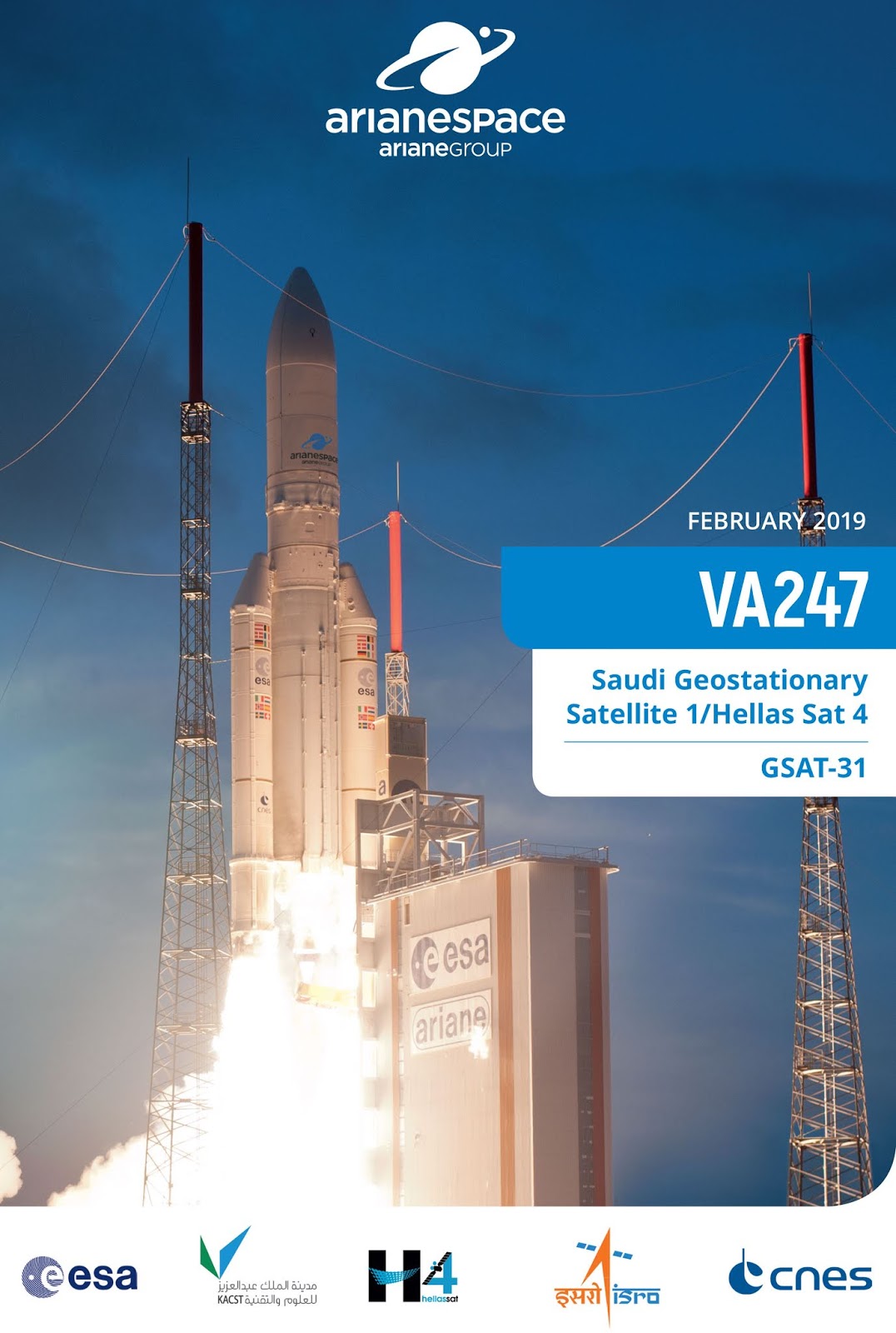
ARIANESPACE - Ariane 5 / Flight VA247 Mission poster.

February 5, 2019

Flight VA247 was performed by an Ariane 5 ECA version

Arianespace has successfully orbited two telecommunications satellites: the Saudi Geostationary Satellite 1/Hellas Sat 4 condosat for operators KACST and Hellas Sat; and GSAT-31 for the Indian Space Research Organisation (ISRO).


Arianespace’s first launch of the year took place on Tuesday, February 5 at 6:01 p.m. (local time) from the Guiana Space Center (CSG), Europe’s Spaceport in French Guiana (South America).

Today’s launch was the 103rd Ariane 5 mission, bringing the number of geostationary satellites launched by Arianespace to 374.

Arianespace Flight VA247 – GSAT-31 - Successful Mission

Following the announcement of this first successful launch of the year, Stéphane Israël, Chief Executive Officer of Arianespace, said: “This year we kick off the 40th anniversary celebration of the first launch of Europe’s Ariane rocket with a successful launch of Ariane 5. Through this emblematic flight, Arianespace underscores the reliability of our heavy launcher, the benchmark in the launch segment for geostationary telecommunications satellites. By carrying out a mission for long-lasting customers from three continents – Arabsat, KACST, Hellas Sat and ISRO – we continue to prove the attractiveness of Arianespace’s launch services for customers from around the world, both institutional and commercial.”

Saudi Geostationary Satellite 1/Hellas Sat 4

Composed of two payloads, Saudi Geostationary Satellite 1/Hellas Sat 4, also called HS- 4/SGS-1, is a geostationary condosat for KACST (King Abdulaziz City for Science and Technology – Saudi Arabia) and Hellas Sat (Greece – Cyprus). To be installed as Flight VA247’s upper passenger, HS-4/SGS-1 will provide telecommunications capabilities, including television, Internet, telephone and secure communications in the Middle East, South Africa and Europe.

The Saudi Geostationary Satellite 1 communications payload will provide advanced Ka-band spot beam communications services for the Kingdom of Saudi Arabia’s KACST, including secure communications for the Gulf Cooperative Council region. KACST is an independent scientific organization of the government of Saudi Arabia that is responsible for the promotion of science and technology in the Kingdom.

GSAT-31

Following the launch of GSAT-11 for the Indian Space Research Organisation (ISRO) using the yearending Ariane 5 of 2018, Arianespace will orbit GSAT-31 utilizing the initial Ariane 5 in 2019.

To be installed as Flight VA247’s lower passenger, GSAT-31 is a telecommunications satellite designed and manufactured by the Indian space agency. To be positioned at a longitude of 48° East, GSAT-31 is configured on ISRO’s enhanced I-2K bus structure to provide communications services from geostationary orbit in Ku-band for a lifetime greater than 15 years.

By operating GSAT-31, ISRO will – once again – foster the use of space to help bridge the digital divide in the Indian subcontinent as part of its ambitious space program, whose objectives are to develop India while pursuing science research and planetary exploration.

For more information about Arianespace, visit: http://www.arianespace.com/

Images, Video, Text, Credit: Arianespace.

Greetings, Orbiter.ch

Human, Physics Research as U.S. Spaceship Preps for Departure


ISS - Expedition 58 Mission patch.

February 5, 2019

The Expedition 58 crew participated in a suite of psychological, biomedical and physics experiments today. The orbital residents are also getting ready to send off a U.S. cargo craft on Friday.

International Space Station (ISS). Image Credit: NASA

Astronauts Anne McClain and David Saint-Jacques collaborated today on an experiment that observes how living in a spacecraft for long periods impacts crew behavior. The duo typed personal impressions about working in space in a private journal then took a robotics test to measure cognition. The astronauts also answered a questionnaire to gather more cognitive data before going to sleep.

McClain also collected and stored biological samples for a pair of human research studies looking at physiological changes and negative effects on bone marrow and blood cells. Saint-Jacques looked at how fluid mechanics affects fuel tanks in spaceships and ocean systems on Earth.


Image above: Anne McClain of NASA looks at a laptop computer screen inside the U.S. Destiny laboratory module during ground conference operations. Image Credit: NASA.

Commander Oleg Kononenko focused his day inside the station’s Russian segment. The veteran cosmonaut worked on computers, maintained life support systems and photographed Earth landmarks today.

Friday at 11:10 a.m. EST, Northrop Grumman’s Cygnus space freighter will depart the station after 81 days attached to the Unity module. Robotics controllers will remotely guide the Canadarm2 robotic arm to grapple Cygnus overnight. McClain will then command the Canadarm2 on Friday to release Cygnus back into Earth orbit as Saint-Jacques backs her up and monitors the activities.

Cygnus has more to do after its release. It will begin to deploy several sets of CubeSats after it reaches a safe distance from the space station. The U.S. resupply ship will then reenter Earth’s atmosphere in late February over a remote portion of the Pacific Ocean for a fiery but safe destruction.

NASA Airs Departure of US Cargo Ship from International Space Station

Three months after delivering several tons of supplies and science to the International Space Station, Northrop Grumman’s Cygnus cargo craft will depart the complex at 11:10 a.m. EST Friday, Feb. 8. Live coverage will begin at 10:45 a.m. on NASA Television and the agency’s website.

Expedition 58 Flight Engineers Anne McClain of NASA and David Saint-Jacques of the Canadian Space Agency will use the station’s Canadarm2 robotic arm to release Cygnus after ground controllers unbolt the spacecraft from the Earth-facing port of the Unity module and maneuver it to the release position.


Image above: Northrop Grumman's Cygnus spacecraft, with its prominent cymbal-shaped UltraFlex solar arrays, is pictured Nov. 19, 2018, in the grips of the International Space Station's Canadarm2 robotic arm after it was captured by Expedition 57 Flight Engineer Serena Auñón-Chancellor and ESA (European Space Agency) astronaut Alexander Gerst. Image Credit: NASA.

Cygnus will depart the station with 5,500 pounds of trash and carry out an extended mission over about two weeks. The spacecraft will maneuver to a higher altitude where an CubeSat deployer will release two CubeSats into orbit through a service provided by industry partner NanoRacks to provide increased commercial access to space. Cygnus then will move to a lower orbit to deploy a third CubeSat, KickSat-2, which carries 100 tiny satellites called femtosatellites. The femtosatellites each include a power, sensor and communication system on a printed circuit board that measures 3.5 by 3.5 cm, with a thickness of a few millimeters and a mass of less than 3.5 ounces. These deployments demonstrate additional commercial activity and technology advancements enabled by the partnerships forged through the orbiting laboratory and the potential for future opportunities. 

Cygnus is scheduled to deorbit Feb. 25 and enter the Earth’s atmosphere, burning up harmlessly over the Pacific Ocean. There will be no television coverage of Cygnus’ deorbit.

Related links:

Expedition 58: https://www.nasa.gov/mission_pages/station/expeditions/expedition58/index.html

Crew behavior: https://www.nasa.gov/mission_pages/station/research/experiments/explorer/Investigation.html?#id=7537

Bone marrow and blood cells: https://www.nasa.gov/mission_pages/station/research/experiments/explorer/Investigation.html?#id=1673

Fluid mechanics: https://www.nasa.gov/mission_pages/station/research/experiments/explorer/Investigation.html?#id=2043

CubeSat deployer: https://www.nasa.gov/mission_pages/station/research/experiments/2281.html

NanoRacks: http://nanoracks.com/products/satellite-deployment/

KickSat-2: https://www.nasa.gov/mission_pages/station/research/experiments/explorer/Investigation.html?#id=7339

Commercial Resupply: http://www.nasa.gov/mission_pages/station/structure/launch/index.html

Cygnus space freighter: https://www.nasa.gov/feature/northrop-grumman-cygnus-launches-arrivals-and-departures/

Unity module: https://www.nasa.gov/mission_pages/station/structure/elements/unity

Canadarm2 robotic arm: https://www.nasa.gov/mission_pages/station/structure/elements/mobile-servicing-system.html

Space Station Research and Technology: https://www.nasa.gov/mission_pages/station/research/index.html

International Space Station (ISS): https://www.nasa.gov/mission_pages/station/main/index.html

Images (mentioned), Text, Credits: NASA/Mark Garcia/Karen Northon/JSC/Gary Jordan.

Best regards, Orbiter.ch

lundi 4 février 2019

InSight's Seismometer Now Has a Cozy Shelter on Mars


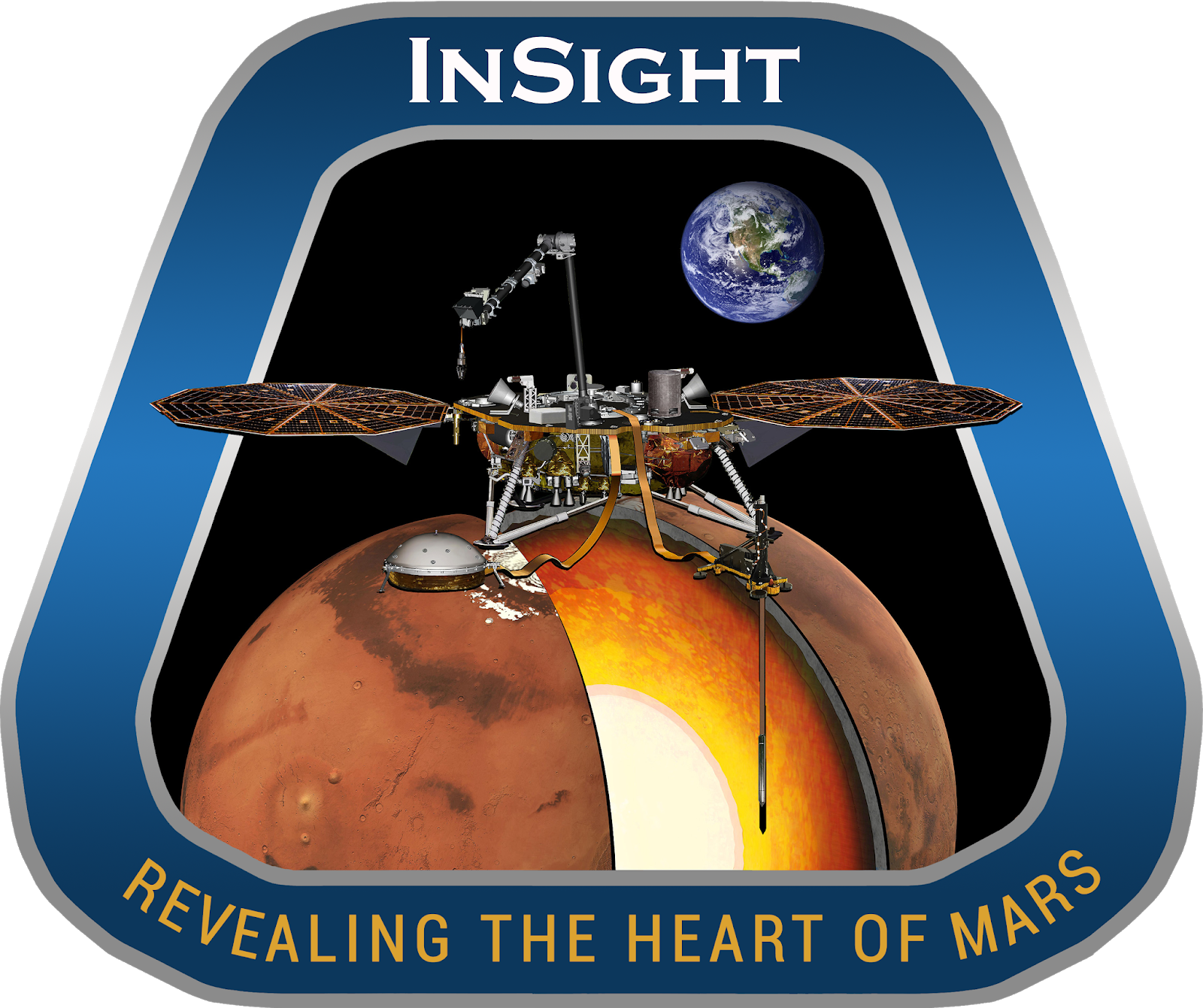
NASA - InSight Mission patch.

Feb. 4, 2019


Image above: NASA's InSight lander deployed its Wind and Thermal Shield on Feb. 2 (Sol 66). The shield covers InSight's seismometer, which was set down onto the Martian surface on Dec. 19. Image Credits: NASA/JPL-Caltech.

For the past several weeks, NASA's InSight lander has been making adjustments to the seismometer it set on the Martian surface on Dec. 19. Now it's reached another milestone by placing a domed shield over the seismometer to help the instrument collect accurate data. The seismometer will give scientists their first look at the deep interior of the Red Planet, helping them understand how it and other rocky planets are formed.

The Wind and Thermal Shield helps protect the supersensitive instrument from being shaken by passing winds, which can add "noise" to its data. The dome's aerodynamic shape causes the wind to press it toward the planet's surface, ensuring it won't flip over. A skirt made of chain mail and thermal blankets rings the bottom, allowing it to settle easily over any rocks, though there are few at InSight's location.

An even bigger concern for InSight's seismometer — called the Seismic Experiment for Interior Structure (SEIS) — is temperature change, which can expand and contract metal springs and other parts inside the seismometer. Where InSight landed, temperatures fluctuate by about 170 degrees Fahrenheit (94 degrees Celsius) over the course of a Martian day, or sol.

"Temperature is one of our biggest bugaboos," said InSight Principal Investigator Bruce Banerdt of NASA's Jet Propulsion Laboratory in Pasadena, California. JPL leads the InSight mission and built the Wind and Thermal Shield. "Think of the shield as putting a cozy over your food on a table. It keeps SEIS from warming up too much during the day or cooling off too much at night. In general, we want to keep the temperature as steady as possible."

 InSight lander deploying its Wind and Thermal Shield. Animation Credits: NASA//JPL-Caltech

On Earth, seismometers are often buried about four feet (1.2 meters) underground in vaults, which helps keep the temperature stable. InSight can't build a vault on Mars, so the mission relies on several measures to protect its seismometer. The shield is the first line of defense.

A second line of defense is SEIS itself, which is specially engineered to correct for wild temperature swings on the Martian surface. The seismometer was built so that as some parts expand and contract, others do so in the opposite direction to partially cancel those effects. Additionally, the instrument is vacuum-sealed in a titanium sphere that insulates its sensitive insides and reduces the influence of temperature.

But even that isn't quite enough. The sphere is enclosed within yet another insulating container — a copper-colored hexagonal box visible during SEIS's deployment. The walls of this box are honeycombed with cells that trap air and keep it from moving. Mars provides an excellent gas for this insulation: Its thin atmosphere is primarily composed of carbon dioxide, which at low pressure is especially slow to conduct heat.

With these three insulating barriers, SEIS is well-protected from thermal "noise" seeping into the data and masking the seismic waves that InSight's team wants to study. Finally, most additional interference from the Martian environment can be detected by InSight's weather sensors, then filtered out by mission scientists.

With the seismometer on the ground and covered, InSight's team is readying for its next step: deploying the heat flow probe, called the Heat Flow and Physical Properties Package (HP3), onto the Martian surface. That's expected to happen next week.

About InSight

JPL manages InSight for NASA's Science Mission Directorate. InSight is part of NASA's Discovery Program, managed by the agency's Marshall Space Flight Center in Huntsville, Alabama. Lockheed Martin Space in Denver built the InSight spacecraft, including its cruise stage and lander, and supports spacecraft operations for the mission.

A number of European partners, including France's Centre National d'Études Spatiales (CNES) and the German Aerospace Center (DLR), are supporting the InSight mission. CNES and the Institut de Physique du Globe de Paris (IPGP) provided the Seismic Experiment for Interior Structure (SEIS) instrument, with significant contributions from the Max Planck Institute for Solar System Research (MPS) in Germany, the Swiss Federal Institute of Technology (ETH Zurich) in Zurich, Switzerland, Imperial College London and Oxford University in the United Kingdom, and JPL. DLR provided the Heat Flow and Physical Properties Package (HP3) instrument, with significant contributions from the Space Research Center (CBK) of the Polish Academy of Sciences and Astronika in Poland. Spain’s Centro de Astrobiología (CAB) supplied the wind sensors.

Related article & link:

InSight Places First Instrument on Mars - New Images
http://orbiterchspacenews.blogspot.com/2019/01/insight-places-first-instrument-on-mars.html

Experiment for Interior Structure (SEIS): https://mars.nasa.gov/insight/spacecraft/instruments/seis/

For more information about InSight, visit: https://mars.nasa.gov/insight/

Image (mentioned), Animation (mentioned), Text, Credits: NASA/Tony Greicius/JPL/Andrew Good.

Greetings, Orbiter.ch

Spotlight on Space Station science


ISS - International Space Station logo.

4 February 2019

Though all ESA astronauts are back on Earth, European science on the International Space Station is ongoing. Explore a few experiments underway right now in celebration of science at ESA.

Columbus module on International Space Station

Learning the ropes

Every ESA astronaut who flies to the International Space Station begins their training at the European Astronaut Centre in Cologne, Germany. Here, they learn the intricacies of ESA’s space laboratory Columbus.

Many European experiments that run on the International Space Station when ESA astronauts are not present – such as those in the commercial ICE Cubes facility – require minimal manual input. Others, like Time Perception in Microgravity continue with current International Space Station crew members.

Crew of ISS Exp 58

With the undocking of two visiting vehicles and packing the NG-10 Cygnus for departure, January was a busy month for the crew of Expedition 58 NASA astronaut Anne McClain, Canadian astronaut David Saint-Jacques and cosmonaut Oleg Kononeko. They also began upgrading an ESA facility that allows ground-based control of and telemetric data retrieval from miniaturised laboratories inside Columbus.

Little labs of life science

Taking their name from the Russian word for cube, ESA’s Kubik units were operational on board the Space Station even before the Columbus module arrived in 2008. Each 40x40 cm temperature-controlled container enables the study of life science in microgravity and can host multiple experiments at one time in separate tissue-box-sized experiment units. 

Kubik on Space Station

Because many biological systems are partially gravity-dependent, ‘removing’ the effects of gravity enables researchers to gain a broader understanding of how these systems work. Samples previously studied using Kubik facilities include: bacteria, fungi, white blood cells and stem cells from human bone marrow and umbilical cords, plant seedlings, and even swimming tadpoles. Upgrades will see this research continue into its second decade, offering even greater opportunities to examine life in space.

Keeping the rhythm

The crew also exchanged the sample chamber of European multi-user facility Electromagnetic Levitator (EML) to activate new material science experiments, and Anne donned the Circadian Rhythms hardware to begin a 36-hour recording session.

NASA astronaut Anne McClain

Led by principal investigator Hanns-Christian Gunga of Charité University Clinic’s Center For Space Medicine, Circadian Rhythms investigates the role of synchronised circadian rhythms, or the “biological clock”. 

Researchers hypothesise that a non-24-hour cycle of light and dark affects crew members’ natural rhythms. The investigation also addresses the effects of reduced physical activity, microgravity and an artificially controlled environment, as changes in body composition and body temperature can affect crew members’ circadian rhythms as well.

Data is collected using a “double sensor” placed on an astronaut’s forehead and chest. This takes continuous core temperature measurements for extended periods before, during and after flight. These measurements are corelated with crew members’ pre and post-flight melatonin levels.

International Space Station (ISS)

Initial results show core body temperature does elevate gradually during long-duration spaceflight. It also rises faster and higher during physical exercise on the Station than it does on the ground. Understanding this and other effects of spaceflight on circadian rhythms will aid the design of future space missions and provide a unique comparison for sleep disorders, autonomic nervous system disorders, and shift work-related disorders on Earth.

Looking ahead

While all this science is happening in space, ESA astronaut Luca Parmitano continues to train on the ground for his upcoming Beyond mission.

Luca recently participated in ground-based sessions for two European experiments that look at how humans judge force and manipulate objects in weightlessness, GRIP and GRASP, and learnt more about an experiment to validate the behavior of fluids under microgravity, known as Fluidics.

Luca Parmitano training for Beyond

Science is everywhere at ESA. As well as exploring the Universe and answering the big questions about our place in space we develop the satellites, rockets and technologies to get there. Science also helps us to care for our home planet. All this week we're highlighting different aspects of science at ESA. Join the conversation with #ScienceAtESA.

Related links:

Columbus: http://www.esa.int/Our_Activities/Human_and_Robotic_Exploration/Columbus/Columbus_laboratory

ICE Cubes: http://www.esa.int/Our_Activities/Human_and_Robotic_Exploration/Research/ICE_Cubes_space_research_service_open_for_business

Time Perception in Microgravity: http://www.esa.int/spaceinvideos/Videos/2018/07/Horizons_science_perceiving_time_in_space

ESA’s Kubik units: https://www.esa.int/spaceinimages/Images/2018/02/Kubik_on_Space_Station

Electromagnetic Levitator (EML): https://www.esa.int/Our_Activities/Human_and_Robotic_Exploration/Proxima/Space_age_metals_and_plasma

Circadian Rhythms: https://www.esa.int/Our_Activities/Human_and_Robotic_Exploration/Research/Keeping_the_rhythm_in_space

GRIP: https://www.esa.int/spaceinimages/Images/2018/06/A_dexterous_laboratory_in_space

GRASP: https://www.esa.int/spaceinimages/Images/2018/06/Alexander_Gerst_during_the_Grasp_Experiment

Fluidics: https://www.esa.int/spaceinimages/Images/2017/11/Fluidics_infographic

Human and Robotic Exploration: http://www.esa.int/Our_Activities/Human_and_Robotic_Exploration

Images, Animation, Text, Credits: ESA/NASA.

Greetings, Orbiter.ch

ESA plans mission to smallest asteroid ever visited


ESA - European Space Agency patch.

4 February 2019

ESA’s planet-defending Hera mission will set a new record in space. The asteroid investigator will not only be the first spacecraft to explore a binary asteroid system – the Didymos pair – but the smaller of these two worldlets, comparable in size to Egypt’s Great Pyramid of Giza, will become the smallest asteroid ever visited.

Hera at smallest asteroid ever visited

From afar, one asteroid looks much like another, until comparing them directly. Checking the well-known scale chart prepared by the Planetary Society of all asteroid and comets so far surveyed by spacecraft and the larger Didymos asteroid would form a modest dot, with its smaller moonlet struggling to make a single pixel.

Didymos itself is just 780 m across – smaller than any asteroid visited by a probe other than the 350-m diameter Itokawa rubble pile visited by Japan’s first Hayabusa spacecraft and the 500 m-diameter Bennu, around which NASA’s Osiris-REx mission is currently in orbit.

That leaves Didymos’s orbiting moonlet ‘Didymoon’ as the smallest of all asteroids scheduled for robotic inspection, at just 160 m across.

“Didymoon’s miniscule size really becomes clear when you look at other asteroids,” comments Hera’s lead scientist Patrick Michel, CNRS Director of Research of France’s Côte d'Azur Observatory.

Asteroids and comets visited by spacecraft

Patrick also serves as co-investigator and interdisciplinary scientist on Japan’s Hayabusa2 mission to the Ryugu asteroid, which is about 1 km in diameter: “Hayabusa2 images show a large boulder near the north pole of Ryugu – and that single boulder is about the same size as Didymoon in its entirety.”

Humankind’s first planetary defence test

Its diminutive size was the reason Didymoon was chosen for a pioneering planetary defence experiment. In 2022, NASA’s DART spacecraft will impact Didymoon in an attempt to change its orbit around its larger twin, to test the feasibility of asteroid deflection.

 Asteroid Ryugu with north polar boulder

“This isn’t the first spacecraft impact into a planetary body,” adds Patrick, “NASA’s Deep Impact crashed into comet Tempel 1 in 2005, but not to try and deflect it, instead it was to expose subsurface material – the 6-km diameter body was much too large. But Didymoon is small enough, and in a tight enough 12-hour orbit around its parent, that its orbital period can indeed be shifted in a measurable way.”

After the impact, Hera will survey the Didymos asteroids in 2026 to gather key information that will not be available from Earth-based observations, including Didymoon’s mass, its surface properties and the shape of DART’s crater.

NASA's Deep Impact hitting a comet

“This will give us a good estimate of the impact’s momentum transfer, and hence its efficiency as a deflection technique,” explains ESA’s Hera project scientist, Michael Küppers. “These are fundamental parameters to enable the validation of numerical impact models necessary to design future deflection missions. We will better understand whether this technique can be used even for larger asteroids, giving us certainty we could protect our home planet if needed.”

Didymoon is very relevant for such testing as it is in the riskiest class of near-Earth asteroids because of its size: larger bodies can more easily be tracked, smaller bodies will burn up or do limited damage, while a Didymoon-sized impactor could devastate an entire region of our planet.

Low-gravity worldlets

The Didymos system is also attractive in terms of bonus science, offering insight into the formation of the binaries that make up around 15% of known asteroids.

“Didymos is spinning very swiftly, rotating once every two hours,” says Patrick. “Around its equator, its weak pull of gravity could be overcome by centrifugal force, potentially leading to material rising from the surface – the leading theory of where Didymoon came from. So landing on the equator would be impossible; you would have to touch down near its poles instead.

DART mission profile

“Didymoon’s small size means we know little about it, but we assume it would be spin-locked around its parent like Earth’s moon, implying a slower spin equal to its orbital period. The plan is to land at least one CubeSat there, although it will require precise navigation to achieve this. The asteroid will have something like one millionth of Earth’s gravity, with an estimated escape velocity of just 6 cm per second, so one danger might be bouncing back out to space.”

Asteroids compared to Didymoon

Patrick suggests Didymoon-class objects may additionally prove optimal for planned asteroid mining: larger bodies are comparatively rarer, while their smaller equivalents are more prone to fast spinning – caused by gradual warming due to sunlight.

Hera is currently under study to be presented for approval by ESA’s Space19+ Council meeting of European space ministers. It is planned for launch in 2023.

Hera mission

Hera would be ESA’s next mission to a small body after the Rosetta comet-chaser, benefiting from the expertise acquired during that 12-year mission. Long-term planning is crucial to realise future missions, and to ensure the continued development of innovative technology, inspiring new generations of European scientists and engineers.

Science is everywhere at ESA. As well as exploring the Universe and answering the big questions about our place in space we develop the satellites, rockets and technologies to get there. Science also helps us to care for our home planet. All this week we're highlighting different aspects of science at ESA. Join the conversation with #ScienceAtESA.

Related links:

Hera mission: http://www.esa.int/Our_Activities/Space_Engineering_Technology/Hera

DART website: http://dart.jhuapl.edu/

The Planetary Society: http://planetary.org/

Images, Video, Text, Credits: ESA/ScienceOffice.org/Planetary Society/Emily Lakdawalla/JAXA, University of Tokyo, Kochi University, Rikkyo University, Nagoya University, Chiba Institute of Technology, Meiji University, University of Aizu and AIST/NASA.

Best regards, Orbiter.ch

dimanche 3 février 2019

China's Chang'e-4 Probe Wakes Up after First Lunar Night


CLEP - China Lunar Exploration Program logo.

Feb. 3, 2019

The rover and the lander of the Chang'e-4 probe have been awakened by sunlight after a long "sleep" during the first extremely cold night on the moon, the China National Space Administration (CNSA) announced on Thursday.

The lander woke up at 8:39 p.m. Wednesday, and the rover, Yutu-2 (Jade Rabbit-2), awoke at about 8:00 p.m. Tuesday, surviving their first lunar night after making the first-ever soft landing on the far side of the moon, said CNSA.

Chang'e-4 Lunar Lander. Image Credits: CNSA/CLEP

China's Chang'e-4 probe, launched on Dec. 8 in 2018, landed on the Von Karman Crater in the South Pole-Aitken Basin on the far side of the moon on Jan. 3.

A lunar day equals 14 days on Earth, and a lunar night is the same length. The Chang'e-4 probe switched to a dormant mode during the lunar night due to the lack of solar power.

Yutu-2 Lunar Rover. Image Credits: CNSA/CLEP

Both the lander and the rover ended the dormant mode automatically according to the elevation angle of the sunlight. And the key instruments on the probe have started to work.


Image above: Chang'e 4 lander-rover relayed back by Queqiao lunar satellite (Magpie Bridge).Image Credits: CASC/CNSA.

Currently, the rover is located about 18 meters northwest of the lander. Communication and data transmission between ground control and the probe via the relay satellite Queqiao (Magpie Bridge) are stable, said CNSA.

Related article:

China's Yutu-2 rover Enters Standby Mode for 'Noon Nap' as Chang'e 4 Tests Continue
https://orbiterchspacenews.blogspot.com/2019/01/chinas-yutu-2-rover-enters-standby-mode.html

For more information about China Aerospace Science and Technology Corporation (CASC), visit: http://english.spacechina.com/n16421/index.html

For more information about China National Space Administration (CNSA), visit: http://www.cnsa.gov.cn/

Images (mentioned), Text, Credits: CASC/CNSA/China Space News.

Best regards, Orbiter.ch

Jupiter Storm Tracker


NASA - JUNO Mission logo.

Feb. 3, 2019


A giant, spiraling storm in Jupiter’s southern hemisphere is captured in this animation from NASA’s Juno spacecraft. The storm is approximately 5,000 miles (8,000 kilometers) across.

The counterclockwise motion of the storm, called Oval BA, is clearly on display. A similar rotation can be seen in the famous Great Red Spot at the top of the animation.

Juno took the nine images used to produce this movie sequence on Dec. 21, between 9:24 a.m. PST (12:24 p.m. EST) and 10:07 a.m. PST (1:07 p.m. EST). At the time the images were taken, the spacecraft was between approximately 15,400 miles (24,800 kilometers) and 60,700 miles (97,700 kilometers) from the planet’s cloud tops above southern latitudes spanning about 36 to 74 degrees.

Juno spacecraft orbiting Jupiter. Image Credits: NASA/JPL-Caltech

Citizen scientists Gerald Eichstädt and Seán Doran created this animation using data from the spacecraft’s JunoCam imager.

JunoCam’s raw images are available for the public to peruse and to process into image products at: http://missionjuno.swri.edu/junocam.  

More information about Juno is at: http://www.nasa.gov/juno and http://missionjuno.swri.edu.

Image, Animation, Text, Credits: NASA/Tony Greicius/JPL-Caltech/SwRI/MSSS/Gerald Eichstädt/Seán Doran.

Greetings, Orbiter.ch