mercredi 13 février 2019

Crew Studies Human Body and Checks Cooling Systems


ISS - Expedition 58 Mission patch.

February 13, 2019

Wednesday saw the Expedition 58 crew explore the inner workings of the human body in space and maintain cooling systems aboard the International Space Station.

NASA astronaut Anne McClain spent all day setting up cooling gear inside the U.S. Destiny lab module and Japan’s Kibo lab module. She drained and refilled water pumps inside the Fluid System Servicer and the Internal Thermal Control System. The life support systems help cool the station’s atmosphere and dispel heat generated by electrical systems.


Image above: Astronaut David Saint-Jacques (right) of the Canadian Space Agency becomes a barber aboard the International Space Station and trims Expedition 58 Commander Oleg Kononenko’s hair with clippers attached to a vacuum hose. Image Credit: NASA.

Microgravity’s impact on the human physiology was the focus of Flight Engineer David Saint-Jacques’ day. The Canadian Space Agency astronaut collected and stowed his breath, blood and urine samples for a variety of human research experiments. The research is supporting the long term-collection of human biological samples and observing bone marrow and blood changes.

Saint-Jacques also conducted ultrasound scans in the Zvezda service module for the Fluid Shifts study with assistance from Commander Oleg Kononenko and doctors on the ground. That research is seeking to reverse increased head and eye pressure that occurs in space.

International Space Station (ISS). Image Credit: NASA

Kononenko started Wednesday servicing Russian life support systems. The four-time station resident then spent the afternoon on more space research studying motion coordination, radiation exposure and crew psychology.

Related links:

Expedition 58: https://www.nasa.gov/mission_pages/station/expeditions/expedition58/index.html

Destiny lab module: https://www.nasa.gov/mission_pages/station/structure/elements/us-destiny-laboratory

Kibo lab module: https://www.nasa.gov/mission_pages/station/structure/elements/japan-kibo-laboratory

Long term-collection of human biological samples: https://www.nasa.gov/mission_pages/station/research/experiments/explorer/Investigation.html?#id=954

Bone marrow and blood changes: https://www.nasa.gov/mission_pages/station/research/experiments/explorer/Investigation.html?#id=1673

Zvezda service module: https://www.nasa.gov/mission_pages/station/structure/elements/zvezda-service-module.html

Fluid Shifts: https://www.nasa.gov/mission_pages/station/research/experiments/explorer/Investigation.html?#id=1126

Motion coordination: https://www.nasa.gov/mission_pages/station/research/experiments/explorer/Investigation.html?#id=1594

Radiation exposure: https://www.nasa.gov/mission_pages/station/research/experiments/explorer/Investigation.html?#id=633

Space Station Research and Technology: https://www.nasa.gov/mission_pages/station/research/index.html

International Space Station (ISS): https://www.nasa.gov/mission_pages/station/main/index.html

Images (mentioned), Text, Credits: NASA/Mark Garcia.

Best regards, Orbiter.ch

Six Things to Know About NASA's Opportunity Mars Rover


NASA - Mars Exploration Rover B (MER -B) patch.

Feb. 13, 2019


Image above: This scene from the panoramic camera on NASA's Mars Exploration Rover Opportunity looks back toward part of the west rim of Endeavour Crater that the rover drove along, heading southward, during the summer of 2014. Image Credits: NASA/JPL-Caltech/Cornell/ASU.

After 15 years, the mission of NASA's Opportunity rover has come to an end, but its successes on Mars have earned it a spot in the robot hall of fame. Here's what you need to know about our intrepid Martian overachiever:

1. Opportunity was a twin.


Image above: This infographic highlights NASA’s twin robot geologists, the Mars Exploration Rovers (MER) Spirit and Opportunity. Image Credits: NASA/JPL-Caltech.

The Mars Exploration Rovers mission featured two identical, golf-cart-sized, solar-powered rovers: Spirit and Opportunity. Spirit landed at Gusev Crater on Jan. 4, 2004. Opportunity landed on the opposite side of Mars at Meridiani Planum on Jan. 24, 2004 PST (Jan. 25 EST). Both rovers were managed for NASA by NASA's Jet Propulsion Laboratory in Pasadena, California.

2. Opportunity and Spirit showed that Mars had the wet and warm conditions in its ancient past that were potentially hospitable to life.


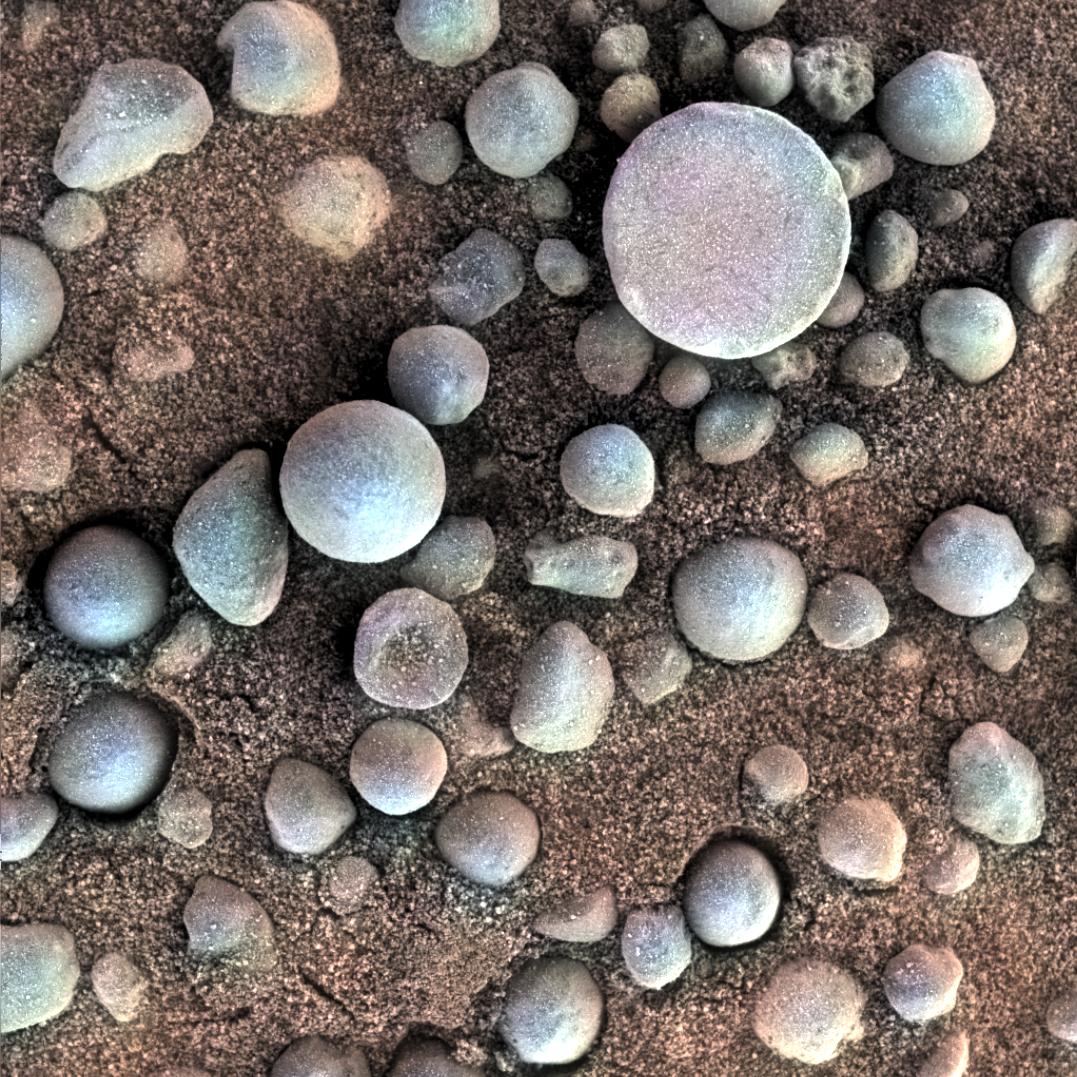
Image above: The small spherules on the Martian surface in this close-up image are near Fram Crater, visited by NASA's Mars Exploration Rover Opportunity during April 2004. Image Credits: NASA/JPL-Caltech/Cornell/USGS.

Foremost among Spirit and Opportunity's many science discoveries: Mars was likely wetter and warmer in the past. These conditions could have served as a cradle for life on Mars at a time when life first emerged on Earth.

Opportunity contributed several key findings to this conclusion. It was the first rover to identify and characterize sedimentary rocks on a planet other than Earth. Opportunity's measurements showed these rocks formed in ancient ephemeral playas. Opportunity also discovered small spheres of hematite nicknamed "blueberries" that formed late from rising, acidic groundwater. Once Opportunity reached the rim of Endeavour crater, the rover found white veins of the mineral gypsum — a telltale sign of water that traveled through underground fractures. Opportunity also found more compelling signs of Mars' watery past in the rocks of Endeavour Crater: clay minerals that formed in neutral-pH (not too acidic, not too basic) water. Of all the places studied by Opportunity, the environment at Endeavour had the friendliest conditions for ancient microbial life.

3. Opportunity is an off-world record holder.


Image above: NASA's Mars Exploration Rover Opportunity used its panoramic camera to record this eastward horizon view on the 2,407th Martian day, or sol, of the rover's work on Mars (Oct. 31, 2010). Image Credits: NASA/JPL-Caltech/Cornell University.

Opportunity worked longer on the surface of Mars than any other robot — more than 14 years. This far exceeded the original 90-day mission planned for Opportunity and Spirit.

During Opportunity's time on Mars, it also drove a total of 28.06 miles (45.16 kilometers), clinching the record for longest drive on another world in 2014.

4. Opportunity was the little rover that could.


Image above: This scene from the panoramic camera (Pancam) of NASA's Mars Exploration Rover Opportunity catches "Pillinger Point," on the western rim of Endeavour Crater, in the foreground. It is presented in false color to make differences in surface materials more easily visible. Image Credits: NASA/JPL-Caltech/Cornell Univ./Arizona State Univ.

Opportunity didn't survive for over 14 years because its mission was easy. It encountered challenges that required its engineers to be resourceful. For instance, the rover's right-front wheel sometimes drew more current than the other wheels, so engineers often drove the rover backward to extend the right front wheel's life.

The terrain was treacherous. After the rover landed at Eagle Crater, its wheels slipped on the loose slopes when it first attempted to drive out of the crater. Rover planners had to come up with creative driving strategies to get out — something they did again at Endurance Crater, where slopes were as steep as 31 degrees. On April 26, 2005, Opportunity's wheels dug into a soft, wind-sculpted sand ripple and got stuck for several nail-biting weeks at "Purgatory Dune." But after extensive testing in a Mars-like sandbox at JPL, the team was able to carefully shimmy out of the Martian sand trap.

Opportunity encountered two mission-threatening dust storms that blocked sunlight from reaching its solar panels. It survived a dust storm in 2007 by minimizing activities and maintaining enough power in its batteries to recover when the skies cleared. Unfortunately, the 2018 dust storm blotted out even more sunlight and kept the skies above Opportunity dark about a month longer.

5. Opportunity and Spirit showed us the beauty of Mars.


Image above: From its perch high on a ridge, NASA's Mars Exploration Rover Opportunity recorded this image of a Martian dust devil twisting through the valley below. The view looks back at the rover's tracks leading up the north-facing slope of "Knudsen Ridge," which forms part of the southern edge of "Marathon Valley." Image Credits: NASA/JPL-Caltech.

Opportunity and Spirit were avid documentarians, giving us a human-scale view of what it was like to be on Mars. They returned over 342,000 raw images, which were promptly posted online for everyone's enjoyment. These two rovers also produced 31 stunning 360-degree color panoramas.

The most memorable images Opportunity took — including ripples of sand that resembled waves on water, patches of jumbled rock on a crater rim, whirling dust devils and its own tracks along a ridge — revealed the otherworldly beauty of Mars and the drama of exploration.

6. The story of Opportunity and Spirit is not over. Their lessons live on in current and future Mars missions. 


Image above: In this navigation camera raw image, NASA's Opportunity Rover looks back over its own tracks on Aug. 4, 2010. NASA's Jet Propulsion Laboratory, a division of Caltech in Pasadena, manages the Mars Exploration Rover Project for NASA's Science Mission Directorate, Washington. Image Credits: NASA/JPL-Caltech.

The success of the Mars Exploration Rovers helped drive the growth of NASA's Mars program, building support for orbiters and new kinds of rovers. Spirit and Opportunity showed how mobile robots on Mars could communicate reliably with Earth (either directly or by employing orbiters around Mars as relays back to our home planet), use 3-D vision to navigate the Martian terrain and make autonomous science observations.

Curiosity and the upcoming Mars 2020 rovers build upon the lessons of Spirit and Opportunity. And scientists will continue to make new discoveries from the Mars Exploration Rovers data for years to come.

Mars Exploration Rover (MER). Image Credits: NASA/JPL-Caltech

Spirit and Opportunity have been a fertile training ground for the many hundreds of engineers and planetary scientists who have learned at their robotic knees. A number have gone on to lead other space missions. Many of those currently operating Opportunity are sharing their expertise part-time with other missions exploring our solar system. For most, working on Spirit and Opportunity has been transformative. You can read many of their stories here: https://www.jpl.nasa.gov/opportunity-memories/

For more highlights of the Mars Exploration Rover mission, visit: https://mars.nasa.gov/mer/highlights/

Images (mentioned), Text, Credits: NASA/Tony Greicius/JPL/Jia-Rui Cook.

Greetings, Orbiter.ch

NASA's Record-Setting Opportunity Rover Mission on Mars Comes to End


NASA - Mars Exploration Rover B (MER-B) patch.


Feb. 13, 2019

One of the most successful and enduring feats of interplanetary exploration, NASA's Opportunity rover mission is at an end after almost 15 years exploring the surface of Mars and helping lay the groundwork for NASA’s return to the Red Planet.

The Opportunity rover stopped communicating with Earth when a severe Mars-wide dust storm blanketed its location in June 2018. After more than a thousand commands to restore contact, engineers in the Space Flight Operations Facility at NASA's Jet Propulsion Laboratory (JPL) made their last attempt to revive Opportunity Tuesday, to no avail. The solar-powered rover's final communication was received June 10.

"It is because of trailblazing missions such as Opportunity that there will come a day when our brave astronauts walk on the surface of Mars," said NASA Administrator Jim Bridenstine. "And when that day arrives, some portion of that first footprint will be owned by the men and women of Opportunity, and a little rover that defied the odds and did so much in the name of exploration."


Animation above: Side-by-side movies shows how dust has enveloped the Red Planet, courtesy of the Mars Color Imager (MARCI) wide-angle camera onboard NASA's Mars Reconnaissance Orbiter (MRO). Animation Credits: NASA/JPL-Caltech/MSSS.

Designed to last just 90 Martian days and travel 1,100 yards (1,000 meters), Opportunity vastly surpassed all expectations in its endurance, scientific value and longevity. In addition to exceeding its life expectancy by 60 times, the rover traveled more than 28 miles (45 kilometers) by the time it reached its most appropriate final resting spot on Mars – Perseverance Valley.

"For more than a decade, Opportunity has been an icon in the field of planetary exploration, teaching us about Mars' ancient past as a wet, potentially habitable planet, and revealing uncharted Martian landscapes," said Thomas Zurbuchen, associate administrator for NASA's Science Mission Directorate. "Whatever loss we feel now must be tempered with the knowledge that the legacy of Opportunity continues – both on the surface of Mars with the Curiosity rover and InSight lander – and in the clean rooms of JPL, where the upcoming Mars 2020 rover is taking shape."


Image above: The dramatic image of NASA's Mars Exploration Rover Opportunity's shadow was taken on sol 180 (July 26, 2004) by the rover's front hazard-avoidance camera as the rover moved farther into Endurance Crater in the Meridiani Planum region of Mars. Image Credits: NASA/JPL-Caltech.

The final transmission, sent via the 70-meter Mars Station antenna at NASA's Goldstone Deep Space Complex in California, ended a multifaceted, eight-month recovery strategy in an attempt to compel the rover to communicate.

“We have made every reasonable engineering effort to try to recover Opportunity and have determined that the likelihood of receiving a signal is far too low to continue recovery efforts," said John Callas, manager of the Mars Exploration Rover (MER) project at JPL.

Opportunity landed in the Meridiani Planum region of Mars on Jan. 24, 2004, seven months after its launch from Cape Canaveral Air Force Station in Florida. Its twin rover, Spirit, landed 20 days earlier in the 103-mile-wide (166-kilometer-wide) Gusev Crater on the other side of Mars. Spirit logged almost 5 miles (8 kilometers) before its mission wrapped up in May 2011.

Mars Exploration Rover (MER): Image Credits: NASA/JPL-Caltech

From the day Opportunity landed, a team of mission engineers, rover drivers and scientists on Earth collaborated to overcome challenges and get the rover from one geologic site on Mars to the next. They plotted workable avenues over rugged terrain so that the 384-pound (174-kilogram) Martian explorer could maneuver around and, at times, over rocks and boulders, climb gravel-strewn slopes as steep as 32-degrees (an off-Earth record), probe crater floors, summit hills and traverse possible dry riverbeds. Its final venture brought it to the western limb of Perseverance Valley.

"I cannot think of a more appropriate place for Opportunity to endure on the surface of Mars than one called Perseverance Valley," said Michael Watkins, director of JPL. "The records, discoveries and sheer tenacity of this intrepid little rover is testament to the ingenuity, dedication, and perseverance of the people who built and guided her."

Opportunity: NASA Rover Completes Mars Mission

Video above: Drive along with the NASA’s Opportunity Mars rover and hear the voices of scientists and engineers behind the mission. Designed to run for 90 days, the exploration spanned more than 15 years from 2004 to 2019. Along the way, it discovered definitive proof of liquid water on ancient Mars and set the off-world driving record. For more information on the Mars Exploration Rovers and all of NASA’s Mars missions, visit mars.nasa.gov. Video Credits: NASA/JPL-Caltech.

More Opportunity Achievements

- Set a one-day Mars driving record March 20, 2005, when it traveled 721 feet (220 meters).

- Returned more than 217,000 images, including 15 360-degree color panoramas.

- Exposed the surfaces of 52 rocks to reveal fresh mineral surfaces for analysis and cleared 72 additional targets with a brush to prepare them for inspection with spectrometers and a microscopic imager.

- Found hematite, a mineral that forms in water, at its landing site.

- Discovered strong indications at Endeavour Crater of the action of ancient water similar to the drinkable water of a pond or lake on Earth.

All of the off-roading and on-location scientific analyses were in service of the Mars Exploration Rovers’ primary objective: To seek out historical evidence of the Red Planet's climate and water at sites where conditions may once have been favorable for life. Because liquid water is required for life, as we know it, Opportunity's discoveries implied that conditions at Meridiani Planum may have been habitable for some period of time in Martian history.

"From the get-go, Opportunity delivered on our search for evidence regarding water," said Steve Squyres, principal investigator of the rovers' science payload at Cornell University. "And when you combine the discoveries of Opportunity and Spirit, they showed us that ancient Mars was a very different place from Mars today, which is a cold, dry, desolate world. But if you look to its ancient past, you find compelling evidence for liquid water below the surface and liquid water at the surface."

All those accomplishments were not without the occasional extraterrestrial impediment. In 2005 alone, Opportunity lost steering to one of its front wheels, a stuck heater threatened to severely limit the rover's available power, and a Martian sand ripple almost trapped it for good. Two years later, a two-month dust storm imperiled the rover before relenting. In 2015, Opportunity lost use of its 256-megabyte flash memory and, in 2017, it lost steering to its other front wheel.

Opportunity wheel traces : Image Credit: NASA.

Each time the rover faced an obstacle, Opportunity's team on Earth found and implemented a solution that enabled the rover to bounce back. However, the massive dust storm that took shape in the summer of 2018 proved too much for history's most senior Mars explorer.

"When I think of Opportunity, I will recall that place on Mars where our intrepid rover far exceeded everyone's expectations," Callas said. "But what I suppose I'll cherish most is the impact Opportunity had on us here on Earth. It's the accomplished exploration and phenomenal discoveries. It’s the generation of young scientists and engineers who became space explorers with this mission. It's the public that followed along with our every step. And it's the technical legacy of the Mars Exploration Rovers, which is carried aboard Curiosity and the upcoming Mars 2020 mission. Farewell, Opportunity, and well done."

Mars exploration continues unabated. NASA's InSight lander, which touched down on Nov. 26, is just beginning its scientific investigations. The Curiosity rover has been exploring Gale Crater for more than six years. And, NASA's Mars 2020 rover and the European Space Agency’s ExoMars rover both will launch in July 2020, becoming the first rover missions designed to seek signs of past microbial life on the Red Planet.

Related articles:

Opportunity Hunkers Down During Dust Storm
https://orbiterchspacenews.blogspot.com/2018/06/opportunity-hunkers-down-during-dust.html

Shades of Martian Darkness
https://orbiterchspacenews.blogspot.com/2018/06/shades-of-martian-darkness.html

Update on Opportunity Rover after Martian Dust Storm
https://orbiterchspacenews.blogspot.com/2018/10/update-on-opportunity-rover-after.html

NASA Encounters the Perfect Storm for Science
https://orbiterchspacenews.blogspot.com/2018/06/nasa-encounters-perfect-storm-for.html

JPL managed the Mars Exploration Rovers Opportunity and Spirit for NASA's Science Mission Directorate in Washington. For more information about the agency’s Mars Exploration program, visit: https://www.nasa.gov/mars

Mars Exploration Rovers (Spirit and Opportunity): https://www.nasa.gov/mission_pages/mer/index.html

Images (mentioned), Animation (mentioned), Video (mentioned), Text, Credits: NASA/Dwayne Brown/JoAnna Wendel/Karen Northon/JPL/DC Agle.

Greetings, Orbiter.ch

mardi 12 février 2019

In Solar System’s Symphony, Earth’s Magnetic Field Drops the Beat


NASA - THEMIS Mission patch.

Feb. 12, 2019

Space isn’t silent. In fact, an entire orchestra of instruments fills our near-Earth environment with eerie sounds. Scientists have long known about space phenomena involving electromagnetic waves travelling around Earth that resonate like string instruments and whistle like wind instruments. Now, new research published in Nature Communications has added a percussive member to the cosmic ensemble: a giant drum, triggered by plasma jets striking the boundary of the protective magnetic bubble surrounding our planet.

This magnetic bubble, known as the magnetosphere, is encased by a boundary region known as the magnetopause, our first barrier to high-energy particles coming from the Sun. At the magnetopause, the majority of solar particles are deflected around Earth, but under certain conditions some sneak through. Understanding the ­­­­­­­mechanics of the magnetopause is key to helping keep our satellites, telecommunications and astronauts safe from the potentially harmful radiation these particles bring.

Earth's Magnetic Field Vibrates Like a Drum

Video above: NASA’s THEMIS mission proves a 45-year old theory that the outer boundary of Earth’s magnetic field vibrates like a drum. Video Credits: Video courtesy Martin Archer, Queen Mary University of London.

Using data from NASA’s Time History of Events and Macroscale Interactions during Substorms, or THEMIS, mission, the scientists discovered ­that when the magnetopause is struck by a jet of plasma from the Sun, it vibrates like a drum, with waves echoing back and forth along its surface, much like they do on top of a drumhead. The new discovery comes several decades after such behavior was first theorized.

“Given the lack of evidence over the 45 years since they were proposed, there had been speculation that these drum-like vibrations might not occur at all,” said Martin Archer, space physicist at Queen Mary University of London and lead author of the new paper. “Now we see that waves on the magnetopause’s surface reflect between two points near the magnetic poles — acting very much like a drum."


Image above: Illustration of a plasma jet impact (yellow) generating standing waves at the boundary (blue) of Earth’s magnetic shield (green). Image Credits: E. Masongsong/UCLA, M. Archer/QMUL, H. Hietala/UTU.

Inside the magnetosphere, scientists have long been listening in on space sounds created by various electromagnetic waves. This veritable orchestra of waves can be heard as sound when processed correctly, and they even exhibit similar behaviors to certain musical instruments. So-called magnetosonic waves pulse through plasma in the same way sound bounces through wind instruments. Another type of wave, known as an Alfvén wave, resonates along magnetic field lines, just like string instruments’ vibrating strings. While both of these types of waves can travel anywhere in space, the newly discovered waves are a type of surface waves — waves that require some sort of boundary to travel along.

In this case the magnetopause acted as the boundary. When a plasma jet — the drumstick — strikes the magnetopause, surface waves form a standing wave pattern — where the ends appear to be standing still while other points vibrate back and forth — just like a drumhead. The fixed points in the wave, which are the rim or edge of the drum, are near Earth’s magnetic poles; the waves vibrate the surface of the magnetopause in between. While the wave itself remains on the surface, the vibrations ultimately work their way down into the magnetosphere and trigger other types of waves.

“The waves likely penetrate far into the inner magnetosphere causing ultra-low frequency waves, which affect things like radiation belts, the aurora, and even the ionosphere,” Archer said.

The Sounds of Earth's Magnetic Drum in Space

Video above: The signals recorded by the THEMIS probes converted to audible sound. Video Credits: Video courtesy Martin Archer, Queen Mary University of London.

The new study used data from the THEMIS mission, which initially used five identical probes to determine what physical process in near-Earth space initiates the auroras.

"The authors make great use of observations from a time early in the mission when the spacecraft followed each other along their mutual orbit like pearls on a string,” said David Sibeck, THEMIS project scientist at NASA’s Goddard Space Flight Center in Greenbelt, Maryland. “In this fortunate case, the THEMIS spacecraft were in just the right place to see the drumstick and hear the drum."


Image above: Different types of plasma waves triggered by various mechanisms, occupy different regions of space around Earth. Image Credits: NASA's Goddard Space Flight Center/Mary Pat Hrybyk-Keith.

The scientists plan to look through archival THEMIS data for more of these events around Earth and determine how often the magnetopause may be booming like a drum. This research may also help provide insights into how to look for this phenomenon at other planets with magnetospheres, like Jupiter and Saturn, and what effect they may have in those systems.

Related Links

Nature Communications: https://doi.org/10.1038/s41467-018-08134-5

Learn more about NASA’s THEMIS and ARTEMIS Missions: https://www.nasa.gov/artemis

NASA Listens in as Electrons Whistle While They Work: https://www.nasa.gov/feature/goddard/2017/nasa-listens-in-as-electrons-whistle-while-they-work

Eavesdropping in Space: How NASA records eerie sounds around Earth: https://blogs.nasa.gov/sunspot/2018/12/11/eavesdropping-in-space-how-nasa-records-eerie-sounds-around-earth/

THEMIS (Time History of Events and Macroscale Interactions During Substorms): http://www.nasa.gov/mission_pages/themis/main/index.html

Space Weather:  https://www.nasa.gov/subject/3165/space-weather

Images (mentioned), Videos (mentioned), Text, Credits: NASA/Rob Garner/GSRC/Mara Johnson-Groh.

Greetings, Orbiter.ch

Exercise Research and Biology Hardware Checks Aboard Orbital Lab


ISS - Expedition 58 Mission patch.

February 12, 2019

The Expedition 58 crew explored space exercise and checked out biology hardware today aboard the International Space Station. The space residents supplemented their research activities and kept the orbital lab systems in tip-top shape.

Daily exercise in space is important so astronauts can fight muscle and bone loss caused by living in weightlessness. Doctors are seeking to optimize workouts for crews to stay in shape for strenuous activities like spacewalks, returning to Earth and adjusting to gravity.


Image above: NASA astronaut Anne McClain is surrounded by exercise gear, including laptop computers and sensors that measure physical exertion and aerobic capacity, during a workout session. Image Credit: NASA.

Anne McClain of NASA contributed to that research today strapping into an exercise bike while attached to breathing tubes and sensors. Scientists measured her breathing and aerobic capacity to understand the effects of microgravity on pulmonary function and physical exertion.

International Space Station (ISS). Image Credit: NASA

Canadian Space Agency astronaut David Saint-Jacques worked on a pair of incubators throughout Tuesday. He disconnected hardware in the Kubik incubator that houses small biology studies in the Columbus lab module. Afterward, he glided into the Kibo lab module and set up a carbon dioxide meter inside the Space Automated Bioproduct Laboratory supporting a wide variety of life sciences.

The commander, Oleg Kononenko of Roscosmos, worked primarily in the station’s Russian segment on Tuesday beginning the day working on life support gear. The highly experienced cosmonaut then moved onto space navigation research before charging the emergency phone inside the Soyuz MS-11 spacecraft.

Related links:

Expedition 58: https://www.nasa.gov/mission_pages/station/expeditions/expedition58/index.html

Exercise bike: https://www.nasa.gov/mission_pages/station/research/experiments/explorer/Facility.html?#id=821

Breathing: https://www.nasa.gov/mission_pages/station/research/experiments/explorer/Investigation.html?#id=103

Aerobic capacity: https://www.nasa.gov/mission_pages/station/research/experiments/explorer/Investigation.html?#id=644

Kubik: https://www.nasa.gov/mission_pages/station/research/experiments/explorer/Facility.html?#id=894

Columbus lab module: https://www.nasa.gov/mission_pages/station/structure/elements/europe-columbus-laboratory

Kibo lab module: https://www.nasa.gov/mission_pages/station/structure/elements/japan-kibo-laboratory

Automated Bioproduct Laboratory: https://www.nasa.gov/mission_pages/station/research/experiments/explorer/Facility.html?#id=1148

Space navigation research: https://www.energia.ru/en/iss/researches/develop/03.html

Space Station Research and Technology: https://www.nasa.gov/mission_pages/station/research/index.html

International Space Station (ISS): https://www.nasa.gov/mission_pages/station/main/index.html

Images (mentioned), Text, Credits: NASA/Mark Garcia.

Best regards, Orbiter.ch

Upgrading ALICE: What’s in store for the next two years?


CERN - ALICE experiment logo.

12 February, 2019

Major internal improvements await the ALICE detector during CERN’s Long Shutdown 2 (LS2)


Image above: The ALICE team is ready for the challenge of upgrading the detector (Image: Maximilien Brice, Julien Ordan/CERN).

With massive red doors weighing 350 tonnes each, it takes more than uttering “open sesame” to open the ALICE detector. Behind the doors lie the inner workings of a unique detector built to study the conditions of matter moments after the birth of the Universe, conditions which are recreated in the LHC.

When the CERN accelerator complex was switched off in December 2018, scientists and technicians entered the ALICE cavern, 56 metres underground, to open the massive shielding around the magnet and to start work on the detector. This maintenance and upgrade work will last two years, the time CERN has allocated for a technical break called Long Shutdown 2 (LS2). For ALICE, LS2 activities started at a fast pace, with a full programme planned of upgrades or replacements of subdetectors as well as of trigger and data-acquisition systems.


Image above: The 16-metre-tall doors of the ALICE experiment magnet, each weighing 350 tonnes, are now open to allow scientists and technicians to work on the detector upgrade. (Image: Julien Marius Ordan/CERN).

ALICE is dedicated to the study of quark-gluon plasma (QGP), a state of matter that prevailed in the first instants of the Universe. By colliding particles, namely protons and lead nuclei, from the Large Hadron Collider (LHC), ALICE can harvest data at the high-energy frontier.

Increased luminosity, first in 2021 and later in the High-Luminosity LHC (HL-LHC) project, will open up a range of possibilities and challenges for ALICE. An increase in luminosity – a measure of the number of collisions per unit of time – will allow ALICE to study rare phenomena and perform high-precision measurements, shedding light on the thermodynamics, evolution and flow of the QGP, as well as on quark and gluon interactions.

Hunting for the right tracks, starting from the core


Image above: This diagram of the ALICE detector shows some of the maintenance and upgrade work in store in the coming two years (Image: CERN).

During this upgrade, a smaller-diameter beam pipe will replace ALICE’s existing one. Inside the beam pipe, particles travel at almost the speed of light and smash together inside the core of the detector, generating many new particles. Scientists are interested in determining the position of the interaction point, and reducing the beam pipe’s diameter improves this measurement by a factor of three with respect to the present detector. ALICE will also become better at detecting particles with a shorter lifetime, i.e. those decaying closer to the interaction point.

The need for a new beam pipe is linked to the replacement of the inner tracking system (ITS), which surrounds it. The new ITS will be equipped with innovative, compact pixel sensor chips. This tracking system measures the properties of the particles emerging from the collisions, so it must be fast-acting and fine-grained to handle the higher collision rates in the future. The new system will dramatically improve the capacity of the detector to pinpoint and reconstruct the particle trajectories.

The sensor and readout chips built into the same piece of silicon for the new inner tracking system will also be employed in the muon forward tracker (MFT), which tracks muons close to the beam pipe. This promises excellent spatial resolution, making ALICE not only more sensitive to several measurements, but also able to access new ones currently beyond reach.

A major upgrade of the ALICE time projection chamber (TPC), an 88-cubic-metre cylinder filled with gas and read-out detectors that follows particles’ trajectories in 3D, is also ongoing. Charged particles spraying out from the collision point ionise the gas along their path, liberating clouds of electrons that drift towards the endplates of the cylinder. These make up a signal that is amplified and then read. The current read-out, based on multi-wire proportional-chamber technology, will not be able to cope with increased interaction rates, so it will be replaced with multi-stage gas electron multiplier (GEM) chambers. This upgrade will increase the read-out rate of the detector by about two orders of magnitude.

In addition, a new fast interaction trigger detector (FIT) will detect particles that scatter with a small angle relative to the beam direction and will replace three current trigger detectors. It will remove unwanted signals, including interactions of the beam with the residual gas in the beam pipe.

A factor of 100 gain in statistics

As a consequence of the increased luminosity and interaction rate, a significantly larger amount of data will have to be processed and selected. More powerful electronics, data processing and computing systems have therefore been designed to sustain high throughput and performance. The ALICE collaboration is currently installing a new data centre above ground to improve computing capacity. When the new LHC run starts in 2021, the significantly improved detector will offer a factor of 100 gain in statistics.


Image above: Work has begun on the inner sub-detectors of the ALICE experiment ahead of the installation of new equipment. (Image: Maximilien Brice/Julien Marius Ordan/CERN).

When ALICE’s magnet doors close again in summer 2020, they will hide an even more powerful instrument, ready to embark on more collisions and more data-taking.

Take a 360° tour of ALICE (Video: CERN)

Note:

CERN, the European Organization for Nuclear Research, is one of the world’s largest and most respected centres for scientific research. Its business is fundamental physics, finding out what the Universe is made of and how it works. At CERN, the world’s largest and most complex scientific instruments are used to study the basic constituents of matter — the fundamental particles. By studying what happens when these particles collide, physicists learn about the laws of Nature.

The instruments used at CERN are particle accelerators and detectors. Accelerators boost beams of particles to high energies before they are made to collide with each other or with stationary targets. Detectors observe and record the results of these collisions.

Related links:

CERN accelerator complex: https://home.cern/science/accelerators/accelerator-complex

Long Shutdown 2 (LS2): https://home.cern/tags/long-shutdown-2

Quark-gluon plasma (QGP): https://home.cern/science/physics/heavy-ions-and-quark-gluon-plasma

Large Hadron Collider (LHC): https://home.cern/science/accelerators/large-hadron-collider

High-Luminosity LHC (HL-LHC): https://home.cern/science/accelerators/high-luminosity-lhc

For more information about European Organization for Nuclear Research (CERN), Visit: https://home.cern/

Images (mentioned), Video (mentioned), Text, Credits: CERN/Letizia Diamante.

Best regards, Orbiter.ch

Space Station Highlights: Week of February 4, 2019


ISS - Expedition 58 Mission patch.

Feb. 12, 2019

This week saw Expedition 58 crew members working on scientific investigations aboard the International Space Station and finishing preparations for Friday’s undocking of the NG-10 Cygnus resupply vehicle from the station.

Here are details about some of the science conducted in space this week:

Cygnus does double duty deploying satellites


Animation above: The NG-10 Cygnus supply craft seen from inside the space station. Crew packed Cygnus with the SlingShot investigation’s small satellites prior to undocking it from the station. Animation Credit: NASA.

Prior to undocking Cygnus from the space station, crew members installed the SlingShot small satellite deployment system, which fits inside the NG-10 Cygnus spacecraft’s Passive Common Berthing Mechanism (PCBM). SlingShot can accommodate up to 18 satellites for deployment after the craft undocks and before it descends toward Earth to safely burn up in the atmosphere over the Pacific Ocean.

Research on bone marrow in microgravity continues


Image above: NASA astronaut Anne McClain with samples collected for the Canadian Space Agency’s MARROW investigation. Image Credit: NASA.

Crew members performed breath and ambient air sample collection and took documentary photos for MARROW. This long-term study looks at the effect of microgravity on bone marrow. Scientists suspect that microgravity has a negative effect on the bone marrow and blood cells that it produces, similar to the effect of long-duration bed rest on Earth.

Connecting live between the space station and schools

The crew spoke to students at Colégio Campo de Flores in Almada, Portugal during an International Space Station Ham Radio (ISS HAM) pass. This program engages with and educates students, teachers, parents and other members of the community about science, technology, engineering, and math by providing a means for direct communication between astronauts and ground HAM radio units.


Animation above: Spheres like this one are used to represent a spacecraft’s fuel tank for the Fluidics investigation. Animation Credit: NASA.

Improving lighting for better crew conditions

Crew made log entries and conducted cognition tests for Lighting Effects. This investigation studies the effects of replacing fluorescent light bulbs with solid-state light-emitting diodes (LEDs). The adjustable intensity and color of LEDs may improve crew circadian rhythms, sleep, and cognitive performance.

Measuring fluid slosh and turbulence

The FLUIDICS experiment covers two aspects of fluid mechanics: the liquid sloshing phenomenon in spacecraft fuel tanks and wave turbulence at the surface of liquids. Understanding liquid sloshing can improve satellite guidance and precision and optimize spacecraft fuel management. Microgravity makes it possible to focus observations of surface wave turbulence only on the liquid’s surface tension and can provide insights into measuring the volume inside a sphere. This week, crew members installed the Fluidics hardware, initiated the session 5 autonomous science run and attempted to run science sessions 2 and 3. A hardware anomaly occurred during run 2 and ESA ground teams are investigating.

Other work was performed on these investigations and facilities:

- CIR includes an optics bench, combustion chamber, fuel and oxidizer control, and five different cameras for performing combustion experiments in microgravity: https://www.nasa.gov/mission_pages/station/research/experiments/explorer/Facility.html?#id=317

- SAGE measures Earth’s sunscreen, or ozone, along with other gases and aerosols, or tiny particles in the atmosphere: https://www.nasa.gov/mission_pages/station/research/experiments/explorer/Investigation.html?#id=976

- MUSES is an Earth imaging platform that hosts up to four instruments such as high-resolution digital cameras and hyperspectral imagers, and provides precision pointing and other accommodations: https://www.nasa.gov/mission_pages/station/research/experiments/explorer/Facility.html?#id=1147

- MELFI, a cold storage unit, maintains experiment samples at ultra-cold temperatures throughout their time on the space station: https://www.nasa.gov/mission_pages/station/research/experiments/explorer/Facility.html?#id=56

- BCM journal and cognition tests are part of examining an integrated, standardized suite of measurements to rapidly and reliably assess the risk of adverse cognitive or behavioral conditions and psychiatric disorders during long-duration spaceflight: https://www.nasa.gov/mission_pages/station/research/experiments/explorer/Investigation.html?#id=7537

- Polar Express is a cold stowage facility for storage of science samples at cryogenic temperatures (-80ºC) and transport to and from the space station: https://www.nasa.gov/mission_pages/station/research/experiments/explorer/Facility.html?#id=1092

Space to Ground: Femtosatellites: 02/08/2019

Related links:

Expedition 58: https://www.nasa.gov/mission_pages/station/expeditions/expedition58/index.html

SlingShot: https://www.nasa.gov/mission_pages/station/research/experiments/explorer/Facility.html?#id=7847

MARROW: https://www.nasa.gov/mission_pages/station/research/experiments/explorer/Investigation.html?#id=1673

ISS HAM: https://www.nasa.gov/mission_pages/station/research/experiments/explorer/Investigation.html?#id=337

Lighting Effects: https://www.nasa.gov/mission_pages/station/research/experiments/explorer/Investigation.html?#id=2013

FLUIDICS: https://www.nasa.gov/mission_pages/station/research/experiments/explorer/Investigation.html?#id=2043

Spot the Station: https://spotthestation.nasa.gov/

Space Station Research and Technology: https://www.nasa.gov/mission_pages/station/research/index.html

International Space Station (ISS): https://www.nasa.gov/mission_pages/station/main/index.html

Image (mentioned), Animations (mentioned), Video, Text, Credits: NASA/Michael Johnson/Vic Cooley, Lead Increment Scientist Expeditions 57/58.

Best regards, Orbiter.ch