mardi 16 avril 2019
NASA's Cassini Reveals Surprises with Titan's Lakes
NASA & ESA - Cassini Mission to Saturn & Titan patch.
April 16, 2019
On its final flyby of Saturn's largest moon in 2017, NASA's Cassini spacecraft gathered radar data revealing that the small liquid lakes in Titan's northern hemisphere are surprisingly deep, perched atop hills and filled with methane.
The new findings, published April 15 in Nature Astronomy, are the first confirmation of just how deep some of Titan's lakes are (more than 300 feet, or 100 meters) and of their composition. They provide new information about the way liquid methane rains on, evaporates from and seeps into Titan - the only planetary body in our solar system other than Earth known to have stable liquid on its surface.
Image above: This near-infrared, color view from Cassini shows the sun glinting off of Titan's north polar seas. Image Credits: NASA/JPL-Caltech/Univ. Arizona/Univ. Idaho.
Scientists have known that Titan's hydrologic cycle works similarly to Earth's - with one major difference. Instead of water evaporating from seas, forming clouds and rain, Titan does it all with methane and ethane. We tend to think of these hydrocarbons as a gas on Earth, unless they're pressurized in a tank. But Titan is so cold that they behave as liquids, like gasoline at room temperature on our planet.
Scientists have known that the much larger northern seas are filled with methane, but finding the smaller northern lakes filled mostly with methane was a surprise. Previously, Cassini data measured Ontario Lacus, the only major lake in Titan's southern hemisphere. There they found a roughly equal mix of methane and ethane. Ethane is slightly heavier than methane, with more carbon and hydrogen atoms in its makeup.
"Every time we make discoveries on Titan, Titan becomes more and more mysterious," said lead author Marco Mastrogiuseppe, Cassini radar scientist at Caltech in Pasadena, California. "But these new measurements help give an answer to a few key questions. We can actually now better understand the hydrology of Titan."
Adding to the oddities of Titan, with its Earth-like features carved by exotic materials, is the fact that the hydrology on one side of the northern hemisphere is completely different than the that of other side, said Cassini scientist and co-author Jonathan Lunine of Cornell University in Ithaca, New York.
"It is as if you looked down on the Earth's North Pole and could see that North America had completely different geologic setting for bodies of liquid than Asia does," Lunine said.
On the eastern side of Titan, there are big seas with low elevation, canyons and islands. On the western side: small lakes. And the new measurements show the lakes perched atop big hills and plateaus. The new radar measurements confirm earlier findings that the lakes are far above sea level, but they conjure a new image of landforms - like mesas or buttes - sticking hundreds of feet above the surrounding landscape, with deep liquid lakes on top.
Image above: Artist's conception of Cassini winging by Saturn's moon Titan (right) with the planet in the background. Image Credits: NASA/JPL-Caltech.
The fact that these western lakes are small - just tens of miles across - but very deep also tells scientists something new about their geology: It's the best evidence yet that they likely formed when the surrounding bedrock of ice and solid organics chemically dissolved and collapsed. On Earth, similar water lakes are known as karstic lakes. Occurring in in areas like Germany, Croatia and the United States, they form when water dissolves limestone bedrock.
Alongside the investigation of deep lakes, a second paper in Nature Astronomy helps unravel more of the mystery of Titan's hydrologic cycle. Researchers used Cassini data to reveal what they call transient lakes. Different sets of observations - from radar and infrared data - seem to show liquid levels significantly changed.
The best explanation is that there was some seasonally driven change in the surface liquids, said lead author Shannon MacKenzie, planetary scientist at the Johns Hopkins Applied Physics Laboratory in Laurel, Maryland. "One possibility is that these transient features could have been shallower bodies of liquid that over the course of the season evaporated and infiltrated into the subsurface," she said.
These results and the findings from the Nature Astronomy paper on Titan's deep lakes support the idea that hydrocarbon rain feeds the lakes, which then can evaporate back into the atmosphere or drain into the subsurface, leaving reservoirs of liquid stored below.
Cassini, which arrived in the Saturn system in 2004 and ended its mission in 2017 by deliberately plunging into Saturn's atmosphere, mapped more than 620,000 square miles (1.6 million square kilometers) of liquid lakes and seas on Titan's surface. It did the work with the radar instrument, which sent out radio waves and collected a return signal (or echo) that provided information about the terrain and the liquid bodies' depth and composition, along with two imaging systems that could penetrate the moon's thick atmospheric haze.
The crucial data for the new research were gathered on Cassini's final close flyby of Titan, on April 22, 2017. It was the mission's last look at the moon's smaller lakes, and the team made the most of it. Collecting echoes from the surfaces of small lakes while Cassini zipped by Titan was a unique challenge.
"This was Cassini's last hurrah at Titan, and it really was a feat," Lunine said
The Cassini-Huygens mission is a cooperative project of NASA, ESA (European Space Agency) and the Italian Space Agency. NASA's Jet Propulsion Laboratory, a division of Caltech in Pasadena, California, manages the mission for NASA's Science Mission Directorate, Washington. JPL designed, developed and assembled the Cassini orbiter. The radar instrument was built by JPL and the Italian Space Agency, working with team members from the U.S. and several European countries.
More information about Cassini can be found here: https://solarsystem.nasa.gov/cassini
Images (mentioned), Text, Credits: NASA/JoAnna Wendel/JPL/Gretchen McCartney.
Greetings, Orbiter.ch
lundi 15 avril 2019
Space Station Science Highlights: Week of April 8, 2019
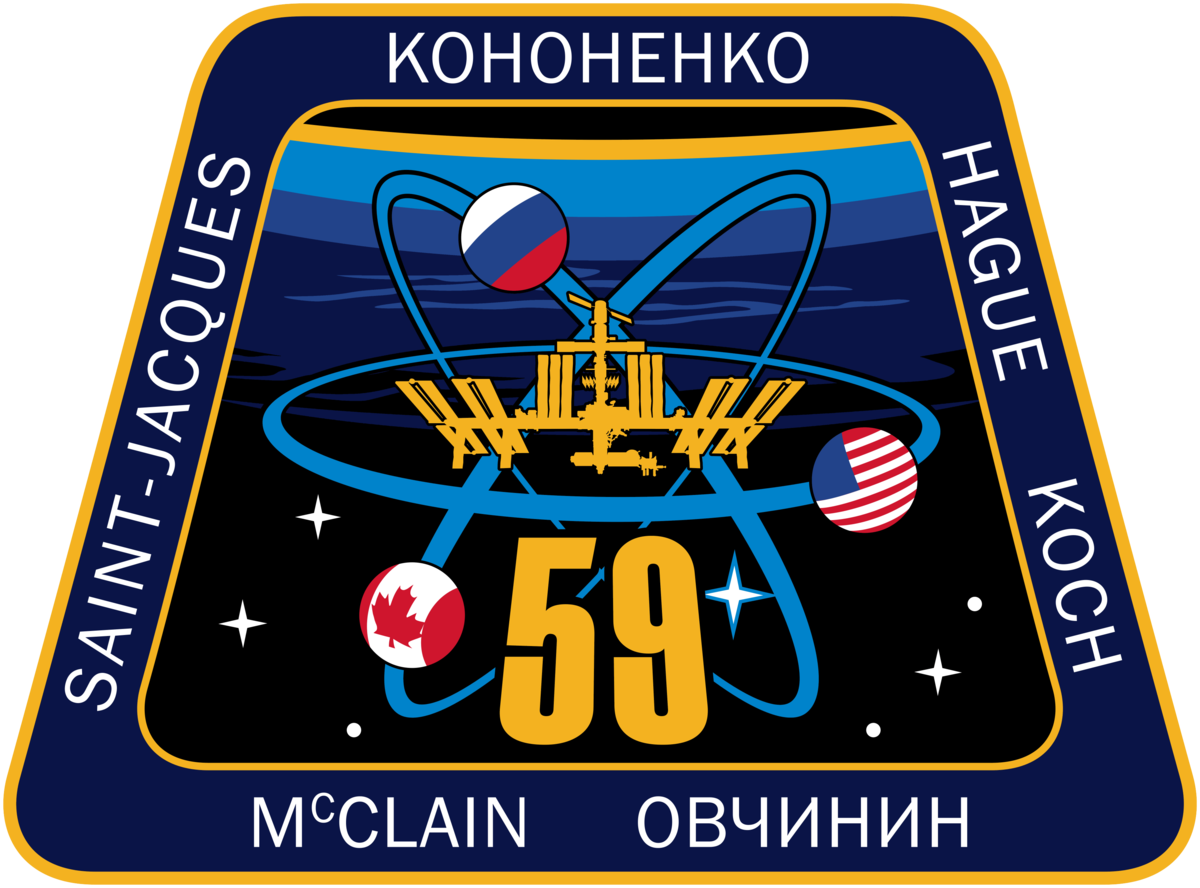
ISS - Expedition 59 Mission patch.
April 15, 2019
Astronauts on the International Space Station completed the third spacewalk since March 22 and continued preparations for resupply ships from both SpaceX and Northrop Grumman carrying important science experiments as part of their cargo.
International Space Station (ISS). Animation Credit: NASA
Here are details on some of the scientific investigations the Expedition 59 crew members conducted in the orbiting lab the week of April 8:
Mission 66 for student photos from space
Image above: An image of the coast of Belize taken in April by the Sally Ride EarthKam aboard the International Space Station. Image Credits: Sally Ride EarthKam Gallery.
The crew performed hardware setup and activation For the Sally Ride Earth Knowledge Acquired by Middle Schools (EarthKAM) mission 66. This program allows students to control the special camera aboard the space station to photograph coastlines, mountain ranges and other geographic features on Earth from the unique vantage of space. The EarthKAM team posts these photographs on its website for viewing by the public and participating classrooms around the world. As of last week, sign-up to request images totaled 218 schools representing 24,065 students from 30 countries and submitted image requests numbered 12,668 with 1,968 images downlinked.
Harvest day on the space station
Image above: Pak Choi plants growing in the Vegetable Production System (Veggie) for Veg-03H, a NASA-sponsored experiment exploring how crew members can grow their own food to sustain long-term space missions. Image Credit: NASA.
Crew members harvested Wasabi Mustard Green and Extra Dwarf Pak Choi plants, which began growing on the space station on March 9 for the Veg-03H investigation. The Wasabi grew faster than the Pak Choi and the crew times this harvest to occur before the Wasabi plants flowered, which can change the flavor of the plants. Even though the Pak Choi did not grow as well, investigators can use the data to refine future experiments on plant growth. Organisms from single-celled bacteria to plants and humans all grow differently in space. Crews need to grow their own food on future long-duration space missions and understanding plant response to microgravity is an important step toward that goal.
Keeping astronauts healthier with probiotics
Image above: Sampling sequence for the JAXA Probiotics investigation, which includes 28 days of taking beneficial bacteria or probiotics. Image Credit: JAXA.
The JAXA Probiotics investigation studies the effect of continuous consumption of beneficial bacteria or probiotics on the immune function and intestinal microbiota of astronauts in microgravity. Some species of harmful bacteria grow stronger and more virulent in space, while the human immune system becomes weaker, leading to increased health risks. A crew member collected saliva samples and completed a questionnaire for the investigation last week.
Solid leads on better crystals
The SUBSA investigation crystallizes melts in microgravity to improve understanding of solidification phenomena and crystal production. The crew processed samples of Indium Iodide (InI), which is ideal for these experiments because it is non-toxic, has a relatively low melting point, and does not react with or stick to the silica crucible. This investigation advances the process of fabricating high-quality InI and other crystals on Earth for use as better and less expensive detectors of nuclear radiation.
Image above: NASA astronaut Nick Hague conducting Space Integrated Global Inertial Navigation System (SIGI) 2 GPS Remove and Replace to recover sensors. Image Credit: NASA.
Other investigations on which the crew performed work:
- The Combustion Integrated Rack (CIR) includes an optics bench, combustion chamber, fuel and oxidizer control, and five different cameras for performing combustion investigations in microgravity: https://www.nasa.gov/mission_pages/station/research/experiments/explorer/Facility.html?#id=317
- The ISS Experience, a virtual reality film, documents daily life aboard the space station to educate a variety of audiences about life aboard the orbiting lab and science conducted there: https://www.nasa.gov/mission_pages/station/research/experiments/explorer/Investigation.html?#id=7877
- Airway Monitoring analyzes exhaled air to study airway inflammation in crew members and help maintain crew well-being on future missions: https://www.nasa.gov/mission_pages/station/research/experiments/explorer/Investigation.html?#id=1067
- Lighting Effects studies the effects that replacing fluorescent light bulbs on the space station with solid-state light-emitting diodes (LEDs) has on crew member circadian rhythms, sleep, and cognitive performance: https://www.nasa.gov/mission_pages/station/research/experiments/explorer/Investigation.html?#id=2013
- Food Acceptability examines changes in the appeal of food aboard the space station during long-duration missions: https://www.nasa.gov/mission_pages/station/research/experiments/explorer/Investigation.html?#id=7562
- The Team Task Switching investigation examines whether crew members have difficulty switching tasks and determines the effects of these switches in order to both reduce any negative consequences and improve individual and team motivation and effectiveness: https://www.nasa.gov/mission_pages/station/research/experiments/explorer/Investigation.html?#id=7538
- Cerebral Autoregulation uses non-invasive tests to measure blood flow in the brain before, during, and after a long-duration spaceflight to provide new insights into how the brain safeguards its blood supply in a challenging environment: https://www.nasa.gov/mission_pages/station/research/experiments/explorer/Investigation.html?#id=1938
Space to Ground: Extended Duration: 04/12/2019
Related links:
Expedition 59: https://www.nasa.gov/mission_pages/station/expeditions/expedition59/index.html
EarthKAM: https://www.nasa.gov/mission_pages/station/research/experiments/explorer/Investigation.html?#id=87
Veg-03H: https://www.nasa.gov/mission_pages/station/research/experiments/explorer/Investigation.html?#id=1159
Probiotics: https://www.nasa.gov/mission_pages/station/research/experiments/explorer/Investigation.html?#id=2047
SUBSA: https://www.nasa.gov/mission_pages/station/research/experiments/explorer/Investigation.html?#id=308
Spot the Station: https://spotthestation.nasa.gov/
Space Station Research and Technology: https://www.nasa.gov/mission_pages/station/research/index.html
International Space Station (ISS): https://www.nasa.gov/mission_pages/station/main/index.html
Images (mentioned), Animation (mentioned), Video (NASA), Text, Credits: NASA/Michael Johnson/Jorge Sotomayor, Lead Increment Scientist Expeditions 59/60.
Best regards, Orbiter.ch
Skylab and Space Shuttle Astronaut Owen Garriott Dies at 88
Rest In Peace.
April 16, 2019
Former astronaut and long-duration spaceflight pioneer Owen Garriott, 88, died today, April 15, at his home in Huntsville, Alabama. Garriott flew aboard the Skylab space station during the Skylab 3 mission and on the Space Shuttle Columbia for the STS-9/Spacelab-1 mission. He spent a total of 70 days in space.
Image above: Scientist-Astronaut Owen K. Garriott, science pilot of the Skylab 3 mission, is stationed at the Apollo Telescope Mount (ATM) console in the Multiple Docking Adapter of the Skylab space station in Earth orbit. From this console the astronauts actively control the ATM solar physics telescope. (sl3-108-1288). Image Credit: NASA.
“The astronauts, scientists and engineers at Johnson Space Center are saddened by the loss of Owen Garriott,” said Chief Astronaut Pat Forrester. “We remember the history he made during the Skylab and space shuttle programs that helped shape the space program we have today. Not only was he a bright scientist and astronaut, he and his crewmates set the stage for international cooperation in human spaceflight. He also was the first to participate in amateur radio from space, a hobby many of our astronauts still enjoy today.”
Garriott was born in Enid, Oklahoma. He earned a bachelor’s degree in electrical engineering from the University of Oklahoma, and master’s and doctoral degrees in electrical engineering from Stanford University, Palo Alto, California. Garriott served as an electronics officer while on active duty with the U.S. Navy from 1953 to 1956, and was stationed aboard several U.S. destroyers at sea. He then taught electronics, electromagnetic theory and ionospheric physics as an associate professor at Stanford. He performed research in ionospheric physics and has authored or co-authored more than 40 scientific papers and one book on this subject.
Image above: Hall of Fame astronaut Owen Garriott thanks the audience for their applause at the 2011 U.S. Astronaut Hall of Fame induction ceremony at NASA's Kennedy Space Center Visitor Complex in Florida. Image Credits: NASA/Jim Grossmann.
He was selected as a scientist-astronaut by NASA in June 1965, and then completed a 53-week course in flight training at Williams Air Force Base, Arizona. He logged more than 5,000 hours flying time -- including more than 2,900 hours in jet and light aircraft, spacecraft and helicopters. In addition to NASA ratings, he held FAA commercial pilot and flight instructor certification for instrument and multi-engine aircraft.
Garriott was the science-pilot for Skylab 3, the second crewed Skylab mission, and was in orbit from July 28 to Sept. 25, 1973. His crewmates were Commander Alan Bean and Pilot Jack Lousma. The crew accomplished 150% of mission goals while completing 858 revolutions of the Earth and traveling some 24.5 million miles. The crew installed replacement rate gyros used for attitude control of the spacecraft and a twin pole sunshade used for thermal control, and repaired nine major experiment or operational equipment items. They devoted 305 hours to extensive solar observations and completed 333 medical experiment performances to obtain valuable data on the effects of extended weightlessness on humans. The crew of Skylab 3 logged 1,427 hours and 9 minutes each in space, setting a world record for a single mission, and Garriott spent 13 hours and 43 minutes in three separate spacewalks outside the orbital workshop.
Image above: Scientist-astronaut Owen K. Garriott, Skylab 3 science pilot, participates in the Aug. 6, 1973 extravehicular activity during which he and astronaut Jack Lousma, Skylab 3 pilot, deployed the twin pole solar shield to help shade the Orbital Workshop. Image Credit: NASA.
On his second and final flight, Garriott flew as a mission specialist on the ninth space shuttle mission and the first six-person flight. He launched aboard the Space Shuttle Columbia for STS-9/Spacelab-1 from Kennedy Space Center, Florida, on Nov. 28, 1983. His crewmates were Commander John Young, Pilot Brewster Shaw, Jr., fellow mission specialist Robert Parker, and Payload Specialists Byron Lichtenberg and Ulf Merbold of (ESA) European Space Agency. This six-person crew was the largest yet to fly aboard a single spacecraft, the first international shuttle crew and the first to carry payload specialists. During STS-9, the first human amateur radio operations in space were conducted using Garriott's station call, W5LFL. After 10 days of Spacelab hardware verification and around-the-clock scientific operations, Columbia and its laboratory cargo landed on the dry lakebed at Edwards Air Force Base, California, on Dec. 8, 1983.
Garriott held other positions at Johnson Space Center such as deputy and later director of Science and Applications, and as the assistant director for Space and Life Science.
For Garriott’s official NASA biography, visit: https://www.nasa.gov/sites/default/files/atoms/files/garriott_owen.pdf
Related link:
Skylab: https://www.nasa.gov/mission_pages/skylab/
Images (mentioned), Text, Credits: NASA/Jason Townsend.
R.I.P., Orbiter.ch
Sending American Astronauts to Moon in 2024: NASA Accepts Challenge
NASA logo.
April 15, 2019
The president directed NASA to land American astronauts on the Moon by 2024, and the agency is working to accelerate humanity’s return to the lunar surface by all means necessary.
“We’ve been given an ambitious and exciting goal. History has proven when we’re given a task by the president, along with the resources and the tools, we can deliver,” said NASA Administrator Jim Bridenstine. “We are committed to making this happen. We have the people to achieve it. Now, we just need bipartisan support and the resources to get this done.”
Bridenstine confirmed at the 35th Space Symposium on April 9, 2019, that the agency’s proposed human lunar landing system architecture remains the plan to return crew to the surface as quickly as possible. The human lunar lander will be a public-private partnership working directly with American companies to expedite the return of Astronauts to the Moon’s surface by 2024. The South Pole continues to be the target of our exploration.
American Astronauts (comeback's) on the Moon. Image Credit: NASA
In order to best accomplish our goals in the next five years, NASA is now going forward to the Moon in two phases.
“First, we are focused on speed to land the next man, and first woman, on the Moon by 2024. Second, we will establish sustainable missions by 2028. To do that, we need our powerful Space Launch System to put the mass of reusable systems into deep space,” he said.
Gateway to Lunar Surface
Both phases rely on the Gateway, which will serve as a reusable command and service module in lunar orbit. Initial development for the lunar outpost calls for a power and propulsion element plus a habitation capability to support access to the surface.
“The Gateway can be positioned in a variety of orbits around the Moon, allows for access to entire lunar surface, and supports development of a reusable human lander system,” said William Gerstenmaier, associate administrator for Human Exploration and Operations Mission Directorate at NASA Headquarters. “Resiliency and reusability are key for sustainable human lunar exploration, and that’s what the Gateway gives us. Furthermore, there’s broad interest from the international community for supporting as well.”
This is how the human lunar lander system would operate from the Gateway:
- A transfer element drives the combined ascent and descent elements with crew inside the ascent element from the Gateway to low-lunar orbit.
- From that orbit, crew will use the descent element to land on the surface.
- When astronauts complete their expedition, they take the ascent element back up to the Gateway.
During lunar expeditions, a team of crew members will remain aboard the Gateway for scientific investigations while a separate team will explore the surface. All crew members ultimately board the Orion spacecraft for a return to Earth.
NASA is already working with U.S. industry to study a transfer element, descent element and refueling systems for use with the lunar Gateway, and begin early development work. A similar request for the ascent element was accelerated to meet the new direction, and a synopsis was issued April 8 to industry. A formal request for proposals will be released in the near future.
New Lunar Science, Technology
NASA will soon begin sending science and technology investigations to the lunar surface through its Commercial Lunar Payload Services (CLPS). By the time NASA sends crew to the Moon, many CLPS deliveries will be complete, with the first one happening by the end of this year if a commercial lander is ready.
NASA - We Are Going
“Using new landers, robots and eventually humans, we will conduct science and technology demonstrations across the entire lunar surface of the Moon to learn more about resources on the Moon and how we can use them for future exploration,” said Bridenstine. “We will move forward to the Moon, this time to stay. And then we’ll take what we learn on the Moon, and go to Mars.”
The president’s direction from Space Policy Directive-1 galvanizes NASA’s return to the Moon and builds on progress on the Space Launch System rocket and Orion spacecraft, collaborations with U.S industry and international partners, and knowledge gained from current robotic assets at the Moon and Mars.
Related articles:
Moon’s South Pole in NASA’s Landing Sites
https://orbiterchspacenews.blogspot.com/2019/04/moons-south-pole-in-nasas-landing-sites.html
Gateway to the Moon
https://orbiterchspacenews.blogspot.com/2019/03/gateway-to-moon.html
Goddard Technologists and Scientists Prepare for a New Era of Human Exploration
https://orbiterchspacenews.blogspot.com/2019/03/goddard-technologists-and-scientists.html
NASA Seeks US Partners to Develop Reusable Systems to Land Astronauts on Moon
https://orbiterchspacenews.blogspot.com/2018/12/nasa-seeks-us-partners-to-develop.html
Related links:
Human lunar landing system architecture: https://www.nasa.gov/feature/nasa-seeks-us-partners-to-develop-reusable-systems-to-land-astronauts-on-moon
Space Launch System (SLS): http://www.nasa.gov/sls
Commercial Lunar Payload Services (CLPS): https://www.nasa.gov/content/commercial-lunar-payload-services
Lunar Orbital Platform-Gateway: https://www.nasa.gov/topics/moon-to-mars/lunar-outpost
Space Policy Directive-1: https://www.nasa.gov/press-release/new-space-policy-directive-calls-for-human-expansion-across-solar-system
For more information about NASA’s Moon to Mars exploration plans, visit: https://www.nasa.gov/moontomars
Image (mentioned), Video (NASA), Text, Credits: NASA/Erin Mahoney.
Best regards, Orbiter.ch
Meteoroid Strikes Eject Precious Water From Moon
NASA - LADEE Mission patch.
April 15, 2019
Researchers from NASA and the Johns Hopkins University Applied Physics Laboratory in Laurel, Maryland, report that streams of meteoroids striking the Moon infuse the thin lunar atmosphere with a short-lived water vapor.
The findings will help scientists understand the history of lunar water — a potential resource for sustaining long term operations on the Moon and human exploration of deep space. Models had predicted that meteoroid impacts could release water from the Moon as a vapor, but scientists hadn’t yet observed the phenomenon.
Now, the team has found dozens of these events in data collected by NASA’s Lunar Atmosphere and Dust Environment Explorer. LADEE was a robotic mission that orbited the Moon to gather detailed information about the structure and composition of the thin lunar atmosphere, and determine whether dust is lofted into the lunar sky.
Water Released from Moon During Meteor Showers
Video above: Scientists have discovered that water is being released from the moon during meteor showers. When a speck of comet debris strikes the moon it vaporizes on impact, creating a shock wave in the lunar soil. For a sufficiently large impactor, this shock wave can breach the soil's dry upper layer and release water molecules from the hydrated layer below. The LADEE spacecraft detects these water molecules as they enter the tenuous lunar atmosphere. This discovery provides a potential resource for future exploration, and it improves our understanding the moon's geologic past and its continued evolution. Video Credits: NASA/Goddard/Dan Gallagher.
“We traced most of these events to known meteoroid streams, but the really surprising part is that we also found evidence of four meteoroid streams that were previously undiscovered,” said Mehdi Benna of NASA’s Goddard Space Flight Center in Greenbelt, Maryland, and the University of Maryland Baltimore County. Benna is the lead author of the study, published in Nature Geosciences.
The newly identified meteoroid streams, observed by LADEE, occurred on Jan. 9, April 2, April 5 and April 9, 2014.
Image above: Artist’s concept of the LADEE spacecraft (left) detecting water vapor from meteoroid impacts on the Moon (right). Image Credits: NASA/Goddard/Conceptual Image Lab.
There’s evidence that the Moon has water (H2O) and hydroxyl (OH), a more reactive relative of H2O. But debates continue about the origins of the water, whether it is widely distributed and how much might be present.
“The Moon doesn’t have significant amounts of H2O or OH in its atmosphere most of the time,” said Richard Elphic, the LADEE project scientist at NASA’s Ames Research Center in California’s Silicon Valley. “But when the Moon passed through one of these meteoroid streams, enough vapor was ejected for us to detect it. And then, when the event was over, the H2O or OH went away.”
Lunar scientists often use the term “water” to refer to both H2O and OH. Figuring out how much H2O and how much OH are present is something future Moon missions might address.
LADEE, which was built and managed by NASA’s Ames Research Center in California’s Silicon Valley, detected the vapor using its Neutral Mass Spectrometer, an instrument built by Goddard. The mission orbited the Moon from October 2013 to April 2014 and gathered detailed information about the structure and composition of the lunar atmosphere, or more correctly, the “exosphere” – a faint envelope of gases around the Moon.
To release water, the meteoroids had to penetrate at least 3 inches (8 centimeters) below the surface. Underneath this bone-dry top layer lies a thin transition layer, then a hydrated layer, where water molecules likely stick to bits of soil and rock, called regolith.
From the measurements of water in the exosphere, the researchers calculated that the hydrated layer has a water concentration of about 200 to 500 parts per million, or about 0.02 to 0.05 percent by weight. This concentration is much drier than the driest terrestrial soil, and is consistent with earlier studies. It is so dry that one would need to process more than a metric ton of regolith in order to collect 16 ounces of water.
Because the material on the lunar surface is fluffy, even a meteoroid that’s a fraction of an inch (5 millimeters) across can penetrate far enough to release a puff of vapor. With each impact, a small shock wave fans out and ejects water from the surrounding area.
When a stream of meteoroids rains down on the lunar surface, the liberated water will enter the exosphere and spread through it. About two-thirds of that vapor escapes into space, but about one-third lands back on the surface of the Moon.
Image above: This infographic shows the lunar water cycle based on the new observations from the Neutral Mass Spectrometer on board the LADEE spacecraft. At the lunar surface, a dry layer overlays a hydrated layer. Water is liberated by shock waves from meteoroid impacts. The liberated water either escapes to space or is redeposited elsewhere on the Moon. Some water is created by chemical reactions between the solar wind and the surface or delivered to the Moon by the meteoroids themselves. However, in order to sustain the water loss from meteoroid impacts, the hydrated layer requires replenishment from a deeper ancient water reservoir. Image Credits: NASA Goddard/Mehdi Benna/Jay Friedlander.
These findings could help explain the deposits of ice in cold traps in the dark reaches of craters near the poles. Most of the known water on the Moon is located in cold traps, where temperatures are so low that water vapor and other volatiles that encounter the surface will remain stable for a very long time, perhaps up to several billion years. Meteoroid strikes can transport water both into and out of cold traps.
The team ruled out the possibility that all of the water detected came from the meteoroids themselves.
“We know that some of the water must be coming from the Moon, because the mass of water being released is greater than the water mass within the meteoroids coming in,” said the second author of the paper, Dana Hurley of the Johns Hopkins University Applied Physics Laboratory.
The analysis indicates that meteoroid impacts release water faster than it can be produced from reactions that occur when the solar wind hits the lunar surface.
“The water being lost is likely ancient, either dating back to the formation of the Moon or deposited early in its history,” said Benna.
NASA is leading a sustainable return to the Moon with commercial and international partners to expand human presence in space and bring back new knowledge and opportunities.
Related links:
Nature Geosciences: https://www.nature.com/articles/s41561-019-0345-3
NASA’s Lunar Atmosphere and Dust Environment Explorer. LADEE: https://www.nasa.gov/ames/ladee/
Images (mentioned), Video (mentioned), Text, Credits: NASA//Ames Research Center/Alison Hawkes/Goddard Space FlightCenter/Bill Steigerwald/Nancy Jones/Elizabeth Zubritsky.
Greetings, Orbiter.ch
Moon’s South Pole in NASA’s Landing Sites
NASA - Lunar Reconnaissance Orbiter (LRO) patch.
April 15, 2019
NASA is working right now to send American astronauts to the surface of the Moon in five years, and the agency has its sights set on a place no humans have ever gone before: the lunar South Pole.
Water is a critical resource for long-term exploration, and that’s one of the main reasons NASA will send astronauts to the Moon’s South Pole by 2024. Water is a necessity for furthering human exploration because it could potentially be used for drinking, cooling equipment, breathing and making rocket fuel for missions farther into the solar system. The experience NASA gains on the Moon, including using lunar natural resources, will be used to help prepare the agency to send astronauts to Mars.
The Moon. Image Credit: NASA
“We know the South Pole region contains ice and may be rich in other resources based on our observations from orbit, but, otherwise, it’s a completely unexplored world,” said Steven Clarke, deputy associate administrator of the Science Mission Directorate at NASA Headquarters in Washington. “The South Pole is far from the Apollo landing sites clustered around the equator, so it will offer us a new challenge and a new environment to explore as we build our capabilities to travel farther into space.”
The South Pole is also a good target for a future human landing because robotically, it’s the most thoroughly investigated region on the Moon.
The elliptical, polar orbit of NASA’s Lunar Reconnaissance Orbiter (LRO) is closest to the Moon during its pass over the South Pole region. Through its thousands of orbits in the last decade, LRO has collected the most precise information about the South Pole region than any other, offering scientists precise details about its topography, temperature and locations of likely frozen water.
Lunar Reconnaissance Orbiter (LRO). Animation Credit: NASA
“We’ve mapped every square meter, even areas of permanent shadow,” said Noah Petro, an LRO project scientist based at NASA’s Goddard Space Flight Center in Greenbelt, Maryland.
There’s still so much to learn about Earth’s nearest neighbor. Ahead of a human return, NASA is planning many to send new science instruments and technology demonstration payloads to the Moon using commercial landers through Commercial Lunar Payload Services (CLPS). These robotic precursors will further investigate regions of interest to human explorers, including the South Pole, and will provide information to the engineers designing modern lunar surface systems.
Water on the Moon
Image above: In this multi-temporal illumination map of the lunar south pole, Shackleton crater (19 km diameter) is in the center, the south pole is located approximately at 9 o'clock on its rim. The map was created from images from the camera aboard the Lunar Reconnaissance Orbiter. Image Credits: NASA/GSFC/Arizona State University.
The floors of polar craters reach frigid temperatures because they’re permanently in shadow as a result of the low angle at which sunlight strikes the Moon’s surface in the polar regions (and also because the Moon has no atmosphere to help warm up its surface). This angle is based on the 1.54-degree tilt of the Moon’s axis (Earth’s is 23.5 degrees). If an astronaut was standing near the South Pole, the Sun would always appear on the horizon, illuminating the surface sideways, and, thus, skimming primarily the rims of deep craters, and leaving their deep interiors in shadow.
These permanently shadowed craters feature some of the lowest temperatures in the solar system — down to -414 degrees Fahrenheit (-248 Celsius). Water ice is stable at these temperatures and it is believed that some of these craters harbor significant ice deposits.
Permanent Shadows on the Moon
Video above: This sample composite combines all the animation elements listed below to visually tell the story of permanent shadows on the Moon. The aquamarine areas highlight the permanently shadowed regions. Video Credits: NASA/Goddard Space Flight Center Scientific Visualization Studio. Digital Elevation Map (DEM) data of the lunar south pole provided by the JAXA/Selene.
The South Pole’s frozen water may date back billions of years and has been untainted by the Sun’s radiation or the geological processes that otherwise constantly churn and renew planetary surfaces (think of wind and erosion on Earth), offering us a window into the early solar system.
Tilted View: Permanent Shadows on the Moon
Video above: Tilted View: In this animation, the camera is parked, looking down at Shackleton Crater at an angle while the shadows cycle through a full 360 degree rotation. Video Credits: NASA/Goddard Space Flight Center Scientific Visualization Studio. Digital Elevation Map (DEM) data of the lunar south pole provided by the JAXA/Selene.
“That record of water collection is a record that can help us understand how water and other volatiles have been moving around the solar system, so we’re very interested in getting to these locations and sampling the material there,” said John W. Keller, a lunar scientist at NASA’s Goddard Space Flight Center in Greenbelt, Maryland. Studying samples of ice from polar regions of Earth, for example, has revealed how our planet's climate and atmosphere have evolved over thousands of years.
Constant Light and Power
Other extremes at the Moon’s South Pole are not so dark and cold — there are also areas, near Shackleton crater for instance, that are bathed in sunlight for extended periods of time, over 200 Earth days of constant illumination. This happens also because of the Moon’s tilt and is a phenomenon that we experience at our own polar regions on Earth. Unrelenting sunlight is a boon to Moon missions, allowing explorers to harvest sunlight in order to light up a lunar base and power its equipment.
The president’s direction from Space Policy Directive-1 galvanizes NASA’s return to the Moon and builds on progress on the Space Launch System rocket and Orion spacecraft, collaborations with U.S industry and international partners, and knowledge gained from current robotic assets at the Moon and Mars.
Related links:
Lunar Reconnaissance Orbiter (LRO): https://www.nasa.gov/mission_pages/LRO/main/index.html
Moon and Mars: https://www.nasa.gov/specials/moon2mars/
Commercial Lunar Payload Services (CLPS): http://www.nasa.gov/clps
Space Policy Directive-1: https://www.nasa.gov/press-release/new-space-policy-directive-calls-for-human-expansion-across-solar-system
Images (mentioned), Animation (mentioned), Videos (mentioned), Text, Credits: NASA/Brian Dunbar.
Greetings, Orbiter.ch
dimanche 14 avril 2019
First successful flight for the world's largest aircraft
Stratolaunch logo.
April 14, 2019
Stratolaunch first flight
The Stratolaunch made its first flight this weekend over the Mojave Desert in the United States.
The American company Stratolaunch announced Saturday that it had carried over a California desert the first test flight of the largest aircraft in the world, whose wingspan is almost half that of an Airbus A380.
The strange aircraft, built by the legendary aeronautical engineering company Scaled Composites in the Mojave Desert, has two fuselages and is powered by six Boeing 747 engines.
Stratolaunch First Flight
It must theoretically be used to carry and drop at altitude a small rocket that will then light its engine, and will propel to space to place satellites in orbit. This is a more flexible method of accessing the space than vertical rocket takeoffs, as a large take-off runway would suffice.
"What a fantastic first flight"
The Stratolaunch aircraft took off from the airport and "spaceport" in Mojave, California at 06:58 local time (13:58 GMT), and remained in the air for two and a half hours, the company said in a statement Sunday. . Until now, the aircraft had only ground taxi tests. The maximum speed during the flight was 304 km / h (189 miles per hour, according to Stratolaunch), and the aircraft climbed to 17,000 feet, or 5182 meters.
Stratolaunch first flight
"What a fantastic first flight," said Stratolaunch general manager Jean Floyd. "Today's flight advances our mission to provide a flexible alternative solution to ground launch systems." The size of the craft, 117 meters, is larger than a football field. An Airbus A380 is 79.75 meters wide.
Image above: An illustration of the "family" of launch vehicles Stratolaunch had planned to offer. The company is ending work on its own launch systems, leaving it with the existing Pegasus XL from Northrop Grumman. Image Credit: Stratolaunch.
Stratolaunch was funded by Microsoft co-founder Paul Allen to become a new player in the small satellite launch market. But the death of Mr. Allen in October 2018 makes the future of the Stratolaunch uncertain.
For more information about Stratolaunch, visit: https://www.stratolaunch.com/
Images, Video, Text, Credits: AFP/Stratolaunch/Orbiter.ch Aerospace/Roland Berga.
Greetings, Orbiter.ch
Inscription à :
Articles (Atom)