mardi 25 juin 2019

X-rays reveal how cosmic giants meet


ESA - XMM-Newton Mission patch.

25 June 2019

Scientists have uncovered an extremely powerful shock wave in a distant part of the Universe where two massive galaxy clusters appear to come into first contact ahead of merging. The study is based on data from several astronomical facilities, including ESA's XMM-Newton X-ray space observatory.


Image above: Merging galaxy clusters at first contact. Image Credits: NASA/CXC (X-rays); SDSS (optical); GMRT (radio); Liyi Gu et al. 2019.

According to Liyi Gu, an astronomer from RIKEN High Energy Astrophysics Laboratory in Japan and the Netherlands Institute for Space Research, who is the lead author of a paper published today in Nature Astronomy, the observations capture the unique moment when the two clusters touch each other for the very first time – something that has never been observed before.

The clusters, called 1E2216 and 1E2215, are located over one billion light years away from the Earth and have been drawn towards each other by gravity for billions of years. Their first contact, indicated by the new data, marks the beginning of a dramatic and lengthy process that will completely mix the clusters up and combine them into one.

"Collisions between galaxy clusters are the most energetic events in the Universe since the Big Bang," said Liyi. "The shocks that arise during the merger are probably the most important particle accelerator in the Universe, releasing a huge amount of heat, radiation and high-energy cosmic rays."


Image above: Sequence of merging galaxy clusters. Image Credit: Abell 399/401: ROSAT (X-rays); GMRT/TGSS (radio); Abell 1758: ESA/XMM-Newton (X-rays); GMRT/TGSS (radio); 1E2215: NASA/Chandra (X-rays), GMRT (radio); CIZA J2242: ESA/XMM-Newton (X-rays); ASTRON/WSRT (radio).

Clusters of galaxies are the largest known objects in the cosmos bound by gravity, and can consist of hundreds of galaxies, each containing billions of stars or more. Interspersed between a cluster's galaxies are huge amounts of hot, X-ray emitting gas, and even larger amounts of the invisible dark matter.

These enormous cosmic objects are thought to form gradually, starting first with individual galaxies encountering each other due to the effects of gravity. The process continues with the formation of smaller groups, which then merge into bigger and bigger clusters. While the first touch, the so-called pre-merger phase, lasts for a relatively short period of time – around 100 million years – the entire merging process takes billions of years to complete.

Liyi and collaborators around the world gathered about 40 hours of observations with ESA's XMM-Newton in 2017 and another 40 hours with NASA's Chandra X-ray telescope in 2018. These observations were combined with 2012 data from JAXA's now decommissioned Suzaku satellite and with radio data from two ground-based telescopes located in Europe and India.

The scientists think that the data reveal a pre-merger shock caused by the first contact between the two clusters.


Image above: Shocks during galaxy cluster merger. Image Credits: Courtesy of H. Akamatsu (SRON).

In the observations, they could distinguish two very hot gas halos with temperatures in excess of 50 million degrees Celsius, each associated with either cluster, and connected by a bridge of even hotter gas.

"This gas bridge is shock-heated: on the two sides you can see a shock front propagating from the inside out along the equatorial plane of the merger," explained Liyi. "The bridge was created by the merger itself. As the two clusters are getting closer, at some point they start getting connected."

Liyi added that it was somewhat surprising to see the shock wave propagating outwards along the equatorial plane, as most shocks found in merging galaxy clusters usually propagate along the vertical axis of the merger. However, theoretical models and numerical simulations do predict that a similar phenomenon might occur during the pre-merger phase.

"The equatorial shock can be explained simply by a very strong compression along the merger axis," said Liyi.


Image above: Temperature distribution of merging galaxy clusters IE2216 and IE2215. Image Credits: ESA/XMM-Newton; GMRT; Liyi Gu et al. 2019.

In particular, XMM-Newton enabled the scientists to calculate the temperature distribution of hot gas within the two clusters, as well as the extremely high temperature in the shock region, reaching up to 100 million degrees Celsius.

"From the XMM-Newton data, we could estimate the shock speed and the total dynamic energy of the system, including its pressure," said Liyi.

The team is planning to keep monitoring this cosmic encounter with XMM-Newton and Chandra.

In coming years, XMM-Newton can be used to identify more cluster mergers like this one via dedicated observations of carefully selected portions of the sky. Next-generation X-ray observatories, such as the Japanese-led XRISM and ESA's Athena missions, will enable astronomers to learn in even greater detail what is happening during these gigantic collisions.

"We have been very lucky to have seen this first encounter between the two clusters," said co-author Jelle Kaastra from the Netherlands Institute for Space Research.

"Usually, we can see galaxy clusters getting closer to each other or already in the process of merging. With the next generation of X-ray telescopes, such as XRISM and Athena, we will be able not only to see more details of this particular merger but also find many more systems that are in different merging phases."

Artist's impression of ESA's XMM-Newton X-ray Observatory. Image Credit: ESA

XRISM, a collaboration between JAXA and NASA including ESA participation, is scheduled to launch in 2021. Athena, part of ESA's Cosmic Vision programme, is expected to launch in 2031, and will carry instruments one hundred times more sensitive than those aboard Chandra and XMM-Newton.

Galaxy cluster mergers are among the most important processes that shape the structure of the Universe on very large scales. Yet, these giant collisions are poorly understood. With the facilities of the coming decades, scientists will be able to observe more such events at various stages and eventually piece together a complete 'movie' of the merging of galaxy clusters.

"Galaxy cluster mergers are difficult to observe because the timescales involved are so long," said Norbert Schartel, XMM-Newton project scientist at ESA.

"It will take a long time to fully understand these processes. We are just getting started by collecting data about mergers at different stages, and it is exciting that XMM-Newton could help capture the beginning of such a clash."

Notes for editors:

The results described here are reported in "Observations of a Pre-Merger Shock in Colliding Clusters of Galaxies" by Liyi Gu et al., published in Nature Astronomy:
https://www.nature.com/articles/s41550-019-0798-8

The study is based on X-ray data from ESA's XMM-Newton, NASA's Chandra X-ray telescope and JAXA's Suzaku satellite, along with radio-wave observations from the Low-Frequency Array (LOFAR), located in the Netherlands and other European countries, and from the Giant Metrewave Radio Telescope, located in India.

The team involves scientists based in Japan, the Netherlands, Australia, Germany, Hungary, the UK, India and South Africa.

Related link:

XMM-Newton: http://sci.esa.int/xmm-newton/

Images (mentioned), Text, Credits: ESA/Norbert Schartel/SRON – Netherlands Institute for Space Research/Jelle S. Kaastra/RIKEN High Energy Astrophysics Laboratory/Liyi Gu.

Greetings, Orbiter.ch

Expedition 59 Crewmates Return from Space Station Mission


ROSCOSMOS - Soyuz MS-11 Mission patch.

June 25, 2019

Expedition 59 Space Station Crew Lands Safely in Kazakhstan

Image above: The Soyuz MS-11 spacecraft is seen as it lands in a remote area near the town of Zhezkazgan, Kazakhstan with Expedition 59 crew members Anne McClain of NASA, David Saint-Jacques of the Canadian Space Agency and Oleg Kononenko of Roscosmos, Tuesday, June 25, 2019, Kazakh time (June 24 Eastern time). McClain, Saint-Jacques and Kononenko are returning after 204 days in space where they served as members of the Expedition 58 and 59 crews onboard the International Space Station. Image Credit: NASA/Bill Ingalls.

NASA astronaut Anne McClain and two of her Expedition 59 crewmates returned to Earth from the International Space Station Monday, landing safely in Kazakhstan at 10:47 p.m. EDT (8:47 a.m. Tuesday, June 25, local time) after months of science and four spacewalks aboard the microgravity laboratory.

Soyuz MS-11 landing

McClain, Expedition 59/Soyuz Commander Oleg Kononenko of the Russian space agency Roscosmos and David Saint-Jacques of the Canadian Space Agency launched Dec. 3, 2018. They arrived at the space station just six hours later to begin their 204-day mission, during which they orbited Earth 3,264 times traveling 86,430,555 miles.

After post-landing medical checks, McClain and Saint-Jacques will return to Houston and Kononenko to Star City, Russia.

The Expedition 59 crew contributed to hundreds of experiments in biology, biotechnology, physical science and Earth science, including investigations into small devices that replicate the structure and function of human organs, editing DNA in space for the first time and recycling 3D-printed material.

McClain, a lieutenant colonel in the U.S. Army and native of Spokane, Washington, conducted two spacewalks totaling 13 hours and 8 minutes on her mission into space.

Saint-Jacques, also on his first space mission and only the sixth Canadian astronaut to perform a spacewalk, joined McClain on her second outing, which totaled 6 hours and 29 minutes. Kononenko, on his fourth mission, conducted two spacewalks totaling 13 hours and 46 minutes, bringing his career total to 32 hours and 13 minutes spread over five spacewalks.


Image above: Oleg Kononenko, Anne McClain and David Saint-Jacques are seen shortly after landing on board Soyuz MS-11. Image Credits: NASA/Bill Ingalls.

When their Soyuz MS-11 spacecraft undocked at 7:25 p.m., Expedition 60 began aboard the station officially, with Nick Hague and Christina Koch of NASA as flight engineers, and Alexey Ovchinin of Roscosmos as the station’s commander.

The next residents to arrive at the space station – Andrew Morgan of NASA, Luca Parmitano of ESA (European Space Agency) and Alexander Skvortsov of Roscosmos – will launch aboard Soyuz MS-13 on July 20, from the Baikonur Cosmodrome in Kazakhstan and join Expedition 60 after a six-hour flight.

Related links:

Expedition 59: https://www.nasa.gov/mission_pages/station/expeditions/expedition59/index.html

Expedition 60: https://www.nasa.gov/mission_pages/station/expeditions/expedition60/index.html

Small devices: https://www.nasa.gov/tissue-chips

Editing DNA in space: https://www.nasa.gov/mission_pages/station/research/news/studying-dna-breaks-in-space

Recycling 3D-printed material: https://www.nasa.gov/mission_pages/station/research/experiments/explorer/Investigation.html?#id=7321

International Space Station (ISS): https://www.nasa.gov/mission_pages/station/main/index.html

Images (mentioned), Video, Text, Credits: NASA/Karen Northon/Joshua Finch/JSC/Gary Jordan/NASA TV/SciNews.

Best regards, Orbiter.ch

SpaceX - STP-2 Mission Success


SpaceX  - Falcon Heavy / STP-2 Mission patch.

June 25, 2019

SpaceX’s Falcon Heavy STP-2 Mission launch

A SpaceX Falcon Heavy rocket launched the STP-2 mission (Space Test Program-2) from Launch Complex 39A (LC-39A), at NASA’s Kennedy Space Center, Florida, on 25 June 2019, at 06:30 UTC (02:30 EDT). Following booster separation, Falcon Heavy’s two side boosters (Block 5 B1052 and B1053) landed at SpaceX’s Landing Zones 1 and 2 (LZ-1 and LZ-2) at Cape Canaveral Air Force Station in Florida.

First Falcon Heavy Night Launch

Falcon Heavy’s center core (Block 5 B1057) attempted to land on the “Of Course I Still Love You” droneship, stationed in the Atlantic Ocean. STP-2 mission from Launch Complex 39A (LC-39A) at NASA’s Kennedy Space Center in Florida. Deployments began approximately 12 minutes after liftoff and ended approximately 3 hours and 32 minutes after liftoff.

Falcon Heavy boosters landing, June 2019

Following booster separation, Falcon Heavy’s two side boosters (Block 5 B1052 and B1053) landed at SpaceX’s Landing Zones 1 and 2 (LZ-1 and LZ-2) at Cape Canaveral Air Force Station in Florida. Falcon Heavy’s center core (Block 5 B1057) attempted to land on the “Of Course I Still Love You” droneship, stationed in the Atlantic Ocean.

Falcon Heavy’s side boosters for the STP-2 mission previously supported the Arabsat-6A mission in April 2019. Following booster separation, Falcon Heavy’s two side boosters landed at SpaceX’s Landing Zones 1 and 2 (LZ-1 and LZ-2) at Cape Canaveral Air Force Station in Florida.

For more information about SpaceX, visit: https://www.spacex.com/

Image, Videos, Text, Credits: SpaceX/SciNews/NASA.


Greetings, Orbiter.ch

lundi 24 juin 2019

Expedition 59 Trio Leaves Station for Ride to Earth


ROSCOSMOS - Soyuz MS-11 Mission patch.

June 24, 2019

NASA Flight Engineer Anne McClain, Expedition 59/Soyuz Commander Oleg Kononenko of the Russian space agency Roscosmos, and David Saint-Jacques of the Canadian Space Agency undocked from the International Space Station at 7:25 p.m. EDT to begin their trip home.


Image above: The Soyuz MS-11 Spacecraft carrying three Expedition 59 crewmembers backs away from the International Space Station moments after undocking. Image Credit: NASA TV.

Deorbit burn is scheduled for approximately 9:55 p.m., with landing in Kazakhstan targeted for 10:48 p.m. NASA will resume coverage on TV and online at 9:30 p.m. for deorbit burn and landing.

At the time of undocking, Expedition 60 began aboard the space station under the command of Roscosmos’ Alexey Ovchinin. Along with his crewmates NASA astronauts Nick Hague and Christina Koch, the three-person crew will operate the station for a few weeks until the next residents arrive July 20.

Soyuz MS-11 undocking and departure

Andrew Morgan of NASA, Luca Parmitano of ESA (European Space Agency) and Alexander Skvortsov of Roscosmos will launch aboard Soyuz MS-13 from the Baikonur Cosmodrome in Kazakhstan and join Expedition 60 after a six-hour flight on the 50th anniversary of the first human landing on the Moon.

Related links:

Expedition 59: https://www.nasa.gov/mission_pages/station/expeditions/expedition59/index.html

Expedition 60: https://www.nasa.gov/mission_pages/station/expeditions/expedition60/index.html

NASA Television: http://nasa.gov/live

Soyuz MS-11: https://www.nasa.gov/feature/soyuz-launches-arrivals-and-departures/

Space Station Research and Technology: https://www.nasa.gov/mission_pages/station/research/index.html

International Space Station (ISS): https://www.nasa.gov/mission_pages/station/main/index.html

Image (mentioned), Video, Text, Credits: NASA/Mark Garcia/NASA TV/SciNews.

Greetings, Orbiter.ch

Departing Trio Aboard Soyuz Crew Ship Awaiting Undocking


ROSCOSMOS -Soyuz MS-11 Mission patch.

June 24, 2019

At 4:15 p.m. EDT, the hatch closed between the Soyuz spacecraft and the International Space Station in preparation for undocking. NASA Flight Engineer Anne McClain, Expedition 59/Soyuz Commander Oleg Konenenko of the Russian space agency Roscosmos, and David Saint-Jacques of the Canadian Space Agency are scheduled to undock their Soyuz at 7:25 p.m.


Image above: Expedition 59 crew members (from left) Anne McClain, Oleg Kononenko and David Saint-Jacques are wearing the Sokol launch and entry suits they will wear on the way back to Earth aboard the Soyuz MS-11 crew ship. Image Credit: NASA TV.

NASA Television will air live coverage of the undocking beginning at 7 p.m.

Soyuz MS-11 hatch closure

Their landing in Kazakhstan is targeted for approximately 10:48 p.m. and will conclude a more than six month mission conducting science and maintenance aboard the space station, in which they circled the globe 3,264 times, covering 86.4 million miles.

Related links:

Expedition 59: https://www.nasa.gov/mission_pages/station/expeditions/expedition59/index.html

Expedition 60: https://www.nasa.gov/mission_pages/station/expeditions/expedition60/index.html

NASA Television: http://nasa.gov/live

Soyuz MS-11: https://www.nasa.gov/feature/soyuz-launches-arrivals-and-departures/

Space Station Research and Technology: https://www.nasa.gov/mission_pages/station/research/index.html

International Space Station (ISS): https://www.nasa.gov/mission_pages/station/main/index.html

Image (mentioned), Video, Text, Credits: NASA/Mark Garcia/NASA TV/SciNews.

Greetings, Orbiter.ch

Lung health, algae and radiation research on Space Station


ESA - Colombus Module logo.

24 June 2019

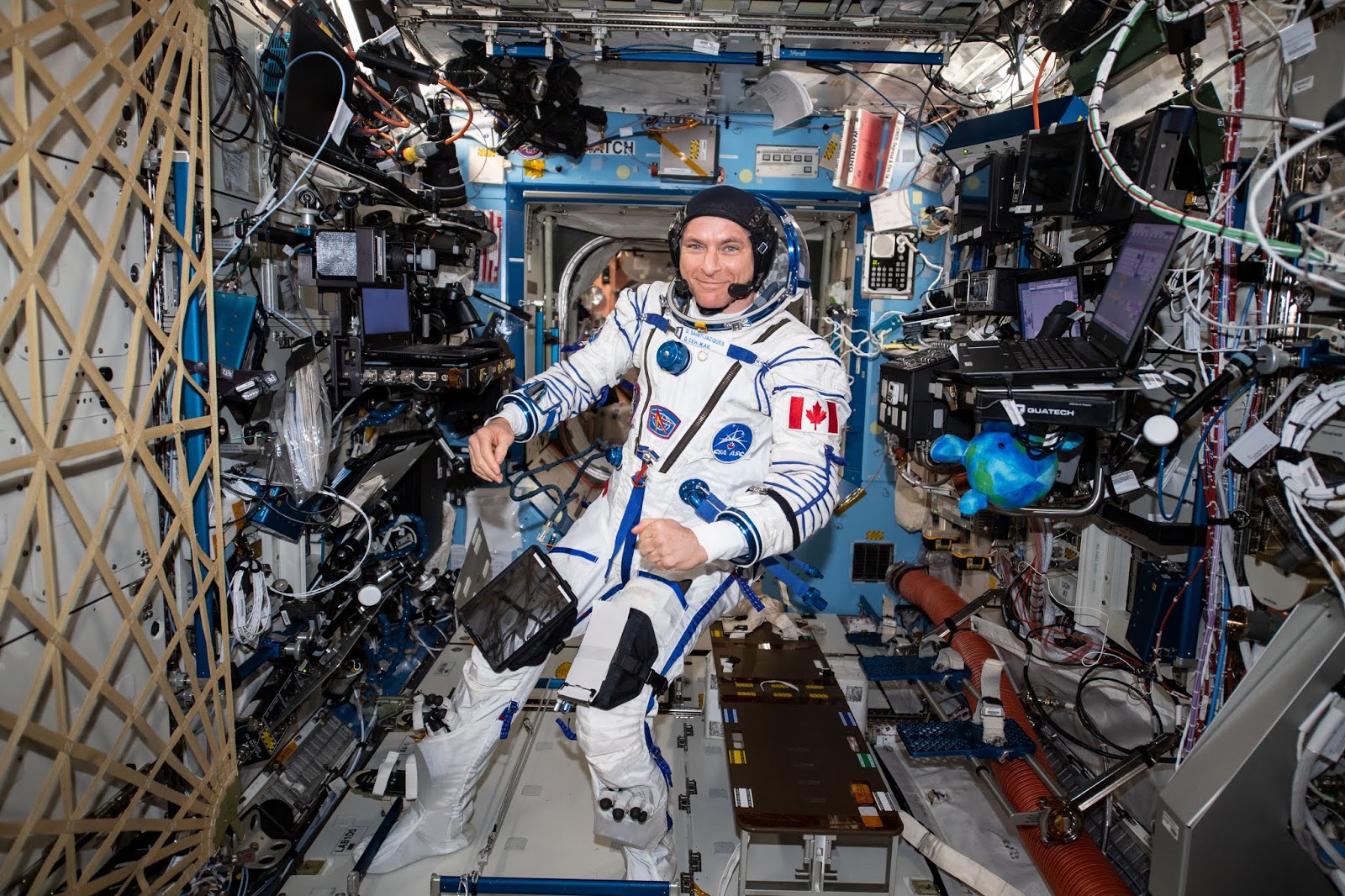
Join us as we look back at the past two weeks of European science on the International Space Station. These were also the last two weeks in space for NASA astronaut Anne McClain, Canadian Space Agency astronaut David Saint-Jacques and Roscosmos astronaut Oleg Kononenko who are preparing to leave the Station at 23:25 GMT today.

David Saint-Jacques in Sokol suit

Strapped inside their Soyuz MS-11 spacecraft, the astronauts will travel home alongside a multitude of carefully-packed pieces experiments and pieces of equipment. Among the cargo are dosimeters from the Dosis 3D experiment that is charting radiation levels on Station.

A breath of fresh science

On 13 June, Anne and NASA astronaut Nick Hague conducted their final session of the Airway Monitoring experiment. This was also the very last session for this experiment in space.

Starting with ESA astronaut Samantha Cristoforetti in 2015, Airway Monitoring has gathered data on how astronauts exhale nitric oxide in space. The research is helping to build a better understanding of the lung problems astronauts might develop on long spaceflights. Dust circulates indefinitely in space, increasing the chance of entering an astronaut’s lungs. Lunar dust could also cause lung inflammation and this experiment is the first to see how astronauts’ lungs cope with the change in environment.

Anne McClain Airway Monitoring

The Airway Monitoring experiment is notable as it is the only experiment to use one of the Space Station’s airlock for research purposes. Part of the research requires the astronauts breathe while in reduced pressure so air is pumped out of the airlock during monitoring sessions.

On 20 June Nick gave some attention to the algae in German Aerospace Center DLR’s PhotoBioreactor. He provided fresh nutrients and removed excess algae in the experiment that is looking at how we can harness the power of Chlorella vulgaris to produce oxygen and food from water and carbon dioxide. Nick also took a sample of the algae and stored it in the Space Station’s –80°C freezer for analysis later on Earth.

PhotoBioreactor

The Electromagnetic Levitator was also powered up for another run of melting and solidifying alloys in space. Roscosmos astronaut Alexi Ovchinin configured the gas valves that allow the metals to be cast in an inert environment. Understanding the underlying physics of metal casting is complicated and factors such as gravity, and the mould used to hold the metal in place as the gas in which the metal is cast, can influence results. For example, gravity pulls on atoms in different ways and heat is transferred to the mould whereas the gas can interact with metal too. The facility was made ready for science on 19 June.

 Matiss experiment

Experiments that have kept on ticking without astronaut intervention are the space storm-hunter ASIM, France's space agency CNES microbiological investigation Matiss-2, Europe’s commercial access to Space Station science ICE Cubes and the ‘air-traffic’ control for ships monitoring Vessel ID.

Soyuz MS-11

After the trio leave the Space Station tonight, Nick, NASA astronaut Christina Koch and Alexei will continue to orbit our planet as a trio until the arrival of Soyuz MS-13 crew. This crew includes ESA astronaut Luca Parmitano and the launch, currently scheduled for 20 July 2019, marks the start of his second mission – Beyond: https://www.esa.int/Our_Activities/Human_and_Robotic_Exploration/International_Space_Station/Beyond_mission_Luca_Parmitano

Related links:

Airway Monitoring experiment: https://www.esa.int/Our_Activities/Human_and_Robotic_Exploration/Research/Monitoring_the_airways

PhotoBioreactor: https://www.dlr.de/dlr/en/desktopdefault.aspx/tabid-11017/1813_read-26324/#/gallery/30222

Electromagnetic Levitator: http://www.esa.int/Our_Activities/Human_and_Robotic_Exploration/Blue_dot/Electromagnetic_levitator

Space storm-hunter ASIM: http://www.esa.int/asim

CNES microbiological investigation Matiss-2: https://www.esa.int/Our_Activities/Human_and_Robotic_Exploration/Proxima/Highlights/Clean_house

ICE: http://www.icecubesservice.com/

Vessel ID: https://www.esa.int/Our_Activities/Human_and_Robotic_Exploration/Columbus/Vessel-ID

European space laboratory Columbus: http://www.esa.int/Our_Activities/Human_and_Robotic_Exploration/Columbus

International Space Station Benefits for Humanity: http://www.esa.int/Our_Activities/Human_and_Robotic_Exploration/International_Space_Station_Benefits_for_Humanity

International Space Station (ISS): http://www.esa.int/Our_Activities/Human_and_Robotic_Exploration/International_Space_Station

Images, Text, Credits: ESA/NASA/Universität Stuttgart/CNES/Emmanuel Grimault.

Best regards, Orbiter.ch

Curiosity Detects Unusually High Methane Levels


NASA - Mars Science Laboratory (MSL) logo.

June 24, 2019


Image above: This image was taken by the left Navcam on NASA's Curiosity Mars rover on June 18, 2019, the 2,440th Martian day, or sol, of the mission. It shows part of "Teal Ridge," which the rover has been studying within a region called the "clay-bearing unit." Image Credits: NASA/JPL-Caltech.

This week, NASA's Curiosity Mars rover found a surprising result: the largest amount of methane ever measured during the mission - about 21 parts per billion units by volume (ppbv). One ppbv means that if you take a volume of air on Mars, one billionth of the volume of air is methane.

The finding came from the rover's Sample Analysis at Mars (SAM) tunable laser spectrometer. It's exciting because microbial life is an important source of methane on Earth, but methane can also be created through interactions between rocks and water.

Curiosity doesn't have instruments that can definitively say what the source of the methane is, or even if it's coming from a local source within Gale Crater or elsewhere on the planet.

"With our current measurements, we have no way of telling if the methane source is biology or geology, or even ancient or modern," said SAM Principal Investigator Paul Mahaffy of NASA's Goddard Spaceflight Center in Greenbelt, Maryland.

The Curiosity team has detected methane many times over the course of the mission. Previous papers have documented how background levels of the gas seem to rise and fall seasonally. They've also noted sudden spikes of methane, but the science team knows very little about how long these transient plumes last or why they're different from the seasonal patterns.

The SAM team organized a different experiment for this weekend to gather more information on what might be a transient plume. Whatever they find - even if it's an absence of methane - will add context to the recent measurement.

Mars Science Laboratory (MSL) or Curiosity rover. Animation Credits: NASA/JPL

Curiosity's scientists need time to analyze these clues and conduct many more methane observations. They also need time to collaborate with other science teams, including those with the European Space Agency's Trace Gas Orbiter, which has been in its science orbit for a little over a year without detecting any methane. Combining observations from the surface and from orbit could help scientists locate sources of the gas on the planet and understand how long it lasts in the Martian atmosphere. That might explain why the Trace Gas Orbiter's and Curiosity's methane observations have been so different.

Related article:

NASA Finds Ancient Organic Material, Mysterious Methane on Mars
https://orbiterchspacenews.blogspot.com/2018/06/nasa-finds-ancient-organic-material.html

For more information about Curiosity, visit:

https://www.nasa.gov/mission_pages/msl/index.html

https://mars.nasa.gov/msl/

Image (mentioned), Animation (mentioned), Text, Credits: NASA/Alana Johnson/JPL/Andrew Good.

Greetings, Orbiter.ch