mardi 20 août 2019

A space cocktail of science, bubbles and sounds


ISS - International Space Station logo.

20 August 2019

The International Space Station was again the stage for novel European science and routine operations during the first half of August. Plenty of action in the form of bubbles and sounds added to the mix in the run-up to a spacewalk and the comings and goings of visiting vehicles.

Day and night

ESA astronaut Luca Parmitano installed the Multiscale Boiling experiment, known affectionately as Rubi, in its new home in Europe’s Columbus laboratory. It took Luca a few hours to fit the container, the size of a large shoebox, inside the Fluid Science Laboratory.

A lot of science will take place in there – Rubi will generate bubbles under controlled conditions using a special heater to expand our knowledge of the boiling process. Larger bubbles in slow motion will allow scientists to observe and measure effects that are too fast and too small on Earth.

With this insight and more accurate calculations of the boiling process, products such as laptops can be improved and made more compact.

Bubbles in altered states of gravity

Can you hear me?

The Space Station is a labyrinth of modules running 24/7, and many astronauts have remarked upon the incessant hum that comes from living in a large spacecraft. Scientists worry that this non-stop buzz might affect the hearing of the astronauts.

Luca and NASA astronaut Andrew Morgan lent their ears to the first session of the Acoustic Diagnostics experiment. Once a month, with headphones on, the astronauts will listen to sounds as a device records the response of their inner ears.  

Detecting hearing loss in space will both help take care of astronauts’ health during long missions and improve a device for testing hearing more accurately on Earth in noisy environments.

Human, all too human - in space

As we get older, the way protein accumulates in our brain is thought to cling together in larger threads, depriving us of memories and a sharp brain. The possibility that astronauts have a higher propensity to develop neurodegenerative diseases is the focus of the Amyloid Aggregation experiment.

Protein aggregation in space

Amyloids are protein aggregations associated with Alzheimer’s disease. Luca carefully manipulated a set of tiny tubes with different incubation times. Upon completion of the experiment, the whole kit will remain frozen at –80°C until it is shipped back to Earth on the SpaceX Dragon vehicle on 27 August.

Disrupted time perception, altered eye-hand coordination and loss of body mass are some of the effects that life in space has on the human body. Both Luca and Andrew ran sessions of the Time, Grip and Grasp experiments to help scientists understand how our brain copes with microgravity.

Dexterity in space

A new experiment for Space Station research is NutrISS. During five consecutive days, Luca logged his nutritional intake and assessed any changes in his body weight, fat mass and fat-free mass in an app called Everywear. Medical teams on Earth will use it to limit bone and muscle loss in space.

Little creatures

Keeping germs at bay on the International Space Station is the focus of the Matiss-2 experiment. For nearly a year, sample holders have been exposed in the Columbus module, letting the air flow through and collect any bacteria floating past.

Luca removed one of the holders and prepared it for download to Earth, where scientists will assess the antibacterial properties of five advanced materials that could stop bacteria from settling and growing on the surface. Which one will work best?

Unwanted bacteria

Elsewhere inside the Columbus module bacteria will continue to grow but for our benefit. The International Space Station is hosting some of the smallest miners in the universe: microbes. Luca unleashed biofilm-forming microbes for incubation in the Kubik experiment container. The BioRock experiment grows different species on basalt slides for 21 days under microgravity, Earth’s gravity and martian gravity.

Bacteria were sent to the Space Station in a desiccated, dormant state and rehydrated on board. Scientists want to learn how altered states of gravity affect the interaction of microbes with rock, and how the little miners could help astronauts on future missions to the Moon and Mars.

Related links:

Multiscale Boiling experiment: https://orbiterchspacenews.blogspot.com/2019/08/bubbles-in-space.html

Time: https://www.esa.int/spaceinimages/Images/2018/06/Lost_in_time

Grip: http://www.esa.int/spaceinimages/Images/2018/06/A_dexterous_laboratory_in_space

Grasp: http://blogs.esa.int/alexander-gerst/2018/06/29/grasp-experiment/

Everywear: http://www.esa.int/spaceinimages/Images/2017/09/Paolo_using_EveryWear_app

Kubik: https://www.esa.int/spaceinimages/Images/2018/02/Kubik_on_Space_Station

BioRock: https://www.esa.int/spaceinimages/Images/2019/03/BioRock

Images, Animation, Text, Credits: ESA/NASA-L.Parmitano/A. Morgan/Technical University Darmstadt.

Greetings, Orbiter.ch

A second planet around the star Beta Pictoris


Astrophysics - Astrobiology logo.

 August 20, 2019

After the giant planet Beta Pictoris B, discovered in 2009, a "little sister" was spotted around the star.

A new giant planet has been discovered around the young star Beta Pictoris, which shines 63.4 light years from Earth, according to a study published Monday in the journal "Nature Astronomy".

Artist's impression of the planet Beta Pictoris b

"This is a giant planet of about 3000 times the mass of the Earth, located 2.7 times farther from its star than the Earth of the Sun," said Anne-Marie Lagrange, CNRS researcher at the Institute of Planetology and Astrophysics of Grenoble, lead author of the study.

Visible to the naked eye and long known for its rapid rotation, the star Beta Pictoris became famous in the 1980s, when it allowed astronomers to obtain the first image of a disk of dust and gas surrounding a star, vestige of the primitive cloud that gave birth to it.

 Map of the sky Beta Pictoris

In addition, the global system of which it is a part, about 20 million years old - very little compared to the 4.6 billion years of the solar system - could look like what our world should be right after its formation. "This planetary system is probably the best to understand their formation and early evolution," says the astrophysicist who studied for 35 years.

Planets in formation

After the giant planet Beta Pictoris B, discovered by a team of Anne-Marie Lagrange in 2009, a second was spotted around the star. This "little sister, almost twin", logically takes the name of Beta Pictoris C. According to scientists, the two planets are still being formed.

"Giant planets play a crucial role in planetary systems," says the astrophysicist. "We can also study the interactions between the planets and the dust disk".

Dust and gas disc around a solar system in formation

Beta Pictoris C was indirectly detected by the HARPS spectrograph, a planet hunter from the Southern European Observatory (ESO) in Chile. The researchers used the so-called "radial velocity" method, which consists in detecting in the spectrum of a star the disturbances caused by the presence around it of a celestial body.

They also determined that Beta Pictoris C, housed between her star and her older sister, orbits relatively close to Beta Pictoris which she tours in about 1200 days. But according to the study "more data will be needed to obtain more accurate estimates". Other planets could be discovered around Beta Pictoris, but "maybe much less massive," concludes Anne-Marie Lagrange.

Related articles:

Infant exoplanet weighed by Hipparcos and Gaia
https://orbiterchspacenews.blogspot.com/2018/08/infant-exoplanet-weighed-by-hipparcos.html

Two Families of Comets Found Around Nearby Star
https://orbiterchspacenews.blogspot.com/2014/10/two-families-of-comets-found-around.html

Crashing Comets Explain Surprise Gas Clump Around Young Star
https://orbiterchspacenews.blogspot.com/2014/03/crashing-comets-explain-surprise-gas.html

Length of Exoplanet Day Measured for First Time
https://orbiterchspacenews.blogspot.com/2014/05/length-of-exoplanet-day-measured-for.html

European Southern Observatory (ESO): https://www.eso.org/public/

Images, Text, Credits: ATS/ESO/IAU Sky & Telescope/NASA/Orbiter.ch Aerospace/Roland Berga.

Best regards, Orbiter.ch

Chandrayaan-2 managed to get into lunar orbit


ISRO - Chandrayaan-2 Mission logo.

August 20, 2019

The Indian spacecraft Chandrayaan-2 arrived Tuesday in lunar orbit after successfully completing one of the most delicate maneuvers of its historic mission to the moon.

Four weeks after launching Sriharikota's launch pad in south-east India, the spacecraft has successfully completed lunar orbiting, the Indian Space Research Organization (Isro) said in a statement.

The insertion "was successfully completed today at 09H02 (03H32 GMT) as planned, using the on-board propulsion system," the space agency said.

Chandrayaan-2 using Earth gravity for orbiting the Moon

The uninhabited expedition, which began on July 22, aims to land a mobile lander and mobile robot near the South Pole of the Moon around September 7, some 384,000 km from the Earth, and to place a probe in lunar orbit.

If the mission were successful, India would become the fourth nation to successfully place a plane on Selenite soil, after the Soviet Union, the United States and China. An Israeli probe missed its moon landing in April and crashed.

The launcher was not powerful enough to reach the Moon directly, so the mission powered up using the force of gravity.

Chandrayaan-2 ("Lunar Trolley" in Hindi) circled the Earth for several weeks, gradually raising its orbit, to reach the lunar orbit.

Tuesday's operation was particularly dangerous, because if the probe approached the lunar orbit at too high a speed, the risk was that it would bounce back and get lost in space. But if her speed was insufficient, she risked being carried away by the gravity of the star and crashing into it.

Chandrayaan-2 orbiting the Moon

The robot named Pragyaan - "wisdom" in Sanskrit - must perform its task during a lunar day, the equivalent of fourteen Earth days. He will study the rocks and the ground of the lunar surface.

New Delhi spent 140 million dollars (124 million euros) on Chandrayaan-2 - much less than other major space agencies for missions of this type - which weighs a total of 3.8 tons.

The Moon has been relatively neglected by humans since the end of the American Apollo program in the 1970s, with large space agencies preferring to study and explore the solar system.

The Indian space program has been noted in recent years by combining ambition and budget sobriety, with operating costs well below those of other countries, as well as by its progression at no charge.

The Isro account by 2022 send a crew of three astronauts into space, which would be his first manned flight. Its scientists are also working on the development of its own space station, expected over the next decade.

Related articles:

GSLV MkIII-M1 Successfully Launches Chandrayaan-2 spacecraft
https://orbiterchspacenews.blogspot.com/2019/07/gslv-mkiii-m1-successfully-launches.html

India revives lunar mission Monday
https://orbiterchspacenews.blogspot.com/2019/07/india-revives-lunar-mission-monday.html

Moon mission for an Indian probe
https://orbiterchspacenews.blogspot.com/2019/07/moon-mission-for-indian-probe.html

For more information about ISRO and Chandrayaan-2 mission, visit:

Indian Space Research Organisation (ISRO): https://www.isro.gov.in/

Chandrayaan-2 mission: https://www.isro.gov.in/chandrayaan2-home-0

Images, Text, Credits: ISRO/AFP/Orbiter.ch Aerospace/Roland Berga.

Best regards, Orbiter.ch

lundi 19 août 2019

Robotics Work Prepping Docking Port Ahead of Wednesday’s Spacewalk


ISS - Expedition 60 Mission patch.

August 19, 2019

Robotics controllers are preparing a new commercial crew docking port for installation during a spacewalk on Wednesday. Meanwhile, the Expedition 60 crew is researching life science and physics while packing a cargo ship for return to Earth next week.

The Canadarm2 robotic arm will extract the International Docking Adapter-3 (IDA-3) from the trunk of the Space Dragon cargo craft during the crew’s sleep shift tonight. Ground controllers will remotely position the IDA-3 on top of the Harmony module where it will soon become a permanent part of the orbiting lab.


Image above: NASA astronaut Nick Hague takes an out-of-this-world “space-selfie” during a spacewalk on March 22, 2019. Image Credit: NASA.

Spacewalkers Nick Hague and Andrew Morgan will exit the station Wednesday about 8:20 a.m. EDT to finish the IDA-3 installation job. The duo will work outside Harmony for about six and a half hours routing cables and configuring the IDA-3 in preparation for the arrival of future SpaceX and Boeing crew vehicles. See an animation (bellow) of their planned activities.

IDA 3 Spacewalk Animation

Hague had time on Monday afternoon to research ways to improve tire manufacturing and performance on Earth. Morgan and NASA astronaut Christina Koch were packing Dragon and readying the space freighter for its return to Earth on Aug. 27.

Flight Engineer Luca Parmitano of ESA (European Space Agency) spent the day on a variety of life science studies. He first collected his blood and urine samples for analysis, and then he tested his blood sugar for the Vascular Aging study observing cardiovascular health and insulin resistance in space. Finally, he spun cell culture samples in a centrifuge for the Micro-15 study investigating cell differentiation.

International Space Station (ISS). Animation Credit: NASA

The two cosmonauts, Alexey Ovchinin and Alexander Skvortsov, kept up the Russian segment of the orbiting lab today. Commander Ovchinin checked out a treadmill in the Zvezda service module before gathering items for return to Earth on a Soyuz spaceship. Flight Engineer Skvortsov is recording his heart activity for the next 24 hours while also maintaining Russian life support hardware.

Russia’s Soyuz MS-14 crew ship has rolled out to its launch pad at the Baikonur Cosmodrome in Kazakhstan today. It will launch Wednesday with no crew onboard at 11:38 p.m. EDT to test its 2.1a booster segment during ascent. The unpiloted Soyuz spacecraft will automatically dock Saturday at 1:30 a.m. to the station’s Poisk module.

Related links:

Expedition 60: https://www.nasa.gov/mission_pages/station/expeditions/expedition60/index.html

Canadarm2 robotic arm: https://www.nasa.gov/mission_pages/station/structure/elements/remote-manipulator-system-canadarm2/

International Docking Adapter-3 (IDA-3): https://www.nasa.gov/feature/meet-the-international-docking-adapter

Harmony module: https://www.nasa.gov/mission_pages/station/structure/elements/harmony

Tire manufacturing and performance: https://www.nasa.gov/mission_pages/station/research/experiments/explorer/Investigation.html?#id=7716

Vascular Aging: https://www.nasa.gov/mission_pages/station/research/experiments/explorer/Investigation.html?#id=7644

Micro-15: https://www.nasa.gov/mission_pages/station/research/experiments/explorer/Investigation.html?#id=7653

Zvezda service module: https://www.nasa.gov/mission_pages/station/structure/elements/zvezda-service-module.html

Poisk module: https://www.nasa.gov/mission_pages/station/structure/elements/poisk-mini-research-module-2

NASA TV: https://www.nasa.gov/multimedia/nasatv/#public and https://www.nasa.gov/nasalive

Space Station Research and Technology: https://www.nasa.gov/mission_pages/station/research/index.html

International Space Station (ISS): https://www.nasa.gov/mission_pages/station/main/index.html

Image (mentioned), Video (NASA), Animation (mentioned), Text, Credits: NASA/Mark Garcia.

Best regards, Orbiter.ch

Data Rate Increase on the International Space Station Supports Future Exploration


SCaN - Space Communication and Navigation patch.

Aug. 19, 2019

NASA recently doubled the rate at which data from the International Space Station returns to Earth, paving the way for similar future upgrades on Gateway, NASA’s upcoming outpost in lunar orbit, and other exploration missions. This new data rate will enable the space station to send back more science data faster than ever before.

NASA’s missions, both near and far, rely on quick and effective communications to relay critical mission data to control centers and scientists here on Earth. The station now supports a 600 megabit-per-second (Mbps) connection, doubling the amount of data that the station can transmit and receive at a time.


Image above: Upgrades to the International Space Station’s data rate has proven increased communications capabilities for future missions. Image Credit: NASA.

“NASA’s communications networks play a pivotal role in every NASA mission, enabling data from human spaceflight, space and Earth science research missions and technological demonstrations to reach Earth for the benefit of humanity,” said George Morrow, the acting center director of NASA’s Goddard Space Flight Center in Greenbelt, Maryland. “This increase in data rate capability for the International Space Station underlines our commitment to provide high-quality operational services for NASA exploration missions today and in the future.”

The space station’s unique environment allows astronauts to conduct research that would not otherwise be possible on Earth. These experiments and technology demonstrations are increasingly reliant on high data rates between the station and researchers on Earth. The work on the orbiting laboratory provides knowledge in human research, experience in long-duration spaceflight, and capabilities for technology demonstrations that may enable future missions. With the data rate increase, the station can now accommodate new experiments and technology demonstrations that require higher resolution or more detailed data than was previously possible.


Image above: The unique environment of the station allows astronauts to perform important science research. These upgrades will increase the amount of data from these experiments that can be sent back to Earth. Image Credit: NASA.

The space station communicates with Earth through radio frequency signals using a system of Tracking and Data Relay Satellites (TDRS) and ground-based antennas called the Space Network. The TDRS are placed in a high orbit above the Earth, over various strategic locations so that they can relay data to the ground from anywhere in orbit. Landlines then send the signal to various NASA centers, and their computer systems turn the radio signal back into readable data. To send data back, the process repeats in the other direction. This happens with less than a one-second delay in communication.

“This project demonstrated that advanced radio frequency waveforms can be used efficiently to increase data rates and improve performance for high-rate communication services,” said Risha George, the upgrade project lead for the Space Network.  “Operational use of these advanced waveforms proves that they can also be used for future missions, such as on the Gateway, a small spaceship that will orbit the Moon and provide a stepping stone to human exploration on Mars.”


Image above: Many components of the Space Network were upgraded to support the increased data rate, including at ground stations such as this one in White Sands, New Mexico. Image Credit: NASA.

Several components in this global communications system were upgraded to support the increased data rate, including a new digital ground architecture for the Space Network. Technicians updated the space station’s software-based modem, improved data processors at various NASA centers, and enhanced routers, interfaces and other equipment and software at the ground stations. The circuits and bandwidth of the terrestrial data lines between the various Earth-based components were also upgraded. The team then performed extensive testing to ensure the upgrades worked correctly. All of this was done while still providing real-time support to the more than 40 missions the network regularly supports.

“Partnerships like this are crucial to our continued success as an agency,” said Penny Roberts, the upgrade project lead for the space station. “Our continued partnership will transition us to 600 Mbps, and who knows where else we will go together.”

Related links:

Lunar Orbital Platform-Gateway: https://www.nasa.gov/topics/moon-to-mars/lunar-outpost

Tracking and Data Relay Satellites (TDRS): https://tdrs.gsfc.nasa.gov/

Space Network: https://sn.gsfc.nasa.gov/

Humans in Space: https://www.nasa.gov/topics/humans-in-space

SCaN (Space Communications and Navigation): https://www.nasa.gov/directorates/heo/scan/index.html

International Space Station (ISS): https://www.nasa.gov/mission_pages/station/main/index.html

Images (mentioned), Text, Credits: NASA/Rob Garner/Goddard Space Flight Center, by Matthew D. Peters.

Greetings, Orbiter.ch

NASA Gets a Rare Look at a Rocky Exoplanet's Surface


NASA - Spitzer Space Telescope patch.

Aug. 19, 2019


Image above: This artist's illustration depicts the exoplanet LHS 3844b, which is 1.3 times the mass of Earth and orbits an M dwarf star. The planet's surface may be covered mostly in dark lava rock, with no apparent atmosphere, according to observations by NASA's Spitzer Space Telescope. Image Credits: NASA/JPL-Caltech/R. Hurt (IPAC).

A new study using data from NASA's Spitzer Space Telescope provides a rare glimpse of conditions on the surface of a rocky planet orbiting a star beyond the Sun. The study, published today in the journal Nature, shows that the planet's surface may resemble those of Earth's Moon or Mercury: The planet likely has little to no atmosphere and could be covered in the same cooled volcanic material found in the dark areas of the Moon's surface, called mare.

Discovered in 2018 by NASA's Transiting Exoplanet Satellite Survey (TESS) mission, planet LHS 3844b is located 48.6 light-years from Earth and has a radius 1.3 times that of Earth. It orbits a small, cool type of star called an M dwarf — especially noteworthy because, as the most common and long-lived type of star in the Milky Way galaxy, M dwarfs may host a high percentage of the total number of planets in the galaxy.

TESS found the planet via the transit method, which involves detecting when the observed light of a parent star dims because of a planet orbiting between the star and Earth. Detecting light coming directly from a planet's surface — another method — is difficult because the star is so much brighter and drowns out the planet's light.

But during follow-up observations, Spitzer was able to detect light from the surface of LHS 3844b. The planet makes one full revolution around its parent star in just 11 hours. With such a tight orbit, LHS 3844b is most likely "tidally locked," which is when one side of a planet permanently faces the star. The star-facing side, or dayside, is about 1,410 degrees Fahrenheit (770 degrees Celsius). Being extremely hot, the planet radiates a lot of infrared light, and Spitzer is an infrared telescope. The planet's parent star is relatively cool (though still much hotter than the planet), making direct observation of LHS 3844b's dayside possible.

This observation marks the first time Spitzer data have been able to provide information about the atmosphere of a terrestrial world around an M dwarf.

The Search for Life

By measuring the temperature difference between the planet's hot and cold sides, the team found that there is a negligible amount of heat being transferred between the two. If an atmosphere were present, hot air on the dayside would naturally expand, generating winds that would transfer heat around the planet. On a rocky world with little to no atmosphere, like the Moon, there is no air present to transfer heat.

"The temperature contrast on this planet is about as big as it can possibly be," said Laura Kreidberg, a researcher at the Harvard and Smithsonian Center for Astrophysics in Cambridge, Massachusetts, and lead author of the new study. "That matches beautifully with our model of a bare rock with no atmosphere."

Understanding the factors that could preserve or destroy planetary atmospheres is part of how scientists plan to search for habitable environments beyond our solar system. Earth's atmosphere is the reason liquid water can exist on the surface, enabling life to thrive. On the other hand, the atmospheric pressure of Mars is now less than 1% of Earth's, and the oceans and rivers that once dotted the Red Planet's surface have disappeared.

"We've got lots of theories about how planetary atmospheres fare around M dwarfs, but we haven't been able to study them empirically," Kreidberg said. "Now, with LHS 3844b, we have a terrestrial planet outside our solar system where for the first time we can determine observationally that an atmosphere is not present."

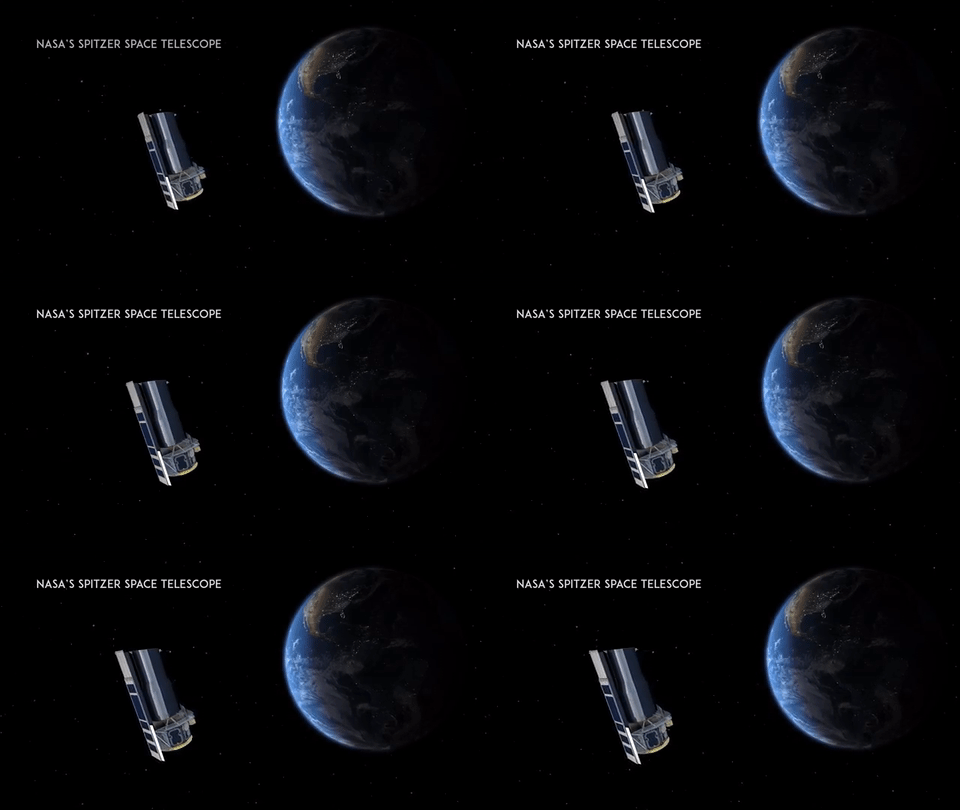
Spitzer Space Telescope. Animation Credit: NASA

Compared to Sun-like stars, M dwarfs emit high levels of ultraviolet light (though less light overall), which is harmful to life and can erode a planet's atmosphere. They're particularly violent in their youth, belching up a large number of flares, or bursts of radiation and particles that could strip away budding planetary atmospheres.

The Spitzer observations rule out an atmosphere with more than 10 times the pressure of Earth's. (Measured in units called bars, Earth's atmospheric pressure at sea level is about 1 bar.) An atmosphere between 1 and 10 bars on LHS 3844b has been almost entirely ruled out as well, although the authors note there's a slim chance it could exist if the stellar and planetary properties were to meet some very specific and unlikely criteria. They also argue that with the planet so close to a star, a thin atmosphere would be stripped away by the star's intense radiation and outflow of material (often called stellar winds).

"I'm still hopeful that other planets around M dwarfs could keep their atmospheres," Kreidberg said. "The terrestrial planets in our solar system are enormously diverse, and I expect the same will be true for exoplanet systems."

A Bare Rock

Spitzer and NASA's Hubble Space Telescope have previously gathered information about the atmospheres of multiple gas planets, but LHS 3844b appears to be the smallest planet for which scientists have used the light coming from its surface to learn about its atmosphere (or lack thereof). Spitzer previously used the transit method to study the seven rocky worlds around the TRAPPIST-1 star (also an M dwarf) and learn about their possible overall composition; for instance, some of them likely contain water ice.

The authors of the new study went one step further, using LHS 3844b's surface albedo (or its reflectiveness) to try to infer its composition.

The Nature study shows that LHS 3844b is "quite dark," according to co-author Renyu Hu, an exoplanet scientist at NASA's Jet Propulsion Laboratory in Pasadena, California, which manages the Spitzer Space Telescope. He and his co-authors believe the planet is covered with basalt, a kind of volcanic rock. "We know that the mare of the Moon are formed by ancient volcanism," Hu said, "and we postulate that this might be what has happened on this planet."

JPL manages the Spitzer Space Telescope mission for NASA's Science Mission Directorate in Washington. Science operations are conducted at the Spitzer Science Center at Caltech in Pasadena. Space operations are based at Lockheed Martin Space in Littleton, Colorado. Data are archived at the Infrared Science Archive housed at IPAC at Caltech. Caltech manages JPL for NASA.

Related link:

NASA's Transiting Exoplanet Satellite Survey (TESS): https://www.nasa.gov/tess-transiting-exoplanet-survey-satellite

For more information on Spitzer, visit:

http://www.nasa.gov/spitzer

http://www.spitzer.caltech.edu/

Image (mentioned), Animation (mentioned), Text, Credits: NASA/Tony Greicius/JPL/Calla Cofield.

Greetings, Orbiter.ch
The 'Look Ma, No Hands' mission success


Rocket Lab - Look Ma, No Hands patch.

Aug. 19, 2019

Look Ma, No Hands lift off

Lift-off of the Look Ma, No Hands mission occurred at 12:12 UTC on August 19 2019 from Rocket Lab Launch Complex 1 on New Zealand's Mahia Peninsula.

Look Ma, No Hands Launch - 08/19/2019

A Rocket Lab Electron rocket launch on its eighth flight from a facility on the Mahia Peninsula on New Zealand’s North Island. The Electron rocket and its Curie upper stage will place four small satellites into orbit on a rideshare mission arranged by Spaceflight and Rocket Lab.

BlackSky constellation

The payloads include the BlackSky Global 4 commercial Earth observation satellite, two tech demo CubeSats for Air Force Space Command’s Pearl White program, and commercial CubeSat for the French company UnseenLabs, which is developing a constellation of maritime surveillance spacecraft. The mission is nicknamed “Look Ma, No Hands.”

Related links:

BlackSky: https://www.blacksky.com/

Rocket Lab: https://www.rocketlabusa.com/

Images, Video, Text, Credits: Rocket Lab/BlackSky/SciNews/Orbiter.ch Aerospace/Roland Berga.

Best regards, Orbiter.ch